

Bloodline School
 |
Description
Book Introduction
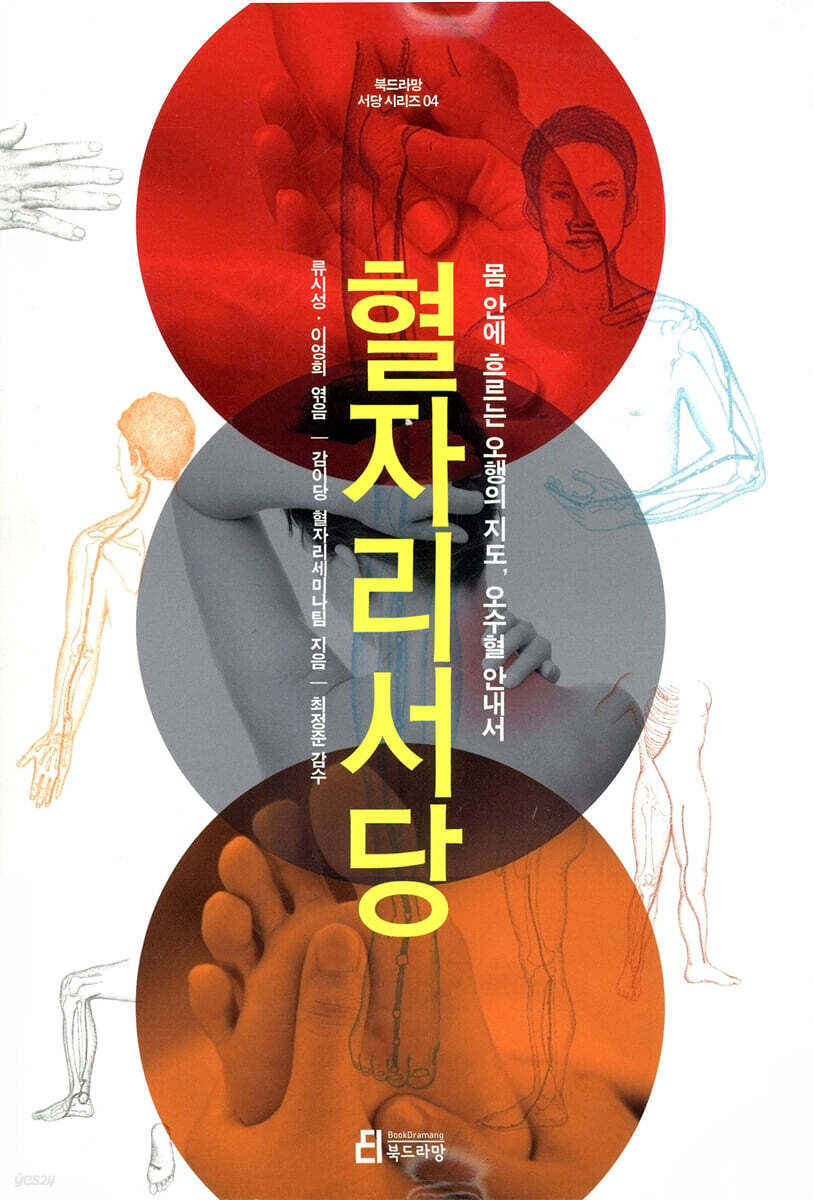
The first step to learning about epidemiology, the fourth book in the Bookdramang Seodang series.
Each of the 12 meridians in our body has an important point, acupuncture point.
According to the Donguibogam, there are 365 acupuncture points in our body, corresponding to the number of days in a year.
Among these, the acupuncture points representing the five elements of wood, fire, earth, gold, and water for each meridian are grouped together and called the five transfer points (12 x 5 = 60).
This book, "Blood Acupuncture: A Guide to the Five Elements Flowing Through the Body, a Guide to the Five Elements," is an exploration of the five acupuncture points.
This is because the five-point acupoint is the most basic of the basic acupoints, serving as a passage through which energy flows in and out according to the four seasons and weather.
Meanwhile, this book shows the process by which blood vessels are connected to meridians, meridians to the five viscera and six bowels, and the five viscera and six bowels to the body and mind. It makes us realize that all studies start from the body and return to the body, and that this is ultimately the best 'healthy life'.
Each of the 12 meridians in our body has an important point, acupuncture point.
According to the Donguibogam, there are 365 acupuncture points in our body, corresponding to the number of days in a year.
Among these, the acupuncture points representing the five elements of wood, fire, earth, gold, and water for each meridian are grouped together and called the five transfer points (12 x 5 = 60).
This book, "Blood Acupuncture: A Guide to the Five Elements Flowing Through the Body, a Guide to the Five Elements," is an exploration of the five acupuncture points.
This is because the five-point acupoint is the most basic of the basic acupoints, serving as a passage through which energy flows in and out according to the four seasons and weather.
Meanwhile, this book shows the process by which blood vessels are connected to meridians, meridians to the five viscera and six bowels, and the five viscera and six bowels to the body and mind. It makes us realize that all studies start from the body and return to the body, and that this is ultimately the best 'healthy life'.
- You can preview some of the book's contents.
Preview
index
preface
Preparatory study.
Acupuncture and Acupressure Points
Acupuncture Story 1: The Doctor Who Abandoned His Surgical Tools, Bian Que-deul
The Wandering Doctor, Pyeonjak│Pyeonjak-deul, Putting Down the Sword
Acupuncture Point Story 2_『The Yellow Emperor's Classic of Internal Medicine』, a medical philosophy book for health
The Yellow Emperor's Classic of Internal Medicine and the King of Chatter│Health, Relationships, and the Body│Messages from Doctors
Acupuncture Point Story 3: The Body, the Path of Time, and Acupuncture Points
My Body is a Clock!│Acupuncture Point Story
The Story of Osuhyeol_Osuhyeol (Five Acupoints), Where Pathology and Physiology Intersect
Osoohyeol, pulse points for diagnosis and treatment│Penis and yang meridians or ganglion density│Jeong Hyeong-su meridian conflict, guidance on Osoohyeol
Chapter 1.
Su-eum-pyeong-gyeong
Chuktaek (尺澤), opening the waterway of creation
The Path of Creation, the Path of Life│A body born from the energy of heaven and earth│The lungs are the disgrace of fire!│Chuk-taek, the palace of water that removes lung heat
Gyeonggeo (經渠), a passion user manual
Breathing, if it's obscene, it's difficult│Ridiculousness, the fire truck of my body
Taeyeon (太淵), the residence of the Queen Mother of the West
The Goddess of Life, the Queen Mother of the West│Taeyeon, the Source of the Conception and Lung Meridian│Taking the Pulse at the Pulse Center
Yesterday (Fish Day), Hill of Abundance
Fisherman's Geography, Yesterday│Pisces│Three Families Under One Roof│Barometer of Health
Small business, relieve the depression
From the cry to the weeping│Disposal and the small things│The small things that even ghosts will cry about
Chapter 2.
Suyangmyeong Tripitaka Koreana
Shangyang (商陽), obesity controlled through circulation
Fat and Water | The Large Intestine, the Source of Water | Sangyang, the Water Catcher
Open the gap, open the horizon
The Revenge of Styes and Bad Breath | Create a 'Galani'
Samgan (三間), comfort the sad teeth!
Tooth, I Didn't Know Your Sorrow | Suyangmyeong Tripitaka Koreana, Connecting the Large Intestine and Teeth | Samgan, Comforting the Sad 'Tooth'
Yanggye (陽谿), treats constipation and diarrhea
About the Colon | The Dynamics of Feces and Madness | Poultry: Reducing Fever
Gokji (曲池), blowing the wind
Unnatural desire | Desire of the wind | Desire of shit | Desire of the grain
Chapter 3.
Foot Yangming Stomach Meridian
Joksamni (足三里), the road to longevity
Joksamli Point and Quotations | Digestion is the Power of the Stomach | The Power of Walking
Haegye (解谿), holding a cold
Sea, relax your muscles and heat | Let's live together, cold!
Hamgok (陷谷), the rediscovery of digestion
If we come together, we die, if we split, we live | The holes and crevices in my body | Swelling or getting angry
The Secret Garden of Lazy People
How Lazy People Live | The Philosophy of Eating and Nagging | Digestion That Revives Me | Secret Garden, Internal Affairs
So far, how to capture the summer's yang energy
Do you know Jeon Gwang? | 'So far', you haven't stabbed me?
Chapter 4.
Foot Taiyin Spleen Meridian
Silver, stop the bleeding!
Can't Live Without Blood! | Blood Stagnation | Eunbaek, Controlling Blood
The great city, dynamism to the listless body!
The Secret of a Lethargic Body | Secret, Transcending Change | The Great Way, Dynamism in the Empty Secret
Taebaek (太白), the dirt road that quells civil war
Wet & Wet | Vito's Physiology | The Power to Calm the Civil War
Sanggu (商丘), the beginning and end of study
Dasan and the Bone | The Study Method of Rain | The Study Method of Sanggu
Eumneungcheon (陰陵泉), for the cheerful 'Pee'!
The self-consciousness of the depressed Mr. So-byeol, who is suffering from urinary incontinence | The Book of Joktae-eum-bi-gyeong, who takes Mr. So-byeol with him | Eum-neung-cheon, for the cheerful Mr. So-byeol!
Chapter 5.
Hydrogen Sound Heart Sutra
Sohae (少海), the peaceful and prosperous politics of the body
Politics of the Yao and Shun Dynasties | The Heart, the Monarch of the Body | The Triangle of My Body | The Sea of Mind, the Sohae
Spiritual path, blood-drying hysteria-fighting blood
Uncover the Truth About Hysteria | Hysteria: The Problem Is Blood | A Guide to Changing the Path of a Blood-Curing Heart
Shinmun (神門), freedom from trembling and obsession
Mom and Dad are so great! | Liver? No, it's the heart first! | Newspaper, a blood that makes you feel good
Sobu, stop the sound of your heart
The Reason for the Heartbeat | Sobu, the Gathering Place of Fire
Shaochong (少衝), governing the mind
I'm feeling uneasy! | The Secret of the Pinky Finger | Cicada, Wake Up God!
Chapter 6.
Sutaeyangsojanggyeong
Sotaek (少澤), a blood with compassion
The Breasts, the Foundation of Femininity | Dear "Chief" | Sotaek, may you find some small blessings.
Jeongok (前谷), stuffy nose, go away!
Nose, the center of one's self | The charm of lukewarmness
Succession, phlegm and gallstones
I want to know about the gallbladder | The precious neck, the gathering place of the Yang meridians | Unblocking the blocked area with the successor!
Yanggok (陽谷), for the small intestines that are tired from gluttony!
Small intestine, remember food | The small intestine's signal from food | When your appetite is aroused, eat grains
Small Sea, the wind blows at the joints
Joints, the empty spaces of the body - Philosophy of discussion | The wind and cold that blow through the joints | To protect the joints, buy the small sea
Chapter 7.
Foot-Taiyang Cystoscope
Weizhong (Committee), Ogeum-ah, save me!
The Kinship of Fear and Fear | The Axis of Danger and Depravity | The World of Back Pain | Is Your Back "Dangerous"?
All rivers flow down from Kunlun.
Urine, the Body's Vivid Source of Information | The House of Urine, the Bladder | Add Energy with Kunlun
Sokgol (束骨), correcting a collapsed center
Chapter 6, Section 6, Hidden on the Back, Baesuhyeol | Back, Yang Energy Channel | Center Loss, Straighten Your Spine! | Stretch Out, Internal Bone
On a windy day, let's cry!
The Mechanism of Headaches | Wailing, the Sea of Water | Grasping Headaches with Your Little Toe
Ji-eum (至陰), communicating with the uterus
The Palace of Life, the Uterus | Menstruation and the Female Body | Written by, Connecting with the Uterus
Chapter 8.
sciatic nerve
Yongcheon (涌泉), the gate of life that opens at the soles of your feet
Oncheon Samyang | Shin, the Source of Life | Yongcheon, Opening the Gate of Life
Yeongok (然谷), How to Survive in an Age of Infertility
Infertility, a Challenge for Humanity | The Body's Treasure, Jeong | Infertility is Due to 'Shin' | The Potential for the Birth of Life, Yeongok
Taegye, the god of kidney essence
Jeong, anything can be | Jeong, the ability to empathize with others | Tae-gye, I will cultivate your Jeong
Flow back, become water and meet again
Fluid, Indra's Net in My Body | Pathology of Sweat | Types, Control Water
Eumgok (陰谷), a valley where sacred water springs up
The Life of a Hurricane | 5, 6, 7 - Panorama of Oro, Yukgeuk, and Chilsang | We'll fix your music and soul!
Chapter 9.
Subjugateumsimpogyeong
Goktaek (曲澤), a firefighter who puts out the fire of the heart
A Child Wanting a Nosebleed | The Mechanism of Bleeding: The Heart Is Furious! | Yang Qi Chongcheon: When Heat Spreads, It Turns into Fire | Gok-taek, the Firefighter Putting Out Heart Fire
Envoy, Finding the Path of My Heart
The Wall of My Heart | The Heart and the Breath | The Secret Agent, Finding the Way
Daereung (大陵), let's bring back the heart that left home!
The Goal-Oriented Man | Eyes, Where the Energy of the Five Internal Organs Gather | Purpose, the Pillar of Fire of the Liver and Mind | From a "Goal"-Oriented Life to a "Daereung"-Oriented Life
Nogung (勞宮), the story of Mr. Tamdasu's fiery palms
Hands, the electric signboard of yang energy | Fatigue breeds anger | Workers of the world, remember the old palace
Zhongchong (中衝), finger ambulance
Fainting after seeing a ghost(?) | The mechanism of fainting | Quickly turn your energy and disperse the wall | My body's ambulance, Zhongchong
Chapter 10.
Hydrogen yangsamchogyeong
Guanchong, would you like me to turn off the lights?
Diseases of the pharynx and throat | Sancho, the gateway to all! | Guanchonghyeol, the gateway to quenching heat
Liquid Gate, recharge your energy!
Traffic Accidents and Discernment | When Your Ears Ring, Cry Again | The Gate of Evil and the Flow of Energy
Zhongzhuo (中渚), a famous remedy for motion sickness
Motion sickness mechanism | Motion sickness-disorder, vomiting disorder | Motion sickness pills on the back of the hand, middle and low
The earth (支溝), making a path for the body
Building a Path Between People | Our Body's Original Manager, Samcho | Fusing Fire, We Need Sanghwa | Earth! Building a Path for the Body, Building a Path for People
Ceiling, wetting the shoulders
Frozen Shoulder: A Sign of Immediate Pain | The Small Way and the Three Causes | The Well of Heaven, Cheonjeong
Chapter 11.
Foot-So-Yang Gallbladder Meridian
Yangling Spring, surrendering to life
The ability to flexibly ride the rhythm | The mechanism of flexing beyond the liver and gallbladder | Yang Lingcheon, living a flexible life
Yangbo (陽輔), the balance of cold and heat
The True Nature of Hair | Between Coolness and Passion | Give in
Bold power, Im-eup (臨泣) comes out
Kings of Speed | The Source of Boldness, Boldness | Boldness Comes from the Side | When You Need Boldness, Go to Im-eup
Chivalry, the power to dispel fear and anxiety
The Disease of Obsession, Jeongchung | Gallbladder, Tiger, and Spring | Hypocrisy, For the Courage of Gallbladder
Open the hole of communication!
Plastic Heaven and Holes | Nine Stars and Nine Holes | When Soyangchunseung Passes, Holes Fever | Gyu-eum, Opening Holes
Chapter 12.
Foot Jueyin Liver Sutra
Daedon (大敦), breaking the pain of labor
'Mountain', blocking the road | A tree that wraps around the body, liver | A forest in spring, Daedon
Line spacing: creating space while walking
A Novel of the Depressed and the Depressed | The Depressed and the Depressed: To Release Your Emotions, Start with a Novel of the Depressed | Between the Lines: Defeating the Depressed and the Depressed
Taechung (太衝), setting up the first wave
Around the age of 20 or 30 | Portrait of a young man | Sagwanhyeol, connect with the Four Seas! | Taechung, a strategic point where blood vessels meet
Zhongbong (中封), go away, fatigue!
Sleep is precious | Liver and blood pressure | How to sleep soundly | Some questions about sleep | Jungbong, hit the spot for fatigue!
Gokcheon (曲泉), the spring of vitality
A History of Muscle | Muscles in the Donguibogam | Muscle Diseases That Afflict Us | Crooked Spring, Gokcheon
supplement.
Doctor for blood transfusion
Find acupuncture points by symptom
Preparatory study.
Acupuncture and Acupressure Points
Acupuncture Story 1: The Doctor Who Abandoned His Surgical Tools, Bian Que-deul
The Wandering Doctor, Pyeonjak│Pyeonjak-deul, Putting Down the Sword
Acupuncture Point Story 2_『The Yellow Emperor's Classic of Internal Medicine』, a medical philosophy book for health
The Yellow Emperor's Classic of Internal Medicine and the King of Chatter│Health, Relationships, and the Body│Messages from Doctors
Acupuncture Point Story 3: The Body, the Path of Time, and Acupuncture Points
My Body is a Clock!│Acupuncture Point Story
The Story of Osuhyeol_Osuhyeol (Five Acupoints), Where Pathology and Physiology Intersect
Osoohyeol, pulse points for diagnosis and treatment│Penis and yang meridians or ganglion density│Jeong Hyeong-su meridian conflict, guidance on Osoohyeol
Chapter 1.
Su-eum-pyeong-gyeong
Chuktaek (尺澤), opening the waterway of creation
The Path of Creation, the Path of Life│A body born from the energy of heaven and earth│The lungs are the disgrace of fire!│Chuk-taek, the palace of water that removes lung heat
Gyeonggeo (經渠), a passion user manual
Breathing, if it's obscene, it's difficult│Ridiculousness, the fire truck of my body
Taeyeon (太淵), the residence of the Queen Mother of the West
The Goddess of Life, the Queen Mother of the West│Taeyeon, the Source of the Conception and Lung Meridian│Taking the Pulse at the Pulse Center
Yesterday (Fish Day), Hill of Abundance
Fisherman's Geography, Yesterday│Pisces│Three Families Under One Roof│Barometer of Health
Small business, relieve the depression
From the cry to the weeping│Disposal and the small things│The small things that even ghosts will cry about
Chapter 2.
Suyangmyeong Tripitaka Koreana
Shangyang (商陽), obesity controlled through circulation
Fat and Water | The Large Intestine, the Source of Water | Sangyang, the Water Catcher
Open the gap, open the horizon
The Revenge of Styes and Bad Breath | Create a 'Galani'
Samgan (三間), comfort the sad teeth!
Tooth, I Didn't Know Your Sorrow | Suyangmyeong Tripitaka Koreana, Connecting the Large Intestine and Teeth | Samgan, Comforting the Sad 'Tooth'
Yanggye (陽谿), treats constipation and diarrhea
About the Colon | The Dynamics of Feces and Madness | Poultry: Reducing Fever
Gokji (曲池), blowing the wind
Unnatural desire | Desire of the wind | Desire of shit | Desire of the grain
Chapter 3.
Foot Yangming Stomach Meridian
Joksamni (足三里), the road to longevity
Joksamli Point and Quotations | Digestion is the Power of the Stomach | The Power of Walking
Haegye (解谿), holding a cold
Sea, relax your muscles and heat | Let's live together, cold!
Hamgok (陷谷), the rediscovery of digestion
If we come together, we die, if we split, we live | The holes and crevices in my body | Swelling or getting angry
The Secret Garden of Lazy People
How Lazy People Live | The Philosophy of Eating and Nagging | Digestion That Revives Me | Secret Garden, Internal Affairs
So far, how to capture the summer's yang energy
Do you know Jeon Gwang? | 'So far', you haven't stabbed me?
Chapter 4.
Foot Taiyin Spleen Meridian
Silver, stop the bleeding!
Can't Live Without Blood! | Blood Stagnation | Eunbaek, Controlling Blood
The great city, dynamism to the listless body!
The Secret of a Lethargic Body | Secret, Transcending Change | The Great Way, Dynamism in the Empty Secret
Taebaek (太白), the dirt road that quells civil war
Wet & Wet | Vito's Physiology | The Power to Calm the Civil War
Sanggu (商丘), the beginning and end of study
Dasan and the Bone | The Study Method of Rain | The Study Method of Sanggu
Eumneungcheon (陰陵泉), for the cheerful 'Pee'!
The self-consciousness of the depressed Mr. So-byeol, who is suffering from urinary incontinence | The Book of Joktae-eum-bi-gyeong, who takes Mr. So-byeol with him | Eum-neung-cheon, for the cheerful Mr. So-byeol!
Chapter 5.
Hydrogen Sound Heart Sutra
Sohae (少海), the peaceful and prosperous politics of the body
Politics of the Yao and Shun Dynasties | The Heart, the Monarch of the Body | The Triangle of My Body | The Sea of Mind, the Sohae
Spiritual path, blood-drying hysteria-fighting blood
Uncover the Truth About Hysteria | Hysteria: The Problem Is Blood | A Guide to Changing the Path of a Blood-Curing Heart
Shinmun (神門), freedom from trembling and obsession
Mom and Dad are so great! | Liver? No, it's the heart first! | Newspaper, a blood that makes you feel good
Sobu, stop the sound of your heart
The Reason for the Heartbeat | Sobu, the Gathering Place of Fire
Shaochong (少衝), governing the mind
I'm feeling uneasy! | The Secret of the Pinky Finger | Cicada, Wake Up God!
Chapter 6.
Sutaeyangsojanggyeong
Sotaek (少澤), a blood with compassion
The Breasts, the Foundation of Femininity | Dear "Chief" | Sotaek, may you find some small blessings.
Jeongok (前谷), stuffy nose, go away!
Nose, the center of one's self | The charm of lukewarmness
Succession, phlegm and gallstones
I want to know about the gallbladder | The precious neck, the gathering place of the Yang meridians | Unblocking the blocked area with the successor!
Yanggok (陽谷), for the small intestines that are tired from gluttony!
Small intestine, remember food | The small intestine's signal from food | When your appetite is aroused, eat grains
Small Sea, the wind blows at the joints
Joints, the empty spaces of the body - Philosophy of discussion | The wind and cold that blow through the joints | To protect the joints, buy the small sea
Chapter 7.
Foot-Taiyang Cystoscope
Weizhong (Committee), Ogeum-ah, save me!
The Kinship of Fear and Fear | The Axis of Danger and Depravity | The World of Back Pain | Is Your Back "Dangerous"?
All rivers flow down from Kunlun.
Urine, the Body's Vivid Source of Information | The House of Urine, the Bladder | Add Energy with Kunlun
Sokgol (束骨), correcting a collapsed center
Chapter 6, Section 6, Hidden on the Back, Baesuhyeol | Back, Yang Energy Channel | Center Loss, Straighten Your Spine! | Stretch Out, Internal Bone
On a windy day, let's cry!
The Mechanism of Headaches | Wailing, the Sea of Water | Grasping Headaches with Your Little Toe
Ji-eum (至陰), communicating with the uterus
The Palace of Life, the Uterus | Menstruation and the Female Body | Written by, Connecting with the Uterus
Chapter 8.
sciatic nerve
Yongcheon (涌泉), the gate of life that opens at the soles of your feet
Oncheon Samyang | Shin, the Source of Life | Yongcheon, Opening the Gate of Life
Yeongok (然谷), How to Survive in an Age of Infertility
Infertility, a Challenge for Humanity | The Body's Treasure, Jeong | Infertility is Due to 'Shin' | The Potential for the Birth of Life, Yeongok
Taegye, the god of kidney essence
Jeong, anything can be | Jeong, the ability to empathize with others | Tae-gye, I will cultivate your Jeong
Flow back, become water and meet again
Fluid, Indra's Net in My Body | Pathology of Sweat | Types, Control Water
Eumgok (陰谷), a valley where sacred water springs up
The Life of a Hurricane | 5, 6, 7 - Panorama of Oro, Yukgeuk, and Chilsang | We'll fix your music and soul!
Chapter 9.
Subjugateumsimpogyeong
Goktaek (曲澤), a firefighter who puts out the fire of the heart
A Child Wanting a Nosebleed | The Mechanism of Bleeding: The Heart Is Furious! | Yang Qi Chongcheon: When Heat Spreads, It Turns into Fire | Gok-taek, the Firefighter Putting Out Heart Fire
Envoy, Finding the Path of My Heart
The Wall of My Heart | The Heart and the Breath | The Secret Agent, Finding the Way
Daereung (大陵), let's bring back the heart that left home!
The Goal-Oriented Man | Eyes, Where the Energy of the Five Internal Organs Gather | Purpose, the Pillar of Fire of the Liver and Mind | From a "Goal"-Oriented Life to a "Daereung"-Oriented Life
Nogung (勞宮), the story of Mr. Tamdasu's fiery palms
Hands, the electric signboard of yang energy | Fatigue breeds anger | Workers of the world, remember the old palace
Zhongchong (中衝), finger ambulance
Fainting after seeing a ghost(?) | The mechanism of fainting | Quickly turn your energy and disperse the wall | My body's ambulance, Zhongchong
Chapter 10.
Hydrogen yangsamchogyeong
Guanchong, would you like me to turn off the lights?
Diseases of the pharynx and throat | Sancho, the gateway to all! | Guanchonghyeol, the gateway to quenching heat
Liquid Gate, recharge your energy!
Traffic Accidents and Discernment | When Your Ears Ring, Cry Again | The Gate of Evil and the Flow of Energy
Zhongzhuo (中渚), a famous remedy for motion sickness
Motion sickness mechanism | Motion sickness-disorder, vomiting disorder | Motion sickness pills on the back of the hand, middle and low
The earth (支溝), making a path for the body
Building a Path Between People | Our Body's Original Manager, Samcho | Fusing Fire, We Need Sanghwa | Earth! Building a Path for the Body, Building a Path for People
Ceiling, wetting the shoulders
Frozen Shoulder: A Sign of Immediate Pain | The Small Way and the Three Causes | The Well of Heaven, Cheonjeong
Chapter 11.
Foot-So-Yang Gallbladder Meridian
Yangling Spring, surrendering to life
The ability to flexibly ride the rhythm | The mechanism of flexing beyond the liver and gallbladder | Yang Lingcheon, living a flexible life
Yangbo (陽輔), the balance of cold and heat
The True Nature of Hair | Between Coolness and Passion | Give in
Bold power, Im-eup (臨泣) comes out
Kings of Speed | The Source of Boldness, Boldness | Boldness Comes from the Side | When You Need Boldness, Go to Im-eup
Chivalry, the power to dispel fear and anxiety
The Disease of Obsession, Jeongchung | Gallbladder, Tiger, and Spring | Hypocrisy, For the Courage of Gallbladder
Open the hole of communication!
Plastic Heaven and Holes | Nine Stars and Nine Holes | When Soyangchunseung Passes, Holes Fever | Gyu-eum, Opening Holes
Chapter 12.
Foot Jueyin Liver Sutra
Daedon (大敦), breaking the pain of labor
'Mountain', blocking the road | A tree that wraps around the body, liver | A forest in spring, Daedon
Line spacing: creating space while walking
A Novel of the Depressed and the Depressed | The Depressed and the Depressed: To Release Your Emotions, Start with a Novel of the Depressed | Between the Lines: Defeating the Depressed and the Depressed
Taechung (太衝), setting up the first wave
Around the age of 20 or 30 | Portrait of a young man | Sagwanhyeol, connect with the Four Seas! | Taechung, a strategic point where blood vessels meet
Zhongbong (中封), go away, fatigue!
Sleep is precious | Liver and blood pressure | How to sleep soundly | Some questions about sleep | Jungbong, hit the spot for fatigue!
Gokcheon (曲泉), the spring of vitality
A History of Muscle | Muscles in the Donguibogam | Muscle Diseases That Afflict Us | Crooked Spring, Gokcheon
supplement.
Doctor for blood transfusion
Find acupuncture points by symptom
Into the book
Being in a state of communication breakdown means being unable to communicate.
This is because the energies are stuck together and cannot change when they should.
Conversely, when we need to experience changes in life, we often experience depression.
This is because crying is created when accessing an unfamiliar environment, experiencing things we have never experienced before, or experiencing confusion in relationships.
If you want to relieve this depressed state, you can't be passive.
We must actively intervene in this state of chaos and manage traffic ourselves.
To find the way, you have to jump into the road.
This is the solution to the problem we must learn from small merchants.
The little one is not afraid of crying.
Like a sprout rising through the depths of winter! --- From "Chapter 1, The Sutae-eum-pyeong-gyeong? So-sang, Unleashing the Cry"
In order to sprout in the spring, the seeds need to be stored deep in the winter.
Behind every brilliant achievement, there is always a hidden help.
Working diligently in places where others cannot see, but not showing off one's virtues outwardly, is a noble virtue and a negative energy.
Hot passion comes from deep within.
The Yongcheon point of the foot-sounding nerve, a fascinating meridian with the right balance of passion and coolness, conveys the vitality of the earth to humans who live on the earth.
Yongcheon is like a hot spring that replenishes exhausted energy with surging energy and washes away the fatigue of tired body and mind.
Humans who live with their feet on the ground, when you stand up with your feet on the ground, the door to life opens.
---From "Chapter 8 of the text: The Yongcheon, the Gate of Life Opening from the Sole of the Foot"
The spleen covers the heart and is greatly influenced by the heart that governs the gods.
According to the divine will of the mind, the diaphragm acts as a passageway for consciousness and emotions.
Ultimately, the place where the mind's usage is revealed is the symphony.
『Donguibogam』 tells us about the warning symptoms of stroke as follows:
“If you have dull sensation in your middle finger, slow movement, or are unable to use it, you will definitely have a stroke within three years.”
Numbness in the middle finger means the sympathetic nerve is paralyzed.
Soon the channels of consciousness and emotion will be frozen.
People who suddenly faint or lose consciousness should not only worry about their body.
You must use the simpo (heart bag), or ‘simbo’, well.
There is clearly an unsolvable mental illness there.
A cold, frozen heart, a heart that has no communication between inside and outside.
You have to free that clogged heart.
At the end of that tangled thread is a middle ground.
This is because the energies are stuck together and cannot change when they should.
Conversely, when we need to experience changes in life, we often experience depression.
This is because crying is created when accessing an unfamiliar environment, experiencing things we have never experienced before, or experiencing confusion in relationships.
If you want to relieve this depressed state, you can't be passive.
We must actively intervene in this state of chaos and manage traffic ourselves.
To find the way, you have to jump into the road.
This is the solution to the problem we must learn from small merchants.
The little one is not afraid of crying.
Like a sprout rising through the depths of winter! --- From "Chapter 1, The Sutae-eum-pyeong-gyeong? So-sang, Unleashing the Cry"
In order to sprout in the spring, the seeds need to be stored deep in the winter.
Behind every brilliant achievement, there is always a hidden help.
Working diligently in places where others cannot see, but not showing off one's virtues outwardly, is a noble virtue and a negative energy.
Hot passion comes from deep within.
The Yongcheon point of the foot-sounding nerve, a fascinating meridian with the right balance of passion and coolness, conveys the vitality of the earth to humans who live on the earth.
Yongcheon is like a hot spring that replenishes exhausted energy with surging energy and washes away the fatigue of tired body and mind.
Humans who live with their feet on the ground, when you stand up with your feet on the ground, the door to life opens.
---From "Chapter 8 of the text: The Yongcheon, the Gate of Life Opening from the Sole of the Foot"
The spleen covers the heart and is greatly influenced by the heart that governs the gods.
According to the divine will of the mind, the diaphragm acts as a passageway for consciousness and emotions.
Ultimately, the place where the mind's usage is revealed is the symphony.
『Donguibogam』 tells us about the warning symptoms of stroke as follows:
“If you have dull sensation in your middle finger, slow movement, or are unable to use it, you will definitely have a stroke within three years.”
Numbness in the middle finger means the sympathetic nerve is paralyzed.
Soon the channels of consciousness and emotion will be frozen.
People who suddenly faint or lose consciousness should not only worry about their body.
You must use the simpo (heart bag), or ‘simbo’, well.
There is clearly an unsolvable mental illness there.
A cold, frozen heart, a heart that has no communication between inside and outside.
You have to free that clogged heart.
At the end of that tangled thread is a middle ground.
---From "Chapter 9 of the main text, "The Zhong Chong, the Finger Ambulance?"
Publisher's Review
[Bloodborne Academy: A Guide to the Five Elements Flowing Through the Body, a Guide to the Five Elements] Author Interview
1.
The title of this book is 『Blood Acupuncture: A Guide to the Five Elements Flowing in the Body, a Guide to the Five Elements』.
Words like blood spot and blood clot are unfamiliar.
Is it different from the meridians in ‘meridian massage’? … … , could you give me a brief explanation?
First, spread your hands wide and clap your hands ten times.
When you clap your hands together, don't you feel the warmth in your palms? In Oriental medicine, the left hand represents yin, and the right hand represents yang.
When you clap, the yin energy of your left hand and the yang energy of your right hand naturally meet and become balanced, creating heat.
There is an invisible energy flowing through our bodies.
This energy is distributed throughout the body along the five internal organs and the surface of the body.
It's called a meridian.
Meridians are connected to the internal organs of the body while communicating with external energy.
It acts as a passage that circulates the energy of the organs throughout the body while breathing with the external energy.
This book, “Blood Acupuncture Points,” deals with the 12 meridians (pulses) connected to the five internal organs and six bowels.
Starting from the Handaiyin Lung Meridian, it flows from the Handaiyin Large Intestine Meridian, the Handaiyangmyeong Stomach Meridian, the Handaiyin Spleen Meridian, the Handaiyin Heart Meridian, the Handaiyang Small Intestine Meridian, the Handaiyang Bladder Meridian, the Handaiyin Nerve Meridian, the Handaiyin Heart Meridian, the Handaiyang Triple Cao Meridian, the Handaiyin Gallbladder Meridian, and the Handaiyin Liver Meridian back to the Handaiyin Lung Meridian.
The flow of the meridians continues to circulate.
In each meridian, there is an important point in the flow of energy, which is called an acupuncture point.
If we consider that the Chinese character for blood is 'hole (穴)', then a hole is a place where the energy of the meridian works deeply, or to put it another way, it is a place where bad energy is deeply accumulated.
So, stimulating the acupoints when there is an illness can be seen as an effort to ward off evil spirits and promote the flow of energy, and it can also be seen as a struggle to invigorate the energy of that meridian.
These acupuncture points are the five-element acupoints that operate according to the flow of the meridians, using the energy of the five elements of wood, fire, earth, metal, and water.
We looked into the flow of energy in more detail and gave each acupoint its own color.
It appears that this was conceived with the intention of increasing the therapeutic effect through the accurate use of energy by closely examining the distribution of energy from the perspective of yin-yang and the five elements.
When the organs become weak, a reaction occurs in the acupuncture points in the weakened meridians.
Also, if the flow of the meridians becomes stagnant, it can have a negative impact on the organs.
At this time, Oriental medical treatment involves inserting a needle or applying moxibustion.
The reason for doing this is to smooth the flow of stagnant energy.
Meridian massage also helps the flow of energy by massaging the body.
Both share the goal of communicating the flow of meridians.
At the foundation of that sharing are the meridians, the channels of energy.
2.
You said that there are a total of 60 acupuncture points in this book, “Blood Acupuncture Points.”
Do I have to memorize all these acupoints? If so, is there an easier way to memorize them? Also, could you share some tips you've learned?
Anything is easy if you start from yourself.
The acupuncture points also originate from places where I often get sick.
For example, if you have a symptom that you frequently experience, you can find a good acupuncture point for that.
Since the first thing that causes the stomach to ache is a problem, we look for the acupuncture points of the Foot Yangming Stomach Meridian and Foot Taiyin Spleen Meridian.
Find the five acupoints of the Foot Yangming Stomach Meridian and Foot Taiyin Spleen Meridian and test them one by one every day.
Then we expand the range to other meridians.
The Foot Yangming Stomach Meridian and the Foot Taiyin Spleen Meridian are both meridians located in the feet.
The meridians in the feet send energy downwards through the body, so in order to balance yin and yang, we must also look for meridians that send energy upwards through the body.
Find the meridian on your hand that corresponds to your foot.
Thinking about 'Which meridian is good for my hand?' can also help you study.
'The spleen meridian has wet earth energy, so wouldn't dry gold energy be helpful in regulating it? What meridians have gold energy?' I looked into it.
There are the Sutaeum Lung Jing and the Suyangmyeong Daejang Jing.
The lungs and large intestine are organs full of gold energy, and they are meridians in the hand, so it would be helpful to apply acupressure to the points of the Foot Yangming Stomach Meridian and Foot Taiyin Spleen Meridian.
So, one test is done on the acupuncture points on the feet, and the other test is done on the acupuncture points on the hands.
As you do this, various cases will appear, and you will find an acupuncture point that fits your body perfectly.
When moving on to other meridian points, this method is easy to use because it starts from your body's symptoms, and you can study while feeling the actual changes in your body.
In this way, studying acupuncture points is helpful as a tool to learn about your body, starting from observing it.
What's important is not knowing what acupuncture points are and what symptoms they are good for.
3.
Why should ordinary people study acupuncture points? If they're sick, why not just go to a Korean medicine clinic and get acupuncture or moxibustion?
In short, studying acupuncture points is studying the body.
As I studied acupuncture, I naturally began to observe my own body.
I wake up in the morning, pee, pour half hot water and half cold water into a mug, and drink it all at once.
Mixing water like this is called yin-yang soup.
Starting the day with yin-yang soup informs the five internal organs and six bowels.
Then, soon, a signal comes from the colon.
I go back to the bathroom and take a dump.
In the past, when I took a dump, I wished it would disappear from my sight as soon as possible.
But while studying blood type, we carefully observe feces and urine.
Observe the thickness, color, and hardness of the stool, and check the color, thinness, and impurities of the urine.
By observing what comes out of my body, what appears on my face, and the changes that occur in my body, I connect them to the acupuncture points.
If your shoulder hurts, you might wonder, 'What meridian passes through your shoulder? Hmm, the small intestine meridian passes through it.'
What function does the small intestine have? Ah, it distinguishes between clear and turbid air, and it also participates in fluid metabolism… … .
I had a problem with my small intestine because I felt uncomfortable urinating in the morning.
What are some good acupuncture points for the small intestine? There's Sotaek, Jeongok, Hugye, Yanggok, and Sohae.
You start to worry, 'Which acupoint would be best? What kind of energy do I need right now according to the Five Elements?'
This process of finding a single acupoint is like making a path in my body.
I manage the energy distribution of my body myself.
Rather than living according to the body I was given, I actively control my body.
Also, studying acupuncture points doesn't stop at just knowing your body.
Zhuangzi said, “The birth of a person is the gathering of energy. When energy gathers, it is life; when it disperses, it is death.” (Zhuangzi, “Journey to the North” 知北遊)
This convergence and dispersal of energy is a huge current that makes the world alive and vibrant.
This is what we call life.
Life flows intertwined in a cycle of life and death.
This also means that humans and nature are inseparable and the same.
The world of energy shown by the blood points is based on this epistemological arrangement.
Therefore, studying acupuncture points is a study of the body and at the same time a study of the world connected to the body.
But now we are on the foundation of a modern Western worldview that separates nature and humans.
Therefore, studying the acupuncture points now means recognizing this arrangement and understanding the principles of harmony between nature and humans.
It is a revolution within me, as well as an ethical practice movement, to change my life according to the principles of life.
4.
Lastly, I'm curious if there are any acupuncture points that teachers prefer to use, and when they usually use them. (^^)
[Lee Young-hee] My whole body feels cold.
Especially in winter, my hands and feet get cold and my knees get numb.
I think it's because my constitution doesn't have good blood circulation.
There is no wood or fire energy in the four pillars, and the metal and water energies are dominant.
I think it's because I live my life mainly using the converging gold energy rather than the radiating cotton energy.
Maybe it's because of the influence of energy, but I like to sit quietly and read a book rather than being active.
When reading a book, I often sit for long periods of time, and when writing, I often don't move my butt until I'm finished.
I think this habit is what makes my body cold.
As I experience this phenomenon of energy concentration, I come up with my own prescription.
In some ways, this could be said to be the result of studying acupuncture points.
When I feel tired, I get signals from my eyes.
My eyes are sore and it's hard to read.
At times like this, I close my eyes and sleep for a little while.
I think it's a signal to take a break.
After a good night's sleep, my body feels lighter and my eyes become clearer.
In Oriental medicine, the eyes are where the energy of the five internal organs and six bowels gather, and are the most yang of the five senses.
Also, because the liver receives the yang energy of the eyes, the liver is connected to the eye sockets.
The eyes are like holes in the liver.
For your eyes to be bright, your liver must have a good supply of blood, and this process takes place while you sleep.
So, sleeping is a precious time that creates energy that enables us to perform daytime activities.
Getting a good night's sleep is the best medicine to relieve fatigue.
Even if you've slept through your fatigue, you may sometimes feel like your blood isn't flowing from your knees to your feet.
There is a blood pressure point that I use in such cases.
The acupressure point that is most frequently applied when you have a cold is Hegok.
It's in the hollow between your thumb and index finger.
There is a good acupressure point when applied with Heopgok.
That place is Taechung (太衝, page 570).
The metatarsal is located at the point where the big toe and the second toe bone diverge.
Heopgok and Taechung are the four points of Sagwanhyeol.
This is where needles are placed to quickly circulate energy when a landslide occurs.
These are the four blood vessels that are like gateways on the hands and feet, so they are called the four gate blood vessels.
It is said that if you use Hegok well among the four main points, you can treat all stomach diseases, and if you use Taechung well, you can treat all internal organ diseases.
Using Hegok and Taechung will improve the circulation of energy and blood throughout the body and regulate the imbalance of yin and yang.
I had sore eyes, heavy body, and drooping symptoms, so I applied acupressure to the Sa-gwan point for about a month.
I noticed that my eyes became clearer and my body felt lighter.
Even if you see results from acupuncture, it will be of no use if you don't change the habits that hinder blood circulation.
I thought that once I started, the fundamental solution for me was to break the habit of doing it all at once.
To do that, I had to get into the habit of doing it little by little every day.
A thought that helped me develop this habit was to think, "This is enough" about what I did today.
Feeling 'this is enough!' That was the sufficiency and satisfaction I felt for the time I had lived today.
How are you feeling? Are you satisfied with what you did today? I'd like to say this.
“That’s enough, folks,” he said.
[Ryu Si-seong] I also have symptoms of my eyes getting sore and irritated at night because I always have books and a computer with me.
At such times, I mainly use Taechung point like teacher Lee Young-hee.
Even if you don't need to get acupuncture, if you are tired or your eyes hurt, press the Taechung with your thumb.
Then, the symptoms of eye irritation and pain will gradually disappear.
Fatigue is also relieved.
So when I'm sitting on the floor and I have nothing to do, I just press the button.
It has become a habit.
Also, my body feels very hot.
Even in winter, my body is so hot that I sweat profusely, and this is all because my body lacks water energy.
So, the Taegye point (p. 360), which is also the source point of the kidney meridian, is used a lot.
This is because the Taegye point is good for circulating water energy in the body and controlling fever.
In addition to the placenta, the areas through which the kidney meridian flows are also pressed.
Frequently massage the areas on the soles of your feet, from the Yongcheon point to the Yeongok point, the Taegye point, and the area that goes up your calf.
On this line, there is an acupuncture point called the Sam-eum-gyo (三陰交), which is not in our book, but is where the three scrotal meridians that flow to the legs meet.
It is classified as an acupuncture point that is especially effective for women, and is often used there as well.
I'm trying to cultivate some negative energy in my body.^^
Joksamli (足三里) is also one of the most frequently used acupuncture points.
As it is written in the book, the Joksamli point is almost a panacea, and it also has the function of calming down the energy that has risen upward.
So, after using my head excessively(?), I also press the Joksamli point.
Also, Joksamli is a really good acupressure point for keeping your legs healthy.
Since I spend most of my time sitting at my desk, my lower body tends to be weak, but Joksamli helps me a lot.
I think this is a useful blood point for office workers and students to know.
Author's Note
“Meridians are invisible channels that surround the entire body.
Information about qi and blood, yin and yang, and the five elements flows through this passage.
The meridians are what connect and move not only the five internal organs but also the entire body.
In short, the meridians are the center of the body and the foundation for forming a network of parts.
It is reminiscent of the Buddhist Indra's net.
A network of relationships where the whole and the parts are connected, and when one part ripples, the whole ripples.
The meridians were saying that the body and the world are also like that.
“Here, I learned that we need to think differently about illness, treatment, and even life itself.”
“The basis for studying (blood pressure) was entirely our own bodies and diseases.
So, studying meridians naturally leads to exploration of oneself.
Here, the exploration of oneself is no different from the exploration of the world.
Because in the world of meridians, everything is connected.
From illness to treatment, from treatment to life, from life to the world, and back to the body.
We all live with illness.
“Just as it was the entrance to our studies, it is an entrance open to everyone.”
1.
The title of this book is 『Blood Acupuncture: A Guide to the Five Elements Flowing in the Body, a Guide to the Five Elements』.
Words like blood spot and blood clot are unfamiliar.
Is it different from the meridians in ‘meridian massage’? … … , could you give me a brief explanation?
First, spread your hands wide and clap your hands ten times.
When you clap your hands together, don't you feel the warmth in your palms? In Oriental medicine, the left hand represents yin, and the right hand represents yang.
When you clap, the yin energy of your left hand and the yang energy of your right hand naturally meet and become balanced, creating heat.
There is an invisible energy flowing through our bodies.
This energy is distributed throughout the body along the five internal organs and the surface of the body.
It's called a meridian.
Meridians are connected to the internal organs of the body while communicating with external energy.
It acts as a passage that circulates the energy of the organs throughout the body while breathing with the external energy.
This book, “Blood Acupuncture Points,” deals with the 12 meridians (pulses) connected to the five internal organs and six bowels.
Starting from the Handaiyin Lung Meridian, it flows from the Handaiyin Large Intestine Meridian, the Handaiyangmyeong Stomach Meridian, the Handaiyin Spleen Meridian, the Handaiyin Heart Meridian, the Handaiyang Small Intestine Meridian, the Handaiyang Bladder Meridian, the Handaiyin Nerve Meridian, the Handaiyin Heart Meridian, the Handaiyang Triple Cao Meridian, the Handaiyin Gallbladder Meridian, and the Handaiyin Liver Meridian back to the Handaiyin Lung Meridian.
The flow of the meridians continues to circulate.
In each meridian, there is an important point in the flow of energy, which is called an acupuncture point.
If we consider that the Chinese character for blood is 'hole (穴)', then a hole is a place where the energy of the meridian works deeply, or to put it another way, it is a place where bad energy is deeply accumulated.
So, stimulating the acupoints when there is an illness can be seen as an effort to ward off evil spirits and promote the flow of energy, and it can also be seen as a struggle to invigorate the energy of that meridian.
These acupuncture points are the five-element acupoints that operate according to the flow of the meridians, using the energy of the five elements of wood, fire, earth, metal, and water.
We looked into the flow of energy in more detail and gave each acupoint its own color.
It appears that this was conceived with the intention of increasing the therapeutic effect through the accurate use of energy by closely examining the distribution of energy from the perspective of yin-yang and the five elements.
When the organs become weak, a reaction occurs in the acupuncture points in the weakened meridians.
Also, if the flow of the meridians becomes stagnant, it can have a negative impact on the organs.
At this time, Oriental medical treatment involves inserting a needle or applying moxibustion.
The reason for doing this is to smooth the flow of stagnant energy.
Meridian massage also helps the flow of energy by massaging the body.
Both share the goal of communicating the flow of meridians.
At the foundation of that sharing are the meridians, the channels of energy.
2.
You said that there are a total of 60 acupuncture points in this book, “Blood Acupuncture Points.”
Do I have to memorize all these acupoints? If so, is there an easier way to memorize them? Also, could you share some tips you've learned?
Anything is easy if you start from yourself.
The acupuncture points also originate from places where I often get sick.
For example, if you have a symptom that you frequently experience, you can find a good acupuncture point for that.
Since the first thing that causes the stomach to ache is a problem, we look for the acupuncture points of the Foot Yangming Stomach Meridian and Foot Taiyin Spleen Meridian.
Find the five acupoints of the Foot Yangming Stomach Meridian and Foot Taiyin Spleen Meridian and test them one by one every day.
Then we expand the range to other meridians.
The Foot Yangming Stomach Meridian and the Foot Taiyin Spleen Meridian are both meridians located in the feet.
The meridians in the feet send energy downwards through the body, so in order to balance yin and yang, we must also look for meridians that send energy upwards through the body.
Find the meridian on your hand that corresponds to your foot.
Thinking about 'Which meridian is good for my hand?' can also help you study.
'The spleen meridian has wet earth energy, so wouldn't dry gold energy be helpful in regulating it? What meridians have gold energy?' I looked into it.
There are the Sutaeum Lung Jing and the Suyangmyeong Daejang Jing.
The lungs and large intestine are organs full of gold energy, and they are meridians in the hand, so it would be helpful to apply acupressure to the points of the Foot Yangming Stomach Meridian and Foot Taiyin Spleen Meridian.
So, one test is done on the acupuncture points on the feet, and the other test is done on the acupuncture points on the hands.
As you do this, various cases will appear, and you will find an acupuncture point that fits your body perfectly.
When moving on to other meridian points, this method is easy to use because it starts from your body's symptoms, and you can study while feeling the actual changes in your body.
In this way, studying acupuncture points is helpful as a tool to learn about your body, starting from observing it.
What's important is not knowing what acupuncture points are and what symptoms they are good for.
3.
Why should ordinary people study acupuncture points? If they're sick, why not just go to a Korean medicine clinic and get acupuncture or moxibustion?
In short, studying acupuncture points is studying the body.
As I studied acupuncture, I naturally began to observe my own body.
I wake up in the morning, pee, pour half hot water and half cold water into a mug, and drink it all at once.
Mixing water like this is called yin-yang soup.
Starting the day with yin-yang soup informs the five internal organs and six bowels.
Then, soon, a signal comes from the colon.
I go back to the bathroom and take a dump.
In the past, when I took a dump, I wished it would disappear from my sight as soon as possible.
But while studying blood type, we carefully observe feces and urine.
Observe the thickness, color, and hardness of the stool, and check the color, thinness, and impurities of the urine.
By observing what comes out of my body, what appears on my face, and the changes that occur in my body, I connect them to the acupuncture points.
If your shoulder hurts, you might wonder, 'What meridian passes through your shoulder? Hmm, the small intestine meridian passes through it.'
What function does the small intestine have? Ah, it distinguishes between clear and turbid air, and it also participates in fluid metabolism… … .
I had a problem with my small intestine because I felt uncomfortable urinating in the morning.
What are some good acupuncture points for the small intestine? There's Sotaek, Jeongok, Hugye, Yanggok, and Sohae.
You start to worry, 'Which acupoint would be best? What kind of energy do I need right now according to the Five Elements?'
This process of finding a single acupoint is like making a path in my body.
I manage the energy distribution of my body myself.
Rather than living according to the body I was given, I actively control my body.
Also, studying acupuncture points doesn't stop at just knowing your body.
Zhuangzi said, “The birth of a person is the gathering of energy. When energy gathers, it is life; when it disperses, it is death.” (Zhuangzi, “Journey to the North” 知北遊)
This convergence and dispersal of energy is a huge current that makes the world alive and vibrant.
This is what we call life.
Life flows intertwined in a cycle of life and death.
This also means that humans and nature are inseparable and the same.
The world of energy shown by the blood points is based on this epistemological arrangement.
Therefore, studying acupuncture points is a study of the body and at the same time a study of the world connected to the body.
But now we are on the foundation of a modern Western worldview that separates nature and humans.
Therefore, studying the acupuncture points now means recognizing this arrangement and understanding the principles of harmony between nature and humans.
It is a revolution within me, as well as an ethical practice movement, to change my life according to the principles of life.
4.
Lastly, I'm curious if there are any acupuncture points that teachers prefer to use, and when they usually use them. (^^)
[Lee Young-hee] My whole body feels cold.
Especially in winter, my hands and feet get cold and my knees get numb.
I think it's because my constitution doesn't have good blood circulation.
There is no wood or fire energy in the four pillars, and the metal and water energies are dominant.
I think it's because I live my life mainly using the converging gold energy rather than the radiating cotton energy.
Maybe it's because of the influence of energy, but I like to sit quietly and read a book rather than being active.
When reading a book, I often sit for long periods of time, and when writing, I often don't move my butt until I'm finished.
I think this habit is what makes my body cold.
As I experience this phenomenon of energy concentration, I come up with my own prescription.
In some ways, this could be said to be the result of studying acupuncture points.
When I feel tired, I get signals from my eyes.
My eyes are sore and it's hard to read.
At times like this, I close my eyes and sleep for a little while.
I think it's a signal to take a break.
After a good night's sleep, my body feels lighter and my eyes become clearer.
In Oriental medicine, the eyes are where the energy of the five internal organs and six bowels gather, and are the most yang of the five senses.
Also, because the liver receives the yang energy of the eyes, the liver is connected to the eye sockets.
The eyes are like holes in the liver.
For your eyes to be bright, your liver must have a good supply of blood, and this process takes place while you sleep.
So, sleeping is a precious time that creates energy that enables us to perform daytime activities.
Getting a good night's sleep is the best medicine to relieve fatigue.
Even if you've slept through your fatigue, you may sometimes feel like your blood isn't flowing from your knees to your feet.
There is a blood pressure point that I use in such cases.
The acupressure point that is most frequently applied when you have a cold is Hegok.
It's in the hollow between your thumb and index finger.
There is a good acupressure point when applied with Heopgok.
That place is Taechung (太衝, page 570).
The metatarsal is located at the point where the big toe and the second toe bone diverge.
Heopgok and Taechung are the four points of Sagwanhyeol.
This is where needles are placed to quickly circulate energy when a landslide occurs.
These are the four blood vessels that are like gateways on the hands and feet, so they are called the four gate blood vessels.
It is said that if you use Hegok well among the four main points, you can treat all stomach diseases, and if you use Taechung well, you can treat all internal organ diseases.
Using Hegok and Taechung will improve the circulation of energy and blood throughout the body and regulate the imbalance of yin and yang.
I had sore eyes, heavy body, and drooping symptoms, so I applied acupressure to the Sa-gwan point for about a month.
I noticed that my eyes became clearer and my body felt lighter.
Even if you see results from acupuncture, it will be of no use if you don't change the habits that hinder blood circulation.
I thought that once I started, the fundamental solution for me was to break the habit of doing it all at once.
To do that, I had to get into the habit of doing it little by little every day.
A thought that helped me develop this habit was to think, "This is enough" about what I did today.
Feeling 'this is enough!' That was the sufficiency and satisfaction I felt for the time I had lived today.
How are you feeling? Are you satisfied with what you did today? I'd like to say this.
“That’s enough, folks,” he said.
[Ryu Si-seong] I also have symptoms of my eyes getting sore and irritated at night because I always have books and a computer with me.
At such times, I mainly use Taechung point like teacher Lee Young-hee.
Even if you don't need to get acupuncture, if you are tired or your eyes hurt, press the Taechung with your thumb.
Then, the symptoms of eye irritation and pain will gradually disappear.
Fatigue is also relieved.
So when I'm sitting on the floor and I have nothing to do, I just press the button.
It has become a habit.
Also, my body feels very hot.
Even in winter, my body is so hot that I sweat profusely, and this is all because my body lacks water energy.
So, the Taegye point (p. 360), which is also the source point of the kidney meridian, is used a lot.
This is because the Taegye point is good for circulating water energy in the body and controlling fever.
In addition to the placenta, the areas through which the kidney meridian flows are also pressed.
Frequently massage the areas on the soles of your feet, from the Yongcheon point to the Yeongok point, the Taegye point, and the area that goes up your calf.
On this line, there is an acupuncture point called the Sam-eum-gyo (三陰交), which is not in our book, but is where the three scrotal meridians that flow to the legs meet.
It is classified as an acupuncture point that is especially effective for women, and is often used there as well.
I'm trying to cultivate some negative energy in my body.^^
Joksamli (足三里) is also one of the most frequently used acupuncture points.
As it is written in the book, the Joksamli point is almost a panacea, and it also has the function of calming down the energy that has risen upward.
So, after using my head excessively(?), I also press the Joksamli point.
Also, Joksamli is a really good acupressure point for keeping your legs healthy.
Since I spend most of my time sitting at my desk, my lower body tends to be weak, but Joksamli helps me a lot.
I think this is a useful blood point for office workers and students to know.
Author's Note
“Meridians are invisible channels that surround the entire body.
Information about qi and blood, yin and yang, and the five elements flows through this passage.
The meridians are what connect and move not only the five internal organs but also the entire body.
In short, the meridians are the center of the body and the foundation for forming a network of parts.
It is reminiscent of the Buddhist Indra's net.
A network of relationships where the whole and the parts are connected, and when one part ripples, the whole ripples.
The meridians were saying that the body and the world are also like that.
“Here, I learned that we need to think differently about illness, treatment, and even life itself.”
“The basis for studying (blood pressure) was entirely our own bodies and diseases.
So, studying meridians naturally leads to exploration of oneself.
Here, the exploration of oneself is no different from the exploration of the world.
Because in the world of meridians, everything is connected.
From illness to treatment, from treatment to life, from life to the world, and back to the body.
We all live with illness.
“Just as it was the entrance to our studies, it is an entrance open to everyone.”
GOODS SPECIFICS
- Date of issue: September 8, 2015
- Page count, weight, size: 624 pages | 712g | 145*210*35mm
- ISBN13: 9788997969715
- ISBN10: 8997969714
You may also like
카테고리
korean


korean

![GQ KOREA Mark (Monthly): December [2025]](http://librairie.coreenne.fr/cdn/shop/files/8ef265dbbfbf186523ed75ba7319009d.jpg?v=1765340328&width=3840)


