

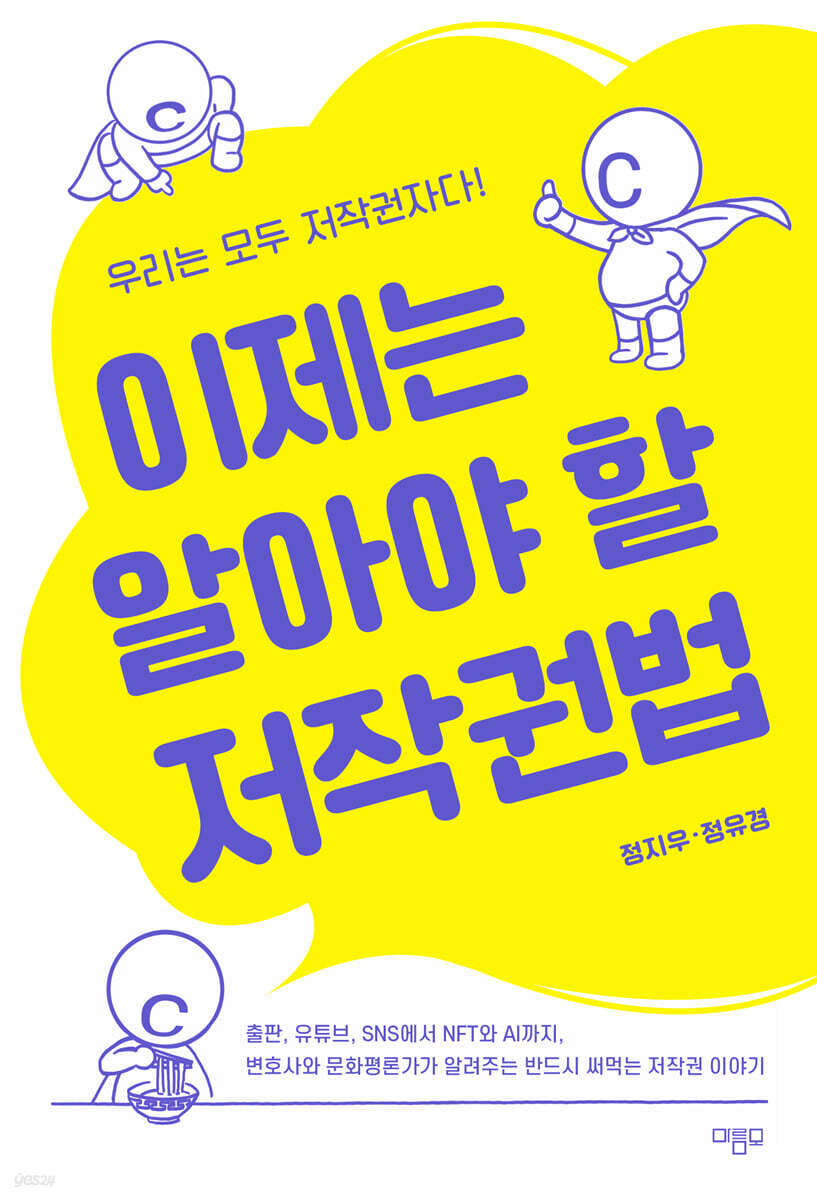
Copyright Law You Need to Know Now
 |
Description
Book Introduction
“This one book will become a powerful weapon for content creators!”
Mastering everything about copyright law in one volume
Jiwoo Jeong, a writer, cultural critic, and lawyer who has written over 20 books including 『Angry Society』, 『There is No Despair on Instagram』, and 『We Don't Take Writing Too Seriously』, has written a book on copyright that anyone can easily read, together with Yukyung Jeong, an in-house lawyer for the IP team of an LG affiliate.
This book is even more credible because it was written by a practicing lawyer, and the author, as a writer and cultural critic, knows the ecosystem of content creators better than anyone else.
Part 1, “Principles of Copyright,” avoids difficult legal terms as much as possible and uses vivid analogies and examples at the level of the general public to help readers learn the basic concepts of copyright in a fun way.
Part 2, "Copyright Solutions," covers the most frequently asked copyright issues among content creators, allowing you to immediately apply what you learned in Part 1 to real-world situations.
In an age where anyone can become a creator of content, knowledge of copyright is essential.
This one book will be the most powerful weapon for content creators.
Mastering everything about copyright law in one volume
Jiwoo Jeong, a writer, cultural critic, and lawyer who has written over 20 books including 『Angry Society』, 『There is No Despair on Instagram』, and 『We Don't Take Writing Too Seriously』, has written a book on copyright that anyone can easily read, together with Yukyung Jeong, an in-house lawyer for the IP team of an LG affiliate.
This book is even more credible because it was written by a practicing lawyer, and the author, as a writer and cultural critic, knows the ecosystem of content creators better than anyone else.
Part 1, “Principles of Copyright,” avoids difficult legal terms as much as possible and uses vivid analogies and examples at the level of the general public to help readers learn the basic concepts of copyright in a fun way.
Part 2, "Copyright Solutions," covers the most frequently asked copyright issues among content creators, allowing you to immediately apply what you learned in Part 1 to real-world situations.
In an age where anyone can become a creator of content, knowledge of copyright is essential.
This one book will be the most powerful weapon for content creators.
- You can preview some of the book's contents.
Preview
index
prolog
Part 1: Principles of Copyright
1.
Copyright: Why It Matters
□When did copyright arise?
2.
What does copyright protect?
human thoughts or feelings
Expression and Creativity
□The title of a work is not a copyrighted work - Trademark Law and the Prevention of Unfair Competition Act
3.
13 types of copyrighted works
literary works
musical works
Theatrical works
Artworks
Architectural works
Photographic works
Video works
graphic works
Computer program works
Edited works
secondary works
Joint works
Works made for the purpose of employment
□How to register copyright
4.
Three Rights Surrounding Copyrighted Works
Copyright
Moral rights
Neighboring rights
Copyright dispute surrounding "Black Rubber Shoes" and "Cloud Bread"
5.
Seven Types of Copyright
Reproduction rights
Performance rights
Exhibition tickets
public transmission rights
Distribution rights
rental rights
Secondary copyright rights
□Copyright at a glance
6.
Cases where copyright is restricted
□The copyright protection period is limited.
7.
Standards for determining copyright infringement
You must 'access' the work
There must be 'substantial similarity'
□ In the end, you have to go to court to find out.
8.
When copyright is infringed
Secure evidence
Notify the copyright infringer or platform
Apply for mediation to the Korea Copyright Commission
Take civil action
Take criminal action
□ Stages of use of copyrighted works
9. NFTs and Copyright
□ Useful Copyright Websites to Know
10. AI and Copyright
□ In the era of generative AI, the key is humans and trust.
Before we wrap up Part 1 and move on to Part 2
Part 2: Resolution of copyright issues
literary works
1.
Is quoting a book or poem also a copyright infringement?
2.
Is it copyright infringement if I read a book at a book club or on YouTube?
3.
What if the drama I submitted to the contest is being broadcast under another writer's name?
musical works
4.
What if the music I created is being used as game music without my knowledge?
5.
Can I upload music I played myself to YouTube?
6.
Is a baseball cheer song created with royalties a copyright infringement?
Architectural works
7.
Is it copyright infringement to take pictures of a model house?
8.
What if someone copied the interior of my cafe?
9.
Can real-world architecture be replicated in the metaverse?
Video works
10.
I just downloaded the movie via torrent…
11.
What if we show a movie in a cafe?
12.
Is linking to a YouTube video a crime?
13.
Can I edit a movie scene and upload it to YouTube?
14.
Can I parody "Squid Game" and use it in an advertisement?
15.
The director of "Squid Game" doesn't own the copyright?
16.
Are Internet site operators also liable for copyright infringement?
Computer program works
17.
What if I receive a notice of copyright infringement due to the use of illegal software?
18.
What if I receive a notice of copyright infringement for a font?
secondary works
19.
Can I create a summary and sell it?
Joint works
20.
I made a musical based on a novel I wrote, but it's copyright infringement?
Works made for the purpose of employment
21.
Could the script I wrote at the company's request be mine?
22.
Can I sell test questions submitted by teachers?
AI and Copyright
23.
Will works created with ChatGPT be copyrighted?
Epilogue
Appendix | Overview of Copyright Law
A Word from Readers|“We Are All Copyright Owners!”
Part 1: Principles of Copyright
1.
Copyright: Why It Matters
□When did copyright arise?
2.
What does copyright protect?
human thoughts or feelings
Expression and Creativity
□The title of a work is not a copyrighted work - Trademark Law and the Prevention of Unfair Competition Act
3.
13 types of copyrighted works
literary works
musical works
Theatrical works
Artworks
Architectural works
Photographic works
Video works
graphic works
Computer program works
Edited works
secondary works
Joint works
Works made for the purpose of employment
□How to register copyright
4.
Three Rights Surrounding Copyrighted Works
Copyright
Moral rights
Neighboring rights
Copyright dispute surrounding "Black Rubber Shoes" and "Cloud Bread"
5.
Seven Types of Copyright
Reproduction rights
Performance rights
Exhibition tickets
public transmission rights
Distribution rights
rental rights
Secondary copyright rights
□Copyright at a glance
6.
Cases where copyright is restricted
□The copyright protection period is limited.
7.
Standards for determining copyright infringement
You must 'access' the work
There must be 'substantial similarity'
□ In the end, you have to go to court to find out.
8.
When copyright is infringed
Secure evidence
Notify the copyright infringer or platform
Apply for mediation to the Korea Copyright Commission
Take civil action
Take criminal action
□ Stages of use of copyrighted works
9. NFTs and Copyright
□ Useful Copyright Websites to Know
10. AI and Copyright
□ In the era of generative AI, the key is humans and trust.
Before we wrap up Part 1 and move on to Part 2
Part 2: Resolution of copyright issues
literary works
1.
Is quoting a book or poem also a copyright infringement?
2.
Is it copyright infringement if I read a book at a book club or on YouTube?
3.
What if the drama I submitted to the contest is being broadcast under another writer's name?
musical works
4.
What if the music I created is being used as game music without my knowledge?
5.
Can I upload music I played myself to YouTube?
6.
Is a baseball cheer song created with royalties a copyright infringement?
Architectural works
7.
Is it copyright infringement to take pictures of a model house?
8.
What if someone copied the interior of my cafe?
9.
Can real-world architecture be replicated in the metaverse?
Video works
10.
I just downloaded the movie via torrent…
11.
What if we show a movie in a cafe?
12.
Is linking to a YouTube video a crime?
13.
Can I edit a movie scene and upload it to YouTube?
14.
Can I parody "Squid Game" and use it in an advertisement?
15.
The director of "Squid Game" doesn't own the copyright?
16.
Are Internet site operators also liable for copyright infringement?
Computer program works
17.
What if I receive a notice of copyright infringement due to the use of illegal software?
18.
What if I receive a notice of copyright infringement for a font?
secondary works
19.
Can I create a summary and sell it?
Joint works
20.
I made a musical based on a novel I wrote, but it's copyright infringement?
Works made for the purpose of employment
21.
Could the script I wrote at the company's request be mine?
22.
Can I sell test questions submitted by teachers?
AI and Copyright
23.
Will works created with ChatGPT be copyrighted?
Epilogue
Appendix | Overview of Copyright Law
A Word from Readers|“We Are All Copyright Owners!”
Detailed image

Into the book
What makes copyright special is that the author automatically becomes the copyright owner of the work upon creation, even if he or she does not register the copyright.
In fact, it is rare in the world of law for any 'action' we perform to be protected like this.
Much of the law, including civil law, is designed to protect what we 'own'.
However, copyright is distinct from such ownership.
We have ownership of things we own, such as land, cars, and money, because we 'own' them.
However, the creator has the rights to it because he 'created' it.
---From "Why Copyright is Important" on pages 20-21
A secondary work created in this way becomes a separate work from the original work and has a separate copyright.
In other words, if a drama is produced based on a webtoon, the drama can also be protected as a separate work from the webtoon.
However, as long as the original exists separately, the legal relationship with the original cannot be ignored.
This requires caution as copyright relations can become complicated.
Above all, since the right to create a derivative work belongs to the copyright holder of the original work, if someone else creates a derivative work of a work without the permission of the copyright holder, it is a copyright infringement (right to create a derivative work).
---From “Secondary Works” on pages 39-40
If you believe your copyright has been infringed, the first thing you should do is secure evidence.
Especially online, since infringing posts can be edited or deleted at any time, it is important to secure evidence of copyright infringement through captures, etc.
Also, since ‘reliance’ is important in copyright infringement (☞ p. 89, “Must ‘access’ to the copyrighted work”), if the other party has accessed my copyrighted work, it is necessary to secure evidence related to that.
---From “When Copyright is Infringed” on pages 95-96
Furthermore, it's important to note that purchasing an NFT doesn't grant you the copyright to the original work it represents. Purchasing an NFT alone is, quite literally, simply purchasing the NFT itself.
To put it metaphorically, it's like buying and selling only the receipt while keeping the actual item. This is because NFTs are closer to a certificate of authenticity, separate from the original work or its copyright.
Therefore, if you want to acquire ownership or copyright (copyright property rights) of an original work, you must deal with the owner or copyright holder of the original work, and not just trade NFTs.
---From "NFT and Copyright" on pages 103-104
Although uploading edited scenes from movies or animations is also an act of copyright infringement, the reason why many of these videos are uploaded to YouTube is because the copyright holder has permitted or tolerated the use of the work for promotional reasons (or the copyright holder may not be aware of it, or it may fall under the category of 'fair use' or 'quotation' mentioned above), but it is by no means because such acts themselves are always permitted by law.
Therefore, if you edit a video work such as a movie or animation without the permission of the copyright holder and post it on your YouTube channel, it may constitute copyright infringement.
---From "Can I edit a movie scene and upload it to YouTube?" on pages 192-193
The Copyright Act defines a work as “a creative work expressing human thoughts or emotions.”
In other words, the copyright holder is limited to only ‘humans’.
This is true not only in our country but also in most countries, including the United States.
Therefore, under the current copyright law, creative works created by artificial intelligence or animals, rather than humans, cannot be protected as copyrighted works.
In fact, it is rare in the world of law for any 'action' we perform to be protected like this.
Much of the law, including civil law, is designed to protect what we 'own'.
However, copyright is distinct from such ownership.
We have ownership of things we own, such as land, cars, and money, because we 'own' them.
However, the creator has the rights to it because he 'created' it.
---From "Why Copyright is Important" on pages 20-21
A secondary work created in this way becomes a separate work from the original work and has a separate copyright.
In other words, if a drama is produced based on a webtoon, the drama can also be protected as a separate work from the webtoon.
However, as long as the original exists separately, the legal relationship with the original cannot be ignored.
This requires caution as copyright relations can become complicated.
Above all, since the right to create a derivative work belongs to the copyright holder of the original work, if someone else creates a derivative work of a work without the permission of the copyright holder, it is a copyright infringement (right to create a derivative work).
---From “Secondary Works” on pages 39-40
If you believe your copyright has been infringed, the first thing you should do is secure evidence.
Especially online, since infringing posts can be edited or deleted at any time, it is important to secure evidence of copyright infringement through captures, etc.
Also, since ‘reliance’ is important in copyright infringement (☞ p. 89, “Must ‘access’ to the copyrighted work”), if the other party has accessed my copyrighted work, it is necessary to secure evidence related to that.
---From “When Copyright is Infringed” on pages 95-96
Furthermore, it's important to note that purchasing an NFT doesn't grant you the copyright to the original work it represents. Purchasing an NFT alone is, quite literally, simply purchasing the NFT itself.
To put it metaphorically, it's like buying and selling only the receipt while keeping the actual item. This is because NFTs are closer to a certificate of authenticity, separate from the original work or its copyright.
Therefore, if you want to acquire ownership or copyright (copyright property rights) of an original work, you must deal with the owner or copyright holder of the original work, and not just trade NFTs.
---From "NFT and Copyright" on pages 103-104
Although uploading edited scenes from movies or animations is also an act of copyright infringement, the reason why many of these videos are uploaded to YouTube is because the copyright holder has permitted or tolerated the use of the work for promotional reasons (or the copyright holder may not be aware of it, or it may fall under the category of 'fair use' or 'quotation' mentioned above), but it is by no means because such acts themselves are always permitted by law.
Therefore, if you edit a video work such as a movie or animation without the permission of the copyright holder and post it on your YouTube channel, it may constitute copyright infringement.
---From "Can I edit a movie scene and upload it to YouTube?" on pages 192-193
The Copyright Act defines a work as “a creative work expressing human thoughts or emotions.”
In other words, the copyright holder is limited to only ‘humans’.
This is true not only in our country but also in most countries, including the United States.
Therefore, under the current copyright law, creative works created by artificial intelligence or animals, rather than humans, cannot be protected as copyrighted works.
---From page 249, “Will works created with ChatGPT be recognized as copyrightable?”
Publisher's Review
A current lawyer, writer, and cultural critic provides the following information:
The easiest copyright law in the world
This is truly the age of content.
In an era where everyone is a creator thanks to the development of various individual media such as blogs, YouTube, and social media, there is no one who does not know the importance of copyright.
Moreover, with the recent emergence of new technologies that utilize works such as generative AI, NFT, and metaverse, including 'Midjourney' and 'ChatGPT', copyright issues related to these technologies are being actively discussed.
But how much do we really know about copyright?
This book is an easy-to-understand copyright book written so that even ordinary people who have not studied law can approach copyright issues that permeate their daily lives in a friendly manner and immediately apply them when faced with copyright issues in their daily lives.
This book is even more trustworthy because it was written based on in-depth discussions by Jiwoo Jeong, a cultural critic and lawyer who has written over 20 books including “Angry Society,” “There is No Despair on Instagram,” and “We Take Writing Too Seriously,” and by attorney Yukyung Jeong, who has long been an in-house lawyer for the IP team of an LG affiliate, examining various copyright issues.
In particular, this book is unique in that it was written from the perspective of a practicing lawyer by author Jiwoo Jeong, who understands the ecosystem of content creators better than anyone else, having published the newsletter “All Cultures of the World” with around 20 content creators, including teachers, architects, interpreters, social workers, and musicians.
A copyright book written by a writer and cultural critic with 20 years of experience is different.
Never before has a book on law been written in such a beautiful and accessible style.
From publishing, YouTube, and social media to NFTs and AI,
A comprehensive guide to the most frequently asked copyright questions from content creators.
We usually know that we should not infringe on the copyrights of others.
It is widely known that sharing movies on web hard drives or plagiarizing other people's works is clearly prohibited.
But when it's not that clear, it's not easy to know exactly when you're infringing on someone else's copyright and when you're not.
For example, can I upload music I played myself to YouTube? Is it a copyright infringement to take photos of a model house? Can I replicate real-world architecture in the metaverse? Are works created with ChatGPT copyrightable?
This book is divided into Part 1, "Principles of Copyright," which covers the overall framework and basic concepts of copyright law, and Part 2, "Resolving Copyright Issues," which uses what you learned in Part 1 to actually solve copyright problems you encounter in everyday life. It is tightly structured so that anyone can systematically understand copyright and acquire the ability to deal with real-life cases.
Regarding the copyright issues surrounding NFTs and AI, which have recently become hot topics, there are still some areas where specific related laws have not been established and discussions are still active, so we have only touched on the essential points that must be known without unnecessary details.
In particular, the two authors, who have dealt with various copyright issues as practicing lawyers, select 23 copyright issues that the general public most frequently asks about and provide specific and practical solutions.
Each case covered in Part 2 is not just an individual case; it is explained thoroughly so that solving this one problem can be applied to solve other related problems.
After mastering Part 2, you will develop the application skills to deal with any copyright issues you encounter.
Copyright is easy if you just know the principles.
A systematic structure that can be applied in real life!
No difficult legal jargon! Friendly explanations at a level that's accessible to everyone.
- Complex content organized into tables for easy understanding at a glance.
- Comprehensive copyright information included at the end of each chapter
- The case is structured as Q&A.
Pick and read the content that interests you.
- ☞ Structured to review what you have learned by following the signs
- Reflects the latest updated case law and vivid everyday examples
- Make difficult content easier and more fun with exciting illustrations!
This book contains several devices to help general readers more easily understand the world of copyright law, which can be difficult to understand.
Part 1, which lays out the framework of copyright law, organizes complex content into tables for easy understanding at a glance, and the end of each chapter is filled with practical information, including how to register a copyright and useful copyright websites.
Part 2, which corresponds to the case, is divided into chapters by type of work, so you can select and read the content that interests you.
Below each chapter title, the types of works and copyright laws related to the case are listed to help readers understand copyright law in a broad sense.
By following the ☞ marks in the text, you can see which page in Part 1 the related content was explained, providing an opportunity for review.
Existing copyright books often focus on theory or, conversely, only on cases.
However, focusing only on theory makes it difficult to apply it in real-world cases, and conversely, focusing only on cases makes it difficult to acquire systematic knowledge, which leads to high volatility.
In this book, I felt I had to kill two birds with one stone and give it to the readers.
Only then can readers gain proper knowledge about copyright after reading a book.
Furthermore, only then can awareness of copyright be properly established in this society.
In an age of content overload, it's now essential for everyone to understand copyright law to protect their own rights and avoid infringing on the rights of others.
As the author says, I hope this book will become “a drop of dew that protects and contributes to someone’s, your, and our culture.”
The easiest copyright law in the world
This is truly the age of content.
In an era where everyone is a creator thanks to the development of various individual media such as blogs, YouTube, and social media, there is no one who does not know the importance of copyright.
Moreover, with the recent emergence of new technologies that utilize works such as generative AI, NFT, and metaverse, including 'Midjourney' and 'ChatGPT', copyright issues related to these technologies are being actively discussed.
But how much do we really know about copyright?
This book is an easy-to-understand copyright book written so that even ordinary people who have not studied law can approach copyright issues that permeate their daily lives in a friendly manner and immediately apply them when faced with copyright issues in their daily lives.
This book is even more trustworthy because it was written based on in-depth discussions by Jiwoo Jeong, a cultural critic and lawyer who has written over 20 books including “Angry Society,” “There is No Despair on Instagram,” and “We Take Writing Too Seriously,” and by attorney Yukyung Jeong, who has long been an in-house lawyer for the IP team of an LG affiliate, examining various copyright issues.
In particular, this book is unique in that it was written from the perspective of a practicing lawyer by author Jiwoo Jeong, who understands the ecosystem of content creators better than anyone else, having published the newsletter “All Cultures of the World” with around 20 content creators, including teachers, architects, interpreters, social workers, and musicians.
A copyright book written by a writer and cultural critic with 20 years of experience is different.
Never before has a book on law been written in such a beautiful and accessible style.
From publishing, YouTube, and social media to NFTs and AI,
A comprehensive guide to the most frequently asked copyright questions from content creators.
We usually know that we should not infringe on the copyrights of others.
It is widely known that sharing movies on web hard drives or plagiarizing other people's works is clearly prohibited.
But when it's not that clear, it's not easy to know exactly when you're infringing on someone else's copyright and when you're not.
For example, can I upload music I played myself to YouTube? Is it a copyright infringement to take photos of a model house? Can I replicate real-world architecture in the metaverse? Are works created with ChatGPT copyrightable?
This book is divided into Part 1, "Principles of Copyright," which covers the overall framework and basic concepts of copyright law, and Part 2, "Resolving Copyright Issues," which uses what you learned in Part 1 to actually solve copyright problems you encounter in everyday life. It is tightly structured so that anyone can systematically understand copyright and acquire the ability to deal with real-life cases.
Regarding the copyright issues surrounding NFTs and AI, which have recently become hot topics, there are still some areas where specific related laws have not been established and discussions are still active, so we have only touched on the essential points that must be known without unnecessary details.
In particular, the two authors, who have dealt with various copyright issues as practicing lawyers, select 23 copyright issues that the general public most frequently asks about and provide specific and practical solutions.
Each case covered in Part 2 is not just an individual case; it is explained thoroughly so that solving this one problem can be applied to solve other related problems.
After mastering Part 2, you will develop the application skills to deal with any copyright issues you encounter.
Copyright is easy if you just know the principles.
A systematic structure that can be applied in real life!
No difficult legal jargon! Friendly explanations at a level that's accessible to everyone.
- Complex content organized into tables for easy understanding at a glance.
- Comprehensive copyright information included at the end of each chapter
- The case is structured as Q&A.
Pick and read the content that interests you.
- ☞ Structured to review what you have learned by following the signs
- Reflects the latest updated case law and vivid everyday examples
- Make difficult content easier and more fun with exciting illustrations!
This book contains several devices to help general readers more easily understand the world of copyright law, which can be difficult to understand.
Part 1, which lays out the framework of copyright law, organizes complex content into tables for easy understanding at a glance, and the end of each chapter is filled with practical information, including how to register a copyright and useful copyright websites.
Part 2, which corresponds to the case, is divided into chapters by type of work, so you can select and read the content that interests you.
Below each chapter title, the types of works and copyright laws related to the case are listed to help readers understand copyright law in a broad sense.
By following the ☞ marks in the text, you can see which page in Part 1 the related content was explained, providing an opportunity for review.
Existing copyright books often focus on theory or, conversely, only on cases.
However, focusing only on theory makes it difficult to apply it in real-world cases, and conversely, focusing only on cases makes it difficult to acquire systematic knowledge, which leads to high volatility.
In this book, I felt I had to kill two birds with one stone and give it to the readers.
Only then can readers gain proper knowledge about copyright after reading a book.
Furthermore, only then can awareness of copyright be properly established in this society.
In an age of content overload, it's now essential for everyone to understand copyright law to protect their own rights and avoid infringing on the rights of others.
As the author says, I hope this book will become “a drop of dew that protects and contributes to someone’s, your, and our culture.”
GOODS SPECIFICS
- Date of issue: July 3, 2023
- Page count, weight, size: 276 pages | 358g | 140*205*18mm
- ISBN13: 9791197826948
- ISBN10: 1197826947
You may also like
카테고리
korean


korean

![GQ KOREA Mark (Monthly): December [2025]](http://librairie.coreenne.fr/cdn/shop/files/8ef265dbbfbf186523ed75ba7319009d.jpg?v=1765340328&width=3840)


