

Why Aid to Africa Doesn't Work
 |
Description
Book Introduction
Africa, which is attracting attention as an emerging market,
Can massive aid really make a difference there?
Dissecting the problems of aid to Africa with the keen perspective of a development cooperation expert
Presenting a sobering proposal for sustainable development and growth in Africa.
Despite decades of steady global aid, Africa continues to be synonymous with hunger, poverty, and inequality.
However, now it is transforming into a target for development cooperation by major powers such as the United States and China, as well as many countries in Europe and Asia.
This is because Africa has great potential to grow into a new market and international political power.
Korea is no exception to this global movement, and has recently shown a move to actively and on a large scale to promote development cooperation in Africa, which was previously relatively inactive.
In fact, looking back at the history of the past few decades, humanitarian aid to Africa has not been very successful.
The main reason cited was that the amount of aid was insufficient to solve Africa's problems.
If this is true, increasing scale could be the solution, but from the perspective of an African expert, this could not only exacerbate Africa's problems but also lead to inefficient and ineffective waste of future aid.
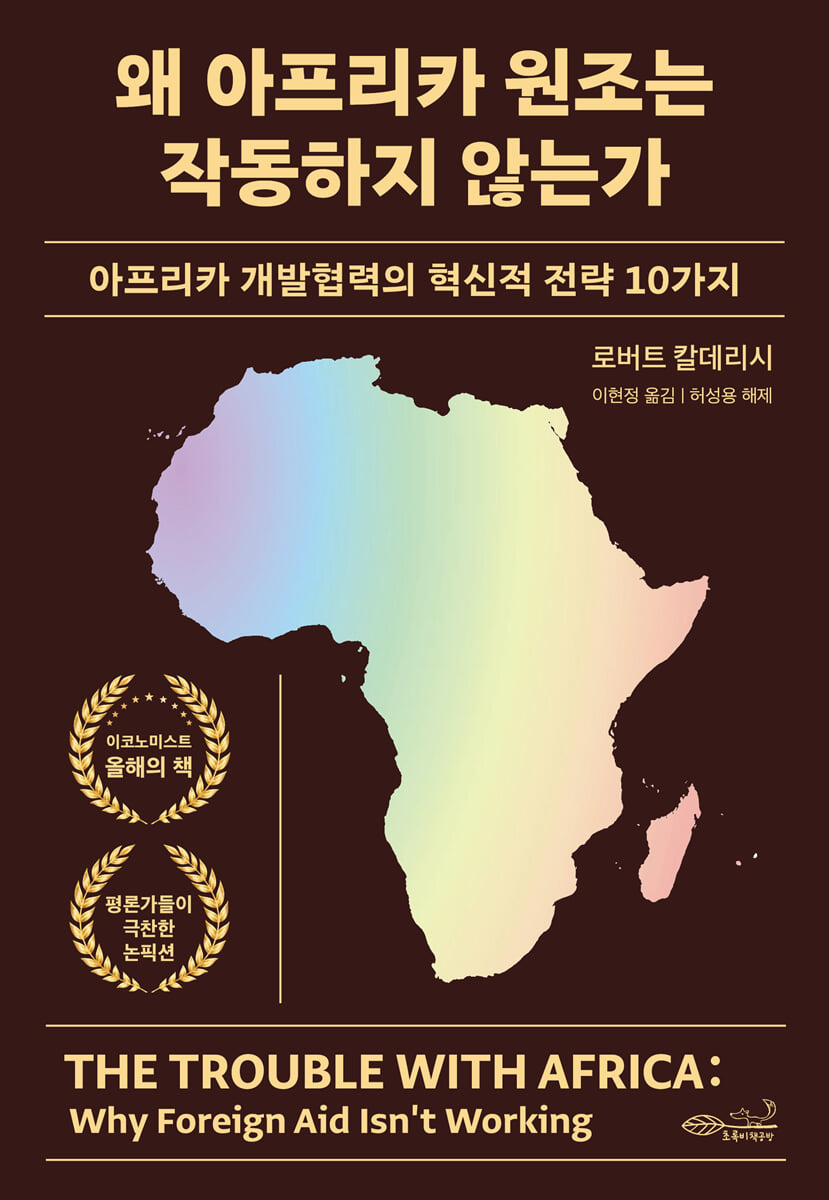
This book is written by Robert Calderisi, who has worked for a long time as the Africa manager at the World Bank, the world's leading international development cooperation organization, and it sharply examines the misunderstandings and truths about foreign aid to Africa and suggests points that must be considered in future development cooperation with Africa.
Foreign aid provided without a proper understanding of Africa cannot develop the region or forge new political and economic alliances with it.
In this respect, this book will be a must-read, a compass-like guide for those seeking to truly strengthen their relationship with Africa.
Can massive aid really make a difference there?
Dissecting the problems of aid to Africa with the keen perspective of a development cooperation expert
Presenting a sobering proposal for sustainable development and growth in Africa.
Despite decades of steady global aid, Africa continues to be synonymous with hunger, poverty, and inequality.
However, now it is transforming into a target for development cooperation by major powers such as the United States and China, as well as many countries in Europe and Asia.
This is because Africa has great potential to grow into a new market and international political power.
Korea is no exception to this global movement, and has recently shown a move to actively and on a large scale to promote development cooperation in Africa, which was previously relatively inactive.
In fact, looking back at the history of the past few decades, humanitarian aid to Africa has not been very successful.
The main reason cited was that the amount of aid was insufficient to solve Africa's problems.
If this is true, increasing scale could be the solution, but from the perspective of an African expert, this could not only exacerbate Africa's problems but also lead to inefficient and ineffective waste of future aid.
This book is written by Robert Calderisi, who has worked for a long time as the Africa manager at the World Bank, the world's leading international development cooperation organization, and it sharply examines the misunderstandings and truths about foreign aid to Africa and suggests points that must be considered in future development cooperation with Africa.
Foreign aid provided without a proper understanding of Africa cannot develop the region or forge new political and economic alliances with it.
In this respect, this book will be a must-read, a compass-like guide for those seeking to truly strengthen their relationship with Africa.
- You can preview some of the book's contents.
Preview
index
To Korean readers in 2023
Preface to the 2015 edition
Preface to the 2006 edition
Part 1: What Makes Africa Different?
Chapter 1.
Finding excuses
Chapter 2.
Africa from different perspectives
Chapter 3.
villains with power
Chapter 4.
Culture, corruption, and legitimacy
Part 2_ Frontline Stories
Chapter 5.
Tanzania: African-Style Socialism
Chapter 6.
Côte d'Ivoire: The End of a Miracle
Chapter 7.
Discord in Central Africa
Part 3: Facing the Facts
Chapter 8.
The failure of economics
Chapter 9.
The challenges of international aid
Chapter 10.
Chad-Cameroon oil pipeline
Chapter 11.
Clash of values
Part 4_ Towards the Future
Chapter 12.
Ten Ways to Change Africa
Chapter 13.
new era
clear
Translator's Note
source
References
Preface to the 2015 edition
Preface to the 2006 edition
Part 1: What Makes Africa Different?
Chapter 1.
Finding excuses
Chapter 2.
Africa from different perspectives
Chapter 3.
villains with power
Chapter 4.
Culture, corruption, and legitimacy
Part 2_ Frontline Stories
Chapter 5.
Tanzania: African-Style Socialism
Chapter 6.
Côte d'Ivoire: The End of a Miracle
Chapter 7.
Discord in Central Africa
Part 3: Facing the Facts
Chapter 8.
The failure of economics
Chapter 9.
The challenges of international aid
Chapter 10.
Chad-Cameroon oil pipeline
Chapter 11.
Clash of values
Part 4_ Towards the Future
Chapter 12.
Ten Ways to Change Africa
Chapter 13.
new era
clear
Translator's Note
source
References
Detailed image

Into the book
Most North Americans and Europeans who share my ideals emphasize governance and believe that more aid would help Africa.
But I want to shatter that illusion.
Africans need breathing space more than money.
What is needed is not a Marshall Plan, but genuine support for the few governments fighting poverty, plus political support for the millions of Africans resisting oppression and violence in the rest of the continent.
Not just a formal democracy, but “a society in which people can live their lives freely without fear of what the government or their neighbors may say.”
---From the "2006 edition preface"
That doesn't mean Africa hasn't changed since my book was published.
Some African countries have experienced high economic growth rates over the past decade, and political discourse has raised awareness of rights across the continent.
According to the World Bank, Rwanda is now a better place to do business than Italy.
And Africans are increasingly resentful of incompetent governments.
(Omitted) However, this progress should not be overestimated.
Africa's economic growth is largely due to rising oil and raw material prices, while the lives of the vast majority of Africans remain the same.
---From the "2015 Edition Preface"
African governments have never explained to the public why they are negotiating with international organizations.
Of course, it was clear that they had little choice.
Those governments, and sometimes some private companies, either lacked faith in reforms, gave them half-hearted consent, or undermined them when aid officials let their guard down.
As a result, the 'crisis' appeared to be caused by others, not themselves.
The entire reform process went awry largely because African governments failed to share the situation with their citizens.
Few Africans knew that Africa was losing its global market and that national budgets could barely afford to pay civil servants' salaries, let alone secure essential materials and supplies.
What Africans witnessed was the collapse of infrastructure and public services.
They had a deep distrust of their own government and even more distrust of external agencies that claimed to be trying to alleviate poverty but always seemed to make things worse.
The fundamental problems of Africa's high production and distribution costs and poor investment environment have been obscured by the West's clumsy efforts to support the continent.
---「Chapter 1.
From "Finding an Excuse"
The transgressions in Africa, and the excuses for them, are already bad enough.
But the excuses offered by those who tried to explain Africa's actions only made matters worse.
Europeans have likened the African nation-building process to their own.
Comparing Africa's frequent wars and iron-fisted rule to the Wars of the Roses in 15th-century England and the struggles between Catholics and Protestants in 16th-century France.
But there is a contradiction in this seemingly plausible comparison.
People have argued that Africa can achieve significant economic growth by skipping certain stages of technological development and moving on to the next.
If so, shouldn't the African continent learn from the economic development and political failures of other continents?
---「Chapter 3.
Among the "villains with power"
Fourth, the perspective that political correction is needed can be found among those who question globalization.
Many people wonder how international trade can help poor and defenseless countries.
They are skeptical of the economists' assertion that a rising tide lifts all boats, see little evidence that prosperity is spreading globally, and are more concerned about the still-large income gap between countries.
Their concerns are deeply and widely shared among economists.
Others go further, describing the global economy as a moral battlefield.
According to them, corporate profits are "blood money," the World Trade Organization is a "war machine," and rich countries are waging a "world war against the poor."
Whether secular or extreme in their expression, this Western sensibility allows African intellectuals to shift responsibility for their problems onto others.
---「Chapter 4.
From “Culture, Corruption, and Legitimacy”
Development agencies have long avoided democracy and human rights issues.
Then, finally, in the late 1980s, and in Africa when the situation was at its worst, aid workers began to openly express concerns about 'governance'.
But this sensitive expression misses the core issue.
By using the technical term "governance," Western governments have been able to comment on internal governmental issues such as government accountability and information, decentralization of power, the judicial system, civil service reform, military spending, corruption, and relations with non-governmental organizations.
But the empty discourse did little to strengthen the rule of law and a culture of openness and equality among citizens.
(Omitted) Over the past five years, official statements from world organizations have become more vocal.
For example, the United Nations International Conference on Development Financing, held in Monterrey, Mexico, in March 2002, came close to linking aid levels to explicit political reform.
But little has actually changed. The EU has cut off support to small countries like Togo, which no longer even try to appear democratic, and to large countries like Côte d'Ivoire and Zimbabwe, which are on the verge of civil war.
---「Chapter 9.
From “The Difficult Road of International Aid”
Contrary to previous recommendations, direct foreign aid to most African countries should be reduced rather than increased.
Because the smaller the budget, the better it can be managed.
Moreover, competition among countries for aid will intensify, and the time to select, prepare, and oversee projects in the few countries that meet rigorous criteria will increase.
Some of the resources saved by reducing direct aid could be redirected to more universal purposes, such as establishing regional universities, multilateral infrastructure projects, agricultural research, and international AIDS initiatives.
Such support would benefit multiple countries simultaneously, or even the entire African continent.
Abundant aid creates false hopes, cripples development plans for the continent's resources, including human capital, and, while soothing the West's conscience, desensitizes it to the greater horrors of the future.
The continued exodus of skilled workers and bad policies will further spread disease, famine, unemployment, and despair.
In such an environment, only political change can offer hope for a change in the situation.
---「Chapter 12.
From "Ten Ways to Change Africa"
Despite its poverty, Africa possesses enormous resources to build a better future.
(Omitted) 40 percent of African savings currently held abroad could potentially be invested domestically.
There are also thousands of talented and experienced Africans abroad who could return home if Africa's political and economic prospects brighten.
In Africa, there are also ongoing good deeds by many governments and private charities seeking to support Africans more directly through money and ideas.
One thing that has not yet collapsed is the African spirit.
Part of Africa's stubbornness stems from simple human survival instincts, and part of it stems from a reluctance to face the truth.
(Omitted) Right now, Africa is in a situation where hope has temporarily stopped.
Only those familiar with Africa's human beauty, potential, and suffering can hope for a breakthrough in the next decade.
They know better than anyone else that only Africans can break the cycle of terror, poverty, and mediocrity that oppresses them.
But I want to shatter that illusion.
Africans need breathing space more than money.
What is needed is not a Marshall Plan, but genuine support for the few governments fighting poverty, plus political support for the millions of Africans resisting oppression and violence in the rest of the continent.
Not just a formal democracy, but “a society in which people can live their lives freely without fear of what the government or their neighbors may say.”
---From the "2006 edition preface"
That doesn't mean Africa hasn't changed since my book was published.
Some African countries have experienced high economic growth rates over the past decade, and political discourse has raised awareness of rights across the continent.
According to the World Bank, Rwanda is now a better place to do business than Italy.
And Africans are increasingly resentful of incompetent governments.
(Omitted) However, this progress should not be overestimated.
Africa's economic growth is largely due to rising oil and raw material prices, while the lives of the vast majority of Africans remain the same.
---From the "2015 Edition Preface"
African governments have never explained to the public why they are negotiating with international organizations.
Of course, it was clear that they had little choice.
Those governments, and sometimes some private companies, either lacked faith in reforms, gave them half-hearted consent, or undermined them when aid officials let their guard down.
As a result, the 'crisis' appeared to be caused by others, not themselves.
The entire reform process went awry largely because African governments failed to share the situation with their citizens.
Few Africans knew that Africa was losing its global market and that national budgets could barely afford to pay civil servants' salaries, let alone secure essential materials and supplies.
What Africans witnessed was the collapse of infrastructure and public services.
They had a deep distrust of their own government and even more distrust of external agencies that claimed to be trying to alleviate poverty but always seemed to make things worse.
The fundamental problems of Africa's high production and distribution costs and poor investment environment have been obscured by the West's clumsy efforts to support the continent.
---「Chapter 1.
From "Finding an Excuse"
The transgressions in Africa, and the excuses for them, are already bad enough.
But the excuses offered by those who tried to explain Africa's actions only made matters worse.
Europeans have likened the African nation-building process to their own.
Comparing Africa's frequent wars and iron-fisted rule to the Wars of the Roses in 15th-century England and the struggles between Catholics and Protestants in 16th-century France.
But there is a contradiction in this seemingly plausible comparison.
People have argued that Africa can achieve significant economic growth by skipping certain stages of technological development and moving on to the next.
If so, shouldn't the African continent learn from the economic development and political failures of other continents?
---「Chapter 3.
Among the "villains with power"
Fourth, the perspective that political correction is needed can be found among those who question globalization.
Many people wonder how international trade can help poor and defenseless countries.
They are skeptical of the economists' assertion that a rising tide lifts all boats, see little evidence that prosperity is spreading globally, and are more concerned about the still-large income gap between countries.
Their concerns are deeply and widely shared among economists.
Others go further, describing the global economy as a moral battlefield.
According to them, corporate profits are "blood money," the World Trade Organization is a "war machine," and rich countries are waging a "world war against the poor."
Whether secular or extreme in their expression, this Western sensibility allows African intellectuals to shift responsibility for their problems onto others.
---「Chapter 4.
From “Culture, Corruption, and Legitimacy”
Development agencies have long avoided democracy and human rights issues.
Then, finally, in the late 1980s, and in Africa when the situation was at its worst, aid workers began to openly express concerns about 'governance'.
But this sensitive expression misses the core issue.
By using the technical term "governance," Western governments have been able to comment on internal governmental issues such as government accountability and information, decentralization of power, the judicial system, civil service reform, military spending, corruption, and relations with non-governmental organizations.
But the empty discourse did little to strengthen the rule of law and a culture of openness and equality among citizens.
(Omitted) Over the past five years, official statements from world organizations have become more vocal.
For example, the United Nations International Conference on Development Financing, held in Monterrey, Mexico, in March 2002, came close to linking aid levels to explicit political reform.
But little has actually changed. The EU has cut off support to small countries like Togo, which no longer even try to appear democratic, and to large countries like Côte d'Ivoire and Zimbabwe, which are on the verge of civil war.
---「Chapter 9.
From “The Difficult Road of International Aid”
Contrary to previous recommendations, direct foreign aid to most African countries should be reduced rather than increased.
Because the smaller the budget, the better it can be managed.
Moreover, competition among countries for aid will intensify, and the time to select, prepare, and oversee projects in the few countries that meet rigorous criteria will increase.
Some of the resources saved by reducing direct aid could be redirected to more universal purposes, such as establishing regional universities, multilateral infrastructure projects, agricultural research, and international AIDS initiatives.
Such support would benefit multiple countries simultaneously, or even the entire African continent.
Abundant aid creates false hopes, cripples development plans for the continent's resources, including human capital, and, while soothing the West's conscience, desensitizes it to the greater horrors of the future.
The continued exodus of skilled workers and bad policies will further spread disease, famine, unemployment, and despair.
In such an environment, only political change can offer hope for a change in the situation.
---「Chapter 12.
From "Ten Ways to Change Africa"
Despite its poverty, Africa possesses enormous resources to build a better future.
(Omitted) 40 percent of African savings currently held abroad could potentially be invested domestically.
There are also thousands of talented and experienced Africans abroad who could return home if Africa's political and economic prospects brighten.
In Africa, there are also ongoing good deeds by many governments and private charities seeking to support Africans more directly through money and ideas.
One thing that has not yet collapsed is the African spirit.
Part of Africa's stubbornness stems from simple human survival instincts, and part of it stems from a reluctance to face the truth.
(Omitted) Right now, Africa is in a situation where hope has temporarily stopped.
Only those familiar with Africa's human beauty, potential, and suffering can hope for a breakthrough in the next decade.
They know better than anyone else that only Africans can break the cycle of terror, poverty, and mediocrity that oppresses them.
---「Chapter 13.
From "New Era"
From "New Era"
Publisher's Review
Is the African continent developing or regressing?
Can international aid really help Africa develop?
Children with emaciated bodies, an environment where poverty and hunger are the norm, a bloody civil war, the tyranny and tyranny of those in power, refugees risking their lives to board boats to go abroad…
These are the things that have often come to mind when we think of 'Africa' over the past few decades.
And for Africa, which is synonymous with 'poor and impoverished' regions, countries and organizations around the world have been continuously providing foreign aid, sometimes on a large scale.
However, recent aid to Africa goes beyond simple humanitarian purposes.
In a global context where the overall economy is more depressed than in the past and the competition for hegemony among major powers is intensifying, Africa has the potential to become a new market, the last growth engine on the planet, and a political ally.
As if to prove this, US Treasury Secretary Janet Yellen and Chinese Foreign Minister Qin Gang each embarked on a tour of Africa at the start of 2023 and announced that they would continue to invest in Africa's development in the future.
The intention of both countries is to maintain the vast African continent as a powerful ally.
Korea has also joined this global movement.
Recently, the Ministry of Trade, Industry and Energy and the Korea Plant Industry Association invited 21 African countries to the 'Korea-Africa Trade and Industry Cooperation Forum' and began exploring ways to expand trade and industrial cooperation between the two countries.
At this forum, the Korean side expressed its intention to actively pursue official development assistance in the industrial and energy sectors.
In addition, the Korean government also announced plans to more than double the scale of its aid to Africa by 2030 compared to 2019 to support Africa's achievement of its sustainable development goals.
This raises a few questions.
Was global foreign aid to Africa sufficiently effective before these recent developments? How can we explain why, despite decades of aid, Africa remains synonymous with poverty, hunger, and underdevelopment? Could the persistence of these problems stem from the woefully inadequate scale of aid to date? Is it certain that expanding foreign aid will drive Africa's development? What considerations should be taken to ensure that aid is invested effectively and reaps maximum benefits? This book answers these very questions.
Aid that was successful in East Asia, including Korea
Why it was impossible in Africa
The author, Robert Calderisi, spent most of his career at the World Bank, the world's largest aid organization, and worked at the Organisation for Economic Co-operation and Development (OECD), which coordinates aid practices across developed countries.
Additionally, while working as the World Bank's Africa spokesperson, I had the opportunity to connect with many people who wanted to bring about change on the African continent, and I gained field experience while serving as the World Bank Country Manager in Tanzania and Côte d'Ivoire.
Throughout this process, he has interacted and spoken with thousands of Africans, ranging from peasants to presidents, with vast ideological and cultural differences.
Through these experiences, I gained insight into why international aid to Africa has failed so far and into specific, realistic solutions to address the issue.
Let me first reveal his answer to the previous question:
“Increasing the scale of aid alone will not save Africa.” This means that the failure of many past international aid projects to Africa was not due to their small scale.
There are several reasons for the failure, as Kalderisi points out, but the biggest one is that 'there are few governments in Africa that set and implement development policy priorities and establish the necessary institutions to do so'.
The country that the author cites as a representative example in contrast to this African reality is Korea.
In the 1960s, South Korea was as poor as Ghana, but 30 years later, it had become wealthy enough to provide aid to Africa.
The author argues that these changes were possible in small East Asian countries, including Korea, thanks to excellent economic policies, robust public finances, low inflation, and clear investment regulations.
More specific and realistic causes are pointed out, including the indigenous dictatorships in Africa, the Western countries' tendency to discuss only the goals of aid without addressing Africa's flawed political and administrative practices, the continent's countries' disdain for the economy, and the reality of Africans losing the strength and motivation needed to confront all these problems.
These are things that can never be discussed unless one has a clear understanding of Africa's internal and external situations and objective truths.
This is why you can feel the sharp and keen perspective in many places in this book, even though it is written as if it were simply sharing one's own experiences, without being stiff or weighty like a professional report.
Vivid, concrete, yet intensive,
Africa's internal and external issues related to international aid
The author argues that we must move beyond the excessive despair and grace that dominate much of the discourse on Africa, and that Africans and the world must propose concrete measures that can liberate African talent and businesses.
To achieve this, he believes that some unpleasant truths that have been ignored must be shared, and this book elaborates on this idea.
〈Part 1.
In "What's Different About Africa," the author examines the factors that have been considered to be the causes of Africa's current problems, such as the slave trade, the colonial Cold War, high debt, and the actions of international organizations, from a skeptical perspective, and shows how harmful the dictatorships that originated in Africa have been to each country through examples from various countries.
We also examine how Africa's unique culture and values have been distorted to condone oppression on the continent.
〈Part 2.
“Frontline Stories” directly addresses chronic problems that have arisen in a number of African countries.
Among these countries, two that the author particularly notes and describes in detail are Tanzania and Côte d'Ivoire.
Tanzania, which advocated African-style socialism under President Julius Nyerere, paradoxically received a lot of international aid thanks to its emphasis on 'self-reliance'.
However, this vision failed to materialize due to a number of factors: state-owned enterprises that absorbed wealth rather than created it; budgetary constraints caused by government expansion that outpaced economic growth; corruption that initially seemed contained but gradually spread; and a miscalculation that attempted to develop agriculture by appealing to national pride rather than providing real economic incentives.
In the case of Côte d'Ivoire, thanks to the efforts of its people, fertile soil, and good location, it achieved miraculous economic success, and enjoyed prosperity and stability from the 1960s to the 1990s. However, the miracle ended in December 1999 when the military overthrew the government due to the excessive control of opposition forces by the founding father, Félix Houphouët-Boigny, and the accumulation of enormous private wealth through illicit means.
The content related to these two countries is noteworthy not only for its individual histories but also for its comprehensive presentation of the various chronic problems the African continent has faced in relation to foreign aid.
〈Part 3.
Facing the Facts examines the challenges Western countries face in supporting Africa and the factors that have hindered their individual policy initiatives with African governments.
The story surrounding the Chad-Cameroon pipeline project, which became a global issue, persuasively demonstrates that more proactive intervention is effective when investing in Africa's future.
It also presents real-world examples that illustrate the vast gap between world and African leaders in their perceptions of and understanding of Africa's problems.
The real value of this book lies not in its stark examination of Africa's problems.
In Part 4, “Towards the Future,” the author, a development cooperation expert, passionately advocates the need for changes in Africa’s foreign aid policy, hoping for Africa’s true development, and presents 10 suggestions for what kind of foreign aid should be to develop Africa in the right direction.
African development cooperation, which contains both risks and possibilities.
Why we need realistic and sober advice from African experts.
In this respect, there are several risks in foreign aid to Africa that we have not yet fully identified.
But the real value of this book lies not only in its stark examination of Africa's problems.
The book is permeated with the hope that Africa will truly develop and that the inherent strengths and culture of Africans will be expressed constructively.
With this loving perspective, the author emphasizes the need for change in Africa's current foreign aid policy and presents ten suggestions for what kind of foreign aid would lead Africa in the right direction.
Some of the author's proposals are radical, while others directly contradict traditional views.
A representative example is the ‘50 percent reduction in direct aid to each country.’
The direct foreign aid to Africa should actually be reduced in scale, as a smaller budget inevitably means better management.
As global aid budgets shrink, African countries will engage in fierce, constructive competition among themselves for aid, and projects in a small number of countries that meet strict aid requirements may be selected for aid.
Among the proposals is one that calls for the international community to link aid to political issues that have been implicitly or explicitly ignored by existing African political leaders: "open political debate and fair elections."
For years, aid agencies have been talking about "governance" rather than the governments themselves in African countries, and have been avoiding the direct link between politics and economics.
It was believed that African countries also had the right to 'private life'.
However, the author argues that this principle of 'non-intervention' should no longer be considered, as Africa's current priority is to bring about large-scale reforms on its own.
Given that the first edition was published in 2006, some might feel that this book is quite out of date.
However, in a note addressed to Korean readers in 2023, the author makes it clear that the situation in Africa has not fundamentally changed much since the book was first written.
With national and governmental interest in and increased scale of foreign aid to Africa, this book is essential reading. It aims to reduce the risks associated with future aid while increasing its effectiveness and efficiency. It also opens the door to establishing Africa as another ally for Korea.
Can international aid really help Africa develop?
Children with emaciated bodies, an environment where poverty and hunger are the norm, a bloody civil war, the tyranny and tyranny of those in power, refugees risking their lives to board boats to go abroad…
These are the things that have often come to mind when we think of 'Africa' over the past few decades.
And for Africa, which is synonymous with 'poor and impoverished' regions, countries and organizations around the world have been continuously providing foreign aid, sometimes on a large scale.
However, recent aid to Africa goes beyond simple humanitarian purposes.
In a global context where the overall economy is more depressed than in the past and the competition for hegemony among major powers is intensifying, Africa has the potential to become a new market, the last growth engine on the planet, and a political ally.
As if to prove this, US Treasury Secretary Janet Yellen and Chinese Foreign Minister Qin Gang each embarked on a tour of Africa at the start of 2023 and announced that they would continue to invest in Africa's development in the future.
The intention of both countries is to maintain the vast African continent as a powerful ally.
Korea has also joined this global movement.
Recently, the Ministry of Trade, Industry and Energy and the Korea Plant Industry Association invited 21 African countries to the 'Korea-Africa Trade and Industry Cooperation Forum' and began exploring ways to expand trade and industrial cooperation between the two countries.
At this forum, the Korean side expressed its intention to actively pursue official development assistance in the industrial and energy sectors.
In addition, the Korean government also announced plans to more than double the scale of its aid to Africa by 2030 compared to 2019 to support Africa's achievement of its sustainable development goals.
This raises a few questions.
Was global foreign aid to Africa sufficiently effective before these recent developments? How can we explain why, despite decades of aid, Africa remains synonymous with poverty, hunger, and underdevelopment? Could the persistence of these problems stem from the woefully inadequate scale of aid to date? Is it certain that expanding foreign aid will drive Africa's development? What considerations should be taken to ensure that aid is invested effectively and reaps maximum benefits? This book answers these very questions.
Aid that was successful in East Asia, including Korea
Why it was impossible in Africa
The author, Robert Calderisi, spent most of his career at the World Bank, the world's largest aid organization, and worked at the Organisation for Economic Co-operation and Development (OECD), which coordinates aid practices across developed countries.
Additionally, while working as the World Bank's Africa spokesperson, I had the opportunity to connect with many people who wanted to bring about change on the African continent, and I gained field experience while serving as the World Bank Country Manager in Tanzania and Côte d'Ivoire.
Throughout this process, he has interacted and spoken with thousands of Africans, ranging from peasants to presidents, with vast ideological and cultural differences.
Through these experiences, I gained insight into why international aid to Africa has failed so far and into specific, realistic solutions to address the issue.
Let me first reveal his answer to the previous question:
“Increasing the scale of aid alone will not save Africa.” This means that the failure of many past international aid projects to Africa was not due to their small scale.
There are several reasons for the failure, as Kalderisi points out, but the biggest one is that 'there are few governments in Africa that set and implement development policy priorities and establish the necessary institutions to do so'.
The country that the author cites as a representative example in contrast to this African reality is Korea.
In the 1960s, South Korea was as poor as Ghana, but 30 years later, it had become wealthy enough to provide aid to Africa.
The author argues that these changes were possible in small East Asian countries, including Korea, thanks to excellent economic policies, robust public finances, low inflation, and clear investment regulations.
More specific and realistic causes are pointed out, including the indigenous dictatorships in Africa, the Western countries' tendency to discuss only the goals of aid without addressing Africa's flawed political and administrative practices, the continent's countries' disdain for the economy, and the reality of Africans losing the strength and motivation needed to confront all these problems.
These are things that can never be discussed unless one has a clear understanding of Africa's internal and external situations and objective truths.
This is why you can feel the sharp and keen perspective in many places in this book, even though it is written as if it were simply sharing one's own experiences, without being stiff or weighty like a professional report.
Vivid, concrete, yet intensive,
Africa's internal and external issues related to international aid
The author argues that we must move beyond the excessive despair and grace that dominate much of the discourse on Africa, and that Africans and the world must propose concrete measures that can liberate African talent and businesses.
To achieve this, he believes that some unpleasant truths that have been ignored must be shared, and this book elaborates on this idea.
〈Part 1.
In "What's Different About Africa," the author examines the factors that have been considered to be the causes of Africa's current problems, such as the slave trade, the colonial Cold War, high debt, and the actions of international organizations, from a skeptical perspective, and shows how harmful the dictatorships that originated in Africa have been to each country through examples from various countries.
We also examine how Africa's unique culture and values have been distorted to condone oppression on the continent.
〈Part 2.
“Frontline Stories” directly addresses chronic problems that have arisen in a number of African countries.
Among these countries, two that the author particularly notes and describes in detail are Tanzania and Côte d'Ivoire.
Tanzania, which advocated African-style socialism under President Julius Nyerere, paradoxically received a lot of international aid thanks to its emphasis on 'self-reliance'.
However, this vision failed to materialize due to a number of factors: state-owned enterprises that absorbed wealth rather than created it; budgetary constraints caused by government expansion that outpaced economic growth; corruption that initially seemed contained but gradually spread; and a miscalculation that attempted to develop agriculture by appealing to national pride rather than providing real economic incentives.
In the case of Côte d'Ivoire, thanks to the efforts of its people, fertile soil, and good location, it achieved miraculous economic success, and enjoyed prosperity and stability from the 1960s to the 1990s. However, the miracle ended in December 1999 when the military overthrew the government due to the excessive control of opposition forces by the founding father, Félix Houphouët-Boigny, and the accumulation of enormous private wealth through illicit means.
The content related to these two countries is noteworthy not only for its individual histories but also for its comprehensive presentation of the various chronic problems the African continent has faced in relation to foreign aid.
〈Part 3.
Facing the Facts examines the challenges Western countries face in supporting Africa and the factors that have hindered their individual policy initiatives with African governments.
The story surrounding the Chad-Cameroon pipeline project, which became a global issue, persuasively demonstrates that more proactive intervention is effective when investing in Africa's future.
It also presents real-world examples that illustrate the vast gap between world and African leaders in their perceptions of and understanding of Africa's problems.
The real value of this book lies not in its stark examination of Africa's problems.
In Part 4, “Towards the Future,” the author, a development cooperation expert, passionately advocates the need for changes in Africa’s foreign aid policy, hoping for Africa’s true development, and presents 10 suggestions for what kind of foreign aid should be to develop Africa in the right direction.
African development cooperation, which contains both risks and possibilities.
Why we need realistic and sober advice from African experts.
In this respect, there are several risks in foreign aid to Africa that we have not yet fully identified.
But the real value of this book lies not only in its stark examination of Africa's problems.
The book is permeated with the hope that Africa will truly develop and that the inherent strengths and culture of Africans will be expressed constructively.
With this loving perspective, the author emphasizes the need for change in Africa's current foreign aid policy and presents ten suggestions for what kind of foreign aid would lead Africa in the right direction.
Some of the author's proposals are radical, while others directly contradict traditional views.
A representative example is the ‘50 percent reduction in direct aid to each country.’
The direct foreign aid to Africa should actually be reduced in scale, as a smaller budget inevitably means better management.
As global aid budgets shrink, African countries will engage in fierce, constructive competition among themselves for aid, and projects in a small number of countries that meet strict aid requirements may be selected for aid.
Among the proposals is one that calls for the international community to link aid to political issues that have been implicitly or explicitly ignored by existing African political leaders: "open political debate and fair elections."
For years, aid agencies have been talking about "governance" rather than the governments themselves in African countries, and have been avoiding the direct link between politics and economics.
It was believed that African countries also had the right to 'private life'.
However, the author argues that this principle of 'non-intervention' should no longer be considered, as Africa's current priority is to bring about large-scale reforms on its own.
Given that the first edition was published in 2006, some might feel that this book is quite out of date.
However, in a note addressed to Korean readers in 2023, the author makes it clear that the situation in Africa has not fundamentally changed much since the book was first written.
With national and governmental interest in and increased scale of foreign aid to Africa, this book is essential reading. It aims to reduce the risks associated with future aid while increasing its effectiveness and efficiency. It also opens the door to establishing Africa as another ally for Korea.
GOODS SPECIFICS
- Date of issue: May 20, 2023
- Page count, weight, size: 376 pages | 564g | 152*210*23mm
- ISBN13: 9791191266801
- ISBN10: 119126680X
You may also like
카테고리
korean


korean

![GQ KOREA Mark (Monthly): December [2025]](http://librairie.coreenne.fr/cdn/shop/files/8ef265dbbfbf186523ed75ba7319009d.jpg?v=1765340328&width=3840)


