

All About Scholarship
 |
Description
Book Introduction
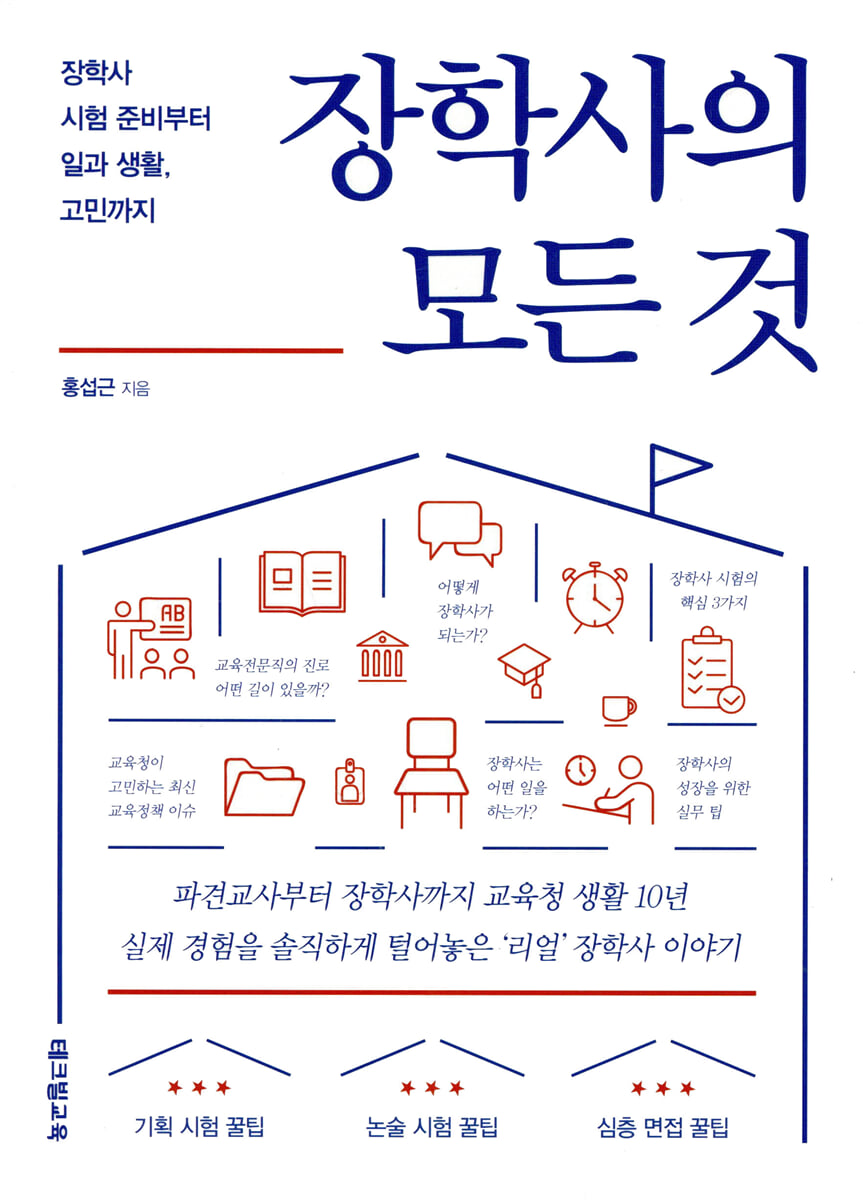
10 years of experience in the Office of Education, from dispatched teacher to scholarship officer
The story of a "real" scholarship recipient who honestly shares his experiences.
From dispatched teacher to scholarship officer, the author reveals 10 years of experience in the Office of Education in "Everything About Scholarship Officers."
Little is known about the life of a scholar.
So, those who want to become scholarship recipients either rely on the private education market or seek out current scholarship recipients step by step.
The author also had many juniors who came to visit him.
So, based on the experience and learning I gained from working at the Office of Education, I started giving advice and before I knew it, I had accumulated a considerable amount of information and data, which I published in a book.
This book is a treasure trove of information and materials related to scholarships, and is a must-read for those who wish to become scholarships or those who have just become scholarships.
It contains tips on how to prepare for the scholarship exam, as well as know-how for successful planning exams, essay exams, and in-depth interviews.
It also presents what you need to know to become a scholarship officer, key policy issues of the Office of Education, tips for a smart scholarship officer's life, and various career paths for education professionals.
As an appendix, we also provide ‘City/Province Office of Education Unit Plan Form’, ‘Education Support Office Unit Plan Form’, and expected topics for the Scholarship Officer’s ‘Policy Essay Test’.
The story of a "real" scholarship recipient who honestly shares his experiences.
From dispatched teacher to scholarship officer, the author reveals 10 years of experience in the Office of Education in "Everything About Scholarship Officers."
Little is known about the life of a scholar.
So, those who want to become scholarship recipients either rely on the private education market or seek out current scholarship recipients step by step.
The author also had many juniors who came to visit him.
So, based on the experience and learning I gained from working at the Office of Education, I started giving advice and before I knew it, I had accumulated a considerable amount of information and data, which I published in a book.
This book is a treasure trove of information and materials related to scholarships, and is a must-read for those who wish to become scholarships or those who have just become scholarships.
It contains tips on how to prepare for the scholarship exam, as well as know-how for successful planning exams, essay exams, and in-depth interviews.
It also presents what you need to know to become a scholarship officer, key policy issues of the Office of Education, tips for a smart scholarship officer's life, and various career paths for education professionals.
As an appendix, we also provide ‘City/Province Office of Education Unit Plan Form’, ‘Education Support Office Unit Plan Form’, and expected topics for the Scholarship Officer’s ‘Policy Essay Test’.
- You can preview some of the book's contents.
Preview
index
Opening remarks
Chapter 1: How should I prepare for the scholarship exam?
1.
Things to know before the scholarship exam
Why do you want to become an education professional?
What paths are there for a career in education?
2.
Preparing for the Scholarship Exam in earnest
Scholarship selection system
Two Ways to Prepare for the Scholarship Exam
3 Key Points of the Scholarship Exam
Chapter 2: Growing into a Professional Scholar
1.
Things to know to become a scholarship recipient
The life of a wise scholar
Interpersonal relationships within the Office of Education organization
Special experiences of scholarship recipients
2.
A scholarship is the beginning of new growth.
Scholars are education experts.
Practical Tips for Growing as a Scholar
Chapter 3: Educational Issues That Have the Ministry of Education and Offices of Education Troubled
1.
The Reality of the Educational Gap Due to COVID-19 and Response Measures - Focusing on the Full-Scale Implementation of In-Person School Reopening Policy
2.
Looking forward to progressive changes in educational autonomy - Focusing on the significance of the superintendent election and future tasks
3.
Why is school education neglected by teachers and parents?
4.
Why are experienced teachers leaving schools?
5.
MZ Generation Teachers Cynical About Teaching and Promotion
6.
Proposing the Need for Diversification of the Teacher Qualification System - Focusing on the Introduction of the Senior Teacher System
7.
Considering the Problems and Alternatives of New Town Schools - Focusing on the Situation in Gyeonggi Province
8.
Looking at the controversy over relocating schools in downtown areas
supplement
[Reference 1] City/Provincial Office of Education Unit Planning Form
[Reference 2] Education Support Office Unit Planning Form
[Reference 3] Expected Topics for the Scholarship Examination's Policy Essay Test
Closing remarks
Chapter 1: How should I prepare for the scholarship exam?
1.
Things to know before the scholarship exam
Why do you want to become an education professional?
What paths are there for a career in education?
2.
Preparing for the Scholarship Exam in earnest
Scholarship selection system
Two Ways to Prepare for the Scholarship Exam
3 Key Points of the Scholarship Exam
Chapter 2: Growing into a Professional Scholar
1.
Things to know to become a scholarship recipient
The life of a wise scholar
Interpersonal relationships within the Office of Education organization
Special experiences of scholarship recipients
2.
A scholarship is the beginning of new growth.
Scholars are education experts.
Practical Tips for Growing as a Scholar
Chapter 3: Educational Issues That Have the Ministry of Education and Offices of Education Troubled
1.
The Reality of the Educational Gap Due to COVID-19 and Response Measures - Focusing on the Full-Scale Implementation of In-Person School Reopening Policy
2.
Looking forward to progressive changes in educational autonomy - Focusing on the significance of the superintendent election and future tasks
3.
Why is school education neglected by teachers and parents?
4.
Why are experienced teachers leaving schools?
5.
MZ Generation Teachers Cynical About Teaching and Promotion
6.
Proposing the Need for Diversification of the Teacher Qualification System - Focusing on the Introduction of the Senior Teacher System
7.
Considering the Problems and Alternatives of New Town Schools - Focusing on the Situation in Gyeonggi Province
8.
Looking at the controversy over relocating schools in downtown areas
supplement
[Reference 1] City/Provincial Office of Education Unit Planning Form
[Reference 2] Education Support Office Unit Planning Form
[Reference 3] Expected Topics for the Scholarship Examination's Policy Essay Test
Closing remarks
Into the book
I often hear people say that they have decided to become a scholarship officer, but they are at a loss because they do not know what a scholarship officer is, what they do, or how to prepare for it.
Perhaps that's why people often rely on information known as 'Kardera' around them, browse the private education market, or just blindly try something out.
Although it is rare now, there have been cases in the past where people received money in exchange for providing preparation methods or information, which has become a problem.
--- p.34
For security reasons, the first written evaluation of the teacher recruitment exam is shared by 17 city and provincial offices of education with the questions from the Korea Institute of Curriculum and Evaluation. As of 2022, there were five city and provincial offices of education that independently evaluated the second in-depth interview.
When teachers prepare for the teacher certification exam, the most important factors to consider are educational philosophy, competency, subject-matter expertise, and the educational policy direction pursued by the relevant city/provincial office of education.
--- p.35
There are many things to consider when organizing a study.
First of all, I think 3-4 people is appropriate for the group, and up to 5 people is possible.
There are some study groups of six people, but there are so many that it can be difficult to maintain the group.
The closer the study group members live or work at their schools, the better.
It is recommended that you study offline if possible.
Because learning must be done through discussion and conversation.
It depends on whether it's vacation or semester, but it's a good idea to meet at least twice a week.
If it's vacation time, you can do it 3-4 times a week.
--- p.48
There is no set format for policy writing, but the general format is 'Introduction, Current Status and Problems, Policy Proposal (Alternative), Conclusion.'
In the 'Introduction' section, the diagnosis should be described.
It evenly includes national situations, situations of city/provincial offices of education, regional situations (depending on conditions), problems and data as seen in the media and public opinion.
'Current Status and Issues' contains an analysis of specific details.
In the 'Policy Proposal' section, alternative policies are included in the analysis of specific contents.
‘Current status and issues’ and ‘policy proposals’ are usually presented in a continuous ‘first, second, third’ format.
Of course, it is best to write the current status, problems, and policy proposals (alternatives) in a way that their contents are connected.
Of course, there may be exceptions.
In 'Going Out', a roadmap, outlook, tasks, and strategies of the relevant city/provincial office of education are presented for what to do going forward.
Therefore, it is difficult to get good grades on the essay test if you do not have an understanding of the Office of Education.
--- pp.63~64
The first appointment of scholarship recipients is similar to the appointment system for new teachers.
Compared to those with experience, they are assigned to unpreferred locations.
The order of teachers' assignment to schools is as follows: teachers with experience outside the district, teachers with experience within the district, teachers with experience transferred from other cities or provinces, and new teachers.
Naturally, new teachers are lower in priority and have no choice but to go to unpopular, non-competitive areas.
Scholarships are not much different.
First, place experienced scholarship officers at city/provincial offices of education and experienced scholarship officers at regional offices of education (or directly affiliated organizations) and then place new scholarship officers in the remaining positions.
Not only are there not many places for scholarship recipients to work, but the places that new scholarship recipients can go are almost always set.
It is true that each city/provincial office of education gives priority to those who pass the exam with the highest scores, but it is difficult to predict which institution they will go to based on the criteria even if they are all appointed on the same day.
Also, in the case of scholarship officers at the main office, it is not known when or where they will be dispatched.
Ultimately, the movement of scholarship personnel is often unpredictable.
Perhaps that's why people often rely on information known as 'Kardera' around them, browse the private education market, or just blindly try something out.
Although it is rare now, there have been cases in the past where people received money in exchange for providing preparation methods or information, which has become a problem.
--- p.34
For security reasons, the first written evaluation of the teacher recruitment exam is shared by 17 city and provincial offices of education with the questions from the Korea Institute of Curriculum and Evaluation. As of 2022, there were five city and provincial offices of education that independently evaluated the second in-depth interview.
When teachers prepare for the teacher certification exam, the most important factors to consider are educational philosophy, competency, subject-matter expertise, and the educational policy direction pursued by the relevant city/provincial office of education.
--- p.35
There are many things to consider when organizing a study.
First of all, I think 3-4 people is appropriate for the group, and up to 5 people is possible.
There are some study groups of six people, but there are so many that it can be difficult to maintain the group.
The closer the study group members live or work at their schools, the better.
It is recommended that you study offline if possible.
Because learning must be done through discussion and conversation.
It depends on whether it's vacation or semester, but it's a good idea to meet at least twice a week.
If it's vacation time, you can do it 3-4 times a week.
--- p.48
There is no set format for policy writing, but the general format is 'Introduction, Current Status and Problems, Policy Proposal (Alternative), Conclusion.'
In the 'Introduction' section, the diagnosis should be described.
It evenly includes national situations, situations of city/provincial offices of education, regional situations (depending on conditions), problems and data as seen in the media and public opinion.
'Current Status and Issues' contains an analysis of specific details.
In the 'Policy Proposal' section, alternative policies are included in the analysis of specific contents.
‘Current status and issues’ and ‘policy proposals’ are usually presented in a continuous ‘first, second, third’ format.
Of course, it is best to write the current status, problems, and policy proposals (alternatives) in a way that their contents are connected.
Of course, there may be exceptions.
In 'Going Out', a roadmap, outlook, tasks, and strategies of the relevant city/provincial office of education are presented for what to do going forward.
Therefore, it is difficult to get good grades on the essay test if you do not have an understanding of the Office of Education.
--- pp.63~64
The first appointment of scholarship recipients is similar to the appointment system for new teachers.
Compared to those with experience, they are assigned to unpreferred locations.
The order of teachers' assignment to schools is as follows: teachers with experience outside the district, teachers with experience within the district, teachers with experience transferred from other cities or provinces, and new teachers.
Naturally, new teachers are lower in priority and have no choice but to go to unpopular, non-competitive areas.
Scholarships are not much different.
First, place experienced scholarship officers at city/provincial offices of education and experienced scholarship officers at regional offices of education (or directly affiliated organizations) and then place new scholarship officers in the remaining positions.
Not only are there not many places for scholarship recipients to work, but the places that new scholarship recipients can go are almost always set.
It is true that each city/provincial office of education gives priority to those who pass the exam with the highest scores, but it is difficult to predict which institution they will go to based on the criteria even if they are all appointed on the same day.
Also, in the case of scholarship officers at the main office, it is not known when or where they will be dispatched.
Ultimately, the movement of scholarship personnel is often unpredictable.
--- pp.81~82
Publisher's Review
How should I prepare for the scholarship exam?
What makes a scholarship officer? What kind of person becomes a scholarship officer, and what do they do? Most teachers rarely have the opportunity to meet a scholarship officer, unless a close colleague or senior colleague happens to be one.
Moreover, the books on scholarship currently available on the market are only introductory or theoretical books, and the papers are mechanical analyses led by groups of professors and researchers, so they do not clearly show the work and life of scholarship scholars.
The author has accumulated a wealth of information while providing advice and assistance to those preparing for the scholarship exam or curious about the scholarship life, and has decided to write a book to share this information with more people.
This book, "Everything About Scholarships," is based on the experience and research of current scholarship recipients and provides information on the scholarship selection system, exam preparation methods, and know-how for successful planning tests, essay tests, and in-depth interviews.
We also provide 'City/Province Office of Education Unit Plan Form', 'Education Support Office Unit Plan Form', and expected topics for the Scholarship 'Policy Essay Test' to help you prepare for the actual test.
How to become a professional scholar?
What are the basic requirements for a successful career as a scholarship officer? How should interpersonal relationships within the Office of Education be developed? How can a scholarship officer expand his or her career path? Becoming a scholarship officer brings with it many new things to learn.
This book is full of information for a wise life as a scholarship officer, from personal management matters such as scholarship training, appointments, welfare and leave of absence, rank and treatment, attitude and speech, to relationships with fellow scholarship officers, educational researchers, general administrative staff, and senior scholarship officers, as well as organizational culture, and even administrative audits, government audits, budget work, and media responses that no scholarship officer can avoid.
Furthermore, it presents various career paths for scholarship recipients, including growth as a competent scholarship recipient and administrator.
It also contains the author's research and insights into key policy issues that the Ministry of Education and the Office of Education must currently consider and address.
The book offers a glimpse into the author's deep reflections and insights on the educational gap triggered by COVID-19 and countermeasures, the search for progressive changes in educational autonomy, the reality that school education is being neglected by teachers and parents, the reasons why experienced teachers or MZ generation teachers are leaving school, the diversification and necessity of the teacher qualification system, and the problems of schools in new towns and old city areas.
What makes a scholarship officer? What kind of person becomes a scholarship officer, and what do they do? Most teachers rarely have the opportunity to meet a scholarship officer, unless a close colleague or senior colleague happens to be one.
Moreover, the books on scholarship currently available on the market are only introductory or theoretical books, and the papers are mechanical analyses led by groups of professors and researchers, so they do not clearly show the work and life of scholarship scholars.
The author has accumulated a wealth of information while providing advice and assistance to those preparing for the scholarship exam or curious about the scholarship life, and has decided to write a book to share this information with more people.
This book, "Everything About Scholarships," is based on the experience and research of current scholarship recipients and provides information on the scholarship selection system, exam preparation methods, and know-how for successful planning tests, essay tests, and in-depth interviews.
We also provide 'City/Province Office of Education Unit Plan Form', 'Education Support Office Unit Plan Form', and expected topics for the Scholarship 'Policy Essay Test' to help you prepare for the actual test.
How to become a professional scholar?
What are the basic requirements for a successful career as a scholarship officer? How should interpersonal relationships within the Office of Education be developed? How can a scholarship officer expand his or her career path? Becoming a scholarship officer brings with it many new things to learn.
This book is full of information for a wise life as a scholarship officer, from personal management matters such as scholarship training, appointments, welfare and leave of absence, rank and treatment, attitude and speech, to relationships with fellow scholarship officers, educational researchers, general administrative staff, and senior scholarship officers, as well as organizational culture, and even administrative audits, government audits, budget work, and media responses that no scholarship officer can avoid.
Furthermore, it presents various career paths for scholarship recipients, including growth as a competent scholarship recipient and administrator.
It also contains the author's research and insights into key policy issues that the Ministry of Education and the Office of Education must currently consider and address.
The book offers a glimpse into the author's deep reflections and insights on the educational gap triggered by COVID-19 and countermeasures, the search for progressive changes in educational autonomy, the reality that school education is being neglected by teachers and parents, the reasons why experienced teachers or MZ generation teachers are leaving school, the diversification and necessity of the teacher qualification system, and the problems of schools in new towns and old city areas.
GOODS SPECIFICS
- Date of issue: March 20, 2023
- Page count, weight, size: 248 pages | 428g | 150*210*17mm
- ISBN13: 9791163461692
- ISBN10: 1163461695
You may also like
카테고리
korean


korean

![GQ KOREA Mark (Monthly): December [2025]](http://librairie.coreenne.fr/cdn/shop/files/8ef265dbbfbf186523ed75ba7319009d.jpg?v=1765340328&width=3840)


