

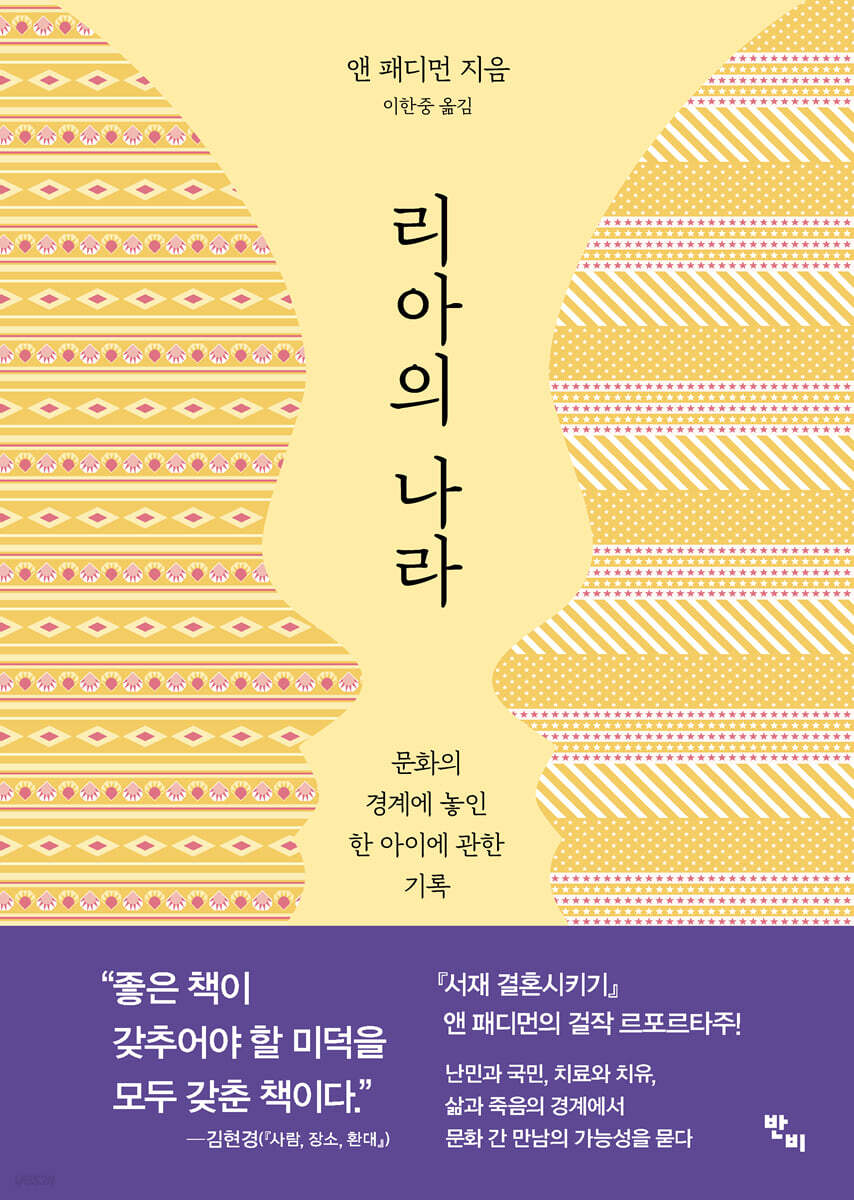
Leah's Country
 |
Description
Book Introduction
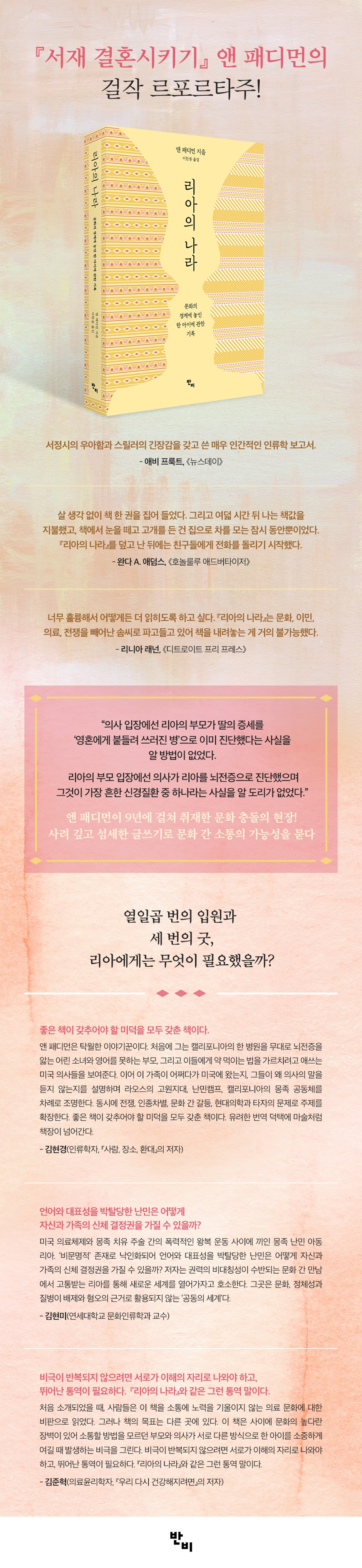
Seventeen hospitalizations and three exorcisms,
What did Leah need?
Refugees and citizens, treatment and healing, at the border of life and death
Questioning the Possibility of Intercultural Encounters
Anne Fadiman is a brilliant storyteller.
At first, he shows a young girl with epilepsy in a hospital in California, her non-English speaking parents, and the American doctors trying to teach them how to give her medicine.
The film then moves on to the highlands of Laos, a refugee camp, and a Hmong community in California, explaining how the family came to America and why they refused to listen to their doctors.
At the same time, it expands the subject matter to include war, racism, intercultural conflict, and the problems of modern medicine and the other.
This book possesses all the virtues a good book should possess. Kim Hyun-kyung (anthropologist, author of People, Place, Hospitality)
Leah, a Hmong refugee child caught between the violent back-and-forth between the American medical system and Hmong healing magic.
How can refugees, stigmatized as "uncivilized" and deprived of language and representation, gain control over their own and their families' bodies? Through Leah, who suffers in intercultural encounters characterized by power asymmetries, the author appeals for the opening of a new world.
It's a "common world" where culture, identity, and disease aren't used as grounds for exclusion and hatred. Kim Hyun-mi (Professor of Cultural Anthropology, Yonsei University)
This book depicts the tragedy that arises when parents and doctors, unable to communicate due to the high cultural barrier between them, cherish a child in different ways. Kim Jun-hyeok (medical ethicist, author of "How to Become Healthy Again")
What did Leah need?
Refugees and citizens, treatment and healing, at the border of life and death
Questioning the Possibility of Intercultural Encounters
Anne Fadiman is a brilliant storyteller.
At first, he shows a young girl with epilepsy in a hospital in California, her non-English speaking parents, and the American doctors trying to teach them how to give her medicine.
The film then moves on to the highlands of Laos, a refugee camp, and a Hmong community in California, explaining how the family came to America and why they refused to listen to their doctors.
At the same time, it expands the subject matter to include war, racism, intercultural conflict, and the problems of modern medicine and the other.
This book possesses all the virtues a good book should possess. Kim Hyun-kyung (anthropologist, author of People, Place, Hospitality)
Leah, a Hmong refugee child caught between the violent back-and-forth between the American medical system and Hmong healing magic.
How can refugees, stigmatized as "uncivilized" and deprived of language and representation, gain control over their own and their families' bodies? Through Leah, who suffers in intercultural encounters characterized by power asymmetries, the author appeals for the opening of a new world.
It's a "common world" where culture, identity, and disease aren't used as grounds for exclusion and hatred. Kim Hyun-mi (Professor of Cultural Anthropology, Yonsei University)
This book depicts the tragedy that arises when parents and doctors, unable to communicate due to the high cultural barrier between them, cherish a child in different ways. Kim Jun-hyeok (medical ethicist, author of "How to Become Healthy Again")
- You can preview some of the book's contents.
Preview
index
Recommendation
To Korean readers
Preface: On the Brink of Conflict
Lia
1 Birth
3 If you are caught by a spirit, you will fall.
5 Take as directed
7 Government-owned children
9 A little medicine and a little cold
11 Something Big Happens
13 Code X
15 Gold and Impurities
17 Eight Questions
19 Sacrificial offerings
Hmong
2 Fish soup
4 Do doctors eat brains?
6 High-speed supercortical lead treatment
8 The Story of Pua and Nao Kao
10 War of Dreams
12 Escape
14 Crucible
16 Why did they choose Merced?
18 Life or Soul
15th Anniversary Edition Review: A Common Language
Acknowledgements
Translator's Note
About the notation, pronunciation, and citation of the Mongolian language
About the source
References
To Korean readers
Preface: On the Brink of Conflict
Lia
1 Birth
3 If you are caught by a spirit, you will fall.
5 Take as directed
7 Government-owned children
9 A little medicine and a little cold
11 Something Big Happens
13 Code X
15 Gold and Impurities
17 Eight Questions
19 Sacrificial offerings
Hmong
2 Fish soup
4 Do doctors eat brains?
6 High-speed supercortical lead treatment
8 The Story of Pua and Nao Kao
10 War of Dreams
12 Escape
14 Crucible
16 Why did they choose Merced?
18 Life or Soul
15th Anniversary Edition Review: A Common Language
Acknowledgements
Translator's Note
About the notation, pronunciation, and citation of the Mongolian language
About the source
References
Detailed image
Into the book
I've always thought that the most interesting things are not what happens at the center, but what happens at the edges where things meet something else.
So coastlines, weather fronts, and borders are good.
In places like this, interesting clashes and dissonances occur, and standing on the border often allows you to see both sides better than if you were in the center of either.
I think this is especially true when it comes to culture.
--- p.18
After hearing about the case of the Lees' daughter, Leah, and getting to know the family and doctors, which was the worst dispute in Merced Hospital history, I truly felt for both sides.
And I realized how difficult it is to hold someone accountable (God knows I tried to do that).
I learned that I shouldn't analyze situations too linearly.
In other words, I unknowingly stopped thinking a little less like an American and a little more like a Mong.
--- p.18
From Dan's perspective, there was no way for him to know that Pua and Nao Kao had already diagnosed his daughter's condition as 'being possessed by a spirit'.
From Pua and Nao Kao's perspective, there was no way of knowing that Dan had diagnosed Leah with epilepsy, one of the most common neurological disorders.
Although both sides had accurately identified the symptoms, Dan would have been shocked to hear that the cause was the loss of the soul.
Leah's parents would also have been shocked to hear that her seizures were caused by electrochemical impulses in her head caused by abnormal stimulation of brain cells.
--- p.61
Is it illegal in the United States to use a qi ning to cure illnesses? Why do American doctors drain so much blood from their patients? Why do they open dead people's heads and take out their brains? Do American doctors eat the livers, kidneys, and brains of Hmong patients? Is it true that in the United States, when Hmong people die, their bodies are cut up and sold in cans as food?
--- p.67
Western medicine was even more inadequate compared to the shamanistic healing experience they were familiar with.
Chi Neng would visit the homes of sick people and stay there for eight hours.
In contrast, Western doctors would make patients come to the hospital no matter how sick they were, and would only stay by their bedside for 20 minutes at most.
Chi Neng was polite and didn't ask any questions.
But the doctor asked all sorts of rude and intimate questions about the patient's life, even about his sexual and bowel habits.
--- p.67
“I just stared at them blankly.
I remember them having such a determined look on their faces.
It was like, 'We're doing what we think is right.'
The attitude was to tell me not to talk nonsense.
I felt like they really cared about Leah.
I felt like I was doing the best I could as a parent to take care of my child.
At least that's how I felt.
I don't remember being angry.
Rather, I felt a sense of awe at how different people’s ways of seeing the world could be.”
--- p.99
When Mong patients spoke, they would only say single syllables like 'yes' and look at the floor.
Soon they realized that a "yes" meant the patient was listening politely, but did not mean that he or she understood or agreed with what the doctor was saying.
A typical Mong characteristic is that they appear passive and docile in front of the doctor (in other words, by hiding their ignorance, they build up their own prestige, and by being polite, they build up the doctor's prestige), but as soon as they leave the hospital, they start to ignore everything.
--- p.122
“In short, the Mong people didn’t have the concepts that I had.
For example, you couldn't tell the Mong people that you had a problem with your pancreas and suffered from diabetes.
They don't have a word for pancreas.
There is no 'concept' of the pancreas itself.
Most of them have no concept that humans also have organs that are found in animals.
When a person dies, they are buried without being dissected.
In the case of the heart, they knew because they could feel the beating.
But other things, like organs like the lungs, were difficult concepts to understand.
“How can you intuitively know of the existence of lungs when you have never seen them?”
--- p.123
But Neil was convinced that it was best to continue to fine-tune the treatment, as Leah's condition was deteriorating and becoming less predictable.
If he had chosen one good anticonvulsant and prescribed it over and over again, he would have been treating Leah differently than he would have treated a middle-class American girl who was willing and able to follow a complex treatment regimen.
So which was more discriminatory? Denying Leah the best treatment available to other children, or failing to simplify treatment in a way Leah's family could easily follow?
--- p.137
The common perception of the Hmong refugees who came to America after the war was, as one newspaper reporter put it, that they had “migrated from the Stone Age to the Space Age.”
However, this view underestimates the complexity of Hmong traditional culture and ignores the tremendous social, cultural, and economic changes that many Hmong experienced during the war.
A way of life that had survived centuries of persecution in China and a mass migration to Laos in the 19th century was irreversibly transformed, at least in appearance, in just a few years.
--- p.227
Few things anger the Mong more than being criticized for being on welfare.
Above all, they felt they deserved the money.
Every Mong person has something to say about the word 'promise'.
It was a written or oral contract made by CIA agents during the Laotian Civil War, promising to help the Hmong, who would be disadvantaged if the People's Army won the war, if they fought for the Americans.
The Hmong expected to be treated as heroes if they fled their country and came to the United States, having risked their lives to save an American pilot who had crash-landed and having endured the devastation of their village by American bombing to help fight America's war.
--- p.330
We were not born into this world to live by receiving food from others.
It's so shameful to live like this, relying on others.
When I lived in my country, I never asked anyone for help like this.
[… … ] I tried very hard to learn English and at the same time, I looked for a job.
Any job, even cleaning the bathroom, was good.
But people don't believe me and don't give me work.
--- p.332
“We want to go back.
If I was born here, I could be here.
This is a really nice country, but we can't speak English here.
And I can't even drive.
You don't have to stay home alone.
When you go there, you can farm on a small piece of land, raise chickens, pigs, and cows, wake up early in the morning, harvest when the season comes, and live off what you have until the next harvest season.
That's enough.
How much peace of mind would that be?
Here, we do what we think is right, but those people say it's wrong.
If we do something we don't want to do, they say it's right.
So what should we do? We have no choice but to go back.”
--- p.336
Dan Murphy, who became director of the family medicine residency program at MCMC, once told me that if you fail to treat one Hmong patient, you fail to treat the entire Hmong community.
I thought that was right.
Who knows how many Hmong families have avoided hospitals because they didn't want their children to end up like Mr. Lee's little daughter? Everyone in the Lee and Yang households in Merced knew what happened to Leah (bad doctors, huh!), just as everyone in MCMC Pediatrics knew what happened to Leah (bad parents, huh!). Leah's case has solidified the worst stereotypes in the Hmong community about medical professionals, and in the medical community about Hmong people.
--- p.418
Was it an "unbridgeable" gap? I couldn't help but think back to when the Lees first encountered the MCMC medical team shortly after Leah's birth.
There was no interpreter at the time, and Leah's epilepsy was misdiagnosed as pneumonia.
What if, instead of becoming "veterinary doctors," the emergency room residents had sought to understand what the Mong believed, feared, and desired, and thus earned the Lees' trust from the start (or at least not violated it)?
--- p.427
Reading the hospital charts and trying to understand Leah and her family (I spent hundreds of hours just trying to understand the charts) was like deconstructing a lyric poem, reducing it to a series of syllogisms.
However, the residents and pediatricians who had been in charge of Leah since she was three months old had no guide to guide her through her world other than the 'chart'.
As each of them struggled to understand issues they could not express in their own language, the chart grew longer and longer, eventually reaching over 400,000 words.
Each of those words reflected the knowledge, training, and goodwill of those who recorded them, but none of them addressed the Lees' perspective on their daughter's illness.
--- p.427
“That’s tyranny.
What if a family refuses surgery because they believe the illness is caused by the soul? What if they believe their child will be eternally damned if they die during the operation? And what if they believe death itself isn't all that important? Which is more important: life or soul?
Bill said.
“There’s no need to go around talking.
Of course, life comes first.”
Then Suki said.
"no.
“I’m single.”
--- p.457
The whole family and over twenty relatives surrounded Leah.
All their attention was focused on the motionless Leah.
It was as if sunlight focused through a magnifying glass was about to burn the object.
Di Corda once said:
“Leah knows how to love and be loved.”
No matter what she had lost, Leah still knew how to be loved.
--- p.469
I have fought, and still fight, the assumption that my perspective is the only correct one.
I found this to be a trap where the conflicting polarities in this story were missing.
But this wasn't a trap I could avoid just by knowing what the core lesson of my book was.
[… … ] Empathy is so difficult that we always live our lives in a state of confusion.
Empathy is harder than anger, harder than compassion.
So coastlines, weather fronts, and borders are good.
In places like this, interesting clashes and dissonances occur, and standing on the border often allows you to see both sides better than if you were in the center of either.
I think this is especially true when it comes to culture.
--- p.18
After hearing about the case of the Lees' daughter, Leah, and getting to know the family and doctors, which was the worst dispute in Merced Hospital history, I truly felt for both sides.
And I realized how difficult it is to hold someone accountable (God knows I tried to do that).
I learned that I shouldn't analyze situations too linearly.
In other words, I unknowingly stopped thinking a little less like an American and a little more like a Mong.
--- p.18
From Dan's perspective, there was no way for him to know that Pua and Nao Kao had already diagnosed his daughter's condition as 'being possessed by a spirit'.
From Pua and Nao Kao's perspective, there was no way of knowing that Dan had diagnosed Leah with epilepsy, one of the most common neurological disorders.
Although both sides had accurately identified the symptoms, Dan would have been shocked to hear that the cause was the loss of the soul.
Leah's parents would also have been shocked to hear that her seizures were caused by electrochemical impulses in her head caused by abnormal stimulation of brain cells.
--- p.61
Is it illegal in the United States to use a qi ning to cure illnesses? Why do American doctors drain so much blood from their patients? Why do they open dead people's heads and take out their brains? Do American doctors eat the livers, kidneys, and brains of Hmong patients? Is it true that in the United States, when Hmong people die, their bodies are cut up and sold in cans as food?
--- p.67
Western medicine was even more inadequate compared to the shamanistic healing experience they were familiar with.
Chi Neng would visit the homes of sick people and stay there for eight hours.
In contrast, Western doctors would make patients come to the hospital no matter how sick they were, and would only stay by their bedside for 20 minutes at most.
Chi Neng was polite and didn't ask any questions.
But the doctor asked all sorts of rude and intimate questions about the patient's life, even about his sexual and bowel habits.
--- p.67
“I just stared at them blankly.
I remember them having such a determined look on their faces.
It was like, 'We're doing what we think is right.'
The attitude was to tell me not to talk nonsense.
I felt like they really cared about Leah.
I felt like I was doing the best I could as a parent to take care of my child.
At least that's how I felt.
I don't remember being angry.
Rather, I felt a sense of awe at how different people’s ways of seeing the world could be.”
--- p.99
When Mong patients spoke, they would only say single syllables like 'yes' and look at the floor.
Soon they realized that a "yes" meant the patient was listening politely, but did not mean that he or she understood or agreed with what the doctor was saying.
A typical Mong characteristic is that they appear passive and docile in front of the doctor (in other words, by hiding their ignorance, they build up their own prestige, and by being polite, they build up the doctor's prestige), but as soon as they leave the hospital, they start to ignore everything.
--- p.122
“In short, the Mong people didn’t have the concepts that I had.
For example, you couldn't tell the Mong people that you had a problem with your pancreas and suffered from diabetes.
They don't have a word for pancreas.
There is no 'concept' of the pancreas itself.
Most of them have no concept that humans also have organs that are found in animals.
When a person dies, they are buried without being dissected.
In the case of the heart, they knew because they could feel the beating.
But other things, like organs like the lungs, were difficult concepts to understand.
“How can you intuitively know of the existence of lungs when you have never seen them?”
--- p.123
But Neil was convinced that it was best to continue to fine-tune the treatment, as Leah's condition was deteriorating and becoming less predictable.
If he had chosen one good anticonvulsant and prescribed it over and over again, he would have been treating Leah differently than he would have treated a middle-class American girl who was willing and able to follow a complex treatment regimen.
So which was more discriminatory? Denying Leah the best treatment available to other children, or failing to simplify treatment in a way Leah's family could easily follow?
--- p.137
The common perception of the Hmong refugees who came to America after the war was, as one newspaper reporter put it, that they had “migrated from the Stone Age to the Space Age.”
However, this view underestimates the complexity of Hmong traditional culture and ignores the tremendous social, cultural, and economic changes that many Hmong experienced during the war.
A way of life that had survived centuries of persecution in China and a mass migration to Laos in the 19th century was irreversibly transformed, at least in appearance, in just a few years.
--- p.227
Few things anger the Mong more than being criticized for being on welfare.
Above all, they felt they deserved the money.
Every Mong person has something to say about the word 'promise'.
It was a written or oral contract made by CIA agents during the Laotian Civil War, promising to help the Hmong, who would be disadvantaged if the People's Army won the war, if they fought for the Americans.
The Hmong expected to be treated as heroes if they fled their country and came to the United States, having risked their lives to save an American pilot who had crash-landed and having endured the devastation of their village by American bombing to help fight America's war.
--- p.330
We were not born into this world to live by receiving food from others.
It's so shameful to live like this, relying on others.
When I lived in my country, I never asked anyone for help like this.
[… … ] I tried very hard to learn English and at the same time, I looked for a job.
Any job, even cleaning the bathroom, was good.
But people don't believe me and don't give me work.
--- p.332
“We want to go back.
If I was born here, I could be here.
This is a really nice country, but we can't speak English here.
And I can't even drive.
You don't have to stay home alone.
When you go there, you can farm on a small piece of land, raise chickens, pigs, and cows, wake up early in the morning, harvest when the season comes, and live off what you have until the next harvest season.
That's enough.
How much peace of mind would that be?
Here, we do what we think is right, but those people say it's wrong.
If we do something we don't want to do, they say it's right.
So what should we do? We have no choice but to go back.”
--- p.336
Dan Murphy, who became director of the family medicine residency program at MCMC, once told me that if you fail to treat one Hmong patient, you fail to treat the entire Hmong community.
I thought that was right.
Who knows how many Hmong families have avoided hospitals because they didn't want their children to end up like Mr. Lee's little daughter? Everyone in the Lee and Yang households in Merced knew what happened to Leah (bad doctors, huh!), just as everyone in MCMC Pediatrics knew what happened to Leah (bad parents, huh!). Leah's case has solidified the worst stereotypes in the Hmong community about medical professionals, and in the medical community about Hmong people.
--- p.418
Was it an "unbridgeable" gap? I couldn't help but think back to when the Lees first encountered the MCMC medical team shortly after Leah's birth.
There was no interpreter at the time, and Leah's epilepsy was misdiagnosed as pneumonia.
What if, instead of becoming "veterinary doctors," the emergency room residents had sought to understand what the Mong believed, feared, and desired, and thus earned the Lees' trust from the start (or at least not violated it)?
--- p.427
Reading the hospital charts and trying to understand Leah and her family (I spent hundreds of hours just trying to understand the charts) was like deconstructing a lyric poem, reducing it to a series of syllogisms.
However, the residents and pediatricians who had been in charge of Leah since she was three months old had no guide to guide her through her world other than the 'chart'.
As each of them struggled to understand issues they could not express in their own language, the chart grew longer and longer, eventually reaching over 400,000 words.
Each of those words reflected the knowledge, training, and goodwill of those who recorded them, but none of them addressed the Lees' perspective on their daughter's illness.
--- p.427
“That’s tyranny.
What if a family refuses surgery because they believe the illness is caused by the soul? What if they believe their child will be eternally damned if they die during the operation? And what if they believe death itself isn't all that important? Which is more important: life or soul?
Bill said.
“There’s no need to go around talking.
Of course, life comes first.”
Then Suki said.
"no.
“I’m single.”
--- p.457
The whole family and over twenty relatives surrounded Leah.
All their attention was focused on the motionless Leah.
It was as if sunlight focused through a magnifying glass was about to burn the object.
Di Corda once said:
“Leah knows how to love and be loved.”
No matter what she had lost, Leah still knew how to be loved.
--- p.469
I have fought, and still fight, the assumption that my perspective is the only correct one.
I found this to be a trap where the conflicting polarities in this story were missing.
But this wasn't a trap I could avoid just by knowing what the core lesson of my book was.
[… … ] Empathy is so difficult that we always live our lives in a state of confusion.
Empathy is harder than anger, harder than compassion.
--- p.494
Publisher's Review
On the meeting of cultures and their inevitable clash
Anne Fadiman's Masterpiece Reportage: "Marrying the Study"
“We oppose the formation of a Muslim refugee community.” This was the title of a petition posted on the Blue House National Petition Bulletin Board earlier this year.
This petition, which opposed the settlement of Afghan special contributors in the region, expressed both fear and disgust towards migrants, asking, “Are you guaranteeing that by allowing them to settle in groups, what happened in other countries in a few years will not happen to us?”
This clash with other cultures is only now beginning to be recognized by Koreans, who have firmly believed in the myth of a single nation.
Even without adding undocumented immigrants, Korea is now very close to meeting the OECD's definition of a "multicultural society" of 5 percent foreign nationals per population.
Conflicts with people of different nationalities and cultures can no longer be avoided.
Now we have to look at what lies beneath the crash.
The hierarchies and power differences that arise between cultures, the hatred and exclusion that arise from them, and the endless and arduous conversations that are necessary to understand each other.
Anne Fadiman's reportage, "Leah's Country," which chronicles the nine-year medical dispute surrounding a refugee child in the United States in the 1980s, is a book that makes us ponder the questions we should ask in the face of inevitable cultural clashes.
What exactly is "cultural difference"? What should we consider when the beliefs and value systems of groups living together clash sharply?
『Leah's Country』 is the debut work of Anne Fadiman, author of the best-selling 『Getting the Library Married』, which was introduced in Korea in 2002 and is still loved by many bibliophiles.
While renowned as a brilliant essayist, Fadiman is also a brilliant reportage writer, and it is Leah's Country, a sensitive and incisive nine-year account of the conflict between an immigrant family and the American health care system, that truly demonstrates her talent.
This book won the National Society of Critics Award in the year it was published, and is still widely read as a required textbook in American medical schools. In 2019, it was selected by Slater as one of the "Best Nonfiction Books Published in the Last 25 Years."
Introduced in Korea in 2010, the book was widely read by medical and nursing students for its delicate medical anthropological reflections from the time of its publication. Even after it went out of print, it was rediscovered several times by discerning readers, and requests for its reprinting continued.
This newly published 『Lia's Country』 is based on the 15th anniversary revised edition, which includes the author's comprehensive revision of the facts and a new afterword.
This book, which tells the story of 1980s America, is timely to be revisited in 2022, in a Korean society where hatred and discrimination against other cultures are rampant.
With a remarkable sense of balance and a thoughtful, warm gaze, Fadiman documents the power dynamics that arise when cultures meet, while simultaneously seeking a “common language” that can mediate between them.
"An anthropological report written with the elegance of lyric poetry and the tension of a thriller."
A cultural clash documented through meticulous reporting and elegant writing.
When she was three months old, Leah, a Hmong child who immigrated to Merced, California, had her first seizure when she was startled by the sound of a slamming door.
Doctors at an American hospital diagnosed Leah with epilepsy, and Leah's family recognized the condition as "ko da fae," meaning possession by a spirit.
As the child's illness is interpreted differently by both cultures, treatment becomes a battle that everyone loses.
Doctors are troubled by Leah's family's failure to properly administer prescribed medications, and Leah's family grows distrustful of doctors and medications as they observe the side effects that Leah experiences.
Leah's parents loved and cherished her more than anyone else, and American doctors worked day and night to treat their young patient, but as they did not trust each other, Leah spent many years receiving inconsistent medication.
Anne Fadiman spent nine years interviewing countless people involved in the case and researching extensive literature to reveal the complex and multi-layered nature of a story that can easily be simplified as a conflict between rational doctors and their disobedient family members.
The author's faithful narrative, which includes direct interviews with Leah's various doctors, nurses, foster parents, interpreters, and Hmong neighbors, and mobilizes books, articles, court documents, and testimonies to explore the origins of the Hmong, their traditional way of life, and the migration and discrimination they have experienced, brings the story to life by revealing the complexities of the layered intercultural conflict.
While the writing is so immersive that “the pages turn magically” (Kim Hyun-kyung), the attitude is by no means light.
The book's elaborate structure, which unfolds the story in parallel, with odd-numbered chapters telling the story of the doctors and family trying to save Leah, and even-numbered chapters telling the story of the Mong people who had to leave their homes due to war, is also notable.
The alternating scenes of Leah's hospital room and the Mong people's escape route converge into a single story that points out the current problems.
The book's most brilliant work is Padiman's careful and delicate approach to this personal tragedy, born of cultural conflict.
After encountering Leah's case, Fadiman, who says he "genuinely fell in love with both sides" and realized "how difficult it is to hold someone accountable," takes a multifaceted and humane approach to why contradictions arise that cannot be resolved even with good intentions and effort.
While distancing himself from Western medicine, which has become so commonplace that it is unnatural to even question it, Fadiman seeks to see the culture of Asian mountain peoples, which is both mystified and despised as uncivilized, as it is.
Meanwhile, it also keenly captures the point that “power asymmetry” (Kim Hyun-mi) inevitably accompanies intercultural encounters.
Through Padman's nuanced writing, readers learn that the Hmong migrated from the Laotian highlands to the United States, aided by a proxy war, only to be deprived of both the promised security and their traditional livelihoods. They also come to realize that "culture clash" or "cultural conflict" is not a conflict that arises between two equals.
The book we need most right now as we face an unfamiliar culture.
What does it mean to read "Lia's Country" in Korea today, 40 years after Leah's birth? It means questioning the culture around us, which has become as natural as breathing.
Questions like whether medical judgment can always take precedence over all else, and how to communicate authentically with other cultures amidst cultural power differences.
The choices made by Leah's family are difficult to understand given Korea's already highly Westernized culture and medical common sense.
As our encounters with other cultures increase, these difficult-to-understand problems will increase.
Anne Fadiman's compelling, unbiased writing style allows us to see the characters in their own culture, and from there, to reflect on our own.
In this way, 『Lia's Country』 presents both the dangers of an attitude that believes only mainstream culture is the answer and the need for dialogue to replace hatred and exclusion.
Leah's Country, which questions the culture that occupies the top of the power hierarchy and encourages the imagination of a common language that can restore balance, has already become a must-read for cultural anthropologists and medical ethics students in the United States.
In a country where we must prepare for encounters with unfamiliar cultures, including immigrants and refugees, more than ever before, "Lia's Country" will once again offer answers to unanswered questions and open up a different future.
Anne Fadiman's Masterpiece Reportage: "Marrying the Study"
“We oppose the formation of a Muslim refugee community.” This was the title of a petition posted on the Blue House National Petition Bulletin Board earlier this year.
This petition, which opposed the settlement of Afghan special contributors in the region, expressed both fear and disgust towards migrants, asking, “Are you guaranteeing that by allowing them to settle in groups, what happened in other countries in a few years will not happen to us?”
This clash with other cultures is only now beginning to be recognized by Koreans, who have firmly believed in the myth of a single nation.
Even without adding undocumented immigrants, Korea is now very close to meeting the OECD's definition of a "multicultural society" of 5 percent foreign nationals per population.
Conflicts with people of different nationalities and cultures can no longer be avoided.
Now we have to look at what lies beneath the crash.
The hierarchies and power differences that arise between cultures, the hatred and exclusion that arise from them, and the endless and arduous conversations that are necessary to understand each other.
Anne Fadiman's reportage, "Leah's Country," which chronicles the nine-year medical dispute surrounding a refugee child in the United States in the 1980s, is a book that makes us ponder the questions we should ask in the face of inevitable cultural clashes.
What exactly is "cultural difference"? What should we consider when the beliefs and value systems of groups living together clash sharply?
『Leah's Country』 is the debut work of Anne Fadiman, author of the best-selling 『Getting the Library Married』, which was introduced in Korea in 2002 and is still loved by many bibliophiles.
While renowned as a brilliant essayist, Fadiman is also a brilliant reportage writer, and it is Leah's Country, a sensitive and incisive nine-year account of the conflict between an immigrant family and the American health care system, that truly demonstrates her talent.
This book won the National Society of Critics Award in the year it was published, and is still widely read as a required textbook in American medical schools. In 2019, it was selected by Slater as one of the "Best Nonfiction Books Published in the Last 25 Years."
Introduced in Korea in 2010, the book was widely read by medical and nursing students for its delicate medical anthropological reflections from the time of its publication. Even after it went out of print, it was rediscovered several times by discerning readers, and requests for its reprinting continued.
This newly published 『Lia's Country』 is based on the 15th anniversary revised edition, which includes the author's comprehensive revision of the facts and a new afterword.
This book, which tells the story of 1980s America, is timely to be revisited in 2022, in a Korean society where hatred and discrimination against other cultures are rampant.
With a remarkable sense of balance and a thoughtful, warm gaze, Fadiman documents the power dynamics that arise when cultures meet, while simultaneously seeking a “common language” that can mediate between them.
"An anthropological report written with the elegance of lyric poetry and the tension of a thriller."
A cultural clash documented through meticulous reporting and elegant writing.
When she was three months old, Leah, a Hmong child who immigrated to Merced, California, had her first seizure when she was startled by the sound of a slamming door.
Doctors at an American hospital diagnosed Leah with epilepsy, and Leah's family recognized the condition as "ko da fae," meaning possession by a spirit.
As the child's illness is interpreted differently by both cultures, treatment becomes a battle that everyone loses.
Doctors are troubled by Leah's family's failure to properly administer prescribed medications, and Leah's family grows distrustful of doctors and medications as they observe the side effects that Leah experiences.
Leah's parents loved and cherished her more than anyone else, and American doctors worked day and night to treat their young patient, but as they did not trust each other, Leah spent many years receiving inconsistent medication.
Anne Fadiman spent nine years interviewing countless people involved in the case and researching extensive literature to reveal the complex and multi-layered nature of a story that can easily be simplified as a conflict between rational doctors and their disobedient family members.
The author's faithful narrative, which includes direct interviews with Leah's various doctors, nurses, foster parents, interpreters, and Hmong neighbors, and mobilizes books, articles, court documents, and testimonies to explore the origins of the Hmong, their traditional way of life, and the migration and discrimination they have experienced, brings the story to life by revealing the complexities of the layered intercultural conflict.
While the writing is so immersive that “the pages turn magically” (Kim Hyun-kyung), the attitude is by no means light.
The book's elaborate structure, which unfolds the story in parallel, with odd-numbered chapters telling the story of the doctors and family trying to save Leah, and even-numbered chapters telling the story of the Mong people who had to leave their homes due to war, is also notable.
The alternating scenes of Leah's hospital room and the Mong people's escape route converge into a single story that points out the current problems.
The book's most brilliant work is Padiman's careful and delicate approach to this personal tragedy, born of cultural conflict.
After encountering Leah's case, Fadiman, who says he "genuinely fell in love with both sides" and realized "how difficult it is to hold someone accountable," takes a multifaceted and humane approach to why contradictions arise that cannot be resolved even with good intentions and effort.
While distancing himself from Western medicine, which has become so commonplace that it is unnatural to even question it, Fadiman seeks to see the culture of Asian mountain peoples, which is both mystified and despised as uncivilized, as it is.
Meanwhile, it also keenly captures the point that “power asymmetry” (Kim Hyun-mi) inevitably accompanies intercultural encounters.
Through Padman's nuanced writing, readers learn that the Hmong migrated from the Laotian highlands to the United States, aided by a proxy war, only to be deprived of both the promised security and their traditional livelihoods. They also come to realize that "culture clash" or "cultural conflict" is not a conflict that arises between two equals.
The book we need most right now as we face an unfamiliar culture.
What does it mean to read "Lia's Country" in Korea today, 40 years after Leah's birth? It means questioning the culture around us, which has become as natural as breathing.
Questions like whether medical judgment can always take precedence over all else, and how to communicate authentically with other cultures amidst cultural power differences.
The choices made by Leah's family are difficult to understand given Korea's already highly Westernized culture and medical common sense.
As our encounters with other cultures increase, these difficult-to-understand problems will increase.
Anne Fadiman's compelling, unbiased writing style allows us to see the characters in their own culture, and from there, to reflect on our own.
In this way, 『Lia's Country』 presents both the dangers of an attitude that believes only mainstream culture is the answer and the need for dialogue to replace hatred and exclusion.
Leah's Country, which questions the culture that occupies the top of the power hierarchy and encourages the imagination of a common language that can restore balance, has already become a must-read for cultural anthropologists and medical ethics students in the United States.
In a country where we must prepare for encounters with unfamiliar cultures, including immigrants and refugees, more than ever before, "Lia's Country" will once again offer answers to unanswered questions and open up a different future.
GOODS SPECIFICS
- Date of issue: September 2, 2022
- Page count, weight, size: 560 pages | 726g | 149*205*28mm
- ISBN13: 9791192107929
- ISBN10: 1192107926
You may also like
카테고리
korean


korean

![GQ KOREA Mark (Monthly): December [2025]](http://librairie.coreenne.fr/cdn/shop/files/8ef265dbbfbf186523ed75ba7319009d.jpg?v=1765340328&width=3840)


