

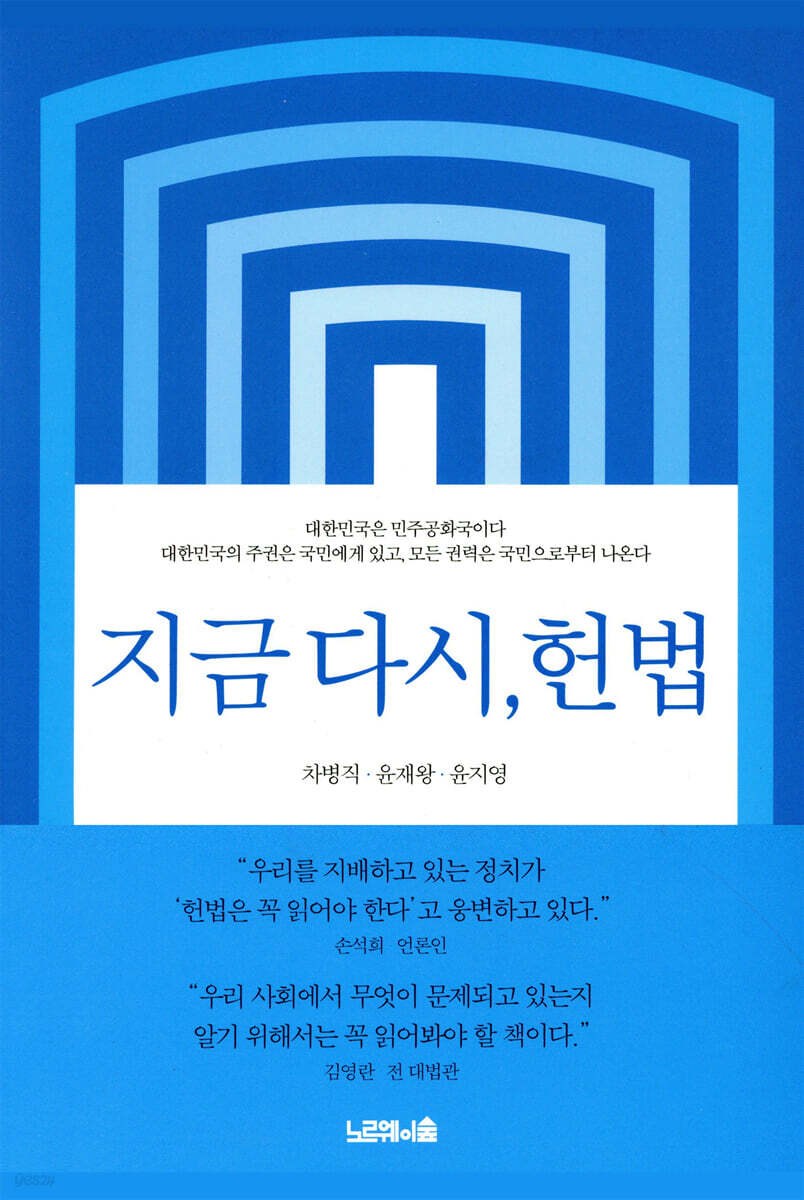
Now again, the Constitution
 |
Description
Book Introduction
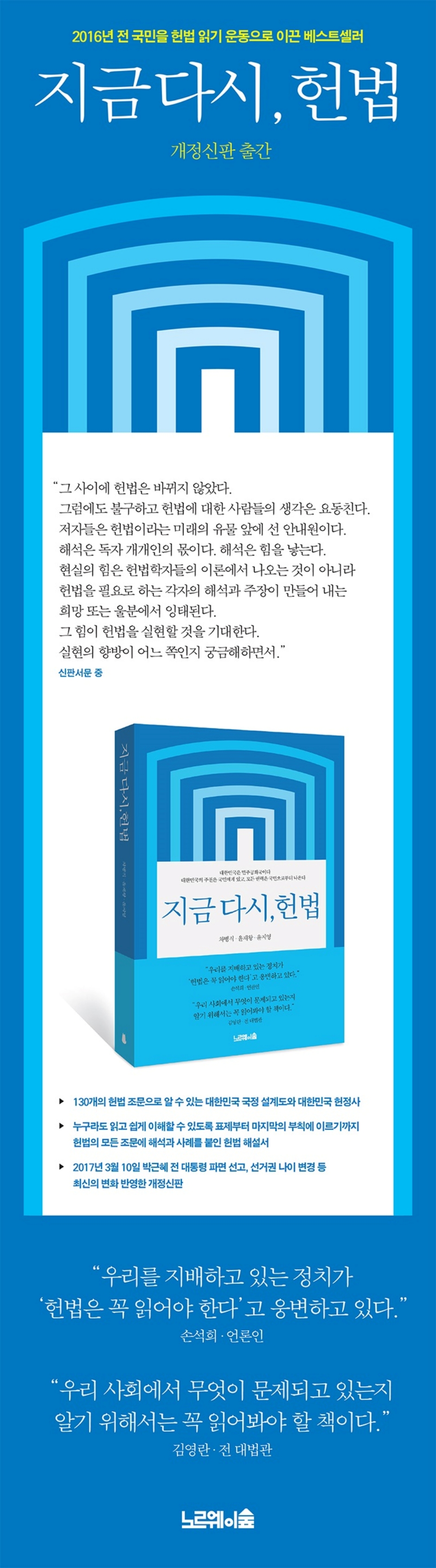
·The blueprint for the government of the Republic of Korea and the constitutional history of the Republic of Korea as revealed in 130 articles of the Constitution
·March 10, 2017: Former President Park Geun-hye's impeachment, change in voting age, etc.
Revised edition reflecting the latest changes
An easy-to-read constitutional commentary tailored to our level
Our Constitution consists of 130 articles, excluding the preamble and supplementary provisions.
Anyone can easily read the entire Korean constitution in about 15 minutes by visiting the website of the Ministry of Government Legislation.
But to go a step further and understand the reasons why each article of the Constitution was created the way it was, the impact and meaning it has on individuals, the social justice and values contained between the lines of the Constitution, and even the constitutional history of the Republic of Korea, a suitable guide is necessary.
『Now Again, the Constitution』 is a 'commentary on the Constitution for citizens' planned out of this need.
The authors, who call themselves “guides standing before the future relic of the Constitution,” wrote with the hope that it would become a “citizen’s textbook,” and provided annotations for everything from the title to the supplementary provisions.
The authors have made it easy for anyone to read and understand the Constitution by explaining the meaning and background of each provision using simple language, a concise style, and numerous examples.
It also highlights how much influence the Constitution has on us from a current perspective through the points of debate in our society and the views on them.
This book is a revised edition of "The Constitution Again," which was published in 2016 and led the entire nation to a movement to read the Constitution. It has been newly revised to reflect changes that have occurred since then, such as the March 10, 2017 ruling on the impeachment of former President Park Geun-hye and the change in the voting age from 19 to 18.
The authors argue that “the power of reality does not come from the theories of constitutional scholars, but from the hopes or resentments created by each individual’s interpretation and argument for the constitution.
“We hope that power will realize the Constitution,” he said, inviting us once again to the magnificent world of reading the Constitution.
"Why should we read the Constitution?" In response to the author's question in the preface, journalist Son Seok-hee responds as follows:
The politicians who rule us are eloquently saying, 'The Constitution must be read.'
This is a book worth reading for anyone who seeks the strength to bring about desirable and rational change in our society.
·March 10, 2017: Former President Park Geun-hye's impeachment, change in voting age, etc.
Revised edition reflecting the latest changes
An easy-to-read constitutional commentary tailored to our level
Our Constitution consists of 130 articles, excluding the preamble and supplementary provisions.
Anyone can easily read the entire Korean constitution in about 15 minutes by visiting the website of the Ministry of Government Legislation.
But to go a step further and understand the reasons why each article of the Constitution was created the way it was, the impact and meaning it has on individuals, the social justice and values contained between the lines of the Constitution, and even the constitutional history of the Republic of Korea, a suitable guide is necessary.
『Now Again, the Constitution』 is a 'commentary on the Constitution for citizens' planned out of this need.
The authors, who call themselves “guides standing before the future relic of the Constitution,” wrote with the hope that it would become a “citizen’s textbook,” and provided annotations for everything from the title to the supplementary provisions.
The authors have made it easy for anyone to read and understand the Constitution by explaining the meaning and background of each provision using simple language, a concise style, and numerous examples.
It also highlights how much influence the Constitution has on us from a current perspective through the points of debate in our society and the views on them.
This book is a revised edition of "The Constitution Again," which was published in 2016 and led the entire nation to a movement to read the Constitution. It has been newly revised to reflect changes that have occurred since then, such as the March 10, 2017 ruling on the impeachment of former President Park Geun-hye and the change in the voting age from 19 to 18.
The authors argue that “the power of reality does not come from the theories of constitutional scholars, but from the hopes or resentments created by each individual’s interpretation and argument for the constitution.
“We hope that power will realize the Constitution,” he said, inviting us once again to the magnificent world of reading the Constitution.
"Why should we read the Constitution?" In response to the author's question in the preface, journalist Son Seok-hee responds as follows:
The politicians who rule us are eloquently saying, 'The Constitution must be read.'
This is a book worth reading for anyone who seeks the strength to bring about desirable and rational change in our society.
- You can preview some of the book's contents.
Preview
index
Preface to the new edition
introduction
Constitution of the Republic of Korea
specialty
Chapter 1 General Provisions
Chapter 2 Rights and Obligations of Citizens
Chapter 3 National Assembly
Chapter 4 Government
Section 1 President | Section 2 Executive Branch
Chapter 5 Courts
Chapter 6 Constitutional Court
Chapter 7 Election Management
Chapter 8 Local Autonomy
Chapter 9 Economy
Chapter 10 Constitutional Amendment
Supplementary provisions
main
Search
introduction
Constitution of the Republic of Korea
specialty
Chapter 1 General Provisions
Chapter 2 Rights and Obligations of Citizens
Chapter 3 National Assembly
Chapter 4 Government
Section 1 President | Section 2 Executive Branch
Chapter 5 Courts
Chapter 6 Constitutional Court
Chapter 7 Election Management
Chapter 8 Local Autonomy
Chapter 9 Economy
Chapter 10 Constitutional Amendment
Supplementary provisions
main
Search
Detailed image
Into the book
We live in the present, but the present itself is ambiguous.
I feel like I'm living in the present, with the past and future constantly intersecting.
As events unfold, the past and future become distinct.
Our lives are a series of actions that we take in response to countless events.
The Constitution is useful as a guide to what course of action to choose.
If you want change, you have to fight in some way.
The fight needed in political reality involves not only struggle but also persuasion.
If so, the Constitution, which forms the basis of politics, is a tool of struggle that can be used in everyday life.
---From "'Preface'"
There is a term called government form.
When constitutional amendments become a topic of discussion, the most frequently discussed area is the form of government.
Citizens are more interested in the fundamental rights aspect of the Constitution, while politicians are more interested in the form of government.
Fundamental rights can be maintained as long as the principles are followed regardless of the provisions of the Constitution, but the form of government completely depends on how the basic framework of the Constitution is structured.
This shows the fundamental difference in views between citizens and politicians on the Constitution.
The form of government, to put it most simply, is determined by how national power is distributed between the legislative and executive branches.
The presidential system and the parliamentary system are the extremes, and the bicameral system is in the middle.
The presidential system is also called a presidential-centered system, and the parliamentary cabinet system is also called a cabinet responsibility system.
Similarly, the bicameral system is also called a mixed system, semi-presidential system, or semi-presidential system.
A characteristic of the presidential system of government is that the president is both the head of state and the head of the executive branch.
It is a form of government in which the president represents the country externally and holds real power as the head of the executive branch internally, establishing a strong ruling system.
The presidential term is an issue that inevitably comes up on the chopping block whenever constitutional amendments are discussed.
The most frequently discussed system is one that allows for one consecutive term of office for a four-year term, due to issues such as conflicts with the four-year term of office and the continuity of policies.
There are other discussions as well.
Since the current Constitution came into effect on February 25, 1988, when the term of office of the former president expires and a new president takes office, the term of office of the new president begins at midnight on February 25, in accordance with Article 2, Paragraph 2 of the Supplementary Provisions of the Constitution, Article 159 of the Civil Act, and Article 14, Paragraph 1 of the Public Official Election Act.
This is precisely why Presidents Roh Tae-woo, Kim Young-sam, Kim Dae-jung, Roh Moo-hyun, Lee Myung-bak, and Park Geun-hye all began their terms at midnight on February 25th.
However, the 18th President Park Geun-hye was removed from office before completing her term. In this case, Article 14, Paragraph 1 of the Public Official Election Act applies, and the term of office begins when the new president is elected.
In other words, the term of office of the 19th President Moon Jae-in began at 8:09 a.m. on May 10, when the election was decided after the presidential election held on May 9, 2017.
Accordingly, President Moon Jae-in's term will expire at midnight on May 9, 2022, five years from now, and the new president's term will begin at midnight on May 10, 2022.
There is criticism that the inauguration time of the new and old presidents is not realistic because it is midnight.
The argument is that it should be done around 10 AM.
It sounds plausible, but one wonders whether the Constitution really needs to pay attention to such details.
---From Chapter 4 Government
There was an incident where this provision, which stipulates the dissolution of a political party, suddenly became the center of a huge controversy.
On December 19, 2014, the Constitutional Court issued the following order:
First, the defendant, the Unified Progressive Party, is dissolved.
Second, the defendant's National Assembly members Kim Mi-hee, Kim Jae-yeon, Oh Byeong-yun, Lee Sang-gyu, and Lee Seok-gi will lose their seats.
It was the first time a political party was dissolved by the Constitutional Court since the system for dissolving unconstitutional political parties was newly established in the third amendment to the Constitution.
---From "Chapter 1 General Provisions"
Anyway, the point is this.
The fundamental rights of the Constitution are the result of the idea of placing humans at the center of everything.
So human rights are considered to be bestowed from heaven at birth.
Every being in the world has meaning and value the moment it is created.
However, humans cannot understand the inner world of other beings, whether living or inanimate.
What humans know best is the human world.
Therefore, humans have no choice but to evaluate humans as the most important value in the world.
The spirit of human rights and fundamental rights in the Constitution was born from the belief that humans are not just parts of the world, but subjects.
---From Chapter 2, Rights and Duties of the People
Only the requirements for impeachment of the president were more strictly stipulated.
On October 18, 1985, 102 New Democratic Party lawmakers proposed impeachment of then-Chief Justice Yoo Tae-heung, but in a vote on October 21, only 95 out of 247 lawmakers voted in favor, failing to secure a majority of the lawmakers present.
On the other hand, in the 246th extraordinary session of the National Assembly on March 12, 2004, the impeachment motion against President Roh Moo-hyun, proposed by 157 members including Representatives Yoo Yong-tae and Hong Sa-deok, was passed with 193 out of 271 members voting in favor, meeting the quorum of more than two-thirds of the members present.
The motion to impeach former President Park Geun-hye was proposed by the floor leaders of the three opposition parties on December 3, 2016, with 171 of the 300 members of the National Assembly present. On December 9, 2016, with 299 of the 300 members present, the motion was passed with 234 of them voting in favor, or more than two-thirds of the members of the National Assembly.
On March 10, 2017, the Constitutional Court ruled to impeach President Park Geun-hye.
---From Chapter 3, National Assembly
In this way, the current Constitution provides a way for the National Assembly, the President, and the people to all participate in constitutional revision.
However, the period of public notice needs to be extended as it is an important procedure for informing the public of the proposed constitutional amendment and for free criticism and exchange of opinions.
There is also a strong opinion that granting the president the right to initiate constitutional amendments is an excessive concentration of power.
On the other hand, there is also the view that citizens should be able to directly propose constitutional amendments.
For example, the constitutions of the 2nd and 3rd Republics stipulated that citizens could directly propose constitutional amendments by obtaining the consent of at least 500,000 voters eligible to vote in the National Assembly (House of Representatives).
If so, can any constitutional provision be amended solely through these procedures? Could Article 1 of the Constitution, which stipulates that the Republic of Korea is a democratic republic and that all state power emanates from the people, be amended solely through constitutional amendment procedures? Could Article 9, which declares that all citizens have the dignity and worth of human beings and the right to pursue happiness, be deleted? What about Article 29, Paragraph 2 of the Constitution, which stipulates that soldiers cannot seek compensation from the state or public entities for damages suffered in combat or training, except as provided by law, for unlawful acts committed by public officials in the course of their duties? If some provisions can be amended and others cannot, what are the criteria for making such distinctions? Who sets these criteria? Assuming that the people are the ones who create these criteria, wouldn't even constitutional provisions that proclaim human dignity and worth be abolished if all citizens so desire? Does such a standard even exist?
I feel like I'm living in the present, with the past and future constantly intersecting.
As events unfold, the past and future become distinct.
Our lives are a series of actions that we take in response to countless events.
The Constitution is useful as a guide to what course of action to choose.
If you want change, you have to fight in some way.
The fight needed in political reality involves not only struggle but also persuasion.
If so, the Constitution, which forms the basis of politics, is a tool of struggle that can be used in everyday life.
---From "'Preface'"
There is a term called government form.
When constitutional amendments become a topic of discussion, the most frequently discussed area is the form of government.
Citizens are more interested in the fundamental rights aspect of the Constitution, while politicians are more interested in the form of government.
Fundamental rights can be maintained as long as the principles are followed regardless of the provisions of the Constitution, but the form of government completely depends on how the basic framework of the Constitution is structured.
This shows the fundamental difference in views between citizens and politicians on the Constitution.
The form of government, to put it most simply, is determined by how national power is distributed between the legislative and executive branches.
The presidential system and the parliamentary system are the extremes, and the bicameral system is in the middle.
The presidential system is also called a presidential-centered system, and the parliamentary cabinet system is also called a cabinet responsibility system.
Similarly, the bicameral system is also called a mixed system, semi-presidential system, or semi-presidential system.
A characteristic of the presidential system of government is that the president is both the head of state and the head of the executive branch.
It is a form of government in which the president represents the country externally and holds real power as the head of the executive branch internally, establishing a strong ruling system.
The presidential term is an issue that inevitably comes up on the chopping block whenever constitutional amendments are discussed.
The most frequently discussed system is one that allows for one consecutive term of office for a four-year term, due to issues such as conflicts with the four-year term of office and the continuity of policies.
There are other discussions as well.
Since the current Constitution came into effect on February 25, 1988, when the term of office of the former president expires and a new president takes office, the term of office of the new president begins at midnight on February 25, in accordance with Article 2, Paragraph 2 of the Supplementary Provisions of the Constitution, Article 159 of the Civil Act, and Article 14, Paragraph 1 of the Public Official Election Act.
This is precisely why Presidents Roh Tae-woo, Kim Young-sam, Kim Dae-jung, Roh Moo-hyun, Lee Myung-bak, and Park Geun-hye all began their terms at midnight on February 25th.
However, the 18th President Park Geun-hye was removed from office before completing her term. In this case, Article 14, Paragraph 1 of the Public Official Election Act applies, and the term of office begins when the new president is elected.
In other words, the term of office of the 19th President Moon Jae-in began at 8:09 a.m. on May 10, when the election was decided after the presidential election held on May 9, 2017.
Accordingly, President Moon Jae-in's term will expire at midnight on May 9, 2022, five years from now, and the new president's term will begin at midnight on May 10, 2022.
There is criticism that the inauguration time of the new and old presidents is not realistic because it is midnight.
The argument is that it should be done around 10 AM.
It sounds plausible, but one wonders whether the Constitution really needs to pay attention to such details.
---From Chapter 4 Government
There was an incident where this provision, which stipulates the dissolution of a political party, suddenly became the center of a huge controversy.
On December 19, 2014, the Constitutional Court issued the following order:
First, the defendant, the Unified Progressive Party, is dissolved.
Second, the defendant's National Assembly members Kim Mi-hee, Kim Jae-yeon, Oh Byeong-yun, Lee Sang-gyu, and Lee Seok-gi will lose their seats.
It was the first time a political party was dissolved by the Constitutional Court since the system for dissolving unconstitutional political parties was newly established in the third amendment to the Constitution.
---From "Chapter 1 General Provisions"
Anyway, the point is this.
The fundamental rights of the Constitution are the result of the idea of placing humans at the center of everything.
So human rights are considered to be bestowed from heaven at birth.
Every being in the world has meaning and value the moment it is created.
However, humans cannot understand the inner world of other beings, whether living or inanimate.
What humans know best is the human world.
Therefore, humans have no choice but to evaluate humans as the most important value in the world.
The spirit of human rights and fundamental rights in the Constitution was born from the belief that humans are not just parts of the world, but subjects.
---From Chapter 2, Rights and Duties of the People
Only the requirements for impeachment of the president were more strictly stipulated.
On October 18, 1985, 102 New Democratic Party lawmakers proposed impeachment of then-Chief Justice Yoo Tae-heung, but in a vote on October 21, only 95 out of 247 lawmakers voted in favor, failing to secure a majority of the lawmakers present.
On the other hand, in the 246th extraordinary session of the National Assembly on March 12, 2004, the impeachment motion against President Roh Moo-hyun, proposed by 157 members including Representatives Yoo Yong-tae and Hong Sa-deok, was passed with 193 out of 271 members voting in favor, meeting the quorum of more than two-thirds of the members present.
The motion to impeach former President Park Geun-hye was proposed by the floor leaders of the three opposition parties on December 3, 2016, with 171 of the 300 members of the National Assembly present. On December 9, 2016, with 299 of the 300 members present, the motion was passed with 234 of them voting in favor, or more than two-thirds of the members of the National Assembly.
On March 10, 2017, the Constitutional Court ruled to impeach President Park Geun-hye.
---From Chapter 3, National Assembly
In this way, the current Constitution provides a way for the National Assembly, the President, and the people to all participate in constitutional revision.
However, the period of public notice needs to be extended as it is an important procedure for informing the public of the proposed constitutional amendment and for free criticism and exchange of opinions.
There is also a strong opinion that granting the president the right to initiate constitutional amendments is an excessive concentration of power.
On the other hand, there is also the view that citizens should be able to directly propose constitutional amendments.
For example, the constitutions of the 2nd and 3rd Republics stipulated that citizens could directly propose constitutional amendments by obtaining the consent of at least 500,000 voters eligible to vote in the National Assembly (House of Representatives).
If so, can any constitutional provision be amended solely through these procedures? Could Article 1 of the Constitution, which stipulates that the Republic of Korea is a democratic republic and that all state power emanates from the people, be amended solely through constitutional amendment procedures? Could Article 9, which declares that all citizens have the dignity and worth of human beings and the right to pursue happiness, be deleted? What about Article 29, Paragraph 2 of the Constitution, which stipulates that soldiers cannot seek compensation from the state or public entities for damages suffered in combat or training, except as provided by law, for unlawful acts committed by public officials in the course of their duties? If some provisions can be amended and others cannot, what are the criteria for making such distinctions? Who sets these criteria? Assuming that the people are the ones who create these criteria, wouldn't even constitutional provisions that proclaim human dignity and worth be abolished if all citizens so desire? Does such a standard even exist?
---From “Chapter 10 Constitutional Amendments”
Publisher's Review
March 10, 2017: Former President Park Geun-hye impeached, voting age changed, etc.
Revised edition reflecting the latest changes
An easy-to-read constitutional commentary tailored to our level
The constitution is a symbol of a nation and an entity that defines the structure and procedures for running the government.
The Constitution guarantees the fundamental rights of citizens, who are its subjects and members, and stipulates the establishment and operation of the power organs responsible for realizing those rights.
I believe that if the Constitution functions properly, we will each be able to pursue our own happiness as citizens of a democratic republic where national sovereignty, separation of powers, and the rule of law are guaranteed.
However, as the constitutional history of the Republic of Korea shows, there is a serious difference between the reality we face and the constitutional spirit we pursue.
Why do these differences arise?
We have seen countless instances of politicians, who were entrusted with power by the sovereign through elections, privatizing that power and engaging in tyranny.
There were also dictators who tore up the constitution to suit their own tastes.
Under the current constitution, which grants the president imperial power, political power has shown itself to become more corrupt without the oversight and criticism of civil society.
The rights of the sovereign are not protected by voting alone.
To realize the values of the Constitution, citizens themselves must be thoroughly aware of their rights guaranteed by the Constitution and their responsibility as sovereign citizens to protect the Constitution.
This is precisely why we must read the Constitution.
Our Constitution consists of 130 articles, excluding the preamble and supplementary provisions.
Anyone can easily read the entire Korean constitution in about 15 minutes by visiting the website of the Ministry of Government Legislation.
But to go a step further and understand the reasons each article of the Constitution was created, its impact and meaning on individuals, the social justice and values contained within its lines, and even the constitutional history of the Republic of Korea, a suitable guide is essential. "The Constitution Again Now" is a "citizen commentary on the Constitution," designed with this need in mind.
The authors, who call themselves “guides standing before the future relic of the Constitution,” wrote with the hope that it would become a “citizen’s textbook,” and provided annotations for everything from the title to the supplementary provisions.
The authors have made it easy for anyone to read and understand the Constitution by explaining the meaning and background of each provision using simple language, a concise style, and numerous examples.
It also highlights how much influence the Constitution has on us from a current perspective through the points of debate in our society and the views on them.
This book is a revised edition of "The Constitution Again," which was published in 2016 and led the entire nation to a movement to read the Constitution. It has been newly revised to reflect changes that have occurred since then, such as the March 10, 2017 ruling on the impeachment of former President Park Geun-hye and the change in the voting age from 19 to 18.
The authors argue that “the power of reality does not come from the theories of constitutional scholars, but from the hopes or resentments created by each individual’s interpretation and argument for the constitution.
“We hope that power will realize the Constitution,” he said, inviting us once again to the magnificent world of reading the Constitution.
"Why should we read the Constitution?" In response to the author's question in the preface, journalist Son Seok-hee responds as follows:
The politicians who rule us are eloquently saying, 'The Constitution must be read.'
This is a book worth reading for anyone who seeks the strength to bring about desirable and rational change in our society.
Constitution, Declaration of the Rights of the Citizen
Our Constitution is divided into 10 chapters (General Provisions, Rights and Duties of the People, National Assembly, Government, Courts, Constitutional Court, Election Management, Local Autonomy, Economy, and Constitutional Amendment) according to the articles.
Among them, the most important chapter for citizens is Chapter 2, ‘Rights and Duties of Citizens.’
Chapter 2 consists of thirty articles, from Articles 10 to 39, of which only two articles, concerning tax payment and national defense, stipulate obligations.
Therefore, Chapter 2 is about the rights of the people, commonly referred to as fundamental rights.
Chapter 2 is the most important part of “Now Again, the Constitution.”
As a citizen of a democratic republic, it is more important than anything else to know what rights you have.
To enhance readers' understanding of fundamental rights, the authors explain the meaning of each provision in detail, using various lower-level laws and Constitutional Court rulings.
Article 10, the first clause of Chapter 2, declares fundamental human rights using abstract terms such as human dignity and value, the right to pursue happiness, and fundamental human rights. The authors explain their meaning step by step in easy-to-understand terms.
Two examples related to the human rights (dignity and right to sleep) of prisoners in prison make us think about the value of basic human rights. (pp. 86, 90) It is also worth pondering the part where the citizens who refused to have their fingerprints collected in response to the government policy of mandating ten-finger fingerprinting for the issuance of electronic resident registration cards, citing Article 17, which guarantees the confidentiality and freedom of private life, as a check on state power. (p. 134) The authors also pay attention to the most controversial law in the current system, the <Act on Assembly and Demonstration>, also known as the 'Assembly and Demonstration Act'.
This law, which restricts the freedom of assembly and association guaranteed by Article 21 of the Constitution, has been criticized for not improving the legislation despite some of its provisions being ruled unconstitutional (p. 155). In our reality, the law that most frequently conflicts with fundamental rights is the National Security Act.
The National Security Act, which was created in the unique circumstances of the Korean Peninsula, including the division of North and South Korea and ideological conflict, has so far violated basic human rights, such as academic freedom (arrest warrants for researchers of the Korean Confederation of Trade Unions, p. 160), freedom of expression (punishment of subversive material, p. 129), and freedom of conscience (punishment of thought criminals, p. 144), according to the tastes of those in power.
The fact that this law is associated with numerous examples of violations of fundamental rights raises strong questions about its unconstitutionality.
The fundamental rights of the Constitution define the state's obligations to its citizens.
Therefore, when the state fails to guarantee the basic rights of the people, the people can demand guarantees based on the Constitution.
If you can't read the entire Constitution, I recommend reading at least the sections dealing with fundamental rights.
State power has the property of trying to control citizens.
In order for human rights to be realized in real life, rather than being rights on a pedestal, citizens' awareness of their rights through the Constitution must come first.
Constitutional Amendment for a True Citizens' Constitution
There is no perfect document or system in the world.
As time passes, the conditions of the times also change.
That is why the Constitution, like the law, needs to be revised.
The current Constitution is the ninth revision made on October 29, 1987, since the Constitution was enacted in 1948.
The current Constitution, a product of the 1987 democratization movement, was the first in our constitutional history to be created through agreement between the ruling and opposition parties through peaceful and democratic procedures, and has left a significant mark on the advancement of democracy.
However, opinions are gradually emerging that the current constitution is insufficient to encompass the changing times over the past 30 years.
For example, one cannot help but question the validity of the concept of local autonomy implemented in 1991 or the changes brought about by the information age.
The issue of constitutional amendment is an issue in our society that comes up every election season or as soon as the election is over.
There are various proposals being discussed, including a parliamentary cabinet system and a bicameral executive system, along with the opinion that the Constitution should include a mechanism to monitor and check the imperial power granted to the president with a single five-year term.
However, there is something that is always overlooked in discussions on constitutional amendment centered around the political world.
This is the part about basic rights.
From the citizens' perspective, the expansion of basic rights should naturally be the central task of the next constitutional amendment.
The authors also express their views on constitutional revision in light of the expansion of fundamental rights.
For example, it is argued that Article 11, Paragraph 2 (page 97), which states that special social classes are not recognized, does not need to be maintained because it states something so obvious, and instead, it should be stipulated that efforts to eliminate real economic classes resulting from the gap between rich and poor should be made the state's duty.
In addition, regarding Article 21, Paragraph 4 (page 157), which states that the press and publications must not infringe upon the honor or rights of others or public morals or social ethics, it is pointed out that all media and activities that serve as means of expression, including the press, stand on values different from an individual's honor, and that a balance must be found between the right to know for the public interest and the individual's value of honor.
There are even provisions that call for its deletion.
Article 29, Paragraph 2 (page 192), which stipulates that if a public official of a special status suffers damage in connection with his or her duties, he or she may only receive compensation as separately prescribed by law and may not claim compensation from the state, is a provision inserted into the Yushin Constitution of 1972 by the Park Chung-hee regime to prevent veterans of the Vietnam War from claiming compensation from the state.
The authors believe that such a provision, which is clearly unconstitutional and violates fundamental rights, should not be left as is.
Regarding Article 30 (page 194), which stipulates the state's obligation to provide relief for victims of criminal acts, it is proposed to change the term "damage to life and body" to "damage to life, body, etc." to expand the scope of relief, not only for relief for life and body, but also for economic relief for the increasing number of victims of economic crimes.
As time goes by, the discussion on constitutional amendment becomes more and more heated.
In response to this, civil society needs to actively present to the political world the opinions necessary for expanding the fundamental rights of the Constitution.
In order to create a true constitution for the citizens, the efforts of the citizens, who are the sovereign, will be necessary above all else.
Revised edition reflecting the latest changes
An easy-to-read constitutional commentary tailored to our level
The constitution is a symbol of a nation and an entity that defines the structure and procedures for running the government.
The Constitution guarantees the fundamental rights of citizens, who are its subjects and members, and stipulates the establishment and operation of the power organs responsible for realizing those rights.
I believe that if the Constitution functions properly, we will each be able to pursue our own happiness as citizens of a democratic republic where national sovereignty, separation of powers, and the rule of law are guaranteed.
However, as the constitutional history of the Republic of Korea shows, there is a serious difference between the reality we face and the constitutional spirit we pursue.
Why do these differences arise?
We have seen countless instances of politicians, who were entrusted with power by the sovereign through elections, privatizing that power and engaging in tyranny.
There were also dictators who tore up the constitution to suit their own tastes.
Under the current constitution, which grants the president imperial power, political power has shown itself to become more corrupt without the oversight and criticism of civil society.
The rights of the sovereign are not protected by voting alone.
To realize the values of the Constitution, citizens themselves must be thoroughly aware of their rights guaranteed by the Constitution and their responsibility as sovereign citizens to protect the Constitution.
This is precisely why we must read the Constitution.
Our Constitution consists of 130 articles, excluding the preamble and supplementary provisions.
Anyone can easily read the entire Korean constitution in about 15 minutes by visiting the website of the Ministry of Government Legislation.
But to go a step further and understand the reasons each article of the Constitution was created, its impact and meaning on individuals, the social justice and values contained within its lines, and even the constitutional history of the Republic of Korea, a suitable guide is essential. "The Constitution Again Now" is a "citizen commentary on the Constitution," designed with this need in mind.
The authors, who call themselves “guides standing before the future relic of the Constitution,” wrote with the hope that it would become a “citizen’s textbook,” and provided annotations for everything from the title to the supplementary provisions.
The authors have made it easy for anyone to read and understand the Constitution by explaining the meaning and background of each provision using simple language, a concise style, and numerous examples.
It also highlights how much influence the Constitution has on us from a current perspective through the points of debate in our society and the views on them.
This book is a revised edition of "The Constitution Again," which was published in 2016 and led the entire nation to a movement to read the Constitution. It has been newly revised to reflect changes that have occurred since then, such as the March 10, 2017 ruling on the impeachment of former President Park Geun-hye and the change in the voting age from 19 to 18.
The authors argue that “the power of reality does not come from the theories of constitutional scholars, but from the hopes or resentments created by each individual’s interpretation and argument for the constitution.
“We hope that power will realize the Constitution,” he said, inviting us once again to the magnificent world of reading the Constitution.
"Why should we read the Constitution?" In response to the author's question in the preface, journalist Son Seok-hee responds as follows:
The politicians who rule us are eloquently saying, 'The Constitution must be read.'
This is a book worth reading for anyone who seeks the strength to bring about desirable and rational change in our society.
Constitution, Declaration of the Rights of the Citizen
Our Constitution is divided into 10 chapters (General Provisions, Rights and Duties of the People, National Assembly, Government, Courts, Constitutional Court, Election Management, Local Autonomy, Economy, and Constitutional Amendment) according to the articles.
Among them, the most important chapter for citizens is Chapter 2, ‘Rights and Duties of Citizens.’
Chapter 2 consists of thirty articles, from Articles 10 to 39, of which only two articles, concerning tax payment and national defense, stipulate obligations.
Therefore, Chapter 2 is about the rights of the people, commonly referred to as fundamental rights.
Chapter 2 is the most important part of “Now Again, the Constitution.”
As a citizen of a democratic republic, it is more important than anything else to know what rights you have.
To enhance readers' understanding of fundamental rights, the authors explain the meaning of each provision in detail, using various lower-level laws and Constitutional Court rulings.
Article 10, the first clause of Chapter 2, declares fundamental human rights using abstract terms such as human dignity and value, the right to pursue happiness, and fundamental human rights. The authors explain their meaning step by step in easy-to-understand terms.
Two examples related to the human rights (dignity and right to sleep) of prisoners in prison make us think about the value of basic human rights. (pp. 86, 90) It is also worth pondering the part where the citizens who refused to have their fingerprints collected in response to the government policy of mandating ten-finger fingerprinting for the issuance of electronic resident registration cards, citing Article 17, which guarantees the confidentiality and freedom of private life, as a check on state power. (p. 134) The authors also pay attention to the most controversial law in the current system, the <Act on Assembly and Demonstration>, also known as the 'Assembly and Demonstration Act'.
This law, which restricts the freedom of assembly and association guaranteed by Article 21 of the Constitution, has been criticized for not improving the legislation despite some of its provisions being ruled unconstitutional (p. 155). In our reality, the law that most frequently conflicts with fundamental rights is the National Security Act.
The National Security Act, which was created in the unique circumstances of the Korean Peninsula, including the division of North and South Korea and ideological conflict, has so far violated basic human rights, such as academic freedom (arrest warrants for researchers of the Korean Confederation of Trade Unions, p. 160), freedom of expression (punishment of subversive material, p. 129), and freedom of conscience (punishment of thought criminals, p. 144), according to the tastes of those in power.
The fact that this law is associated with numerous examples of violations of fundamental rights raises strong questions about its unconstitutionality.
The fundamental rights of the Constitution define the state's obligations to its citizens.
Therefore, when the state fails to guarantee the basic rights of the people, the people can demand guarantees based on the Constitution.
If you can't read the entire Constitution, I recommend reading at least the sections dealing with fundamental rights.
State power has the property of trying to control citizens.
In order for human rights to be realized in real life, rather than being rights on a pedestal, citizens' awareness of their rights through the Constitution must come first.
Constitutional Amendment for a True Citizens' Constitution
There is no perfect document or system in the world.
As time passes, the conditions of the times also change.
That is why the Constitution, like the law, needs to be revised.
The current Constitution is the ninth revision made on October 29, 1987, since the Constitution was enacted in 1948.
The current Constitution, a product of the 1987 democratization movement, was the first in our constitutional history to be created through agreement between the ruling and opposition parties through peaceful and democratic procedures, and has left a significant mark on the advancement of democracy.
However, opinions are gradually emerging that the current constitution is insufficient to encompass the changing times over the past 30 years.
For example, one cannot help but question the validity of the concept of local autonomy implemented in 1991 or the changes brought about by the information age.
The issue of constitutional amendment is an issue in our society that comes up every election season or as soon as the election is over.
There are various proposals being discussed, including a parliamentary cabinet system and a bicameral executive system, along with the opinion that the Constitution should include a mechanism to monitor and check the imperial power granted to the president with a single five-year term.
However, there is something that is always overlooked in discussions on constitutional amendment centered around the political world.
This is the part about basic rights.
From the citizens' perspective, the expansion of basic rights should naturally be the central task of the next constitutional amendment.
The authors also express their views on constitutional revision in light of the expansion of fundamental rights.
For example, it is argued that Article 11, Paragraph 2 (page 97), which states that special social classes are not recognized, does not need to be maintained because it states something so obvious, and instead, it should be stipulated that efforts to eliminate real economic classes resulting from the gap between rich and poor should be made the state's duty.
In addition, regarding Article 21, Paragraph 4 (page 157), which states that the press and publications must not infringe upon the honor or rights of others or public morals or social ethics, it is pointed out that all media and activities that serve as means of expression, including the press, stand on values different from an individual's honor, and that a balance must be found between the right to know for the public interest and the individual's value of honor.
There are even provisions that call for its deletion.
Article 29, Paragraph 2 (page 192), which stipulates that if a public official of a special status suffers damage in connection with his or her duties, he or she may only receive compensation as separately prescribed by law and may not claim compensation from the state, is a provision inserted into the Yushin Constitution of 1972 by the Park Chung-hee regime to prevent veterans of the Vietnam War from claiming compensation from the state.
The authors believe that such a provision, which is clearly unconstitutional and violates fundamental rights, should not be left as is.
Regarding Article 30 (page 194), which stipulates the state's obligation to provide relief for victims of criminal acts, it is proposed to change the term "damage to life and body" to "damage to life, body, etc." to expand the scope of relief, not only for relief for life and body, but also for economic relief for the increasing number of victims of economic crimes.
As time goes by, the discussion on constitutional amendment becomes more and more heated.
In response to this, civil society needs to actively present to the political world the opinions necessary for expanding the fundamental rights of the Constitution.
In order to create a true constitution for the citizens, the efforts of the citizens, who are the sovereign, will be necessary above all else.
GOODS SPECIFICS
- Date of issue: April 5, 2022
- Page count, weight, size: 516 pages | 756g | 153*225*27mm
- ISBN13: 9791197791703
- ISBN10: 1197791701
You may also like
카테고리
korean


korean

![GQ KOREA Mark (Monthly): December [2025]](http://librairie.coreenne.fr/cdn/shop/files/8ef265dbbfbf186523ed75ba7319009d.jpg?v=1765340328&width=3840)


