

It all started in the library
 |
Description
Book Introduction
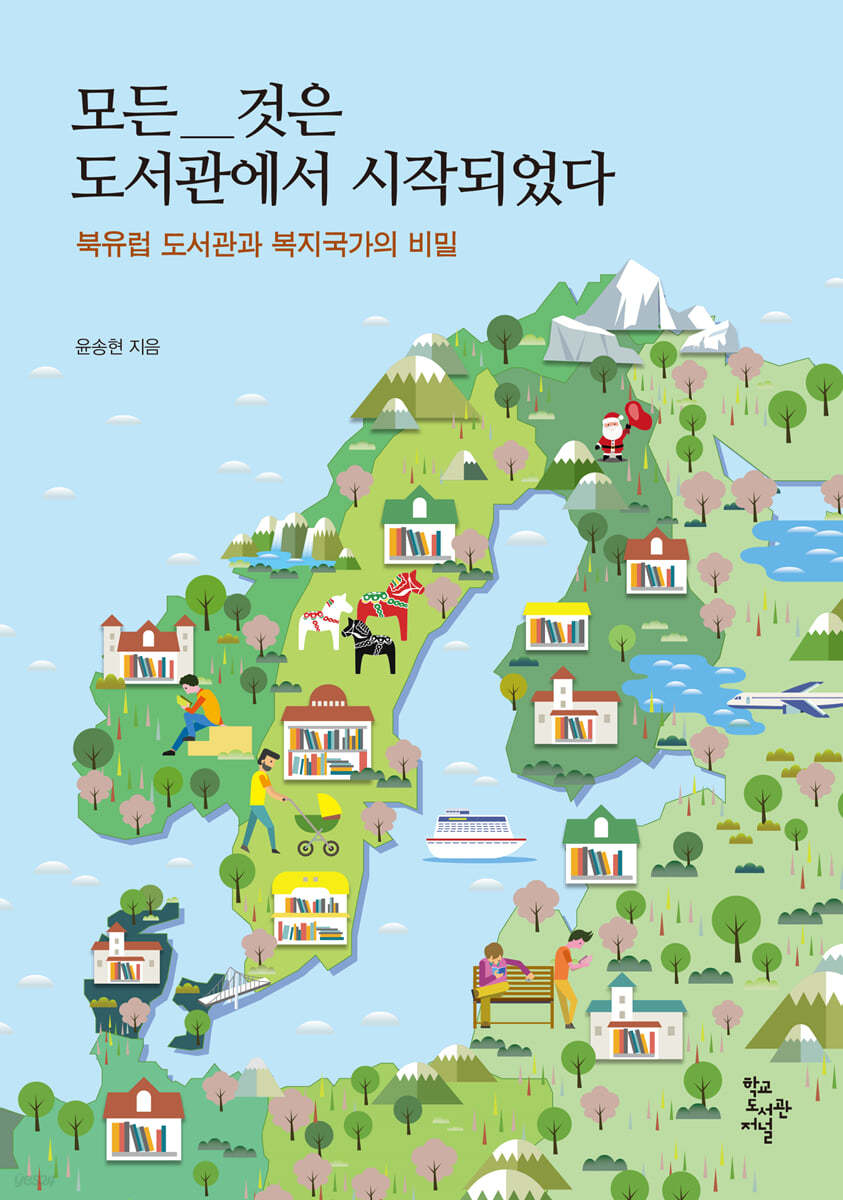
This is a travelogue of Nordic libraries, written by the author, a library activist and civic activist, after visiting over 80 libraries in Northern Europe over 10 occasions.
However, this book does not stop at introducing the various aspects of advanced libraries.
We focus more on the social systems that made such libraries possible, and the changes that libraries brought about in individual lives and communities.
The driving force that enabled Northern Europe, once a periphery of Europe, to advance into a welfare state was libraries.
By expanding the story of Nordic libraries beyond the realm of libraries to encompass the entirety of society, it carefully examines how libraries change the world and how they can serve as platforms for a welfare state, presenting a discourse we need today.
However, this book does not stop at introducing the various aspects of advanced libraries.
We focus more on the social systems that made such libraries possible, and the changes that libraries brought about in individual lives and communities.
The driving force that enabled Northern Europe, once a periphery of Europe, to advance into a welfare state was libraries.
By expanding the story of Nordic libraries beyond the realm of libraries to encompass the entirety of society, it carefully examines how libraries change the world and how they can serve as platforms for a welfare state, presenting a discourse we need today.
- You can preview some of the book's contents.
Preview
index
Opening Remarks: The Path to a Welfare State: Finding It in the Library
Part 1.
New libraries in Northern Europe
Chapter 1.
The library is in the middle of town.
As soon as I exited the subway station, I saw the library.
It was the same even outside Stockholm.
There was a library in the middle of the village.
Sister Library located in a shopping mall
Almir New Library located in the central square
Idea Store shows that location matters
Hamlet Castle and Kulturbeapt
Heanning, who transformed a neglected downtown commercial building into a library.
Superkiln Park and Nerebro Library, examples of regional development
Chapter 2.
The library is a place for meeting
A library with stars pouring down from the ceiling
One roof, one connected reading room
Innovation at the tip of the Jutland Peninsula
The library as a meeting place
Almir Library, which creates a bookstore-like atmosphere
Furniture and lighting create the atmosphere.
Chapter 3.
New library services
A library is not a repository of books.
Serves through network
Makerspace, a space for creation
Music resource service with studio
A library accessible to people with disabilities
Multilingual services that embrace immigrants
Chapter 4.
Reaching out to children and youth
Meet Latte Papa
Children's corner like a playground
Unibakken, a fantasy space for children's literature
Storytelling Amusement Park, Astrid Lindgren World
Tiotreton, which catches adolescent children
Bibliothein in Oslo, Norway
Balagan of Malmö Library
Pointy, a space for the energetic generation
Part 2.
Libraries, Literacy, and the Welfare State
Chapter 5.
Reading culture in Northern Europe
The country that reads the most books: Northern Europe
The roots of Nordic reading culture
Swedish education reform and reading
Danish education reform and reading
The Secret of Finland's Reading Culture
Chapter 6.
Sweden_ From People's Library to Public Library
Reading rooms, study circles, and labor libraries
Universal Suffrage Movement and the People's Library Support Act
Library movements in Norway and Denmark
From People's Library to Public Library
Stockholm City Library, a representative library of Northern Europe
A library that embodies equality and democracy
Chapter 7.
Finland_ From a developing country to a leading library country
Finding National Identity and the Library Movement
The country with the most developed public libraries
Finland's new landmark, the Odi Library
How should the libraries of the future change?
Go to Tampere, surrounded by lakes
Cities with a lot of library use
Tampere Library, one step ahead
Tampere branch library, Sampolan and Lierahti library
Chapter 8.
Libraries and the Welfare State
Starting with the library movement
Libraries and Democracy
From class confrontation to class inclusion
The path to an equal society led by labor unions
The women's movement that started in the library
Cooperative politics created by high civic consciousness
Establishing a Pension System: The Core of Welfare Policy
Choices in a political crisis
A virtuous cycle of transparent politics and social trust
The power to protect the welfare state: creative culture
Closing Remarks: Building the Foundation for a Universal Welfare State
Part 1.
New libraries in Northern Europe
Chapter 1.
The library is in the middle of town.
As soon as I exited the subway station, I saw the library.
It was the same even outside Stockholm.
There was a library in the middle of the village.
Sister Library located in a shopping mall
Almir New Library located in the central square
Idea Store shows that location matters
Hamlet Castle and Kulturbeapt
Heanning, who transformed a neglected downtown commercial building into a library.
Superkiln Park and Nerebro Library, examples of regional development
Chapter 2.
The library is a place for meeting
A library with stars pouring down from the ceiling
One roof, one connected reading room
Innovation at the tip of the Jutland Peninsula
The library as a meeting place
Almir Library, which creates a bookstore-like atmosphere
Furniture and lighting create the atmosphere.
Chapter 3.
New library services
A library is not a repository of books.
Serves through network
Makerspace, a space for creation
Music resource service with studio
A library accessible to people with disabilities
Multilingual services that embrace immigrants
Chapter 4.
Reaching out to children and youth
Meet Latte Papa
Children's corner like a playground
Unibakken, a fantasy space for children's literature
Storytelling Amusement Park, Astrid Lindgren World
Tiotreton, which catches adolescent children
Bibliothein in Oslo, Norway
Balagan of Malmö Library
Pointy, a space for the energetic generation
Part 2.
Libraries, Literacy, and the Welfare State
Chapter 5.
Reading culture in Northern Europe
The country that reads the most books: Northern Europe
The roots of Nordic reading culture
Swedish education reform and reading
Danish education reform and reading
The Secret of Finland's Reading Culture
Chapter 6.
Sweden_ From People's Library to Public Library
Reading rooms, study circles, and labor libraries
Universal Suffrage Movement and the People's Library Support Act
Library movements in Norway and Denmark
From People's Library to Public Library
Stockholm City Library, a representative library of Northern Europe
A library that embodies equality and democracy
Chapter 7.
Finland_ From a developing country to a leading library country
Finding National Identity and the Library Movement
The country with the most developed public libraries
Finland's new landmark, the Odi Library
How should the libraries of the future change?
Go to Tampere, surrounded by lakes
Cities with a lot of library use
Tampere Library, one step ahead
Tampere branch library, Sampolan and Lierahti library
Chapter 8.
Libraries and the Welfare State
Starting with the library movement
Libraries and Democracy
From class confrontation to class inclusion
The path to an equal society led by labor unions
The women's movement that started in the library
Cooperative politics created by high civic consciousness
Establishing a Pension System: The Core of Welfare Policy
Choices in a political crisis
A virtuous cycle of transparent politics and social trust
The power to protect the welfare state: creative culture
Closing Remarks: Building the Foundation for a Universal Welfare State
Detailed image
Into the book
“Libraries are not for books, but for people.” I was struck by the explanation given by Director Lindberg Firkó at the Tampere Central Library in Finland, which I visited for the first time.
I thought the library was a place to read and borrow books, but Director Pirkó said, “The collection is just one of the many services the library provides.”
He then said, “Libraries have the important task of forming civic consciousness in the society they belong to and ensuring that everyone can use them freely and equally.”
It gave us a message to think about the reason for the existence of libraries and their social role.
---From the "Opening Remarks"
While each library is unique, it is impressive that a building in the heart of Stockholm has been transformed into a library rather than a commercial space.
Sejong Center for the Performing Arts in Seoul not only has a performance hall but also several libraries.
I imagined what it would be like if there was a large library next to Gwanghwamun Square.
---From "The library is in the middle of the town"
A library like a bookstore.
A library like a retail store.
A prime example of this emerging library trend is the new library in Almere, Netherlands.
In the 2000s, library usage rates began to decline due to the spread of IT.
Librarians, concerned about declining library usage, tried to decorate the bookshelves like a bookstore to make it easier for visitors to access books.
Bookstores display popular or recommended new books on the shelves so that their covers are easily visible, so that people who visit without knowing the books will immediately open the books out of curiosity.
---From "The Library is a Space for Encounters"
It is not easy for a library to provide services through a network.
In our country, there is little interaction between libraries run by universities, libraries run by education offices, and libraries run by local governments, even if they are all located in the same area.
There are many places where local governments have built separate libraries next to the education office library.
There is no interlibrary loan.
They are all public libraries run with tax support.
---From "New Library Services"
Here, teenagers draw pictures and do school assignments.
I also play computer games.
Young people can also develop and create their own stories.
He makes music videos and is interested in nanotechnology.
You can bring your own food to eat, but the library has a communal kitchen.
There is a table with cooking facilities so you can cook your favorite dishes.
If you want to learn how to cook properly, you can take out books from various places and refer to them.
---From "Reaching Children and Youth"
There was a barbecue area with a fire in the school playground.
They say they sometimes make barbecues with the kids, or just light a fire and play with it.
They say that in such cases, there is always an adult watching from the side, but anyway, there is a place in school where you can play with fire.
Looking at us in surprise, Woof kindly explains.
In Denmark, children's safety is important, but that doesn't mean they are prevented from doing something. Rather, they are made aware of the risks and taught how to avoid and overcome them.
“When you’re young, you don’t get hurt too badly even if you fall, but when you become an adult, you can easily get hurt too badly if you fall.
“If you don’t let your child climb a tree because it’s dangerous, that child will never be able to climb a tree again.” This was the story of an ordinary Danish father raising a child.
---From "Reading Culture in Northern Europe"
A new discussion also took place in the library.
Public libraries were not satisfied with simply providing basic collection services.
Enabling members of society to acquire the knowledge and cultural experiences necessary for political, social, and cultural development has been emphasized as a democratic issue.
In 1968, a committee was formed to establish a new cultural policy.
One of the key elements of the new cultural policy was that cultural policy should play a role in promoting equality in society.
---From "Sweden_From People's Library to Public Library"
The Odi Library is a space that embodies the message that “modern libraries are not for books, but for people” through Finnish design capabilities.
This sensibility is the power of Finland, which expanded design into the realm of social design.
Audi soon became Helsinki's new landmark.
Not only library lovers but also groups of tourists visiting Helsinki line up to visit Audi.
In 2019, it was selected as the Library of the Year by the International Library Association (IFLA), a highly selective organization.
---From “Finland: From a Latecomer to a Leading Library Nation”
Through reading and learning, people come into contact with other people's thoughts and experiences, and with stories from the wider world.
As they come into contact with their own history, they realize their own identity and develop a sense of national consciousness and solidarity.
You will learn about other people's thoughts and opinions, and you will have repeated experiences of telling your own story and listening to others' stories through conversation and discussion.
Through all activities that involve books in reading rooms, study clubs, and worker libraries, we gain awareness of ourselves as human beings, a sense of our rights, and a sense of citizenship.
---From "Libraries and the Welfare State"
High literacy leads to respect for others.
Through dialogue and discussion, we come to understand, acknowledge, and respect differences.
Don't fight to impose or impose your own ideas or norms on others.
A society with high literacy allows individuals and communities to coexist peacefully.
Although Nordic societies appear to be prevalent in individualism, they place great importance on family and community activities.
A society where individuals are happy and the community functions smoothly is a welfare state.
I thought the library was a place to read and borrow books, but Director Pirkó said, “The collection is just one of the many services the library provides.”
He then said, “Libraries have the important task of forming civic consciousness in the society they belong to and ensuring that everyone can use them freely and equally.”
It gave us a message to think about the reason for the existence of libraries and their social role.
---From the "Opening Remarks"
While each library is unique, it is impressive that a building in the heart of Stockholm has been transformed into a library rather than a commercial space.
Sejong Center for the Performing Arts in Seoul not only has a performance hall but also several libraries.
I imagined what it would be like if there was a large library next to Gwanghwamun Square.
---From "The library is in the middle of the town"
A library like a bookstore.
A library like a retail store.
A prime example of this emerging library trend is the new library in Almere, Netherlands.
In the 2000s, library usage rates began to decline due to the spread of IT.
Librarians, concerned about declining library usage, tried to decorate the bookshelves like a bookstore to make it easier for visitors to access books.
Bookstores display popular or recommended new books on the shelves so that their covers are easily visible, so that people who visit without knowing the books will immediately open the books out of curiosity.
---From "The Library is a Space for Encounters"
It is not easy for a library to provide services through a network.
In our country, there is little interaction between libraries run by universities, libraries run by education offices, and libraries run by local governments, even if they are all located in the same area.
There are many places where local governments have built separate libraries next to the education office library.
There is no interlibrary loan.
They are all public libraries run with tax support.
---From "New Library Services"
Here, teenagers draw pictures and do school assignments.
I also play computer games.
Young people can also develop and create their own stories.
He makes music videos and is interested in nanotechnology.
You can bring your own food to eat, but the library has a communal kitchen.
There is a table with cooking facilities so you can cook your favorite dishes.
If you want to learn how to cook properly, you can take out books from various places and refer to them.
---From "Reaching Children and Youth"
There was a barbecue area with a fire in the school playground.
They say they sometimes make barbecues with the kids, or just light a fire and play with it.
They say that in such cases, there is always an adult watching from the side, but anyway, there is a place in school where you can play with fire.
Looking at us in surprise, Woof kindly explains.
In Denmark, children's safety is important, but that doesn't mean they are prevented from doing something. Rather, they are made aware of the risks and taught how to avoid and overcome them.
“When you’re young, you don’t get hurt too badly even if you fall, but when you become an adult, you can easily get hurt too badly if you fall.
“If you don’t let your child climb a tree because it’s dangerous, that child will never be able to climb a tree again.” This was the story of an ordinary Danish father raising a child.
---From "Reading Culture in Northern Europe"
A new discussion also took place in the library.
Public libraries were not satisfied with simply providing basic collection services.
Enabling members of society to acquire the knowledge and cultural experiences necessary for political, social, and cultural development has been emphasized as a democratic issue.
In 1968, a committee was formed to establish a new cultural policy.
One of the key elements of the new cultural policy was that cultural policy should play a role in promoting equality in society.
---From "Sweden_From People's Library to Public Library"
The Odi Library is a space that embodies the message that “modern libraries are not for books, but for people” through Finnish design capabilities.
This sensibility is the power of Finland, which expanded design into the realm of social design.
Audi soon became Helsinki's new landmark.
Not only library lovers but also groups of tourists visiting Helsinki line up to visit Audi.
In 2019, it was selected as the Library of the Year by the International Library Association (IFLA), a highly selective organization.
---From “Finland: From a Latecomer to a Leading Library Nation”
Through reading and learning, people come into contact with other people's thoughts and experiences, and with stories from the wider world.
As they come into contact with their own history, they realize their own identity and develop a sense of national consciousness and solidarity.
You will learn about other people's thoughts and opinions, and you will have repeated experiences of telling your own story and listening to others' stories through conversation and discussion.
Through all activities that involve books in reading rooms, study clubs, and worker libraries, we gain awareness of ourselves as human beings, a sense of our rights, and a sense of citizenship.
---From "Libraries and the Welfare State"
High literacy leads to respect for others.
Through dialogue and discussion, we come to understand, acknowledge, and respect differences.
Don't fight to impose or impose your own ideas or norms on others.
A society with high literacy allows individuals and communities to coexist peacefully.
Although Nordic societies appear to be prevalent in individualism, they place great importance on family and community activities.
A society where individuals are happy and the community functions smoothly is a welfare state.
---From the "Closing Notes"
Publisher's Review
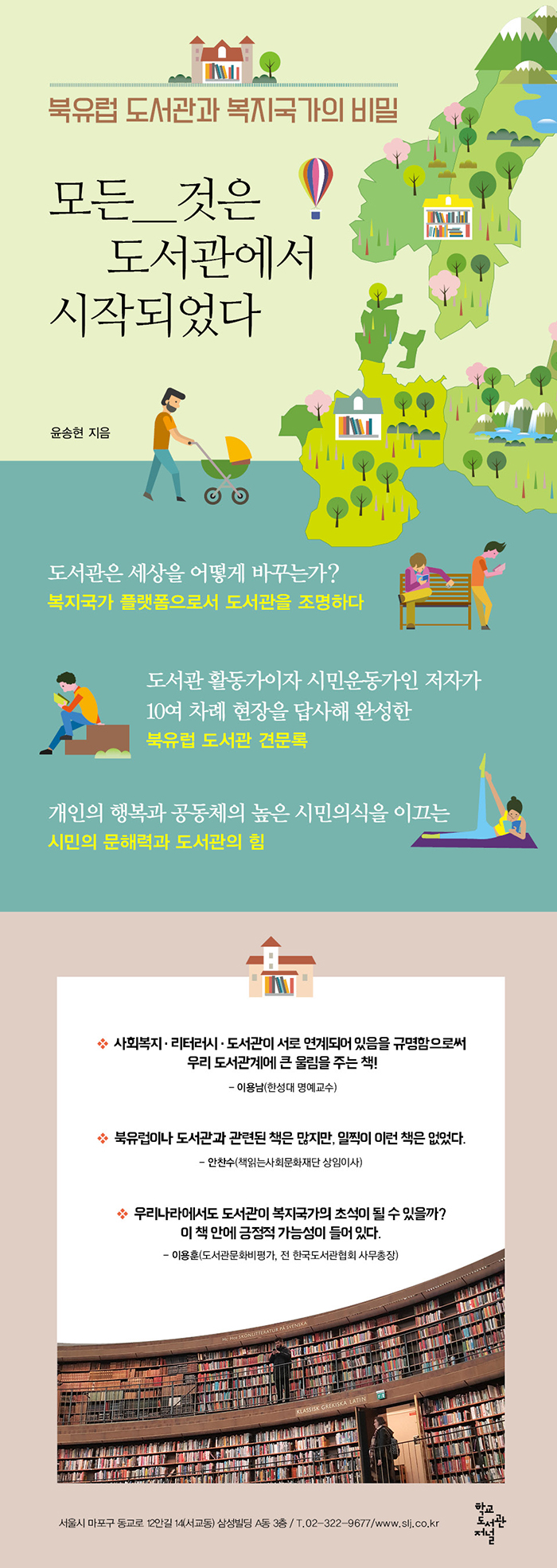
How do libraries change the world?
Highlighting Libraries as a Platform for a Welfare State
These days, many local governments in our country are building libraries and actively remodeling them.
Unfortunately, however, there is little discussion about what a library should be.
What does a library do? Why is it important? What should a library be like? The author answers these questions by asserting that libraries play a key role in our society's advancement toward a welfare state.
The example of Northern Europe, which took the lead in challenging and innovating, clearly demonstrates this.
'The essence of welfare policy is to foster the ability to understand and judge information and develop a sense of democratic citizenship (education), to recover self-esteem and stand on one's own (self-reliance), to find one's role in a changing society and spend one's old age maintaining self-esteem (elderly welfare, senior jobs), to overcome career breaks and participate in society through access to necessary information (women), and to foster the ability to overcome physical limitations by utilizing information (disability)', and the author emphasizes that the library is the platform that serves as the foundation for all of these universal welfare policies.
The author, a library activist and civic activist,
Completed after visiting over 80 sites over 10 occasions
A Travelogue of Nordic Libraries
The streets shivering in the cold of Andersen's 'The Little Match Girl', the empty village in Astrid Lindgren's 'Rasmus and the Wanderer'... The author questioned the image of poor Northern Europe that she had first encountered through stories.
The author, curious about how the Nordic countries, which were poor agricultural nations with harsh environments just 100 years ago, became the happiest countries and welfare states in the world in just 50 years, traveled to Northern Europe and encountered libraries wherever he went.
The moment I realized, 'Everything was done in the library!', I ran back to Northern Europe.
This book is a travelogue, a record of reflection and reflection, completed through over 10 visits to over 80 locations, including touring Nordic welfare sites with social welfare workers, exploring Nordic political and social settings with civic group activists, exploring educational settings with provincial council members, and visiting libraries large and small with library activists.
Leading to individual happiness and high civic consciousness in the community
Citizen Literacy and the Role of Libraries
The author argues that the reason Northern Europe developed into a welfare state in such a short period of time and maintained its welfare state system despite difficulties is the power of the high civic consciousness fostered in libraries.
High civic awareness is achieved through citizens' reading culture and high literacy.
A 2016 study of literacy levels around the world found Finland ranked first, followed by Norway, Iceland, Denmark, and Sweden.
When only reading materials were evaluated, Asian countries such as Singapore, Korea, Japan, and China ranked high, but when factors other than reading assessment were considered, they all fell below the top 25.
So how is high literacy created and maintained? This book vividly illustrates the correlation between an open education system, well-established library services, and citizens' literacy.
The power of literacy fostered by libraries supports and develops the welfare state.
"I hope my new story will be a source of strength and new perspective for those who strive for a reading society, those who strive for good libraries, and those who dream of a welfare state."
Highlighting Libraries as a Platform for a Welfare State
These days, many local governments in our country are building libraries and actively remodeling them.
Unfortunately, however, there is little discussion about what a library should be.
What does a library do? Why is it important? What should a library be like? The author answers these questions by asserting that libraries play a key role in our society's advancement toward a welfare state.
The example of Northern Europe, which took the lead in challenging and innovating, clearly demonstrates this.
'The essence of welfare policy is to foster the ability to understand and judge information and develop a sense of democratic citizenship (education), to recover self-esteem and stand on one's own (self-reliance), to find one's role in a changing society and spend one's old age maintaining self-esteem (elderly welfare, senior jobs), to overcome career breaks and participate in society through access to necessary information (women), and to foster the ability to overcome physical limitations by utilizing information (disability)', and the author emphasizes that the library is the platform that serves as the foundation for all of these universal welfare policies.
The author, a library activist and civic activist,
Completed after visiting over 80 sites over 10 occasions
A Travelogue of Nordic Libraries
The streets shivering in the cold of Andersen's 'The Little Match Girl', the empty village in Astrid Lindgren's 'Rasmus and the Wanderer'... The author questioned the image of poor Northern Europe that she had first encountered through stories.
The author, curious about how the Nordic countries, which were poor agricultural nations with harsh environments just 100 years ago, became the happiest countries and welfare states in the world in just 50 years, traveled to Northern Europe and encountered libraries wherever he went.
The moment I realized, 'Everything was done in the library!', I ran back to Northern Europe.
This book is a travelogue, a record of reflection and reflection, completed through over 10 visits to over 80 locations, including touring Nordic welfare sites with social welfare workers, exploring Nordic political and social settings with civic group activists, exploring educational settings with provincial council members, and visiting libraries large and small with library activists.
Leading to individual happiness and high civic consciousness in the community
Citizen Literacy and the Role of Libraries
The author argues that the reason Northern Europe developed into a welfare state in such a short period of time and maintained its welfare state system despite difficulties is the power of the high civic consciousness fostered in libraries.
High civic awareness is achieved through citizens' reading culture and high literacy.
A 2016 study of literacy levels around the world found Finland ranked first, followed by Norway, Iceland, Denmark, and Sweden.
When only reading materials were evaluated, Asian countries such as Singapore, Korea, Japan, and China ranked high, but when factors other than reading assessment were considered, they all fell below the top 25.
So how is high literacy created and maintained? This book vividly illustrates the correlation between an open education system, well-established library services, and citizens' literacy.
The power of literacy fostered by libraries supports and develops the welfare state.
"I hope my new story will be a source of strength and new perspective for those who strive for a reading society, those who strive for good libraries, and those who dream of a welfare state."
GOODS SPECIFICS
- Date of issue: January 25, 2022
- Page count, weight, size: 288 pages | 392g | 148*210*20mm
- ISBN13: 9788969151223
- ISBN10: 8969151222
You may also like
카테고리
korean


korean

![GQ KOREA Mark (Monthly): December [2025]](http://librairie.coreenne.fr/cdn/shop/files/8ef265dbbfbf186523ed75ba7319009d.jpg?v=1765340328&width=3840)


