

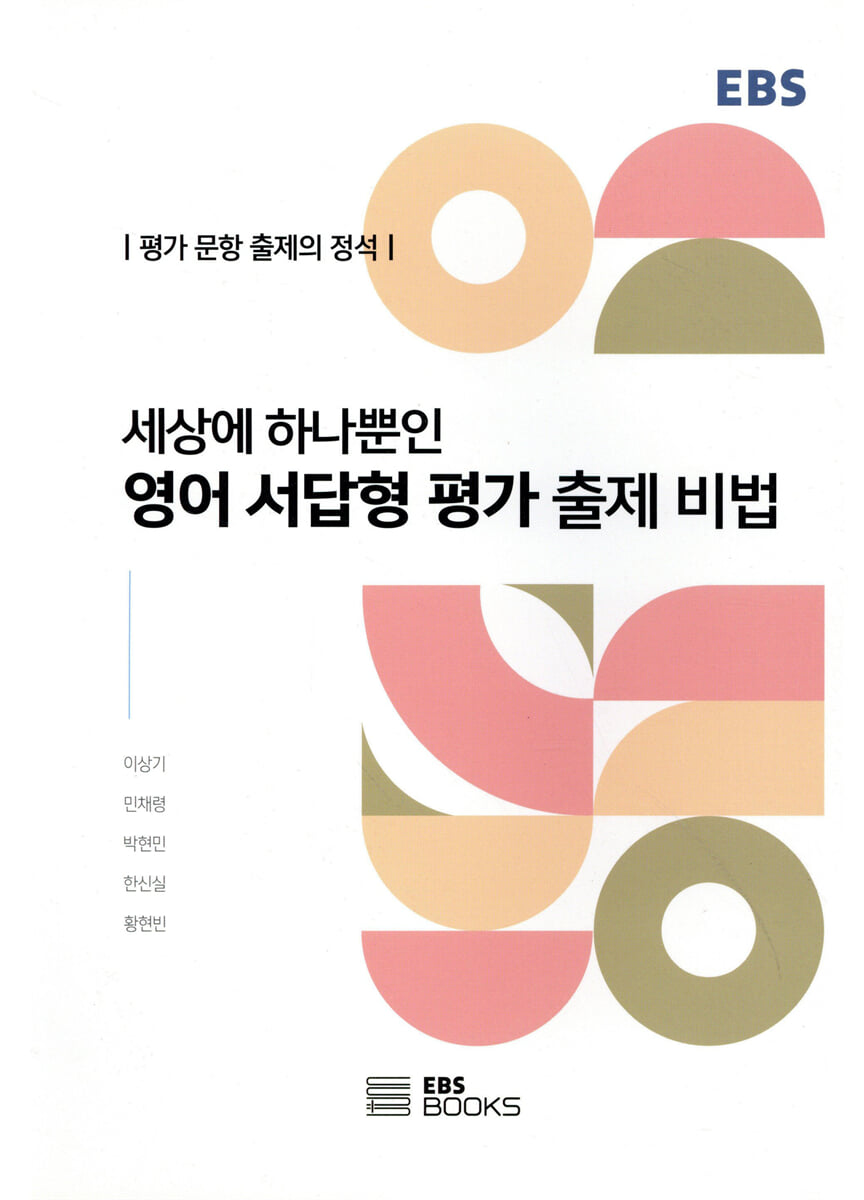
The secret to creating the world's only English essay-based assessment
 |
Description
Book Introduction
The meeting of theory and practice at the core of creating essay-type assessment questions!
The world's only assessment item development guidebook that vividly captures the real-world experience of assessment!
English education experts in the field, who have been diligently researching for many years, delve into the fundamentals of creating assessment items, from the concept of written assessment items to assessment types, production, and scoring principles, and suggest directions for written assessments through a wealth of assessment examples.
The world's only assessment item development guidebook that vividly captures the real-world experience of assessment!
English education experts in the field, who have been diligently researching for many years, delve into the fundamentals of creating assessment items, from the concept of written assessment items to assessment types, production, and scoring principles, and suggest directions for written assessments through a wealth of assessment examples.
- You can preview some of the book's contents.
Preview
index
preface
Chapter 1: Basic Direction and Points to Note in Essay-Based Evaluation
1.1 Types of evaluation and basic concepts related to evaluation
1.1.1 Types of Evaluation
1.1.2 Types and Scope of Essay-Based Assessment
1.1.3 Validity
1.1.4 Reliability
1.2 Basic Requirements for Developing and Implementing High-Quality Short-Term Assessment Items
1.2.1 A good evaluator with skills and experience
1.2.2 Well-structured, good questions
1.2.3 Systematic Item Review
1.2.4 Ensuring Scoring Reliability
Chapter 2 Types of Essay-Type Assessment Questions
2.1 Completion Evaluation
2.1.1 Example of a completed assessment item
2.1.2 Definitional characteristics of completed assessment items
2.1.3 Principles and procedures for creating completed assessment items
2.1.4 Scoring principles and procedures for completed assessment items
2.1.5 Types of Completion-Type Assessment Items
2.1.6 Advantages and Disadvantages of Completed Assessment Questions
2.2 Short answer assessment
2.2.1 Example of short-answer assessment questions
2.2.2 Definitional Characteristics of Short-Answer Assessment Questions
2.2.3 Principles and procedures for creating short-answer assessment questions
2.2.4 Scoring principles and procedures for short-answer assessment questions
2.2.5 Types of short-answer assessment questions
2.2.6 Advantages and Disadvantages of Short-Answer Assessment Questions
2.3 Descriptive Evaluation
2.3.1 Example of descriptive assessment questions
2.3.2 Definitional Characteristics of Descriptive Assessment Items
2.3.3 Principles and procedures for creating descriptive evaluation items
2.3.4 Scoring principles and procedures for descriptive evaluation items
2.3.5 Types of descriptive assessment questions
2.3.6 Advantages and Disadvantages of Descriptive Evaluation
2.4 Essay-type evaluation
2.4.1 Examples of essay-type assessment questions
2.4.2 Definitional Characteristics of Essay-Type Evaluation Items
2.4.3 Principles and procedures for creating essay-type evaluation items
2.4.4 Scoring principles and procedures for essay-type evaluation items
2.4.5 Types of essay-type evaluation questions
2.4.6 Advantages and Disadvantages of Essay-Based Evaluation
Chapter 3: Practical Use of Short-Response Assessment Questions
3.1 [Example 1] Comprehensive evaluation for middle and high schools
3.1.1 Example of a written assessment question for the middle school comprehensive assessment
[Example 1] Writing simple practical sentences
[Example 2] Describing a Picture
[Example 3] Inferring References
[Example 4] Arranging sentence order
[Evaluation Example 5] Identifying Content Consistency or Inconsistency
[Example 6] Understanding the main idea and topic
3.1.2 Sample High School Comprehensive Assessment Essay-Type Evaluation Questions
[Example 1] Summarizing a Text
[Example 2] Identifying Grammar and Vocabulary Appropriateness
[Example 3] Understanding Vocabulary Usage
[Example 4] Understanding the Details
[Example 5] Judging Grammatical Accuracy
[Example 6] Writing a Simple Letter
[Example 7] Explaining the Diagram
3.2 Example of Use 2 Middle School Performance Evaluation
[Example 1] Writing a self-introduction newspaper article
[Example 2] Presenting an experience visiting a traditional market
[Example 3] Creating a Stress Relief Book
[Example 4] Writing a Critique
[Example 5] Essay Writing
3.3 Example of Use 3 High School Performance Evaluation
[Example 1] Writing a Letter
[Evaluation Example 2] Writing a Business Plan
[Example 3] Writing a Summary
[Example 4] Writing an Essay
References
About the Author
Chapter 1: Basic Direction and Points to Note in Essay-Based Evaluation
1.1 Types of evaluation and basic concepts related to evaluation
1.1.1 Types of Evaluation
1.1.2 Types and Scope of Essay-Based Assessment
1.1.3 Validity
1.1.4 Reliability
1.2 Basic Requirements for Developing and Implementing High-Quality Short-Term Assessment Items
1.2.1 A good evaluator with skills and experience
1.2.2 Well-structured, good questions
1.2.3 Systematic Item Review
1.2.4 Ensuring Scoring Reliability
Chapter 2 Types of Essay-Type Assessment Questions
2.1 Completion Evaluation
2.1.1 Example of a completed assessment item
2.1.2 Definitional characteristics of completed assessment items
2.1.3 Principles and procedures for creating completed assessment items
2.1.4 Scoring principles and procedures for completed assessment items
2.1.5 Types of Completion-Type Assessment Items
2.1.6 Advantages and Disadvantages of Completed Assessment Questions
2.2 Short answer assessment
2.2.1 Example of short-answer assessment questions
2.2.2 Definitional Characteristics of Short-Answer Assessment Questions
2.2.3 Principles and procedures for creating short-answer assessment questions
2.2.4 Scoring principles and procedures for short-answer assessment questions
2.2.5 Types of short-answer assessment questions
2.2.6 Advantages and Disadvantages of Short-Answer Assessment Questions
2.3 Descriptive Evaluation
2.3.1 Example of descriptive assessment questions
2.3.2 Definitional Characteristics of Descriptive Assessment Items
2.3.3 Principles and procedures for creating descriptive evaluation items
2.3.4 Scoring principles and procedures for descriptive evaluation items
2.3.5 Types of descriptive assessment questions
2.3.6 Advantages and Disadvantages of Descriptive Evaluation
2.4 Essay-type evaluation
2.4.1 Examples of essay-type assessment questions
2.4.2 Definitional Characteristics of Essay-Type Evaluation Items
2.4.3 Principles and procedures for creating essay-type evaluation items
2.4.4 Scoring principles and procedures for essay-type evaluation items
2.4.5 Types of essay-type evaluation questions
2.4.6 Advantages and Disadvantages of Essay-Based Evaluation
Chapter 3: Practical Use of Short-Response Assessment Questions
3.1 [Example 1] Comprehensive evaluation for middle and high schools
3.1.1 Example of a written assessment question for the middle school comprehensive assessment
[Example 1] Writing simple practical sentences
[Example 2] Describing a Picture
[Example 3] Inferring References
[Example 4] Arranging sentence order
[Evaluation Example 5] Identifying Content Consistency or Inconsistency
[Example 6] Understanding the main idea and topic
3.1.2 Sample High School Comprehensive Assessment Essay-Type Evaluation Questions
[Example 1] Summarizing a Text
[Example 2] Identifying Grammar and Vocabulary Appropriateness
[Example 3] Understanding Vocabulary Usage
[Example 4] Understanding the Details
[Example 5] Judging Grammatical Accuracy
[Example 6] Writing a Simple Letter
[Example 7] Explaining the Diagram
3.2 Example of Use 2 Middle School Performance Evaluation
[Example 1] Writing a self-introduction newspaper article
[Example 2] Presenting an experience visiting a traditional market
[Example 3] Creating a Stress Relief Book
[Example 4] Writing a Critique
[Example 5] Essay Writing
3.3 Example of Use 3 High School Performance Evaluation
[Example 1] Writing a Letter
[Evaluation Example 2] Writing a Business Plan
[Example 3] Writing a Summary
[Example 4] Writing an Essay
References
About the Author
Publisher's Review
Evaluation plays a significant role in the overall educational process.
When we say that the goal of education is to set the direction of education, we can say that its achievement can only be confirmed through evaluation.
The educational content is determined based on the outline of educational goals, educational methods are established to achieve these goals, and evaluation tools are also developed within this series of processes.
Each of these processes is intertwined in a circular relationship, and none of them is unimportant. However, in the actual educational field where evaluation results determine the joy and sorrow of educational stakeholders, evaluation has a decisive influence on the learning content and the form of teaching and learning.
That is, the learning content and teaching and learning methods covered in the educational field can differ depending on what is evaluated and how it is evaluated.
Frontline teachers, who fully understand the importance of such assessments, are doing their best to develop high-quality assessment items, and many educational experts are continuously trying to develop and apply various assessment methods to positively impact the educational field by improving the content and methods of assessments.
Recently, in the field of education, the importance of process-centered assessment, which evaluates how much students have grown during the learning process rather than focusing solely on the outcomes of learning, has been highlighted.
Accordingly, the development and use of short-answer assessments that allow students to directly respond to questions about what they know or think are gaining attention, recognizing that multiple-choice assessments that require students to select the correct answer from a given list have limitations in evaluating the learning process.
Essay-based assessments can be a more three-dimensional tool for assessing students' abilities than multiple-choice assessments, as they can measure students' thinking processes in a variety of ways depending on the type.
In fact, the utility of this type of written assessment has not suddenly gained attention in recent times.
However, in actual educational settings where a majority of students must be evaluated quickly and objectively, it is difficult for written assessments to be utilized in a variety of ways to fully realize their potential, which is holding teachers back.
So, how can we create open-ended assessment questions that accurately measure students' thought processes and can be effectively implemented in the field? This book addresses these questions and provides a step-by-step guide to the creation and grading of open-ended assessment questions, grounded in principles.
Chapter 1 is the basics of creating written assessment questions, and provides guidance on the basic direction and points to note for written assessment.
A house without a solid foundation is nothing more than a castle in the air. Therefore, this chapter will provide a solid foundation for the types of assessment and related basic concepts, and examine the basic requirements for developing and implementing high-quality, open-ended assessment items.
Chapter 2 examines the types of short-answer assessment questions.
This book broadly divides open-ended questions into four types: complete, short-answer, descriptive, and essay-type, and examines in detail the defining characteristics of each, the principles and procedures for creating assessment questions, and the scoring principles and procedures.
Additionally, by examining the pros and cons of each short-answer assessment question, we examine the implications of each assessment type for education.
Rather than boringly listing the concepts of each type, this chapter first presents examples of each evaluation, allowing readers to infer the defining characteristics of each type.
This chapter presents a variety of short-answer assessment question types that reflect the characteristics of the English subject and are well-integrated into the assessment process. It also provides a selection of cases that demonstrate how the principles of creating and scoring the assessment questions described above are actually applied. This is a feature of this chapter that will keep readers interested in creating short-answer assessment questions in the English subject engaged.
Chapter 3 demonstrates the practical use of short-answer assessment items.
It provides abundant examples of how the four types of short-answer assessment questions examined in Chapter 2 are actually used in schools.
First, we will look at examples of using short-answer assessment questions as a comprehensive assessment in middle and high schools, and then look at examples of performance assessments by school level.
Each case is systematically presented in four stages: explanation of the basis for the curriculum, method of conducting the class, example of evaluation items, and feedback or recording.
In particular, for middle and high school performance assessment cases, it was planned to be of practical help to current and prospective teachers by including actual student answers, teacher feedback, grading results and basis, and examples of writing student records.
This book lays the foundation for the principles and procedures of creating short-answer assessment questions and systematically provides a wealth of examples of how these principles have been applied.
In particular, this book's unique strength, which sets it apart from other books on essay-based assessment, is that it goes beyond simply listing theories and strives to capture the vivid atmosphere of the assessment field.
The basic principles and procedures for creating each evaluation item, as well as evaluation examples, are systematically organized into subheadings so that readers can expand and refer to the necessary sections at any time.
As the title suggests, this book is a one-of-a-kind book that contains the secrets of evaluation.
We hope that this book will open a new horizon for guidelines on creating assessment items that faithfully preserve the fundamental purpose of short-answer assessment items while also being applicable to the field without difficulty.
When we say that the goal of education is to set the direction of education, we can say that its achievement can only be confirmed through evaluation.
The educational content is determined based on the outline of educational goals, educational methods are established to achieve these goals, and evaluation tools are also developed within this series of processes.
Each of these processes is intertwined in a circular relationship, and none of them is unimportant. However, in the actual educational field where evaluation results determine the joy and sorrow of educational stakeholders, evaluation has a decisive influence on the learning content and the form of teaching and learning.
That is, the learning content and teaching and learning methods covered in the educational field can differ depending on what is evaluated and how it is evaluated.
Frontline teachers, who fully understand the importance of such assessments, are doing their best to develop high-quality assessment items, and many educational experts are continuously trying to develop and apply various assessment methods to positively impact the educational field by improving the content and methods of assessments.
Recently, in the field of education, the importance of process-centered assessment, which evaluates how much students have grown during the learning process rather than focusing solely on the outcomes of learning, has been highlighted.
Accordingly, the development and use of short-answer assessments that allow students to directly respond to questions about what they know or think are gaining attention, recognizing that multiple-choice assessments that require students to select the correct answer from a given list have limitations in evaluating the learning process.
Essay-based assessments can be a more three-dimensional tool for assessing students' abilities than multiple-choice assessments, as they can measure students' thinking processes in a variety of ways depending on the type.
In fact, the utility of this type of written assessment has not suddenly gained attention in recent times.
However, in actual educational settings where a majority of students must be evaluated quickly and objectively, it is difficult for written assessments to be utilized in a variety of ways to fully realize their potential, which is holding teachers back.
So, how can we create open-ended assessment questions that accurately measure students' thought processes and can be effectively implemented in the field? This book addresses these questions and provides a step-by-step guide to the creation and grading of open-ended assessment questions, grounded in principles.
Chapter 1 is the basics of creating written assessment questions, and provides guidance on the basic direction and points to note for written assessment.
A house without a solid foundation is nothing more than a castle in the air. Therefore, this chapter will provide a solid foundation for the types of assessment and related basic concepts, and examine the basic requirements for developing and implementing high-quality, open-ended assessment items.
Chapter 2 examines the types of short-answer assessment questions.
This book broadly divides open-ended questions into four types: complete, short-answer, descriptive, and essay-type, and examines in detail the defining characteristics of each, the principles and procedures for creating assessment questions, and the scoring principles and procedures.
Additionally, by examining the pros and cons of each short-answer assessment question, we examine the implications of each assessment type for education.
Rather than boringly listing the concepts of each type, this chapter first presents examples of each evaluation, allowing readers to infer the defining characteristics of each type.
This chapter presents a variety of short-answer assessment question types that reflect the characteristics of the English subject and are well-integrated into the assessment process. It also provides a selection of cases that demonstrate how the principles of creating and scoring the assessment questions described above are actually applied. This is a feature of this chapter that will keep readers interested in creating short-answer assessment questions in the English subject engaged.
Chapter 3 demonstrates the practical use of short-answer assessment items.
It provides abundant examples of how the four types of short-answer assessment questions examined in Chapter 2 are actually used in schools.
First, we will look at examples of using short-answer assessment questions as a comprehensive assessment in middle and high schools, and then look at examples of performance assessments by school level.
Each case is systematically presented in four stages: explanation of the basis for the curriculum, method of conducting the class, example of evaluation items, and feedback or recording.
In particular, for middle and high school performance assessment cases, it was planned to be of practical help to current and prospective teachers by including actual student answers, teacher feedback, grading results and basis, and examples of writing student records.
This book lays the foundation for the principles and procedures of creating short-answer assessment questions and systematically provides a wealth of examples of how these principles have been applied.
In particular, this book's unique strength, which sets it apart from other books on essay-based assessment, is that it goes beyond simply listing theories and strives to capture the vivid atmosphere of the assessment field.
The basic principles and procedures for creating each evaluation item, as well as evaluation examples, are systematically organized into subheadings so that readers can expand and refer to the necessary sections at any time.
As the title suggests, this book is a one-of-a-kind book that contains the secrets of evaluation.
We hope that this book will open a new horizon for guidelines on creating assessment items that faithfully preserve the fundamental purpose of short-answer assessment items while also being applicable to the field without difficulty.
GOODS SPECIFICS
- Date of issue: December 31, 2021
- Page count, weight, size: 304 pages | 570g | 176*246*30mm
- ISBN13: 9788954762922
- ISBN10: 8954762921
You may also like
카테고리
korean


korean

![GQ KOREA Mark (Monthly): December [2025]](http://librairie.coreenne.fr/cdn/shop/files/8ef265dbbfbf186523ed75ba7319009d.jpg?v=1765340328&width=3840)


