

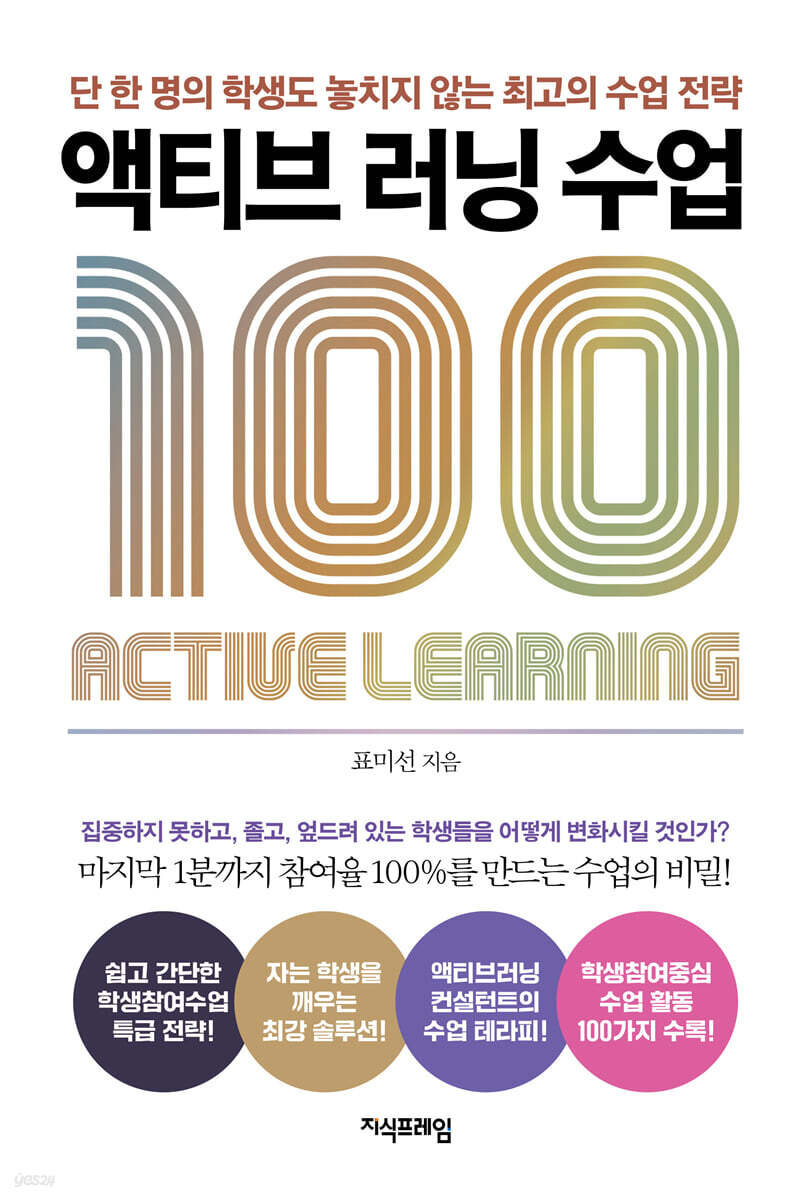
Active Learning Class 100
 |
Description
Book Introduction
No more boring classes where students are dozing off and lying down!
Until the last minute, not a single person is missed
100 Active Teaching Strategies
Any teacher dreams of creating meaningful and enjoyable classes where learning occurs for all students.
But what is the reality? Unfortunately, there are many students who doze off, chatter, do other things, or stare blankly at the blackboard.
What exactly is the problem?
This book offers concrete, practical solutions to energize and engage your classes right now.
This method involves breaking down a class into short mini-lectures and interspersing them with activities that increase students' concentration and interest.
100 fun activities that increase students' concentration, check their understanding, and develop their critical thinking and creativity will make boring lecture-style classes more active just by following along.
If you are a teacher who wants to create a class where everyone is happy, you will find simple but certain answers in this book.
Until the last minute, not a single person is missed
100 Active Teaching Strategies
Any teacher dreams of creating meaningful and enjoyable classes where learning occurs for all students.
But what is the reality? Unfortunately, there are many students who doze off, chatter, do other things, or stare blankly at the blackboard.
What exactly is the problem?
This book offers concrete, practical solutions to energize and engage your classes right now.
This method involves breaking down a class into short mini-lectures and interspersing them with activities that increase students' concentration and interest.
100 fun activities that increase students' concentration, check their understanding, and develop their critical thinking and creativity will make boring lecture-style classes more active just by following along.
If you are a teacher who wants to create a class where everyone is happy, you will find simple but certain answers in this book.
- You can preview some of the book's contents.
Preview
index
Introduction | How can we be happy in class?
Intro.
Transforming Classes with Active Learning
1.
Why Your Classes Are Ruined
2.
What is active learning?
3.
The 10-Minute Rule and the Interest Curve
4.
Splitting classes is key
5.
8 Active Learning Classroom Strategies
Part 1.
Activities to increase class concentration
1.
Mission Upside Down
2.
Twenty Questions Teaching Method
3.
Let's lecture among ourselves
4.
Concept test
5.
Peer teaching method
6.
Expected forecast
7.
Crocodile fortune telling
8.
Find the mistake
9.
Traffic light vocabulary
10.
Mindfulness Review
Part 2.
Easily check students' understanding
11.
Rock-paper-scissors
12.
Thumb strategy
13.
Tell me in color
14.
Comment Color Card
15.
Telepathy Thumbs Up
Part 3.
Creating Active Learning Classes Easily and Simply
16.
Summary of the mystery
17.
1 Minute Paper
18.
Think-Pair-Share
19.
Think-Pair-Write
20.
The last three sentences
21.
Find the mud
22.
Class admission ticket
23.
Class exit ticket
24.
3-2-1
25.
Pyramid 3-2-1
26.
Find the word
27. ABC Jumping Ball Presentation
28.
Summary of key keywords
29.
Keywords chosen by each person
Part 4.
Boost class energy with physical activity
30.
Problem Relay Race
31.
Classroom Olympics
32.
Fitness Dice
33.
Find a mate
34.
Classroom Beach Volleyball
35.
4-corner quiz
36.
Run, run!
37.
Problem snowball fight
38. True or False Quiz
Part 5.
When we need to develop students' thinking skills
39. HOT Question Dice
40.
Carousel
41.
Creative Matrix
42.
Four questions
43.
hot chair
44.
Color Card Discussion
45.
Problem Creator
46.
Peer Editor
47.
Diamond Ranking Discussion
48.
Jumping question strategy
49.
Discussion Briefing
50.
Thought Post-it
Part 6.
When you need to brainstorm
51.
Brain Writing
52.
Mix-and-match
53.
Instant drawing
54.
KEW chart
55.
KEE Chart
56.
Word Duel
57.
One mind! Speak out loud!
58.
Showdown! Speak out loud!
59.
Ga~Ha chart
60.
All in one lap
61.
If thinking ability
62.
See-Think-Wonder
63.
Imagination subtitles
Part 7.
End the unit with a game
64.
Yutnori
65.
Jeopardy Upside Down!
66.
Mud Quiz
67.
Jenga
68.
Group Challenge Golden Bell
69.
Partner's cheat sheet
70.
Review letter
71.
Concept Tree
72.
Problem fishing
Part 8.
Activities to end class in a fun way
73.
Taboo words
74.
Taboo card game
75.
Holey handwriting
76.
Summary of Silence
77.
Instant Picture Quiz
78.
Tell Me in Colors II
79.
Ready, set, go!
80.
Two truths, one lie
81.
Scramble sentences
82.
One Mind Hang Man
83.
Dice Game of Chance
84.
Pyramid Bingo
85.
Buddy Pyramid Bingo
86.
Tic-Tac-Toe
87.
sentence juggling
88.
Mini Pecha Kucha
89.
Complete the sentences
90.
Complete the sentences together
91.
Speedy Circle
92.
I praise you
Part 9.
When there is a lot of learning material to teach
93.
Guided Discovery Learning
94.
Person of the Year Interview
95.
Speed 10-Second Question Race
96.
One each
97.
Memory Run
98.
Review memory rush
99.
Memory Card Game
100.
traffic light highlighter
Intro.
Transforming Classes with Active Learning
1.
Why Your Classes Are Ruined
2.
What is active learning?
3.
The 10-Minute Rule and the Interest Curve
4.
Splitting classes is key
5.
8 Active Learning Classroom Strategies
Part 1.
Activities to increase class concentration
1.
Mission Upside Down
2.
Twenty Questions Teaching Method
3.
Let's lecture among ourselves
4.
Concept test
5.
Peer teaching method
6.
Expected forecast
7.
Crocodile fortune telling
8.
Find the mistake
9.
Traffic light vocabulary
10.
Mindfulness Review
Part 2.
Easily check students' understanding
11.
Rock-paper-scissors
12.
Thumb strategy
13.
Tell me in color
14.
Comment Color Card
15.
Telepathy Thumbs Up
Part 3.
Creating Active Learning Classes Easily and Simply
16.
Summary of the mystery
17.
1 Minute Paper
18.
Think-Pair-Share
19.
Think-Pair-Write
20.
The last three sentences
21.
Find the mud
22.
Class admission ticket
23.
Class exit ticket
24.
3-2-1
25.
Pyramid 3-2-1
26.
Find the word
27. ABC Jumping Ball Presentation
28.
Summary of key keywords
29.
Keywords chosen by each person
Part 4.
Boost class energy with physical activity
30.
Problem Relay Race
31.
Classroom Olympics
32.
Fitness Dice
33.
Find a mate
34.
Classroom Beach Volleyball
35.
4-corner quiz
36.
Run, run!
37.
Problem snowball fight
38. True or False Quiz
Part 5.
When we need to develop students' thinking skills
39. HOT Question Dice
40.
Carousel
41.
Creative Matrix
42.
Four questions
43.
hot chair
44.
Color Card Discussion
45.
Problem Creator
46.
Peer Editor
47.
Diamond Ranking Discussion
48.
Jumping question strategy
49.
Discussion Briefing
50.
Thought Post-it
Part 6.
When you need to brainstorm
51.
Brain Writing
52.
Mix-and-match
53.
Instant drawing
54.
KEW chart
55.
KEE Chart
56.
Word Duel
57.
One mind! Speak out loud!
58.
Showdown! Speak out loud!
59.
Ga~Ha chart
60.
All in one lap
61.
If thinking ability
62.
See-Think-Wonder
63.
Imagination subtitles
Part 7.
End the unit with a game
64.
Yutnori
65.
Jeopardy Upside Down!
66.
Mud Quiz
67.
Jenga
68.
Group Challenge Golden Bell
69.
Partner's cheat sheet
70.
Review letter
71.
Concept Tree
72.
Problem fishing
Part 8.
Activities to end class in a fun way
73.
Taboo words
74.
Taboo card game
75.
Holey handwriting
76.
Summary of Silence
77.
Instant Picture Quiz
78.
Tell Me in Colors II
79.
Ready, set, go!
80.
Two truths, one lie
81.
Scramble sentences
82.
One Mind Hang Man
83.
Dice Game of Chance
84.
Pyramid Bingo
85.
Buddy Pyramid Bingo
86.
Tic-Tac-Toe
87.
sentence juggling
88.
Mini Pecha Kucha
89.
Complete the sentences
90.
Complete the sentences together
91.
Speedy Circle
92.
I praise you
Part 9.
When there is a lot of learning material to teach
93.
Guided Discovery Learning
94.
Person of the Year Interview
95.
Speed 10-Second Question Race
96.
One each
97.
Memory Run
98.
Review memory rush
99.
Memory Card Game
100.
traffic light highlighter
Into the book
The reason why classes are conducted passively is surprisingly simple.
It is precisely because of the problem of “how the class is assembled.”
The problem can be solved by appropriately combining the teaching elements of “lecture” and “activity” in a way that awakens the brains and bodies of students who are prone.
But because they don't know how to assemble this, the class is filled with machines without the teacher knowing.
The teacher is a talking machine and the students are listening machines.
If you think about classes only from the teacher's perspective and not from the students' perspective, you will end up focusing only on "transferring" knowledge.
So the teacher becomes a “talking machine” that just keeps lecturing.
Ironically, the moment the teacher is constantly talking, the students run away from learning as best they can.
I'm so bored that I don't even know what to do, let alone learn.
But you have to sit still and mechanically look at the teacher.
Precious time passes, but unfortunately, no learning occurs.
A teacher's words that do not lead to learning become noise to the students.
---「Intro.
Transforming Classes with Active Learning: 1.
From “Why Teachers’ Classes Fail”
In classes where students do not have the opportunity to “actively and independently apply” the knowledge imparted by the teacher, it is natural for students to fall asleep.
Since this is a time when “learning” does not occur, there is no reason to focus on the teacher’s explanation.
So, if you want to bring your students to life in class, you must give them opportunities to actively use their minds, to move around, to actively connect with other learners, to create meaning and understand things for themselves, and to apply new knowledge on their own.
Only then can we say that the teacher “taught” the students and that “learning occurred”, that is, that the class was properly “constructed.”
Here's the secret to an active learning class that doesn't miss a single student.
It's about making classes active so students can continue to do something with the material they're learning.
We utilize all possible classroom activities in our lessons, including listening, speaking, reading, writing, questioning, answering, discussing, walking, running, throwing, memorizing, thinking, cooperating, competing, evaluating, criticizing, individual work, pair work, group work, and whole-class work.
So, the goal is to make students' brains, minds, and bodies actively participate in class, so that learning happens naturally.
In active classes, students never fall asleep.
I can't sleep.
Because something is going on, students have no other choice but to participate in class.
---「Intro.
Transforming Classes with Active Learning: 1.
From “Why Teachers’ Classes Fail”
So, what do students gain from "activity" in class? It's that they become naturally and actively involved in the learning process.
Students can monitor their own understanding of the knowledge conveyed in lectures while engaging in activities.
You can also expand your knowledge by adding your own thoughts and experiences.
And most importantly, you get the chance to make mistakes.
You will have the opportunity to realize your own shortcomings and to make up for them.
That is, through activities, you can give yourself feedback on your learning process.
This helps students take ownership of their own learning process, which in turn fosters self-efficacy and a sense of responsibility for their learning.
It's not just about adding depth to knowledge and understanding, but also improving learning skills and attitudes.
---「Intro.
Transforming Classes with Active Learning: 2.
From "What is Active Learning?"
The moment the class status board appears, the class becomes a board game for the students.
At the end of each activity, students' activities are immediately evaluated and true or false cards are posted on the class bulletin board.
Whenever a team does well, it accumulates O cards, and vice versa, the team loses O cards or even accumulates X cards.
Students can visually see how their responses, consideration, communication, and collaboration directly impact the team through the status board.
By showing the team's scores as they change from moment to moment, students will feel as if they are playing a board game throughout the class.
Teams that are leading are trying to maintain their position, while teams that are not are constantly stimulated to move forward.
---「Intro.
Transforming Classes with Active Learning: 5.
From "8 Active Learning Class Strategies"
The winning team strategy and the small success experience strategy are big factors that move students.
However, you may be concerned that classes may become too reliant on extrinsic motivations or rewards like “winning,” leading to overly heated competition among students.
Therefore, it is necessary to make it clear to students at the beginning of the school year that being a winning team is not the goal of teamwork.
Not only will learning efficiency improve, but by fully explaining the important social skills students gain from teamwork, such as collaboration, communication, and problem-solving, students will be able to enjoy learning even if they don't win.
It is precisely because of the problem of “how the class is assembled.”
The problem can be solved by appropriately combining the teaching elements of “lecture” and “activity” in a way that awakens the brains and bodies of students who are prone.
But because they don't know how to assemble this, the class is filled with machines without the teacher knowing.
The teacher is a talking machine and the students are listening machines.
If you think about classes only from the teacher's perspective and not from the students' perspective, you will end up focusing only on "transferring" knowledge.
So the teacher becomes a “talking machine” that just keeps lecturing.
Ironically, the moment the teacher is constantly talking, the students run away from learning as best they can.
I'm so bored that I don't even know what to do, let alone learn.
But you have to sit still and mechanically look at the teacher.
Precious time passes, but unfortunately, no learning occurs.
A teacher's words that do not lead to learning become noise to the students.
---「Intro.
Transforming Classes with Active Learning: 1.
From “Why Teachers’ Classes Fail”
In classes where students do not have the opportunity to “actively and independently apply” the knowledge imparted by the teacher, it is natural for students to fall asleep.
Since this is a time when “learning” does not occur, there is no reason to focus on the teacher’s explanation.
So, if you want to bring your students to life in class, you must give them opportunities to actively use their minds, to move around, to actively connect with other learners, to create meaning and understand things for themselves, and to apply new knowledge on their own.
Only then can we say that the teacher “taught” the students and that “learning occurred”, that is, that the class was properly “constructed.”
Here's the secret to an active learning class that doesn't miss a single student.
It's about making classes active so students can continue to do something with the material they're learning.
We utilize all possible classroom activities in our lessons, including listening, speaking, reading, writing, questioning, answering, discussing, walking, running, throwing, memorizing, thinking, cooperating, competing, evaluating, criticizing, individual work, pair work, group work, and whole-class work.
So, the goal is to make students' brains, minds, and bodies actively participate in class, so that learning happens naturally.
In active classes, students never fall asleep.
I can't sleep.
Because something is going on, students have no other choice but to participate in class.
---「Intro.
Transforming Classes with Active Learning: 1.
From “Why Teachers’ Classes Fail”
So, what do students gain from "activity" in class? It's that they become naturally and actively involved in the learning process.
Students can monitor their own understanding of the knowledge conveyed in lectures while engaging in activities.
You can also expand your knowledge by adding your own thoughts and experiences.
And most importantly, you get the chance to make mistakes.
You will have the opportunity to realize your own shortcomings and to make up for them.
That is, through activities, you can give yourself feedback on your learning process.
This helps students take ownership of their own learning process, which in turn fosters self-efficacy and a sense of responsibility for their learning.
It's not just about adding depth to knowledge and understanding, but also improving learning skills and attitudes.
---「Intro.
Transforming Classes with Active Learning: 2.
From "What is Active Learning?"
The moment the class status board appears, the class becomes a board game for the students.
At the end of each activity, students' activities are immediately evaluated and true or false cards are posted on the class bulletin board.
Whenever a team does well, it accumulates O cards, and vice versa, the team loses O cards or even accumulates X cards.
Students can visually see how their responses, consideration, communication, and collaboration directly impact the team through the status board.
By showing the team's scores as they change from moment to moment, students will feel as if they are playing a board game throughout the class.
Teams that are leading are trying to maintain their position, while teams that are not are constantly stimulated to move forward.
---「Intro.
Transforming Classes with Active Learning: 5.
From "8 Active Learning Class Strategies"
The winning team strategy and the small success experience strategy are big factors that move students.
However, you may be concerned that classes may become too reliant on extrinsic motivations or rewards like “winning,” leading to overly heated competition among students.
Therefore, it is necessary to make it clear to students at the beginning of the school year that being a winning team is not the goal of teamwork.
Not only will learning efficiency improve, but by fully explaining the important social skills students gain from teamwork, such as collaboration, communication, and problem-solving, students will be able to enjoy learning even if they don't win.
---「Intro.
Transforming Classes with Active Learning: 5.
From "8 Active Learning Class Strategies"
Transforming Classes with Active Learning: 5.
From "8 Active Learning Class Strategies"
Publisher's Review
From a failing class to a thriving class!
What strategies should teachers use to create engaging classes? This book's "Intro.
In "Changing Classes with Active Learning," we examine the reasons why teachers' classes are conducted passively and propose "active learning" as a solution to overcome this.
To achieve this, the author says, we must first reflect on our own teaching style and have the courage to step out of our comfort zone.
No matter how good a lecture is, if it is not properly conveyed to students, it is just noise.
The active learning method proposed in this book has been proven effective through numerous studies and is already being used at several American universities, including Harvard University.
Active learning, which understands students' concentration span and incorporates the "interest curve" derived from game theory into classes, is a powerful teaching method that truly keeps students engaged throughout class time.
Students don't have the luxury of dozing off or doing other things.
In particular, active learning can flexibly change the means of expression, activity time, activity form, and level of thinking ability according to the purpose and situation.
Therefore, it is possible to provide individualized learning that meets the learner's capabilities and diverse learning styles through various configurations, and it has the advantage that even general lecture-style classes can be transformed into active learning classes with just a few modifications to the existing method.
8 Teaching Strategies to Make Classes Interesting
This book introduces eight active learning teaching strategies that help students actively participate and engage in class.
These include: 'team-based learning, providing immediate feedback, using class progress boards, providing opportunities for mistakes, providing experiences of success, building balanced teams, promoting individual accountability through seat numbers, and providing unpredictable and exciting ways to participate.'
These novel and innovative teaching strategies stimulate students' reason and emotions, add vitality to classes, and help students engage.
Team classes, which add vitality to active learning classes, are conducted based on the principle that all teams are composed of similar levels, and if a team wins or makes a comeback three or more times, it is reorganized into a new team.
Additionally, they use 'OX cards' to give students feedback at every moment and make them reflect on their mistakes, and they also use a strategy of creating a 'class status board' to make the class itself into a board game.
You can also assign seat numbers to prevent free riders from participating in the class, and use the "Cup of Destiny" to create an interesting sense of tension, as anyone can be chosen, adding some new energy to the class.
By utilizing the eight teaching strategies presented in this book, you can create an active learning class that leaves no room for boredom or tedium, and doesn't miss a single student from beginning to end.
100 Activities to Create Active Classes
Active learning activities can be used in a variety of situations, such as when beginning and ending a class, when students' concentration is waning, when checking students' understanding, when brainstorming is needed, when class energy through physical activity is needed, when thinking skills need to be improved, and when there is a lot of learning material to cover in class.
This book presents 100 active learning activities divided into 9 parts, each type.
The method and purpose of each activity are explained in detail, and examples of classes actually used by the author are provided along with activity sheets.
Additionally, the contents of 'Plus Tips' allow for various variations of activities and in-depth class progress.
Anyone can easily and simply conduct active learning classes through 100 activities that will make classes more enjoyable just by following along.
What strategies should teachers use to create engaging classes? This book's "Intro.
In "Changing Classes with Active Learning," we examine the reasons why teachers' classes are conducted passively and propose "active learning" as a solution to overcome this.
To achieve this, the author says, we must first reflect on our own teaching style and have the courage to step out of our comfort zone.
No matter how good a lecture is, if it is not properly conveyed to students, it is just noise.
The active learning method proposed in this book has been proven effective through numerous studies and is already being used at several American universities, including Harvard University.
Active learning, which understands students' concentration span and incorporates the "interest curve" derived from game theory into classes, is a powerful teaching method that truly keeps students engaged throughout class time.
Students don't have the luxury of dozing off or doing other things.
In particular, active learning can flexibly change the means of expression, activity time, activity form, and level of thinking ability according to the purpose and situation.
Therefore, it is possible to provide individualized learning that meets the learner's capabilities and diverse learning styles through various configurations, and it has the advantage that even general lecture-style classes can be transformed into active learning classes with just a few modifications to the existing method.
8 Teaching Strategies to Make Classes Interesting
This book introduces eight active learning teaching strategies that help students actively participate and engage in class.
These include: 'team-based learning, providing immediate feedback, using class progress boards, providing opportunities for mistakes, providing experiences of success, building balanced teams, promoting individual accountability through seat numbers, and providing unpredictable and exciting ways to participate.'
These novel and innovative teaching strategies stimulate students' reason and emotions, add vitality to classes, and help students engage.
Team classes, which add vitality to active learning classes, are conducted based on the principle that all teams are composed of similar levels, and if a team wins or makes a comeback three or more times, it is reorganized into a new team.
Additionally, they use 'OX cards' to give students feedback at every moment and make them reflect on their mistakes, and they also use a strategy of creating a 'class status board' to make the class itself into a board game.
You can also assign seat numbers to prevent free riders from participating in the class, and use the "Cup of Destiny" to create an interesting sense of tension, as anyone can be chosen, adding some new energy to the class.
By utilizing the eight teaching strategies presented in this book, you can create an active learning class that leaves no room for boredom or tedium, and doesn't miss a single student from beginning to end.
100 Activities to Create Active Classes
Active learning activities can be used in a variety of situations, such as when beginning and ending a class, when students' concentration is waning, when checking students' understanding, when brainstorming is needed, when class energy through physical activity is needed, when thinking skills need to be improved, and when there is a lot of learning material to cover in class.
This book presents 100 active learning activities divided into 9 parts, each type.
The method and purpose of each activity are explained in detail, and examples of classes actually used by the author are provided along with activity sheets.
Additionally, the contents of 'Plus Tips' allow for various variations of activities and in-depth class progress.
Anyone can easily and simply conduct active learning classes through 100 activities that will make classes more enjoyable just by following along.
GOODS SPECIFICS
- Publication date: October 11, 2021
- Page count, weight, size: 352 pages | 604g | 152*225*30mm
- ISBN13: 9788994655994
- ISBN10: 8994655999
You may also like
카테고리
korean


korean

![GQ KOREA Mark (Monthly): December [2025]](http://librairie.coreenne.fr/cdn/shop/files/8ef265dbbfbf186523ed75ba7319009d.jpg?v=1765340328&width=3840)


