

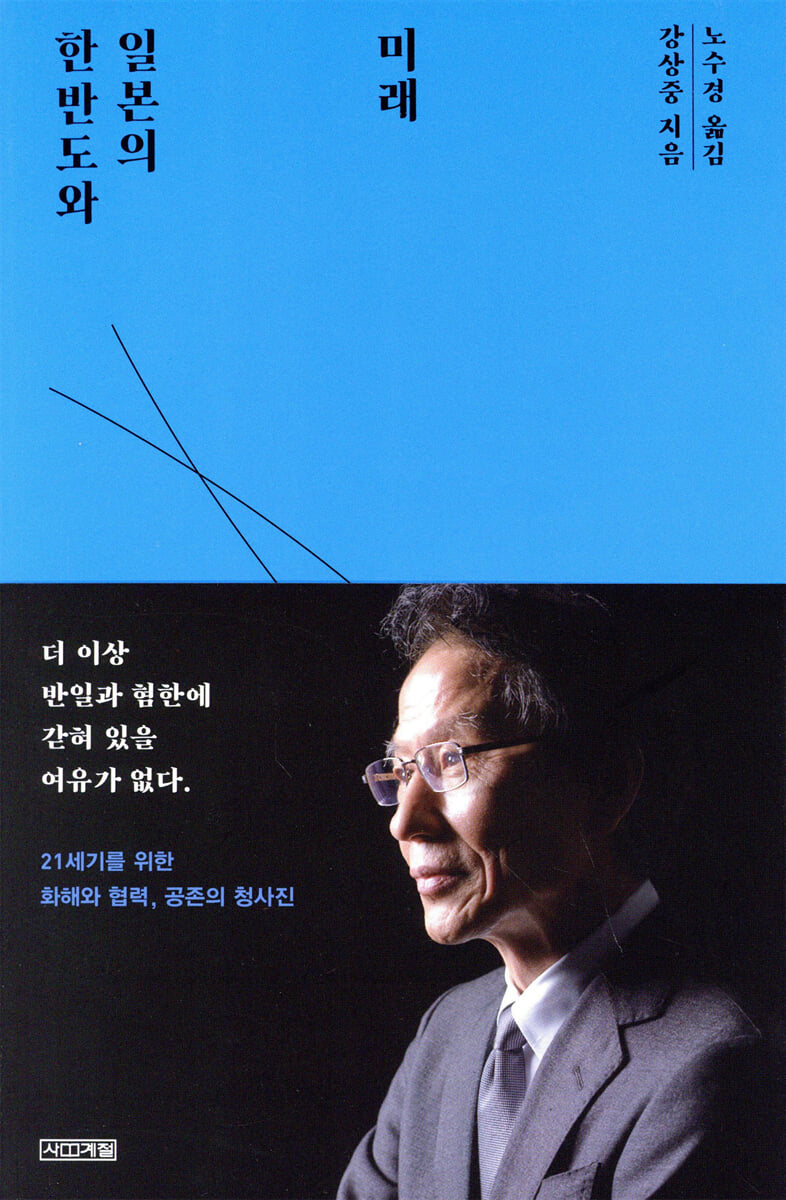
The Future of the Korean Peninsula and Japan
 |
Description
Book Introduction
- A word from MD
- Relations between South Korea and Japan reached their worst point in 2019 when Japan excluded South Korea from its whitelist.
This situation must have been complicated for Kang Sang-jung, a second-generation Korean resident in Japan who has been talking about peace and coexistence in Northeast Asia.
In this book, Kang Sang-jung summarizes the events that have occurred over the past 70 years and sketches out the future we will create.
- Son Min-gyu, Social and Political MD
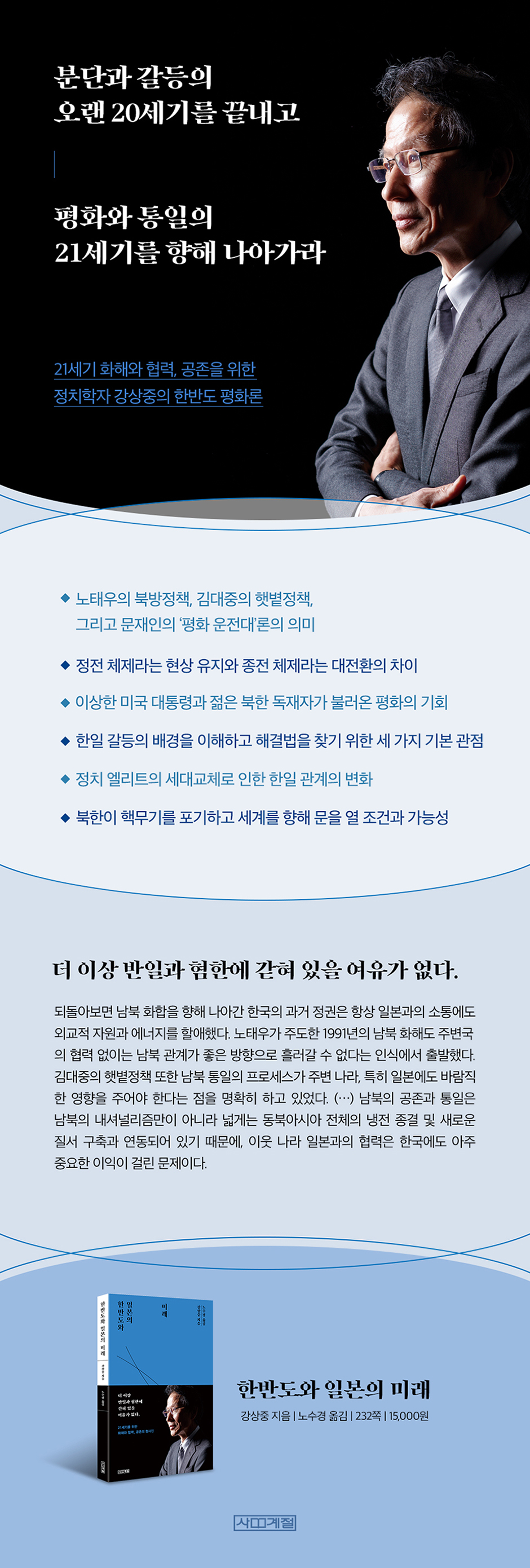
Ending the long 20th century of division and conflict
Moving towards a 21st century of peace and unification
Kang Sang-jung, who was born in the year the Korean War broke out, placed the peaceful unification of the Korean Peninsula at the center of his life.
His identity as a second-generation Korean born in Japan and the confrontation between his homeland divided into North and South made him a "being on the border" who did not belong anywhere.
Standing on this boundary, he explained the meaning of events that occurred on the Korean Peninsula, Japan, and in neighboring countries, and summarized the conflicts and attempts at peace that occurred within them.
As a result, it was confirmed that the only way to end the conflict surrounding the Korean Peninsula and Japan was to dismantle the division system on the Korean Peninsula.
In this book, Kang Sang-jung does not stop at explaining the future of the Korean Peninsula and Japan based on his own experiences and senses.
He presents a more objective and persuasive future based on the diplomatic negotiations and resulting agreements and treaties between South Korea, North Korea, the United States, Japan, China, and Russia over the past 70 years.
Through this work, we can confirm that the currents of cooperation between the Korean Peninsula and its neighbors are finally beginning to converge and flow in one direction.
Moving towards a 21st century of peace and unification
Kang Sang-jung, who was born in the year the Korean War broke out, placed the peaceful unification of the Korean Peninsula at the center of his life.
His identity as a second-generation Korean born in Japan and the confrontation between his homeland divided into North and South made him a "being on the border" who did not belong anywhere.
Standing on this boundary, he explained the meaning of events that occurred on the Korean Peninsula, Japan, and in neighboring countries, and summarized the conflicts and attempts at peace that occurred within them.
As a result, it was confirmed that the only way to end the conflict surrounding the Korean Peninsula and Japan was to dismantle the division system on the Korean Peninsula.
In this book, Kang Sang-jung does not stop at explaining the future of the Korean Peninsula and Japan based on his own experiences and senses.
He presents a more objective and persuasive future based on the diplomatic negotiations and resulting agreements and treaties between South Korea, North Korea, the United States, Japan, China, and Russia over the past 70 years.
Through this work, we can confirm that the currents of cooperation between the Korean Peninsula and its neighbors are finally beginning to converge and flow in one direction.
- You can preview some of the book's contents.
Preview
index
Entering 4
Chapter 1.
Crisis of Transition
Crisis is Opportunity 13
From Hostility to Compromise and Cooperation 15
Chilling Korea-Japan Relations 18
Three Perspectives on the Relations Between the Two Countries 21
Clash of National Identities 24
The Korean Peninsula's Long 20th Century 25
Structure of this book 27
Chapter 2.
Why didn't North Korea collapse?
North Korea's Demand for Denuclearization of the Korean Peninsula 33
1994: The Beginning of Crisis, Crossroads of Destruction 36
The Geneva Agreement and Sudden Death 40
Is North Korea the embodiment of "absolute evil"?
North Korea's Early Collapse Scenario 45
Lost Opportunity 47
Changes in North Korea and Kim Dae-jung's Sunshine Policy 49
2000, 51 years before the normalization of diplomatic relations between North Korea and the United States
A Shaken America and an Unwavering North Korea 53
Chapter 3.
30 Years of Inter-Korean Reconciliation and the "Reverse Course"
The Historical Inevitability of the Moon Jae-in Administration 57
Preceding Model 59: The Unification of West and East Germany
Diverging Dreams Between Korea, the US, and Japan 61
The Importance of the 1991 Inter-Korean Basic Agreement 62
The Kim Young-sam Administration's Backsliding 63
Friendly Korea-Japan Relations 65
The Unification Process 67 Created by Kim Dae-jung
Blackout from Euphoria 70
Background to Koizumi's Visit to North Korea 71
The upgraded "North Korea-Japan Pyongyang Declaration" 72
Lost Initiative 73
The Second Nuclear Crisis and the Failure of the Hardline Policy 75
Key Points of the Joint Statement of the Fourth Six-Party Talks
The Third Chance That Turned into a Pie in the Sky 78
Obama and the Lost Decade 80
What's Changed in 30 Years 82
Chapter 4.
The worst post-war Korea-Japan relations
Tal-a entrance and Shunchibogeo 85
Four Limitations of Korea-Japan Relations 87
Ambiguous Agreement 95
$500 million in grants and loans and a trade surplus of $99 million
Opening Pandora's Box 101
From Hope to Conflict 102
The "History Wars" Fueled by the United States 104
Dizzying Japanese Politics and the Conversation 106
107 Landmines Stepped on by Lee Myung-bak
The Curse of History 109
The Inside Story of the "Comfort Women Agreement" 111
Historical Faults in the Forced Conscription Issue 113
The Impact of the Japanese Boycott 115
The Truth Behind the Termination of GSOMIA 117
South Korea's rapidly increasing defense budget 118
Moon Jae-in Needs Ji-il 120
The Whereabouts of Nationalism 123
Differences Between Kim Dae-jung and Moon Jae-in 125
Moon Jae-in's approval rating is 126.
127 Reasons Why We Must Uphold the Japan-ROK Basic Treaty
Chapter 5.
Korean Endgame
Endgame 133
History's Spiral Staircase Toward Unification 134
What Has Kim Jong-un Changed in North Korea? 138
Crisis 140 of 2017
Moon Jae-in's "Berlin Plan" and North Korea's Criticism 142
The PyeongChang Olympics: A Turning Point 143
Japan 145, just stepping on the brakes
The Significance of the Panmunjom Declaration and the First North Korea-US Summit 147
The Strange American President, Donald Trump 149
North Korea Awaits Trump's Re-election 151
The unrealistic nature of military options 154
The possibility that North Korea will give up its nuclear weapons is 155.
Should Japan Possess Nuclear Weapons? 158
159 To resolve the kidnapping issue
Korea's Limitations and Japan's Potential 161
Is the unification of North and South Korea a threat to Japan? 163
New Balance of Power, New Opportunities 164
A Long Journey Around the Korean Peninsula 165
Chapter 6: The Future of the Korean Peninsula and Japan
The End of the Cold War Hegemony Competition 169
Freedom from Hostile Doctrine 172
Bilateral/Multilateral Negotiations and Japan's Role 174
In conclusion 181
Translator's Note 185
Appendix 189
Chapter 1.
Crisis of Transition
Crisis is Opportunity 13
From Hostility to Compromise and Cooperation 15
Chilling Korea-Japan Relations 18
Three Perspectives on the Relations Between the Two Countries 21
Clash of National Identities 24
The Korean Peninsula's Long 20th Century 25
Structure of this book 27
Chapter 2.
Why didn't North Korea collapse?
North Korea's Demand for Denuclearization of the Korean Peninsula 33
1994: The Beginning of Crisis, Crossroads of Destruction 36
The Geneva Agreement and Sudden Death 40
Is North Korea the embodiment of "absolute evil"?
North Korea's Early Collapse Scenario 45
Lost Opportunity 47
Changes in North Korea and Kim Dae-jung's Sunshine Policy 49
2000, 51 years before the normalization of diplomatic relations between North Korea and the United States
A Shaken America and an Unwavering North Korea 53
Chapter 3.
30 Years of Inter-Korean Reconciliation and the "Reverse Course"
The Historical Inevitability of the Moon Jae-in Administration 57
Preceding Model 59: The Unification of West and East Germany
Diverging Dreams Between Korea, the US, and Japan 61
The Importance of the 1991 Inter-Korean Basic Agreement 62
The Kim Young-sam Administration's Backsliding 63
Friendly Korea-Japan Relations 65
The Unification Process 67 Created by Kim Dae-jung
Blackout from Euphoria 70
Background to Koizumi's Visit to North Korea 71
The upgraded "North Korea-Japan Pyongyang Declaration" 72
Lost Initiative 73
The Second Nuclear Crisis and the Failure of the Hardline Policy 75
Key Points of the Joint Statement of the Fourth Six-Party Talks
The Third Chance That Turned into a Pie in the Sky 78
Obama and the Lost Decade 80
What's Changed in 30 Years 82
Chapter 4.
The worst post-war Korea-Japan relations
Tal-a entrance and Shunchibogeo 85
Four Limitations of Korea-Japan Relations 87
Ambiguous Agreement 95
$500 million in grants and loans and a trade surplus of $99 million
Opening Pandora's Box 101
From Hope to Conflict 102
The "History Wars" Fueled by the United States 104
Dizzying Japanese Politics and the Conversation 106
107 Landmines Stepped on by Lee Myung-bak
The Curse of History 109
The Inside Story of the "Comfort Women Agreement" 111
Historical Faults in the Forced Conscription Issue 113
The Impact of the Japanese Boycott 115
The Truth Behind the Termination of GSOMIA 117
South Korea's rapidly increasing defense budget 118
Moon Jae-in Needs Ji-il 120
The Whereabouts of Nationalism 123
Differences Between Kim Dae-jung and Moon Jae-in 125
Moon Jae-in's approval rating is 126.
127 Reasons Why We Must Uphold the Japan-ROK Basic Treaty
Chapter 5.
Korean Endgame
Endgame 133
History's Spiral Staircase Toward Unification 134
What Has Kim Jong-un Changed in North Korea? 138
Crisis 140 of 2017
Moon Jae-in's "Berlin Plan" and North Korea's Criticism 142
The PyeongChang Olympics: A Turning Point 143
Japan 145, just stepping on the brakes
The Significance of the Panmunjom Declaration and the First North Korea-US Summit 147
The Strange American President, Donald Trump 149
North Korea Awaits Trump's Re-election 151
The unrealistic nature of military options 154
The possibility that North Korea will give up its nuclear weapons is 155.
Should Japan Possess Nuclear Weapons? 158
159 To resolve the kidnapping issue
Korea's Limitations and Japan's Potential 161
Is the unification of North and South Korea a threat to Japan? 163
New Balance of Power, New Opportunities 164
A Long Journey Around the Korean Peninsula 165
Chapter 6: The Future of the Korean Peninsula and Japan
The End of the Cold War Hegemony Competition 169
Freedom from Hostile Doctrine 172
Bilateral/Multilateral Negotiations and Japan's Role 174
In conclusion 181
Translator's Note 185
Appendix 189
Detailed image
Into the book
North Korea's sudden change of policy and the start of nuclear development coincided with the movement toward the end of the Cold War.
This led to a series of events known as the nuclear crisis.
With the end of the Cold War and the collapse of the Soviet Union and Eastern European socialist countries, North Korea was left in a difficult situation, facing two challenges: security and economic reconstruction.
The biggest turning point was the active diplomacy of Roh Tae-woo, who became president as a result of the democratization of Korea in 1987 and the implementation of a direct presidential election system.
South Korea established diplomatic relations not only with the Soviet Union, which backed North Korea, but also with China.
As a result, not only did the security that North Korea enjoyed under the Soviet nuclear umbrella no longer hold, but its economy, which had relied on Soviet aid, also fell into ruin.
To make matters worse, as the communist regimes in Eastern Europe collapsed one after another, North Korea's isolation deepened.
--- p.36, from “1994: The Beginning of Crisis, the Crossroads of Destruction”
Among the words used to describe the country called North Korea, there is the word 'guerrilla state'.
Kim Il-sung's youth, when he was active as a fighter in the anti-Japanese guerrilla war in Manchuria, became a founding myth of North Korea.
North Korea, which adopted the guerrillas' principles of action as the core ideology of the state, appealed to its citizens to "fight like anti-Japanese guerrillas" whenever the country faced a crisis, and demanded that all citizens "follow the leader, the sole commander of our guerrillas."
It is perhaps natural that North Korea, after the Korean War, has transformed into a barracks state constantly preparing for war.
After Kim Il-sung's death, North Korea experienced an economic collapse and food crisis in the mid-1990s, and developed the "military-first" ideology, in which Supreme Commander Kim Jong-il and the military manage and act on behalf of the state and the party.
As Haruki Wada said, North Korea during the Kim Jong-il era could be described as a “regular military state.”
--- p.42~43, from “Is North Korea the Incarnation of ‘Absolute Evil’?”
The Obama administration adopted a policy of "strategic patience" to address the turmoil in Northeast Asia, but has done little in practice.
The Obama administration's basic stance was multilateralism, which was far from North Korea's obsession with bilateral negotiations with the United States.
The Obama administration called on South Korea, the United States, and Japan to work together to respond to North Korea and for China to also apply pressure on North Korea.
However, South Korea and Japan were unable to adopt a policy of engagement with North Korea due to the aforementioned circumstances.
The situation only got worse.
--- p.81, from “Obama and the Lost Decade”
The "Korea-Japan Basic Treaty" contained deep rifts surrounding its interpretation.
Article 2 of the treaty states, “It is confirmed that all treaties and agreements concluded between the Empire of Korea and the Empire of Japan on or before August 22, 1910, are already null and void.”
However, the word 'already' (もはや in Japanese) is a product of compromise that ambiguously ended the conflict of opinions between the two countries.
The two sides had different interpretations of 'already invalid'.
Korea has not changed its position that the 1910 Japan-Korea Annexation Treaty was concluded by Japan using its power to trample on Korea's sovereignty, and was therefore illegal from the very beginning, meaning it is null and void.
This showed a significant difference from Japan's perception of the legitimacy of the Japan-Korea Annexation Treaty.
These two different perspectives still run parallel.
--- p.97~98, from “Ambiguous Agreement”
As the Korean people failed to accept the "Comfort Women Agreement," a final and irreversible resolution to the comfort women issue was not realized.
Moon Jae-in, who was elected as the next president after Park Geun-hye was impeached for the first time in South Korea's constitutional history, put the brakes on the implementation of the "Comfort Women Agreement."
The "Comfort Women Agreement" is an official decision between governments.
Therefore, President Moon Jae-in, who took office in May 2017, was unable to carry out his campaign promise to “renegotiate the Korea-Japan agreement,” but as a result of this agreement, he dissolved the “Reconciliation and Healing Foundation,” which was established to support comfort women victims, in November 2018.
Japan strongly protested this, saying it was a violation of the agreement, and Korea-Japan relations fell into a quagmire.
--- p.112, from “The Inside Story of the Comfort Women Agreement”
For President Moon Jae-in, Japan is essentially a "blank slate" of neighboring countries.
He is not adamantly anti-Japanese, nor does he have any affinity for Japan, and he is certainly not a "pro-Japanese" person.
This is not so much a characteristic of Moon Jae-in as an individual, but rather an inevitable result of the generational shift in Korean politics.
The president's staff also show similar tendencies, and in fact, the situation in Japanese politics is no different.
It cannot be denied that the current conflict between Korea and Japan is rooted in the gap between new generations who, as generations change, are unable to grasp the resentment of the past.
--- p.121, from “Moon Jae-in Needs ‘Ji-il’”
Whether it is the "Republic of Korea-Japan Basic Treaty" or the 2015 "Comfort Women Agreement," adhering to intergovernmental decisions is essential to maintaining normal relations between countries.
We must maintain the basic principles and framework of this treaty, while evolving with the times and increasing mutual cooperation to achieve a more desirable future.
The basis of the issues of forced labor and comfort women is the interpretation of ‘individual claims.’
In an age of constant change, the question we face is, "What will we draw from the crucible of history?"
(…) Regarding historical issues between Korea and Japan, we must move forward while tenaciously understanding each other’s positions and keeping pace with national sentiment, while carefully observing the light and shadow of Germany.
To achieve this, mutual compliance with the Japan-ROK Basic Treaty is essential, and the two countries must compromise and cooperate based on this.
--- p.128~129, from “Reasons for Maintaining the Japan-ROK Basic Treaty”
A confrontational structure was created between the two countries as Japan was suspicious of South Korea, which was leading the way in promoting reconciliation between the North and South, and South Korea thought that Japan was holding them back.
However, if things had gone as planned, it would have been Japan, an ally of the United States and with greater national power, rather than South Korea, who should have stepped in and acted as a mediator between North Korea and the United States to resolve the abduction issue, which is a matter of national concern.
(…) A hard-line policy toward North Korea that focuses solely on pressure may temporarily gain public support.
But diplomacy is fundamentally a game of compromise.
Therefore, policies that only follow public opinion are bound to reveal their limitations at some point.
--- p.146, from “Japan Only Hits the Brakes”
In Japan, there are concerns that if North and South Korea are unified, the Moon Jae-in administration will attempt to break away from the South Korea-US-Japan security guarantee system and move closer to China.
Even if it doesn't reach that level, there is also a growing concern that if North and South Korea become closer, the two countries may jointly pressure Japan.
There is also concern that if tensions on the Korean Peninsula ease, the withdrawal of US troops from South Korea will create a power vacuum, allowing North Korea and China to expand their influence.
There is concern that the Military Demarcation Line, which was fixed at the waist of the Korean Peninsula, will move south to the Korea Strait, threatening Japan's security.
If we understand the content of the various agreements exchanged between South and North Korea to date, we can see that this "unification threat theory" is nothing more than a groundless worry.
--- p.163, from “Is the unification of North and South Korea a threat to Japan?”
The power game between the superpowers will have an impact on the Korean Peninsula as a geopolitical hub where they check each other, and on the division of the peninsula.
However, between the United States, which acknowledges the victory of the Cold War, and the emerging power China, the "rule of hostile interdependence" that tacitly recognizes each other's spheres of influence, as in the Cold War, while not interfering in the "backyard" of the superpowers in principle, is not in operation.
Because China, which has become the world's second-largest economy, occupies a central position in the capitalist world order, unlike the former Soviet Union, which could only occupy a "semi-central" position at best.
Therefore, in order to contain China, the United States must also be prepared to sacrifice its own interests.
(…) Then, it is no longer a zero-sum game-like Cold War-style hegemony competition where China’s loss is America’s gain and America’s loss is China’s gain.
It cannot stabilize the world order.
This newly emerging pattern could be applied to inter-Korean relations as well as South Korea-Japan relations.
This led to a series of events known as the nuclear crisis.
With the end of the Cold War and the collapse of the Soviet Union and Eastern European socialist countries, North Korea was left in a difficult situation, facing two challenges: security and economic reconstruction.
The biggest turning point was the active diplomacy of Roh Tae-woo, who became president as a result of the democratization of Korea in 1987 and the implementation of a direct presidential election system.
South Korea established diplomatic relations not only with the Soviet Union, which backed North Korea, but also with China.
As a result, not only did the security that North Korea enjoyed under the Soviet nuclear umbrella no longer hold, but its economy, which had relied on Soviet aid, also fell into ruin.
To make matters worse, as the communist regimes in Eastern Europe collapsed one after another, North Korea's isolation deepened.
--- p.36, from “1994: The Beginning of Crisis, the Crossroads of Destruction”
Among the words used to describe the country called North Korea, there is the word 'guerrilla state'.
Kim Il-sung's youth, when he was active as a fighter in the anti-Japanese guerrilla war in Manchuria, became a founding myth of North Korea.
North Korea, which adopted the guerrillas' principles of action as the core ideology of the state, appealed to its citizens to "fight like anti-Japanese guerrillas" whenever the country faced a crisis, and demanded that all citizens "follow the leader, the sole commander of our guerrillas."
It is perhaps natural that North Korea, after the Korean War, has transformed into a barracks state constantly preparing for war.
After Kim Il-sung's death, North Korea experienced an economic collapse and food crisis in the mid-1990s, and developed the "military-first" ideology, in which Supreme Commander Kim Jong-il and the military manage and act on behalf of the state and the party.
As Haruki Wada said, North Korea during the Kim Jong-il era could be described as a “regular military state.”
--- p.42~43, from “Is North Korea the Incarnation of ‘Absolute Evil’?”
The Obama administration adopted a policy of "strategic patience" to address the turmoil in Northeast Asia, but has done little in practice.
The Obama administration's basic stance was multilateralism, which was far from North Korea's obsession with bilateral negotiations with the United States.
The Obama administration called on South Korea, the United States, and Japan to work together to respond to North Korea and for China to also apply pressure on North Korea.
However, South Korea and Japan were unable to adopt a policy of engagement with North Korea due to the aforementioned circumstances.
The situation only got worse.
--- p.81, from “Obama and the Lost Decade”
The "Korea-Japan Basic Treaty" contained deep rifts surrounding its interpretation.
Article 2 of the treaty states, “It is confirmed that all treaties and agreements concluded between the Empire of Korea and the Empire of Japan on or before August 22, 1910, are already null and void.”
However, the word 'already' (もはや in Japanese) is a product of compromise that ambiguously ended the conflict of opinions between the two countries.
The two sides had different interpretations of 'already invalid'.
Korea has not changed its position that the 1910 Japan-Korea Annexation Treaty was concluded by Japan using its power to trample on Korea's sovereignty, and was therefore illegal from the very beginning, meaning it is null and void.
This showed a significant difference from Japan's perception of the legitimacy of the Japan-Korea Annexation Treaty.
These two different perspectives still run parallel.
--- p.97~98, from “Ambiguous Agreement”
As the Korean people failed to accept the "Comfort Women Agreement," a final and irreversible resolution to the comfort women issue was not realized.
Moon Jae-in, who was elected as the next president after Park Geun-hye was impeached for the first time in South Korea's constitutional history, put the brakes on the implementation of the "Comfort Women Agreement."
The "Comfort Women Agreement" is an official decision between governments.
Therefore, President Moon Jae-in, who took office in May 2017, was unable to carry out his campaign promise to “renegotiate the Korea-Japan agreement,” but as a result of this agreement, he dissolved the “Reconciliation and Healing Foundation,” which was established to support comfort women victims, in November 2018.
Japan strongly protested this, saying it was a violation of the agreement, and Korea-Japan relations fell into a quagmire.
--- p.112, from “The Inside Story of the Comfort Women Agreement”
For President Moon Jae-in, Japan is essentially a "blank slate" of neighboring countries.
He is not adamantly anti-Japanese, nor does he have any affinity for Japan, and he is certainly not a "pro-Japanese" person.
This is not so much a characteristic of Moon Jae-in as an individual, but rather an inevitable result of the generational shift in Korean politics.
The president's staff also show similar tendencies, and in fact, the situation in Japanese politics is no different.
It cannot be denied that the current conflict between Korea and Japan is rooted in the gap between new generations who, as generations change, are unable to grasp the resentment of the past.
--- p.121, from “Moon Jae-in Needs ‘Ji-il’”
Whether it is the "Republic of Korea-Japan Basic Treaty" or the 2015 "Comfort Women Agreement," adhering to intergovernmental decisions is essential to maintaining normal relations between countries.
We must maintain the basic principles and framework of this treaty, while evolving with the times and increasing mutual cooperation to achieve a more desirable future.
The basis of the issues of forced labor and comfort women is the interpretation of ‘individual claims.’
In an age of constant change, the question we face is, "What will we draw from the crucible of history?"
(…) Regarding historical issues between Korea and Japan, we must move forward while tenaciously understanding each other’s positions and keeping pace with national sentiment, while carefully observing the light and shadow of Germany.
To achieve this, mutual compliance with the Japan-ROK Basic Treaty is essential, and the two countries must compromise and cooperate based on this.
--- p.128~129, from “Reasons for Maintaining the Japan-ROK Basic Treaty”
A confrontational structure was created between the two countries as Japan was suspicious of South Korea, which was leading the way in promoting reconciliation between the North and South, and South Korea thought that Japan was holding them back.
However, if things had gone as planned, it would have been Japan, an ally of the United States and with greater national power, rather than South Korea, who should have stepped in and acted as a mediator between North Korea and the United States to resolve the abduction issue, which is a matter of national concern.
(…) A hard-line policy toward North Korea that focuses solely on pressure may temporarily gain public support.
But diplomacy is fundamentally a game of compromise.
Therefore, policies that only follow public opinion are bound to reveal their limitations at some point.
--- p.146, from “Japan Only Hits the Brakes”
In Japan, there are concerns that if North and South Korea are unified, the Moon Jae-in administration will attempt to break away from the South Korea-US-Japan security guarantee system and move closer to China.
Even if it doesn't reach that level, there is also a growing concern that if North and South Korea become closer, the two countries may jointly pressure Japan.
There is also concern that if tensions on the Korean Peninsula ease, the withdrawal of US troops from South Korea will create a power vacuum, allowing North Korea and China to expand their influence.
There is concern that the Military Demarcation Line, which was fixed at the waist of the Korean Peninsula, will move south to the Korea Strait, threatening Japan's security.
If we understand the content of the various agreements exchanged between South and North Korea to date, we can see that this "unification threat theory" is nothing more than a groundless worry.
--- p.163, from “Is the unification of North and South Korea a threat to Japan?”
The power game between the superpowers will have an impact on the Korean Peninsula as a geopolitical hub where they check each other, and on the division of the peninsula.
However, between the United States, which acknowledges the victory of the Cold War, and the emerging power China, the "rule of hostile interdependence" that tacitly recognizes each other's spheres of influence, as in the Cold War, while not interfering in the "backyard" of the superpowers in principle, is not in operation.
Because China, which has become the world's second-largest economy, occupies a central position in the capitalist world order, unlike the former Soviet Union, which could only occupy a "semi-central" position at best.
Therefore, in order to contain China, the United States must also be prepared to sacrifice its own interests.
(…) Then, it is no longer a zero-sum game-like Cold War-style hegemony competition where China’s loss is America’s gain and America’s loss is China’s gain.
It cannot stabilize the world order.
This newly emerging pattern could be applied to inter-Korean relations as well as South Korea-Japan relations.
--- p.170~172, from “The End of the Cold War Hegemony Competition”
Publisher's Review
[Significance of Publication]
History never leaps forward.
Political scientist Kang Sang-jung's theory of peace on the Korean Peninsula
“It has been 30 years since the end of the Cold War.
The efforts to achieve peace and stability on the Korean Peninsula and its surrounding regions are steadily moving forward, with some ups and downs.
If you look at the spiral staircase from directly below, it appears as if the movement is repeating the same circular motion forever.
But if you move your seat and look from the side, you can see that the steps are steadily moving towards the goal.
Likewise, the journey toward coexistence and unification of the South and the North, and peace on the Korean Peninsula, is also climbing the spiral staircase of history.” _Page 135
After South Korean President Moon Jae-in and North Korean Chairman Kim Jong-un met at Panmunjom on April 27, 2018, it appeared that not only inter-Korean relations but also North Korea-U.S. relations were rapidly advancing.
As the inter-Korean summits and the North Korea-US summit were held several times and military outposts in the demilitarized zone that stretches across the Korean Peninsula were dismantled, the words "peace" and "unification" seemed to be gradually gaining a sense of reality.
However, after the second North Korea-US summit held in Hanoi, Vietnam on February 28, 2019, ended without any results, silence returned.
With the North Korean nuclear issue back at square one, the Japanese government suddenly removed South Korea from its export control whitelist.
Since then, South Korea has been locked in a tense conflict with Japan over trade and military cooperation, has become bogged down in the North Korean nuclear issue, which it had been seeking a solution to in cooperation with the United States, and has been facing a serious crisis with the new coronavirus outbreak.
Koreans are accustomed to the words 'peace' and 'unification' coming right before our eyes and then disappearing in an instant.
South and North Korea have joined hands several times, promising peace and unification, including the July 4th South-North Joint Statement in 1972, the Basic Agreement between South and North Korea in 1991, and the June 15th South-North Joint Declaration in 2000, but these promises soon became meaningless.
Meanwhile, distrust of North Korea grew, with people saying, "North Korea is a liar and we don't know what it's going to do," and "They promise peace in front of us, but develop nuclear weapons behind our backs."
Perhaps the situation in 2018-19 will be recorded as a similar incident to the previous one.
In “The Future of the Korean Peninsula and Japan,” Kang Sang-jung interprets this familiar retreat differently.
The conflict between the South and the North and the crisis on the Korean Peninsula, which seem to be at a standstill, are seen from another perspective as a steady process toward a goal.
This means that peace and unification do not come suddenly, but must be built up step by step.
In this book, Kang Sang-jung establishes the proposition that "history never leaps forward," and under this proposition, he organizes the attempts at reconciliation and cooperation (and sometimes hostility and conflict) made by the South and the North, as well as the surrounding countries of the Korean Peninsula, such as Japan, the United States, China, and Russia.
Find opportunity in crisis, hope in despair.
Causes and Solutions to the North Korean Nuclear Problem
There have been several opportunities for North Korea to give up its nuclear development and come out to the international community.
The most representative examples are the 1994 Geneva Agreement, when the United States and North Korea announced the "U.S.-North Korea Joint Statement," and the 2000 Joint Statement.
In both cases, the two countries established diplomatic relations and promised to guarantee peace.
However, the promise of 1994 ran aground on the reef of Kim Il-sung's death, and the promise of 2000 was overturned by the change of government in the United States (from the Democratic Clinton administration to the Republican Bush administration).
The miscalculation that 'North Korea will not be able to withstand the changing circumstances and will collapse' has destroyed the attempts at peace that have been built up over the years.
In the ensuing sanctions, North Korea devoted all its energies to developing nuclear weapons in an even more ferocious manner to ensure its survival, ultimately declaring the “completion of nuclear force” in November 2017 and becoming a de facto nuclear power.
Kang Sang-jung traces the origins of the crisis surrounding the Korean Peninsula to the division of the Korean Peninsula formed during the Cold War.
And, in order to resolve the crisis, he argues that a new order that overcomes the division system, that is, a post-war peace system, must emerge.
He presents Kim Dae-jung's Sunshine Policy, the Six-Party Talks involving North and South Korea and the four surrounding powers, and German unification as models for conflict resolution.
There is a way to solve the problem within the process that North and South Korea and the entire world have already gone through.
He then says, “Finding opportunity in crisis, optimism in pessimism, and hope in despair is not a mere delusion,” and encourages us to move toward peace and unification.
While the exercise of force, intimidation, unilateral pressure, and coercive blockades ultimately lead to irreversible disaster, deals reached through non-military processes of negotiation and compromise, no matter how long it takes, are more peaceful.
Also, wouldn't the latter approach be a more reasonable approach in terms of human and material costs? _Page 150
It has already been 30 years since 1991, when South and North Korea simultaneously joined the United Nations.
Twenty years have passed since the first inter-Korean summit in 2000.
The unification of East and West Germany took place through absorption and merger 17 years after their simultaneous admission to the United Nations.
It is inevitable that it will take more time for the unification of North and South Korea, which experienced the 'hot war' called the Korean War.
But no matter how rough and long the road is, there is no choice but to overcome it on foot.
Page 165
“Peace isn’t something to be kept, it’s something to be made.”
Moon Jae-in's "Peace Steering Wheel" Theory and the Opportunity Created by a Strange US President
Kang Sang-joong analyzes that if we draw a line connecting the attempts at inter-Korean reconciliation that South Korea has pursued over the past 30 years, the current President Moon Jae-in stands at the end of it.
Moon Jae-in, who was elected President of South Korea in May 2017 following the impeachment of his predecessor, met with Trump immediately after taking office and secured an agreement not to pursue hostile policies toward North Korea, war or armed provocations, forced regime change or collapse, or artificial unification.
He later declared that he would continue the Kim Dae-jung administration's Sunshine Policy and that Korea would take the lead in resolving the Korean Peninsula issue.
Afterwards, the South Korean government opened the door to dialogue by making contact behind the scenes with North Korea and the United States.
Donald Trump, the 45th President of the United States, has been impeached twice for obstructing Congress and inciting insurrection.
However, his appearance will be recorded as a milestone on the Korean Peninsula's path toward peace.
Aside from sparking a global conservative backlash with his "America First" rhetoric, he became the first sitting U.S. president in history to meet with North Korea's top leader.
After meeting Kim Jong-un, Trump emphasized that “there is not enough time to achieve complete denuclearization, but the process toward denuclearization begins now.”
Although there was a lot of criticism that this was a "political show for re-election," Kang Sang-joong said that the fact that the two leaders, who had been boasting about each other's nuclear weapons and heightening the risk of war until just before, sat down together was significant.
Until now, the United States has insisted on a package deal: "If North Korea denuclearizes first, we will lift sanctions and guarantee the maintenance of the regime."
On the other hand, North Korea responded by saying, "If the United States first lifts sanctions and guarantees the maintenance of the regime, we will freeze our nuclear facilities and dismantle our nuclear weapons."
The leaders of the two countries met in person twice, guaranteed each other's security, pledged the complete denuclearization of the Korean Peninsula, and agreed to make joint efforts and build trust to achieve this goal.
The future of the Korean Peninsula will depend on how this promise is implemented.
Don't waste our national power on patriotic competition.
Another difficult situation in Korea-Japan relations
While negotiations between North and South Korea and between North Korea and the United States were at a standstill, South Korea began to clash with Japan, which faces it across the sea.
The trigger was the South Korean Supreme Court's ruling in October 2018 that ordered a Japanese company to compensate victims of forced labor.
This was followed by a series of trade retaliatory measures by the Japanese government, a boycott of Japanese products by the Korean people, and the Korean government's consideration of terminating GSOMIA.
Kang Sang-joong analyzes this trend as “the areas of economy, security, and history that South Korea and Japan had previously managed separately are now intertwined, taking on the appearance of all-out confrontation.”
After the end of World War II, the two countries, which were incorporated into the world as the axis and spokes of Northeast Asia according to American plans, have increased exchanges and cooperation in the fields of economy and culture without properly resolving historical issues.
However, the "comfort women agreement" reached between the two countries in 2015 fell through, and with the subsequent final ruling on victims of forced labor, Pandora's box that had been sealed over historical issues was opened.
In the past, when Japan enjoyed overwhelming economic dominance, Korea could not help but be conscious of the gap, and thus economic development was more important than historical issues.
However, as the gap in national power between the two countries narrowed, the situation changed, and this point is related to the third perspective, 'national identity.'
The question, “What country am I a citizen of?” has made it impossible to avoid conflict over history.
Pages 23-24
Kang Sang-joong emphasizes that Japan is an important partner for South Korea that can serve as a breakthrough when negotiations with North Korea and the United States reach a deadlock.
Examples include the Yasuhiro Nakasone cabinet's support of Roh Tae-woo's Northern Diplomacy and the simultaneous entry of North and South Korea into the UN in the late 1980s, and the Koizumi cabinet's mediation of North Korea-US negotiations while advancing North Korea-Japan relations in the early 2000s.
In contrast, the Shinzo Abe administration is criticized for insisting on a hard-line policy of pressure on North Korea and for diminishing Japan's role in resolving the Korean Peninsula issue.
"We can no longer afford to be trapped in anti-Korean and anti-Japanese sentiments."
A Blueprint for Reconciliation, Cooperation, and Coexistence for the 21st Century
Kang Sang-jung points to the generational change in political elites as one of the causes of the conflict between Korea and Japan.
In the past, the two countries had a strong network centered around politicians who deeply understood each other's cultural differences and national sentiments. However, with the generational shift in politics, that connection has disappeared.
As a result, the two countries are downgrading their relationship from that of “close, friendly, and cooperative partners” to that of “most important neighbors,” and are wasting national power on conflict.
This book argues that to resolve the conflict, mutual understanding must be expanded and the Japan-ROK Basic Treaty must be further strengthened.
Here, understanding encompasses empathy for history and identity and cooperation for future coexistence.
Looking back, past South Korean administrations that moved toward inter-Korean reconciliation always devoted diplomatic resources and energy to communication with Japan.
The 1991 inter-Korean reconciliation led by Roh Tae-woo also began with the recognition that inter-Korean relations could not progress in a positive direction without the cooperation of neighboring countries.
Kim Dae-jung's Sunshine Policy also made it clear that the process of unification between North and South Korea should have a positive impact on neighboring countries, especially Japan.
(…) Since coexistence and unification of the South and the North are linked not only to the nationalism of the two Koreas but also to the end of the Cold War and the establishment of a new order in Northeast Asia as a whole, cooperation with neighboring Japan is also a matter of very important interests for Korea.
Pages 125-126
Next, he adds that the "Republic of Korea-Japan Basic Treaty," despite its numerous problems, is the foundation and everything that governs the relationship between the two countries.
If either side denies this, the Korea-Japan relationship will be irreversible.
Kang Sang-jung argues that Korea and Japan should mutually abide by the "Korea-Japan Basic Treaty," and that the differences between 1965 (the year the "Korea-Japan Basic Treaty" was signed) and the present should be reinterpreted and established based on that.
The starting point for a future truly moving toward peace and cooperation between the Korean Peninsula and Japan lies right here.
In an age of constant change, the question we face is, "What will we draw from the crucible of history?"
Even though the two governments agreed that everything was resolved in the Claims Agreement, various problems that were not visible in 1965 later surfaced.
The apologies and reflections expressed by the Japanese government, including the Kono Statement, the Murayama Statement, the Kan Statement, and the 2002 Japan-ROK Pyongyang Declaration, are ultimately expressions responding to a different historical course from that of 1965, when the Japan-ROK Basic Treaty was signed.
(…) We must move forward while persistently understanding each other’s positions and keeping pace with the public sentiment, while carefully observing the light and shadow.
To achieve this, mutual compliance with the Japan-ROK Basic Treaty is essential, and the two countries must compromise and cooperate based on this.
Pages 128-129
History never leaps forward.
Political scientist Kang Sang-jung's theory of peace on the Korean Peninsula
“It has been 30 years since the end of the Cold War.
The efforts to achieve peace and stability on the Korean Peninsula and its surrounding regions are steadily moving forward, with some ups and downs.
If you look at the spiral staircase from directly below, it appears as if the movement is repeating the same circular motion forever.
But if you move your seat and look from the side, you can see that the steps are steadily moving towards the goal.
Likewise, the journey toward coexistence and unification of the South and the North, and peace on the Korean Peninsula, is also climbing the spiral staircase of history.” _Page 135
After South Korean President Moon Jae-in and North Korean Chairman Kim Jong-un met at Panmunjom on April 27, 2018, it appeared that not only inter-Korean relations but also North Korea-U.S. relations were rapidly advancing.
As the inter-Korean summits and the North Korea-US summit were held several times and military outposts in the demilitarized zone that stretches across the Korean Peninsula were dismantled, the words "peace" and "unification" seemed to be gradually gaining a sense of reality.
However, after the second North Korea-US summit held in Hanoi, Vietnam on February 28, 2019, ended without any results, silence returned.
With the North Korean nuclear issue back at square one, the Japanese government suddenly removed South Korea from its export control whitelist.
Since then, South Korea has been locked in a tense conflict with Japan over trade and military cooperation, has become bogged down in the North Korean nuclear issue, which it had been seeking a solution to in cooperation with the United States, and has been facing a serious crisis with the new coronavirus outbreak.
Koreans are accustomed to the words 'peace' and 'unification' coming right before our eyes and then disappearing in an instant.
South and North Korea have joined hands several times, promising peace and unification, including the July 4th South-North Joint Statement in 1972, the Basic Agreement between South and North Korea in 1991, and the June 15th South-North Joint Declaration in 2000, but these promises soon became meaningless.
Meanwhile, distrust of North Korea grew, with people saying, "North Korea is a liar and we don't know what it's going to do," and "They promise peace in front of us, but develop nuclear weapons behind our backs."
Perhaps the situation in 2018-19 will be recorded as a similar incident to the previous one.
In “The Future of the Korean Peninsula and Japan,” Kang Sang-jung interprets this familiar retreat differently.
The conflict between the South and the North and the crisis on the Korean Peninsula, which seem to be at a standstill, are seen from another perspective as a steady process toward a goal.
This means that peace and unification do not come suddenly, but must be built up step by step.
In this book, Kang Sang-jung establishes the proposition that "history never leaps forward," and under this proposition, he organizes the attempts at reconciliation and cooperation (and sometimes hostility and conflict) made by the South and the North, as well as the surrounding countries of the Korean Peninsula, such as Japan, the United States, China, and Russia.
Find opportunity in crisis, hope in despair.
Causes and Solutions to the North Korean Nuclear Problem
There have been several opportunities for North Korea to give up its nuclear development and come out to the international community.
The most representative examples are the 1994 Geneva Agreement, when the United States and North Korea announced the "U.S.-North Korea Joint Statement," and the 2000 Joint Statement.
In both cases, the two countries established diplomatic relations and promised to guarantee peace.
However, the promise of 1994 ran aground on the reef of Kim Il-sung's death, and the promise of 2000 was overturned by the change of government in the United States (from the Democratic Clinton administration to the Republican Bush administration).
The miscalculation that 'North Korea will not be able to withstand the changing circumstances and will collapse' has destroyed the attempts at peace that have been built up over the years.
In the ensuing sanctions, North Korea devoted all its energies to developing nuclear weapons in an even more ferocious manner to ensure its survival, ultimately declaring the “completion of nuclear force” in November 2017 and becoming a de facto nuclear power.
Kang Sang-jung traces the origins of the crisis surrounding the Korean Peninsula to the division of the Korean Peninsula formed during the Cold War.
And, in order to resolve the crisis, he argues that a new order that overcomes the division system, that is, a post-war peace system, must emerge.
He presents Kim Dae-jung's Sunshine Policy, the Six-Party Talks involving North and South Korea and the four surrounding powers, and German unification as models for conflict resolution.
There is a way to solve the problem within the process that North and South Korea and the entire world have already gone through.
He then says, “Finding opportunity in crisis, optimism in pessimism, and hope in despair is not a mere delusion,” and encourages us to move toward peace and unification.
While the exercise of force, intimidation, unilateral pressure, and coercive blockades ultimately lead to irreversible disaster, deals reached through non-military processes of negotiation and compromise, no matter how long it takes, are more peaceful.
Also, wouldn't the latter approach be a more reasonable approach in terms of human and material costs? _Page 150
It has already been 30 years since 1991, when South and North Korea simultaneously joined the United Nations.
Twenty years have passed since the first inter-Korean summit in 2000.
The unification of East and West Germany took place through absorption and merger 17 years after their simultaneous admission to the United Nations.
It is inevitable that it will take more time for the unification of North and South Korea, which experienced the 'hot war' called the Korean War.
But no matter how rough and long the road is, there is no choice but to overcome it on foot.
Page 165
“Peace isn’t something to be kept, it’s something to be made.”
Moon Jae-in's "Peace Steering Wheel" Theory and the Opportunity Created by a Strange US President
Kang Sang-joong analyzes that if we draw a line connecting the attempts at inter-Korean reconciliation that South Korea has pursued over the past 30 years, the current President Moon Jae-in stands at the end of it.
Moon Jae-in, who was elected President of South Korea in May 2017 following the impeachment of his predecessor, met with Trump immediately after taking office and secured an agreement not to pursue hostile policies toward North Korea, war or armed provocations, forced regime change or collapse, or artificial unification.
He later declared that he would continue the Kim Dae-jung administration's Sunshine Policy and that Korea would take the lead in resolving the Korean Peninsula issue.
Afterwards, the South Korean government opened the door to dialogue by making contact behind the scenes with North Korea and the United States.
Donald Trump, the 45th President of the United States, has been impeached twice for obstructing Congress and inciting insurrection.
However, his appearance will be recorded as a milestone on the Korean Peninsula's path toward peace.
Aside from sparking a global conservative backlash with his "America First" rhetoric, he became the first sitting U.S. president in history to meet with North Korea's top leader.
After meeting Kim Jong-un, Trump emphasized that “there is not enough time to achieve complete denuclearization, but the process toward denuclearization begins now.”
Although there was a lot of criticism that this was a "political show for re-election," Kang Sang-joong said that the fact that the two leaders, who had been boasting about each other's nuclear weapons and heightening the risk of war until just before, sat down together was significant.
Until now, the United States has insisted on a package deal: "If North Korea denuclearizes first, we will lift sanctions and guarantee the maintenance of the regime."
On the other hand, North Korea responded by saying, "If the United States first lifts sanctions and guarantees the maintenance of the regime, we will freeze our nuclear facilities and dismantle our nuclear weapons."
The leaders of the two countries met in person twice, guaranteed each other's security, pledged the complete denuclearization of the Korean Peninsula, and agreed to make joint efforts and build trust to achieve this goal.
The future of the Korean Peninsula will depend on how this promise is implemented.
Don't waste our national power on patriotic competition.
Another difficult situation in Korea-Japan relations
While negotiations between North and South Korea and between North Korea and the United States were at a standstill, South Korea began to clash with Japan, which faces it across the sea.
The trigger was the South Korean Supreme Court's ruling in October 2018 that ordered a Japanese company to compensate victims of forced labor.
This was followed by a series of trade retaliatory measures by the Japanese government, a boycott of Japanese products by the Korean people, and the Korean government's consideration of terminating GSOMIA.
Kang Sang-joong analyzes this trend as “the areas of economy, security, and history that South Korea and Japan had previously managed separately are now intertwined, taking on the appearance of all-out confrontation.”
After the end of World War II, the two countries, which were incorporated into the world as the axis and spokes of Northeast Asia according to American plans, have increased exchanges and cooperation in the fields of economy and culture without properly resolving historical issues.
However, the "comfort women agreement" reached between the two countries in 2015 fell through, and with the subsequent final ruling on victims of forced labor, Pandora's box that had been sealed over historical issues was opened.
In the past, when Japan enjoyed overwhelming economic dominance, Korea could not help but be conscious of the gap, and thus economic development was more important than historical issues.
However, as the gap in national power between the two countries narrowed, the situation changed, and this point is related to the third perspective, 'national identity.'
The question, “What country am I a citizen of?” has made it impossible to avoid conflict over history.
Pages 23-24
Kang Sang-joong emphasizes that Japan is an important partner for South Korea that can serve as a breakthrough when negotiations with North Korea and the United States reach a deadlock.
Examples include the Yasuhiro Nakasone cabinet's support of Roh Tae-woo's Northern Diplomacy and the simultaneous entry of North and South Korea into the UN in the late 1980s, and the Koizumi cabinet's mediation of North Korea-US negotiations while advancing North Korea-Japan relations in the early 2000s.
In contrast, the Shinzo Abe administration is criticized for insisting on a hard-line policy of pressure on North Korea and for diminishing Japan's role in resolving the Korean Peninsula issue.
"We can no longer afford to be trapped in anti-Korean and anti-Japanese sentiments."
A Blueprint for Reconciliation, Cooperation, and Coexistence for the 21st Century
Kang Sang-jung points to the generational change in political elites as one of the causes of the conflict between Korea and Japan.
In the past, the two countries had a strong network centered around politicians who deeply understood each other's cultural differences and national sentiments. However, with the generational shift in politics, that connection has disappeared.
As a result, the two countries are downgrading their relationship from that of “close, friendly, and cooperative partners” to that of “most important neighbors,” and are wasting national power on conflict.
This book argues that to resolve the conflict, mutual understanding must be expanded and the Japan-ROK Basic Treaty must be further strengthened.
Here, understanding encompasses empathy for history and identity and cooperation for future coexistence.
Looking back, past South Korean administrations that moved toward inter-Korean reconciliation always devoted diplomatic resources and energy to communication with Japan.
The 1991 inter-Korean reconciliation led by Roh Tae-woo also began with the recognition that inter-Korean relations could not progress in a positive direction without the cooperation of neighboring countries.
Kim Dae-jung's Sunshine Policy also made it clear that the process of unification between North and South Korea should have a positive impact on neighboring countries, especially Japan.
(…) Since coexistence and unification of the South and the North are linked not only to the nationalism of the two Koreas but also to the end of the Cold War and the establishment of a new order in Northeast Asia as a whole, cooperation with neighboring Japan is also a matter of very important interests for Korea.
Pages 125-126
Next, he adds that the "Republic of Korea-Japan Basic Treaty," despite its numerous problems, is the foundation and everything that governs the relationship between the two countries.
If either side denies this, the Korea-Japan relationship will be irreversible.
Kang Sang-jung argues that Korea and Japan should mutually abide by the "Korea-Japan Basic Treaty," and that the differences between 1965 (the year the "Korea-Japan Basic Treaty" was signed) and the present should be reinterpreted and established based on that.
The starting point for a future truly moving toward peace and cooperation between the Korean Peninsula and Japan lies right here.
In an age of constant change, the question we face is, "What will we draw from the crucible of history?"
Even though the two governments agreed that everything was resolved in the Claims Agreement, various problems that were not visible in 1965 later surfaced.
The apologies and reflections expressed by the Japanese government, including the Kono Statement, the Murayama Statement, the Kan Statement, and the 2002 Japan-ROK Pyongyang Declaration, are ultimately expressions responding to a different historical course from that of 1965, when the Japan-ROK Basic Treaty was signed.
(…) We must move forward while persistently understanding each other’s positions and keeping pace with the public sentiment, while carefully observing the light and shadow.
To achieve this, mutual compliance with the Japan-ROK Basic Treaty is essential, and the two countries must compromise and cooperate based on this.
Pages 128-129
GOODS SPECIFICS
- Publication date: February 19, 2021
- Page count, weight, size: 232 pages | 374g | 140*213*13mm
- ISBN13: 9791160947113
- ISBN10: 1160947112
You may also like
카테고리
korean


korean

![GQ KOREA Mark (Monthly): December [2025]](http://librairie.coreenne.fr/cdn/shop/files/8ef265dbbfbf186523ed75ba7319009d.jpg?v=1765340328&width=3840)


