

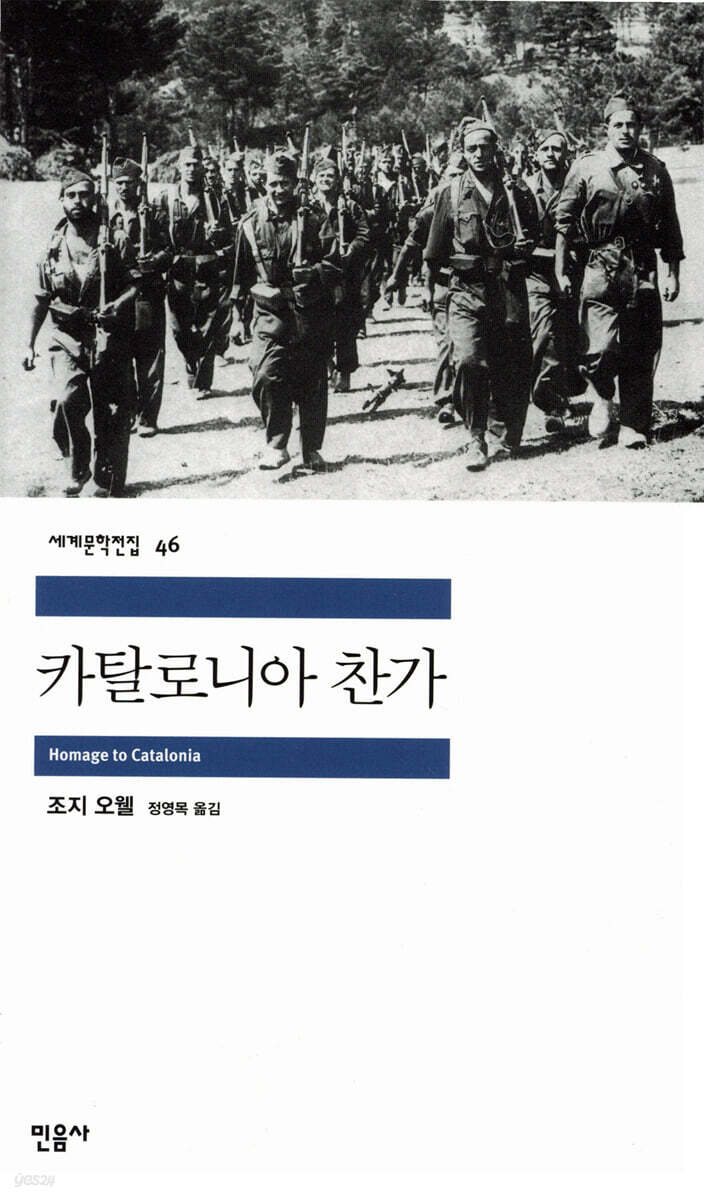
Catalan Hymn
 |
Description
Book Introduction
The masterpiece that made George Orwell one of the most influential voices of the 20th century.
A classic war novel that vividly depicts the Spanish Civil War and Catalonia in 1936.
A record of practical conscience fighting for justice and equality on the site of history.
“One of the most terrible things about war is that all the propaganda, all the evil and lies and hatred, always comes from people who are not fighting.”
Homage to Catalonia (1938) is a reportage piece written by George Orwell, who fought in the Spanish Civil War as an ordinary militiaman against Franco's fascism, and vividly recorded the historical scene.
The Spanish Civil War was a revolution for freedom and equality internally, and an event that triggered World War II externally.
George Orwell went to Spain as a war correspondent at the time, but was so fascinated by the revolution that he jumped into the war.
Orwell participated in this war as an ordinary militiaman, but when the Republicans split, the Workers' Party of Unification (POUM), to which Orwell belonged, was put in danger by a Communist conspiracy.
However, Orwell narrowly escaped the crossroads of life and death and escaped to France.
And the work he completed upon returning to England was 『Homage to Catalonia』(1938).
This work is a record of conscience fighting for justice and equality, and also depicts the promise of revolution, the betrayal of power, and the frustration and disillusionment that result.
A classic war novel that vividly depicts the Spanish Civil War and Catalonia in 1936.
A record of practical conscience fighting for justice and equality on the site of history.
“One of the most terrible things about war is that all the propaganda, all the evil and lies and hatred, always comes from people who are not fighting.”
Homage to Catalonia (1938) is a reportage piece written by George Orwell, who fought in the Spanish Civil War as an ordinary militiaman against Franco's fascism, and vividly recorded the historical scene.
The Spanish Civil War was a revolution for freedom and equality internally, and an event that triggered World War II externally.
George Orwell went to Spain as a war correspondent at the time, but was so fascinated by the revolution that he jumped into the war.
Orwell participated in this war as an ordinary militiaman, but when the Republicans split, the Workers' Party of Unification (POUM), to which Orwell belonged, was put in danger by a Communist conspiracy.
However, Orwell narrowly escaped the crossroads of life and death and escaped to France.
And the work he completed upon returning to England was 『Homage to Catalonia』(1938).
This work is a record of conscience fighting for justice and equality, and also depicts the promise of revolution, the betrayal of power, and the frustration and disillusionment that result.
- You can preview some of the book's contents.
Preview
Into the book
In order to suppress all revolutionary tendencies and make the war look as ordinary as possible, it was necessary to give up strategic opportunities that actually existed.
I spoke of how we were armed, or not armed, on the Aragon front.
Those weapons must not have been distributed intentionally.
Because I hoped the anarchists wouldn't have too many weapons.
They were worried that it would later be used for revolutionary purposes.
As a result, a major offensive in Aragon was not carried out.
If that had been possible, Franco might have withdrawn from Bilbao, or perhaps even from Madrid.
However, this can be said to be a relatively minor matter.
More importantly, as the war narrowed, it became impossible to appeal to the working class abroad for aid on a large scale.
I spoke of how we were armed, or not armed, on the Aragon front.
Those weapons must not have been distributed intentionally.
Because I hoped the anarchists wouldn't have too many weapons.
They were worried that it would later be used for revolutionary purposes.
As a result, a major offensive in Aragon was not carried out.
If that had been possible, Franco might have withdrawn from Bilbao, or perhaps even from Madrid.
However, this can be said to be a relatively minor matter.
More importantly, as the war narrowed, it became impossible to appeal to the working class abroad for aid on a large scale.
---p.
93
93
Publisher's Review
The Spanish Civil War, which served as the ideological basis for Orwell's work
Why did Orwell, who went to Spain to write articles, end up participating in the war?
For Orwell, who was disillusioned with capitalism and Britain's class society, the equality enjoyed by the Aragon region at the time was a very surprising event.
There, all classes were equal, and there was hope, not alienation.
Orwell believed that true equality must be maintained, and this belief forms the basis of Homage to Catalonia.
I went to Spain with the intention of writing a newspaper article.
But as soon as I got there, I enlisted in the volunteer army.
Because at that time, in that atmosphere, it was the only thing worth doing.
Until then, Catalonia was effectively controlled by anarchists.
The revolution was still actively underway.
(……) There were signs posted in every store and cafe saying that it was collectivized.
Even the box-like shoe shine shops were collectivized and painted red and black.
Waiters and store managers looked straight into the faces of customers and greeted them on an equal footing.
Even submissive and formal speech temporarily disappeared.
(……) The most surprising thing was the appearance of the crowd.
On the surface, the city was a place where the wealthy class had been virtually annihilated.
Except for a few women and foreigners, no one was seen 'dressed up'.
Almost everyone wore the rough clothes of the working class.
Or they wore blue overalls, or slightly altered versions of the volunteer army uniform.
All of this was amazing and moving.
(……) I was immediately convinced that the city was worth fighting to protect.
―From the text
For Orwell, his experience in Spain was “so intense that it changed everything.”
Later, in "Why I Write" (included in "Animal Farm"), Orwell makes his position as a writer clear.
Since 1936, Orwell's "all works have been written, directly or indirectly, to oppose totalitarianism and to support democratic socialism," and "Homage to Catalonia" is also a work in this context.
The Spanish Civil War (1936-39), which is the setting of the novel, began with General Franco's coup.
Spain held its first elections in 1931 amidst the chaos of 33 changes of government over 20 years, resulting in the establishment of the Second Republic.
The Popular Front, which won this election, was a coalition of socialists and liberals.
When the government announced land reform, it was immediately welcomed by the anarchist, socialist, and communist camps.
However, moderate republicans were alarmed by the radical changes, and resentment grew, especially among the army, which was supported by the church, the nobility, and the far right.
Eventually, the Catholic Church and other right-wing groups rebelled against Republicanism and declared civil war with General Franco at the forefront (1936).
Then, intellectuals, artists, and workers from all over Europe formed the International Brigade and flocked to Spain to fight against fascism.
Meanwhile, in Catalonia, anarchists took over the lands of the nobles and organized a militia against Franco.
They sought to implement direct democracy and ultimately achieve a new social revolution.
A classic of war literature
Homage to Catalonia can be compared to another work on the same subject, Hemingway's For Whom the Bell Tolls (1940).
Both works deal with themes of freedom and equality, but while Hemingway's work uses the Spanish Civil War as the backdrop to the story, Homage to Catalonia makes the Spanish Civil War itself the center of the story.
In his work, Orwell reveals the positions of numerous factions, analyzes the events that were central to the civil war, and shows Orwell's own ideological changes.
Meanwhile, 『Homage to Catalonia』 stands out for its detailed and realistic depiction of ‘trench warfare.’
Orwell's description of trench warfare, written as if he were writing his own diary, is infused with his own experiences.
Orwell initially had little understanding of the differences between the various political groups.
There are three positions surrounding this civil war.
First, the position that the revolution should be suspended until the war was won, which was the position of most people (FAI, CNT), including Orwell who had just entered the civil war.
Second, there is the extreme and purest position that the overthrow of the bourgeois state and the completion of the revolution are the same as victory in the war (POUM).
And thirdly, there was the purely republican position that the bourgeois state had to be rebuilt, which ironically was also the position of the Communist Party of the Soviet Union.
Orwell became disillusioned when he realized that the Communist Party, which was supposed to help the revolution, was actually taking a third-party stance.
When Orwell returned to Barcelona after his vacation to join the International Brigades, the revolution had died down and pro-Soviet figures had taken control of the army.
Ultimately, a Communist conspiracy with the backing of the Soviet Union led to a mass attack on the telephone exchange controlled by the anarchists (CNT) in May 1937.
Then both the socialists (POUM) and the anarchists were imprisoned together, and Orwell was accused of being a Trotskyist spy.
In the midst of this crisis, Orwell was fortunate enough to escape to France with the help of the British consul.
In the final chapter, Orwell concludes by lamenting why we cannot cast off all these ideologies and continue to fight each other without engaging in a real war.
Reportage with a strong political purpose
Orwell analyzes Franco's victory as a result of the division of the Republican Party due to the Communist Party's plot to seize power with the support of the Soviet Union.
In other words, the Communist Party, which was supported by Stalin, mistakenly believed that it could negotiate with Franco if it could just expel the anarchists.
Thus, another civil war broke out within the civil war.
After the 'May Days', the Communist Party accused the POUM of being 'Trotskyists' working in alliance with the fascists, and prominent American and European newspapers of the time, such as the Daily Worker and the News Chronicle, published articles claiming that the POUM had risen up under the orders of the fascists.
The May events marked the point where Orwell's illusions were shattered and political positions changed.
In other words, Orwell could not help but be angry that “innocent people were being wrongly accused.”
Also, the intention to clear the POUM of its unjust accusations is the reason for writing 『Homage to Catalonia』.
In particular, since Orwell's analysis is introduced in detail in chapters 5 and 11, some editions included these two chapters separately as an appendix, but Minumsa kept them in order to respect Orwell's political intentions.
Upon his return to England, Orwell attempted to publish "Spilling the Spanish Beans," but the work failed due to widespread misunderstanding and hostility toward the POUM. He also had difficulty publishing "Homage to Catalonia" later on.
A work imbued with a practical conscience for justice
George Orwell was a writer who was quite sensitive to social justice.
His life was a practical resistance to overthrow “all forms of human oppression” and to save “the scapegoats of an unjust society.”
Meanwhile, Orwell stated that he recognized his calling as a writer from the age of five, and his works also strongly reveal his yearning for justice.
Orwell ridiculed Stalin in his work "Animal Farm" and warned of the dangers of a thoroughly bureaucratized, centralized government in "1984."
Thus, his achievements lie primarily in satirizing the class consciousness that was a problem of his time and in incorporating criticism of the nightmarish despotism that underlies modern society into his works.
Homage to Catalonia also contains this tendency, and this novel in particular is a work that embodies Orwell's practical conscience toward justice.
There is a widespread assumption in modern historians that if Europe had prevented German intervention in the Spanish Civil War, World War II would not have occurred.
In other words, the general view is that Germany's testing of its fighting power in the Spanish Civil War was an opportunity to advance into Europe.
Orwell was able to demonstrate his literary calling in that the Spanish Civil War, with its many meanings, was not only a resistance against fascism but also a struggle for justice and equality.
Why did Orwell, who went to Spain to write articles, end up participating in the war?
For Orwell, who was disillusioned with capitalism and Britain's class society, the equality enjoyed by the Aragon region at the time was a very surprising event.
There, all classes were equal, and there was hope, not alienation.
Orwell believed that true equality must be maintained, and this belief forms the basis of Homage to Catalonia.
I went to Spain with the intention of writing a newspaper article.
But as soon as I got there, I enlisted in the volunteer army.
Because at that time, in that atmosphere, it was the only thing worth doing.
Until then, Catalonia was effectively controlled by anarchists.
The revolution was still actively underway.
(……) There were signs posted in every store and cafe saying that it was collectivized.
Even the box-like shoe shine shops were collectivized and painted red and black.
Waiters and store managers looked straight into the faces of customers and greeted them on an equal footing.
Even submissive and formal speech temporarily disappeared.
(……) The most surprising thing was the appearance of the crowd.
On the surface, the city was a place where the wealthy class had been virtually annihilated.
Except for a few women and foreigners, no one was seen 'dressed up'.
Almost everyone wore the rough clothes of the working class.
Or they wore blue overalls, or slightly altered versions of the volunteer army uniform.
All of this was amazing and moving.
(……) I was immediately convinced that the city was worth fighting to protect.
―From the text
For Orwell, his experience in Spain was “so intense that it changed everything.”
Later, in "Why I Write" (included in "Animal Farm"), Orwell makes his position as a writer clear.
Since 1936, Orwell's "all works have been written, directly or indirectly, to oppose totalitarianism and to support democratic socialism," and "Homage to Catalonia" is also a work in this context.
The Spanish Civil War (1936-39), which is the setting of the novel, began with General Franco's coup.
Spain held its first elections in 1931 amidst the chaos of 33 changes of government over 20 years, resulting in the establishment of the Second Republic.
The Popular Front, which won this election, was a coalition of socialists and liberals.
When the government announced land reform, it was immediately welcomed by the anarchist, socialist, and communist camps.
However, moderate republicans were alarmed by the radical changes, and resentment grew, especially among the army, which was supported by the church, the nobility, and the far right.
Eventually, the Catholic Church and other right-wing groups rebelled against Republicanism and declared civil war with General Franco at the forefront (1936).
Then, intellectuals, artists, and workers from all over Europe formed the International Brigade and flocked to Spain to fight against fascism.
Meanwhile, in Catalonia, anarchists took over the lands of the nobles and organized a militia against Franco.
They sought to implement direct democracy and ultimately achieve a new social revolution.
A classic of war literature
Homage to Catalonia can be compared to another work on the same subject, Hemingway's For Whom the Bell Tolls (1940).
Both works deal with themes of freedom and equality, but while Hemingway's work uses the Spanish Civil War as the backdrop to the story, Homage to Catalonia makes the Spanish Civil War itself the center of the story.
In his work, Orwell reveals the positions of numerous factions, analyzes the events that were central to the civil war, and shows Orwell's own ideological changes.
Meanwhile, 『Homage to Catalonia』 stands out for its detailed and realistic depiction of ‘trench warfare.’
Orwell's description of trench warfare, written as if he were writing his own diary, is infused with his own experiences.
Orwell initially had little understanding of the differences between the various political groups.
There are three positions surrounding this civil war.
First, the position that the revolution should be suspended until the war was won, which was the position of most people (FAI, CNT), including Orwell who had just entered the civil war.
Second, there is the extreme and purest position that the overthrow of the bourgeois state and the completion of the revolution are the same as victory in the war (POUM).
And thirdly, there was the purely republican position that the bourgeois state had to be rebuilt, which ironically was also the position of the Communist Party of the Soviet Union.
Orwell became disillusioned when he realized that the Communist Party, which was supposed to help the revolution, was actually taking a third-party stance.
When Orwell returned to Barcelona after his vacation to join the International Brigades, the revolution had died down and pro-Soviet figures had taken control of the army.
Ultimately, a Communist conspiracy with the backing of the Soviet Union led to a mass attack on the telephone exchange controlled by the anarchists (CNT) in May 1937.
Then both the socialists (POUM) and the anarchists were imprisoned together, and Orwell was accused of being a Trotskyist spy.
In the midst of this crisis, Orwell was fortunate enough to escape to France with the help of the British consul.
In the final chapter, Orwell concludes by lamenting why we cannot cast off all these ideologies and continue to fight each other without engaging in a real war.
Reportage with a strong political purpose
Orwell analyzes Franco's victory as a result of the division of the Republican Party due to the Communist Party's plot to seize power with the support of the Soviet Union.
In other words, the Communist Party, which was supported by Stalin, mistakenly believed that it could negotiate with Franco if it could just expel the anarchists.
Thus, another civil war broke out within the civil war.
After the 'May Days', the Communist Party accused the POUM of being 'Trotskyists' working in alliance with the fascists, and prominent American and European newspapers of the time, such as the Daily Worker and the News Chronicle, published articles claiming that the POUM had risen up under the orders of the fascists.
The May events marked the point where Orwell's illusions were shattered and political positions changed.
In other words, Orwell could not help but be angry that “innocent people were being wrongly accused.”
Also, the intention to clear the POUM of its unjust accusations is the reason for writing 『Homage to Catalonia』.
In particular, since Orwell's analysis is introduced in detail in chapters 5 and 11, some editions included these two chapters separately as an appendix, but Minumsa kept them in order to respect Orwell's political intentions.
Upon his return to England, Orwell attempted to publish "Spilling the Spanish Beans," but the work failed due to widespread misunderstanding and hostility toward the POUM. He also had difficulty publishing "Homage to Catalonia" later on.
A work imbued with a practical conscience for justice
George Orwell was a writer who was quite sensitive to social justice.
His life was a practical resistance to overthrow “all forms of human oppression” and to save “the scapegoats of an unjust society.”
Meanwhile, Orwell stated that he recognized his calling as a writer from the age of five, and his works also strongly reveal his yearning for justice.
Orwell ridiculed Stalin in his work "Animal Farm" and warned of the dangers of a thoroughly bureaucratized, centralized government in "1984."
Thus, his achievements lie primarily in satirizing the class consciousness that was a problem of his time and in incorporating criticism of the nightmarish despotism that underlies modern society into his works.
Homage to Catalonia also contains this tendency, and this novel in particular is a work that embodies Orwell's practical conscience toward justice.
There is a widespread assumption in modern historians that if Europe had prevented German intervention in the Spanish Civil War, World War II would not have occurred.
In other words, the general view is that Germany's testing of its fighting power in the Spanish Civil War was an opportunity to advance into Europe.
Orwell was able to demonstrate his literary calling in that the Spanish Civil War, with its many meanings, was not only a resistance against fascism but also a struggle for justice and equality.
GOODS SPECIFICS
- Date of issue: May 31, 2001
- Page count, weight, size: 310 pages | 412g | 132*225*30mm
- ISBN13: 9788937460463
- ISBN10: 8937460467
You may also like
카테고리
korean


korean

![ELLE 엘르 스페셜 에디션 A형 : 12월 [2025]](http://librairie.coreenne.fr/cdn/shop/files/b8e27a3de6c9538896439686c6b0e8fb.jpg?v=1766436872&width=3840)


