

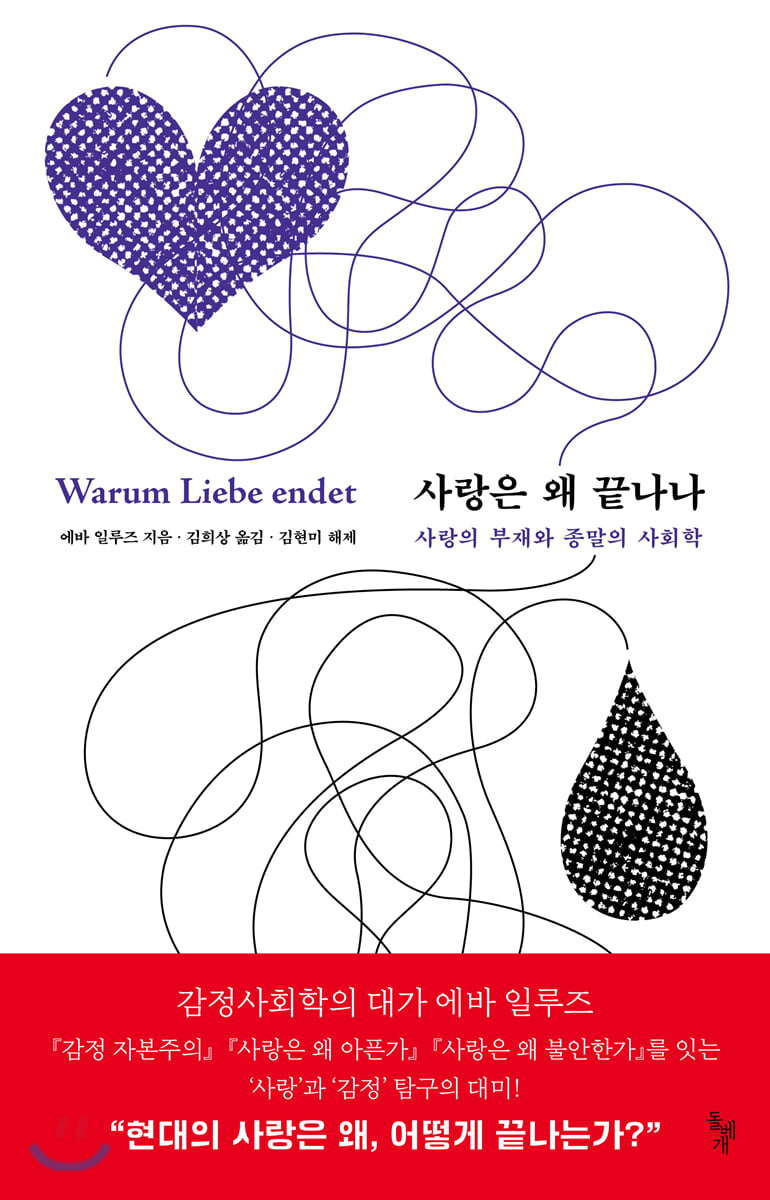
Why does love end?
 |
Description
Book Introduction
"Why Love Ends" is the culmination of Eva Illouz's 20-year research in the sociology of emotions, and explains "how capitalism has taken over sexual freedom, making sexual and romantic relationships fluid and confusing" (p. 48).
As the title suggests, “Why Does Love End” sociologically analyzes the process of love ending (unloving) in modern society.
Here, the 'end of love' or 'absence of love' focuses on explaining how this form became the subject of contemporary society rather than on the specific process and cause of separation.
Author Eva Illouz's problem is that contemporary sociology must investigate what has caused this transformation of 'love,' once revered as an eternal value.
As the title suggests, “Why Does Love End” sociologically analyzes the process of love ending (unloving) in modern society.
Here, the 'end of love' or 'absence of love' focuses on explaining how this form became the subject of contemporary society rather than on the specific process and cause of separation.
Author Eva Illouz's problem is that contemporary sociology must investigate what has caused this transformation of 'love,' once revered as an eternal value.
index
1.
prolog.
From 'Select' to 'Do not select'
Love as Freedom
Discontent with criticism of freedom
A matter of choice
negative selection
2.
Pre-modern courtship, social certainty, and the emergence of negative relationships
Courtship as a sociological construct
Certainty as a sociological construct
Sexual freedom as freedom of consumption
New social and sexual grammar
3.
confusing sex
Casual Sex and Its Difficult-to-Define Effects
Casual sex and uncertainty
Uncertainty and negative sociality
4.
The rise of ontological uncertainty
The value of the body
Production of symbolic and economic value
evaluation
Devaluation of grades
Changes in evaluation criteria
The confusing status of the subject
5.
Freedom with many limitations
What do you agree with?
confused will
fickle emotions
Rather than expressing your opinion, escape
Trust and Uncertainty
6.
Breakup as a negative relationship
The End of Love
Divorce and the Position of Women in the Emotional Realm
Narrative structure of separation
Sexuality: The Great Divide
Consumption target: From transition target to exit target
Autonomy and Bonding: A Struggling Couple
Emotional Ontology and the Unbound Emotional Contract
Emotional capacity and women's position in relationship formation
Epilogue.
The Butterfly Politics of Negative Relationships and Sex
Acknowledgements
main
References
Search
Breakups are easy to meet and cool to break up, so why bother?
prolog.
From 'Select' to 'Do not select'
Love as Freedom
Discontent with criticism of freedom
A matter of choice
negative selection
2.
Pre-modern courtship, social certainty, and the emergence of negative relationships
Courtship as a sociological construct
Certainty as a sociological construct
Sexual freedom as freedom of consumption
New social and sexual grammar
3.
confusing sex
Casual Sex and Its Difficult-to-Define Effects
Casual sex and uncertainty
Uncertainty and negative sociality
4.
The rise of ontological uncertainty
The value of the body
Production of symbolic and economic value
evaluation
Devaluation of grades
Changes in evaluation criteria
The confusing status of the subject
5.
Freedom with many limitations
What do you agree with?
confused will
fickle emotions
Rather than expressing your opinion, escape
Trust and Uncertainty
6.
Breakup as a negative relationship
The End of Love
Divorce and the Position of Women in the Emotional Realm
Narrative structure of separation
Sexuality: The Great Divide
Consumption target: From transition target to exit target
Autonomy and Bonding: A Struggling Couple
Emotional Ontology and the Unbound Emotional Contract
Emotional capacity and women's position in relationship formation
Epilogue.
The Butterfly Politics of Negative Relationships and Sex
Acknowledgements
main
References
Search
Breakups are easy to meet and cool to break up, so why bother?
Publisher's Review
I end love easily
Buy and consume love (emotions, relationships)
Give up (do not) making a choice
Distance yourself from the relationship
I don't love you
…
UNLOVING
Even with more freedom, we live in a time of extreme insecurity.
Why are people afraid of relationships?
Are you trying to distance yourself from a relationship?
"Why Does Love End?" offers valuable inspiration for reflecting on the difficulties of love and relationships, the world's tendency to meet and break up easily, the rise of late marriage, non-marriage, and divorce, low birth rates, and hatred.
Eva Illouz, a leading sociologist of emotions
Following 『Emotional Capitalism』 『Why Does Love Hurt』 『Why Is Love Anxious』
The ultimate exploration of 'love' and 'emotions'!
“Why and how does modern love end?”
■ A work that marks the culmination of 20 years of research in the sociology of emotions
"Why Love Ends" is the culmination of Eva Illouz's 20-year research in the sociology of emotions, and explains "how capitalism has taken over sexual freedom, making sexual and romantic relationships fluid and confusing" (p. 48).
A Sociologist's Exploration of a Loveless Society
As the title suggests, “Why Does Love End” sociologically analyzes the process of love ending (unloving) in modern society.
Here, the 'end of love' or 'absence of love' focuses on explaining how this form became the subject of contemporary society rather than on the specific process and cause of separation.
Author Eva Illouz's problem is that contemporary sociology must investigate what has caused this transformation of 'love,' once revered as an eternal value.
■ Sexual Freedom: Shaking Norms, Systems, and Relationships
Sexuality, which has entered the realm of freedom, that is, sexual freedom, has shaken the existing norms and institutions.
The possibilities and alternatives for sexual activity have increased, and naturally, meeting and breaking up have become easier.
The institution of marriage entered a new phase (the number of non-marriages and late marriages increased), and divorce was no longer considered a moral failing.
What Eva Illouz points out as the real problem with sexual freedom is that this freedom has deepened male domination over women in heterosexual relationships and that sexuality, the most intimate part of human beings, has been subsumed into consumer capitalism.
The Strange Paradox of Sexual Freedom Supporting Male Dominance
Sexuality is easily conflated with female identity ('female beauty and sexiness', 'the spectacle of the female body'), and women are placed in a double bind where they are forced to have an ethics of care in their gender roles while also having to hold sexual value.
Women still occupy different positions and roles in the home and society.
In other words, women's sexuality can be a symbolic power ('beauty', 'body', etc.), but it also functions as an indicator that satisfies men's desires and supports their social status by becoming a necessary condition for both love and economic activity.
■ Freedom of love in our time is freedom of consumption.
Today, sexuality and love are governed by consumer culture and the grammar of the market.
The meaning of a spouse as a life partner has faded, and now a couple has taken on the meaning of a partner who can share (consumption) tastes.
The expression of rejection, “He’s not my type,” is an expression of disapproval that says that one’s consumer tastes do not apply.
The problem with taste becoming a criterion for choosing a partner is that it provides an easy reason to end a relationship.
The author argues that the foundation that makes encounters possible and sustains them today is consumer capitalism.
Freedom of meeting and parting is another name for freedom of consumption.
■ Technology and economy that objectifies and exploits women's sexuality
Digital technology and dating apps have turned subjects into “consumers of sex and emotions” (p. 45).
Technological advancements have enabled the mass distribution and consumption of pornography, and dating apps have opened up the possibility of sexual freedom and deviance through the constant switching of partners.
Technology and economics are becoming additional conduits for male sexual dominance.
Eva Illouz calls this a system of scopic capitalism.
The visual appropriation of women's sexuality has become a system that devalues women's human worth, and technology and the sex economy have established a system that sexualizes (objectifies) women.
Buy and consume love (emotions, relationships)
Give up (do not) making a choice
Distance yourself from the relationship
I don't love you
…
UNLOVING
Even with more freedom, we live in a time of extreme insecurity.
Why are people afraid of relationships?
Are you trying to distance yourself from a relationship?
"Why Does Love End?" offers valuable inspiration for reflecting on the difficulties of love and relationships, the world's tendency to meet and break up easily, the rise of late marriage, non-marriage, and divorce, low birth rates, and hatred.
Eva Illouz, a leading sociologist of emotions
Following 『Emotional Capitalism』 『Why Does Love Hurt』 『Why Is Love Anxious』
The ultimate exploration of 'love' and 'emotions'!
“Why and how does modern love end?”
■ A work that marks the culmination of 20 years of research in the sociology of emotions
"Why Love Ends" is the culmination of Eva Illouz's 20-year research in the sociology of emotions, and explains "how capitalism has taken over sexual freedom, making sexual and romantic relationships fluid and confusing" (p. 48).
A Sociologist's Exploration of a Loveless Society
As the title suggests, “Why Does Love End” sociologically analyzes the process of love ending (unloving) in modern society.
Here, the 'end of love' or 'absence of love' focuses on explaining how this form became the subject of contemporary society rather than on the specific process and cause of separation.
Author Eva Illouz's problem is that contemporary sociology must investigate what has caused this transformation of 'love,' once revered as an eternal value.
■ Sexual Freedom: Shaking Norms, Systems, and Relationships
Sexuality, which has entered the realm of freedom, that is, sexual freedom, has shaken the existing norms and institutions.
The possibilities and alternatives for sexual activity have increased, and naturally, meeting and breaking up have become easier.
The institution of marriage entered a new phase (the number of non-marriages and late marriages increased), and divorce was no longer considered a moral failing.
What Eva Illouz points out as the real problem with sexual freedom is that this freedom has deepened male domination over women in heterosexual relationships and that sexuality, the most intimate part of human beings, has been subsumed into consumer capitalism.
The Strange Paradox of Sexual Freedom Supporting Male Dominance
Sexuality is easily conflated with female identity ('female beauty and sexiness', 'the spectacle of the female body'), and women are placed in a double bind where they are forced to have an ethics of care in their gender roles while also having to hold sexual value.
Women still occupy different positions and roles in the home and society.
In other words, women's sexuality can be a symbolic power ('beauty', 'body', etc.), but it also functions as an indicator that satisfies men's desires and supports their social status by becoming a necessary condition for both love and economic activity.
■ Freedom of love in our time is freedom of consumption.
Today, sexuality and love are governed by consumer culture and the grammar of the market.
The meaning of a spouse as a life partner has faded, and now a couple has taken on the meaning of a partner who can share (consumption) tastes.
The expression of rejection, “He’s not my type,” is an expression of disapproval that says that one’s consumer tastes do not apply.
The problem with taste becoming a criterion for choosing a partner is that it provides an easy reason to end a relationship.
The author argues that the foundation that makes encounters possible and sustains them today is consumer capitalism.
Freedom of meeting and parting is another name for freedom of consumption.
■ Technology and economy that objectifies and exploits women's sexuality
Digital technology and dating apps have turned subjects into “consumers of sex and emotions” (p. 45).
Technological advancements have enabled the mass distribution and consumption of pornography, and dating apps have opened up the possibility of sexual freedom and deviance through the constant switching of partners.
Technology and economics are becoming additional conduits for male sexual dominance.
Eva Illouz calls this a system of scopic capitalism.
The visual appropriation of women's sexuality has become a system that devalues women's human worth, and technology and the sex economy have established a system that sexualizes (objectifies) women.
GOODS SPECIFICS
- Publication date: November 16, 2020
- Page count, weight, size: 531 pages | 698g | 140*218*25mm
- ISBN13: 9788971997956
- ISBN10: 8971997958
You may also like
카테고리
korean


korean

![GQ KOREA Mark (Monthly): December [2025]](http://librairie.coreenne.fr/cdn/shop/files/8ef265dbbfbf186523ed75ba7319009d.jpg?v=1765340328&width=3840)


