

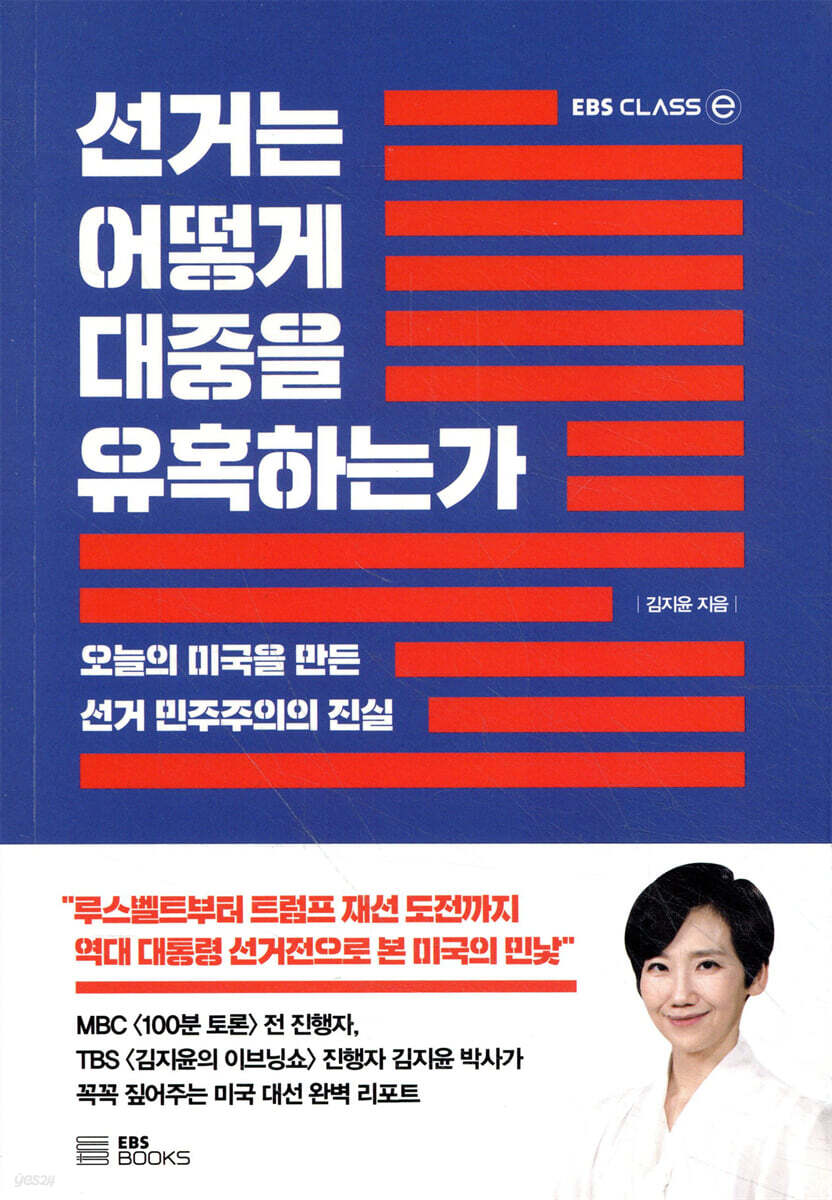
How Elections Seduce the Public
 |
Description
Book Introduction
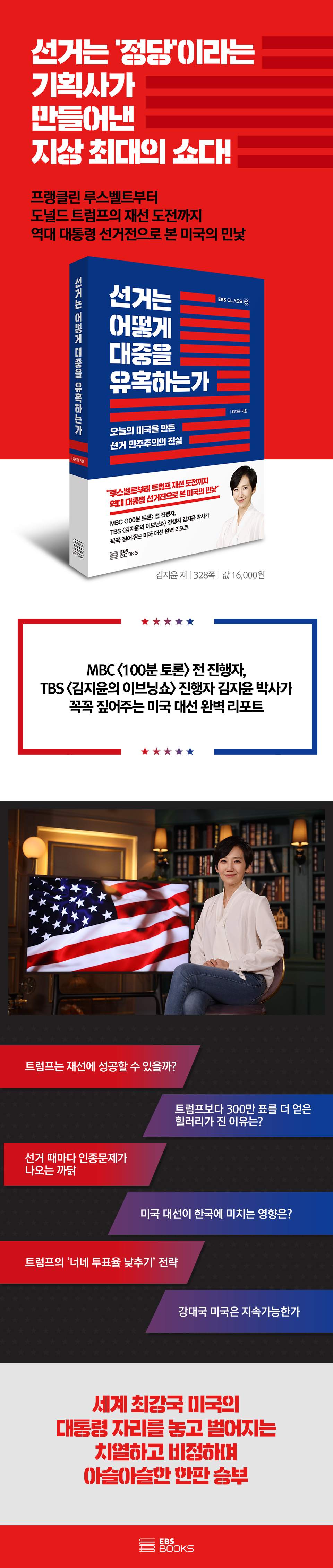
Elections are created by a planning company called a ‘political party’.
It's the greatest show on earth!
From Franklin Roosevelt to Donald Trump's re-election bid
The True Face of America as Seen Through Past Presidential Elections
In an unprecedented situation where the threat of COVID-19 has become a daily occurrence and the economic downturn is protracted, the entire world, including Korea, is focused on the presidential election in the United States, the world's largest economic and military power.
What impact would it have on our political landscape if Republican Donald Trump, who touts his commitment to making America great again, were re-elected? How would things change if Democrat Joe Biden, who is already leading in various opinion polls, wins the election? The answers to these questions are by no means simple.
However, this book, "How Elections Seduce the Public," goes beyond simply exploring the changes in the global political and economic landscape that the U.S. presidential election results will bring.
By analyzing the hidden history of the electoral system and two-party system that have shaped the United States, a leader in the democratic camp and one that wields incredible power around the world today, and the structural causes of the increasingly severe social and racial disparities, this book paints a vivid picture of America's true face.
Going a step further, it sharply examines the contradictions of the electoral system and the paradoxes of voting, examining why we vote, how the sophisticated slogans of political parties that excite the public during election season are created, and how the power that emerges through elections can divide society and threaten democracy.
This book will help you understand how the United States, the world's most powerful nation, has seduced the public through a flawed and mysterious election system.
It's the greatest show on earth!
From Franklin Roosevelt to Donald Trump's re-election bid
The True Face of America as Seen Through Past Presidential Elections
In an unprecedented situation where the threat of COVID-19 has become a daily occurrence and the economic downturn is protracted, the entire world, including Korea, is focused on the presidential election in the United States, the world's largest economic and military power.
What impact would it have on our political landscape if Republican Donald Trump, who touts his commitment to making America great again, were re-elected? How would things change if Democrat Joe Biden, who is already leading in various opinion polls, wins the election? The answers to these questions are by no means simple.
However, this book, "How Elections Seduce the Public," goes beyond simply exploring the changes in the global political and economic landscape that the U.S. presidential election results will bring.
By analyzing the hidden history of the electoral system and two-party system that have shaped the United States, a leader in the democratic camp and one that wields incredible power around the world today, and the structural causes of the increasingly severe social and racial disparities, this book paints a vivid picture of America's true face.
Going a step further, it sharply examines the contradictions of the electoral system and the paradoxes of voting, examining why we vote, how the sophisticated slogans of political parties that excite the public during election season are created, and how the power that emerges through elections can divide society and threaten democracy.
This book will help you understand how the United States, the world's most powerful nation, has seduced the public through a flawed and mysterious election system.
- You can preview some of the book's contents.
Preview
index
Prologue│The petty and insignificant world of a powerful and mighty nation
PART 1│The Paradox of Choice: Donkey or Elephant?
How Trump Became President
The Hidden History of Two-Party Politics
What's Different About the US Presidential Election?
Conditions or Destiny of the Second Person
Why Focus on Iowa
Is Ohio still valid?
PART 2│The Art of Elections: What Makes an Election
Voting never stops
Big data knows the answer
The mysterious and fascinating world of negatives
Money, money, money
How important are election debates?
The real strategists who move the board
Preempt the issue
PART 3│A Shifting System: Who to Appeal to
Thucydides' Trap
Whose party is this?
Black Lives Matter
America's Roots, Immigrants: Immigration and the Changing Political Landscape I
Us and Yours: Immigration and the Changing Political Landscape II
America First
Epilogue│Dreaming of a society for everyone, winners and losers
References
PART 1│The Paradox of Choice: Donkey or Elephant?
How Trump Became President
The Hidden History of Two-Party Politics
What's Different About the US Presidential Election?
Conditions or Destiny of the Second Person
Why Focus on Iowa
Is Ohio still valid?
PART 2│The Art of Elections: What Makes an Election
Voting never stops
Big data knows the answer
The mysterious and fascinating world of negatives
Money, money, money
How important are election debates?
The real strategists who move the board
Preempt the issue
PART 3│A Shifting System: Who to Appeal to
Thucydides' Trap
Whose party is this?
Black Lives Matter
America's Roots, Immigrants: Immigration and the Changing Political Landscape I
Us and Yours: Immigration and the Changing Political Landscape II
America First
Epilogue│Dreaming of a society for everyone, winners and losers
References
Detailed image
Into the book
The Electoral College system actually tends to distort public opinion considerably.
Just look at the difference between the total votes and the total number of electors in the 2016 election.
In fact, immediately after the 2016 election, many progressive Americans, shocked by Trump's victory, began talking about changing the electoral system.
Some California voters, in particular, were so outraged by the unfairness that they even went so far as to call for California to secede from the Union and establish its own state (secession, of course, was impossible after the Civil War).
Why are Californians so angry?
--- pp.49-50
Until 1970, the trend was caucuses.
But recently, more and more states are changing their systems to primaries.
One reason is that the caucus system is inefficient and expensive for the parties, but many people also question whether the caucus is truly a democratic process.
Questions are being raised about whether a caucus primary in which less than 10 percent of a party's members participate is truly legitimate, and whether the person chosen in this way can truly represent the will of the entire party and be competitive against the opposing candidate in the actual presidential election.
--- p.76
If Obama's 2012 team resembled scientists working in unison after sending a probe into space, Trump's 2016 team was the complete opposite.
The Trump campaign was a team of Trump, for Trump, and by Trump, completely disregarding logic, data, and science.
Trump was also at the center of the election strategy.
Because he himself was the greatest director.
--- p.129
Many voters say they will watch the debates to decide who to vote for.
The debate is a place to determine which candidate has the best policies, who has the character and intelligence to be president, and who is prepared to lead the country for the next few years.
Every time there is a debate, the media evaluates who did better and who did worse and discusses winners and losers.
Every time I hear such stories, I think to myself:
'That's a lie.'
--- p.174
No matter what, the biggest issue in an election is inevitably making a living.
Aside from the pie-in-the-sky stuff that pops up in the news about solving inequality or maintaining fiscal soundness, the most important thing in an election is whether the current economic situation satisfies all of these questions: how much money is out of my pocket right now, whether I can live comfortably and securely, whether I can continue working at my job without being laid off, and whether I and my family can have good health insurance.
In particular, economic performance is bound to be the most important criterion for evaluating a sitting president.
People are surprisingly very economical animals.
--- p.216
The Black Lives Matter movement didn't happen overnight.
Floyd's death was not an accidental tragedy.
It erupted amidst nearly 300 years of violent conflict between black communities and white vigilantes, slave patrols, the KKK, and the police.
It should be seen not as an unfortunate occurrence due to the racial discrimination that still remains, but as an extension of a history of persistent discrimination and violence.
What is truly regrettable is that, well into the 21st century, the KKK, reduced to a ridiculous mass of pretentious, middle-school-age bluffers, has reappeared on the streets of America in broad daylight.
--- p.266
Currently, American voters generally perceive the Democratic Party as being friendly to immigrants and the Republican Party as being unfriendly.
The executive order to provide relief to children and youth who became illegal immigrants with their parents was issued by Democratic President Obama, while Republican President Trump went beyond a firm stance against illegal immigrants and even displayed hostility.
But the Democratic Party wasn't like that from the beginning.
Just look at the difference between the total votes and the total number of electors in the 2016 election.
In fact, immediately after the 2016 election, many progressive Americans, shocked by Trump's victory, began talking about changing the electoral system.
Some California voters, in particular, were so outraged by the unfairness that they even went so far as to call for California to secede from the Union and establish its own state (secession, of course, was impossible after the Civil War).
Why are Californians so angry?
--- pp.49-50
Until 1970, the trend was caucuses.
But recently, more and more states are changing their systems to primaries.
One reason is that the caucus system is inefficient and expensive for the parties, but many people also question whether the caucus is truly a democratic process.
Questions are being raised about whether a caucus primary in which less than 10 percent of a party's members participate is truly legitimate, and whether the person chosen in this way can truly represent the will of the entire party and be competitive against the opposing candidate in the actual presidential election.
--- p.76
If Obama's 2012 team resembled scientists working in unison after sending a probe into space, Trump's 2016 team was the complete opposite.
The Trump campaign was a team of Trump, for Trump, and by Trump, completely disregarding logic, data, and science.
Trump was also at the center of the election strategy.
Because he himself was the greatest director.
--- p.129
Many voters say they will watch the debates to decide who to vote for.
The debate is a place to determine which candidate has the best policies, who has the character and intelligence to be president, and who is prepared to lead the country for the next few years.
Every time there is a debate, the media evaluates who did better and who did worse and discusses winners and losers.
Every time I hear such stories, I think to myself:
'That's a lie.'
--- p.174
No matter what, the biggest issue in an election is inevitably making a living.
Aside from the pie-in-the-sky stuff that pops up in the news about solving inequality or maintaining fiscal soundness, the most important thing in an election is whether the current economic situation satisfies all of these questions: how much money is out of my pocket right now, whether I can live comfortably and securely, whether I can continue working at my job without being laid off, and whether I and my family can have good health insurance.
In particular, economic performance is bound to be the most important criterion for evaluating a sitting president.
People are surprisingly very economical animals.
--- p.216
The Black Lives Matter movement didn't happen overnight.
Floyd's death was not an accidental tragedy.
It erupted amidst nearly 300 years of violent conflict between black communities and white vigilantes, slave patrols, the KKK, and the police.
It should be seen not as an unfortunate occurrence due to the racial discrimination that still remains, but as an extension of a history of persistent discrimination and violence.
What is truly regrettable is that, well into the 21st century, the KKK, reduced to a ridiculous mass of pretentious, middle-school-age bluffers, has reappeared on the streets of America in broad daylight.
--- p.266
Currently, American voters generally perceive the Democratic Party as being friendly to immigrants and the Republican Party as being unfriendly.
The executive order to provide relief to children and youth who became illegal immigrants with their parents was issued by Democratic President Obama, while Republican President Trump went beyond a firm stance against illegal immigrants and even displayed hostility.
But the Democratic Party wasn't like that from the beginning.
--- p.284
Publisher's Review
How Trump Became President
On November 8, 2016, many were shocked when Donald Trump was elected the 45th President of the United States.
While there were certainly many Republicans and supporters who rejoiced at his election, the predominant reaction was, "How could this happen?"
That's understandable, as Republican Donald Trump received 62,984,828 votes while Democratic candidate Hillary Clinton received 65,853,514 votes, a difference of nearly 3 million votes, yet Clinton lost the election.
According to Dr. Jiyoon Kim, author of "How Elections Seduce the Public" and an expert on American politics who is renowned for providing deep and balanced insights into domestic and international affairs, there is a hidden contradiction in the complex and even bizarre American presidential election system.
In the United States, electors are allocated to each of the 50 states to choose the president, and the candidate who receives even one more vote in each state takes all of that state's electoral votes.
Since the presidential election is held indirectly through the Electoral College, the number of electoral votes is much more important than the actual number of votes.
Thanks to this system, Trump, who received nearly 3 million fewer votes than Clinton, was able to easily defeat Clinton, who received 227 electoral votes, securing 304 electoral votes.
One of the areas that greatly contributed to Trump's victory at this time was the Rust Belt, the Northeastern and Midwestern regions surrounding the Great Lakes.
Factory workers in the Rust Belt, once a booming manufacturing hub in the 1970s, are now in decline, their memories of the glory days of the past fading away.
The candidate who embraced those who had suffered directly from globalization and free trade was not Clinton of the Democratic Party, which once represented the working class but has now changed, but Trump of the Republican Party, who strongly advocated protectionism and anti-immigration policies.
It was no coincidence that many Rust Belt voters were enthusiastic about Trump.
Who is this party for?
Franklin Roosevelt, the Democratic Party's 32nd President, introduced the New Deal in 1933, which included social welfare policies and government-led, proactive economic stimulus measures that had previously been unwelcome in the United States.
And 30 years later, Democratic President Lyndon Johnson launched a massive social security program called the "Great Society."
Through this series of events, the Democratic Party came to have the image of being a party for workers and the vulnerable, and an anti-corporate party.
Meanwhile, the Republican Party, starting with Ronald Reagan's election as president in 1980, began to implement tax cuts for corporations and the wealthy, establishing itself as a party representing their interests.
However, historically, the two parties have changed their appearances by exchanging policies and lines according to the times.
The stance toward people of color and immigrants is no different.
The Democratic Party, which produced a black president and a female presidential candidate in the 2000s, was once a very racist party, and the Republican Party during Abraham Lincoln's presidency was a strong advocate of abolishing slavery.
According to the author's analysis, political parties' positions on issues that arise at any given time are variable.
The tendencies and public opinion of supporters play a big role here.
This trend becomes more evident as elections approach.
To win an election, you need to read the minds of the voters who are likely to vote for you and properly target them.
The Politics of Voter Turnout
President Trump's insulting remarks about Mexican immigrants during his 2016 presidential campaign are well-known.
Many people criticized him for pursuing politics that promotes hatred and loathing.
However, at this point, the author focuses on the strategies related to 'voter turnout' in past US presidential elections.
Unlike us, in the United States, the government does not automatically register voters.
Voters who wish to vote must complete the registration process themselves.
In that case, from the candidate's perspective, he or she must employ a strategy to get at least one more voter who is likely to vote for him or her to come out to the polls.
In 2008, the Obama campaign mobilized a large number of voters by actively utilizing the Internet and online platforms based on micro-targeting. In his 2012 re-election bid, he went one step further and focused on bold persuasion strategies to win over the opposing party's persuasive voters to his side.
But the Trump campaign's 2016 election strategy was quite different.
Rather than using the strategy of "raising our voter turnout" to get as many voters as possible to the polls, they used the strategy of "lowering your voter turnout" to get people who are unlikely to vote for them to not come to the polls at all.
To achieve this, they have, of course, cleverly used negative techniques such as fake news and smear campaigns, including sectarianism based on race, gender, origin, and political leanings.
Trump's stance as he seeks re-election in 2020 is not much different.
This year in particular, the Black Lives Matter movement sparked by the death of George Floyd and the conflict between citizens and police have created an optimal environment for Trump.
Between the division between 'you' and 'me,' 'them' and 'us,' and true Americans and foreigners, the voter's vote has nowhere to go.
Why do we go to the trouble of voting?
As the 2016 US presidential election clearly demonstrated, polls and voting are two different things.
This is because voting is an ‘action’ that must be supported by activism and strong support for the candidate.
You have to register to vote, review pledges and policies, sometimes even participate in debates, go to the polls, stand in line, and check the vote count.
But why do we go to all this trouble to vote?
As is often said, 'a sense of responsibility as a member of a democratic society' is one reason why we vote, but the author mentions a more fundamental factor.
It's 'fun'.
Although it is called a noble process of selecting our representatives, the election is ultimately a 'duel' on a single-log bridge, a 'game' that drives people to excitement like a huge show.
They support candidates and parties, identify with them, and get excited as if they were running for office themselves, and they get excited watching candidates sharply attack each other in televised debates.
Moreover, whenever election season comes, high-ranking officials who have been so stiff until now shout, “Please choose me!” and try to shake our hands one more time, make eye contact one more time, and act friendly in front of us.
It is a unique opportunity to fully enjoy one's rights as a voter, which comes around once every few years.
The sad thing is that in every competition, there is always a winner and a loser.
When the candidate and party I support wins, I feel proud as if I won, but if they lose, I feel at a loss as if I foresee an uncertain future.
But as the author emphasizes, the true value of democracy lies not in how the winners enjoy their victory, but in how the losers accept their defeat.
Since Trump came to power, many have expressed concern about the fragility of democracy.
Many people are already thinking that if President Trump loses the election, he will not admit defeat.
However, this is also a litmus test to see how strong the foundation of American democracy is, and regardless of the outcome, the United States will continue to build its own country through further reflection and revision, as it has done so far.
With elections that tempt the public.
On November 8, 2016, many were shocked when Donald Trump was elected the 45th President of the United States.
While there were certainly many Republicans and supporters who rejoiced at his election, the predominant reaction was, "How could this happen?"
That's understandable, as Republican Donald Trump received 62,984,828 votes while Democratic candidate Hillary Clinton received 65,853,514 votes, a difference of nearly 3 million votes, yet Clinton lost the election.
According to Dr. Jiyoon Kim, author of "How Elections Seduce the Public" and an expert on American politics who is renowned for providing deep and balanced insights into domestic and international affairs, there is a hidden contradiction in the complex and even bizarre American presidential election system.
In the United States, electors are allocated to each of the 50 states to choose the president, and the candidate who receives even one more vote in each state takes all of that state's electoral votes.
Since the presidential election is held indirectly through the Electoral College, the number of electoral votes is much more important than the actual number of votes.
Thanks to this system, Trump, who received nearly 3 million fewer votes than Clinton, was able to easily defeat Clinton, who received 227 electoral votes, securing 304 electoral votes.
One of the areas that greatly contributed to Trump's victory at this time was the Rust Belt, the Northeastern and Midwestern regions surrounding the Great Lakes.
Factory workers in the Rust Belt, once a booming manufacturing hub in the 1970s, are now in decline, their memories of the glory days of the past fading away.
The candidate who embraced those who had suffered directly from globalization and free trade was not Clinton of the Democratic Party, which once represented the working class but has now changed, but Trump of the Republican Party, who strongly advocated protectionism and anti-immigration policies.
It was no coincidence that many Rust Belt voters were enthusiastic about Trump.
Who is this party for?
Franklin Roosevelt, the Democratic Party's 32nd President, introduced the New Deal in 1933, which included social welfare policies and government-led, proactive economic stimulus measures that had previously been unwelcome in the United States.
And 30 years later, Democratic President Lyndon Johnson launched a massive social security program called the "Great Society."
Through this series of events, the Democratic Party came to have the image of being a party for workers and the vulnerable, and an anti-corporate party.
Meanwhile, the Republican Party, starting with Ronald Reagan's election as president in 1980, began to implement tax cuts for corporations and the wealthy, establishing itself as a party representing their interests.
However, historically, the two parties have changed their appearances by exchanging policies and lines according to the times.
The stance toward people of color and immigrants is no different.
The Democratic Party, which produced a black president and a female presidential candidate in the 2000s, was once a very racist party, and the Republican Party during Abraham Lincoln's presidency was a strong advocate of abolishing slavery.
According to the author's analysis, political parties' positions on issues that arise at any given time are variable.
The tendencies and public opinion of supporters play a big role here.
This trend becomes more evident as elections approach.
To win an election, you need to read the minds of the voters who are likely to vote for you and properly target them.
The Politics of Voter Turnout
President Trump's insulting remarks about Mexican immigrants during his 2016 presidential campaign are well-known.
Many people criticized him for pursuing politics that promotes hatred and loathing.
However, at this point, the author focuses on the strategies related to 'voter turnout' in past US presidential elections.
Unlike us, in the United States, the government does not automatically register voters.
Voters who wish to vote must complete the registration process themselves.
In that case, from the candidate's perspective, he or she must employ a strategy to get at least one more voter who is likely to vote for him or her to come out to the polls.
In 2008, the Obama campaign mobilized a large number of voters by actively utilizing the Internet and online platforms based on micro-targeting. In his 2012 re-election bid, he went one step further and focused on bold persuasion strategies to win over the opposing party's persuasive voters to his side.
But the Trump campaign's 2016 election strategy was quite different.
Rather than using the strategy of "raising our voter turnout" to get as many voters as possible to the polls, they used the strategy of "lowering your voter turnout" to get people who are unlikely to vote for them to not come to the polls at all.
To achieve this, they have, of course, cleverly used negative techniques such as fake news and smear campaigns, including sectarianism based on race, gender, origin, and political leanings.
Trump's stance as he seeks re-election in 2020 is not much different.
This year in particular, the Black Lives Matter movement sparked by the death of George Floyd and the conflict between citizens and police have created an optimal environment for Trump.
Between the division between 'you' and 'me,' 'them' and 'us,' and true Americans and foreigners, the voter's vote has nowhere to go.
Why do we go to the trouble of voting?
As the 2016 US presidential election clearly demonstrated, polls and voting are two different things.
This is because voting is an ‘action’ that must be supported by activism and strong support for the candidate.
You have to register to vote, review pledges and policies, sometimes even participate in debates, go to the polls, stand in line, and check the vote count.
But why do we go to all this trouble to vote?
As is often said, 'a sense of responsibility as a member of a democratic society' is one reason why we vote, but the author mentions a more fundamental factor.
It's 'fun'.
Although it is called a noble process of selecting our representatives, the election is ultimately a 'duel' on a single-log bridge, a 'game' that drives people to excitement like a huge show.
They support candidates and parties, identify with them, and get excited as if they were running for office themselves, and they get excited watching candidates sharply attack each other in televised debates.
Moreover, whenever election season comes, high-ranking officials who have been so stiff until now shout, “Please choose me!” and try to shake our hands one more time, make eye contact one more time, and act friendly in front of us.
It is a unique opportunity to fully enjoy one's rights as a voter, which comes around once every few years.
The sad thing is that in every competition, there is always a winner and a loser.
When the candidate and party I support wins, I feel proud as if I won, but if they lose, I feel at a loss as if I foresee an uncertain future.
But as the author emphasizes, the true value of democracy lies not in how the winners enjoy their victory, but in how the losers accept their defeat.
Since Trump came to power, many have expressed concern about the fragility of democracy.
Many people are already thinking that if President Trump loses the election, he will not admit defeat.
However, this is also a litmus test to see how strong the foundation of American democracy is, and regardless of the outcome, the United States will continue to build its own country through further reflection and revision, as it has done so far.
With elections that tempt the public.
GOODS SPECIFICS
- Date of publication: October 21, 2020
- Page count, weight, size: 328 pages | 518g | 145*210*19mm
- ISBN13: 9788954754286
- ISBN 10: 8954754287
You may also like
카테고리
korean


korean

![GQ KOREA Mark (Monthly): December [2025]](http://librairie.coreenne.fr/cdn/shop/files/8ef265dbbfbf186523ed75ba7319009d.jpg?v=1765340328&width=3840)


