

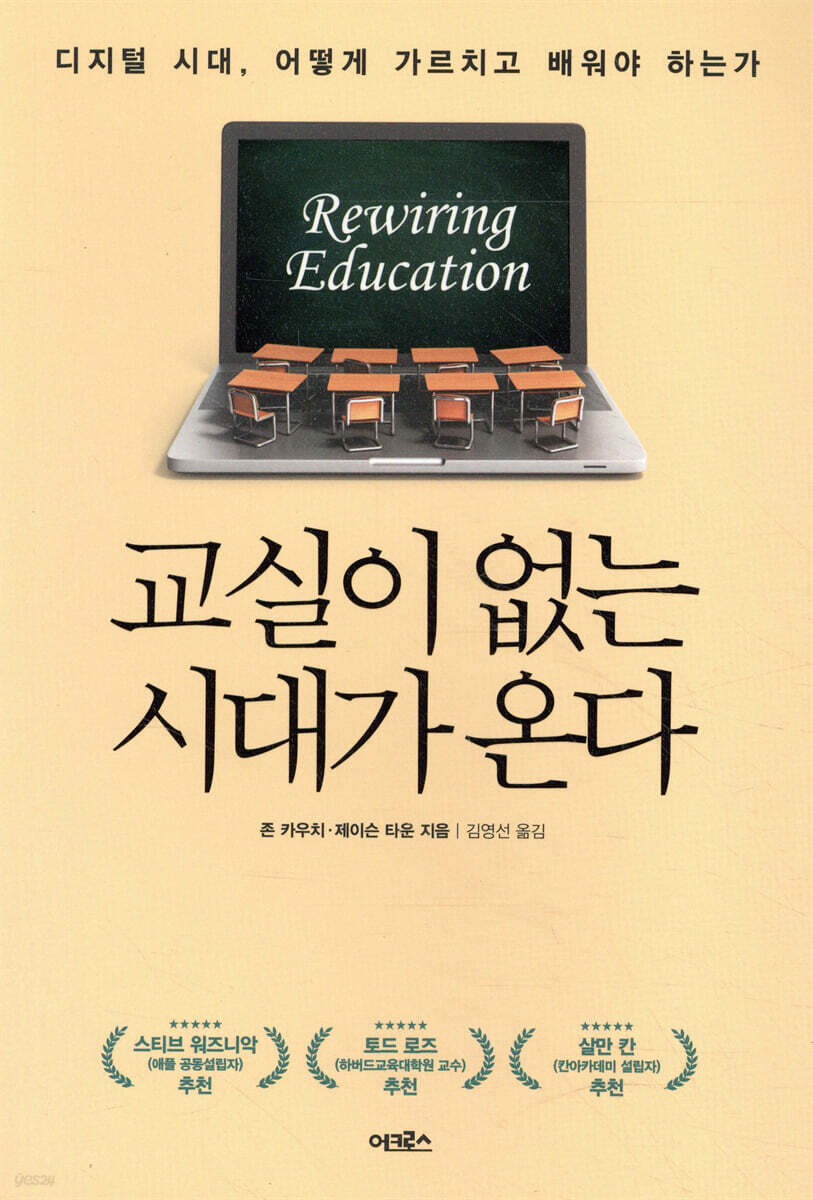
The era without classrooms is coming.
 |
Description
Book Introduction
The biggest topic in the education field right now is ‘online education.’
As cutting-edge technology meets education, learning is no longer confined to the classroom.
The era of personalized and customized education accessible anytime, anywhere has arrived.
With the new trend, questions are increasing.
With all the knowledge available online, what should we teach our children? How can we engage children who aren't even in front of us? If we can access all the necessary courses online, why do we still need schools and teachers?
"The Age Without Classrooms Is Coming" is a practical guide that can help you find answers to these questions.
This book helps you understand the new educational formula brought about by digital technology through key educational psychology theories and case studies from various educational settings, and provides insightful perspectives on the future of education.
As cutting-edge technology meets education, learning is no longer confined to the classroom.
The era of personalized and customized education accessible anytime, anywhere has arrived.
With the new trend, questions are increasing.
With all the knowledge available online, what should we teach our children? How can we engage children who aren't even in front of us? If we can access all the necessary courses online, why do we still need schools and teachers?
"The Age Without Classrooms Is Coming" is a practical guide that can help you find answers to these questions.
This book helps you understand the new educational formula brought about by digital technology through key educational psychology theories and case studies from various educational settings, and provides insightful perspectives on the future of education.
- You can preview some of the book's contents.
Preview
index
Steve Wozniak's Preface: A New Education Like No One Has Ever Experienced
Prologue: The Moment the Learning Paradigm Shifted
Part 1 - A World Arrived Unprepared
Chapter 1: A Whole Different Generation: Digital Natives
Chapter 2: The Biggest Flaws of the Standardized Education System
Part 2: The Essence of Studying That Everyone Was Missing
Chapter 3: Why Do We Think Everyone Should Learn the Same Way?
Chapter 4: What's More Important Than What You Learn
Chapter 5: The End of Consumption/Memorization Learning and New Types of Learning
Chapter 6: Designing Learning Spaces that Unleash Potential
Chapter 7: We Need Reality, Not Scripts
Part 3: Learning Differently in the Digital Age
Chapter 8: Challenge-Based Learning: From Content Consumer to Content Creator
Chapter 9 Accessibility: Opportunity for All
Chapter 10: The Maker Movement: The Core of Creativity and Autonomy
Chapter 11: Coding: The Beginning of Digital Literacy
Part 4: The Coexistence of Technology and Education for Optimal Results
Chapter 12: Will Technology Really Replace Teachers?
Chapter 13: What to Do with Your iPad
Chapter 14: From AI to VR, Tools Transforming the Learning Experience
Chapter 15 Five Years From Now
Epilogue_Change
Acknowledgements
main
Prologue: The Moment the Learning Paradigm Shifted
Part 1 - A World Arrived Unprepared
Chapter 1: A Whole Different Generation: Digital Natives
Chapter 2: The Biggest Flaws of the Standardized Education System
Part 2: The Essence of Studying That Everyone Was Missing
Chapter 3: Why Do We Think Everyone Should Learn the Same Way?
Chapter 4: What's More Important Than What You Learn
Chapter 5: The End of Consumption/Memorization Learning and New Types of Learning
Chapter 6: Designing Learning Spaces that Unleash Potential
Chapter 7: We Need Reality, Not Scripts
Part 3: Learning Differently in the Digital Age
Chapter 8: Challenge-Based Learning: From Content Consumer to Content Creator
Chapter 9 Accessibility: Opportunity for All
Chapter 10: The Maker Movement: The Core of Creativity and Autonomy
Chapter 11: Coding: The Beginning of Digital Literacy
Part 4: The Coexistence of Technology and Education for Optimal Results
Chapter 12: Will Technology Really Replace Teachers?
Chapter 13: What to Do with Your iPad
Chapter 14: From AI to VR, Tools Transforming the Learning Experience
Chapter 15 Five Years From Now
Epilogue_Change
Acknowledgements
main
Into the book
In fact, today's children can discover and learn more from mobile apps than from any traditional textbook.
Prensky says:
“The biggest problem facing education is that teachers are trying to teach children who speak an almost entirely digital language using an outdated, pre-digital language.” The current education system was created to teach very different children in a very different world, with very different needs from digital natives.
---From "A Completely Different Generation, Digital Natives"
It is problematic for expectations of students to become such that all students must achieve the same results at the same time.
Rather, it should be relative to the child's ability.
This does not mean that we do not expect students to be able to divide complex fractions.
Just don't expect that to happen in the third week of the fourth month of fifth grade!
---From "Why Do People Think They Have to Learn the Same Thing?"
I've been to hundreds of schools and classrooms around the world, and it's amazing how outdated most of the physical spaces are, and how antiquated the things that happen within them are.… Digital natives have a desire to engage, socialize, share, and create something relevant to their lives.
But often, they don't have access to a dedicated learning environment that makes that possible.
We need to make better use of the physical and digital learning spaces that are purposely created to allow students to be active.
---From "Designing a Learning Space that Unleashes Potential"
For example, while a project in project-based learning might ask students to find a YouTube video and share it as a slide presentation, a challenge in challenge-based learning might ask them to create a YouTube video and share it as a live simulation.
While project-based learning projects require students to read and take notes on blogs, challenge-based learning challenges students to create vlogs together and annotate them using digital annotation tools.
Challenge-based learning aims to move children from being mere consumers of content to becoming content producers and creators.
---From "Challenge-Based Learning: From Content Consumer to Content Creator"
The teacher's role is no longer to assign reading passages from textbooks, assign practice worksheets to help students memorize information, and rely on standardized tests to assess students.
The teacher's role should be to help students discover their innate talents and to shift from being a conveyer of information to a facilitator of learning.
Instead of relying on the traditional teacher role, facilitators rely on asking open-ended questions, guiding students through open-ended activities, providing personalized feedback, making lessons relevant and engaging to students, presenting real-world and fictional cases, encouraging collaboration and creativity, modeling problem-solving behaviors, and actively engaging students in their learning.
Prensky says:
“The biggest problem facing education is that teachers are trying to teach children who speak an almost entirely digital language using an outdated, pre-digital language.” The current education system was created to teach very different children in a very different world, with very different needs from digital natives.
---From "A Completely Different Generation, Digital Natives"
It is problematic for expectations of students to become such that all students must achieve the same results at the same time.
Rather, it should be relative to the child's ability.
This does not mean that we do not expect students to be able to divide complex fractions.
Just don't expect that to happen in the third week of the fourth month of fifth grade!
---From "Why Do People Think They Have to Learn the Same Thing?"
I've been to hundreds of schools and classrooms around the world, and it's amazing how outdated most of the physical spaces are, and how antiquated the things that happen within them are.… Digital natives have a desire to engage, socialize, share, and create something relevant to their lives.
But often, they don't have access to a dedicated learning environment that makes that possible.
We need to make better use of the physical and digital learning spaces that are purposely created to allow students to be active.
---From "Designing a Learning Space that Unleashes Potential"
For example, while a project in project-based learning might ask students to find a YouTube video and share it as a slide presentation, a challenge in challenge-based learning might ask them to create a YouTube video and share it as a live simulation.
While project-based learning projects require students to read and take notes on blogs, challenge-based learning challenges students to create vlogs together and annotate them using digital annotation tools.
Challenge-based learning aims to move children from being mere consumers of content to becoming content producers and creators.
---From "Challenge-Based Learning: From Content Consumer to Content Creator"
The teacher's role is no longer to assign reading passages from textbooks, assign practice worksheets to help students memorize information, and rely on standardized tests to assess students.
The teacher's role should be to help students discover their innate talents and to shift from being a conveyer of information to a facilitator of learning.
Instead of relying on the traditional teacher role, facilitators rely on asking open-ended questions, guiding students through open-ended activities, providing personalized feedback, making lessons relevant and engaging to students, presenting real-world and fictional cases, encouraging collaboration and creativity, modeling problem-solving behaviors, and actively engaging students in their learning.
---From "Will Technology Really Replace Teachers?"
Publisher's Review
Classroomless learning becomes the new normal.
: A new education formula brought about by digital technology
World-renowned scholar Yuval Harari recently predicted the post-COVID-19 world in an interview.
He cited the 'routine adoption of online lectures' as the biggest change.
The Hebrew University where Yuval Harari teaches closed its campus and moved all lectures online due to COVID-19, and he added that he himself had taught three lectures online.
“It’s impossible to imagine that universities will return to normal after the crisis has passed.”
As Yuval Harari said, online learning and remote classes are becoming the 'new normal' in the post-corona era.
As cutting-edge technologies such as artificial intelligence converge with education, we have entered an era where learning is no longer confined to the classroom.
Global technology companies such as Apple, Google, and Microsoft have been pioneering schools as a new market for several years, confident that the infinite possibilities of technology can maximize learning outcomes.
"The Age Without Classrooms Is Coming" is a book that offers answers to the question of what the essence of education should be, given that distance learning has become the norm.
Author John Couch, who has been at the forefront of technology and educational change for decades as Apple's vice president of education, examines what we can't afford to miss in education in the digital age.
How can we engage children who aren't even present in class?
: How 21st Century Learners, Digital Natives, Learn
Online learning has the advantage of being accessible anytime, anywhere, but it also has the disadvantage of reducing concentration because teachers have limited ability to encourage class participation.
When students struggle with learning, it's usually not because they lack the ability to learn, but because they don't convince themselves that it's worth learning.
John Couch says that why you learn, or motivation, is more important than what you learn.
Therefore, he emphasizes that the primary role of educators and parents going forward should be to help children find their optimal point by finding out what they are good at and what they want to learn, and linking it to what they need to learn.
As online learning becomes more commonplace, motivation will become even more important.
Most teachers agree that motivation is a prerequisite for effective learning, but they still struggle with how to achieve it.
This book introduces four secrets to motivation: giving learners choices, making it realistic, acknowledging and encouraging failure, and fostering passionate persistence.
Meanwhile, digital natives are active learners who enjoy creating their own online content, such as YouTube and vlogs, by leveraging the vast amount of information available. They want to be creators, not just consumers of content.
They need education that deals with themselves, learning in a form that allows them to create something that is relevant to themselves.
This book introduces various learning methods that can be utilized to suit the characteristics of these digital natives.
This book demonstrates how technology can be utilized in various ways to solve problems through students' own creations, such as 'challenge-based learning,' which is a further development of 'project-based learning,' which is commonly used in schools, and the 'maker movement,' which fosters problem-solving skills by teaching students how to use tools rather than teaching them about the tools. It also shows through several examples how technology can be utilized in various ways to solve problems through students' own creations.
What should teachers teach in the future of education?
: From ‘information provider’ and ‘content expert’ to ‘learning facilitator’ and ‘context expert’
The "digital native" generation, who grew up surrounded by digital devices from birth, have access to a vast amount of information at their fingertips.
Not only can we get instant answers from web-based resources like search engines, Wikipedia, and YouTube, but we can now also get answers simply by asking AI assistants like Siri and Alexa.
For children living in this environment, learning in the form of memorizing knowledge is meaningless.
But until now, teachers have been expected to teach to ensure that all students receive the same education, to achieve “grade level.”
Silicon Valley leaders at the forefront of technological change, such as Elon Musk, Steve Wozniak, and Mark Zuckerberg, have witnessed firsthand how talented individuals who value creativity, collaboration, and challenge, and who excel at these, can achieve remarkable results.
For this reason, he emphasizes that rather than rushing to learn the latest knowledge, it is more important to learn how to use it to solve problems, and that education should prepare people for life, not just for the workforce.
This is why today's learning methods must differ from those of the past, when the primary purpose was to provide "standard education for average learning" and exam preparation to mass-produce unskilled workers, and why the role of teachers must change.
This book argues that the role of teachers should no longer be to assign reading passages from textbooks, assign practice worksheets for memorization, and rely on tests to evaluate students, but rather to help students discover their own talents, shifting from being "information transmitters" to "learning facilitators."
A facilitator is someone who asks expandable questions that allow people to discover their own questions and answers, rather than questions that Google, Wikipedia, or Siri can answer.
Furthermore, he argues that teachers should not be "content experts" boasting specialized knowledge, but rather "context experts" who firmly enter the digital native context and relate their lessons to the students' world as much as possible.
Any teacher who has ever considered their role in the current trend of online classes and digital learning will find this book very helpful.
What to do with an iPad
: How Technology Can Lead to Optimal Learning Outcomes
When the Apple II computer was first released, John Couch donated two Apple II computers to his children's school.
At school, we didn't know how to use it, so we put it in the closet and only allowed people to use the computer during free time.
After a while, when we purchased more computers and had more than enough to fit in the closet, we decided to add computer classes to our curriculum and asked a parent who worked at IBM to create a curriculum.
The parent copied the first page of the computer manual, erased a few words, and had the students fill in the blanks.
This episode makes us question whether we are using technology properly for our learners.
Computer classes have been conducted in this format in many places so far.
Even now, when technology is introduced into the classroom, it is often used to make previously analog tasks, such as searching the Internet or printing worksheets, more efficient, rather than as a means of increasing learner motivation or drawing out their potential.
Simply putting digital devices in children's hands doesn't suddenly make them creative and spontaneous.
Improper introduction methods can actually undermine trust in technology and the confidence children have in handling digital devices.
This book addresses common illusions and misunderstandings that arise when introducing technology into learning, and cites TCPK and SAMR, two major models for technology introduction, to explain the process for desirable technology introduction.
This is essential knowledge for anyone who hopes to leverage technologies like mobile devices, the Internet of Things, 3D printers, augmented and virtual reality, and holograms to unlock the potential of every student and help them achieve their best.
: A new education formula brought about by digital technology
World-renowned scholar Yuval Harari recently predicted the post-COVID-19 world in an interview.
He cited the 'routine adoption of online lectures' as the biggest change.
The Hebrew University where Yuval Harari teaches closed its campus and moved all lectures online due to COVID-19, and he added that he himself had taught three lectures online.
“It’s impossible to imagine that universities will return to normal after the crisis has passed.”
As Yuval Harari said, online learning and remote classes are becoming the 'new normal' in the post-corona era.
As cutting-edge technologies such as artificial intelligence converge with education, we have entered an era where learning is no longer confined to the classroom.
Global technology companies such as Apple, Google, and Microsoft have been pioneering schools as a new market for several years, confident that the infinite possibilities of technology can maximize learning outcomes.
"The Age Without Classrooms Is Coming" is a book that offers answers to the question of what the essence of education should be, given that distance learning has become the norm.
Author John Couch, who has been at the forefront of technology and educational change for decades as Apple's vice president of education, examines what we can't afford to miss in education in the digital age.
How can we engage children who aren't even present in class?
: How 21st Century Learners, Digital Natives, Learn
Online learning has the advantage of being accessible anytime, anywhere, but it also has the disadvantage of reducing concentration because teachers have limited ability to encourage class participation.
When students struggle with learning, it's usually not because they lack the ability to learn, but because they don't convince themselves that it's worth learning.
John Couch says that why you learn, or motivation, is more important than what you learn.
Therefore, he emphasizes that the primary role of educators and parents going forward should be to help children find their optimal point by finding out what they are good at and what they want to learn, and linking it to what they need to learn.
As online learning becomes more commonplace, motivation will become even more important.
Most teachers agree that motivation is a prerequisite for effective learning, but they still struggle with how to achieve it.
This book introduces four secrets to motivation: giving learners choices, making it realistic, acknowledging and encouraging failure, and fostering passionate persistence.
Meanwhile, digital natives are active learners who enjoy creating their own online content, such as YouTube and vlogs, by leveraging the vast amount of information available. They want to be creators, not just consumers of content.
They need education that deals with themselves, learning in a form that allows them to create something that is relevant to themselves.
This book introduces various learning methods that can be utilized to suit the characteristics of these digital natives.
This book demonstrates how technology can be utilized in various ways to solve problems through students' own creations, such as 'challenge-based learning,' which is a further development of 'project-based learning,' which is commonly used in schools, and the 'maker movement,' which fosters problem-solving skills by teaching students how to use tools rather than teaching them about the tools. It also shows through several examples how technology can be utilized in various ways to solve problems through students' own creations.
What should teachers teach in the future of education?
: From ‘information provider’ and ‘content expert’ to ‘learning facilitator’ and ‘context expert’
The "digital native" generation, who grew up surrounded by digital devices from birth, have access to a vast amount of information at their fingertips.
Not only can we get instant answers from web-based resources like search engines, Wikipedia, and YouTube, but we can now also get answers simply by asking AI assistants like Siri and Alexa.
For children living in this environment, learning in the form of memorizing knowledge is meaningless.
But until now, teachers have been expected to teach to ensure that all students receive the same education, to achieve “grade level.”
Silicon Valley leaders at the forefront of technological change, such as Elon Musk, Steve Wozniak, and Mark Zuckerberg, have witnessed firsthand how talented individuals who value creativity, collaboration, and challenge, and who excel at these, can achieve remarkable results.
For this reason, he emphasizes that rather than rushing to learn the latest knowledge, it is more important to learn how to use it to solve problems, and that education should prepare people for life, not just for the workforce.
This is why today's learning methods must differ from those of the past, when the primary purpose was to provide "standard education for average learning" and exam preparation to mass-produce unskilled workers, and why the role of teachers must change.
This book argues that the role of teachers should no longer be to assign reading passages from textbooks, assign practice worksheets for memorization, and rely on tests to evaluate students, but rather to help students discover their own talents, shifting from being "information transmitters" to "learning facilitators."
A facilitator is someone who asks expandable questions that allow people to discover their own questions and answers, rather than questions that Google, Wikipedia, or Siri can answer.
Furthermore, he argues that teachers should not be "content experts" boasting specialized knowledge, but rather "context experts" who firmly enter the digital native context and relate their lessons to the students' world as much as possible.
Any teacher who has ever considered their role in the current trend of online classes and digital learning will find this book very helpful.
What to do with an iPad
: How Technology Can Lead to Optimal Learning Outcomes
When the Apple II computer was first released, John Couch donated two Apple II computers to his children's school.
At school, we didn't know how to use it, so we put it in the closet and only allowed people to use the computer during free time.
After a while, when we purchased more computers and had more than enough to fit in the closet, we decided to add computer classes to our curriculum and asked a parent who worked at IBM to create a curriculum.
The parent copied the first page of the computer manual, erased a few words, and had the students fill in the blanks.
This episode makes us question whether we are using technology properly for our learners.
Computer classes have been conducted in this format in many places so far.
Even now, when technology is introduced into the classroom, it is often used to make previously analog tasks, such as searching the Internet or printing worksheets, more efficient, rather than as a means of increasing learner motivation or drawing out their potential.
Simply putting digital devices in children's hands doesn't suddenly make them creative and spontaneous.
Improper introduction methods can actually undermine trust in technology and the confidence children have in handling digital devices.
This book addresses common illusions and misunderstandings that arise when introducing technology into learning, and cites TCPK and SAMR, two major models for technology introduction, to explain the process for desirable technology introduction.
This is essential knowledge for anyone who hopes to leverage technologies like mobile devices, the Internet of Things, 3D printers, augmented and virtual reality, and holograms to unlock the potential of every student and help them achieve their best.
GOODS SPECIFICS
- Publication date: April 28, 2020
- Page count, weight, size: 312 pages | 440g | 147*215*30mm
- ISBN13: 9791190030434
- ISBN10: 1190030438
You may also like
카테고리
korean


korean

![GQ KOREA Mark (Monthly): December [2025]](http://librairie.coreenne.fr/cdn/shop/files/8ef265dbbfbf186523ed75ba7319009d.jpg?v=1765340328&width=3840)


