

meritocracy
 |
Description
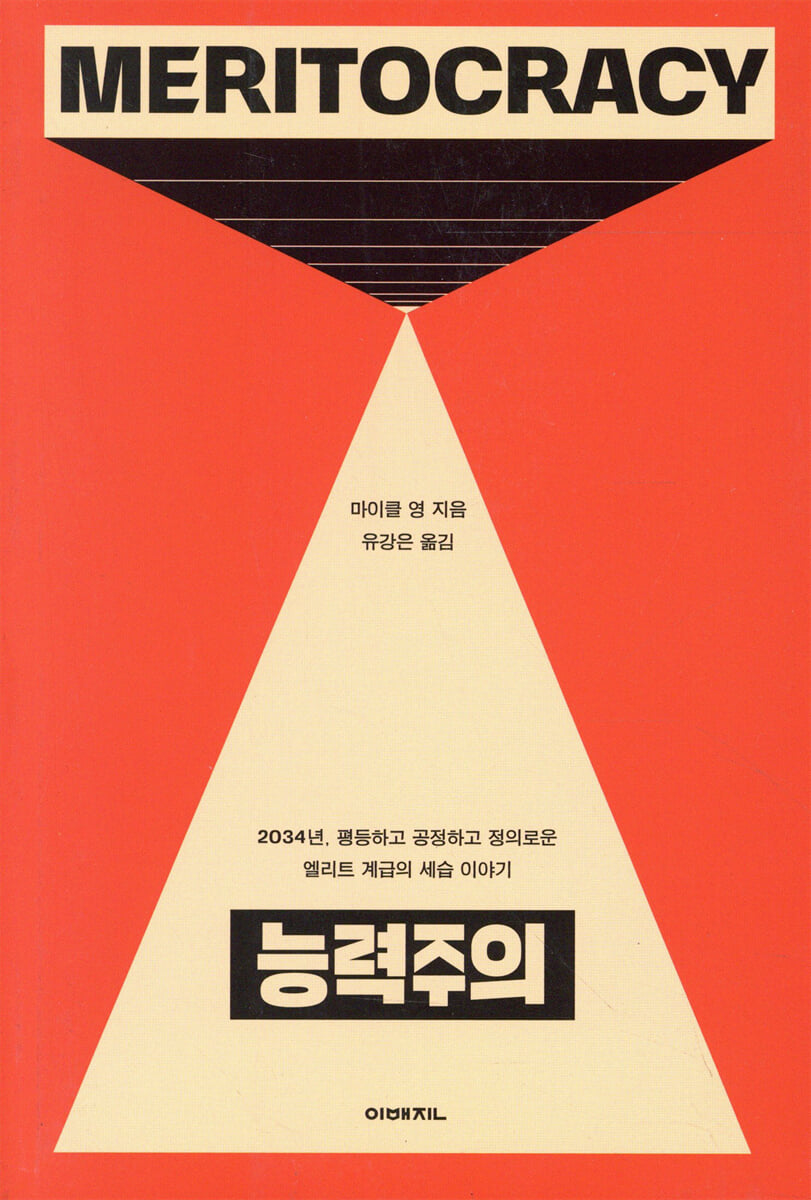
Book Introduction
Meritocracy in 2034 and 2020
― A hereditary society of an elite class based on equality, fairness, and justice
If you don't belong to the top 5 percent of the "superior class" with an IQ of over 125, you are forced to become a lower class, and some are hired by the elite to work as domestic servants.
The elite, who make up only 5 percent of the population, hold power over politics, the economy, and culture, and pass down their status to their children under the guise of equality, fairness, and justice, while the lower classes and their children fall further and further into the abyss.
Is this the story of Korea today, where a single test at a school divided into classes determines one's life, and where 'Bilger', 'Hugher', and 'Elsa' support 'Gangnam Republic' and 'Sky Castle'?
Michael Young, a British sociologist and social activist, depicts a 'meritocracy' and a 'meritocracy society' based on the equation 'intelligence (IQ) + effort (Effort) = ability (Merit)' in his sociological dystopian novel 'Meritocracy'.
The term "meritocracy," given to the oligarchy set in British society in 2034, has entered the English dictionary and has now become the creed and moral standard of the 21st-century ruling class.
In Korea, where controversies over gender equality and irregular employment arise, people from all walks of life, from the '86 generation' to 'Ilbe' share the values of 'equality,' 'fairness,' and 'justice'—the winner-takes-all' and meritocracy—transcending age, class, and ideology, this sociological satire clearly demonstrates how meritocracy, which justifies discrimination based on ability and the hereditary succession of a capable elite class, can reform society.
― A hereditary society of an elite class based on equality, fairness, and justice
If you don't belong to the top 5 percent of the "superior class" with an IQ of over 125, you are forced to become a lower class, and some are hired by the elite to work as domestic servants.
The elite, who make up only 5 percent of the population, hold power over politics, the economy, and culture, and pass down their status to their children under the guise of equality, fairness, and justice, while the lower classes and their children fall further and further into the abyss.
Is this the story of Korea today, where a single test at a school divided into classes determines one's life, and where 'Bilger', 'Hugher', and 'Elsa' support 'Gangnam Republic' and 'Sky Castle'?
Michael Young, a British sociologist and social activist, depicts a 'meritocracy' and a 'meritocracy society' based on the equation 'intelligence (IQ) + effort (Effort) = ability (Merit)' in his sociological dystopian novel 'Meritocracy'.
The term "meritocracy," given to the oligarchy set in British society in 2034, has entered the English dictionary and has now become the creed and moral standard of the 21st-century ruling class.
In Korea, where controversies over gender equality and irregular employment arise, people from all walks of life, from the '86 generation' to 'Ilbe' share the values of 'equality,' 'fairness,' and 'justice'—the winner-takes-all' and meritocracy—transcending age, class, and ideology, this sociological satire clearly demonstrates how meritocracy, which justifies discrimination based on ability and the hereditary succession of a capable elite class, can reform society.
- You can preview some of the book's contents.
Preview
index
Acknowledgements
Introduction to the Transactions Publishing Edition
introduction
Part 1.
The rise of the elite
Chapter 1: The Clash of Social Forces
1.
Civil servant model 2.
Beautiful and splendid world 3.
Family and Feudalism 4.
Stimulus of external competition 5.
Socialist Midwives 6.
summation
Chapter 2: The Threat of Comprehensive Schools
1.
Third force in school 2.
Defeated agitation 3.
Leicester's Eclectic School 4.
summation
Chapter 3: The Origins of Modern Education
1.
The most fundamental reform 2.
Teacher salary increase 3.
Boarding grammar school 4.
Development of intelligence tests 5.
summation
Chapter 4: From Seniority to Ability
1.
Senior class 2.
The factory that stopped being a school 3.
Age Challenge 4.
summation
Part 2.
The decline of the lower classes
Chapter 5: The Status of Workers
1.
The Golden Age of Equality 2.
The Abyss Separating the Classes 3.
4. Engineers performing menial tasks.
New unemployment 5.
The reappearance of the house servant 6.
summation
Chapter 6: The Decline of the Labor Movement
1.
Historical Mission 2.
The Decline of Parliament 3.
Technicians 4.
Coordination within the union 5.
summation
Chapter 7: The Rich and the Poor
1.
Ability and Money 2.
Modern Synthesis 3.
summation
Chapter 8: Crisis
1.
The first campaign launched by women 2.
Contemporary Feminist Movement 3.
The advent of crisis 4.
New Conservatism 5.
Finally, the general public rises up 6.
Where to from here
Translator's note
Introduction to the Transactions Publishing Edition
introduction
Part 1.
The rise of the elite
Chapter 1: The Clash of Social Forces
1.
Civil servant model 2.
Beautiful and splendid world 3.
Family and Feudalism 4.
Stimulus of external competition 5.
Socialist Midwives 6.
summation
Chapter 2: The Threat of Comprehensive Schools
1.
Third force in school 2.
Defeated agitation 3.
Leicester's Eclectic School 4.
summation
Chapter 3: The Origins of Modern Education
1.
The most fundamental reform 2.
Teacher salary increase 3.
Boarding grammar school 4.
Development of intelligence tests 5.
summation
Chapter 4: From Seniority to Ability
1.
Senior class 2.
The factory that stopped being a school 3.
Age Challenge 4.
summation
Part 2.
The decline of the lower classes
Chapter 5: The Status of Workers
1.
The Golden Age of Equality 2.
The Abyss Separating the Classes 3.
4. Engineers performing menial tasks.
New unemployment 5.
The reappearance of the house servant 6.
summation
Chapter 6: The Decline of the Labor Movement
1.
Historical Mission 2.
The Decline of Parliament 3.
Technicians 4.
Coordination within the union 5.
summation
Chapter 7: The Rich and the Poor
1.
Ability and Money 2.
Modern Synthesis 3.
summation
Chapter 8: Crisis
1.
The first campaign launched by women 2.
Contemporary Feminist Movement 3.
The advent of crisis 4.
New Conservatism 5.
Finally, the general public rises up 6.
Where to from here
Translator's note
Into the book
The 20th century was a time when this neologism had room to creep in.
Those in power and privilege are more willing than ever to believe that modern society is "ruled not by the people but by the wise few," that is, "not by an aristocracy of birth or a plutocracy based on wealth, but by a true meritocracy based on talent."
The connection between aristocracy and meritocracy was particularly advantageous.
--- p.13
Intelligence (I.
The proposition that ‘Q.)+effort=merit’ was not new, but the way in which the proposition was formalized was refreshing.
Since the Industrial Revolution, or even before it, the idea of “opening the path to success for the talented” (la carriere ouverte aux talents) has been one of the main goals of social reform.
Cronyism, bribery, and inheritance, which were all means of obtaining public office, must now all disappear.
Of course, such practices have not yet disappeared, but the belief that it is wrong to allow even the slightest influence of nepotism, bribery, and inheritance is becoming more and more entrenched.
Now, individual ability has become the only criterion.
--- p.14
In 1914, the upper classes had their fair share of geniuses and dullards, and so did the working classes.
Or to put it another way, because a few smart and lucky working-class men, despite their subordinate status in society, always managed to rise to the top, the inferior classes had almost as many superiors as the upper classes themselves.
Intelligence is distributed somewhat randomly.
Each social class was a microcosm of society itself in terms of its capabilities.
The parts were identical to the whole.
A fundamental change that had already begun to take place in the last century, that is, before 1963, was the redistribution of intelligence among classes and the transformation of the character of each class.
While the talented were given the opportunity to rise to a level commensurate with their abilities, the lower classes became the domain of the less capable.
Now the part is not identical to the whole.
--- p.28~29
“I am a worker here.
Why am I a worker? Am I not suited for other jobs? Of course not.
If only I had the chance, I could have shown it to the world.
A doctor? A brewer? A minister? I could have done anything.
There just wasn't an opportunity.
So now I am a worker.
But I shouldn't think that I am truly more incompetent than anyone else.
“I am better than anyone else.” Unfair education allowed people to maintain their illusions, and unequal opportunities fostered the myth of human equality.
We know this story is a myth, but our ancestors did not know.
--- p.171~172
Equality of opportunity is not about the chance to climb the social ladder, but about ensuring that everyone has equal opportunities to develop their innate virtues and talents, their full capacity to appreciate the depth and beauty of human experience, and their full potential in life, regardless of their "intelligence."
Every child is a valuable individual, not simply a potential job maker needed by society.
Schools should be dedicated to fostering all human talents, not to producing people to fill jobs deemed crucial at any given moment, tied to the vocational structure.
--- p.269~270
The educational reforms of a century ago played a crucial role in reducing the waste of talent among the lower classes.
But as more intelligent people are filtered out and move into the upper classes, the incentive to continue this process correspondingly weakens.
By 1990, all adults with an IQ of 125 or higher were considered meritocratic.
Most children with an IQ of 125 or higher were the children of these adults.
The likelihood that today's elite will nurture tomorrow's elite is greater than ever before.
The elite group is now becoming hereditary, and the principle of heredity and the principle of ability are being combined.
Those in power and privilege are more willing than ever to believe that modern society is "ruled not by the people but by the wise few," that is, "not by an aristocracy of birth or a plutocracy based on wealth, but by a true meritocracy based on talent."
The connection between aristocracy and meritocracy was particularly advantageous.
--- p.13
Intelligence (I.
The proposition that ‘Q.)+effort=merit’ was not new, but the way in which the proposition was formalized was refreshing.
Since the Industrial Revolution, or even before it, the idea of “opening the path to success for the talented” (la carriere ouverte aux talents) has been one of the main goals of social reform.
Cronyism, bribery, and inheritance, which were all means of obtaining public office, must now all disappear.
Of course, such practices have not yet disappeared, but the belief that it is wrong to allow even the slightest influence of nepotism, bribery, and inheritance is becoming more and more entrenched.
Now, individual ability has become the only criterion.
--- p.14
In 1914, the upper classes had their fair share of geniuses and dullards, and so did the working classes.
Or to put it another way, because a few smart and lucky working-class men, despite their subordinate status in society, always managed to rise to the top, the inferior classes had almost as many superiors as the upper classes themselves.
Intelligence is distributed somewhat randomly.
Each social class was a microcosm of society itself in terms of its capabilities.
The parts were identical to the whole.
A fundamental change that had already begun to take place in the last century, that is, before 1963, was the redistribution of intelligence among classes and the transformation of the character of each class.
While the talented were given the opportunity to rise to a level commensurate with their abilities, the lower classes became the domain of the less capable.
Now the part is not identical to the whole.
--- p.28~29
“I am a worker here.
Why am I a worker? Am I not suited for other jobs? Of course not.
If only I had the chance, I could have shown it to the world.
A doctor? A brewer? A minister? I could have done anything.
There just wasn't an opportunity.
So now I am a worker.
But I shouldn't think that I am truly more incompetent than anyone else.
“I am better than anyone else.” Unfair education allowed people to maintain their illusions, and unequal opportunities fostered the myth of human equality.
We know this story is a myth, but our ancestors did not know.
--- p.171~172
Equality of opportunity is not about the chance to climb the social ladder, but about ensuring that everyone has equal opportunities to develop their innate virtues and talents, their full capacity to appreciate the depth and beauty of human experience, and their full potential in life, regardless of their "intelligence."
Every child is a valuable individual, not simply a potential job maker needed by society.
Schools should be dedicated to fostering all human talents, not to producing people to fill jobs deemed crucial at any given moment, tied to the vocational structure.
--- p.269~270
The educational reforms of a century ago played a crucial role in reducing the waste of talent among the lower classes.
But as more intelligent people are filtered out and move into the upper classes, the incentive to continue this process correspondingly weakens.
By 1990, all adults with an IQ of 125 or higher were considered meritocratic.
Most children with an IQ of 125 or higher were the children of these adults.
The likelihood that today's elite will nurture tomorrow's elite is greater than ever before.
The elite group is now becoming hereditary, and the principle of heredity and the principle of ability are being combined.
--- p.278~279
Publisher's Review
The advent of a meritocratic society
― A novel that feels like reality and a meritocracy that feels like a novel
This story, which depicts a future dominated by meritocracy, begins in 1870.
In 1870, Britain began free public education, introduced open civil service examinations, and introduced promotion examinations.
In 1944, the Education Act was revised, dividing secondary schools into aristocratic schools (grammar schools aimed at university entrance) and common schools (modern secondary schools providing vocational education).
In 1958, when 『Meritocracy』 was published, educational equality was progressing and equal opportunity was expanding, but the way life was determined at the age of 11 when entering middle school began to become a problem.
Even after the introduction of American-style comprehensive schools as an alternative, the controversy surrounding prestigious private schools and grammar schools continued to linger.
When equal opportunity is equated with meritocracy, the ideal of equal and democratic education is shaken.
The story begins in 1958.
The part that covers the period before 1958 is based on historical facts, but the rest is fiction, imagined and predicted by the author based on the flow of reality.
Young, who created the word 'meritocracy' and the equation 'intelligence (I) + effort (E) = ability (M),' imagines that a meritocracy society measures ability, skills, achievements, and talent based on 'intelligence.'
There is a widespread perception that some people's descendants are not equipped to hold responsible positions in business, government, education, or science.
Experts in education and selection apply scientific principles to identify future leaders.
We need to have a certain level of intelligence, qualifications, experience, and application, and we need to have certain competencies required to achieve a position.
In short, everyone must demonstrate the ability to develop in the new society of the future.
The biggest problem with meritocracy is that the standards for measuring human ability are becoming narrower.
The meritocracy in the novel and the meritocracy we experience today both utilize standardized tests as important tools.
College entrance exams, job entrance exams, qualification exams, national examinations, etc. all take the form of ‘equal,’ ‘fair,’ and ‘just’ examinations.
In the novel's meritocratic society, as intelligence measurement becomes increasingly scientific and precise, technology is also developing to accurately predict potential IQ, or the maximum IQ that can be achieved in the future.
Meritocracy, which once led to a "golden age of equality," has become an ideology that justifies inequality, and the ladder of success, climbed only by the privileged class and hereditary elites in the "lucky sperm club," has become more solid.
Now, the abilities of the elite have become a qualification for the privileged class, and the class of capable elites is passed down to their children.
Ability becomes class, and class is hereditary.
True equal opportunity
― Thinking of people first, beyond the inheritance of ability and class.
The story, which mixes fact and fiction, can be difficult to follow, but if you first read the translator's note summarizing the story's background and plot, you can enjoy the opportunity to get a bird's-eye view of the meritocracy and meritocratic society set in 2034 Britain.
Part 1 describes how the boundaries between aristocracy and secularism were broken down, and meritocracy took root in education and industry, as war heightened the need for efficient use of manpower and revealed that low productivity was a fatal weakness in increasingly fierce international competition.
Part 2 depicts the various negative consequences of meritocracy, particularly the changing circumstances of the upper and lower classes, and the story unfolds as attempts at resistance, led by populist groups, slowly emerge.
The meritocracy, which had been functioning smoothly for a while, faced a challenge from a new resistance force called the populist movement as the gap between classes became noticeably widened and hardened to the point of irreversibility, blocking social mobility between classes.
As intelligence testing techniques developed and the practice of intellectual eugenics and job inheritance spread, where capable fathers produced capable children, intelligence, which was previously distributed more or less randomly, went through a widespread redistribution process, revealing the gap between classes.
The talented upper classes are given the opportunity to rise to a level commensurate with their abilities, while the lower classes are reserved for those with less ability.
The novel draws to a close as the utopian society, where only the elite with the highest level of intelligence and work ability are rewarded and most of the rest are punished, finally descends into a nightmare, and the shadow of chaos and rebellion caused by the lower classes looms large.
Michael Young attempts to give new meaning to 'equal opportunity' through his novel, 'The Chelsea Declaration'.
True equality of opportunity is not about the opportunity to climb the social ladder, but about ensuring that everyone, regardless of intelligence, has equal opportunity to develop to their fullest potential all their innate virtues and talents, all their capacities to appreciate the depth and beauty of human experience, and all their life potential.
Because every child is a ‘valuable individual’ before being a ‘human resource’ who should be subject to intelligence testing.
Because schools should focus on encouraging “all human talents” rather than focusing on filling jobs to fit the job structure.
Let's overthrow meritocracy
― Imagining a new education, ability, and equality beyond the dystopia of endless competition and polarization.
In the 20th century, sociologist Michael Young, who supported the British Labour Party, wrote “Meritocracy.”
In 2001, when Prime Minister Tony Blair made a speech calling for Britain to follow the United States and completely transform into a meritocracy, Young, enraged by the Labour government's blind faith in distorted meritocracy, wrote a column in the Guardian titled "Let's overthrow meritocracy."
The core ambiguity surrounding ‘meritocracy’ becomes clearer in this way.
Michael Young in real life and Michael Young in the novel are politically polar opposites, but like the duality of meritocracy, they also overlap.
Because of this duality, Meritocracy is not perceived as a satirical novel or a dystopian novel, but rather as a book that prophesies the major organizing principles of the modern world, and meritocracy becomes a measure of modernization and a modern person's faith, centered around the United States.
In the 21st century, the meritocratic society depicted in novels is finally coming into full bloom in Korea.
Korean society, which believes in the "fairness" of "reward according to ability" regardless of political views and social class, trusts in a system where one's future is determined by a single, fair college entrance exam.
The college entrance exam war, reminiscent of an "eternal arms race," breeds endless competition and polarization, and most incompetent people, who have been eliminated from the hereditary competition surrounding the elite class and are desperate for stable jobs, suffer from low self-esteem, blaming their lack of ability.
How can we imagine a fair and new education, competence, and equality, moving beyond the meritocracy presented in a simplistic diagram and the critique of meritocracy trapped in flawed logic? This is a question we should be asking ourselves, not Michael Young.
― A novel that feels like reality and a meritocracy that feels like a novel
This story, which depicts a future dominated by meritocracy, begins in 1870.
In 1870, Britain began free public education, introduced open civil service examinations, and introduced promotion examinations.
In 1944, the Education Act was revised, dividing secondary schools into aristocratic schools (grammar schools aimed at university entrance) and common schools (modern secondary schools providing vocational education).
In 1958, when 『Meritocracy』 was published, educational equality was progressing and equal opportunity was expanding, but the way life was determined at the age of 11 when entering middle school began to become a problem.
Even after the introduction of American-style comprehensive schools as an alternative, the controversy surrounding prestigious private schools and grammar schools continued to linger.
When equal opportunity is equated with meritocracy, the ideal of equal and democratic education is shaken.
The story begins in 1958.
The part that covers the period before 1958 is based on historical facts, but the rest is fiction, imagined and predicted by the author based on the flow of reality.
Young, who created the word 'meritocracy' and the equation 'intelligence (I) + effort (E) = ability (M),' imagines that a meritocracy society measures ability, skills, achievements, and talent based on 'intelligence.'
There is a widespread perception that some people's descendants are not equipped to hold responsible positions in business, government, education, or science.
Experts in education and selection apply scientific principles to identify future leaders.
We need to have a certain level of intelligence, qualifications, experience, and application, and we need to have certain competencies required to achieve a position.
In short, everyone must demonstrate the ability to develop in the new society of the future.
The biggest problem with meritocracy is that the standards for measuring human ability are becoming narrower.
The meritocracy in the novel and the meritocracy we experience today both utilize standardized tests as important tools.
College entrance exams, job entrance exams, qualification exams, national examinations, etc. all take the form of ‘equal,’ ‘fair,’ and ‘just’ examinations.
In the novel's meritocratic society, as intelligence measurement becomes increasingly scientific and precise, technology is also developing to accurately predict potential IQ, or the maximum IQ that can be achieved in the future.
Meritocracy, which once led to a "golden age of equality," has become an ideology that justifies inequality, and the ladder of success, climbed only by the privileged class and hereditary elites in the "lucky sperm club," has become more solid.
Now, the abilities of the elite have become a qualification for the privileged class, and the class of capable elites is passed down to their children.
Ability becomes class, and class is hereditary.
True equal opportunity
― Thinking of people first, beyond the inheritance of ability and class.
The story, which mixes fact and fiction, can be difficult to follow, but if you first read the translator's note summarizing the story's background and plot, you can enjoy the opportunity to get a bird's-eye view of the meritocracy and meritocratic society set in 2034 Britain.
Part 1 describes how the boundaries between aristocracy and secularism were broken down, and meritocracy took root in education and industry, as war heightened the need for efficient use of manpower and revealed that low productivity was a fatal weakness in increasingly fierce international competition.
Part 2 depicts the various negative consequences of meritocracy, particularly the changing circumstances of the upper and lower classes, and the story unfolds as attempts at resistance, led by populist groups, slowly emerge.
The meritocracy, which had been functioning smoothly for a while, faced a challenge from a new resistance force called the populist movement as the gap between classes became noticeably widened and hardened to the point of irreversibility, blocking social mobility between classes.
As intelligence testing techniques developed and the practice of intellectual eugenics and job inheritance spread, where capable fathers produced capable children, intelligence, which was previously distributed more or less randomly, went through a widespread redistribution process, revealing the gap between classes.
The talented upper classes are given the opportunity to rise to a level commensurate with their abilities, while the lower classes are reserved for those with less ability.
The novel draws to a close as the utopian society, where only the elite with the highest level of intelligence and work ability are rewarded and most of the rest are punished, finally descends into a nightmare, and the shadow of chaos and rebellion caused by the lower classes looms large.
Michael Young attempts to give new meaning to 'equal opportunity' through his novel, 'The Chelsea Declaration'.
True equality of opportunity is not about the opportunity to climb the social ladder, but about ensuring that everyone, regardless of intelligence, has equal opportunity to develop to their fullest potential all their innate virtues and talents, all their capacities to appreciate the depth and beauty of human experience, and all their life potential.
Because every child is a ‘valuable individual’ before being a ‘human resource’ who should be subject to intelligence testing.
Because schools should focus on encouraging “all human talents” rather than focusing on filling jobs to fit the job structure.
Let's overthrow meritocracy
― Imagining a new education, ability, and equality beyond the dystopia of endless competition and polarization.
In the 20th century, sociologist Michael Young, who supported the British Labour Party, wrote “Meritocracy.”
In 2001, when Prime Minister Tony Blair made a speech calling for Britain to follow the United States and completely transform into a meritocracy, Young, enraged by the Labour government's blind faith in distorted meritocracy, wrote a column in the Guardian titled "Let's overthrow meritocracy."
The core ambiguity surrounding ‘meritocracy’ becomes clearer in this way.
Michael Young in real life and Michael Young in the novel are politically polar opposites, but like the duality of meritocracy, they also overlap.
Because of this duality, Meritocracy is not perceived as a satirical novel or a dystopian novel, but rather as a book that prophesies the major organizing principles of the modern world, and meritocracy becomes a measure of modernization and a modern person's faith, centered around the United States.
In the 21st century, the meritocratic society depicted in novels is finally coming into full bloom in Korea.
Korean society, which believes in the "fairness" of "reward according to ability" regardless of political views and social class, trusts in a system where one's future is determined by a single, fair college entrance exam.
The college entrance exam war, reminiscent of an "eternal arms race," breeds endless competition and polarization, and most incompetent people, who have been eliminated from the hereditary competition surrounding the elite class and are desperate for stable jobs, suffer from low self-esteem, blaming their lack of ability.
How can we imagine a fair and new education, competence, and equality, moving beyond the meritocracy presented in a simplistic diagram and the critique of meritocracy trapped in flawed logic? This is a question we should be asking ourselves, not Michael Young.
GOODS SPECIFICS
- Date of issue: April 6, 2020
- Page count, weight, size: 319 pages | 292g | 128*188*30mm
- ISBN13: 9791155311158
- ISBN10: 1155311159
You may also like
카테고리
korean


korean

![GQ KOREA Mark (Monthly): December [2025]](http://librairie.coreenne.fr/cdn/shop/files/8ef265dbbfbf186523ed75ba7319009d.jpg?v=1765340328&width=3840)


