

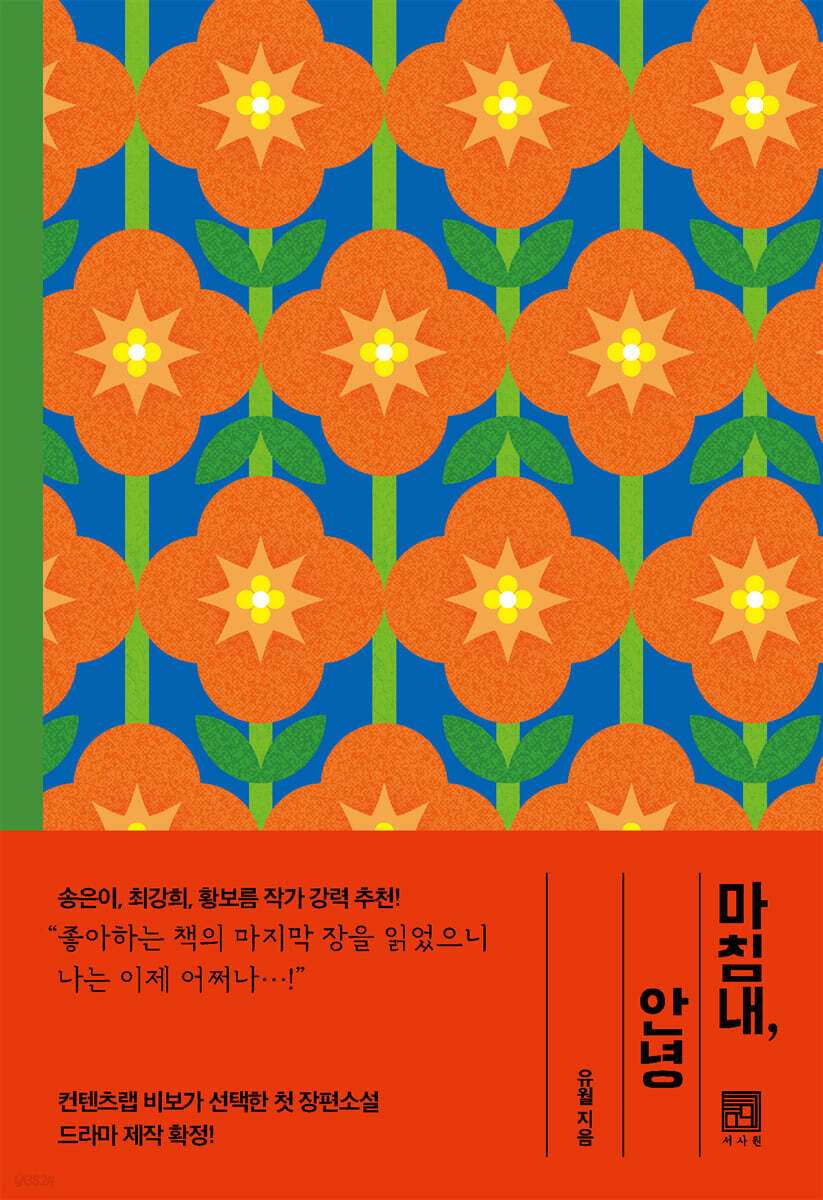
Finally, goodbye
 |
Description
Book Introduction
The very work that Song Eun-i discovered and actress Choi Kang-hee fell in love with!
The first full-length novel selected by Content Lab Vivo! A drama adaptation confirmed immediately upon publication!
Highly recommended by writers Song Eun-i, Choi Kang-hee, and Hwang Bo-reum!
“I’ve just finished reading the last chapter of my favorite book, so what do I do now…?” _Actress Choi Kang-hee
“Reading this book, you will realize that we all have moments when we wished for someone to sympathize with our pain.” _Welcome to the Hyeonam-dong Bookstore, author Hwang Bo-reum
Millie's Study series, a hot topic! Finally published!
Milliload Push ranked first in monthly rankings, surpassing 7,000 views in just one month.
The material is good and the content is immersive.
A masterpiece will be born! _******* Author
This is life.
I cry, laugh, imagine, and empathize.
Doyeon, a friend I want to share a drink with.
_***** stray cat
I watched it with a light heart, but I felt a pang of sadness at the end.
I read it well.
thank you.
_**** Hope Evangelist
Doyeon, who became a domestic affairs investigator, meets various people at the court.
Cases such as divorce and division of property are diverse and the stories are complex.
The court, which seemed like the most dignified and rational organization in Korea, is now so busy with all sorts of events that it's hard to tell if it's a court or an event company.
Domestic investigators, who are temporary civil servants who are converted to regular employees after an evaluation, are forced to take on various tasks that no one wants to do under the pretext of the evaluation system.
Do-yeon, who is fed up with the conservative and unreasonable court life, gradually becomes complacent as she takes on cases.
Doyeon, who never wanted to do her best in anything, whether it was work or relationships, grew up hearing from her father that she should always do her best.
Doyeon ran away from the world due to resentment towards her father who told her to live honestly and the pain and wounds of her past.
She had never properly listened to the pain of her sister, who always dreamed of being ordinary, and she felt that “having to constantly listen to other people’s lives” was “like a punishment” for her.
"Finally, Goodbye" is the story of Doyeon, who wanted to live a peaceful and safe life, and through the loose solidarity and friendship with the people she met at the court, her colleagues, and those around her, she finally says "Finally, Goodbye" to her dark past.
Doyeon decides to break down her own boundaries and move forward a little further, hoping for the sliver of hope that still remains in our lives.
Even if it means being a little hurt by the world.
The author observes the work of a domestic affairs investigator and the people around him, sometimes from very close up, sometimes from afar.
Rather than simply pursuing provocative material, it empathizes with, observes, and reflects on human pain and sorrow.
This may be the most ethical attitude shown by someone who has been observing the human mind for a long time.
Yet, it delivers a sense of speed that runs at a rapid pace without losing the tension of the story.
An exciting and heartwarming novel that arrives to us in 2025.
The first full-length novel selected by Content Lab Vivo! A drama adaptation confirmed immediately upon publication!
Highly recommended by writers Song Eun-i, Choi Kang-hee, and Hwang Bo-reum!
“I’ve just finished reading the last chapter of my favorite book, so what do I do now…?” _Actress Choi Kang-hee
“Reading this book, you will realize that we all have moments when we wished for someone to sympathize with our pain.” _Welcome to the Hyeonam-dong Bookstore, author Hwang Bo-reum
Millie's Study series, a hot topic! Finally published!
Milliload Push ranked first in monthly rankings, surpassing 7,000 views in just one month.
The material is good and the content is immersive.
A masterpiece will be born! _******* Author
This is life.
I cry, laugh, imagine, and empathize.
Doyeon, a friend I want to share a drink with.
_***** stray cat
I watched it with a light heart, but I felt a pang of sadness at the end.
I read it well.
thank you.
_**** Hope Evangelist
Doyeon, who became a domestic affairs investigator, meets various people at the court.
Cases such as divorce and division of property are diverse and the stories are complex.
The court, which seemed like the most dignified and rational organization in Korea, is now so busy with all sorts of events that it's hard to tell if it's a court or an event company.
Domestic investigators, who are temporary civil servants who are converted to regular employees after an evaluation, are forced to take on various tasks that no one wants to do under the pretext of the evaluation system.
Do-yeon, who is fed up with the conservative and unreasonable court life, gradually becomes complacent as she takes on cases.
Doyeon, who never wanted to do her best in anything, whether it was work or relationships, grew up hearing from her father that she should always do her best.
Doyeon ran away from the world due to resentment towards her father who told her to live honestly and the pain and wounds of her past.
She had never properly listened to the pain of her sister, who always dreamed of being ordinary, and she felt that “having to constantly listen to other people’s lives” was “like a punishment” for her.
"Finally, Goodbye" is the story of Doyeon, who wanted to live a peaceful and safe life, and through the loose solidarity and friendship with the people she met at the court, her colleagues, and those around her, she finally says "Finally, Goodbye" to her dark past.
Doyeon decides to break down her own boundaries and move forward a little further, hoping for the sliver of hope that still remains in our lives.
Even if it means being a little hurt by the world.
The author observes the work of a domestic affairs investigator and the people around him, sometimes from very close up, sometimes from afar.
Rather than simply pursuing provocative material, it empathizes with, observes, and reflects on human pain and sorrow.
This may be the most ethical attitude shown by someone who has been observing the human mind for a long time.
Yet, it delivers a sense of speed that runs at a rapid pace without losing the tension of the story.
An exciting and heartwarming novel that arrives to us in 2025.
- You can preview some of the book's contents.
Preview
index
#1 Housekeeping Inspector
#2 Children always forgive adults.
#3 The noisy court life
#4 Healthy Potatoes
#5 Closest people, family
#6 The Weight of Complacency
#7 Woojin and Muheon
#8 The Form of Love
#9 Doyeon's first job
#10 Runaway Train
#11 Distance between two people
#12 A bleak time
#13 Man in a robot t-shirt
#14 Where the wind passes
#15 Maps and Territories
#16 A Midsummer Night's Woojin
#17 Because we are colleagues
#18 Reunion with Support
#19 Things that don't seem too close
#20 Finally, goodbye
#2 Children always forgive adults.
#3 The noisy court life
#4 Healthy Potatoes
#5 Closest people, family
#6 The Weight of Complacency
#7 Woojin and Muheon
#8 The Form of Love
#9 Doyeon's first job
#10 Runaway Train
#11 Distance between two people
#12 A bleak time
#13 Man in a robot t-shirt
#14 Where the wind passes
#15 Maps and Territories
#16 A Midsummer Night's Woojin
#17 Because we are colleagues
#18 Reunion with Support
#19 Things that don't seem too close
#20 Finally, goodbye
Detailed image

Into the book
As soon as the remaining troops arrived, the microphone was turned on and the trial began.
The director, the chief judge, the director, and the section chief bowed in turn to the red piggy bank that replaced the pig's head.
I knew the civil service was a conservative organization, but I didn't know it was this bad.
It's a sight to see so-called elites from prestigious universities in Korea gathered on a mountain and bowing down to piggy banks.
--- p.32
The new father, who was standing next to her as if he had nothing to do with her, condoned, tolerated, and sometimes even encouraged her beatings.
Mom, who was always watching Dad's face, did her best to scold and beat Sijae as if it was her role.
At that time, Mom was like a tiny, shady creature that Sijae had learned about at school.
Growing up in the shadow of my new dad.
--- p.47
The expressions on the faces of the people Doyeon met in the interrogation room were generally similar.
They criticized each other and blamed each other with faces that were a mixture of depression, anxiety, and anger, just as needed.
All language used in the interrogation room was offensive.
Doyeon's mediation or intervention bounced off like a huge wall.
Doyeon's words, which could not reach anyone, gradually became powerless, and when even writing reports became tiresome, her only goal became to quickly resolve the incident.
I listened to people's statements and asked the necessary questions, but I gradually reduced my efforts to empathize and understand.
The party that did not cooperate was simply declared to be the truth.
Then I could blame all the problems on them.
His own arrogance, complacency, and lethargy were all caused by him.
Blaming others has always been the easiest way.
--- pp.66~-67
My mother's phone calls ended with her wailing and blaming her family.
Every time I heard my mother's voice crying so hard that she felt like she was going to suffocate, I thought that tears were like a spring that never dried up.
Mom's phone calls were like homework, and only when the homework was finished could Sijae finally fall asleep.
Sometimes I finished my homework at 11 PM, and sometimes at 2 AM.
Shijae waited for her mother's phone call every night, sick of it.
I need to finish my homework quickly because the day is over.
If Mom's in that state, who's going to take care of my younger brother? I found myself worrying about my younger brother, and every night, I would get rage-ridden for no reason, yet still worry about someone. It was a little funny.
The friend who was listening to the story said that it was not funny, but sad.
After hearing that, I felt really sorry for myself and kept my mouth shut.
--- p.132
Honesty may not solve everything, but without it, nothing can begin.
Shijae believed that her bright and cheerful appearance was everything to her.
No, I wanted to believe it.
Kim Si-jae, who is infinitely light and cool.
Kim Si-jae stands tall in the face of sorrow.
Kim Si-jae, who is not discouraged by poverty.
Even when resentment and hatred toward my parents suddenly surged into my heart, I did my best to pretend not to notice.
Perhaps that heart is rushing in like a debt collector, burying itself in a dark pool.
That dark, cold place was filled with acrid jealousy and self-pity.
--- p.158
What if we could be each other's therapists? You eat with me, and I drink with you.
It's a kind of exposure therapy.
Don't overdo it, just do it little by little.
By covering each other's pain little by little with each other's stories, Baek Do-yeon and Kim Woo-jin rewrite the history of rice and alcohol.
“There should not only be sadness, but also joy, pleasure, and happiness interspersed here and there.”
The director, the chief judge, the director, and the section chief bowed in turn to the red piggy bank that replaced the pig's head.
I knew the civil service was a conservative organization, but I didn't know it was this bad.
It's a sight to see so-called elites from prestigious universities in Korea gathered on a mountain and bowing down to piggy banks.
--- p.32
The new father, who was standing next to her as if he had nothing to do with her, condoned, tolerated, and sometimes even encouraged her beatings.
Mom, who was always watching Dad's face, did her best to scold and beat Sijae as if it was her role.
At that time, Mom was like a tiny, shady creature that Sijae had learned about at school.
Growing up in the shadow of my new dad.
--- p.47
The expressions on the faces of the people Doyeon met in the interrogation room were generally similar.
They criticized each other and blamed each other with faces that were a mixture of depression, anxiety, and anger, just as needed.
All language used in the interrogation room was offensive.
Doyeon's mediation or intervention bounced off like a huge wall.
Doyeon's words, which could not reach anyone, gradually became powerless, and when even writing reports became tiresome, her only goal became to quickly resolve the incident.
I listened to people's statements and asked the necessary questions, but I gradually reduced my efforts to empathize and understand.
The party that did not cooperate was simply declared to be the truth.
Then I could blame all the problems on them.
His own arrogance, complacency, and lethargy were all caused by him.
Blaming others has always been the easiest way.
--- pp.66~-67
My mother's phone calls ended with her wailing and blaming her family.
Every time I heard my mother's voice crying so hard that she felt like she was going to suffocate, I thought that tears were like a spring that never dried up.
Mom's phone calls were like homework, and only when the homework was finished could Sijae finally fall asleep.
Sometimes I finished my homework at 11 PM, and sometimes at 2 AM.
Shijae waited for her mother's phone call every night, sick of it.
I need to finish my homework quickly because the day is over.
If Mom's in that state, who's going to take care of my younger brother? I found myself worrying about my younger brother, and every night, I would get rage-ridden for no reason, yet still worry about someone. It was a little funny.
The friend who was listening to the story said that it was not funny, but sad.
After hearing that, I felt really sorry for myself and kept my mouth shut.
--- p.132
Honesty may not solve everything, but without it, nothing can begin.
Shijae believed that her bright and cheerful appearance was everything to her.
No, I wanted to believe it.
Kim Si-jae, who is infinitely light and cool.
Kim Si-jae stands tall in the face of sorrow.
Kim Si-jae, who is not discouraged by poverty.
Even when resentment and hatred toward my parents suddenly surged into my heart, I did my best to pretend not to notice.
Perhaps that heart is rushing in like a debt collector, burying itself in a dark pool.
That dark, cold place was filled with acrid jealousy and self-pity.
--- p.158
What if we could be each other's therapists? You eat with me, and I drink with you.
It's a kind of exposure therapy.
Don't overdo it, just do it little by little.
By covering each other's pain little by little with each other's stories, Baek Do-yeon and Kim Woo-jin rewrite the history of rice and alcohol.
“There should not only be sadness, but also joy, pleasure, and happiness interspersed here and there.”
--- p.208
Publisher's Review
“When a piece of desperate life is thrown onto your heart,
“The ripples were as heavy as that weight.”
To you who could do nothing but endure, writer Yuwol delivers
A heartbreaking story
The new novel, "Finally, Goodbye," captivates readers with its exceptional emotional descriptions and delivery that make it hard to believe it's a debut work. It examines various human figures through the eyes of a domestic affairs investigator.
“It is the investigator’s job to call the parties involved into a small, stuffy interrogation room and look into their intimate and squeamish inner thoughts.”
The true face of “an unhappy family in its own way” is clearly revealed in the space called the court.
A mother who chose to remarry, leaving behind a child who can't even remember her own face, a child who always forgives adults because they have nowhere else to lean on, even if they are bad parents, a man who got married while hiding the fact that he was a gangster, but was stabbed and collapsed, ruining his life with alcohol and violence, another head of a household who lost his family in an instant due to schizophrenia, and a wife who chose divorce because she was afraid of the disease that swallowed her kind and honest husband...
The tragedy they encountered at some point in their lives sometimes felt like a “crude joke” and sometimes like a “common play that always ends the same way no matter how it starts.”
Consisting of twenty episodes, the novel reveals the protagonist's past piece by piece, moving between his court colleagues and the parties involved in the case.
Although Doyeon trained as a clinical psychologist and counselor at a university hospital, she was unable to properly face her own wounds and tries to protect herself by becoming insensitive to the world.
Just as the divorced parties believed that “their lives, which had been ruined by their marriage, would be reset once the lawsuit was over,” Do-yeon wants to “reset her life to normalcy by working as a worn-out civil servant.”
Doyeon, who worked moderately, only had relationships that were necessary, and didn't want to interfere in anyone's life.
“I’m going to live a really rough life.
I will never live hard.
But if you don't want to live hard, you have to make this resolution every day.
You have to keep telling me.
So that I don't forget.
So it’s so hard not to live hard.”
Doyeon, who suffered from intense emotional labor, confesses that “blaming others has always been the easiest way.”
Doyeon's appearance of confessing her own complacency brings her from the perspective of a 'viewer' observing the parties from outside the one-sided view to the position of the parties involved.
Just as people who meet in the investigation room “criticize and blame each other with faces that show just the right amount of depression, anxiety, and anger,” Doyeon also said, “If a party does not cooperate, we can just define them as the truth and that’s it.”
Doyeon's reflection on herself, who blamed all her problems on others, makes us reflect on the true meaning of 'growth'.
As is the case with our lives, some people remain by Doyeon's side and create gentle waves.
Sijae, who was raised by her maternal grandmother after her parents' divorce, went to court to apply for a change of surname to her new father's surname in accordance with her mother's wishes after she remarried.
Even in a situation where “all the adults in the house are a mess,” the maturity of a 19-year-old girl who understands and accepts everything touches Doyeon’s heart.
“Mr. Shijae, don’t live so hard.
I won't just take it easy.
I won't live like my sister.
So, Mr. Shijae, don’t live too hard.”
The relationship with Sijae, which continues until the end of the novel, makes Doyeon reflect on her relationship with her older sister and gradually approaches the pain she was unable to overcome.
“How lonely can people be?”
The contemplative, and therefore most ethical, gaze of a novelist
We watch other people's tragedies in real time.
In an age where events like divorce and domestic violence are easily consumed as content, someone's tragedy often provides easy fodder for blaming the person involved.
When we criticize others like that, we easily become ethical.
Author Yuwol does not treat the characters' wounds lightly, nor does he approach their pain with curiosity.
However, this does not mean that they are objects of pity.
Due to the nature of my job as a domestic affairs investigator, I deal with provocative material, but that is why I do not stop at listing tragedies, but follow the characters' changes and growth.
I don't just support Doyeon, who is upright in raising issues about the seemingly unreasonable court life.
We step back from the issues of good and bad, right and wrong, and simply look at their world with an observant gaze.
This novel deals with the universal emotion of wanting to be sympathized with by revealing one's wounds or deeply hidden feelings to someone.
“Some people said they had never told their stories like this before and thanked me for listening.
Every time Doyeon received such greetings, she wondered how lonely people could be.
Doyeon also had difficulty telling her own story, so she tried to figure out how lonely she was.
Even when we are hurt by people and hide in deep caves, we want to connect with someone.
I find solace in the fact that I am not alone in bearing the burden of life's suffering, and that everyone has moments when they stumble under the reins of life.
Ultimately, the author shows that by looking into the suffering of others, one can heal oneself.
When someone's suffering is not treated trivially, when even one person does not pass over it lightly, we can all recover a little.
The author says:
Just like the small things like giving a plant a little bit of air and water, being a source of wind and sunshine for each other is the most “good thing” that can happen to us right now.
“Doyeon stood where Jiwon had stopped and looked down at the flower pot.
Small petals were blooming like rabbit grass.
I had never really looked after it, even though I had been watering it out of habit, but life was somehow growing in the small amount of attention.
“I hope something good happens,” he added, repeating the words of support.
Without even knowing what a good thing is.
“I hoped for it a little earnestly, not knowing if the flowers had bloomed or what the flowers of the lucky tree meant.”
“The ripples were as heavy as that weight.”
To you who could do nothing but endure, writer Yuwol delivers
A heartbreaking story
The new novel, "Finally, Goodbye," captivates readers with its exceptional emotional descriptions and delivery that make it hard to believe it's a debut work. It examines various human figures through the eyes of a domestic affairs investigator.
“It is the investigator’s job to call the parties involved into a small, stuffy interrogation room and look into their intimate and squeamish inner thoughts.”
The true face of “an unhappy family in its own way” is clearly revealed in the space called the court.
A mother who chose to remarry, leaving behind a child who can't even remember her own face, a child who always forgives adults because they have nowhere else to lean on, even if they are bad parents, a man who got married while hiding the fact that he was a gangster, but was stabbed and collapsed, ruining his life with alcohol and violence, another head of a household who lost his family in an instant due to schizophrenia, and a wife who chose divorce because she was afraid of the disease that swallowed her kind and honest husband...
The tragedy they encountered at some point in their lives sometimes felt like a “crude joke” and sometimes like a “common play that always ends the same way no matter how it starts.”
Consisting of twenty episodes, the novel reveals the protagonist's past piece by piece, moving between his court colleagues and the parties involved in the case.
Although Doyeon trained as a clinical psychologist and counselor at a university hospital, she was unable to properly face her own wounds and tries to protect herself by becoming insensitive to the world.
Just as the divorced parties believed that “their lives, which had been ruined by their marriage, would be reset once the lawsuit was over,” Do-yeon wants to “reset her life to normalcy by working as a worn-out civil servant.”
Doyeon, who worked moderately, only had relationships that were necessary, and didn't want to interfere in anyone's life.
“I’m going to live a really rough life.
I will never live hard.
But if you don't want to live hard, you have to make this resolution every day.
You have to keep telling me.
So that I don't forget.
So it’s so hard not to live hard.”
Doyeon, who suffered from intense emotional labor, confesses that “blaming others has always been the easiest way.”
Doyeon's appearance of confessing her own complacency brings her from the perspective of a 'viewer' observing the parties from outside the one-sided view to the position of the parties involved.
Just as people who meet in the investigation room “criticize and blame each other with faces that show just the right amount of depression, anxiety, and anger,” Doyeon also said, “If a party does not cooperate, we can just define them as the truth and that’s it.”
Doyeon's reflection on herself, who blamed all her problems on others, makes us reflect on the true meaning of 'growth'.
As is the case with our lives, some people remain by Doyeon's side and create gentle waves.
Sijae, who was raised by her maternal grandmother after her parents' divorce, went to court to apply for a change of surname to her new father's surname in accordance with her mother's wishes after she remarried.
Even in a situation where “all the adults in the house are a mess,” the maturity of a 19-year-old girl who understands and accepts everything touches Doyeon’s heart.
“Mr. Shijae, don’t live so hard.
I won't just take it easy.
I won't live like my sister.
So, Mr. Shijae, don’t live too hard.”
The relationship with Sijae, which continues until the end of the novel, makes Doyeon reflect on her relationship with her older sister and gradually approaches the pain she was unable to overcome.
“How lonely can people be?”
The contemplative, and therefore most ethical, gaze of a novelist
We watch other people's tragedies in real time.
In an age where events like divorce and domestic violence are easily consumed as content, someone's tragedy often provides easy fodder for blaming the person involved.
When we criticize others like that, we easily become ethical.
Author Yuwol does not treat the characters' wounds lightly, nor does he approach their pain with curiosity.
However, this does not mean that they are objects of pity.
Due to the nature of my job as a domestic affairs investigator, I deal with provocative material, but that is why I do not stop at listing tragedies, but follow the characters' changes and growth.
I don't just support Doyeon, who is upright in raising issues about the seemingly unreasonable court life.
We step back from the issues of good and bad, right and wrong, and simply look at their world with an observant gaze.
This novel deals with the universal emotion of wanting to be sympathized with by revealing one's wounds or deeply hidden feelings to someone.
“Some people said they had never told their stories like this before and thanked me for listening.
Every time Doyeon received such greetings, she wondered how lonely people could be.
Doyeon also had difficulty telling her own story, so she tried to figure out how lonely she was.
Even when we are hurt by people and hide in deep caves, we want to connect with someone.
I find solace in the fact that I am not alone in bearing the burden of life's suffering, and that everyone has moments when they stumble under the reins of life.
Ultimately, the author shows that by looking into the suffering of others, one can heal oneself.
When someone's suffering is not treated trivially, when even one person does not pass over it lightly, we can all recover a little.
The author says:
Just like the small things like giving a plant a little bit of air and water, being a source of wind and sunshine for each other is the most “good thing” that can happen to us right now.
“Doyeon stood where Jiwon had stopped and looked down at the flower pot.
Small petals were blooming like rabbit grass.
I had never really looked after it, even though I had been watering it out of habit, but life was somehow growing in the small amount of attention.
“I hope something good happens,” he added, repeating the words of support.
Without even knowing what a good thing is.
“I hoped for it a little earnestly, not knowing if the flowers had bloomed or what the flowers of the lucky tree meant.”
GOODS SPECIFICS
- Date of issue: May 26, 2025
- Page count, weight, size: 214 pages | 125*182*100mm
- ISBN13: 9791168223981
You may also like
카테고리
korean


korean

![ELLE 엘르 스페셜 에디션 A형 : 12월 [2025]](http://librairie.coreenne.fr/cdn/shop/files/b8e27a3de6c9538896439686c6b0e8fb.jpg?v=1766436872&width=3840)


