

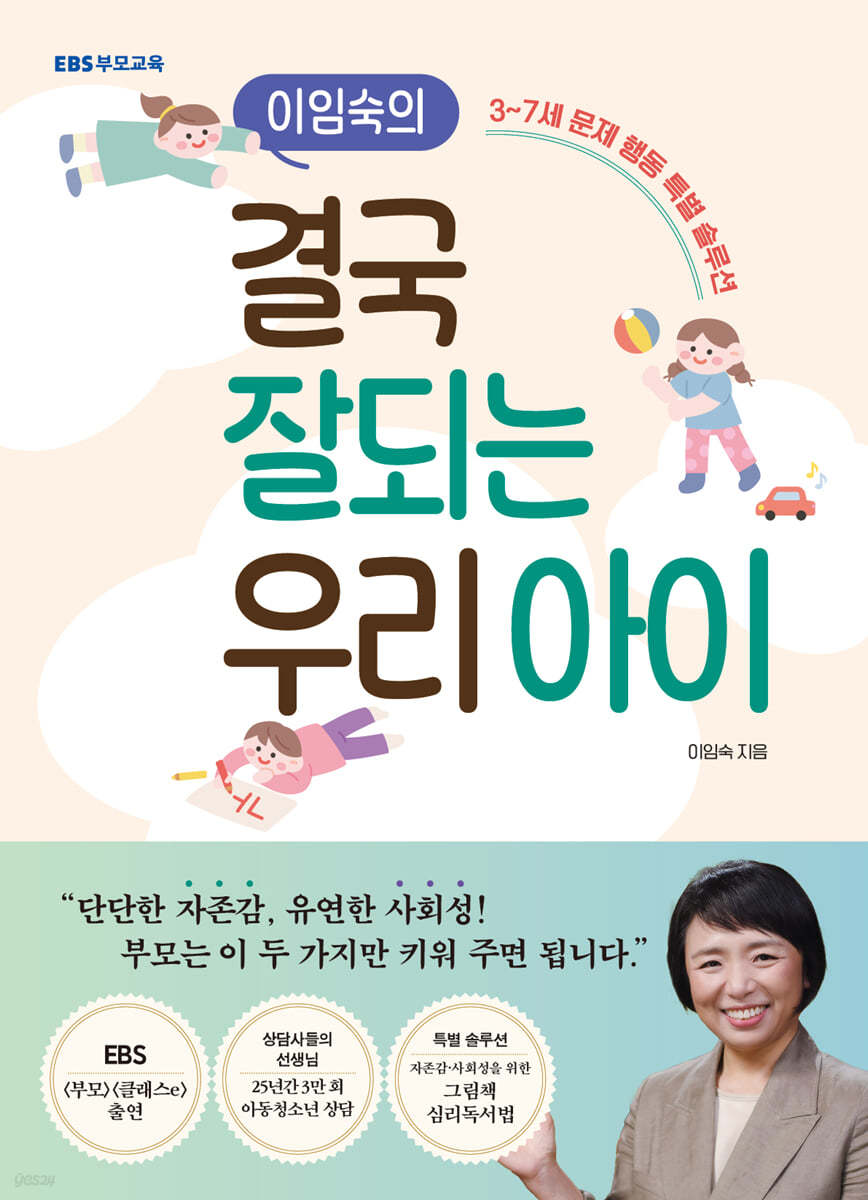
Lee Im-sook's Our Child Who Will Do Well in the End
 |
Description
Book Introduction
The two pillars of childcare, culminated by Director Lee Im-sook's 25 years of clinical experience.
“Strong self-esteem, flexible social skills.
“Parents just need to raise their children in these two areas.”
When parents learn all kinds of parenting information from mom cafes, parenting books, and YouTube and try to raise their children well, but their children's behavioral problems only increase, they feel at a loss as to where to focus their parenting efforts.
Director Im-Sook Lee, a leading expert in child and adolescent counseling who has met children in counseling rooms for 25 years, has repeatedly confirmed through over 30,000 clinical sessions that 90 percent of children's problem behaviors stem from a lack of self-esteem and social skills.
“There are two common characteristics that I see in the children I have met in my counseling office over the past 25 years.
I have low self-esteem.
I have trouble making friends.
“Self-esteem is the core issue that plagues children, and social skills are the trigger for the problem to manifest itself.”
While parenting trends change with the times, such as creativity, brain science, resilience, and AI capabilities, the author argues that there is a unique, unchanging driving force for human growth.
It is the self-esteem that allows one to see oneself as a valuable being with potential, and the sociality that allows one to get along well with friends and deal flexibly with conflict situations.
The author emphasizes that fostering these two fundamental mental strengths in children aged 3 to 7 will form the foundation for a successful child, and the remaining abilities will follow.
Unfortunately, however, many parents fail to properly assess their child's level of self-esteem and social development, and only realize the severity of the problem when their child exhibits serious behavioral problems such as refusal to go to school or violent behavior.
This book examines the following signs that appear when a child lacks self-esteem and social skills, and provides guidance for parents to provide appropriate help.
* Except when he is annoyed and throwing a tantrum, he is usually unable to express his feelings properly.
* Poor impulse control and increased aggressive language and behavior.
* Even if something seems a little difficult, they easily give up and say they can't do it.
* When I make a mistake or fail, I compare my results with other children and become jealous.
* Shows no interest in learning and mastering new things.
* Acting without awareness of the surroundings.
This book analyzes cases of children's problem behaviors that many parents complain about, and identifies the causes of problems with children's self-esteem and social skills.
And the author has personally counseled children and carefully selected only the methods that have proven effective, explaining the three self-esteems (physical self-esteem, emotional self-esteem, and cognitive self-esteem) that protect children throughout their lives and the four habits of parents that strengthen them. He also explains the three conditions for fostering the sociality of children who can be happy on their own (self-expression, empathy, and social cognitive ability) and the four wisdoms of parents that help them blossom.
At the end of each chapter, the author introduces the author's special solution, 'Picture Book Psychological Reading', which is the most effective in fostering self-esteem and sociality. It also contains various cases obtained through the author's 25 years of clinical experience, specific conversation methods that can be shared with children, various checklists to check the current state, and a list of recommended books that are helpful in developing self-esteem and sociality, making it very useful for practical application.
“Strong self-esteem, flexible social skills.
“Parents just need to raise their children in these two areas.”
When parents learn all kinds of parenting information from mom cafes, parenting books, and YouTube and try to raise their children well, but their children's behavioral problems only increase, they feel at a loss as to where to focus their parenting efforts.
Director Im-Sook Lee, a leading expert in child and adolescent counseling who has met children in counseling rooms for 25 years, has repeatedly confirmed through over 30,000 clinical sessions that 90 percent of children's problem behaviors stem from a lack of self-esteem and social skills.
“There are two common characteristics that I see in the children I have met in my counseling office over the past 25 years.
I have low self-esteem.
I have trouble making friends.
“Self-esteem is the core issue that plagues children, and social skills are the trigger for the problem to manifest itself.”
While parenting trends change with the times, such as creativity, brain science, resilience, and AI capabilities, the author argues that there is a unique, unchanging driving force for human growth.
It is the self-esteem that allows one to see oneself as a valuable being with potential, and the sociality that allows one to get along well with friends and deal flexibly with conflict situations.
The author emphasizes that fostering these two fundamental mental strengths in children aged 3 to 7 will form the foundation for a successful child, and the remaining abilities will follow.
Unfortunately, however, many parents fail to properly assess their child's level of self-esteem and social development, and only realize the severity of the problem when their child exhibits serious behavioral problems such as refusal to go to school or violent behavior.
This book examines the following signs that appear when a child lacks self-esteem and social skills, and provides guidance for parents to provide appropriate help.
* Except when he is annoyed and throwing a tantrum, he is usually unable to express his feelings properly.
* Poor impulse control and increased aggressive language and behavior.
* Even if something seems a little difficult, they easily give up and say they can't do it.
* When I make a mistake or fail, I compare my results with other children and become jealous.
* Shows no interest in learning and mastering new things.
* Acting without awareness of the surroundings.
This book analyzes cases of children's problem behaviors that many parents complain about, and identifies the causes of problems with children's self-esteem and social skills.
And the author has personally counseled children and carefully selected only the methods that have proven effective, explaining the three self-esteems (physical self-esteem, emotional self-esteem, and cognitive self-esteem) that protect children throughout their lives and the four habits of parents that strengthen them. He also explains the three conditions for fostering the sociality of children who can be happy on their own (self-expression, empathy, and social cognitive ability) and the four wisdoms of parents that help them blossom.
At the end of each chapter, the author introduces the author's special solution, 'Picture Book Psychological Reading', which is the most effective in fostering self-esteem and sociality. It also contains various cases obtained through the author's 25 years of clinical experience, specific conversation methods that can be shared with children, various checklists to check the current state, and a list of recommended books that are helpful in developing self-esteem and sociality, making it very useful for practical application.
- You can preview some of the book's contents.
Preview
index
Prologue: The Best Psychological Legacy Parents Give Their Children: Self-Esteem and Sociality
Part 1.
Two strengths of a child who eventually succeeds
“I don’t know why my child is like this.”
- 'Is it my fault that I'm ruining my child?'
- I raised him with all my heart, so why is he showing behavioral problems?
- Signs of self-esteem and social crisis
A child who is timid and has low self-esteem
- Three things a child with high self-esteem has
- The child as seen by the mother, the child as seen by me
- A child with high self-esteem, not pride
- Self-esteem changes with praise given when there is no problem.
- Techniques for praising children according to their developmental stage
A child who keeps having problems with friends
- Two basic principles of social development
- Restoring the relationship between parents and children comes first.
- Seoyoon's social skills improved through the experience of safe interaction.
Special Solution 1.
The Beginning of Positive Change: Psychological Reading through Picture Books
- The effects of psychological reading through picture books that change the brain, mind, and behavior
- Eunchan's story
- How you read is more important than what you read.
Part 2.
Laying the foundation for self-esteem and sociality
The three axes that form the basis of self-esteem and sociality
- Three things to look for when problem behavior is displayed
- Emotions and a comfortable mind are the beginning of all change.
- Don't try to fix your temperament, but develop it into a strength.
- Cognitive, the fundamental skill of a child to interact smoothly anywhere
Three Pillars of Parenting That Support Children's Self-Esteem and Sociality
- Parental Needs: Examine Your Parenting Style
- Parental self-esteem: Influences parenting stress
- Parenting Beliefs: Change negative thoughts about your child into constructive thoughts.
Special Solution 2.
Picture Book Psychological Reading for Moms and Dads
- A psychological reading of picture books that care for a mother's heart
- A picture book psychological reading that cares for a father's heart
- Parental wisdom learned from picture books
Part 3.
Self-esteem, the power of the mind that moves forward
The three best legacies to protect your child for life: cultivating self-esteem.
- The three most important self-esteem factors in early childhood
Body self-esteem: A child who is not intimidated by their physical abilities and appearance.
Emotional self-esteem: A child who loves, believes in, and cares for himself.
Cognitive Self-Esteem: A Child Who Enjoys Learning and Thinking
Four Parenting Habits That Strengthen Your Child's Self-Esteem
Surprising Problems That Hurt Your Child's Self-Esteem
Parents' emotional habits: cheerfulness, kindness, gratitude
Parental Thinking Habits: Curiosity, Acceptance, and Positive Intention
Parents' behavioral habits: good marital relationships, manners, laughter
Parents' conversation habits: Consensual conversation, no double messaging, conversation in comfortable situations
Special Solution 3.
Psychological Reading: Picture Books That Will Boost Your Self-Esteem
- Psychological reading conversation method to develop a strong inner self
Picture book psychological reading to boost body self-esteem
Psychological reading: Picture books that foster emotional self-esteem
Psychological reading of picture books that boost cognitive self-esteem
Psychological reading: Picture books that help you develop the strength to live your own way
Part 4.
Sociality: A Key to a Happy Child Anywhere
Does our child have the three conditions for sociality?
Social issues in children that teachers worry about
The first step to communicating with the world: self-expression.
The power to lead smooth relationships, the ability to empathize
The secret to a child's ability to adapt well anywhere: social cognitive ability.
Four Tips for Parents to Help Their Children Develop Social Skills
- Attachment restoration is essential before developing social skills.
Wisdom in Utilizing the Stages of Friendship
Wisdom for developing everyday social skills
Wisdom for developing learning-related social skills
The Wisdom of Conversation for Solving Friendship Problems
※ A letter to parents concerned about their child's social skills.
Special Solution 4.
Five Psychological Reading Methods to Boost Your Social Skills
- Picture book cover dialogue that develops social cognitive skills
Picture book psychological reading that fosters the concept of healthy friendships
Psychological Reading: Picture Books to Heal Friends' Wounds
Psychological Reading: Picture Books That Teach Social Skills
Picture book psychological reading that develops learning-related social skills
Appendix 1: Daily Picture Book Psychological Reading Scenarios to Develop Self-Esteem and Social Skills
Appendix 2: Recommended Picture Books for Children and Parents
Part 1.
Two strengths of a child who eventually succeeds
“I don’t know why my child is like this.”
- 'Is it my fault that I'm ruining my child?'
- I raised him with all my heart, so why is he showing behavioral problems?
- Signs of self-esteem and social crisis
A child who is timid and has low self-esteem
- Three things a child with high self-esteem has
- The child as seen by the mother, the child as seen by me
- A child with high self-esteem, not pride
- Self-esteem changes with praise given when there is no problem.
- Techniques for praising children according to their developmental stage
A child who keeps having problems with friends
- Two basic principles of social development
- Restoring the relationship between parents and children comes first.
- Seoyoon's social skills improved through the experience of safe interaction.
Special Solution 1.
The Beginning of Positive Change: Psychological Reading through Picture Books
- The effects of psychological reading through picture books that change the brain, mind, and behavior
- Eunchan's story
- How you read is more important than what you read.
Part 2.
Laying the foundation for self-esteem and sociality
The three axes that form the basis of self-esteem and sociality
- Three things to look for when problem behavior is displayed
- Emotions and a comfortable mind are the beginning of all change.
- Don't try to fix your temperament, but develop it into a strength.
- Cognitive, the fundamental skill of a child to interact smoothly anywhere
Three Pillars of Parenting That Support Children's Self-Esteem and Sociality
- Parental Needs: Examine Your Parenting Style
- Parental self-esteem: Influences parenting stress
- Parenting Beliefs: Change negative thoughts about your child into constructive thoughts.
Special Solution 2.
Picture Book Psychological Reading for Moms and Dads
- A psychological reading of picture books that care for a mother's heart
- A picture book psychological reading that cares for a father's heart
- Parental wisdom learned from picture books
Part 3.
Self-esteem, the power of the mind that moves forward
The three best legacies to protect your child for life: cultivating self-esteem.
- The three most important self-esteem factors in early childhood
Body self-esteem: A child who is not intimidated by their physical abilities and appearance.
Emotional self-esteem: A child who loves, believes in, and cares for himself.
Cognitive Self-Esteem: A Child Who Enjoys Learning and Thinking
Four Parenting Habits That Strengthen Your Child's Self-Esteem
Surprising Problems That Hurt Your Child's Self-Esteem
Parents' emotional habits: cheerfulness, kindness, gratitude
Parental Thinking Habits: Curiosity, Acceptance, and Positive Intention
Parents' behavioral habits: good marital relationships, manners, laughter
Parents' conversation habits: Consensual conversation, no double messaging, conversation in comfortable situations
Special Solution 3.
Psychological Reading: Picture Books That Will Boost Your Self-Esteem
- Psychological reading conversation method to develop a strong inner self
Picture book psychological reading to boost body self-esteem
Psychological reading: Picture books that foster emotional self-esteem
Psychological reading of picture books that boost cognitive self-esteem
Psychological reading: Picture books that help you develop the strength to live your own way
Part 4.
Sociality: A Key to a Happy Child Anywhere
Does our child have the three conditions for sociality?
Social issues in children that teachers worry about
The first step to communicating with the world: self-expression.
The power to lead smooth relationships, the ability to empathize
The secret to a child's ability to adapt well anywhere: social cognitive ability.
Four Tips for Parents to Help Their Children Develop Social Skills
- Attachment restoration is essential before developing social skills.
Wisdom in Utilizing the Stages of Friendship
Wisdom for developing everyday social skills
Wisdom for developing learning-related social skills
The Wisdom of Conversation for Solving Friendship Problems
※ A letter to parents concerned about their child's social skills.
Special Solution 4.
Five Psychological Reading Methods to Boost Your Social Skills
- Picture book cover dialogue that develops social cognitive skills
Picture book psychological reading that fosters the concept of healthy friendships
Psychological Reading: Picture Books to Heal Friends' Wounds
Psychological Reading: Picture Books That Teach Social Skills
Picture book psychological reading that develops learning-related social skills
Appendix 1: Daily Picture Book Psychological Reading Scenarios to Develop Self-Esteem and Social Skills
Appendix 2: Recommended Picture Books for Children and Parents
Detailed image

Into the book
Many parents don't say much when their children are playing well or are calm, and only start talking when they cause trouble.
When children are comfortable doing their own thing, there is a severe lack of conversations that offer praise, support, and encouragement about what they are doing well, and conversations that identify and point out their strengths.
Only after the child starts crying and screaming do parents try to calm the child down.
But more importantly, neither the parent nor the child gets angry, and the way to do that is to find specific things to praise in the child's small actions and praise them, encourage them when they are enduring difficulties, and support them when they are making efforts.
---p.45
The most important thing to emphasize during this period (ages 3-7) is to turn weaknesses into strengths.
If your child hesitates to act, say, “You’re being cautious.”
If they seem distracted, compliment them by saying, “You’re so curious.”
If you praise your child for being curious and then praise their efforts to not give up, you can develop both creative curiosity and persistent perseverance.
---p.54
If your child's behavioral problems are increasing, there are three things you should look for with a therapist's perspective.
Therapists don't just look at a child's problem behavior.
Let's look at the 'emotional state' of a child that is bound to cause such problems, the 'innate temperament' of the child that is the cause of such emotional problems, and how the 'cognitive ability' that strongly influences the child's emotions develops as they grow up.
Child psychotherapy is the process of finding the cause of the problem in temperament, emotional development, and cognitive development, and finding and applying a solution that is suitable for the child.
---pp.89-90
Scholars emphasize that parental stress is an important factor in determining the quality of parenting.
In fact, many studies have shown that children of parents with high levels of parenting stress are more likely to exhibit emotional and behavioral problems, may have cognitive development difficulties, and take longer to acquire social skills than average children.
......
When we looked at cases where parenting stress was low, we found that the primary caregiver had high self-esteem.
Parents with high self-esteem were found to have relatively lower parenting stress and more positive parenting attitudes.
---p.124
Have you ever wondered why your child is distracted, irritable, or throws tantrums? Surprisingly, most parents don't ask their children why they behave this way.
Even when parents say they asked, if you look closely, most of the time they are just urging the child by saying, “Why did you do that?”
There is a reason for every child's behavior.
No matter what problem your child is having, you should at least know why.
If you do not, and unconditionally judge that the child did something wrong and scold him or her and try to correct him or her, it can actually cause emotional problems in the child and damage his or her self-esteem.
---pp.178-179
When disciplining a child, you must have a conversation in which the content of your words, facial expressions, and tone of voice are consistent.
When parents make a gentle face when talking about their child's misbehavior, the child may not recognize the problem with his or her behavior and may simply accept the parent's words as a passing remark.
If you want to properly teach your child about their mistakes, it is best to clearly state what they did wrong and make a serious expression.
If your child throws a tantrum and hits you because he or she is annoyed, look him or her in the eye with a serious expression and speak slowly in a low, calm voice.
“No matter how annoyed you are, you should never hit someone.
Try to repeat what Mom says.
You must never hit.
“You have to speak up in any situation.”
---pp.191-192
One of the mistakes that parents in our country often make is one that hinders the development of their children's emotional self-esteem.
It's about forcing good behavior on the child.
When a child does one good deed, all adults praise him like this.
“You’re so kind.” Originally, the word ‘kind’ meant kind, upright, and gentle in words and actions, but the conventional meaning of ‘kind’ goes further to mean being tolerant and considerate.
Although compromise and consideration are very important values, early childhood is a time when children must first learn self-care.
If you teach a child at that age to be considerate of others first, the child is more likely to learn to sacrifice first and put aside his or her own feelings.
---p.212
Remember, one of the easiest and most effective ways to strengthen your relationship with a friend is to compliment them.
Many parents ask how to help their children when they have problems with friends, but when their children are not in trouble, they don't teach them anything.
Resolving conflict situations is a difficult problem even for adults.
When your child is getting along well with friends, help them first teach and practice praising them in ways they can easily use in their everyday lives.
When children are comfortable doing their own thing, there is a severe lack of conversations that offer praise, support, and encouragement about what they are doing well, and conversations that identify and point out their strengths.
Only after the child starts crying and screaming do parents try to calm the child down.
But more importantly, neither the parent nor the child gets angry, and the way to do that is to find specific things to praise in the child's small actions and praise them, encourage them when they are enduring difficulties, and support them when they are making efforts.
---p.45
The most important thing to emphasize during this period (ages 3-7) is to turn weaknesses into strengths.
If your child hesitates to act, say, “You’re being cautious.”
If they seem distracted, compliment them by saying, “You’re so curious.”
If you praise your child for being curious and then praise their efforts to not give up, you can develop both creative curiosity and persistent perseverance.
---p.54
If your child's behavioral problems are increasing, there are three things you should look for with a therapist's perspective.
Therapists don't just look at a child's problem behavior.
Let's look at the 'emotional state' of a child that is bound to cause such problems, the 'innate temperament' of the child that is the cause of such emotional problems, and how the 'cognitive ability' that strongly influences the child's emotions develops as they grow up.
Child psychotherapy is the process of finding the cause of the problem in temperament, emotional development, and cognitive development, and finding and applying a solution that is suitable for the child.
---pp.89-90
Scholars emphasize that parental stress is an important factor in determining the quality of parenting.
In fact, many studies have shown that children of parents with high levels of parenting stress are more likely to exhibit emotional and behavioral problems, may have cognitive development difficulties, and take longer to acquire social skills than average children.
......
When we looked at cases where parenting stress was low, we found that the primary caregiver had high self-esteem.
Parents with high self-esteem were found to have relatively lower parenting stress and more positive parenting attitudes.
---p.124
Have you ever wondered why your child is distracted, irritable, or throws tantrums? Surprisingly, most parents don't ask their children why they behave this way.
Even when parents say they asked, if you look closely, most of the time they are just urging the child by saying, “Why did you do that?”
There is a reason for every child's behavior.
No matter what problem your child is having, you should at least know why.
If you do not, and unconditionally judge that the child did something wrong and scold him or her and try to correct him or her, it can actually cause emotional problems in the child and damage his or her self-esteem.
---pp.178-179
When disciplining a child, you must have a conversation in which the content of your words, facial expressions, and tone of voice are consistent.
When parents make a gentle face when talking about their child's misbehavior, the child may not recognize the problem with his or her behavior and may simply accept the parent's words as a passing remark.
If you want to properly teach your child about their mistakes, it is best to clearly state what they did wrong and make a serious expression.
If your child throws a tantrum and hits you because he or she is annoyed, look him or her in the eye with a serious expression and speak slowly in a low, calm voice.
“No matter how annoyed you are, you should never hit someone.
Try to repeat what Mom says.
You must never hit.
“You have to speak up in any situation.”
---pp.191-192
One of the mistakes that parents in our country often make is one that hinders the development of their children's emotional self-esteem.
It's about forcing good behavior on the child.
When a child does one good deed, all adults praise him like this.
“You’re so kind.” Originally, the word ‘kind’ meant kind, upright, and gentle in words and actions, but the conventional meaning of ‘kind’ goes further to mean being tolerant and considerate.
Although compromise and consideration are very important values, early childhood is a time when children must first learn self-care.
If you teach a child at that age to be considerate of others first, the child is more likely to learn to sacrifice first and put aside his or her own feelings.
---p.212
Remember, one of the easiest and most effective ways to strengthen your relationship with a friend is to compliment them.
Many parents ask how to help their children when they have problems with friends, but when their children are not in trouble, they don't teach them anything.
Resolving conflict situations is a difficult problem even for adults.
When your child is getting along well with friends, help them first teach and practice praising them in ways they can easily use in their everyday lives.
---pp.256-257
Publisher's Review
The power that moves a child forward, self-esteem!
The best inheritance parents can give us: physical self-esteem, emotional self-esteem, and cognitive self-esteem.
A Parenting Habit Reset Program to Strengthen Your Child's Self-Esteem
This book focuses on the three core self-esteems in early childhood development: physical self-esteem, emotional self-esteem, and cognitive self-esteem. It introduces ways to foster these three self-esteems in everyday life.
Body self-esteem is the feeling of valuing and caring for one's body, appearance, and physical abilities.
The trigger for young children to develop overall satisfaction with their appearance, and to think, "I'm good at it," and strive to improve at physical abilities like spoon-feeding or drawing, comes when they receive positive feedback from those close to them, such as their parents and teachers.
If parents worry about their child's appearance or praise them excessively at this time, or point out their mistakes and do their work for them, their child's physical self-esteem will not develop properly.
Self-esteem about physical abilities is especially important during the toddler years when children are constantly trying and learning new things, so it is a key factor in determining whether a child will grow up to be a person who consistently tries things or a child who avoids things even when they seem slightly difficult.
This book details effective feedback that fosters a child's physical self-esteem.
Emotional self-esteem is the belief that you are worthy, competent, and capable of handling difficult emotions.
Through this emotional self-esteem, children gain the power to love and care for themselves.
This book provides parents with the appropriate attitude and conversation methods to use in problematic situations where their children are irritable and unable to control their emotions.
The author points out a common misconception about the importance of empathy, warning that if we simply read a child's mind in a problematic situation by saying, "I'm sorry you lost your toy," we risk causing the child to become even more deeply immersed in his or her own emotions.
This book explains, using detailed situational examples and dialogue, how to help children quickly overcome uncomfortable emotions, develop self-regulation, self-competence, and problem-solving skills, and help them build strong emotional self-esteem.
Cognitive self-esteem is the belief that one enjoys learning various knowledge and is able to think and reason logically.
An interesting point is that it introduces the use of 'positive illusions' as a way to increase cognitive self-esteem in children during infancy and academic performance and academic satisfaction in adolescence.
Positive illusions are positive beliefs that you are doing well now and will continue to do well in the future. It is said that the more you think you are bad at cognitive skills related to learning, such as math, Korean, and English, the more you will dislike doing them.
Therefore, even if a child shows some immaturity in performing a task, it is important for parents to consistently encourage and praise the child so that the child can develop a positive illusion that he or she is doing well on his or her own, and to provide an opportunity for the child to challenge himself or herself and make an effort even in difficult tasks.
Most parents try to build their children's self-esteem, but these efforts often pale in comparison to the actions they unintentionally take in their children's self-esteem.
This book introduces various habit re-establishment programs, such as parents looking back on their own emotions, thoughts, behaviors, and conversation habits, and how to help children have comfortable background emotions with pleasant emotional habits, thinking habits that accept children's behaviors and feelings that are different from parents' expectations, behavioral habits that treat children with manners and warmth like the child next door, and conversational habits that support children's desirable behaviors in non-problematic situations.
The condition for a happy child anywhere: sociality!
The three conditions of sociality: self-expression, empathy, and social cognition.
The optimal parenting solution for nurturing your child's social skills.
When we look at cases of children who have difficulty developing social skills, three commonalities emerge.
They lack self-expression skills, which are the ability to honestly express their thoughts and feelings; empathy, which is the ability to understand and respond appropriately to the feelings of friends; and social cognition, which is the ability to read social contexts such as classroom situations or rules in public places and act accordingly.
These three abilities, which are the roots of social development, are abilities that parents must take care to develop even before their children enter daycare or kindergarten.
However, in order to develop these three abilities, two basic principles must take priority.
First, it is important to raise children according to their temperamental characteristics. Second, it is important for parents to smile warmly at their children, teach them, support their attempts, and lead them to various experiences so that they can develop stable social emotions that allow them to trust people and the world.
However, parents are worried that their child's temperament, such as being difficult and sensitive, slow and timid, will lead to a lack of social skills, and they try to correct such temperaments in any way possible.
The author emphasizes that regardless of a child's temperamental characteristics, every temperament is a child's unique strength and potential.
If you understand your child's innate temperament and provide appropriate parenting, your child can develop self-esteem and social skills that are unique to him or her.
And to help you properly understand what kind of child your child is, we introduce four types of temperament and five types of needs based on how they react to surrounding stimuli, and suggest appropriate parenting methods to help you establish an effective parenting strategy that suits your child's temperament characteristics.
Based on the second principle, when a child has a social problem, the first thing parents should do is to examine the child's level of attachment and restore the relationship between the child and the parents.
This book provides three solutions to help children regain secure attachment and develop social skills.
First, it introduces ways for parents to be sensitive to and respond to their children's emotions in daily life, and second, it introduces techniques to help children mature by maintaining a non-punitive parenting attitude, empathizing with their difficult emotions, but firmly teaching them the rules of behavior that must be followed.
And finally, we will teach you the attitude and conversation methods of parents to serve as a psychological safety base for their children.
For a child's social development to be successful, parents must also make an effort to teach them social skills, which are the foundational competencies.
Social skills are the skills needed to get along well with others and interact positively. These skills include communication skills, helping friends, resolving conflicts, following rules, and cooperating and discussing with others.
This book selects social skills that are essential for a child's social development and provides guidelines for parents to teach them appropriately to their children.
In addition to interpersonal skills, social skills also include learning-related social skills.
Learning-related social skills include concepts such as cooperation to work with other children, assertiveness to express one's opinions appropriately, self-regulation to appropriately manage emotions in conflict situations, responsibility for assigned tasks, and task performance ability to concentrate and complete tasks or activities on one's own.
Parents who expected that their children would naturally develop social skills if they played well with friends when they were young sometimes become puzzled when they see their children being distracted in class and having problems with their friends after entering elementary school.
The author notes that a common characteristic among children who exhibit this behavior is a lack of social skills related to learning.
We also provide a checklist to help you check whether your child's learning-related social skills are developing well, and introduce specific methods to develop learning-related social skills.
Since all learning-related activities are based on repetition, this book introduces various examples of how to help children become interested in repetitive activities for mastery, how to provide opportunities for children to confidently assert themselves in everyday life such as getting dressed, playing, and reading, and how to help them successfully self-regulate when performing difficult tasks.
In addition, it helps readers to respond to their children's social issues from various angles by providing methods to help children make friends naturally when they enter daycare or kindergarten by utilizing the six stages of friendship in infancy, conversation guidelines to heal the minds of children struggling with friend issues, and help children deal more flexibly with problem situations.
The best inheritance parents can give us: physical self-esteem, emotional self-esteem, and cognitive self-esteem.
A Parenting Habit Reset Program to Strengthen Your Child's Self-Esteem
This book focuses on the three core self-esteems in early childhood development: physical self-esteem, emotional self-esteem, and cognitive self-esteem. It introduces ways to foster these three self-esteems in everyday life.
Body self-esteem is the feeling of valuing and caring for one's body, appearance, and physical abilities.
The trigger for young children to develop overall satisfaction with their appearance, and to think, "I'm good at it," and strive to improve at physical abilities like spoon-feeding or drawing, comes when they receive positive feedback from those close to them, such as their parents and teachers.
If parents worry about their child's appearance or praise them excessively at this time, or point out their mistakes and do their work for them, their child's physical self-esteem will not develop properly.
Self-esteem about physical abilities is especially important during the toddler years when children are constantly trying and learning new things, so it is a key factor in determining whether a child will grow up to be a person who consistently tries things or a child who avoids things even when they seem slightly difficult.
This book details effective feedback that fosters a child's physical self-esteem.
Emotional self-esteem is the belief that you are worthy, competent, and capable of handling difficult emotions.
Through this emotional self-esteem, children gain the power to love and care for themselves.
This book provides parents with the appropriate attitude and conversation methods to use in problematic situations where their children are irritable and unable to control their emotions.
The author points out a common misconception about the importance of empathy, warning that if we simply read a child's mind in a problematic situation by saying, "I'm sorry you lost your toy," we risk causing the child to become even more deeply immersed in his or her own emotions.
This book explains, using detailed situational examples and dialogue, how to help children quickly overcome uncomfortable emotions, develop self-regulation, self-competence, and problem-solving skills, and help them build strong emotional self-esteem.
Cognitive self-esteem is the belief that one enjoys learning various knowledge and is able to think and reason logically.
An interesting point is that it introduces the use of 'positive illusions' as a way to increase cognitive self-esteem in children during infancy and academic performance and academic satisfaction in adolescence.
Positive illusions are positive beliefs that you are doing well now and will continue to do well in the future. It is said that the more you think you are bad at cognitive skills related to learning, such as math, Korean, and English, the more you will dislike doing them.
Therefore, even if a child shows some immaturity in performing a task, it is important for parents to consistently encourage and praise the child so that the child can develop a positive illusion that he or she is doing well on his or her own, and to provide an opportunity for the child to challenge himself or herself and make an effort even in difficult tasks.
Most parents try to build their children's self-esteem, but these efforts often pale in comparison to the actions they unintentionally take in their children's self-esteem.
This book introduces various habit re-establishment programs, such as parents looking back on their own emotions, thoughts, behaviors, and conversation habits, and how to help children have comfortable background emotions with pleasant emotional habits, thinking habits that accept children's behaviors and feelings that are different from parents' expectations, behavioral habits that treat children with manners and warmth like the child next door, and conversational habits that support children's desirable behaviors in non-problematic situations.
The condition for a happy child anywhere: sociality!
The three conditions of sociality: self-expression, empathy, and social cognition.
The optimal parenting solution for nurturing your child's social skills.
When we look at cases of children who have difficulty developing social skills, three commonalities emerge.
They lack self-expression skills, which are the ability to honestly express their thoughts and feelings; empathy, which is the ability to understand and respond appropriately to the feelings of friends; and social cognition, which is the ability to read social contexts such as classroom situations or rules in public places and act accordingly.
These three abilities, which are the roots of social development, are abilities that parents must take care to develop even before their children enter daycare or kindergarten.
However, in order to develop these three abilities, two basic principles must take priority.
First, it is important to raise children according to their temperamental characteristics. Second, it is important for parents to smile warmly at their children, teach them, support their attempts, and lead them to various experiences so that they can develop stable social emotions that allow them to trust people and the world.
However, parents are worried that their child's temperament, such as being difficult and sensitive, slow and timid, will lead to a lack of social skills, and they try to correct such temperaments in any way possible.
The author emphasizes that regardless of a child's temperamental characteristics, every temperament is a child's unique strength and potential.
If you understand your child's innate temperament and provide appropriate parenting, your child can develop self-esteem and social skills that are unique to him or her.
And to help you properly understand what kind of child your child is, we introduce four types of temperament and five types of needs based on how they react to surrounding stimuli, and suggest appropriate parenting methods to help you establish an effective parenting strategy that suits your child's temperament characteristics.
Based on the second principle, when a child has a social problem, the first thing parents should do is to examine the child's level of attachment and restore the relationship between the child and the parents.
This book provides three solutions to help children regain secure attachment and develop social skills.
First, it introduces ways for parents to be sensitive to and respond to their children's emotions in daily life, and second, it introduces techniques to help children mature by maintaining a non-punitive parenting attitude, empathizing with their difficult emotions, but firmly teaching them the rules of behavior that must be followed.
And finally, we will teach you the attitude and conversation methods of parents to serve as a psychological safety base for their children.
For a child's social development to be successful, parents must also make an effort to teach them social skills, which are the foundational competencies.
Social skills are the skills needed to get along well with others and interact positively. These skills include communication skills, helping friends, resolving conflicts, following rules, and cooperating and discussing with others.
This book selects social skills that are essential for a child's social development and provides guidelines for parents to teach them appropriately to their children.
In addition to interpersonal skills, social skills also include learning-related social skills.
Learning-related social skills include concepts such as cooperation to work with other children, assertiveness to express one's opinions appropriately, self-regulation to appropriately manage emotions in conflict situations, responsibility for assigned tasks, and task performance ability to concentrate and complete tasks or activities on one's own.
Parents who expected that their children would naturally develop social skills if they played well with friends when they were young sometimes become puzzled when they see their children being distracted in class and having problems with their friends after entering elementary school.
The author notes that a common characteristic among children who exhibit this behavior is a lack of social skills related to learning.
We also provide a checklist to help you check whether your child's learning-related social skills are developing well, and introduce specific methods to develop learning-related social skills.
Since all learning-related activities are based on repetition, this book introduces various examples of how to help children become interested in repetitive activities for mastery, how to provide opportunities for children to confidently assert themselves in everyday life such as getting dressed, playing, and reading, and how to help them successfully self-regulate when performing difficult tasks.
In addition, it helps readers to respond to their children's social issues from various angles by providing methods to help children make friends naturally when they enter daycare or kindergarten by utilizing the six stages of friendship in infancy, conversation guidelines to heal the minds of children struggling with friend issues, and help children deal more flexibly with problem situations.
GOODS SPECIFICS
- Date of issue: November 1, 2023
- Page count, weight, size: 304 pages | 534g | 152*210*18mm
- ISBN13: 9788954799508
- ISBN10: 8954799507
You may also like
카테고리
korean


korean

![GQ KOREA Mark (Monthly): December [2025]](http://librairie.coreenne.fr/cdn/shop/files/8ef265dbbfbf186523ed75ba7319009d.jpg?v=1765340328&width=3840)


