

Fertilizer-Free Gardening Textbook
 |
Description
Book Introduction
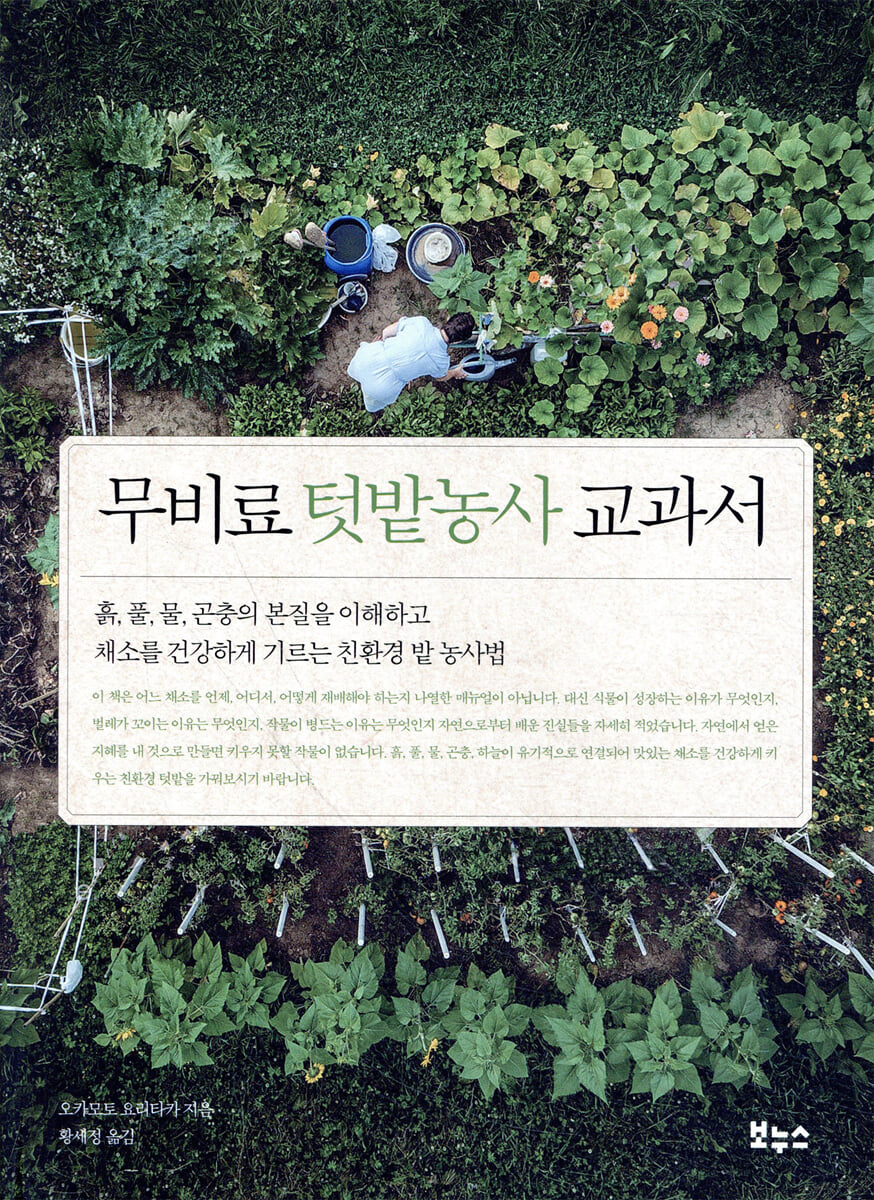
『Fertilizer-Free Gardening Textbook』 is not just a simple farming manual.
Instead, it provides easy-to-understand cultivation methods taught by nature to those who want to grow vegetables in an eco-friendly way.
Farming becomes easier and more enjoyable when you understand the role of nature in your garden, including soil, grass, water, sky, and insects, and properly understand what your crops need.
By growing your vegetables without fertilizers or pesticides, you will not only improve your health but also your body and mind.
Instead, it provides easy-to-understand cultivation methods taught by nature to those who want to grow vegetables in an eco-friendly way.
Farming becomes easier and more enjoyable when you understand the role of nature in your garden, including soil, grass, water, sky, and insects, and properly understand what your crops need.
By growing your vegetables without fertilizers or pesticides, you will not only improve your health but also your body and mind.
- You can preview some of the book's contents.
Preview
index
Preface: When the Cuckoo Cries, Sow the Seeds
The Basics of First Cultivation
The structure of plant growth
nitrogen cycle
carbon cycle
essential elements for plants
microelement
Seven plant hormones
What is soil?
What is initiation?
What Roots Do and How to Water Them Properly
The role of microorganisms
Another role of microorganisms
What the soil needs
The role of leaves and the use of plant endophytes
Look at the moon
Summary of the basic points of cultivation
Second field and soil
Field design
Wind Watching
Handling the wind
Water monitoring
The condition of the soil as seen from the weeds
The role of weeds
How to see the color of soil
Check the acidity of your soil
Soil acidity as determined by weeds
Revive dry soil
Opposition and promotion
Check the hard floor
Physical improvement of soil
Improving the soil of a large field
Improving the soil in your garden
High and low gyri
Composting with Weeds
Making vegetable fertilizer
Topsoil
makeshift greenhouse
Making seedlings
Field and Soil Key Points Summary
Third pool
The grass that needs to be pulled out
Weeds that should not be pulled out
How to cut grass
Look at the grass (1)
Look at the grass (2)
Look at the grass (3)
Full summary
Fourth insect and disease
Soil animals
The relationship between insects
What Aphids Do
Cabbage and butterfly caterpillar
Listen to the sound of the insect (1)
Listen to the sound of the insect (2)
Listen to the sound of the insect (3)
Understanding the disease
Signs of nutritional deficiency, nitrogen
Signs of nutritional deficiencies, phosphorus and potassium
Aging of the roots
plague
Summary of Insects and Diseases
Fifth crop cultivation
public plants
tomato
Tomato public plants
egg plant
pimento
cucumber
potato
beans (soybeans)
cabbage
broccoli
turnip
Summary of Crop Cultivation Key Points
Sixth Planter Cultivation
How to make clay at home
Filling the planter with soil
Protecting Microorganisms
Regenerating the soil
Soil and roots
The seventh seed
Types of seeds
Learn about seeds
The shape of the seed has meaning
Sowing seeds
Seed collection of fruit vegetables
Leafy vegetable seed collection
Seed collection of root vegetables and legumes
Seed storage
Conclusion: To those who are considering fertilizer-free farming
The Basics of First Cultivation
The structure of plant growth
nitrogen cycle
carbon cycle
essential elements for plants
microelement
Seven plant hormones
What is soil?
What is initiation?
What Roots Do and How to Water Them Properly
The role of microorganisms
Another role of microorganisms
What the soil needs
The role of leaves and the use of plant endophytes
Look at the moon
Summary of the basic points of cultivation
Second field and soil
Field design
Wind Watching
Handling the wind
Water monitoring
The condition of the soil as seen from the weeds
The role of weeds
How to see the color of soil
Check the acidity of your soil
Soil acidity as determined by weeds
Revive dry soil
Opposition and promotion
Check the hard floor
Physical improvement of soil
Improving the soil of a large field
Improving the soil in your garden
High and low gyri
Composting with Weeds
Making vegetable fertilizer
Topsoil
makeshift greenhouse
Making seedlings
Field and Soil Key Points Summary
Third pool
The grass that needs to be pulled out
Weeds that should not be pulled out
How to cut grass
Look at the grass (1)
Look at the grass (2)
Look at the grass (3)
Full summary
Fourth insect and disease
Soil animals
The relationship between insects
What Aphids Do
Cabbage and butterfly caterpillar
Listen to the sound of the insect (1)
Listen to the sound of the insect (2)
Listen to the sound of the insect (3)
Understanding the disease
Signs of nutritional deficiency, nitrogen
Signs of nutritional deficiencies, phosphorus and potassium
Aging of the roots
plague
Summary of Insects and Diseases
Fifth crop cultivation
public plants
tomato
Tomato public plants
egg plant
pimento
cucumber
potato
beans (soybeans)
cabbage
broccoli
turnip
Summary of Crop Cultivation Key Points
Sixth Planter Cultivation
How to make clay at home
Filling the planter with soil
Protecting Microorganisms
Regenerating the soil
Soil and roots
The seventh seed
Types of seeds
Learn about seeds
The shape of the seed has meaning
Sowing seeds
Seed collection of fruit vegetables
Leafy vegetable seed collection
Seed collection of root vegetables and legumes
Seed storage
Conclusion: To those who are considering fertilizer-free farming
Detailed image

Publisher's Review
Everything you need for farming is found in nature.
Easy and convenient organic gardening without fertilizers
When people think of farming, they often picture a scene of working in a large field under the blazing sun.
But growing cherry tomatoes in a small pot or growing lettuce on the veranda as a pastime is the same kind of farming.
Farming is one of life's most routine activities.
We can jump right into farming whenever we want.
The most ideal form of human life in the world is 'everyone engaged in agriculture.'
This means that everyone has the right to grow food that they can eat with confidence.
In today's society, where everything around us is dangerous and unstable, farming ourselves relieves the anxiety and impatience of life and brings small but precious moments of leisure to our lives.
Some people may already be farming in large or small gardens, while others may be thinking, "Should I give farming a try?"
But there is something holding them back.
These are weeds growing wildly, insects swarming, and various diseases that occur in crops.
They are often considered nuisances that ruin crops.
So, even if you initially decide to grow vegetables in an eco-friendly way, it is common to worry about whether you really need to use fertilizers, pesticides, and herbicides.
In conclusion, crops can be grown without much effort without fertilizers or pesticides.
Fertilizers and pesticides are real obstacles that interfere with nature's role in helping farming, making vegetable growing more difficult.
The very act of trying to make farming easier is actually making farming more difficult.
The nature surrounding the garden is already helping the crops grow well in its own way.
The soil and sky where vegetables grow, as well as groundwater, nameless weeds, and countless insects, all coexist with the crops.
Those who were thought to be harassing crops actually play a significant role in crop growth.
When you realize this law of nature, your perspective on farming completely changes.
For example, each bean pod contains two or three seeds.
In nature, soybeans shed these seeds all at once and allow them to grow together.
Because beans are plants that like to grow while competing with each other.
So, when planting beans by hand, they grow just right when planted two or three at a time, just like nature does when sowing seeds.
If you plant them one by one, the stems will become too thick and the seeds will not form well.
Weeds growing in the field also have roles depending on their type.
Asteraceae plants such as mugwort help control insect populations, and grasses such as horsetail and vetch make the soil slightly acidic, ideal for crop growth.
Weeds belonging to the legume family play an important role in fixing nitrogen in the soil, which is essential for plant growth.
Rather than just pulling out weeds, you can think of it as understanding the characteristics of the grass and growing it together as a plant that helps crop growth.
If you grow crops in this way while constantly communicating with nature, you can grow any vegetable well according to the situation.
Anyone can become a farmer if they put their mind to it.
Grow safe food yourself using eco-friendly planter farming methods for city dwellers.
Contrary to popular belief, farming does not require large areas of land, a lot of time, or labor.
With just a little bit of soil to grow crops, the knowledge to understand and manage the flow of nature, and the sincerity to observe the crops with a loving eye and timely sense their needs, farming can be done anywhere, and anyone can become a great farmer.
Even if you don't have the luxury of a dedicated garden, you can easily grow organic vegetables on a small plot of land or on your balcony using a planter.
Of course, in planter cultivation, no chemicals such as fertilizers or pesticides are needed.
First, spread well-drained sand or coarse sand soil on a wooden or clay planter, then mix peat moss and rice husk charcoal with organic soil without fertilizer and spread it alternately with leaf mold.
Next, grow green manure or other appropriate weeds to allow the entire planter to breathe.
This starts a natural cycle within the planter, allowing you to grow vegetables in the same way you would grow crops in nature.
These vegetables are the freshest food you can pick, wash, and serve right on the table.
A planter is also a small field and nature.
Let's farm while understanding and communicating with the nature that circulates within the planter.
You can easily grow healthy vegetables at home without having to go the extra mile of farming to set up a garden or taking a long trip to the garden on the weekends.
Understanding the role of nature makes farming easy and enjoyable.
Fertilizer-Free Farming: Learning from Soil, Grass, Water, Sky, and Insects
When farming, there are bound to be situations where you have questions or problems that require you to find solutions.
The first thing to do in such a case is not to spray fertilizer or pesticide, search the Internet, or mobilize agricultural machinery.
Go directly to the field and ask nature for advice.
Nature knows everything about what crops to grow, when, where, and how.
We are just looking for answers in the wrong places without knowing it.
When setting up a garden and growing vegetables, the thing to avoid the most is a manual that only lists farming procedures and guidelines.
Such manuals prevent us from breaking away from the stereotype that crops can only be grown by human effort.
From then on, farming was no longer a fun and rewarding task.
Everything in the garden other than the crops becomes just a nuisance that interferes with my farming, and I waste my energy chasing them away.
Cultivation methods that should be flexible and adaptable to the situation can easily become rigid and fixed.
This is a classic pattern of farming failure.
If you want to grow vegetables well without failing in farming, you just need to learn how to ask questions of nature.
Plants can secrete growth hormones simply by being exposed to wind.
Feel the wind, observe it, and design the ridges and fields where the breeze flows.
Next, look at the color of the soil and the grass growing there to determine the acidity and nutritional status of the soil.
If the condition is not good, naturally improve the quality of the soil by changing the soil, providing plant nutrients with eco-friendly compost, or growing grass to control acidity.
Crops are planted in the soil made this way.
Crops are not grown alone, but are planted together with communal plants that help them grow.
If a bug is tangled, watch its movements carefully and do the work for it.
Farming with an understanding of the flow of nature can have a much greater effect than spraying fertilizers or pesticides.
Farming is not something that humans do alone, but rather something that is achieved through a continuous dialogue with nature.
Each element of nature speaks to help crops grow well.
We just have to take that message and make it our own.
If you understand the nature of the space called a garden and actively utilize it, you can get hints and find solutions to any problems that arise.
Easy and convenient organic gardening without fertilizers
When people think of farming, they often picture a scene of working in a large field under the blazing sun.
But growing cherry tomatoes in a small pot or growing lettuce on the veranda as a pastime is the same kind of farming.
Farming is one of life's most routine activities.
We can jump right into farming whenever we want.
The most ideal form of human life in the world is 'everyone engaged in agriculture.'
This means that everyone has the right to grow food that they can eat with confidence.
In today's society, where everything around us is dangerous and unstable, farming ourselves relieves the anxiety and impatience of life and brings small but precious moments of leisure to our lives.
Some people may already be farming in large or small gardens, while others may be thinking, "Should I give farming a try?"
But there is something holding them back.
These are weeds growing wildly, insects swarming, and various diseases that occur in crops.
They are often considered nuisances that ruin crops.
So, even if you initially decide to grow vegetables in an eco-friendly way, it is common to worry about whether you really need to use fertilizers, pesticides, and herbicides.
In conclusion, crops can be grown without much effort without fertilizers or pesticides.
Fertilizers and pesticides are real obstacles that interfere with nature's role in helping farming, making vegetable growing more difficult.
The very act of trying to make farming easier is actually making farming more difficult.
The nature surrounding the garden is already helping the crops grow well in its own way.
The soil and sky where vegetables grow, as well as groundwater, nameless weeds, and countless insects, all coexist with the crops.
Those who were thought to be harassing crops actually play a significant role in crop growth.
When you realize this law of nature, your perspective on farming completely changes.
For example, each bean pod contains two or three seeds.
In nature, soybeans shed these seeds all at once and allow them to grow together.
Because beans are plants that like to grow while competing with each other.
So, when planting beans by hand, they grow just right when planted two or three at a time, just like nature does when sowing seeds.
If you plant them one by one, the stems will become too thick and the seeds will not form well.
Weeds growing in the field also have roles depending on their type.
Asteraceae plants such as mugwort help control insect populations, and grasses such as horsetail and vetch make the soil slightly acidic, ideal for crop growth.
Weeds belonging to the legume family play an important role in fixing nitrogen in the soil, which is essential for plant growth.
Rather than just pulling out weeds, you can think of it as understanding the characteristics of the grass and growing it together as a plant that helps crop growth.
If you grow crops in this way while constantly communicating with nature, you can grow any vegetable well according to the situation.
Anyone can become a farmer if they put their mind to it.
Grow safe food yourself using eco-friendly planter farming methods for city dwellers.
Contrary to popular belief, farming does not require large areas of land, a lot of time, or labor.
With just a little bit of soil to grow crops, the knowledge to understand and manage the flow of nature, and the sincerity to observe the crops with a loving eye and timely sense their needs, farming can be done anywhere, and anyone can become a great farmer.
Even if you don't have the luxury of a dedicated garden, you can easily grow organic vegetables on a small plot of land or on your balcony using a planter.
Of course, in planter cultivation, no chemicals such as fertilizers or pesticides are needed.
First, spread well-drained sand or coarse sand soil on a wooden or clay planter, then mix peat moss and rice husk charcoal with organic soil without fertilizer and spread it alternately with leaf mold.
Next, grow green manure or other appropriate weeds to allow the entire planter to breathe.
This starts a natural cycle within the planter, allowing you to grow vegetables in the same way you would grow crops in nature.
These vegetables are the freshest food you can pick, wash, and serve right on the table.
A planter is also a small field and nature.
Let's farm while understanding and communicating with the nature that circulates within the planter.
You can easily grow healthy vegetables at home without having to go the extra mile of farming to set up a garden or taking a long trip to the garden on the weekends.
Understanding the role of nature makes farming easy and enjoyable.
Fertilizer-Free Farming: Learning from Soil, Grass, Water, Sky, and Insects
When farming, there are bound to be situations where you have questions or problems that require you to find solutions.
The first thing to do in such a case is not to spray fertilizer or pesticide, search the Internet, or mobilize agricultural machinery.
Go directly to the field and ask nature for advice.
Nature knows everything about what crops to grow, when, where, and how.
We are just looking for answers in the wrong places without knowing it.
When setting up a garden and growing vegetables, the thing to avoid the most is a manual that only lists farming procedures and guidelines.
Such manuals prevent us from breaking away from the stereotype that crops can only be grown by human effort.
From then on, farming was no longer a fun and rewarding task.
Everything in the garden other than the crops becomes just a nuisance that interferes with my farming, and I waste my energy chasing them away.
Cultivation methods that should be flexible and adaptable to the situation can easily become rigid and fixed.
This is a classic pattern of farming failure.
If you want to grow vegetables well without failing in farming, you just need to learn how to ask questions of nature.
Plants can secrete growth hormones simply by being exposed to wind.
Feel the wind, observe it, and design the ridges and fields where the breeze flows.
Next, look at the color of the soil and the grass growing there to determine the acidity and nutritional status of the soil.
If the condition is not good, naturally improve the quality of the soil by changing the soil, providing plant nutrients with eco-friendly compost, or growing grass to control acidity.
Crops are planted in the soil made this way.
Crops are not grown alone, but are planted together with communal plants that help them grow.
If a bug is tangled, watch its movements carefully and do the work for it.
Farming with an understanding of the flow of nature can have a much greater effect than spraying fertilizers or pesticides.
Farming is not something that humans do alone, but rather something that is achieved through a continuous dialogue with nature.
Each element of nature speaks to help crops grow well.
We just have to take that message and make it our own.
If you understand the nature of the space called a garden and actively utilize it, you can get hints and find solutions to any problems that arise.
GOODS SPECIFICS
- Publication date: April 13, 2020
- Page count, weight, size: 264 pages | 564g | 175*235*20mm
- ISBN13: 9788964944301
- ISBN10: 8964944305
You may also like
카테고리
korean


korean

![ELLE 엘르 스페셜 에디션 A형 : 12월 [2025]](http://librairie.coreenne.fr/cdn/shop/files/b8e27a3de6c9538896439686c6b0e8fb.jpg?v=1766436872&width=3840)


