

Elementary Korean Vocabulary is Reading Comprehension Level 4 A Elementary 3rd and 4th Grade
 |
Description
Book Introduction
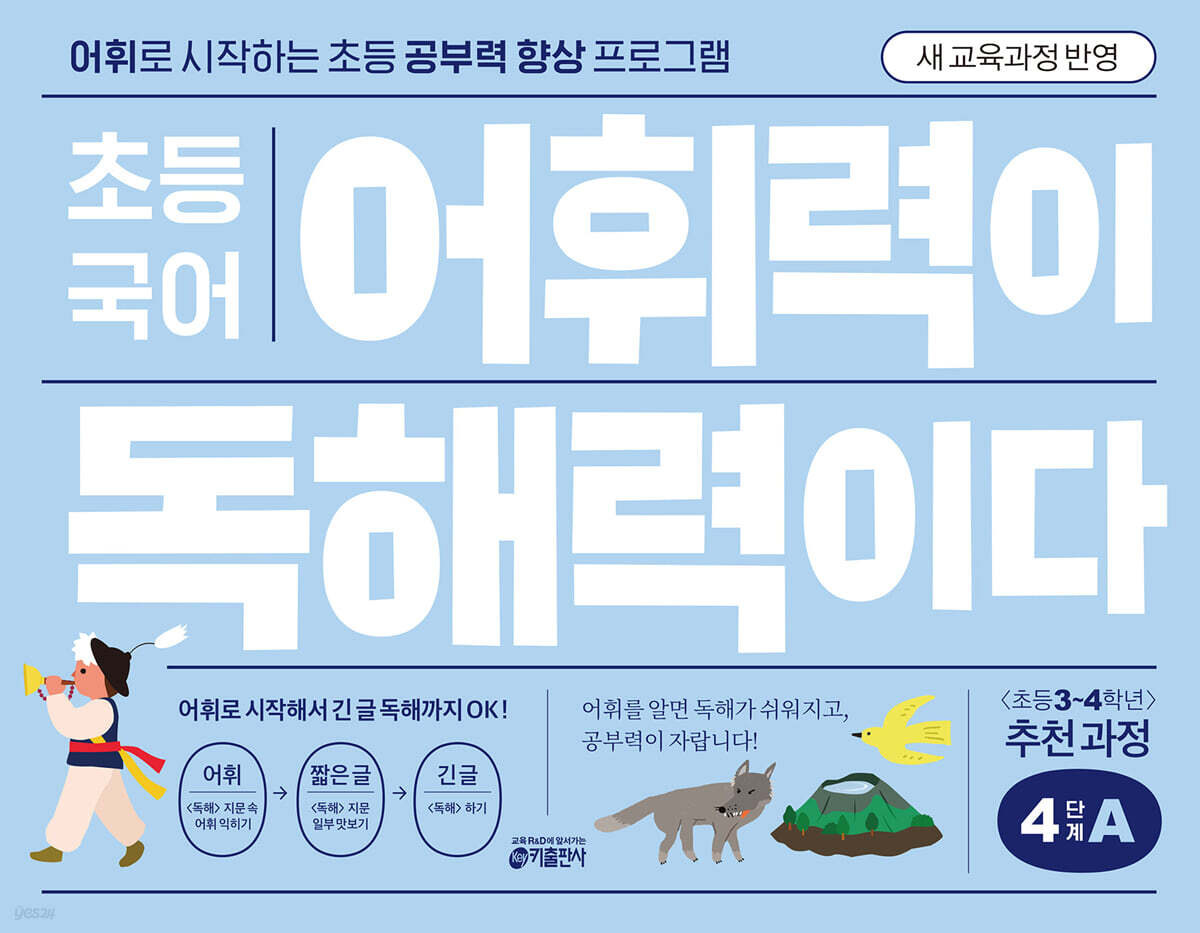
An elementary school study skills improvement program that starts with vocabulary!
Reading comprehension develops as you develop your vocabulary.
If you develop your reading comprehension skills, your study skills will grow.
Starting with single words and progressing to reading long texts, we lay the foundation for reading comprehension.
Improve your study skills with 『Elementary Korean Vocabulary is Reading Comprehension』!
Reading comprehension means reading a text and understanding its meaning.
A text is made up of several sentences, and a sentence is made up of words.
Therefore, vocabulary can be said to be the smallest unit that makes up a text and the basis of reading comprehension.
When you know exactly what words mean and how they are used, you can correctly understand the meaning contained in a text.
『Elementary Korean Vocabulary is Reading Comprehension, Step 4 A』 is comprised of a 3-step learning method (Step 1: Reading Preparation: Encounter with Vocabulary → Step 2: Reading Taste: Encounter with Short Texts → Step 3: Reading Comprehension: Encounter with Long Texts) that makes learning reading the easiest.
This 3-step learning method has been created to help you properly develop your reading comprehension skills.
Reading comprehension, the ability to read and understand text, is a necessary skill not only in Korean but also in all subjects, including social studies, science, and mathematics.
Therefore, reading comprehension can be said to be the basic ability for all subject learning.
Develop your vocabulary, reading comprehension, and study skills with 『Elementary Korean Vocabulary is Reading Comprehension』!
Reading comprehension develops as you develop your vocabulary.
If you develop your reading comprehension skills, your study skills will grow.
Starting with single words and progressing to reading long texts, we lay the foundation for reading comprehension.
Improve your study skills with 『Elementary Korean Vocabulary is Reading Comprehension』!
Reading comprehension means reading a text and understanding its meaning.
A text is made up of several sentences, and a sentence is made up of words.
Therefore, vocabulary can be said to be the smallest unit that makes up a text and the basis of reading comprehension.
When you know exactly what words mean and how they are used, you can correctly understand the meaning contained in a text.
『Elementary Korean Vocabulary is Reading Comprehension, Step 4 A』 is comprised of a 3-step learning method (Step 1: Reading Preparation: Encounter with Vocabulary → Step 2: Reading Taste: Encounter with Short Texts → Step 3: Reading Comprehension: Encounter with Long Texts) that makes learning reading the easiest.
This 3-step learning method has been created to help you properly develop your reading comprehension skills.
Reading comprehension, the ability to read and understand text, is a necessary skill not only in Korean but also in all subjects, including social studies, science, and mathematics.
Therefore, reading comprehension can be said to be the basic ability for all subject learning.
Develop your vocabulary, reading comprehension, and study skills with 『Elementary Korean Vocabulary is Reading Comprehension』!
- You can preview some of the book's contents.
Preview
index
Day 1: Seolmundae Halmang (Traditional Fairy Tale)
Day 2: Class Meeting (Discussion) for Class 2, Grade 4
Day 3: Making Yumi's Korean Dictionary (Fairy Tale)
Day 4: Thank You, King Sejong! (Fairy Tale)
Day 5: Confirmation Learning
Take a break
Day 6: Map Museum Website (Questions and Answers)
Day 7: Letter to a Friend (Letter Writing)
Day 8: Public Works (News)
Day 9: Visiting the Unification Observatory (Travelogue)
Day 10: Confirmation Learning
Take a break
Day 11: Grandpa Trilobite (Fairy Tale)
Day 12: Growing Kidney Beans (Instructions)
Day 13: The Best Scale Is Me! (Fairy Tale)
Day 14: Learn About Angles (Explanation)
Day 15: Confirmation Learning
Take a break
Day 16: Introducing the Print Version (Explanation)
Day 17: Letter to My Sister (Letter Writing)
Day 18: Peter and the Wolf (Guide)
Day 19: Watching a Soccer Game (Diary)
Day 20: Confirmation Learning
Take a break
Answer and explanation
Day 2: Class Meeting (Discussion) for Class 2, Grade 4
Day 3: Making Yumi's Korean Dictionary (Fairy Tale)
Day 4: Thank You, King Sejong! (Fairy Tale)
Day 5: Confirmation Learning
Take a break
Day 6: Map Museum Website (Questions and Answers)
Day 7: Letter to a Friend (Letter Writing)
Day 8: Public Works (News)
Day 9: Visiting the Unification Observatory (Travelogue)
Day 10: Confirmation Learning
Take a break
Day 11: Grandpa Trilobite (Fairy Tale)
Day 12: Growing Kidney Beans (Instructions)
Day 13: The Best Scale Is Me! (Fairy Tale)
Day 14: Learn About Angles (Explanation)
Day 15: Confirmation Learning
Take a break
Day 16: Introducing the Print Version (Explanation)
Day 17: Letter to My Sister (Letter Writing)
Day 18: Peter and the Wolf (Guide)
Day 19: Watching a Soccer Game (Diary)
Day 20: Confirmation Learning
Take a break
Answer and explanation
Detailed image

Publisher's Review
Children who can read books but cannot talk about what is in them
Children who can read the question but cannot solve it because they cannot understand the question's intent.
Children who have the ability to read but not the ability to understand text
We prepared this for these children.
Our child's first reading comprehension is not only reading but also understanding the hidden meaning within the text!
Feature 1.
Easy reading with our step-by-step learning system!
The three-step learning method of 'vocabulary → short text → long text' is the easiest way to learn reading comprehension.
The four learning vocabulary words featured in 'Vocabulary' are provided with images to aid understanding, helping you build your vocabulary.
Additionally, reading comprehension that goes from 'short text → long text' can help you develop your reading comprehension skills without difficulty.
Step 1: Reading Preparation: Getting Started with Vocabulary
First, learn the vocabulary that appears in the reading passage.
Images make it easy to learn the meaning and usage of vocabulary.
You can use digital learning materials to practice more vocabulary problems.
Step 2: Previewing Reading Comprehension: Short Texts
Read some of the reading passages and practice reading comprehension.
Read a short passage of 3 to 5 lines and solve a question to check your understanding of the passage.
Step 3 Reading: Encountering Long Texts
Practice reading comprehension by reading long texts that include short passages.
Solve problems that will help you develop your reading comprehension skills, such as checking the details of the text, understanding the flow of the text, and identifying the topic of the text.
Feature 2.
Study six pages a day! Enjoy learning with a variety of images expressing diverse text and vocabulary!
The study volume of 6 pages per day helps you study without getting bored.
You can enjoy learning by reading a variety of writing styles, including poems, fairy tales, diaries, book reviews, explanatory writing, editorials, articles, and guides.
You can learn easily and enjoyably through various images that help you understand vocabulary.
Feature 3.
Linking curriculum vocabulary + curriculum topics to curriculum!
"Elementary Korean Vocabulary is Reading Comprehension, Level 4 A" is comprised of various topics linked to the learning achievement standards for Korean, Math, Social Studies, Science, Ethics, Art, and Music for grades 3 and 4.
The learning vocabulary is also organized around vocabulary frequently used in textbooks.
If your child struggles with reading comprehension, start with "Elementary Korean Vocabulary is Reading Comprehension, Level 4 A"!
Feature 4.
Includes smart digital learning materials that allow you to solve more vocabulary problems.
Children who can read the question but cannot solve it because they cannot understand the question's intent.
Children who have the ability to read but not the ability to understand text
We prepared this for these children.
Our child's first reading comprehension is not only reading but also understanding the hidden meaning within the text!
Feature 1.
Easy reading with our step-by-step learning system!
The three-step learning method of 'vocabulary → short text → long text' is the easiest way to learn reading comprehension.
The four learning vocabulary words featured in 'Vocabulary' are provided with images to aid understanding, helping you build your vocabulary.
Additionally, reading comprehension that goes from 'short text → long text' can help you develop your reading comprehension skills without difficulty.
Step 1: Reading Preparation: Getting Started with Vocabulary
First, learn the vocabulary that appears in the reading passage.
Images make it easy to learn the meaning and usage of vocabulary.
You can use digital learning materials to practice more vocabulary problems.
Step 2: Previewing Reading Comprehension: Short Texts
Read some of the reading passages and practice reading comprehension.
Read a short passage of 3 to 5 lines and solve a question to check your understanding of the passage.
Step 3 Reading: Encountering Long Texts
Practice reading comprehension by reading long texts that include short passages.
Solve problems that will help you develop your reading comprehension skills, such as checking the details of the text, understanding the flow of the text, and identifying the topic of the text.
Feature 2.
Study six pages a day! Enjoy learning with a variety of images expressing diverse text and vocabulary!
The study volume of 6 pages per day helps you study without getting bored.
You can enjoy learning by reading a variety of writing styles, including poems, fairy tales, diaries, book reviews, explanatory writing, editorials, articles, and guides.
You can learn easily and enjoyably through various images that help you understand vocabulary.
Feature 3.
Linking curriculum vocabulary + curriculum topics to curriculum!
"Elementary Korean Vocabulary is Reading Comprehension, Level 4 A" is comprised of various topics linked to the learning achievement standards for Korean, Math, Social Studies, Science, Ethics, Art, and Music for grades 3 and 4.
The learning vocabulary is also organized around vocabulary frequently used in textbooks.
If your child struggles with reading comprehension, start with "Elementary Korean Vocabulary is Reading Comprehension, Level 4 A"!
Feature 4.
Includes smart digital learning materials that allow you to solve more vocabulary problems.
GOODS SPECIFICS
- Date of issue: August 28, 2025
- Page count, weight, size: 164 pages | 270*210*10mm
- ISBN13: 9791165263270
- ISBN10: 1165263270
- Reference book for use in grades: 3rd and 4th grades
- KC Certification: Certification Type: Conformity Confirmation
You may also like
카테고리
korean


korean

![GQ KOREA Mark (Monthly): December [2025]](http://librairie.coreenne.fr/cdn/shop/files/8ef265dbbfbf186523ed75ba7319009d.jpg?v=1765340328&width=3840)


