

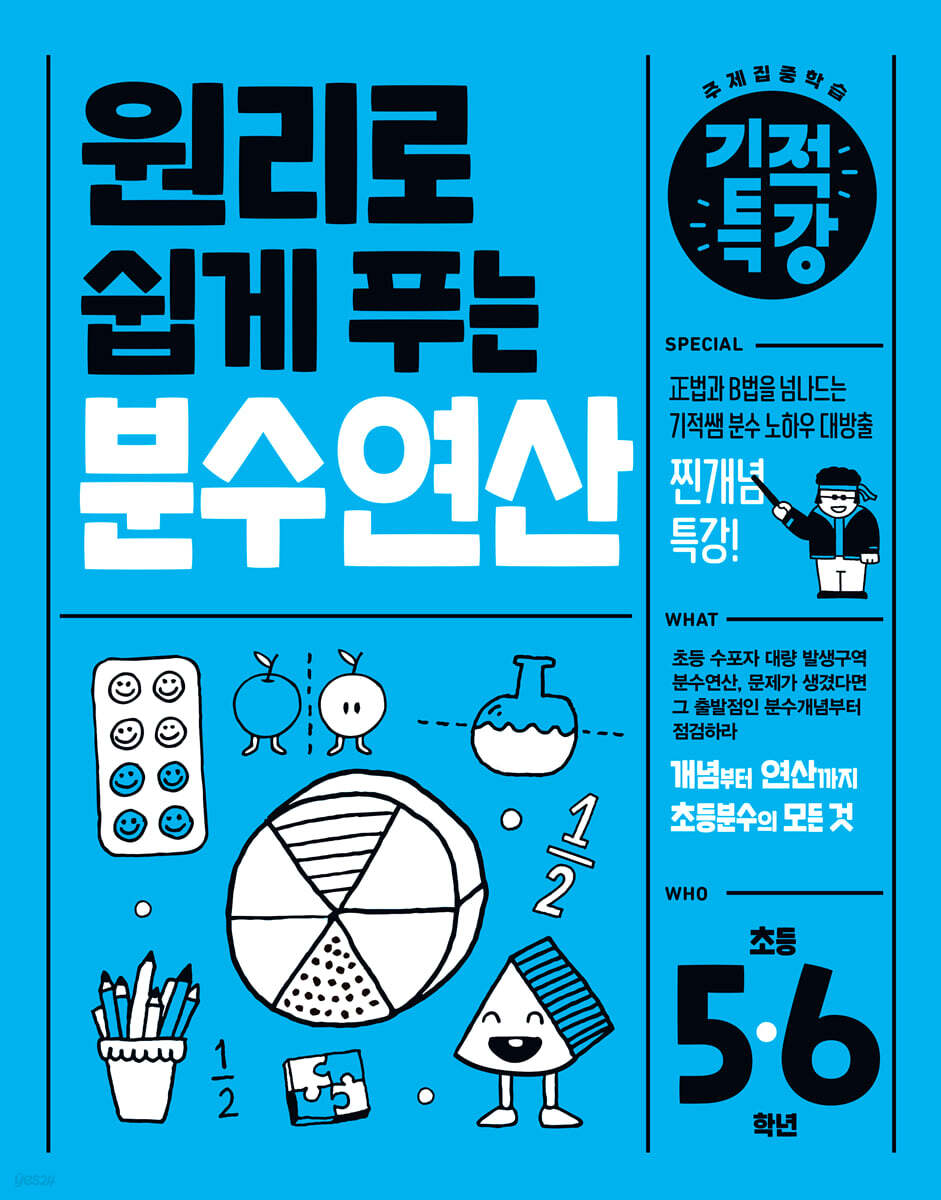
Miracle Special Lecture on Fraction Operations: Easy Solving with Principles
 |
Description
Book Introduction
The "Miracle Mathematics Special Lecture" series of intensive learning topics, this time on "Fractions"!
Take this opportunity to learn everything about elementary fractions, from concepts to operations.
Miracle Special Lectures, "Fractions: Easily Understanding with Principles" and "Fractions: Easily Solving with Principles," are a complete set of elementary fractions that bring together fractions, previously taught separately in each unit from 3rd to 6th grade, and allow students to study them while understanding the system and context.
In the elementary school curriculum, the area of arithmetic is largely divided into ‘lower grades - concepts of natural numbers and four basic operations’ and ‘upper grades - concepts of fractions and four basic operations.’
The reason why children who loved and were confident in math in the lower grades gradually start to dislike math is because 'fractions', which they learn in the upper grades, are a difficult concept to understand.
Unfortunately, for this reason, the fountain area is also a high-risk area for elementary school dropouts.
In elementary mathematics, there are many difficult hurdles that must be overcome but are not easily conquered.
However, no matter how difficult the topic is, if you learn it from A to Z in context with the Miracle Special Lecture, you can easily find the path to the top.
Now, let's go conquer the 'fountain' crisis that stands before us with the Miracle Special Lecture.
Take this opportunity to learn everything about elementary fractions, from concepts to operations.
Miracle Special Lectures, "Fractions: Easily Understanding with Principles" and "Fractions: Easily Solving with Principles," are a complete set of elementary fractions that bring together fractions, previously taught separately in each unit from 3rd to 6th grade, and allow students to study them while understanding the system and context.
In the elementary school curriculum, the area of arithmetic is largely divided into ‘lower grades - concepts of natural numbers and four basic operations’ and ‘upper grades - concepts of fractions and four basic operations.’
The reason why children who loved and were confident in math in the lower grades gradually start to dislike math is because 'fractions', which they learn in the upper grades, are a difficult concept to understand.
Unfortunately, for this reason, the fountain area is also a high-risk area for elementary school dropouts.
In elementary mathematics, there are many difficult hurdles that must be overcome but are not easily conquered.
However, no matter how difficult the topic is, if you learn it from A to Z in context with the Miracle Special Lecture, you can easily find the path to the top.
Now, let's go conquer the 'fountain' crisis that stands before us with the Miracle Special Lecture.
- You can preview some of the book's contents.
Preview
index
1.
Fraction Review for Grades 3 and 4 (Textbooks 3-1, 3-2, and 4-2)
Lesson 1: Summary of Fraction Concepts
Fraction conversions used in class 2 calculations
Lesson 3: Addition and subtraction of proper fractions with the same denominator
Addition and subtraction of mixed numbers with the same denominator
Lesson 5: Addition and Subtraction of Fractions with Like Denominators
Comprehensive Assessment for Lesson 6, Unit 1
2.
Preparing for Fraction Calculations (Textbook 5-1)
Lesson 7: Factors and Multiples
Greatest common divisor and least common multiple of the eight
Lesson 9: Properties of Fractions
10th lecture, reduction
Lesson 11: Tongun
Comprehensive Assessment for Lesson 12, Unit 2
3.
Addition and Subtraction of Fractions with Different Denominators (Textbook 5-1)
Lesson 13: Addition of Proper Fractions
Lesson 14 Subtraction of Proper Fractions
Lesson 15: Addition and Subtraction of Mixed Fractions
Addition of fractions with carryover in the 16th round
Lesson 17: Subtraction of Fractions with Reduction
Comprehensive Assessment for Lesson 18, Unit 3
4.
Multiplying Fractions (Textbook 5-2)
Lesson 19: Multiplying Proper Fractions and Natural Numbers
Lesson 20 Multiplication of Proper Fractions
Lesson 21: Reduction in Multiplication of Fractions
Lesson 22: Multiplying Mixed Fractions
Lesson 23, Unit 4 Comprehensive Assessment
5.
Division of Fractions (Textbook 6-1, 6-2)
24th (natural number) ÷ (natural number)
Lesson 25 Fractions with the same denominator ÷ Fractions
Lesson 26: Transformations of Fraction Division
Lesson 27 (Fraction) ÷ (Natural Number)
Lesson 28 (natural number)÷(proper fraction), (proper fraction)÷(proper fraction)
Lesson 29 Division of Mixed Fractions
Lesson 30, Unit 5 Comprehensive Evaluation
※ (Separate) Answers and Solutions
Fraction Review for Grades 3 and 4 (Textbooks 3-1, 3-2, and 4-2)
Lesson 1: Summary of Fraction Concepts
Fraction conversions used in class 2 calculations
Lesson 3: Addition and subtraction of proper fractions with the same denominator
Addition and subtraction of mixed numbers with the same denominator
Lesson 5: Addition and Subtraction of Fractions with Like Denominators
Comprehensive Assessment for Lesson 6, Unit 1
2.
Preparing for Fraction Calculations (Textbook 5-1)
Lesson 7: Factors and Multiples
Greatest common divisor and least common multiple of the eight
Lesson 9: Properties of Fractions
10th lecture, reduction
Lesson 11: Tongun
Comprehensive Assessment for Lesson 12, Unit 2
3.
Addition and Subtraction of Fractions with Different Denominators (Textbook 5-1)
Lesson 13: Addition of Proper Fractions
Lesson 14 Subtraction of Proper Fractions
Lesson 15: Addition and Subtraction of Mixed Fractions
Addition of fractions with carryover in the 16th round
Lesson 17: Subtraction of Fractions with Reduction
Comprehensive Assessment for Lesson 18, Unit 3
4.
Multiplying Fractions (Textbook 5-2)
Lesson 19: Multiplying Proper Fractions and Natural Numbers
Lesson 20 Multiplication of Proper Fractions
Lesson 21: Reduction in Multiplication of Fractions
Lesson 22: Multiplying Mixed Fractions
Lesson 23, Unit 4 Comprehensive Assessment
5.
Division of Fractions (Textbook 6-1, 6-2)
24th (natural number) ÷ (natural number)
Lesson 25 Fractions with the same denominator ÷ Fractions
Lesson 26: Transformations of Fraction Division
Lesson 27 (Fraction) ÷ (Natural Number)
Lesson 28 (natural number)÷(proper fraction), (proper fraction)÷(proper fraction)
Lesson 29 Division of Mixed Fractions
Lesson 30, Unit 5 Comprehensive Evaluation
※ (Separate) Answers and Solutions
Detailed image

Publisher's Review
Miracle Lecture's "Fractions Learning Method" Know-How Revealed
1.
Math is a systematic study, so don't lose sight of the connections.
The concepts of fractions are interconnected like a string of candies.
If you have a good grasp of '[3-1] Basic concepts of fractions', you can freely perform '[3-2] conversion between improper fractions and mixed numbers', and only then can you skillfully perform the operations of '[4-2] addition and subtraction of fractions'.
If any part of this chain of concepts is missing, subsequent learning will collapse like dominoes.
The Miracle Special Lecture links all of these processes together, allowing you to build a solid foundation.
2.
Miracle Teacher's special lecture that crosses the lines between the right and wrong methods
Teacher Miracle believes that 'the basics of mathematics begin with concepts.'
So, we try to spread the right concept of slow but good for the body, rather than the instant concept of fast but harmful to health.
From intuitive and clear explanations and easy-to-understand math terms with Chinese character definitions to the joy of discovering principles on your own through pure mathematics, all of Miracle Teacher's know-how is revealed to help you plant the right seeds of concepts in your brain.
3.
Perfect Study Day (Concept Lecture + Practice Questions)
If you have properly understood the concept through the special lecture, you must go through the process of making it your own and digesting it through problems.
A perfect day of study can only be achieved by solving step-by-step practice problems of 'understanding the principle → applying the principle → utilizing the principle.'
※ Checkpoint
1.
Elementary 5th and 6th grade textbook-linked learning
· 5-1 Factors and multiples/Reduction and common denominator/Addition and subtraction of fractions
· Multiplying fractions 5-2
· Division of 6-1 fractions
· 6-2 Division of fractions
2.
Complete a book in 30 days with the Perfect Day Study (Concept Lecture + Practice Problems).
3.
Includes a perfect end-of-study 'unit comprehensive assessment'
※ Recommended points
1.
Elementary school students in grades 5 and 6 who want to study fractional operations in a systematic and contextual manner
2.
A person who wants to learn a concept-based math study method
3.
Elementary school students in grades 5 and 6 who do not understand the principles of fractional operations and are confused about the methods
1.
Math is a systematic study, so don't lose sight of the connections.
The concepts of fractions are interconnected like a string of candies.
If you have a good grasp of '[3-1] Basic concepts of fractions', you can freely perform '[3-2] conversion between improper fractions and mixed numbers', and only then can you skillfully perform the operations of '[4-2] addition and subtraction of fractions'.
If any part of this chain of concepts is missing, subsequent learning will collapse like dominoes.
The Miracle Special Lecture links all of these processes together, allowing you to build a solid foundation.
2.
Miracle Teacher's special lecture that crosses the lines between the right and wrong methods
Teacher Miracle believes that 'the basics of mathematics begin with concepts.'
So, we try to spread the right concept of slow but good for the body, rather than the instant concept of fast but harmful to health.
From intuitive and clear explanations and easy-to-understand math terms with Chinese character definitions to the joy of discovering principles on your own through pure mathematics, all of Miracle Teacher's know-how is revealed to help you plant the right seeds of concepts in your brain.
3.
Perfect Study Day (Concept Lecture + Practice Questions)
If you have properly understood the concept through the special lecture, you must go through the process of making it your own and digesting it through problems.
A perfect day of study can only be achieved by solving step-by-step practice problems of 'understanding the principle → applying the principle → utilizing the principle.'
※ Checkpoint
1.
Elementary 5th and 6th grade textbook-linked learning
· 5-1 Factors and multiples/Reduction and common denominator/Addition and subtraction of fractions
· Multiplying fractions 5-2
· Division of 6-1 fractions
· 6-2 Division of fractions
2.
Complete a book in 30 days with the Perfect Day Study (Concept Lecture + Practice Problems).
3.
Includes a perfect end-of-study 'unit comprehensive assessment'
※ Recommended points
1.
Elementary school students in grades 5 and 6 who want to study fractional operations in a systematic and contextual manner
2.
A person who wants to learn a concept-based math study method
3.
Elementary school students in grades 5 and 6 who do not understand the principles of fractional operations and are confused about the methods
GOODS SPECIFICS
- Date of issue: December 15, 2024
- Page count, weight, size: 164 pages | 470g | 220*280*9mm
- ISBN13: 9791164068548
- ISBN10: 1164068547
- Reference book for use in grades: 5th and 6th grades
- KC Certification: Certification Type: Conformity Confirmation
You may also like
카테고리
korean


korean

![GQ KOREA Mark (Monthly): December [2025]](http://librairie.coreenne.fr/cdn/shop/files/8ef265dbbfbf186523ed75ba7319009d.jpg?v=1765340328&width=3840)


