

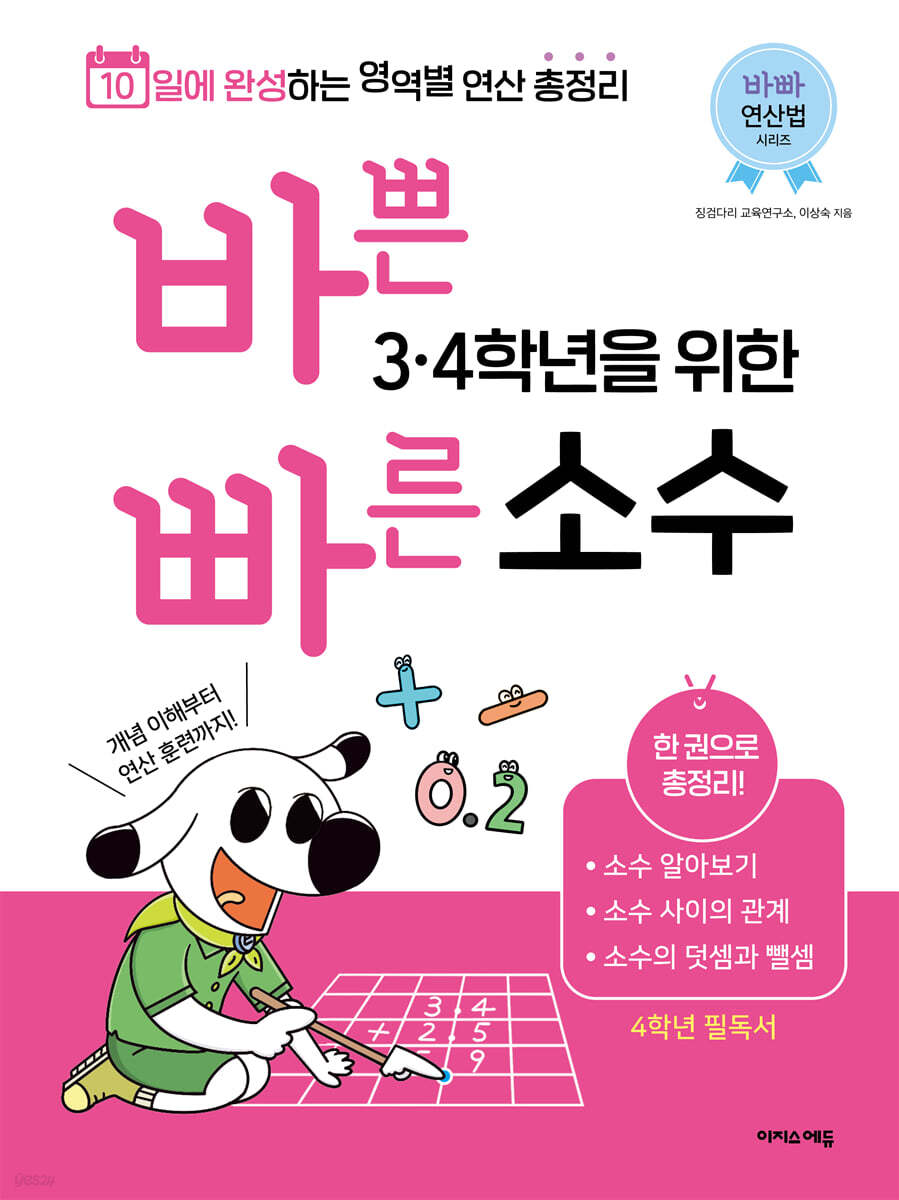
Quick decimals for busy 3rd and 4th graders
 |
Description
Book Introduction
Finish the 3rd and 4th grade decimals in one book!
Everything from conceptual understanding to computational training, all in one place!
"Quick Decimals for Busy Third and Fourth Graders" (hereafter, "Busy Third and Fourth Grade Decimals"), a comprehensive compilation of the decimals students often learn in scattered classes, has been released! "Busy Third and Fourth Grade Decimals" is a smart, time-saving training method.
This is because it is scientifically designed to help you quickly skim through easy content and practice more on difficult problems.
The author of this book, Jinju teacher Lee Sang-sook, who teaches elementary school students in Mokdong, says, “Children in the third and fourth grades have a particularly hard time with the ‘relationship between decimals,’ so it is important to first understand this part accurately before practicing calculating decimals.”
This book covers the 'relationships between prime numbers', which is particularly difficult for third and fourth graders, in a separate chapter, allowing them to solidify their basic concept of prime numbers.
Additionally, calculation problems where the number of digits is important are edited to be written on a grid, and the part where decimal points are written is structured to focus on practice, which can drastically reduce the mistakes children often make in decimal calculations.
After solving the diagnostic assessment in the book, follow the provided schedule to complete the 3rd and 4th grade decimals in 10 days! This will solidify your foundation in elementary decimals!
Everything from conceptual understanding to computational training, all in one place!
"Quick Decimals for Busy Third and Fourth Graders" (hereafter, "Busy Third and Fourth Grade Decimals"), a comprehensive compilation of the decimals students often learn in scattered classes, has been released! "Busy Third and Fourth Grade Decimals" is a smart, time-saving training method.
This is because it is scientifically designed to help you quickly skim through easy content and practice more on difficult problems.
The author of this book, Jinju teacher Lee Sang-sook, who teaches elementary school students in Mokdong, says, “Children in the third and fourth grades have a particularly hard time with the ‘relationship between decimals,’ so it is important to first understand this part accurately before practicing calculating decimals.”
This book covers the 'relationships between prime numbers', which is particularly difficult for third and fourth graders, in a separate chapter, allowing them to solidify their basic concept of prime numbers.
Additionally, calculation problems where the number of digits is important are edited to be written on a grid, and the part where decimal points are written is structured to focus on practice, which can drastically reduce the mistakes children often make in decimal calculations.
After solving the diagnostic assessment in the book, follow the provided schedule to complete the 3rd and 4th grade decimals in 10 days! This will solidify your foundation in elementary decimals!
- You can preview some of the book's contents.
Preview
index
Minority Basic Diagnostic Assessment
First yard.
Learn about prime numbers
01 Fractions with a denominator of 10 can be expressed as decimals.
02 The given length can be expressed as a decimal number.
03 Fractions with a denominator of 1000 can be expressed as decimals.
04 I can find two decimal places greater than 1
05 Fractions with a denominator of 100 can be expressed as decimals.
06 I can find three decimal places greater than 1
07 The number represented by a decimal varies depending on the position.
08 Comparison of the sizes of prime numbers in order from highest to lowest!
Second yard.
Relationships between minorities
If you multiply a prime number by 10, 100, or 1000, the number gets bigger.
11 The prime numbers 1/10, 1/100, 1/1000 are getting smaller and smaller.
12 To the left of the decimal point is 1/10, to the right is 10 times
13 Comprehensive problem on relations between prime numbers
Third yard.
Addition and subtraction of decimals
14 Addition of single-digit decimal numbers, the decimal point is the standard!
15 Addition of single-digit decimal numbers, don't forget to carry over!
16 Subtraction of single-digit decimal numbers is also based on the decimal point!
17 Be careful when subtracting and rounding down single-digit decimal numbers!
18 Addition of two-digit decimal numbers with carry
If the digits are different, add them so that the digits are the same.
20 Let's subtract from the second decimal place in order.
If the 21 digits are different, subtract them to make them the same.
22 Comprehensive addition and subtraction problems for decimals
Correct answer
First yard.
Learn about prime numbers
01 Fractions with a denominator of 10 can be expressed as decimals.
02 The given length can be expressed as a decimal number.
03 Fractions with a denominator of 1000 can be expressed as decimals.
04 I can find two decimal places greater than 1
05 Fractions with a denominator of 100 can be expressed as decimals.
06 I can find three decimal places greater than 1
07 The number represented by a decimal varies depending on the position.
08 Comparison of the sizes of prime numbers in order from highest to lowest!
Second yard.
Relationships between minorities
If you multiply a prime number by 10, 100, or 1000, the number gets bigger.
11 The prime numbers 1/10, 1/100, 1/1000 are getting smaller and smaller.
12 To the left of the decimal point is 1/10, to the right is 10 times
13 Comprehensive problem on relations between prime numbers
Third yard.
Addition and subtraction of decimals
14 Addition of single-digit decimal numbers, the decimal point is the standard!
15 Addition of single-digit decimal numbers, don't forget to carry over!
16 Subtraction of single-digit decimal numbers is also based on the decimal point!
17 Be careful when subtracting and rounding down single-digit decimal numbers!
18 Addition of two-digit decimal numbers with carry
If the digits are different, add them so that the digits are the same.
20 Let's subtract from the second decimal place in order.
If the 21 digits are different, subtract them to make them the same.
22 Comprehensive addition and subtraction problems for decimals
Correct answer
Detailed image
.jpg)
Into the book
The part that third and fourth graders find most difficult about decimals is the 'relationship between decimals.'
'Addition and subtraction of decimals' is not that difficult because the calculation method is the same as for natural numbers, as long as you get the decimal point position right.
Therefore, before doing decimal calculations, you must first understand and move on to the concept of decimal and the relationship between decimals!
'Addition and subtraction of decimals' is not that difficult because the calculation method is the same as for natural numbers, as long as you get the decimal point position right.
Therefore, before doing decimal calculations, you must first understand and move on to the concept of decimal and the relationship between decimals!
--- From "To 3rd and 4th grade elementary school students and their parents"
Publisher's Review
Quick Decimals for Busy Third and Fourth Graders
Accurately explain the concept of prime numbers, which is first encountered in elementary mathematics!
We've gathered all the prime numbers that 3rd and 4th graders need to know in one book!
■ Why are prime numbers important for 3rd and 4th graders?
Decimals are first learned in the 'Fractions and Decimals' unit in the first semester of the third grade in elementary school.
In lower grades, we only learn natural numbers, so this is the first unit where we feel that math is difficult.
Elementary decimals are taught from 3rd to 6th grade.
Among them, the 'Fractions and Decimals' unit learned in the third grade and the 'Addition and Subtraction of Decimals' unit learned in the fourth grade are the foundation of elementary decimals.
Therefore, if you learn decimals properly in 3rd and 4th grade, you will also be able to do well in 'multiplication and division of decimals' learned in 5th and 6th grade.
This book is a book that focuses on the decimal part of 3rd and 4th grade math.
Before solving a problem, we help you easily understand the concept with friendly explanations, and we help you adapt to increasingly difficult problems with small step-by-step operation training.
You can also cover basic sentence structures and prepare for school exams, so focus on just 10 days and build a solid foundation in elementary school decimals.
■ What parts of the course do 3rd and 4th graders find difficult?
The part that third and fourth graders find most difficult about decimals is the 'relationship between decimals.'
'Addition and subtraction of decimals' is not that difficult because the calculation method is the same as for natural numbers, as long as you get the decimal point position right.
Therefore, before adding and subtracting decimals, you must first understand the concept of decimals and the relationship between decimals. This book has a separate chapter devoted to the topic of "relationships between decimals," which third and fourth graders find particularly challenging. By the end of this book, students will have a solid foundation in the fundamentals of decimals.
■ Decimal points are important in decimal calculations! - Practice calculations on a grid.
If you have a clear understanding of the 'concept of decimals' and the 'relationship between decimals', you should now practice 'adding and subtracting decimals' skillfully.
'Addition and subtraction of decimals' can be done by aligning the decimal point position, calculating like a natural number, and then lowering the decimal point.
Since calculations using decimals with different digits often result in mistakes, it is important to make sure the decimal point is positioned correctly.
In this book, calculation problems where digits are important have been edited to be written on a grid.
Focus on practicing calculating with the same digits and then adding the decimal point.
■ An efficient learning method that builds skills through flexible training!
'Busy 3rd and 4th Grade Minority', like other busy series, presents a study method that builds skills more effectively while spending the same amount of time.
We've reduced the problems in stages that can be easily understood with simple practice, and expanded the stages that require more learning to allow for sufficient training.
Additionally, it is structured so that you can study intensively in a short period of time by solving 2-3 levels per day within 10-20 days.
If you study intensively, you can easily understand the overall context, which reduces the time it takes to complete a book, and like snow that piles up when you pour it down, your skills will gradually build up.
After understanding the concept of prime numbers with 'Busy 3rd and 4th Grade Prime Numbers' and practicing with grade-appropriate strategies and basic word problems, you will be able to get high scores on elementary school math tests.
■ Features of this book
1) Just 10 days to shape your math life! Customized learning is available at home after a diagnostic assessment!
We applied the actual diagnostic assessment methods of math academy directors to accurately diagnose your child's current learning status and create a customized learning plan even at home.
You can choose to study using either the 10-day progress chart or the 20-day progress chart based on the results of the '10-minute diagnostic assessment' included in this book.
If you want a faster diagnosis, you can also check the progress chart that is right for you with the '7-minute diagnostic assessment'.
If you are a 4th grader, even if a 20-day progress chart is provided, we recommend that you focus on completing the calculations by challenging the 10-day progress chart.
Just 10 days to address your learning deficits will be a crucial turning point that will determine your future math career.
2) Don't solve it unconditionally! Look at the concept and 'get the feeling~'
If you solve problems without properly understanding the concepts, you may hit a wall at some point.
Just as you need to consume a balanced diet to build basic physical strength, you need to learn concepts and principles during the training process to build a healthy foundation.
Unlike training books that only contain calculations, Busy Operation Method includes 'concepts at a glance' for each lesson.
It is helpful for friends who are learning on their own, as it allows them to understand the principles and practice calculations through friendly concept explanations that can be understood just by looking at the title.
3) The teacher in the book! Solve the puzzle with the teacher using 'Busy Tips' and hints from Padok!
No more mechanical, haphazard solving! From useful problem-solving tips to error-reducing tricks, this guide offers easy-to-understand tips and hints throughout the book. Even if you're working on your own, you'll benefit from learning alongside a friendly teacher.
4) Scientific learning design! Baboo's "small steps" method builds skills!
No more mechanical, repetitive calculations! We've structured it so you can quickly learn the easy parts and practice more on the more challenging ones.
The more flexible structure allows you to learn more efficiently with the same investment of time, with stages that require more practice expanded to 4-5 pages while stages that require simple practice are expanded to 3 pages.
Additionally, the level of immersion has been further increased by designing the stages meticulously and scientifically using the 'small step' method of Busy, which gradually increases the level and challenges.
It doesn't suddenly become difficult, so anyone can immerse themselves in it until the end and build their skills.
5) Understand the language of daily life and make it your own, and you will gain confidence naturally!
It doesn't end with just practicing simple calculation problems.
You can prepare for descriptive problems that you will definitely encounter in school, and also develop your thinking skills with fun 'operational playground' problems that are like games.
This book is not just about calculations, but it is more than just a book about calculations, and it helps you develop the problem-solving and creative convergence skills required by the current curriculum!
Accurately explain the concept of prime numbers, which is first encountered in elementary mathematics!
We've gathered all the prime numbers that 3rd and 4th graders need to know in one book!
■ Why are prime numbers important for 3rd and 4th graders?
Decimals are first learned in the 'Fractions and Decimals' unit in the first semester of the third grade in elementary school.
In lower grades, we only learn natural numbers, so this is the first unit where we feel that math is difficult.
Elementary decimals are taught from 3rd to 6th grade.
Among them, the 'Fractions and Decimals' unit learned in the third grade and the 'Addition and Subtraction of Decimals' unit learned in the fourth grade are the foundation of elementary decimals.
Therefore, if you learn decimals properly in 3rd and 4th grade, you will also be able to do well in 'multiplication and division of decimals' learned in 5th and 6th grade.
This book is a book that focuses on the decimal part of 3rd and 4th grade math.
Before solving a problem, we help you easily understand the concept with friendly explanations, and we help you adapt to increasingly difficult problems with small step-by-step operation training.
You can also cover basic sentence structures and prepare for school exams, so focus on just 10 days and build a solid foundation in elementary school decimals.
■ What parts of the course do 3rd and 4th graders find difficult?
The part that third and fourth graders find most difficult about decimals is the 'relationship between decimals.'
'Addition and subtraction of decimals' is not that difficult because the calculation method is the same as for natural numbers, as long as you get the decimal point position right.
Therefore, before adding and subtracting decimals, you must first understand the concept of decimals and the relationship between decimals. This book has a separate chapter devoted to the topic of "relationships between decimals," which third and fourth graders find particularly challenging. By the end of this book, students will have a solid foundation in the fundamentals of decimals.
■ Decimal points are important in decimal calculations! - Practice calculations on a grid.
If you have a clear understanding of the 'concept of decimals' and the 'relationship between decimals', you should now practice 'adding and subtracting decimals' skillfully.
'Addition and subtraction of decimals' can be done by aligning the decimal point position, calculating like a natural number, and then lowering the decimal point.
Since calculations using decimals with different digits often result in mistakes, it is important to make sure the decimal point is positioned correctly.
In this book, calculation problems where digits are important have been edited to be written on a grid.
Focus on practicing calculating with the same digits and then adding the decimal point.
■ An efficient learning method that builds skills through flexible training!
'Busy 3rd and 4th Grade Minority', like other busy series, presents a study method that builds skills more effectively while spending the same amount of time.
We've reduced the problems in stages that can be easily understood with simple practice, and expanded the stages that require more learning to allow for sufficient training.
Additionally, it is structured so that you can study intensively in a short period of time by solving 2-3 levels per day within 10-20 days.
If you study intensively, you can easily understand the overall context, which reduces the time it takes to complete a book, and like snow that piles up when you pour it down, your skills will gradually build up.
After understanding the concept of prime numbers with 'Busy 3rd and 4th Grade Prime Numbers' and practicing with grade-appropriate strategies and basic word problems, you will be able to get high scores on elementary school math tests.
■ Features of this book
1) Just 10 days to shape your math life! Customized learning is available at home after a diagnostic assessment!
We applied the actual diagnostic assessment methods of math academy directors to accurately diagnose your child's current learning status and create a customized learning plan even at home.
You can choose to study using either the 10-day progress chart or the 20-day progress chart based on the results of the '10-minute diagnostic assessment' included in this book.
If you want a faster diagnosis, you can also check the progress chart that is right for you with the '7-minute diagnostic assessment'.
If you are a 4th grader, even if a 20-day progress chart is provided, we recommend that you focus on completing the calculations by challenging the 10-day progress chart.
Just 10 days to address your learning deficits will be a crucial turning point that will determine your future math career.
2) Don't solve it unconditionally! Look at the concept and 'get the feeling~'
If you solve problems without properly understanding the concepts, you may hit a wall at some point.
Just as you need to consume a balanced diet to build basic physical strength, you need to learn concepts and principles during the training process to build a healthy foundation.
Unlike training books that only contain calculations, Busy Operation Method includes 'concepts at a glance' for each lesson.
It is helpful for friends who are learning on their own, as it allows them to understand the principles and practice calculations through friendly concept explanations that can be understood just by looking at the title.
3) The teacher in the book! Solve the puzzle with the teacher using 'Busy Tips' and hints from Padok!
No more mechanical, haphazard solving! From useful problem-solving tips to error-reducing tricks, this guide offers easy-to-understand tips and hints throughout the book. Even if you're working on your own, you'll benefit from learning alongside a friendly teacher.
4) Scientific learning design! Baboo's "small steps" method builds skills!
No more mechanical, repetitive calculations! We've structured it so you can quickly learn the easy parts and practice more on the more challenging ones.
The more flexible structure allows you to learn more efficiently with the same investment of time, with stages that require more practice expanded to 4-5 pages while stages that require simple practice are expanded to 3 pages.
Additionally, the level of immersion has been further increased by designing the stages meticulously and scientifically using the 'small step' method of Busy, which gradually increases the level and challenges.
It doesn't suddenly become difficult, so anyone can immerse themselves in it until the end and build their skills.
5) Understand the language of daily life and make it your own, and you will gain confidence naturally!
It doesn't end with just practicing simple calculation problems.
You can prepare for descriptive problems that you will definitely encounter in school, and also develop your thinking skills with fun 'operational playground' problems that are like games.
This book is not just about calculations, but it is more than just a book about calculations, and it helps you develop the problem-solving and creative convergence skills required by the current curriculum!
GOODS SPECIFICS
- Date of issue: December 15, 2023
- Page count, weight, size: 144 pages | 414g | 210*280*8mm
- ISBN13: 9791163035329
- Reference book for use in grades: 3rd and 4th grades
You may also like
카테고리
korean


korean

![GQ KOREA Mark (Monthly): December [2025]](http://librairie.coreenne.fr/cdn/shop/files/8ef265dbbfbf186523ed75ba7319009d.jpg?v=1765340328&width=3840)


