

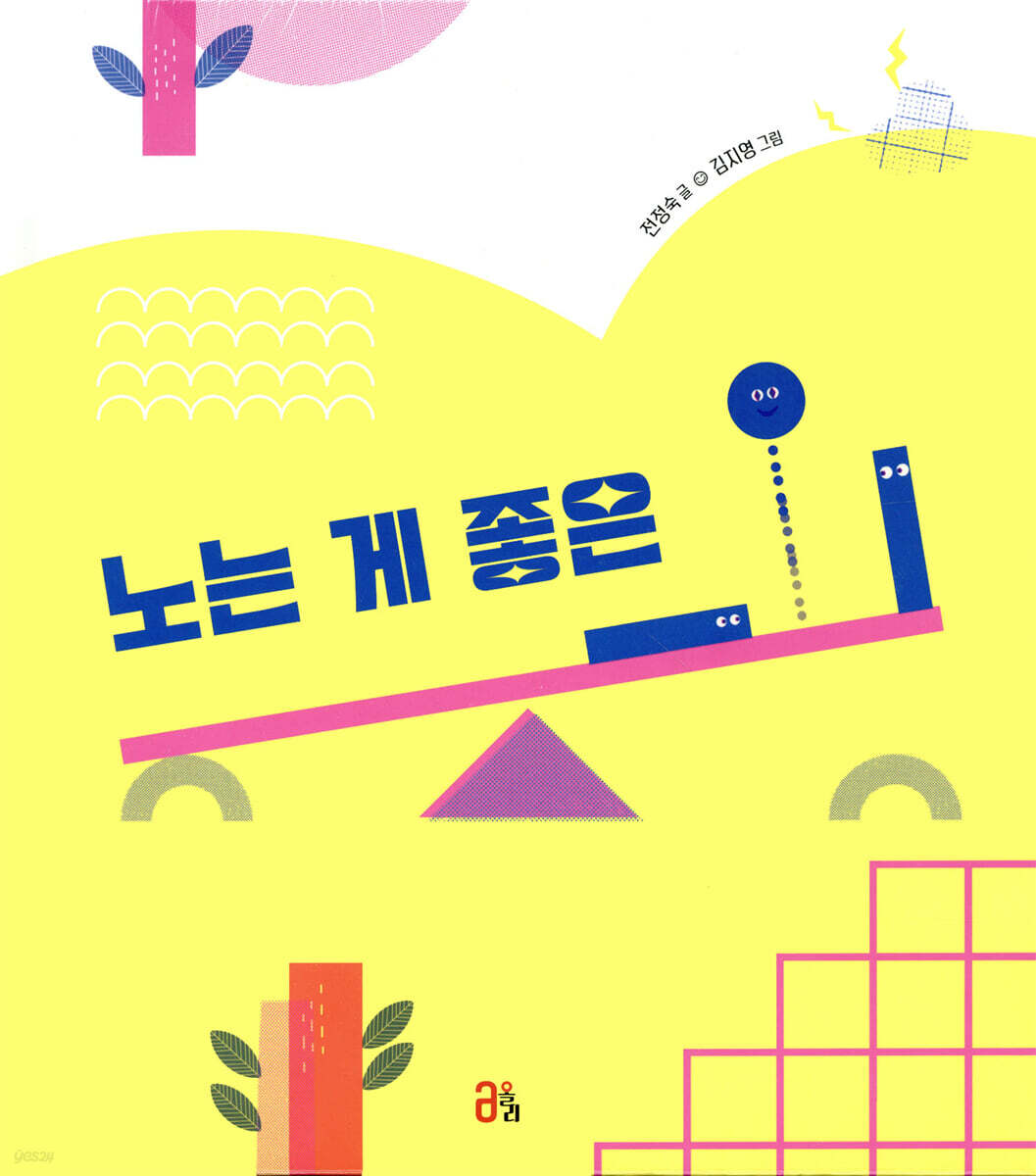
It's good to play ㅡㆍㅣ
 |
Description
Book Introduction
Expressing the basic letters of the vowel 天(ㆍ) 地(ㅡ) 人(ㅣ) as characters Explain in simple terms the principles of how vowels are formed. The basic vowel letters of Hunminjeongeum were modeled after the sky (ㆍ), the earth (ㅡ), and the person (ㅣ). By adding ㆍ to the top of ㅡ and the outside (right) of ㅣ, ㅗ and ㅏ were created, and by adding ㆍ to the bottom of ㅡ and the inside (left) of l, ㅜ and ㅓ were created. In this way, the basic three letters were combined to complete the vowel form we use today: ㅏㅑㅓㅕ… Vowels are scientific letters designed based on the 'principle of addition' that combines ㆍ with the basic letters ㅡ and ㅣ, and the 'principle of symmetry' that creates perfect symmetry in all directions. When learning Hangul, we usually learn the vowel forms that are created: a, ya, eo, yeo…, so we do not think deeply about the principles of Hangul’s creation and discipleship. 『Playing is Good ㅡㆍㅣ』 was planned to easily explain the principles and roles of vowels. The three basic letters, sky (ㆍ), earth (ㅡ), and person (ㅣ), are expressed as characters and an interesting story is woven to convey the value and excellence of Hangul at a level that children can understand. |
- You can preview some of the book's contents.
Preview
Detailed image
Publisher's Review
Expressing the basic letters of the vowel 天(·) 地(ㅡ) 人(l) as characters
Explain in simple terms the principles of how vowels are formed.
The basic vowel letters of Hunminjeongeum were modeled after the sky (·), the earth (ㅡ), and the person (ㅣ).
By adding · to the top of ㅡ and the outside (right) of ㅣ, ㅗ and ㅏ were created, and by adding · to the bottom of ㅡ and the inside (left) of l, ㅜ and ㅓ were created.
In this way, the basic three letters were combined to complete the vowel form we use today: ㅏㅑㅓㅕ…
Vowels are scientific letters designed based on the 'principle of addition' that combines · with the basic letters ㅡ and ㅣ, and the 'principle of symmetry' that creates perfect symmetry up, down, left, and right.
When learning Hangul, we usually learn the vowel forms that are created: a, ya, eo, yeo…, so we do not think deeply about the principles of Hangul’s creation and discipleship.
『Playing is Good ㅡ·ㅣ』 was planned to easily explain the principles and roles of vowels.
The three basic letters of heaven (天·), earth (ㅡ), and person (ㅣ) are expressed as characters and an interesting story is woven to convey the value and excellence of Hangul at a level that children can understand.
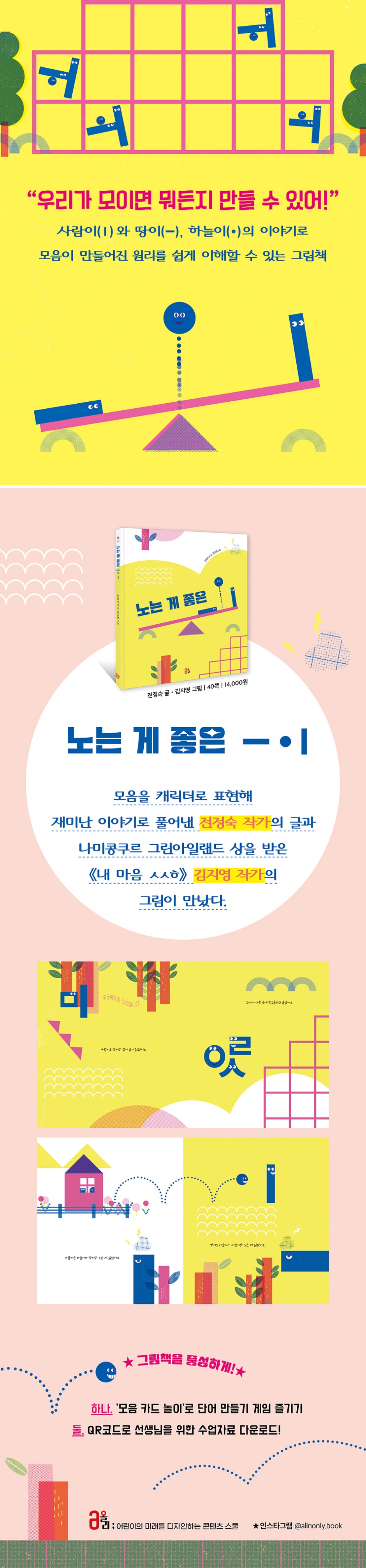
“When we come together, we can make anything!”
A collection of friends' stories with interesting stories
The main characters of 『Playing is Good ㅡ·ㅣ』 are the earth (ㅡ), the sky (·), and a person (l).
Although Ttang-i and Saram-i lived in the same neighborhood, they were not close because they were so different.
So, Ttang-i and Saram-i hung out with their friends from other neighborhoods.
Then one day, Haneul moves in.
Thanks to Haneul, who is round and round and rolls around well wherever she goes and gets along well with everyone, the three friends realize that they can make anything and have more fun when they get together.
This is an interesting story about the principle of vowel creation: if the three basic consonants are separated, there are not many letters that can be written, but when they are all combined together, more letters can be created.
Writer Jeon Jeong-suk, who has worked as an editor for a long time and has been arranging letters neatly, at some point began to see the vowels of the Korean alphabet as characters.
With that thought in mind, I decided to write a story about my friends.
Author Jiyoung Kim, who won the Grand Prize at the Four Seasons Picture Book Award for her work, “My Heart ㅅㅅㅎ,” and the Nami Concours Green Island Award, expressed letter characters in a concise yet humorous way.
The characters' emotions are expressed through just the expression of their eyes, making it more fun to read.
From post-reading activity sheets to class materials
Literacy Picture Books for Enjoyment
『Playing is Good ㅡ·ㅣ』 includes cards for playing with the vowels sky (·), earth (ㅡ), and person (l).
This is a game where you divide the cards into groups of three and use the cards you have to make words. For example, if you have one sky card and two person cards, you can make words such as bug or lemon that contain 'ㅔ', or eggplant or train that contain 'ㅏ' and 'l'.
If you read the book and play with the sky, earth, and people cards, you can enjoy a more fun letter game.
Additionally, lesson materials for teachers and parents can be downloaded via QR code.
This is a lesson material created by Ms. Da-Hye Kim, a current teacher and member of the 'Picture Book Research Group for Love', and is designed to help students build vocabulary through activities such as word addition, word relay, and sentence play along with the book.
It can be used effectively in picture book classes in conjunction with various subjects.
Let's read and enjoy picture books more richly.
Curriculum linkage
First semester, first year, Korean language 3, let's all learn together
We are playing with words in Korean language 4, first semester of second grade.
3rd grade, 1st semester Korean language 1 is so much fun
Explain in simple terms the principles of how vowels are formed.
The basic vowel letters of Hunminjeongeum were modeled after the sky (·), the earth (ㅡ), and the person (ㅣ).
By adding · to the top of ㅡ and the outside (right) of ㅣ, ㅗ and ㅏ were created, and by adding · to the bottom of ㅡ and the inside (left) of l, ㅜ and ㅓ were created.
In this way, the basic three letters were combined to complete the vowel form we use today: ㅏㅑㅓㅕ…
Vowels are scientific letters designed based on the 'principle of addition' that combines · with the basic letters ㅡ and ㅣ, and the 'principle of symmetry' that creates perfect symmetry up, down, left, and right.
When learning Hangul, we usually learn the vowel forms that are created: a, ya, eo, yeo…, so we do not think deeply about the principles of Hangul’s creation and discipleship.
『Playing is Good ㅡ·ㅣ』 was planned to easily explain the principles and roles of vowels.
The three basic letters of heaven (天·), earth (ㅡ), and person (ㅣ) are expressed as characters and an interesting story is woven to convey the value and excellence of Hangul at a level that children can understand.
“When we come together, we can make anything!”
A collection of friends' stories with interesting stories
The main characters of 『Playing is Good ㅡ·ㅣ』 are the earth (ㅡ), the sky (·), and a person (l).
Although Ttang-i and Saram-i lived in the same neighborhood, they were not close because they were so different.
So, Ttang-i and Saram-i hung out with their friends from other neighborhoods.
Then one day, Haneul moves in.
Thanks to Haneul, who is round and round and rolls around well wherever she goes and gets along well with everyone, the three friends realize that they can make anything and have more fun when they get together.
This is an interesting story about the principle of vowel creation: if the three basic consonants are separated, there are not many letters that can be written, but when they are all combined together, more letters can be created.
Writer Jeon Jeong-suk, who has worked as an editor for a long time and has been arranging letters neatly, at some point began to see the vowels of the Korean alphabet as characters.
With that thought in mind, I decided to write a story about my friends.
Author Jiyoung Kim, who won the Grand Prize at the Four Seasons Picture Book Award for her work, “My Heart ㅅㅅㅎ,” and the Nami Concours Green Island Award, expressed letter characters in a concise yet humorous way.
The characters' emotions are expressed through just the expression of their eyes, making it more fun to read.
From post-reading activity sheets to class materials
Literacy Picture Books for Enjoyment
『Playing is Good ㅡ·ㅣ』 includes cards for playing with the vowels sky (·), earth (ㅡ), and person (l).
This is a game where you divide the cards into groups of three and use the cards you have to make words. For example, if you have one sky card and two person cards, you can make words such as bug or lemon that contain 'ㅔ', or eggplant or train that contain 'ㅏ' and 'l'.
If you read the book and play with the sky, earth, and people cards, you can enjoy a more fun letter game.
Additionally, lesson materials for teachers and parents can be downloaded via QR code.
This is a lesson material created by Ms. Da-Hye Kim, a current teacher and member of the 'Picture Book Research Group for Love', and is designed to help students build vocabulary through activities such as word addition, word relay, and sentence play along with the book.
It can be used effectively in picture book classes in conjunction with various subjects.
Let's read and enjoy picture books more richly.
Curriculum linkage
First semester, first year, Korean language 3, let's all learn together
We are playing with words in Korean language 4, first semester of second grade.
3rd grade, 1st semester Korean language 1 is so much fun
GOODS SPECIFICS
- Publication date: September 6, 2022
- Format: Hardcover book binding method guide
- Page count, weight, size: 40 pages | 390g | 232*262*9mm
- ISBN13: 9791165344498
- ISBN10: 1165344491
- KC Certification: Certification Type: Conformity Confirmation
You may also like
카테고리
korean


korean

![GQ KOREA Mark (Monthly): December [2025]](http://librairie.coreenne.fr/cdn/shop/files/8ef265dbbfbf186523ed75ba7319009d.jpg?v=1765340328&width=3840)


