

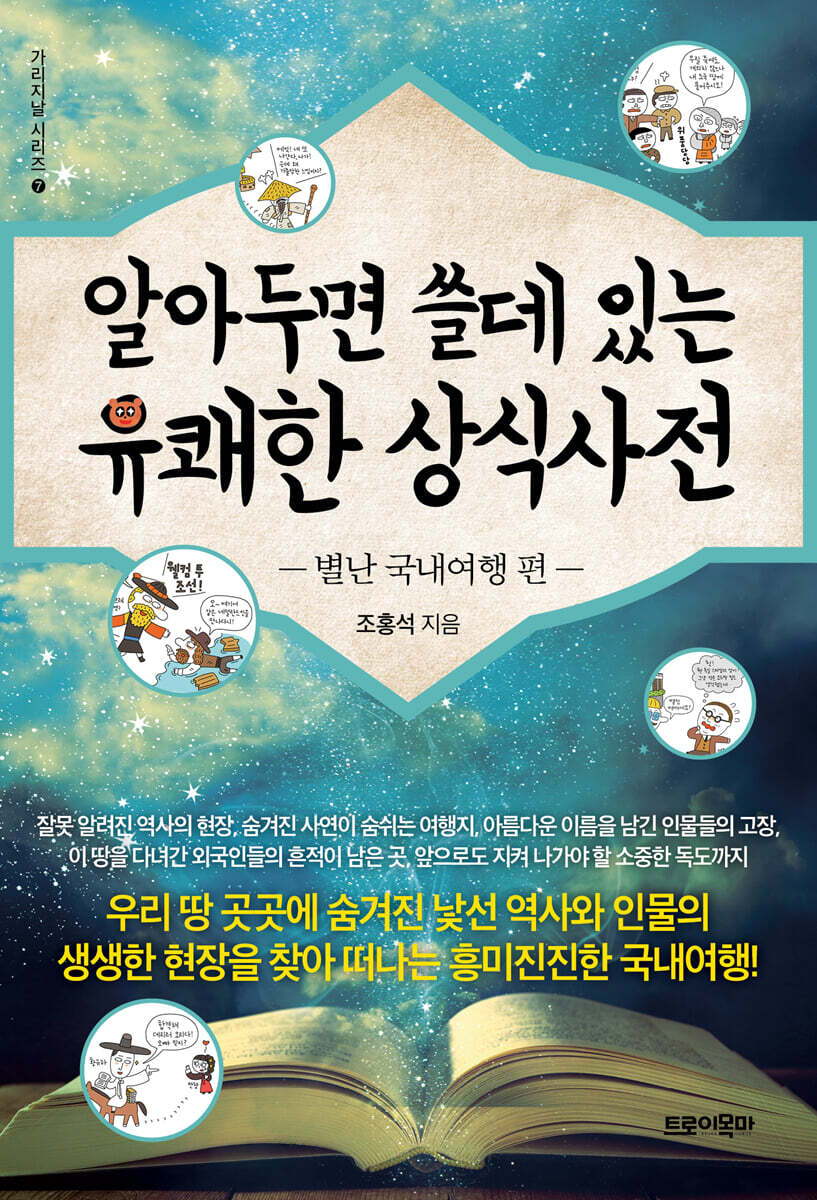
A Useful Dictionary of Pleasant Common Sense: Unusual Domestic Travel
 |
Description
Book Introduction
“The unfamiliar history and people hidden throughout our land
“An exciting humanities journey to discover vivid scenes!” The seventh installment of the Garijinal series, revealing surprising facts 99% of people don't know. Starting from the question, "Is the common sense I know really true?", the seventh book in the "Garigenal Series" (a common sense dictionary series that reveals in detail that the common sense that most people think of as "original" is actually "fake original," that is, garijinal, and explains the origin and history of original knowledge) compiled by digging through numerous books, various research materials, newspapers, and broadcasts has been published. The first volume of the series, 'Daily Life', the second volume, 'Science and Economy', the third volume, 'Language and Art', the fourth volume, 'Korean History', the fifth volume, 'The First and the Best', and the sixth volume, 'Our Language and Writing', received enthusiastic responses from readers. This time, we have published the 'Unusual Domestic Travel' volume, which goes on a journey to discover hidden history and people throughout our land. The "Useful and Fun Dictionary of Common Sense" series published so far is the result of the author's accumulated experience of reading and studying various media, including books, broadcasts, papers, and newspapers, in various fields for over 30 years, and his long-term efforts to convey difficult and fragmented knowledge in an easy, fun, and three-dimensional way. Among them, this book tells the stories of places that were previously unknown or were mistakenly believed to be distorted truths, among the countless events, stories, and people that took place in our land throughout history, in a surprising, unique, and interesting way. The book introduces the sites of historical distortion related to the 'Rajetongmun' in Muju, Jeollabuk-do; the stories behind the two Buseoksa temples in Yeongju, Gyeongsangbuk-do and Seosan, Chungcheongnam-do, built during the Silla Dynasty; the truth about the tomb of General Nami on Nami Island, a representative tourist attraction in Chuncheon, Gangwon-do; the beauty of the Red Cliffs of Hwasun that Kim Satgat, a representative wandering poet of the late Joseon Dynasty, admired; the regrettable decision to change the name of Goseong, Gangwon-do, to 'Kim Il-sung's Villa' when it had a pretty name, 'Hwajinpo Castle'; and the stories of Manhyang, Gyeongchun, Lee Maechang, Kim Geum-won, and Lee Nan-hyang, who left behind three beautiful names as gisaeng during the Joseon Dynasty when there were many restrictions on women's social activities and social status. It also tells the many stories left behind in our territory, including the traces left by foreigners who visited our land from BC to the Joseon Dynasty in Jeju, Namhae in South Gyeongsang Province, Yeosu and Gangjin in South Jeolla Province, the reason why a street of Japanese houses appeared in Guryongpo Port in Pohang, North Gyeongsang Province during the Japanese colonial period, the mystery surrounding the herring that was the original ingredient of gwamegi, the Chinatowns in Incheon and Busan where a large number of overseas Chinese, the largest immigrant group who settled in Korea, live, and the truth about the 'Manbosan Incident', a dark history of our people buried in history, and lastly, the history of Dokdo, which has clearly been our territory since the Joseon Dynasty, and the desirable way for us to respond to Japan's irrational claims to Dokdo. In addition to introducing famous tourist attractions in the area, it also introduces lesser-known hidden gems, allowing readers to fully enjoy the curiosity and pleasure of being a humanistic traveler, beyond just food and sights. The author is evaluated by numerous readers as a Korean-style knowledge curator and the "Korean Bill Bryson" by questioning the so-called common sense that 99% of people believe without question, finding the source of knowledge and delivering a surprising story. Furthermore, believing that "all knowledge is interconnected, not isolated," we strive to provide readers with small insights that allow them to explore the three-dimensional connections between diverse knowledge sources, rather than simply providing fragmented knowledge. |
- You can preview some of the book's contents.
Preview
index
Entering
| Part 1 | In Search of the Site of Misunderstood History
01 Muju, Jeollabuk-do - Rajetongmun, a site of historical distortion created by our own hands.
Places to visit in Muju, Jeollabuk-do
02 Yeongju, Gyeongbuk, Seosan, Chungnam - Buseoksa Temple vs. Buseoksa Temple
Places to visit in Yeongju, Gyeongbuk
Places to visit in Seosan, South Chungcheong Province
03 Chuncheon, Gangwon-do - The Secret of General Nami's Tomb on Nami Island
Places to visit in Chuncheon, Gangwon-do
04 Seoul - In Search of Manhae Han Yong-un's True Face
| Part 2 | In search of travel destinations with hidden stories
01 Gangwon Cheorwon - A place where Gung Ye's dreams and the sorrow of displaced people remain.
Places to visit in Cheorwon, Gangwon-do
02 Hwasun, Jeollanam-do - The last love of Kim Satgat, who ran away from home, Hwasun Jeokbyeok
Places to visit in Hwasun, Jeollanam-do
03 Gangwon Gosung - Until the castle in Hwajinpo became known as Kim Il-sung's villa
04 Seoul - Temple Stories with Stories (Bomunsa, Bongeunsa, Gilsangsa)
| Part 3 | In Search of Those Who Left Beautiful Names
01 Hongseong, South Chungcheong Province - In search of the sad story of Manhyang, a fragrance that spreads late
Places to visit in Hongseong, South Chungcheong Province
02 Yeongwol, Gangwon - The Stories of Nakhwaam and the Gisaeng Gyeongchun
Places to visit in Yeongwol, Gangwon-do
03 Goyang, Namwon, Bonghwa, Yeongju, Damyang - In Search of the Origin of Chunhyangjeon
Places to Visit in Namwon, Bonghwa, and Damyang
04 Buan, Wonju, Seoul - The Last Traces of Gisaeng
Places to visit in Buan and Wonju
| Part 4 | In search of traces of foreigners who visited this land
01 Jeju, Namhae - Seo Bok, in search of the elixir of life
Places to visit in Jeju Island
Places to visit in Namhae, Gyeongsangnam-do
02 Jeju, Gangjin, Yeosu - In Search of Hamel's Journey to Escape Joseon
03 Pohang, Gyeongbuk - Guryongpo Japanese Village with a Stunning Story
04 Incheon, Busan - Chinatown, a place with a sad and regrettable dark history
[Epilogue] Dokdo, Gyeongbuk - Our Land We Must Protect
References
| Part 1 | In Search of the Site of Misunderstood History
01 Muju, Jeollabuk-do - Rajetongmun, a site of historical distortion created by our own hands.
Places to visit in Muju, Jeollabuk-do
02 Yeongju, Gyeongbuk, Seosan, Chungnam - Buseoksa Temple vs. Buseoksa Temple
Places to visit in Yeongju, Gyeongbuk
Places to visit in Seosan, South Chungcheong Province
03 Chuncheon, Gangwon-do - The Secret of General Nami's Tomb on Nami Island
Places to visit in Chuncheon, Gangwon-do
04 Seoul - In Search of Manhae Han Yong-un's True Face
| Part 2 | In search of travel destinations with hidden stories
01 Gangwon Cheorwon - A place where Gung Ye's dreams and the sorrow of displaced people remain.
Places to visit in Cheorwon, Gangwon-do
02 Hwasun, Jeollanam-do - The last love of Kim Satgat, who ran away from home, Hwasun Jeokbyeok
Places to visit in Hwasun, Jeollanam-do
03 Gangwon Gosung - Until the castle in Hwajinpo became known as Kim Il-sung's villa
04 Seoul - Temple Stories with Stories (Bomunsa, Bongeunsa, Gilsangsa)
| Part 3 | In Search of Those Who Left Beautiful Names
01 Hongseong, South Chungcheong Province - In search of the sad story of Manhyang, a fragrance that spreads late
Places to visit in Hongseong, South Chungcheong Province
02 Yeongwol, Gangwon - The Stories of Nakhwaam and the Gisaeng Gyeongchun
Places to visit in Yeongwol, Gangwon-do
03 Goyang, Namwon, Bonghwa, Yeongju, Damyang - In Search of the Origin of Chunhyangjeon
Places to Visit in Namwon, Bonghwa, and Damyang
04 Buan, Wonju, Seoul - The Last Traces of Gisaeng
Places to visit in Buan and Wonju
| Part 4 | In search of traces of foreigners who visited this land
01 Jeju, Namhae - Seo Bok, in search of the elixir of life
Places to visit in Jeju Island
Places to visit in Namhae, Gyeongsangnam-do
02 Jeju, Gangjin, Yeosu - In Search of Hamel's Journey to Escape Joseon
03 Pohang, Gyeongbuk - Guryongpo Japanese Village with a Stunning Story
04 Incheon, Busan - Chinatown, a place with a sad and regrettable dark history
[Epilogue] Dokdo, Gyeongbuk - Our Land We Must Protect
References
Detailed image

Into the book
In Part 1, we introduce well-known figures and famous places that many people know as incorrect information, or "false information."
(syncopation)
Part 2 introduces travel destinations with hidden stories.
(syncopation)
Part 3 introduces relics that contain traces of several women who have not seen the light of day for a long time.
(syncopation)
Part 4 is a journey that explores the traces of foreigners who visited this land.
(syncopation)
In the final epilogue, I would like to conclude with a little-known story about Dokdo.
---「pp7~8.
From "Entering"
However, an incident occurred where the previously unknown Seosan Bulguksa Temple suddenly became famous.
In 2012, a group of thieves from our country stole a gilt-bronze seated statue of Avalokitesvara Bodhisattva from Gannonji Temple on Tsushima Island and brought it back to our country, but were arrested.
Legally, it should be returned to its original owner, but although there is a record that this Buddha statue was originally made and enshrined at Buseoksa Temple in Seosan in 1330, there is no record of the Buddha statue being sent to Japan, and as there are traces of fire on the Buddha statue, experts have stated that it is likely that this Buddha statue was plundered by Tsushima Japanese pirates.
As the argument that this Buddhist statue was originally our country's and should not be returned to Japan gained strength, it was temporarily stored at the Daejeon National Research Institute of Cultural Heritage.
Accordingly, in the first trial in 2017, the court ruled that the Buddhist statue should be returned to Buseoksa Temple in Seosan, after pieces of Goryeo Dynasty fish bone pattern roof tiles and celadon discovered at Buseoksa Temple in Seosan were presented as evidence.
However, due to the opposition of the Japanese Kannonji, which claimed to have received the Buddhist statue from Joseon in 1527, the second trial of the Daejeon High Court held in February 2023 ruled, “It is possible to acknowledge the fact that Seosan Buseoksa Temple, which existed around 1330, produced this Buddhist statue, and there is evidence that suggests that Japanese pirates plundered and illegally exported it, but it is difficult to acknowledge ownership because there is insufficient evidence that Buseoksa Temple at the time was the same religious organization as the current Buseoksa Temple and a continuous religious organization.” The ruling was to return the statue to the Japanese Kannonji, which had possessed the statue for more than 20 years since January 26, 1953, when it was registered as a religious corporation, and the statute of limitations on the statue had expired. In the end, the Supreme Court had to make the final decision.
---「pp42~43.
Part 1.
In search of a site of misunderstood history 02.
Among Gyeongbuk Yeongju and Chungnam Seosan - Buseoksa Temple vs. Buseoksa Temple
Dopiansa Temple, which was built in the late Unified Silla period and was within a civilian control zone for a while, has recently become open to the public.
The reason you must visit Dopiansa Temple is because there is a famous Buddhist statue called the ‘Iron Vairocana Buddha (National Treasure No. 63)’ inside the Daejeokgwangjeon Hall of Dopiansa Temple.
This 91-centimeter-tall Buddha statue is known to have been created by 1,500 ordinary believers (gyesa) in January of the fifth year of King Gyeongmun of Silla (865), as evidenced by the inscription on its back. It is one of the few treasures whose date of creation is clearly known.
Compared to the Buddha statues of Seorabeol at the time, which had plump and dignified appearances, this statue has a slender face with a slight smile on its lips, showing the beginning of a change towards free-spirited Buddha statues of local aristocrats during the Goryeo Dynasty.
Additionally, this Buddha statue is made of iron, which is rare in our country.
It is said that this Buddha statue is the only one in which not only the Buddha but also the pedestal on which he sits is made entirely of iron.
Usually, Buddhist statues are made of stone or bronze, carved from wood, or molded from clay.
Iron Buddha was rarely attempted because it was difficult to make and the seams of the mold left tiny marks during the casting process. However, it is also valuable in that it is one of the earliest forms of iron Buddha that appeared in the mid-9th century and continued until the Goryeo Dynasty.
So, even though the building burned down during the war, the iron Buddha statue was able to be preserved intact.
---「pp106~107.
Part 2.
[Places to visit in Cheorwon, Gangwon-do]
In 1937, when Japan started the Second Sino-Japanese War, it declared Wonsan Port off-limits to the general public in order to use it as a military port, and closed the foreign resort village at Wonsan Beach. It was decided to provide these foreigners with a new resort site in Hwajinpo, Goseong.
Dr. Sherwood Hall, who was a former executive committee member of the resort, visited Hwajinpo and decided to build a villa overlooking the lake, as he saw it from the hill and it reminded him of Lake Lucerne in Switzerland.
However, at the time, it was difficult to find a Korean architect who could build a Western-style villa on a rock face, so after asking around, he found out that there was a German architect in Korea.
So, the person Dr. Sherwood Hall met was a German architect named Weber, and surprisingly, he had fled to the Korean Peninsula to escape Hitler's reign of terror.
There is no information on how Beaver came to Joseon and what happened to him afterward.
(syncopation)
This villa, which was completed in 1938 at a great expense, was usually used as a chapel for foreign missionaries, but the family of Dr. Sherwood Hall only used it for a few days for vacation, and after being expelled in 1941, it was left without an owner, so after liberation, it became North Korean territory and Dr. Sherwood Hall could no longer go there.
The North Korean regime used this villa, whose owner had disappeared, as a resort for VIPs. Kim Il-sung's family also often used it, so it was later called the Kim Il-sung villa.
If you go there now, you will see a photo of Kim Jong-il sitting on the stairs among the various exhibits.
During the Korean War, when our army advanced to the south of Goseong and it became South Korean territory, Kim Il-sung was unable to use this villa. In March 2005, the building, which had been damaged, was restored to its original appearance and is now used as an exhibition hall for Dr. Sherwood Hall's life and inter-Korean reconciliation and exchange.
---「pp135~138.
Part 2.
In search of a travel destination with a hidden story 03.
From "Gangwon Gosung - Until the castle in Hwajinpo became known as Kim Il-sung's villa"
Shin Saimdang, Heo Nanseolheon, Hwang Jini, and Lee Maechang are mentioned as the four greatest female poets of the Joseon Dynasty. They were all women who lived around the same time in the 16th century. Of these, Shin Saimdang and Heo Nanseolheon were noted as female poets from noble families, while Hwang Jini and Lee Maechang were famous in their time as gisaeng.
However, even now, the most famous gisaeng among the gisaengs, Hwang Jin-i (1506-1567), is counted as one of the 'Songdo Three Perfections' along with Park Yeon-pokpo and Seo Gyeong-deok, but most of the unofficial history that has been passed down was created later, and her name first appeared in the records of the 18th century Silhak scholar Lee Deok-mu, so it is difficult to confirm how much of it is true, and not much is known about what her actual life was like.
On the other hand, another female poet, Lee Mae-chang (1573-1610), was one of the 'Three Perfects of Buan' along with Jikso Falls and Yu Hui-gyeong, and her love story with Yu Hui-gyeong was noted as the greatest love story of Joseon at the time.
Lee Mae-chang was born as the daughter of Lee Tang-jong, a government official in Buan County, North Jeolla Province, and a concubine. She became a gisaeng (female entertainer). She became famous for her outstanding skills playing the geomungo and for writing excellent Chinese poetry using the writing skills she learned from her father.
Poets and writers of the time, including Heo Gyun (許筠), came to Buan, North Jeolla Province, to meet Lee Mae-chang, who was unable to leave Buan due to her status as a government official, and it is said that Yeonpyeong Buwongun Lee Gwi (李貴) and Kwon Pil (權?) exchanged poems and written conversations with her.
---「pp235~236.
Part 3.
In search of those who left behind beautiful names 04.
Buan, Wonju, Seoul - From "The Disappeared Gisaengs"
The Japanese House Street in Guryongpo, Pohang, which has recently become widely known after appearing as the main background for the domestic dramas 'When the Camellia Blooms' and 'The Sea Village Cha Cha Cha', is gaining popularity as a photo zone full of emotion as it contains around 80 houses from the Japanese colonial period.
While other regions have scattered old Japanese houses, Pohang is one of the few places where a Japanese-style street with houses lined up in a row remains. Capitalizing on its popularity, Pohang City is making efforts to attract more tourists by operating weekend experiences, exhibition programs, and ocean tour buses.
However, the starting point of the Japanese house street in Guryongpo was different from that of other Japanese residential areas.
The Japanese districts of Busan, Incheon, and Wonsan Port were strategically developed areas where Japanese wholesale and retail merchants settled to sell goods in Joseon and branches of the Oriental Development Company were established from the time of the opening of the ports. Gunsan and Mokpo were inhabited by Japanese capitalists and employees who transported cheap Joseon agricultural products to Japan.
On the other hand, Guryongpo Village was a quiet fishing village that no one paid attention to until the end of Joseon, but starting in 1883, when Japanese fishermen were also able to fish in Joseon waters, around 80 fishing boats from Kagawa Prefecture (香川?) came to Guryongpo and fell in love with the golden fishing grounds where there was half water and half fish, so the first Japanese people moved in and naturally created a Japanese street, so the purpose itself was different.
---「pp295~966.
Part 4.
In search of traces of foreigners who visited this land 03.
Pohang, Gyeongbuk - From "Guryongpo Japanese Village with a Breathtaking Story"
Then, a great man appeared who proved that the two precious islands were our territory… … , ah~, his name was An Yong-bok (安龍福, 1658~?).
An Yong-bok, who was originally a slave in Dongrae-gun, served in the navy and frequently came into contact with Japanese people at the Japanese residence in Busanpo, where he also worked as a Japanese interpreter.
However, he couldn't make a living just by interpreting Japanese, so he also worked as a fisherman. It is said that fishermen at the time knew that there were many fish caught near the forbidden island of Ulleungdo.
I always see that only the noble ones don't know such real-life information.
In 1693, about 40 fishermen, including An Yong-bok, who set out from Dongrae, went to Ulleungdo and encountered Japanese fishermen.
An Yong-bok and his party protested, saying, “Why did you invade Joseon territory?” However, the Japanese fishermen, who were significantly more numerous than the others, did not know that the island was Joseon territory and instead captured An Yong-bok and his party, claiming that it was an uninhabited island they had discovered and dragged them to Japan.
However, the Japanese officials become embarrassed when, during the interrogation, they discover that in 1625, the Oya and Murakawa families received passage licenses from the Tokugawa shogunate that allowed them to sail to Ulleungdo and Dokdo.
The navigation license was a permit issued when going abroad, so it was proof that the Japanese shogunate already knew that Ulleungdo and Dokdo were Joseon territory.
(syncopation)
Part 2 introduces travel destinations with hidden stories.
(syncopation)
Part 3 introduces relics that contain traces of several women who have not seen the light of day for a long time.
(syncopation)
Part 4 is a journey that explores the traces of foreigners who visited this land.
(syncopation)
In the final epilogue, I would like to conclude with a little-known story about Dokdo.
---「pp7~8.
From "Entering"
However, an incident occurred where the previously unknown Seosan Bulguksa Temple suddenly became famous.
In 2012, a group of thieves from our country stole a gilt-bronze seated statue of Avalokitesvara Bodhisattva from Gannonji Temple on Tsushima Island and brought it back to our country, but were arrested.
Legally, it should be returned to its original owner, but although there is a record that this Buddha statue was originally made and enshrined at Buseoksa Temple in Seosan in 1330, there is no record of the Buddha statue being sent to Japan, and as there are traces of fire on the Buddha statue, experts have stated that it is likely that this Buddha statue was plundered by Tsushima Japanese pirates.
As the argument that this Buddhist statue was originally our country's and should not be returned to Japan gained strength, it was temporarily stored at the Daejeon National Research Institute of Cultural Heritage.
Accordingly, in the first trial in 2017, the court ruled that the Buddhist statue should be returned to Buseoksa Temple in Seosan, after pieces of Goryeo Dynasty fish bone pattern roof tiles and celadon discovered at Buseoksa Temple in Seosan were presented as evidence.
However, due to the opposition of the Japanese Kannonji, which claimed to have received the Buddhist statue from Joseon in 1527, the second trial of the Daejeon High Court held in February 2023 ruled, “It is possible to acknowledge the fact that Seosan Buseoksa Temple, which existed around 1330, produced this Buddhist statue, and there is evidence that suggests that Japanese pirates plundered and illegally exported it, but it is difficult to acknowledge ownership because there is insufficient evidence that Buseoksa Temple at the time was the same religious organization as the current Buseoksa Temple and a continuous religious organization.” The ruling was to return the statue to the Japanese Kannonji, which had possessed the statue for more than 20 years since January 26, 1953, when it was registered as a religious corporation, and the statute of limitations on the statue had expired. In the end, the Supreme Court had to make the final decision.
---「pp42~43.
Part 1.
In search of a site of misunderstood history 02.
Among Gyeongbuk Yeongju and Chungnam Seosan - Buseoksa Temple vs. Buseoksa Temple
Dopiansa Temple, which was built in the late Unified Silla period and was within a civilian control zone for a while, has recently become open to the public.
The reason you must visit Dopiansa Temple is because there is a famous Buddhist statue called the ‘Iron Vairocana Buddha (National Treasure No. 63)’ inside the Daejeokgwangjeon Hall of Dopiansa Temple.
This 91-centimeter-tall Buddha statue is known to have been created by 1,500 ordinary believers (gyesa) in January of the fifth year of King Gyeongmun of Silla (865), as evidenced by the inscription on its back. It is one of the few treasures whose date of creation is clearly known.
Compared to the Buddha statues of Seorabeol at the time, which had plump and dignified appearances, this statue has a slender face with a slight smile on its lips, showing the beginning of a change towards free-spirited Buddha statues of local aristocrats during the Goryeo Dynasty.
Additionally, this Buddha statue is made of iron, which is rare in our country.
It is said that this Buddha statue is the only one in which not only the Buddha but also the pedestal on which he sits is made entirely of iron.
Usually, Buddhist statues are made of stone or bronze, carved from wood, or molded from clay.
Iron Buddha was rarely attempted because it was difficult to make and the seams of the mold left tiny marks during the casting process. However, it is also valuable in that it is one of the earliest forms of iron Buddha that appeared in the mid-9th century and continued until the Goryeo Dynasty.
So, even though the building burned down during the war, the iron Buddha statue was able to be preserved intact.
---「pp106~107.
Part 2.
[Places to visit in Cheorwon, Gangwon-do]
In 1937, when Japan started the Second Sino-Japanese War, it declared Wonsan Port off-limits to the general public in order to use it as a military port, and closed the foreign resort village at Wonsan Beach. It was decided to provide these foreigners with a new resort site in Hwajinpo, Goseong.
Dr. Sherwood Hall, who was a former executive committee member of the resort, visited Hwajinpo and decided to build a villa overlooking the lake, as he saw it from the hill and it reminded him of Lake Lucerne in Switzerland.
However, at the time, it was difficult to find a Korean architect who could build a Western-style villa on a rock face, so after asking around, he found out that there was a German architect in Korea.
So, the person Dr. Sherwood Hall met was a German architect named Weber, and surprisingly, he had fled to the Korean Peninsula to escape Hitler's reign of terror.
There is no information on how Beaver came to Joseon and what happened to him afterward.
(syncopation)
This villa, which was completed in 1938 at a great expense, was usually used as a chapel for foreign missionaries, but the family of Dr. Sherwood Hall only used it for a few days for vacation, and after being expelled in 1941, it was left without an owner, so after liberation, it became North Korean territory and Dr. Sherwood Hall could no longer go there.
The North Korean regime used this villa, whose owner had disappeared, as a resort for VIPs. Kim Il-sung's family also often used it, so it was later called the Kim Il-sung villa.
If you go there now, you will see a photo of Kim Jong-il sitting on the stairs among the various exhibits.
During the Korean War, when our army advanced to the south of Goseong and it became South Korean territory, Kim Il-sung was unable to use this villa. In March 2005, the building, which had been damaged, was restored to its original appearance and is now used as an exhibition hall for Dr. Sherwood Hall's life and inter-Korean reconciliation and exchange.
---「pp135~138.
Part 2.
In search of a travel destination with a hidden story 03.
From "Gangwon Gosung - Until the castle in Hwajinpo became known as Kim Il-sung's villa"
Shin Saimdang, Heo Nanseolheon, Hwang Jini, and Lee Maechang are mentioned as the four greatest female poets of the Joseon Dynasty. They were all women who lived around the same time in the 16th century. Of these, Shin Saimdang and Heo Nanseolheon were noted as female poets from noble families, while Hwang Jini and Lee Maechang were famous in their time as gisaeng.
However, even now, the most famous gisaeng among the gisaengs, Hwang Jin-i (1506-1567), is counted as one of the 'Songdo Three Perfections' along with Park Yeon-pokpo and Seo Gyeong-deok, but most of the unofficial history that has been passed down was created later, and her name first appeared in the records of the 18th century Silhak scholar Lee Deok-mu, so it is difficult to confirm how much of it is true, and not much is known about what her actual life was like.
On the other hand, another female poet, Lee Mae-chang (1573-1610), was one of the 'Three Perfects of Buan' along with Jikso Falls and Yu Hui-gyeong, and her love story with Yu Hui-gyeong was noted as the greatest love story of Joseon at the time.
Lee Mae-chang was born as the daughter of Lee Tang-jong, a government official in Buan County, North Jeolla Province, and a concubine. She became a gisaeng (female entertainer). She became famous for her outstanding skills playing the geomungo and for writing excellent Chinese poetry using the writing skills she learned from her father.
Poets and writers of the time, including Heo Gyun (許筠), came to Buan, North Jeolla Province, to meet Lee Mae-chang, who was unable to leave Buan due to her status as a government official, and it is said that Yeonpyeong Buwongun Lee Gwi (李貴) and Kwon Pil (權?) exchanged poems and written conversations with her.
---「pp235~236.
Part 3.
In search of those who left behind beautiful names 04.
Buan, Wonju, Seoul - From "The Disappeared Gisaengs"
The Japanese House Street in Guryongpo, Pohang, which has recently become widely known after appearing as the main background for the domestic dramas 'When the Camellia Blooms' and 'The Sea Village Cha Cha Cha', is gaining popularity as a photo zone full of emotion as it contains around 80 houses from the Japanese colonial period.
While other regions have scattered old Japanese houses, Pohang is one of the few places where a Japanese-style street with houses lined up in a row remains. Capitalizing on its popularity, Pohang City is making efforts to attract more tourists by operating weekend experiences, exhibition programs, and ocean tour buses.
However, the starting point of the Japanese house street in Guryongpo was different from that of other Japanese residential areas.
The Japanese districts of Busan, Incheon, and Wonsan Port were strategically developed areas where Japanese wholesale and retail merchants settled to sell goods in Joseon and branches of the Oriental Development Company were established from the time of the opening of the ports. Gunsan and Mokpo were inhabited by Japanese capitalists and employees who transported cheap Joseon agricultural products to Japan.
On the other hand, Guryongpo Village was a quiet fishing village that no one paid attention to until the end of Joseon, but starting in 1883, when Japanese fishermen were also able to fish in Joseon waters, around 80 fishing boats from Kagawa Prefecture (香川?) came to Guryongpo and fell in love with the golden fishing grounds where there was half water and half fish, so the first Japanese people moved in and naturally created a Japanese street, so the purpose itself was different.
---「pp295~966.
Part 4.
In search of traces of foreigners who visited this land 03.
Pohang, Gyeongbuk - From "Guryongpo Japanese Village with a Breathtaking Story"
Then, a great man appeared who proved that the two precious islands were our territory… … , ah~, his name was An Yong-bok (安龍福, 1658~?).
An Yong-bok, who was originally a slave in Dongrae-gun, served in the navy and frequently came into contact with Japanese people at the Japanese residence in Busanpo, where he also worked as a Japanese interpreter.
However, he couldn't make a living just by interpreting Japanese, so he also worked as a fisherman. It is said that fishermen at the time knew that there were many fish caught near the forbidden island of Ulleungdo.
I always see that only the noble ones don't know such real-life information.
In 1693, about 40 fishermen, including An Yong-bok, who set out from Dongrae, went to Ulleungdo and encountered Japanese fishermen.
An Yong-bok and his party protested, saying, “Why did you invade Joseon territory?” However, the Japanese fishermen, who were significantly more numerous than the others, did not know that the island was Joseon territory and instead captured An Yong-bok and his party, claiming that it was an uninhabited island they had discovered and dragged them to Japan.
However, the Japanese officials become embarrassed when, during the interrogation, they discover that in 1625, the Oya and Murakawa families received passage licenses from the Tokugawa shogunate that allowed them to sail to Ulleungdo and Dokdo.
The navigation license was a permit issued when going abroad, so it was proof that the Japanese shogunate already knew that Ulleungdo and Dokdo were Joseon territory.
---「pp329~330.
[Epilogue] Gyeongbuk Dokdo - Dokdo, our land that we must continue to protect
[Epilogue] Gyeongbuk Dokdo - Dokdo, our land that we must continue to protect
Publisher's Review
A place of misunderstood history, a hometown of people who left beautiful names.
A place where traces of foreigners who visited this land remain, even our precious territory, Dokdo.
Let's go on an 'unusual domestic trip' to find hidden stories everywhere!
A dictionary of general knowledge filled with interesting and useful information that you may have misunderstood or not known well.
This book, "Useful Dictionary of Common Sense" ("Unusual Domestic Travel"), is the seventh book in the series, following Volume 1 "Daily Life," Volume 2 "Science and Economy," Volume 3 "Language and Arts," Volume 4 "Korean History," Volume 5 "First and Best," and Volume 6 "Korean Language and Writing."
The author, Hong-Seok Cho, has been sharing his unique content, which he has studied through numerous books, research materials, newspapers, and broadcasts, with approximately 40,000 people for over 10 years through the company intranet blog, emails to club members, colleagues, and customers, and columns in external media outlets.
Thanks to the support of over 40,000 people who are enthusiastic about the author's content, the "Useful Dictionary of Common Sense" series, which is published in various formats including paperback, e-book, and audiobook, has received many readers' reviews for being fun and informative.
The author, who has been called 'the walking Naver', 'Yuval Harari's younger brother, Mubal Harari', and 'the Bill Bryson of Korea', and has introduced 'original' common sense and knowledge across various fields such as history, people, geography, astronomy, food, clothing, shelter, sports, music, art, and language, introduces a variety of beautiful, sad, and regrettable stories hidden here and there in our land, with the knowledge he has accumulated not only through books, papers, articles, and broadcasts, but also through his long life as a history enthusiast (geek).
A humanities travelogue and travel guide that explores the history and people intertwined in every corner of our land.
The seventh book in the series, 'Unusual Domestic Travel', introduces the history, people, and stories that have left their traces all over our land, as the theme suggests.
In particular, it provides information on additional tourist attractions and hidden gems worth visiting in the major areas, allowing you to broaden your humanistic understanding of the area.
The story of General Nami, who was a great general but was killed at the young age of 26, remains intriguingly; Cheorwon, a region in Gangwon-do surrounded by mountains but with wide plains, still vivid with the unfulfilled dreams of Gung Ye and the painful tragedy of the Korean War; Simwoojang at the foot of Bukaksan Mountain in Seoul where Manhae Han Yong-un, a poet, independence activist, and leader in Buddhist reform, ended his life; Hwajinpo in Goseong, Gangwon-do, which was the villa of the Sherwood Hall family and is buried in the Yanghwajin Foreign Missionary Cemetery in Seoul but is known only as Kim Il-sung's villa; and Nakhwaam in Yeongwol, Gangwon-do, which holds the heartbreaking history of King Danjong and the unfulfilled love of the gisaeng Gyeongchun.
Let's meet interesting stories about hidden gems all over Korea that you can visit right now, such as Buan and Wonju, where only distorted and negative images remain after the Japanese colonial period, and where the stories of the lives and challenges of the unfairly treated gisaeng of the Joseon Dynasty are buried; Jeju Island and Namhae in South Gyeongsang Province, where the story of Seo Bok and his party, a Chinese group of tourists who came to Korea around 200 BC in search of the elixir of life of Qin Shi Huang, remains; and Gangjin and Yeosu in South Jeolla Province, where the eventful story of the Dutch who came to Joseon after many twists and turns is told.
● Muju - Did Silla General Kim Yu-sin actually pass through the Rajetongmun Gate and attack Baekje?
● Yeongju, Seosan - The story of the two Bulguksa temples built by the Silla envoy
● Chuncheon - Is the 'General Nami's Tomb' on Nami Island really real?
● Cheorwon - Do you know the site of modern security education, where Gung Ye's unfulfilled dreams and the sorrow of displaced people coexist?
● Hwasun - What is the scenic beauty that soothed the bitter heart of the wandering poet Kim Satgat after he ran away from home?
● Gosung - The original owner of the 'Hwajinpo Castle', also known as Kim Il-sung's villa, is not Kim Il-sung!
● Hongseong, Yeongwol, Namwon, Buan, Wonju, Seoul - Do you know Manhyang, Gyeongchun, Chunhyang, Lee Maechang, Kim Geumwon, and Lee Nanhyang?
● Jeju, Gangjin, Yeosu - They were both Dutch, but why did Weltevree (Park Yeon) live well in Joseon, while Hamel dreamed of escape?
● Pohang - What is the mystery surrounding the herring, the original ingredient in gwamegi and the one that hastened Japan's fall during World War II?
● Incheon, Busan - Let us not forget the sad history of the largest immigrant group in Korea, the Chinese, and the 'Manbosan Incident'.
● Dokdo - An island of only rocks, why does Japan call Dokdo 'Takeshima (竹島, bamboo island)' and insist that it is their land?
Easy, colloquial explanations, delightful illustrations, and a variety of images provide both fun and information.
In addition to the storytelling that spans across East and West, past and present, and every corner of the Korean Peninsula, another strength of this book is its unique depiction of conversational situations, blending the author's wit with easy-to-understand colloquial explanations.
To make the book more approachable for readers, the author wrote in a comfortable, colloquial style, as if he were telling a story and talking to readers right there in the field.
In addition, the various photographic images that provide abundant information, the author's 'situation description dialogue', and illustrations in a cheerful and lively style are a unique point of differentiation of the 'Useful Common Sense Dictionary' series, which provides readers with visual information as well as small laughter and fun.
A place where traces of foreigners who visited this land remain, even our precious territory, Dokdo.
Let's go on an 'unusual domestic trip' to find hidden stories everywhere!
A dictionary of general knowledge filled with interesting and useful information that you may have misunderstood or not known well.
This book, "Useful Dictionary of Common Sense" ("Unusual Domestic Travel"), is the seventh book in the series, following Volume 1 "Daily Life," Volume 2 "Science and Economy," Volume 3 "Language and Arts," Volume 4 "Korean History," Volume 5 "First and Best," and Volume 6 "Korean Language and Writing."
The author, Hong-Seok Cho, has been sharing his unique content, which he has studied through numerous books, research materials, newspapers, and broadcasts, with approximately 40,000 people for over 10 years through the company intranet blog, emails to club members, colleagues, and customers, and columns in external media outlets.
Thanks to the support of over 40,000 people who are enthusiastic about the author's content, the "Useful Dictionary of Common Sense" series, which is published in various formats including paperback, e-book, and audiobook, has received many readers' reviews for being fun and informative.
The author, who has been called 'the walking Naver', 'Yuval Harari's younger brother, Mubal Harari', and 'the Bill Bryson of Korea', and has introduced 'original' common sense and knowledge across various fields such as history, people, geography, astronomy, food, clothing, shelter, sports, music, art, and language, introduces a variety of beautiful, sad, and regrettable stories hidden here and there in our land, with the knowledge he has accumulated not only through books, papers, articles, and broadcasts, but also through his long life as a history enthusiast (geek).
A humanities travelogue and travel guide that explores the history and people intertwined in every corner of our land.
The seventh book in the series, 'Unusual Domestic Travel', introduces the history, people, and stories that have left their traces all over our land, as the theme suggests.
In particular, it provides information on additional tourist attractions and hidden gems worth visiting in the major areas, allowing you to broaden your humanistic understanding of the area.
The story of General Nami, who was a great general but was killed at the young age of 26, remains intriguingly; Cheorwon, a region in Gangwon-do surrounded by mountains but with wide plains, still vivid with the unfulfilled dreams of Gung Ye and the painful tragedy of the Korean War; Simwoojang at the foot of Bukaksan Mountain in Seoul where Manhae Han Yong-un, a poet, independence activist, and leader in Buddhist reform, ended his life; Hwajinpo in Goseong, Gangwon-do, which was the villa of the Sherwood Hall family and is buried in the Yanghwajin Foreign Missionary Cemetery in Seoul but is known only as Kim Il-sung's villa; and Nakhwaam in Yeongwol, Gangwon-do, which holds the heartbreaking history of King Danjong and the unfulfilled love of the gisaeng Gyeongchun.
Let's meet interesting stories about hidden gems all over Korea that you can visit right now, such as Buan and Wonju, where only distorted and negative images remain after the Japanese colonial period, and where the stories of the lives and challenges of the unfairly treated gisaeng of the Joseon Dynasty are buried; Jeju Island and Namhae in South Gyeongsang Province, where the story of Seo Bok and his party, a Chinese group of tourists who came to Korea around 200 BC in search of the elixir of life of Qin Shi Huang, remains; and Gangjin and Yeosu in South Jeolla Province, where the eventful story of the Dutch who came to Joseon after many twists and turns is told.
● Muju - Did Silla General Kim Yu-sin actually pass through the Rajetongmun Gate and attack Baekje?
● Yeongju, Seosan - The story of the two Bulguksa temples built by the Silla envoy
● Chuncheon - Is the 'General Nami's Tomb' on Nami Island really real?
● Cheorwon - Do you know the site of modern security education, where Gung Ye's unfulfilled dreams and the sorrow of displaced people coexist?
● Hwasun - What is the scenic beauty that soothed the bitter heart of the wandering poet Kim Satgat after he ran away from home?
● Gosung - The original owner of the 'Hwajinpo Castle', also known as Kim Il-sung's villa, is not Kim Il-sung!
● Hongseong, Yeongwol, Namwon, Buan, Wonju, Seoul - Do you know Manhyang, Gyeongchun, Chunhyang, Lee Maechang, Kim Geumwon, and Lee Nanhyang?
● Jeju, Gangjin, Yeosu - They were both Dutch, but why did Weltevree (Park Yeon) live well in Joseon, while Hamel dreamed of escape?
● Pohang - What is the mystery surrounding the herring, the original ingredient in gwamegi and the one that hastened Japan's fall during World War II?
● Incheon, Busan - Let us not forget the sad history of the largest immigrant group in Korea, the Chinese, and the 'Manbosan Incident'.
● Dokdo - An island of only rocks, why does Japan call Dokdo 'Takeshima (竹島, bamboo island)' and insist that it is their land?
Easy, colloquial explanations, delightful illustrations, and a variety of images provide both fun and information.
In addition to the storytelling that spans across East and West, past and present, and every corner of the Korean Peninsula, another strength of this book is its unique depiction of conversational situations, blending the author's wit with easy-to-understand colloquial explanations.
To make the book more approachable for readers, the author wrote in a comfortable, colloquial style, as if he were telling a story and talking to readers right there in the field.
In addition, the various photographic images that provide abundant information, the author's 'situation description dialogue', and illustrations in a cheerful and lively style are a unique point of differentiation of the 'Useful Common Sense Dictionary' series, which provides readers with visual information as well as small laughter and fun.
GOODS SPECIFICS
- Date of issue: June 30, 2023
- Page count, weight, size: 352 pages | 390g | 128*188*23mm
- ISBN13: 9791192959184
- ISBN10: 1192959183
You may also like
카테고리
korean


korean

![GQ KOREA Mark (Monthly): December [2025]](http://librairie.coreenne.fr/cdn/shop/files/8ef265dbbfbf186523ed75ba7319009d.jpg?v=1765340328&width=3840)


