

How Fungi Shape the World
 |
Description
Book Introduction
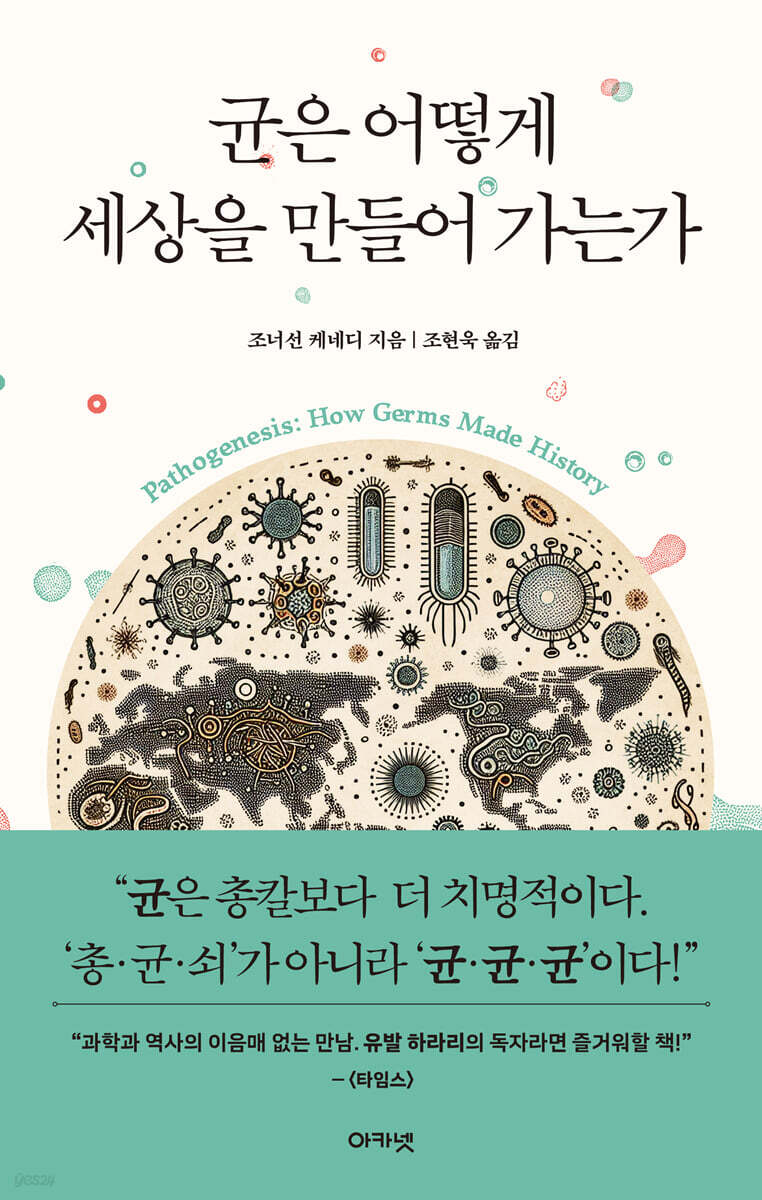
“Germs are more deadly than guns and swords.
“It’s not ‘Guns, Germs, and Steel,’ it’s ‘Guns, Germs, Germs!’”
A grand panorama of 50,000 years of history created by the world's most microscopic things.
We are merely guests invited into this world made of fungi.
"How Fungi Shape the World" is a book that explores the profound impact fungi have had on our lives by examining the history of mankind over approximately 50,000 years, from the era of Homo sapiens, the origin of modern humans, to the recent outbreak of COVID-19, based on the latest research in various fields such as genetics, biology, anthropology, archaeology, economics, and history.
Jonathan Kennedy, the author who is meeting Korean readers for the first time, teaches global public health at Queen Mary University of London, and this book has received much attention from the media and readers in the English-speaking world.
Despite this being the author's first book, his fluent writing and broad, deep perspective, which seamlessly bridge the scientific and humanistic realms, make a surprisingly vast body of material accessible and engaging, will captivate even readers familiar with the subject.
Kennedy, mindful of Jared Diamond, who identified guns, germs, and steel as the three factors that changed the fate of human society, emphasizes that among them, 'germs' are more lethal and powerful than guns and swords, and also than any great man.
“This book features many of Thomas Carlyle’s ‘great men,’ including Alexander the Great, Muhammad, Charlemagne, Martin Luther, and George Washington.
“But these ‘heroes’ did not change the course of history with their genius and strong character; rather, these qualities enabled them to take advantage of the opportunities already created by the deadly epidemic.” (p. 338)
“In terms of military technology, such as guns and iron, the Spanish actually had an advantage over the Native Americans.
However, (omitted) the guns of the conquerors, although they brought about a shocking effect, also had problems.
(Omitted) Primitive muskets took more than a minute to reload, and cannons were difficult to transport across rugged terrain.
(Omitted) Diamond argues that the Aztecs and Incas had never encountered languages before, and that this played a decisive role in the outcome of their invasions.
(Omitted) However, the importance of words should not be exaggerated.
The Spanish army had only a very small number of horses: 16 during Cortés' invasion and 68 during Pizarro's invasion.
(Omitted) So, if guns and steel aren't the reasons why the conquerors were able to conquer Central and South America so decisively, then what is the reason? The answer is simple.
“It’s fungus, fungus, fungus.” (pp. 183-185)
The British daily newspaper The Times said of “How Fungi Shape the World”: “A seamless meeting of science and history.
“A book that readers of Yuval Harari will enjoy,” said Louis Dartnell, author of “On Being Human,” and “It’s exciting and wonderful.”
“From Neolithic diseases to the recent COVID-19 pandemic, we explore the enormous role played by the most microscopic life forms on this planet,” he said in amazement.
The book also received favorable reviews, with the Sunday Times, Amazon, and Goodreads also selecting it as one of the best books of 2023.
Readers who enjoy books like Guns, Germs, and Steel, Sapiens, and Becoming Human will also not be able to ignore this book.
Meanwhile, the introduction of this book includes 32 carefully selected high-quality color illustrations not found in the original book, as an appetizer.
Each illustration is accompanied by a short but informative commentary, providing a useful guide to the broad scope of this book, which explores the powerful influence of fungi from prehistoric times to the present day.
“It’s not ‘Guns, Germs, and Steel,’ it’s ‘Guns, Germs, Germs!’”
A grand panorama of 50,000 years of history created by the world's most microscopic things.
We are merely guests invited into this world made of fungi.
"How Fungi Shape the World" is a book that explores the profound impact fungi have had on our lives by examining the history of mankind over approximately 50,000 years, from the era of Homo sapiens, the origin of modern humans, to the recent outbreak of COVID-19, based on the latest research in various fields such as genetics, biology, anthropology, archaeology, economics, and history.
Jonathan Kennedy, the author who is meeting Korean readers for the first time, teaches global public health at Queen Mary University of London, and this book has received much attention from the media and readers in the English-speaking world.
Despite this being the author's first book, his fluent writing and broad, deep perspective, which seamlessly bridge the scientific and humanistic realms, make a surprisingly vast body of material accessible and engaging, will captivate even readers familiar with the subject.
Kennedy, mindful of Jared Diamond, who identified guns, germs, and steel as the three factors that changed the fate of human society, emphasizes that among them, 'germs' are more lethal and powerful than guns and swords, and also than any great man.
“This book features many of Thomas Carlyle’s ‘great men,’ including Alexander the Great, Muhammad, Charlemagne, Martin Luther, and George Washington.
“But these ‘heroes’ did not change the course of history with their genius and strong character; rather, these qualities enabled them to take advantage of the opportunities already created by the deadly epidemic.” (p. 338)
“In terms of military technology, such as guns and iron, the Spanish actually had an advantage over the Native Americans.
However, (omitted) the guns of the conquerors, although they brought about a shocking effect, also had problems.
(Omitted) Primitive muskets took more than a minute to reload, and cannons were difficult to transport across rugged terrain.
(Omitted) Diamond argues that the Aztecs and Incas had never encountered languages before, and that this played a decisive role in the outcome of their invasions.
(Omitted) However, the importance of words should not be exaggerated.
The Spanish army had only a very small number of horses: 16 during Cortés' invasion and 68 during Pizarro's invasion.
(Omitted) So, if guns and steel aren't the reasons why the conquerors were able to conquer Central and South America so decisively, then what is the reason? The answer is simple.
“It’s fungus, fungus, fungus.” (pp. 183-185)
The British daily newspaper The Times said of “How Fungi Shape the World”: “A seamless meeting of science and history.
“A book that readers of Yuval Harari will enjoy,” said Louis Dartnell, author of “On Being Human,” and “It’s exciting and wonderful.”
“From Neolithic diseases to the recent COVID-19 pandemic, we explore the enormous role played by the most microscopic life forms on this planet,” he said in amazement.
The book also received favorable reviews, with the Sunday Times, Amazon, and Goodreads also selecting it as one of the best books of 2023.
Readers who enjoy books like Guns, Germs, and Steel, Sapiens, and Becoming Human will also not be able to ignore this book.
Meanwhile, the introduction of this book includes 32 carefully selected high-quality color illustrations not found in the original book, as an appetizer.
Each illustration is accompanied by a short but informative commentary, providing a useful guide to the broad scope of this book, which explores the powerful influence of fungi from prehistoric times to the present day.
- You can preview some of the book's contents.
Preview
index
Introduction: In the beginning there was a plague.
Chapter 1: The Paleolithic: Homo sapiens defeats Neanderthals
Chapter 2: The Neolithic: The Great Wave of Migration
Chapter 3: Antiquity: The Rise and Fall of Empires
Chapter 4: The Middle Ages: The Black Death Opens the Door to Modernity
Chapter 5: Colonialism: The Ultimate Weapon for Invasion
Chapter 6: The Age of Revolution: Changing the Map of War
Chapter 7: The Industrial Revolution: London, at the forefront of European sanitary engineering
Chapter 8: The Poverty Epidemic: Reducing Inequality is a Health Innovation
Conclusion For a healthier world
main
Acknowledgements
Translator's Note
Chapter 1: The Paleolithic: Homo sapiens defeats Neanderthals
Chapter 2: The Neolithic: The Great Wave of Migration
Chapter 3: Antiquity: The Rise and Fall of Empires
Chapter 4: The Middle Ages: The Black Death Opens the Door to Modernity
Chapter 5: Colonialism: The Ultimate Weapon for Invasion
Chapter 6: The Age of Revolution: Changing the Map of War
Chapter 7: The Industrial Revolution: London, at the forefront of European sanitary engineering
Chapter 8: The Poverty Epidemic: Reducing Inequality is a Health Innovation
Conclusion For a healthier world
main
Acknowledgements
Translator's Note
Into the book
But it is now abundantly clear that microbes are not simply agents of decay, death, and disease.
Over the past few decades, researchers have begun to realize that bacteria and viruses play a wide range of roles essential to the functioning of our planet, our bodies, and even our minds.
Human life, or any form of complex life, is unimaginable without microorganisms.
--- p.11
It is no exaggeration to say that bacteria made the Earth a place where complex life forms, including humans, can exist.
The Earth is a world of bacteria and we are just squatting there.
--- p.15
Not only did we evolve from bacteria, we also acquired essential parts of our genome from viruses.
It's now clear that our bodies, and even our brains, function the way they do thanks in large part to the contributions of microbes that evolved alongside our ancestors.
The discovery that gut microbes can influence our emotions and behavior in subtle but significant ways suggests that humans may not have complete control over their own minds.
--- p.24
Homo sapiens finally developed immunity to Neanderthal diseases between 50,000 and 40,000 years ago, allowing them to migrate out of Africa and north to the Neanderthal regions without contracting serious diseases.
The curse that had made the eastern Mediterranean uninhabitable for tens of thousands of years has been lifted.
As our ancestors migrated deep into Eurasia, they encountered communities of Neanderthals and Denisovans who had never been exposed to African pathogens and had no opportunity to develop resistance.
Within a relatively short period of time, all other human species became extinct, leaving only the newly emerged Homo sapiens to survive.
Our world will never be the same again.
Earth no longer resembled Middle-earth, once inhabited by various human species, and became a planet dominated by Homo sapiens, the species we live on today.
--- p.57
Prehistoric times were marked by waves of large-scale migrations, with new populations moving into an area and almost completely wiping out the previous inhabitants.
Almost always, immigrants unknowingly helped to create an invisible weapon of mass destruction: infectious diseases.
This is because they had some degree of immunity, but the existing local population had little or no resistance.
In addition to new pathogens, Neolithic migrants brought new genes, new languages, and new ideas like agriculture and metallurgy.
In this way, epidemics that occurred thousands of years ago played a significant role in shaping the world we live in today.
--- p.64
Thucydides argues that the plague in Athens had a significant impact on the outcome of the Peloponnesian War.
He comments on the outbreak:
“Nothing has ever done so much damage to the Athenians or so weakened their resolve for war.”
--- p.99
Although endemic diseases killed countless Romans, they also had the surprising advantage of providing a protective shield around the imperial capital against diarrhea and malaria.
Any Roman who survived to adulthood would have developed immunity, but outsiders, including the city's conquerors, were at high risk of illness and death if they stayed too long.
Malaria had been a deterrent to attacks on the empire's capital since the late 3rd century BC, when Hannibal arduously crossed the Alps with an army of 60,000 men, 12,000 horses, and 37 war elephants.
The Carthaginian army defeated the Romans on several occasions.
What stopped the invasion and saved Rome was malaria, which killed Hannibal's wife, son, and many soldiers.
--- p.109
The Roman Empire barely survived the Plague of Cyprian and the Crisis of the Third Century, but the damage was severe.
Rome had been in a state of crisis for a long time, and its national power had weakened.
But the plague's most lasting impact was not political but religious.
The plague transformed a small, obscure Jewish sect on the outskirts of the empire into a major religion today, with 2.3 billion adherents, making up nearly a third of the world's population.
--- p.116
How can we explain Christianity's sudden transformation from a fringe Jewish sect to a popular religion? American sociologist Rodney Stark argues that epidemics are a crucial part of this story.
The Christian faith grew rapidly in the 2nd and 3rd centuries when deadly plagues ravaged the Roman Empire, because it offered a more appealing and certain guide to life and death than polytheism.
--- p.118
When the Catholic Church failed to respond effectively to the trauma of the plague, people began to consider other means of salvation.
Although there had been challenges to the authority and teachings of the Catholic Church before, such ideas did not gain widespread support until the Black Death.
John Wycliffe, an Oxford University priest and theologian born in the 1320s, was at the forefront of the rebellion against religious orthodoxy and church corruption in the late 14th century.
He targeted parish priests who had no time to preach the Gospel and comfort the poor, and the Pope who claimed to be God's representative on earth.
--- p.160~161
As Europeans began to settle in the Caribbean, it was only a matter of time before viruses and bacteria that had evolved in the Old World following the Neolithic Revolution crossed the Atlantic.
Because the Taino had never been exposed to these pathogens in the past, they did not develop resistance.
They became extinct because of the waves of infectious diseases they encountered for the first time.
--- p.187
The Pilgrims led a wave of Puritan immigration from 'Old' England to 'New' England.
Over the next two decades, countless people fled the religious persecution of Charles I, and 21,000 of them settled in North America.
The settlers benefited from another smallpox outbreak in 1630, which they almost certainly introduced.
The disease halved the remaining Native American population in Massachusetts.
--- p.204
On New Year's Day 1804, the rebels proclaimed the birth of a new nation called Haiti.
The name comes from the Taino word for the island of Hispaniola.
The French defeat by Haitian rebels and the island's mosquitoes contributed significantly to the formation of the modern world as it is today.
--- p.258
So what should we do? The best way for humanity to survive the threat of pathogens as a species is to cooperate with one another.
Contrary to William McNeill's claim, the dramatic improvements in health in high-income countries in the 19th and 20th centuries were not due to advances in medicine.
It wasn't even a result of economic growth itself.
Rather, it was the result of political decisions to invest heavily in water, sanitation, housing, and poverty reduction.
Over the past few decades, researchers have begun to realize that bacteria and viruses play a wide range of roles essential to the functioning of our planet, our bodies, and even our minds.
Human life, or any form of complex life, is unimaginable without microorganisms.
--- p.11
It is no exaggeration to say that bacteria made the Earth a place where complex life forms, including humans, can exist.
The Earth is a world of bacteria and we are just squatting there.
--- p.15
Not only did we evolve from bacteria, we also acquired essential parts of our genome from viruses.
It's now clear that our bodies, and even our brains, function the way they do thanks in large part to the contributions of microbes that evolved alongside our ancestors.
The discovery that gut microbes can influence our emotions and behavior in subtle but significant ways suggests that humans may not have complete control over their own minds.
--- p.24
Homo sapiens finally developed immunity to Neanderthal diseases between 50,000 and 40,000 years ago, allowing them to migrate out of Africa and north to the Neanderthal regions without contracting serious diseases.
The curse that had made the eastern Mediterranean uninhabitable for tens of thousands of years has been lifted.
As our ancestors migrated deep into Eurasia, they encountered communities of Neanderthals and Denisovans who had never been exposed to African pathogens and had no opportunity to develop resistance.
Within a relatively short period of time, all other human species became extinct, leaving only the newly emerged Homo sapiens to survive.
Our world will never be the same again.
Earth no longer resembled Middle-earth, once inhabited by various human species, and became a planet dominated by Homo sapiens, the species we live on today.
--- p.57
Prehistoric times were marked by waves of large-scale migrations, with new populations moving into an area and almost completely wiping out the previous inhabitants.
Almost always, immigrants unknowingly helped to create an invisible weapon of mass destruction: infectious diseases.
This is because they had some degree of immunity, but the existing local population had little or no resistance.
In addition to new pathogens, Neolithic migrants brought new genes, new languages, and new ideas like agriculture and metallurgy.
In this way, epidemics that occurred thousands of years ago played a significant role in shaping the world we live in today.
--- p.64
Thucydides argues that the plague in Athens had a significant impact on the outcome of the Peloponnesian War.
He comments on the outbreak:
“Nothing has ever done so much damage to the Athenians or so weakened their resolve for war.”
--- p.99
Although endemic diseases killed countless Romans, they also had the surprising advantage of providing a protective shield around the imperial capital against diarrhea and malaria.
Any Roman who survived to adulthood would have developed immunity, but outsiders, including the city's conquerors, were at high risk of illness and death if they stayed too long.
Malaria had been a deterrent to attacks on the empire's capital since the late 3rd century BC, when Hannibal arduously crossed the Alps with an army of 60,000 men, 12,000 horses, and 37 war elephants.
The Carthaginian army defeated the Romans on several occasions.
What stopped the invasion and saved Rome was malaria, which killed Hannibal's wife, son, and many soldiers.
--- p.109
The Roman Empire barely survived the Plague of Cyprian and the Crisis of the Third Century, but the damage was severe.
Rome had been in a state of crisis for a long time, and its national power had weakened.
But the plague's most lasting impact was not political but religious.
The plague transformed a small, obscure Jewish sect on the outskirts of the empire into a major religion today, with 2.3 billion adherents, making up nearly a third of the world's population.
--- p.116
How can we explain Christianity's sudden transformation from a fringe Jewish sect to a popular religion? American sociologist Rodney Stark argues that epidemics are a crucial part of this story.
The Christian faith grew rapidly in the 2nd and 3rd centuries when deadly plagues ravaged the Roman Empire, because it offered a more appealing and certain guide to life and death than polytheism.
--- p.118
When the Catholic Church failed to respond effectively to the trauma of the plague, people began to consider other means of salvation.
Although there had been challenges to the authority and teachings of the Catholic Church before, such ideas did not gain widespread support until the Black Death.
John Wycliffe, an Oxford University priest and theologian born in the 1320s, was at the forefront of the rebellion against religious orthodoxy and church corruption in the late 14th century.
He targeted parish priests who had no time to preach the Gospel and comfort the poor, and the Pope who claimed to be God's representative on earth.
--- p.160~161
As Europeans began to settle in the Caribbean, it was only a matter of time before viruses and bacteria that had evolved in the Old World following the Neolithic Revolution crossed the Atlantic.
Because the Taino had never been exposed to these pathogens in the past, they did not develop resistance.
They became extinct because of the waves of infectious diseases they encountered for the first time.
--- p.187
The Pilgrims led a wave of Puritan immigration from 'Old' England to 'New' England.
Over the next two decades, countless people fled the religious persecution of Charles I, and 21,000 of them settled in North America.
The settlers benefited from another smallpox outbreak in 1630, which they almost certainly introduced.
The disease halved the remaining Native American population in Massachusetts.
--- p.204
On New Year's Day 1804, the rebels proclaimed the birth of a new nation called Haiti.
The name comes from the Taino word for the island of Hispaniola.
The French defeat by Haitian rebels and the island's mosquitoes contributed significantly to the formation of the modern world as it is today.
--- p.258
So what should we do? The best way for humanity to survive the threat of pathogens as a species is to cooperate with one another.
Contrary to William McNeill's claim, the dramatic improvements in health in high-income countries in the 19th and 20th centuries were not due to advances in medicine.
It wasn't even a result of economic growth itself.
Rather, it was the result of political decisions to invest heavily in water, sanitation, housing, and poverty reduction.
--- p.344
Publisher's Review
Rewriting the Human Narrative from the Perspective of Fungi
The world of microorganisms, first discovered in the 17th century by the Dutch textile merchant and scientist Antoni van Leeuwenhoek, was as transformative to our understanding of humanity and nature as Copernicus's heliocentric theory, Darwin's theory of evolution, and Freud's discovery of the unconscious.
Many later researchers realized that this world of tiny beings, invisible to the naked eye, was not only “the agents of disease, decay, and death,” but that without them “human life, or indeed any form of complex life, would be inconceivable.”
Indeed, countless bacteria and viruses have claimed countless lives and weakened numerous civilizations throughout history, but in their ruins, they have also created opportunities for new worlds to emerge and thrive.
The author unfolds this story in detail over eight chapters.
First, the author examines how our Earth became a planet dominated by Homo sapiens.
In the early days of human evolution, many different species of humans lived together on this land, much like Tolkien's Middle-earth.
These include Homo sapiens, the same species as us humans today; Neanderthals, who were stronger and had larger brains than Homo sapiens; Denisovans, who had genes that allowed them to live comfortably at high altitudes; Homo floresiensis, who were a little over a meter tall and had disproportionately long feet; and Homo lucensis, who were short and had curved fingers and toes.
However, around 40,000 to 50,000 years ago, Homo sapiens left Africa and rapidly spread across the globe, causing other human species to disappear from the face of the Earth.
Many scholars, including Yuval Harari, say that this is because Homo sapiens experienced a 'cognitive revolution' between 70,000 and 30,000 BC, which brought about changes in the way they thought and acted.
However, the author presents evidence to refute such claims that Homo sapiens possess superior intelligence to other human species.
And it focuses on the pathogens that Homo sapiens encounter when interacting with other human species.
Homo sapiens, who lived in Africa for millions of years, acquired a strong immune system through their long journey, while Neanderthals in Europe were vulnerable to the pathogens they brought with them.
The author argues that epidemics also played a decisive role in the collapse of the Aztec and Inca empires in South America, which boasted vast and sophisticated civilizations.
Since Columbus set out on his transatlantic voyage in 1492, it was only a matter of time before the various viruses and bacteria that had evolved in Europe would surge toward South America.
The indigenous people of South America had never been exposed to European pathogens and thus did not develop resistance.
In 1545, a plague called cocoliztli struck the Aztecs, killing 80 percent of the local population, and in 1524, a smallpox epidemic struck the Incas, severely weakening their empire.
The European conquest of the New World was made possible by such devastating epidemics.
This conquest narrative recurred in subsequent centuries in the Americas, Pacific islands, Australia, and elsewhere.
The author says that infectious diseases were also behind the unintentional path of slavery across the entire tropical region of the American continent.
The Aedes aegypti mosquito, which carries the yellow fever virus, arrived in the Caribbean on slave ships from West Africa.
For these mosquitoes, the sugarcane plantations of the Caribbean provided ideal breeding conditions.
The Caribbean became a new graveyard for white people thanks to the pathogens carried by these mosquitoes.
Those born and raised in West Africa were exposed to the disease and developed lifelong immunity, while those who arrived from Europe and settled there did not develop immunity and died en masse.
Ultimately, African slave labor became a rational choice for plantation owners.
The core point of this book is that bacteria have always played a decisive role in major turning points in history.
This makes us realize how insignificant and powerless human beings are in this vast universe.
Yet, despite overwhelming evidence, humans still cling to the illusion that we dominate nature.
In this regard, the author suggests an alternative perspective on the world, saying that humans are merely guests invited to this world made up of microscopic things.
Humans are much less important than we thought, and microbes have played a much more important role in our lives.
To this end, the author develops his argument by taking a comprehensive approach to various fields of study and supporting it with concrete evidence.
It is so good that it could be used as a textbook in this field.
This point can be said to be a major difference from other popular books that focus on stories.
The world of microorganisms, first discovered in the 17th century by the Dutch textile merchant and scientist Antoni van Leeuwenhoek, was as transformative to our understanding of humanity and nature as Copernicus's heliocentric theory, Darwin's theory of evolution, and Freud's discovery of the unconscious.
Many later researchers realized that this world of tiny beings, invisible to the naked eye, was not only “the agents of disease, decay, and death,” but that without them “human life, or indeed any form of complex life, would be inconceivable.”
Indeed, countless bacteria and viruses have claimed countless lives and weakened numerous civilizations throughout history, but in their ruins, they have also created opportunities for new worlds to emerge and thrive.
The author unfolds this story in detail over eight chapters.
First, the author examines how our Earth became a planet dominated by Homo sapiens.
In the early days of human evolution, many different species of humans lived together on this land, much like Tolkien's Middle-earth.
These include Homo sapiens, the same species as us humans today; Neanderthals, who were stronger and had larger brains than Homo sapiens; Denisovans, who had genes that allowed them to live comfortably at high altitudes; Homo floresiensis, who were a little over a meter tall and had disproportionately long feet; and Homo lucensis, who were short and had curved fingers and toes.
However, around 40,000 to 50,000 years ago, Homo sapiens left Africa and rapidly spread across the globe, causing other human species to disappear from the face of the Earth.
Many scholars, including Yuval Harari, say that this is because Homo sapiens experienced a 'cognitive revolution' between 70,000 and 30,000 BC, which brought about changes in the way they thought and acted.
However, the author presents evidence to refute such claims that Homo sapiens possess superior intelligence to other human species.
And it focuses on the pathogens that Homo sapiens encounter when interacting with other human species.
Homo sapiens, who lived in Africa for millions of years, acquired a strong immune system through their long journey, while Neanderthals in Europe were vulnerable to the pathogens they brought with them.
The author argues that epidemics also played a decisive role in the collapse of the Aztec and Inca empires in South America, which boasted vast and sophisticated civilizations.
Since Columbus set out on his transatlantic voyage in 1492, it was only a matter of time before the various viruses and bacteria that had evolved in Europe would surge toward South America.
The indigenous people of South America had never been exposed to European pathogens and thus did not develop resistance.
In 1545, a plague called cocoliztli struck the Aztecs, killing 80 percent of the local population, and in 1524, a smallpox epidemic struck the Incas, severely weakening their empire.
The European conquest of the New World was made possible by such devastating epidemics.
This conquest narrative recurred in subsequent centuries in the Americas, Pacific islands, Australia, and elsewhere.
The author says that infectious diseases were also behind the unintentional path of slavery across the entire tropical region of the American continent.
The Aedes aegypti mosquito, which carries the yellow fever virus, arrived in the Caribbean on slave ships from West Africa.
For these mosquitoes, the sugarcane plantations of the Caribbean provided ideal breeding conditions.
The Caribbean became a new graveyard for white people thanks to the pathogens carried by these mosquitoes.
Those born and raised in West Africa were exposed to the disease and developed lifelong immunity, while those who arrived from Europe and settled there did not develop immunity and died en masse.
Ultimately, African slave labor became a rational choice for plantation owners.
The core point of this book is that bacteria have always played a decisive role in major turning points in history.
This makes us realize how insignificant and powerless human beings are in this vast universe.
Yet, despite overwhelming evidence, humans still cling to the illusion that we dominate nature.
In this regard, the author suggests an alternative perspective on the world, saying that humans are merely guests invited to this world made up of microscopic things.
Humans are much less important than we thought, and microbes have played a much more important role in our lives.
To this end, the author develops his argument by taking a comprehensive approach to various fields of study and supporting it with concrete evidence.
It is so good that it could be used as a textbook in this field.
This point can be said to be a major difference from other popular books that focus on stories.
GOODS SPECIFICS
- Date of issue: April 25, 2025
- Page count, weight, size: 408 pages | 604g | 140*220*30mm
- ISBN13: 9788957339787
- ISBN10: 8957339787
You may also like
카테고리
korean


korean

![GQ KOREA Mark (Monthly): December [2025]](http://librairie.coreenne.fr/cdn/shop/files/8ef265dbbfbf186523ed75ba7319009d.jpg?v=1765340328&width=3840)


