

Everything creates good
 |
Description
Book Introduction
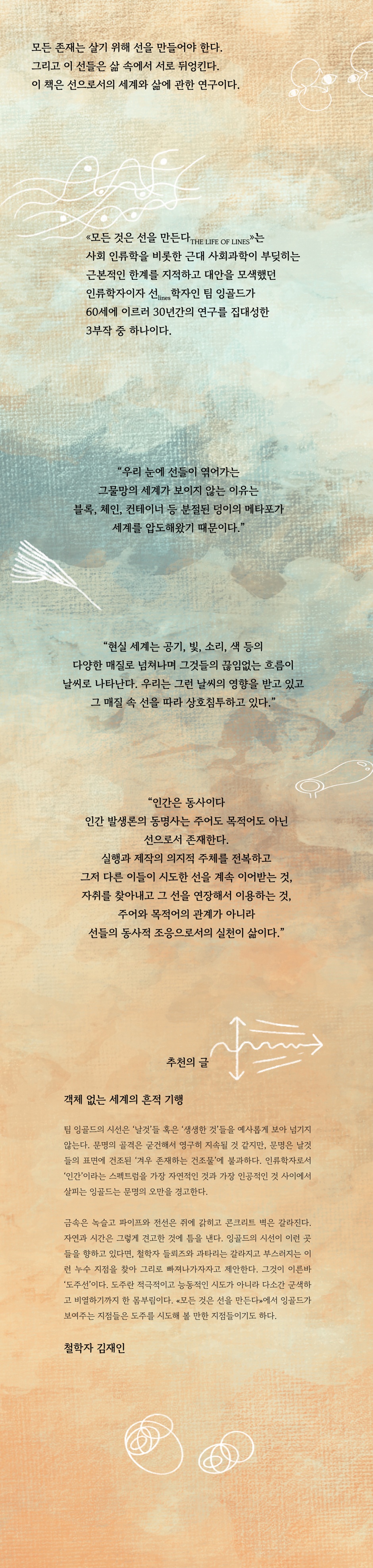
All beings must create good in order to live.
And these lines are intertwined in life.
This book is a study of the world and life as a line.
Tim Ingold uses lines to talk about life, land, wind, walking, imagination, and what it means to be human.
This book, which resembles a wanderer's walk, brings our thoughts about the material world back to life through its traces and lines.
Based on anthropology, it connects and encompasses various academic fields such as philosophy, geography, sociology, art, and architecture, and creates and unravels knots.
And these lines are intertwined in life.
This book is a study of the world and life as a line.
Tim Ingold uses lines to talk about life, land, wind, walking, imagination, and what it means to be human.
This book, which resembles a wanderer's walk, brings our thoughts about the material world back to life through its traces and lines.
Based on anthropology, it connects and encompasses various academic fields such as philosophy, geography, sociology, art, and architecture, and creates and unravels knots.
- You can preview some of the book's contents.
Preview
index
introduction
Part 1: Tying Knots
1.
Lines and lumps
2.
Octopus and sea anemone
3.
A world without objects
4.
Matter, gesture, sense, emotion
5.
About knots and seams
6.
wall
7.
Mountains and skyscrapers
8.
surface
9.
surface
10.
knowledge
Part 2: Soaking in the Weather
11.
whirlwind
12.
Footprints along the road
13.
Wind-walking
14.
Weather-World
15.
atmosphere; atmosphere
16.
Puffing up in a smooth space
17.
Wrapping
18.
Under the sky
19.
View with sunlight
20.
Lines and colors
21.
Line and Sound
Part 3: Being Human
22.
Being human is a verb
23.
Human development
24.
To do, to experience
25.
Mazes and Labyrinths
26.
Education and Attention
27.
Obedience leads and skill follows.
28.
One life
29.
Sai-an
30.
Harmony of lines
Translator's Note
References
Search
Part 1: Tying Knots
1.
Lines and lumps
2.
Octopus and sea anemone
3.
A world without objects
4.
Matter, gesture, sense, emotion
5.
About knots and seams
6.
wall
7.
Mountains and skyscrapers
8.
surface
9.
surface
10.
knowledge
Part 2: Soaking in the Weather
11.
whirlwind
12.
Footprints along the road
13.
Wind-walking
14.
Weather-World
15.
atmosphere; atmosphere
16.
Puffing up in a smooth space
17.
Wrapping
18.
Under the sky
19.
View with sunlight
20.
Lines and colors
21.
Line and Sound
Part 3: Being Human
22.
Being human is a verb
23.
Human development
24.
To do, to experience
25.
Mazes and Labyrinths
26.
Education and Attention
27.
Obedience leads and skill follows.
28.
One life
29.
Sai-an
30.
Harmony of lines
Translator's Note
References
Search
Detailed image
Into the book
Good gives us life.
Life began when the line emerged and broke free from the monopoly of the mass.
If the lump demonstrates the principle of territorialization, the line demonstrates the opposite principle of deterritorialization.
--- p.18
“You may think you are complete, but that is a big mistake.
Because think about where the materials that make you up – the concrete, the steel, the glass – come from.
And do you really think such materials will last forever in their current form? They came from the earth, and they will eventually return to the earth.
I yield them to you, but only if I am patient.
Because they still exist as my flesh, my substance.
So I stand in your skeleton.”
--- p.70
As beings are exposed to the weather, they draw inspiration, strength, and resilience from the medium to continue along their path.
Weathering can highlight the tactile or texture of beings and bind them together in empathy.
In it, the whirlwind of nature's various forces transforms into a weaving of lines, and the storm creates time.
--- p.139
Merleau-Ponty continues by saying that the moment their division is concluded, “I return to myself.”
We discover, to our surprise, that the twinkling stars are our own eyes, that we not only see the stars, but also see with them.
What Van Gogh painted was not the panorama of the sky as a whole, as is often shown in planetariums.
His paintings cannot be said to be reproductions of what the artist saw.
Rather, it is a performance of the birth of vision in lines and colors that seems to explode like a baptism of fireworks as it opens into space.
--- p.182
This is what makes life unique.
At no point can the process reach its final conclusion, for at every moment man must resolve not what he is, but what he is becoming.
Achievement is always postponed and always 'not yet'.
Wherever and however we live, humans are always becoming more human, and as we progress, we create ourselves.
--- p.266
In this process, there are only those who desire it.
This being is shaped by experience, and his agency has not yet separated from action.
And his life with the typist is lived more in a labyrinth than a maze, more deliberately than attentively.
This is an immanent life lived as a flow in the middle, within a space where there is only a verb, without subject, object, or subject-object hybrid.
Wherever we find humans, humans are being human.
Life began when the line emerged and broke free from the monopoly of the mass.
If the lump demonstrates the principle of territorialization, the line demonstrates the opposite principle of deterritorialization.
--- p.18
“You may think you are complete, but that is a big mistake.
Because think about where the materials that make you up – the concrete, the steel, the glass – come from.
And do you really think such materials will last forever in their current form? They came from the earth, and they will eventually return to the earth.
I yield them to you, but only if I am patient.
Because they still exist as my flesh, my substance.
So I stand in your skeleton.”
--- p.70
As beings are exposed to the weather, they draw inspiration, strength, and resilience from the medium to continue along their path.
Weathering can highlight the tactile or texture of beings and bind them together in empathy.
In it, the whirlwind of nature's various forces transforms into a weaving of lines, and the storm creates time.
--- p.139
Merleau-Ponty continues by saying that the moment their division is concluded, “I return to myself.”
We discover, to our surprise, that the twinkling stars are our own eyes, that we not only see the stars, but also see with them.
What Van Gogh painted was not the panorama of the sky as a whole, as is often shown in planetariums.
His paintings cannot be said to be reproductions of what the artist saw.
Rather, it is a performance of the birth of vision in lines and colors that seems to explode like a baptism of fireworks as it opens into space.
--- p.182
This is what makes life unique.
At no point can the process reach its final conclusion, for at every moment man must resolve not what he is, but what he is becoming.
Achievement is always postponed and always 'not yet'.
Wherever and however we live, humans are always becoming more human, and as we progress, we create ourselves.
--- p.266
In this process, there are only those who desire it.
This being is shaped by experience, and his agency has not yet separated from action.
And his life with the typist is lived more in a labyrinth than a maze, more deliberately than attentively.
This is an immanent life lived as a flow in the middle, within a space where there is only a verb, without subject, object, or subject-object hybrid.
Wherever we find humans, humans are being human.
--- p.288
Publisher's Review
"Everything Makes Good" is one of three works by anthropologist Tim Ingold, who, at the age of 60, compiled 30 years of research to point out the fundamental limitations of modern social science, including social anthropology, and to seek alternatives.
When viewed as lumps, blocks, chains, and containers, the inexplicable and the unrevealed are read through lines and knots, and walls, mountains, skyscrapers, the ground… … speak of existence and life.
Furthermore, by unraveling the weather and atmosphere surrounding us in lines, it brings about the sensation of air, light, and sound as a medium.
And finally, we ask about the meaning of human being from the perspective of good, and discuss human being as a verb, life and education as good.
This book, which resembles a wanderer's walk, discusses the ontology of Earth's inhabitants through a methodological fusion of anthropology, ecology, architecture, meteorology, aesthetics, and sociology.
Lines and knots
When we think in terms of lines and knots, there are things that can be seen and explained.
The author reexamines the definition and categories of scholarship.
Ecology has been defined as the study of organisms and their environments, and within it, organisms are assumed to be lumps enclosed in shells and skin.
But you can't live on lumps alone.
In reality, life is a combination of mass and line, and there must be a line, and that line must meet another line for life to begin.
The author criticizes the concept of society as modeled after a superorganism such as a colony, and argues that sociology, like ecology, which is based on the principle of the mass, cannot reveal the true meaning of the relationships between living beings, and that from the perspective of good, social life is a life activity that energizes one another.
According to him, the reason we cannot see the world of meshwork with lines is because the metaphor of segmented masses such as blocks, chains, and containers has dominated the world.
Things that end in disconnection and fragmentation have no memory.
When an individual chain link is released, it does not remember where or how it was hung, but when a line is released from a knot, it remembers the shape of the knot.
The lines leave behind the memories of past connections in the form of shapes, and from that state, they promise to be even newer in the future.
A line that advances by repeatedly intertwining and unraveling with other lines.
That's how we connect and relate.
And this relationship is not fixed or unchanging, but rather it is entangled and unraveled repeatedly, leaving traces of life.
The good deeds of goodness, which remember everything and leave traces, encompass the invisible and immaterial.
A life that is not a straight line with a starting point and an ending point, but a life that uses the senses to find threads and traces.
Like a wanderer's walk, the author walks through walls, mountains and skyscrapers.
surface.
Walking through knowledge, reading lines and knots, connecting and weaving anthropology, architecture, philosophy, and psychology.
weather, atmosphere, light, sound, color
Just as defining organisms as lumps fails to elucidate the activity of life, ecology loses its dynamism when viewed as a mess of solids scattered on a baseboard called the environment.
The real world is filled with various media such as air, light, sound, and color, and their constant flow is expressed as weather.
We are influenced by that weather and we are interpenetrating along the lines in that medium.
But we have removed weather from our world perception.
According to the author, a world without weather is the result of the evangelization that took place in modern Europe.
Our experience of pre-modern weather has integrated the medium of air and our emotions as we live within it.
However, with the establishment of meteorology, the atmosphere was treated as oxygen and nitrogen gases excluding emotions, and the atmosphere of aesthetics showed only the sensory experience of ether, not air, and only sensibility placed in a vacuum.
Just as the movement of a fish indicates that it is in the sea, our movement indicates that it is in the air.
The breath of movement reveals that air is created and flows, and the world of weather creates lines along the path of the senses, inducing the mental engagement of the body.
Above all, the knots and nets that this line weaves create empathy.
It is like an archaeologist feeling the touch of stone in his hand when he strokes a stone monument, or like the Tulingit people of the Northwest Pacific coast thinking they can hear a glacier.
It is not because the glacier has ears, but because it believes that its own sound line resonates in the air filled with the thunderous cracking of ice and the blinding white light.
The experience of empathy, completely surrounded by air, light, and sound, is perhaps the atmosphere that modernity has erased.
As a fusion and division of the cosmic and the emotional, the atmospheric weather world is a living field where lines are created through visual, auditory, and tactile perception.
Ingold brings the weather-world into the realm of our perception through Gibson's perceptual psychology and Merleau-Ponty's phenomenology.
Light and sound, such as the air as a medium, and Van Gogh's paintings that attempted to capture the visual consciousness of myself leaving the starry night sky and merging with the universe.
It brings back a new sense of color.
human as a verb
So then, what is a human being from the perspective of good?
The author brings in the anthropology of Spanish philosopher Jose Ortega and says that the grammatical form of human life is the gerund.
This means that human existence is not given a priori, but is productively achieved.
Appealing to the human spirit for humanity is like placing an unattainable end at the origin.
Ingold says that the gerund in human development exists as a good that is neither subject nor object.
The grammatical form of good is a verb.
From this perspective, humans grow not as active, volitional subjects, but through passive, experiential acts.
He overturns the modern European view of humanity that advocates the superiority of activity over passivity and speaks of the humanization of obedience.
We know that in a world where the lines of various existences intertwine, life does not proceed as intended.
Nevertheless, the modern subject myth has been isolating humans themselves and otherizing them as if conquering the world of diverse beings.
The author says that life is about overturning the willful subject of execution and production and simply continuing the line attempted by others, finding traces and extending and utilizing that line.
It is not a relationship between subject and object, but a practice as a verbal correspondence of lines.
Ingold approaches education through various binary comparisons and contrasts, such as intention and attention, labyrinth and labyrinth, doing and experiencing, making and growing, between and between-in.
According to him, education is not about instilling knowledge about the world represented by the modern subject, but rather about drawing existence out of the world of representation and releasing its lines into the world of empathy in the atmosphere.
It is said that education is about finding oneself in wandering, responding to other lines in the journey of endless interweaving and unraveling of lines, wandering over the trajectory of life as if it were a web.
When viewed as lumps, blocks, chains, and containers, the inexplicable and the unrevealed are read through lines and knots, and walls, mountains, skyscrapers, the ground… … speak of existence and life.
Furthermore, by unraveling the weather and atmosphere surrounding us in lines, it brings about the sensation of air, light, and sound as a medium.
And finally, we ask about the meaning of human being from the perspective of good, and discuss human being as a verb, life and education as good.
This book, which resembles a wanderer's walk, discusses the ontology of Earth's inhabitants through a methodological fusion of anthropology, ecology, architecture, meteorology, aesthetics, and sociology.
Lines and knots
When we think in terms of lines and knots, there are things that can be seen and explained.
The author reexamines the definition and categories of scholarship.
Ecology has been defined as the study of organisms and their environments, and within it, organisms are assumed to be lumps enclosed in shells and skin.
But you can't live on lumps alone.
In reality, life is a combination of mass and line, and there must be a line, and that line must meet another line for life to begin.
The author criticizes the concept of society as modeled after a superorganism such as a colony, and argues that sociology, like ecology, which is based on the principle of the mass, cannot reveal the true meaning of the relationships between living beings, and that from the perspective of good, social life is a life activity that energizes one another.
According to him, the reason we cannot see the world of meshwork with lines is because the metaphor of segmented masses such as blocks, chains, and containers has dominated the world.
Things that end in disconnection and fragmentation have no memory.
When an individual chain link is released, it does not remember where or how it was hung, but when a line is released from a knot, it remembers the shape of the knot.
The lines leave behind the memories of past connections in the form of shapes, and from that state, they promise to be even newer in the future.
A line that advances by repeatedly intertwining and unraveling with other lines.
That's how we connect and relate.
And this relationship is not fixed or unchanging, but rather it is entangled and unraveled repeatedly, leaving traces of life.
The good deeds of goodness, which remember everything and leave traces, encompass the invisible and immaterial.
A life that is not a straight line with a starting point and an ending point, but a life that uses the senses to find threads and traces.
Like a wanderer's walk, the author walks through walls, mountains and skyscrapers.
surface.
Walking through knowledge, reading lines and knots, connecting and weaving anthropology, architecture, philosophy, and psychology.
weather, atmosphere, light, sound, color
Just as defining organisms as lumps fails to elucidate the activity of life, ecology loses its dynamism when viewed as a mess of solids scattered on a baseboard called the environment.
The real world is filled with various media such as air, light, sound, and color, and their constant flow is expressed as weather.
We are influenced by that weather and we are interpenetrating along the lines in that medium.
But we have removed weather from our world perception.
According to the author, a world without weather is the result of the evangelization that took place in modern Europe.
Our experience of pre-modern weather has integrated the medium of air and our emotions as we live within it.
However, with the establishment of meteorology, the atmosphere was treated as oxygen and nitrogen gases excluding emotions, and the atmosphere of aesthetics showed only the sensory experience of ether, not air, and only sensibility placed in a vacuum.
Just as the movement of a fish indicates that it is in the sea, our movement indicates that it is in the air.
The breath of movement reveals that air is created and flows, and the world of weather creates lines along the path of the senses, inducing the mental engagement of the body.
Above all, the knots and nets that this line weaves create empathy.
It is like an archaeologist feeling the touch of stone in his hand when he strokes a stone monument, or like the Tulingit people of the Northwest Pacific coast thinking they can hear a glacier.
It is not because the glacier has ears, but because it believes that its own sound line resonates in the air filled with the thunderous cracking of ice and the blinding white light.
The experience of empathy, completely surrounded by air, light, and sound, is perhaps the atmosphere that modernity has erased.
As a fusion and division of the cosmic and the emotional, the atmospheric weather world is a living field where lines are created through visual, auditory, and tactile perception.
Ingold brings the weather-world into the realm of our perception through Gibson's perceptual psychology and Merleau-Ponty's phenomenology.
Light and sound, such as the air as a medium, and Van Gogh's paintings that attempted to capture the visual consciousness of myself leaving the starry night sky and merging with the universe.
It brings back a new sense of color.
human as a verb
So then, what is a human being from the perspective of good?
The author brings in the anthropology of Spanish philosopher Jose Ortega and says that the grammatical form of human life is the gerund.
This means that human existence is not given a priori, but is productively achieved.
Appealing to the human spirit for humanity is like placing an unattainable end at the origin.
Ingold says that the gerund in human development exists as a good that is neither subject nor object.
The grammatical form of good is a verb.
From this perspective, humans grow not as active, volitional subjects, but through passive, experiential acts.
He overturns the modern European view of humanity that advocates the superiority of activity over passivity and speaks of the humanization of obedience.
We know that in a world where the lines of various existences intertwine, life does not proceed as intended.
Nevertheless, the modern subject myth has been isolating humans themselves and otherizing them as if conquering the world of diverse beings.
The author says that life is about overturning the willful subject of execution and production and simply continuing the line attempted by others, finding traces and extending and utilizing that line.
It is not a relationship between subject and object, but a practice as a verbal correspondence of lines.
Ingold approaches education through various binary comparisons and contrasts, such as intention and attention, labyrinth and labyrinth, doing and experiencing, making and growing, between and between-in.
According to him, education is not about instilling knowledge about the world represented by the modern subject, but rather about drawing existence out of the world of representation and releasing its lines into the world of empathy in the atmosphere.
It is said that education is about finding oneself in wandering, responding to other lines in the journey of endless interweaving and unraveling of lines, wandering over the trajectory of life as if it were a web.
GOODS SPECIFICS
- Date of issue: February 27, 2024
- Page count, weight, size: 348 pages | 446g | 140*210*21mm
- ISBN13: 9791197164460
- ISBN10: 1197164464
You may also like
카테고리
korean


korean

![ELLE 엘르 스페셜 에디션 A형 : 12월 [2025]](http://librairie.coreenne.fr/cdn/shop/files/b8e27a3de6c9538896439686c6b0e8fb.jpg?v=1766436872&width=3840)


