

Southeast Asian History Through Cities
 |
Description
Book Introduction
- A word from MD
- We think of Southeast Asia primarily as a vacation destination.
Relatively little attention is paid to the history of this region.
It is true that easily accessible books on Southeast Asian history are rare.
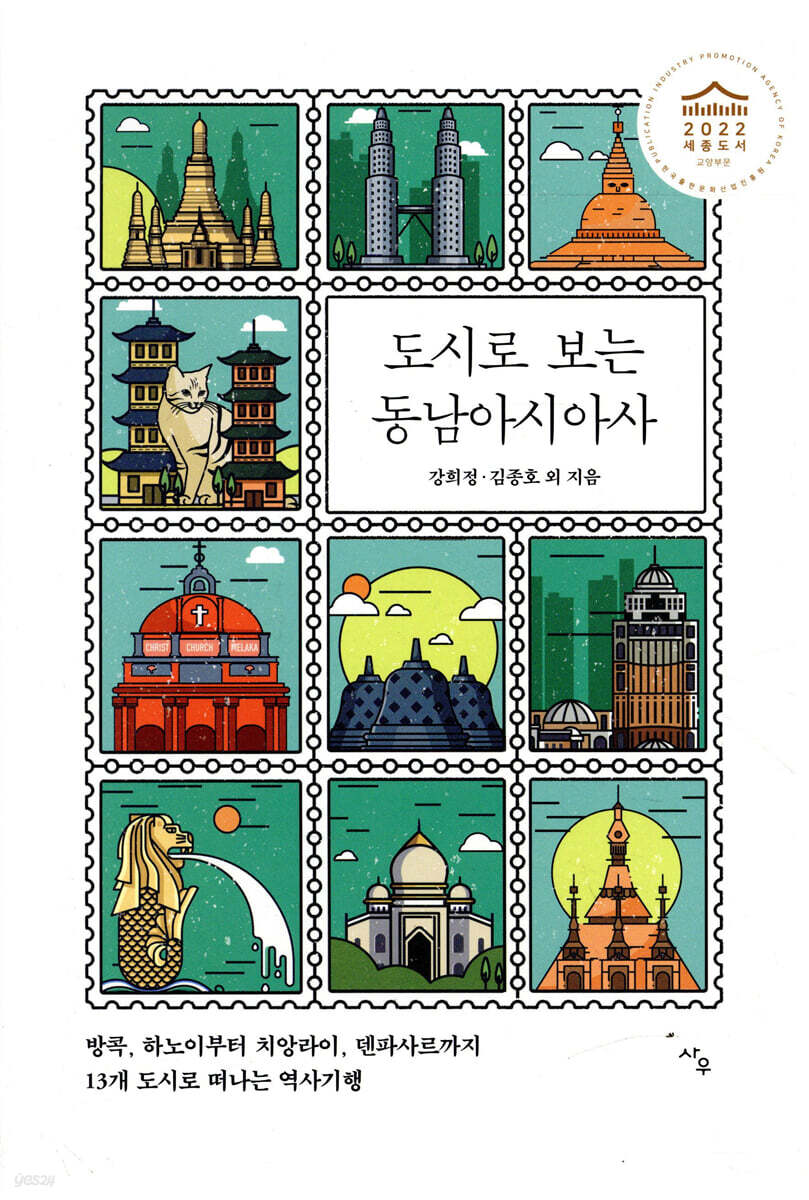
This book introduces 13 cities, including Chiang Mai, Hanoi, and Ho Chi Minh City, and provides an easy-to-understand explanation of Southeast Asian history and culture.
- Son Min-gyu, MD of History
The ultimate introductory book for deeply understanding the past and present of unfamiliar Southeast Asia!
From Malacca, the “Venice of the East,” to Hanoi, the “City of Resistance”
A concise history of Southeast Asia through 13 cities
Southeast Asia is one of the most economically significant regions in the world and has close ties with us.
However, we do not really know Southeast Asia, but rather think of it as a resort.
The authors present a colorful account of the history and culture of 13 cities selected from 7 countries.
Although we haven't covered all the cities, they are more than enough to show the history of Southeast Asia.
The authors act as tour guides, taking you through the city's main streets and providing in-depth insights into the stories and meaning behind the buildings and landscapes.
This book, written by authors familiar with the region and drawing on their experience and knowledge, provides a light yet informative introduction to Southeast Asia's history.
Readers can enjoy the pleasure of “touring the city and experiencing history on the spot” with a competent guide.
The authors concisely unravel the history of a country through the window of the city.
Through this book, readers will be able to approach the complex and unfamiliar history of Southeast Asia, where hundreds of thousands of languages and cultures coexist across 11 countries.
From Malacca, the “Venice of the East,” to Hanoi, the “City of Resistance”
A concise history of Southeast Asia through 13 cities
Southeast Asia is one of the most economically significant regions in the world and has close ties with us.
However, we do not really know Southeast Asia, but rather think of it as a resort.
The authors present a colorful account of the history and culture of 13 cities selected from 7 countries.
Although we haven't covered all the cities, they are more than enough to show the history of Southeast Asia.
The authors act as tour guides, taking you through the city's main streets and providing in-depth insights into the stories and meaning behind the buildings and landscapes.
This book, written by authors familiar with the region and drawing on their experience and knowledge, provides a light yet informative introduction to Southeast Asia's history.
Readers can enjoy the pleasure of “touring the city and experiencing history on the spot” with a competent guide.
The authors concisely unravel the history of a country through the window of the city.
Through this book, readers will be able to approach the complex and unfamiliar history of Southeast Asia, where hundreds of thousands of languages and cultures coexist across 11 countries.
- You can preview some of the book's contents.
Preview
index
Prologue: A Look Inside the Book
Malacca, the Venice of the East
Penang, a charming World Heritage city
Kuching, the tranquil city of cats
Yogyakarta, Indonesia's Hidden Gem
The Balinese people living on Denpasar, the Island of the Gods
Surabaya, the happiest second-tier city
In search of Singapore's 'real' Chinatown
Chiang Rai, the place that embraces the border between us and them
Bangkok: The Path to Democracy Found in the King's Walk
Phonsavan, a plain that could not escape the flames of the Vietnam War
Yangon, a cosmopolitan city in the Buddhist nation of Myanmar
Hanoi, a city steeped in Vietnamese history
Modern and Contemporary Vietnamese History on Dong Khoi Street in Ho Chi Minh City
Epilogue: Reading Southeast Asian History Encapsulated in the City
Malacca, the Venice of the East
Penang, a charming World Heritage city
Kuching, the tranquil city of cats
Yogyakarta, Indonesia's Hidden Gem
The Balinese people living on Denpasar, the Island of the Gods
Surabaya, the happiest second-tier city
In search of Singapore's 'real' Chinatown
Chiang Rai, the place that embraces the border between us and them
Bangkok: The Path to Democracy Found in the King's Walk
Phonsavan, a plain that could not escape the flames of the Vietnam War
Yangon, a cosmopolitan city in the Buddhist nation of Myanmar
Hanoi, a city steeped in Vietnamese history
Modern and Contemporary Vietnamese History on Dong Khoi Street in Ho Chi Minh City
Epilogue: Reading Southeast Asian History Encapsulated in the City
Publisher's Review
The ultimate introductory book for an in-depth understanding of Southeast Asian history!
Experience the history of the city by strolling through it with local experts.
Southeast Asia is one of the most economically significant regions in the world.
Not only does it have a high economic growth rate, but it also has a large young population, so its growth potential is very large.
Southeast Asia is also a very popular travel destination for us.
Because it is geographically close, has low prices, and has an excellent natural environment.
Rich and delicious food is also a big attraction for travelers.
The number of immigrants from Southeast Asia is also increasing.
Factories owned by South Korean companies are sending smoke billowing across Southeast Asia.
Yet, we know little about the history, culture, politics, and economy of Southeast Asia.
Books related to Southeast Asia are also rare.
To us, Southeast Asia is nothing more than a palm-fringed resort.
This is no one's fault.
This is a natural result, as there are not many researchers in Southeast Asia.
There was no opportunity for the general public to properly understand Southeast Asia.
A small group of researchers has finally published a book that explores the history and culture of major cities in Southeast Asia.
What does it mean to delve into a country's history through its cities? Southeast Asia, though comprised of just 11 countries, is a vast region, home to hundreds and thousands of languages and cultures.
The land is vast but the population is small, so the city developed as the center.
“It is no exaggeration to say that throughout the long history of each Southeast Asian country, the cities that served as its base have virtually determined the fate of the country.
As a result, cities with long histories remain important tourist attractions to this day, or serve as transportation hubs that connect to other tourist destinations.
“This is why Southeast Asian cities are more important than any other region.”_From the ‘Prologue’
The authors tell a colorful story of 13 cities selected from 7 countries.
Although we haven't covered all the cities, they are more than enough to show the history of Southeast Asia.
Experts specializing in each region serve as tour guides, taking you through the city's main streets and sharing the stories and meaning behind the buildings and landscapes.
This book, written by authors familiar with the region and drawing on their experience and knowledge, provides a light yet informative introduction to Southeast Asia's history.
Readers can enjoy the pleasure of “touring the city and experiencing history on the spot” with a competent guide.
From Malacca, the “Venice of the East,” to Hanoi, the “City of Resistance”
A condensed history of Southeast Asia through the window of the city
Kang Hee-jeong, who has dedicated herself to the study of Southeast Asian Buddhist art, introduces the architecture of Malacca, the “Venice of the East,” and Penang, the “Pearl of Asia,” one by one, and tells the history of the colonial struggle.
Cultural anthropologist Jeong Jeong-hoon, who studies Balinese traditions and culture, provides in-depth explanations of the parks, cemeteries, monuments, and buildings of the three Indonesian cities of Yogyakarta, Denpasar, and Surabaya.
Kim Jong-ho, a historian who studies the history of Chinese communities in Southeast Asia, describes the history of the cities, focusing on the process of formation and growth of Chinatowns in three cities: Singapore, Yangon, and Kuching (Malaysia).
Historian Hyun Sinae, who studies modern Thai history, shows the various aspects of political conflict and tragedy experienced by Southeast Asian countries in the late 20th century through Bangkok, Chiang Rai, and Phonsavan (Laos).
Lee Han-woo, a political scientist specializing in Vietnamese politics and economics, depicts the history of Vietnam's resistance, independence, unification, and development engraved in the streets and buildings of Hanoi and Ho Chi Minh City.
The authors concisely unravel the country's history through the window of the city.
Through this book, readers will be able to approach the complex and unfamiliar history of Southeast Asia, where hundreds of thousands of languages and cultures coexist across 11 countries.
Experience the history of the city by strolling through it with local experts.
Southeast Asia is one of the most economically significant regions in the world.
Not only does it have a high economic growth rate, but it also has a large young population, so its growth potential is very large.
Southeast Asia is also a very popular travel destination for us.
Because it is geographically close, has low prices, and has an excellent natural environment.
Rich and delicious food is also a big attraction for travelers.
The number of immigrants from Southeast Asia is also increasing.
Factories owned by South Korean companies are sending smoke billowing across Southeast Asia.
Yet, we know little about the history, culture, politics, and economy of Southeast Asia.
Books related to Southeast Asia are also rare.
To us, Southeast Asia is nothing more than a palm-fringed resort.
This is no one's fault.
This is a natural result, as there are not many researchers in Southeast Asia.
There was no opportunity for the general public to properly understand Southeast Asia.
A small group of researchers has finally published a book that explores the history and culture of major cities in Southeast Asia.
What does it mean to delve into a country's history through its cities? Southeast Asia, though comprised of just 11 countries, is a vast region, home to hundreds and thousands of languages and cultures.
The land is vast but the population is small, so the city developed as the center.
“It is no exaggeration to say that throughout the long history of each Southeast Asian country, the cities that served as its base have virtually determined the fate of the country.
As a result, cities with long histories remain important tourist attractions to this day, or serve as transportation hubs that connect to other tourist destinations.
“This is why Southeast Asian cities are more important than any other region.”_From the ‘Prologue’
The authors tell a colorful story of 13 cities selected from 7 countries.
Although we haven't covered all the cities, they are more than enough to show the history of Southeast Asia.
Experts specializing in each region serve as tour guides, taking you through the city's main streets and sharing the stories and meaning behind the buildings and landscapes.
This book, written by authors familiar with the region and drawing on their experience and knowledge, provides a light yet informative introduction to Southeast Asia's history.
Readers can enjoy the pleasure of “touring the city and experiencing history on the spot” with a competent guide.
From Malacca, the “Venice of the East,” to Hanoi, the “City of Resistance”
A condensed history of Southeast Asia through the window of the city
Kang Hee-jeong, who has dedicated herself to the study of Southeast Asian Buddhist art, introduces the architecture of Malacca, the “Venice of the East,” and Penang, the “Pearl of Asia,” one by one, and tells the history of the colonial struggle.
Cultural anthropologist Jeong Jeong-hoon, who studies Balinese traditions and culture, provides in-depth explanations of the parks, cemeteries, monuments, and buildings of the three Indonesian cities of Yogyakarta, Denpasar, and Surabaya.
Kim Jong-ho, a historian who studies the history of Chinese communities in Southeast Asia, describes the history of the cities, focusing on the process of formation and growth of Chinatowns in three cities: Singapore, Yangon, and Kuching (Malaysia).
Historian Hyun Sinae, who studies modern Thai history, shows the various aspects of political conflict and tragedy experienced by Southeast Asian countries in the late 20th century through Bangkok, Chiang Rai, and Phonsavan (Laos).
Lee Han-woo, a political scientist specializing in Vietnamese politics and economics, depicts the history of Vietnam's resistance, independence, unification, and development engraved in the streets and buildings of Hanoi and Ho Chi Minh City.
The authors concisely unravel the country's history through the window of the city.
Through this book, readers will be able to approach the complex and unfamiliar history of Southeast Asia, where hundreds of thousands of languages and cultures coexist across 11 countries.
GOODS SPECIFICS
- Date of issue: April 5, 2022
- Page count, weight, size: 352 pages | 616g | 152*224*30mm
- ISBN13: 9791187332749
- ISBN10: 1187332747
You may also like
카테고리
korean


korean

![GQ KOREA Mark (Monthly): December [2025]](http://librairie.coreenne.fr/cdn/shop/files/8ef265dbbfbf186523ed75ba7319009d.jpg?v=1765340328&width=3840)


