

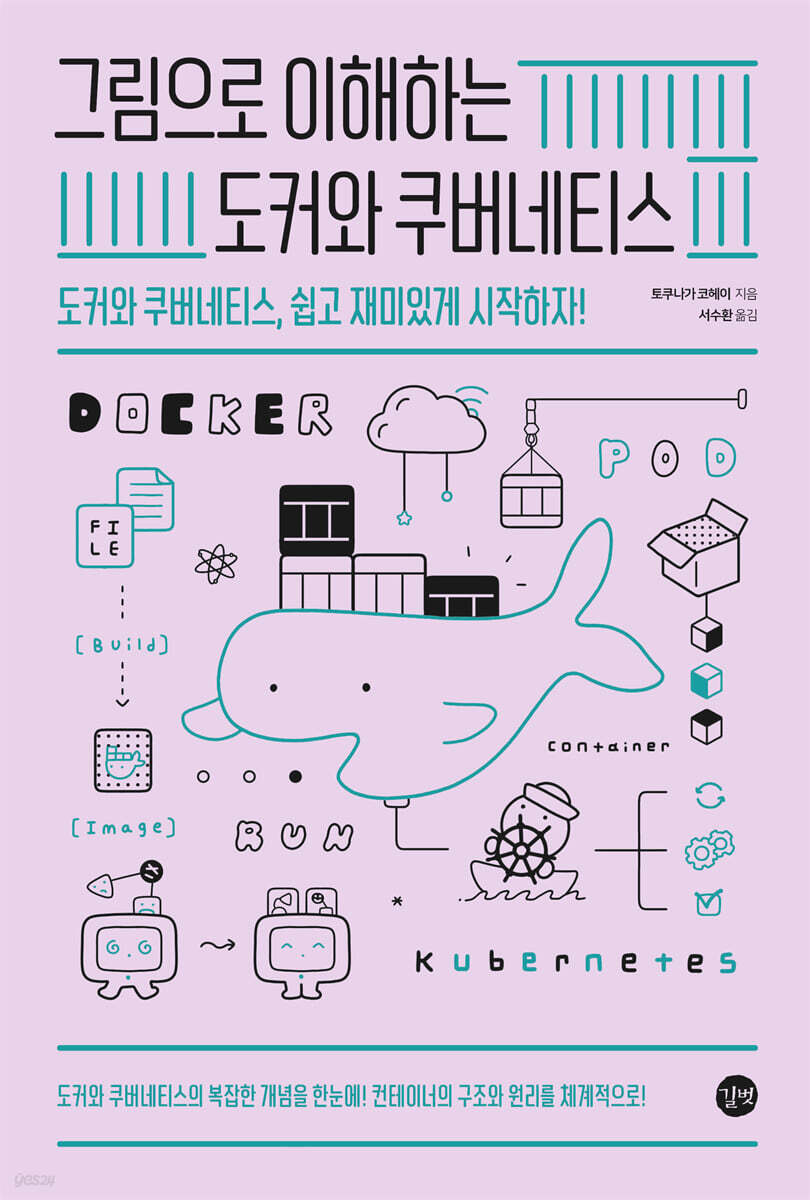
Understanding Docker and Kubernetes in Pictures
 |
Description
Book Introduction
“Why does it work this way?” The complex principles are explained in one picture!
From Understanding to Practice, Docker & Kubernetes Makes Sense Just by Reading
This book is an introductory book that uses illustrations and diagrams to help readers intuitively understand the complex concepts and principles of Docker and Kubernetes, the core of container technology.
It starts with the basic structure of Docker and the image creation process, and gradually expands to large-scale system operation using Kubernetes, explaining core components such as Pods, Deployments, and Services with real-world examples.
It is structured so that you can learn not only the basics but also practice and operation in one book by looking at the structure in the picture and also confirming the practical process with your own eyes.
In addition, rather than just memorizing commands, the concept was explained from the root, focusing on the principle of “why it works this way,” so that it could be understood and applied more deeply.
From Understanding to Practice, Docker & Kubernetes Makes Sense Just by Reading
This book is an introductory book that uses illustrations and diagrams to help readers intuitively understand the complex concepts and principles of Docker and Kubernetes, the core of container technology.
It starts with the basic structure of Docker and the image creation process, and gradually expands to large-scale system operation using Kubernetes, explaining core components such as Pods, Deployments, and Services with real-world examples.
It is structured so that you can learn not only the basics but also practice and operation in one book by looking at the structure in the picture and also confirming the practical process with your own eyes.
In addition, rather than just memorizing commands, the concept was explained from the root, focusing on the principle of “why it works this way,” so that it could be understood and applied more deeply.
- You can preview some of the book's contents.
Preview
index
Chapter 1: Overview of Container Technology
1.1 Exploring Containers
____1.1.1 Running a container
____1.1.2 Container Image
1.2 Features of basic container technology
____1.2.1 Lightweight execution environment
____1.2.2 High portability
____1.2.3 A huge ecosystem
1.3 Docker and Kubernetes covered in this book
Chapter 2: Docker Overview
2.1 Docker and Build, Ship, Run
____2.1.1 Build: Building a Container Image
____2.1.2 Run: Running a container
____2.1.3 Ship: Deploying Containers Using a Registry
2.2 Various container execution methods
____2.2.1 File sharing and data persistence between hosts and containers
____2.2.2 Exposing container ports from the host
____2.2.3 Compose: Managing Multiple Containers at Once
2.3 Dockerfile
____2.3.1 Dockerfile Basic Grammar
____2.3.2 Multi-Stage Build
2.4 Container Layer Structure
____2.4.1 Layer structure of container images
____2.4.2 Viewing the contents of a container image
____2.4.3 Container Build and Layer Structure
____2.4.4 Layer structure of container execution
____2.4.5 Skills required to create layered images and root filesystems
2.5 Docker Architecture and OCI Runtime
2.6 Checking container images in Docker 25 version
2.7 Summary
Chapter 3: Kubernetes Overview
3.1 Features of Kubernetes
____3.1.1 Declarative Management Using Files
____3.1.2 Support for a wide range of distribution formats
____3.1.3 Highly scalable architecture and active developer community
3.2 Kubernetes Cluster and kubectl
3.3 The basic deployment unit of Kubernetes: Pod
____3.3.1 Pods and Containers
____3.3.2 Labels and Annotations
3.4 Application Deployment
____3.4.1 Deployment
____3.4.2 StatefulSets
____3.4.3 Demonset
____3.4.4 Jobs and Cron Jobs
3.5 Settings and Volume
____3.5.1 Managing Application Settings Using ConfigMaps and Secrets
____3.5.2 Storage Management Using Volumes
____3.5.3 PersistentVolume
____3.5.4 Temporary Volume
3.6 Service Release
____3.6.1 Connecting to a pod using a service
____3.6.2 Exposing the service to the outside world
3.7 Pods and CRI Container Runtime in Kubernetes
____3.7.1 Managing Pods with the Kubelet
____3.7.2 CRI Runtime
____3.7.3 CNI Plugin
____3.7.4 kube-proxy
____3.7.5 Node Component Relationships
3.8 Summary
Chapter 4 Container Runtime and Container Standard Specifications
4.1 Container Runtime Overview
____4.1.1 Relationship between Docker, Kubernetes, and Container Runtimes
____4.1.2 Two types of runtime layers
____4.1.3 CRI runtime, OCI runtime linkage and pod creation flow
4.2 Various high-level runtimes (Docker-compatible runtimes)
____4.2.1 Docker
____4.2.2 Padman
4.3 Various high-level runtimes (CRI runtimes)
____4.3.1 containerd
____4.3.2 CRI-O
4.4 Various low-level runtimes
____4.4.1 runc
____4.4.2 gVisor
____4.4.3 Kata Containers
4.5 OCI Standard Specifications
____4.5.1 OCI Runtime Specification
____4.5.2 OCI Image Specification
____4.5.3 OCI Distribution Specification
4.6 Running containers using runc
____4.6.1 Fetching container images and building container-based
____4.6.2 Running containers
____4.6.3 Stopping and Deleting Containers
4.7 Base technologies used to create execution environments
____4.7.1 Namespaces
____4.7.2 cgroups
4.8 Summary
1.1 Exploring Containers
____1.1.1 Running a container
____1.1.2 Container Image
1.2 Features of basic container technology
____1.2.1 Lightweight execution environment
____1.2.2 High portability
____1.2.3 A huge ecosystem
1.3 Docker and Kubernetes covered in this book
Chapter 2: Docker Overview
2.1 Docker and Build, Ship, Run
____2.1.1 Build: Building a Container Image
____2.1.2 Run: Running a container
____2.1.3 Ship: Deploying Containers Using a Registry
2.2 Various container execution methods
____2.2.1 File sharing and data persistence between hosts and containers
____2.2.2 Exposing container ports from the host
____2.2.3 Compose: Managing Multiple Containers at Once
2.3 Dockerfile
____2.3.1 Dockerfile Basic Grammar
____2.3.2 Multi-Stage Build
2.4 Container Layer Structure
____2.4.1 Layer structure of container images
____2.4.2 Viewing the contents of a container image
____2.4.3 Container Build and Layer Structure
____2.4.4 Layer structure of container execution
____2.4.5 Skills required to create layered images and root filesystems
2.5 Docker Architecture and OCI Runtime
2.6 Checking container images in Docker 25 version
2.7 Summary
Chapter 3: Kubernetes Overview
3.1 Features of Kubernetes
____3.1.1 Declarative Management Using Files
____3.1.2 Support for a wide range of distribution formats
____3.1.3 Highly scalable architecture and active developer community
3.2 Kubernetes Cluster and kubectl
3.3 The basic deployment unit of Kubernetes: Pod
____3.3.1 Pods and Containers
____3.3.2 Labels and Annotations
3.4 Application Deployment
____3.4.1 Deployment
____3.4.2 StatefulSets
____3.4.3 Demonset
____3.4.4 Jobs and Cron Jobs
3.5 Settings and Volume
____3.5.1 Managing Application Settings Using ConfigMaps and Secrets
____3.5.2 Storage Management Using Volumes
____3.5.3 PersistentVolume
____3.5.4 Temporary Volume
3.6 Service Release
____3.6.1 Connecting to a pod using a service
____3.6.2 Exposing the service to the outside world
3.7 Pods and CRI Container Runtime in Kubernetes
____3.7.1 Managing Pods with the Kubelet
____3.7.2 CRI Runtime
____3.7.3 CNI Plugin
____3.7.4 kube-proxy
____3.7.5 Node Component Relationships
3.8 Summary
Chapter 4 Container Runtime and Container Standard Specifications
4.1 Container Runtime Overview
____4.1.1 Relationship between Docker, Kubernetes, and Container Runtimes
____4.1.2 Two types of runtime layers
____4.1.3 CRI runtime, OCI runtime linkage and pod creation flow
4.2 Various high-level runtimes (Docker-compatible runtimes)
____4.2.1 Docker
____4.2.2 Padman
4.3 Various high-level runtimes (CRI runtimes)
____4.3.1 containerd
____4.3.2 CRI-O
4.4 Various low-level runtimes
____4.4.1 runc
____4.4.2 gVisor
____4.4.3 Kata Containers
4.5 OCI Standard Specifications
____4.5.1 OCI Runtime Specification
____4.5.2 OCI Image Specification
____4.5.3 OCI Distribution Specification
4.6 Running containers using runc
____4.6.1 Fetching container images and building container-based
____4.6.2 Running containers
____4.6.3 Stopping and Deleting Containers
4.7 Base technologies used to create execution environments
____4.7.1 Namespaces
____4.7.2 cgroups
4.8 Summary
Detailed image

Publisher's Review
Just reading is enough!
Understanding Docker and Kubernetes quickly and easily!
Container technology is essential in modern system development and operations environments.
Docker, which manages applications in container units and enables consistent deployment and operation across multiple environments, and Kubernetes, which orchestrates these at scale and realizes automated infrastructure, are at the core of today's cloud-native architecture.
This book explains these complex techniques in an easy-to-understand way, using illustrations and diagrams to enable visual and intuitive understanding of key concepts.
The overall learning flow is structured to learn the basics and operating principles of containers through Docker, and then expand to large-scale operations and management using Kubernetes, naturally connecting from Docker to Kubernetes.
We cover container structure and image creation, the relationship between Pod/Deployment/Service with real-world examples, and also learn frequently encountered functions and concepts in practice, such as network configuration, resource control, scheduling, and service management.
When learning a function, we do not simply introduce commands, but explain the background and structural reasons behind the creation of the function, focusing on the principle of 'why it works this way'.
This is to enable you to understand and apply the skills rather than just memorizing them.
This book will help you understand complex concepts through illustrations and see the results of practical experiments, allowing you to learn the principles and practices of container technology in one book.
[Author's Preface]
Container runtime software, which is not usually covered in detail, is also a central topic in this book.
Container runtime is the most fundamental software in container technology.
One of its important roles is the ability to create and manage containers.
Docker and Kubernetes internally use a container runtime to create and manage containers and serve as the foundation of container technology.
Learning the basics of container runtimes and the container structures built on them will be helpful when learning about Docker and Kubernetes features not covered in this book, as well as other container-related tools.
[Translator's Preface]
You might feel, 'If only we had AI, wouldn't everything be fine even if we didn't know about this?'
But in fact, I think that as AI development becomes more active, technologies like containers and Kubernetes become more necessary.
Behind the scenes, AI services used around the world use technologies like Kubernetes and containers to ensure stable operation of such services.
Discovering these connections is the fun of computer technology and the joy of learning.
This book explains the underlying concepts in an easy-to-understand way with illustrations and detailed explanations.
I hope that through this book, you too can discover the connections between cutting-edge and existing technologies, acquire and enjoy the technical knowledge that underpins cutting-edge technology.
Understanding Docker and Kubernetes quickly and easily!
Container technology is essential in modern system development and operations environments.
Docker, which manages applications in container units and enables consistent deployment and operation across multiple environments, and Kubernetes, which orchestrates these at scale and realizes automated infrastructure, are at the core of today's cloud-native architecture.
This book explains these complex techniques in an easy-to-understand way, using illustrations and diagrams to enable visual and intuitive understanding of key concepts.
The overall learning flow is structured to learn the basics and operating principles of containers through Docker, and then expand to large-scale operations and management using Kubernetes, naturally connecting from Docker to Kubernetes.
We cover container structure and image creation, the relationship between Pod/Deployment/Service with real-world examples, and also learn frequently encountered functions and concepts in practice, such as network configuration, resource control, scheduling, and service management.
When learning a function, we do not simply introduce commands, but explain the background and structural reasons behind the creation of the function, focusing on the principle of 'why it works this way'.
This is to enable you to understand and apply the skills rather than just memorizing them.
This book will help you understand complex concepts through illustrations and see the results of practical experiments, allowing you to learn the principles and practices of container technology in one book.
[Author's Preface]
Container runtime software, which is not usually covered in detail, is also a central topic in this book.
Container runtime is the most fundamental software in container technology.
One of its important roles is the ability to create and manage containers.
Docker and Kubernetes internally use a container runtime to create and manage containers and serve as the foundation of container technology.
Learning the basics of container runtimes and the container structures built on them will be helpful when learning about Docker and Kubernetes features not covered in this book, as well as other container-related tools.
[Translator's Preface]
You might feel, 'If only we had AI, wouldn't everything be fine even if we didn't know about this?'
But in fact, I think that as AI development becomes more active, technologies like containers and Kubernetes become more necessary.
Behind the scenes, AI services used around the world use technologies like Kubernetes and containers to ensure stable operation of such services.
Discovering these connections is the fun of computer technology and the joy of learning.
This book explains the underlying concepts in an easy-to-understand way with illustrations and detailed explanations.
I hope that through this book, you too can discover the connections between cutting-edge and existing technologies, acquire and enjoy the technical knowledge that underpins cutting-edge technology.
GOODS SPECIFICS
- Date of issue: November 20, 2025
- Page count, weight, size: 224 pages | 152*225*9mm
- ISBN13: 9791140716562
You may also like
카테고리
korean


korean

![GQ KOREA Mark (Monthly): December [2025]](http://librairie.coreenne.fr/cdn/shop/files/8ef265dbbfbf186523ed75ba7319009d.jpg?v=1765340328&width=3840)


