

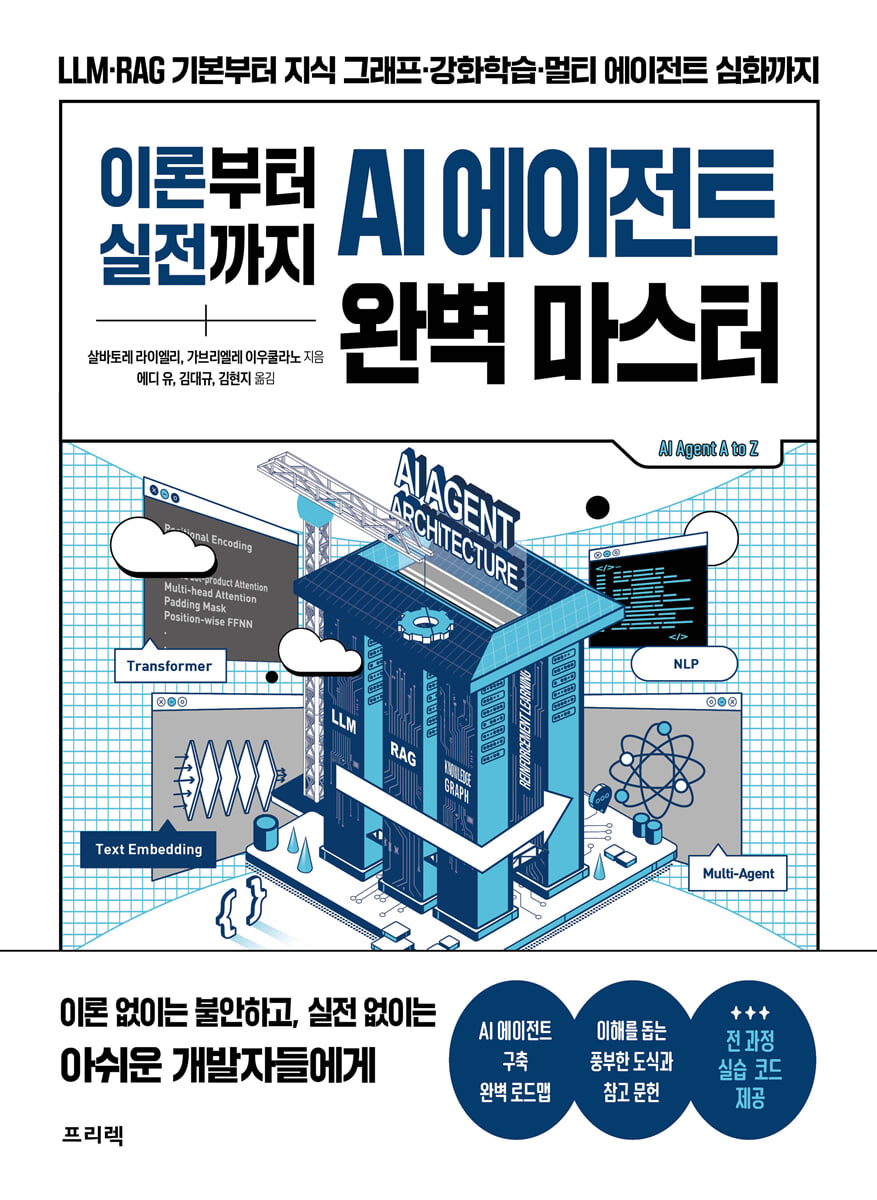
Master AI agents from theory to practice.
 |
Description
Book Introduction
A to Z of AI Agent Development
All about LLM-based agent theory and practice in just one volume!
This book presents a systematic roadmap for the entire process of AI agent development, starting from the principles of text encoding and transformers, which are the basis of AI agents, to LLM, RAG, knowledge graphs, reinforcement learning, and building complex multi-agent systems.
Based on numerous papers and references, the book provides an in-depth overview of core theories and provides practical project examples, including web scraping, movie recommendation, and travel planner agents, allowing readers to learn through implementation.
For all developers who feel anxious without theory and frustrated without practice, this book will be the most reliable guide.
Recommended for these people!
● Developers who want to build a solid foundation in the fundamental principles of AI agents (text encoding, transformers, LLM)
● Practitioners who want to create autonomous agents that make decisions and act on their own, beyond simple LLM API calls.
● Engineers who want to systematically master the core technologies of AI agents, such as RAG, knowledge graph (GraphRAG), and reinforcement learning.
● Senior developers and leaders who want to experience designing and deploying the entire architecture of an AI agent system.
Researchers and graduate students who want to study the principles of the latest AI technology in depth with theses.
All about LLM-based agent theory and practice in just one volume!
This book presents a systematic roadmap for the entire process of AI agent development, starting from the principles of text encoding and transformers, which are the basis of AI agents, to LLM, RAG, knowledge graphs, reinforcement learning, and building complex multi-agent systems.
Based on numerous papers and references, the book provides an in-depth overview of core theories and provides practical project examples, including web scraping, movie recommendation, and travel planner agents, allowing readers to learn through implementation.
For all developers who feel anxious without theory and frustrated without practice, this book will be the most reliable guide.
Recommended for these people!
● Developers who want to build a solid foundation in the fundamental principles of AI agents (text encoding, transformers, LLM)
● Practitioners who want to create autonomous agents that make decisions and act on their own, beyond simple LLM API calls.
● Engineers who want to systematically master the core technologies of AI agents, such as RAG, knowledge graph (GraphRAG), and reinforcement learning.
● Senior developers and leaders who want to experience designing and deploying the entire architecture of an AI agent system.
Researchers and graduate students who want to study the principles of the latest AI technology in depth with theses.
- You can preview some of the book's contents.
Preview
index
Recommendation
Translator's Note
Entering
Part 1: AI Agent Engine: From Text to Large-Scale Language Models
Chapter 1: Analyzing Text Data with Deep Learning
1. Text representation for AI
__One-hot encoding
__word bag
__TF-IDF
2.
Embedding, Applications, and Representation
__word2vec
__Concept of text similarity
__Properties of embedding
3.
RNN, LSTM, GRU, and CNN for text processing
__Recurrent Neural Network
__long and short-term memory
__gate circulation unit
__CNN for text
4.
Sentiment Analysis Using Embedding and Deep Learning
Chapter 2: Transformers: The Model Behind the Modern AI Revolution
1.
Exploring Attention and Self-Attention
2.
Introducing the Transformer Model
3.
Learning Transformers
4.
Exploring Masked Language Modeling
5.
Visualizing the internal mechanisms
6.
Using Transformers
Chapter 3: Exploring the Powerful AI Engine: LLM
1. Examining the evolution of LLM
__scaling law
__Emergent characteristics
__Context length
__Expert Mix
2.
Instruction tuning, fine tuning, alignment
3.
Explore small and efficient LLMs
4.
Exploring Multimodal Models
5.
Understanding Hallucination and the Ethical and Legal Issues
6.
Prompt Engineering
Part 2: AI Agents and Knowledge Retrieval
Chapter 4: Building a Web Scraping Agent with LLM
1.
Understanding the Brain, Perception, and Behavior Paradigms
__brains
__perception
__action
2. Classifying AI Agents
3.
Understanding Single-Agent and Multi-Agent Systems
4.
Explore the main libraries
__LangChain
__Haystack
__LlamaIndex
__Semantic Kernel
__AutoGen
Choosing an __LLM Agent Framework
5.
Creating a ReAct agent that searches and finds information on its own
Chapter 5: RAG-based agent to prevent hallucination
1.
Exploring Naive RAG
2.
Search, Optimize, Augment
__Chunking strategy
__Embedding Strategy
__Embedding Database
3.
Evaluate the output
4. Comparing RAG and Fine Tuning
5. Building a Movie Recommendation Agent Using RAG
Chapter 6: Advanced RAG Techniques for Information Retrieval and Augmentation
1.
Problems with Naive RAG
2.
Explore the Advanced RAG Pipeline
__Hierarchical indexing
__Virtual Questions and HyDE
__Context enhancement
__Query Transformation
__Keyword-based search and hybrid search
__Query Routing
__Re-ranking
__Response Optimization
3.
Integrating modular RAG with other systems
__Training-based and non-training approaches
4.
Implementing an Advanced RAG Pipeline
5. Understanding RAG's Scalability and Performance
__Data scalability, storage, and preprocessing
__Parallel processing
__Security and Privacy
6.
Unsolved Issues and Future Prospects
Chapter 7: Creating a Knowledge Graph and Connecting It to an AI Agent
1.
Introducing the Knowledge Graph
__Formal definitions of graphs and knowledge graphs
__Classification system and ontology
2. Building a Knowledge Graph Using LLM
__Knowledge Creation
Creating a knowledge graph with __LLM
__Knowledge Assessment
__Knowledge Refinement
__Expand your knowledge
__Knowledge Hosting and Distribution
3.
Finding information using knowledge graphs and LLM
__Graph-based indexing
__Graph-based search
__Using Graph RAG
4.
Understanding Graph Inference
__Knowledge Graph Embedding
__graph neural network
__LLM's knowledge graph inference
5.
Challenges of Knowledge Graphs and Graph RAGs
Chapter 8: Reinforcement Learning and AI Agents
1.
Introduction to Reinforcement Learning
__Multi-armed bandit problem
Markov decision process
2.
Deep Reinforcement Learning
__Model-free and model-based approaches
__On-policy and off-policy methods
__A Closer Look at Deep Reinforcement Learning
__Challenges and Future Prospects of Deep Reinforcement Learning
Learning Video Games with Reinforcement Learning
3. Interaction between LLM and reinforcement learning models
__LLM enhanced with reinforcement learning
__Reinforcement Learning Enhanced with LLM
4.
Key Summary
Part 3: Advanced AI Agents Solving Complex Scenarios
Chapter 9: Building Single- and Multi-Agent Systems
1.
Introducing Autonomous Agents
__Toolformer
__Hugging GPT
__Chemcrow
__Swift City
__Chem Agent
__Multiple Agents in the Legal Field
__Multiple agents in healthcare
2.
Using Hugging GPT
__Using Hugging GPT locally
__Using Hugging GPT on the Web
3.
multi-agent system
4.
SaaS, MaaS, DaaS, RaaS
__Software as a Service, SaaS
__Service-as-a-Service Model, MaaS
__Data as a Service, DaaS
__Results as a Service, RaaS
__Comparing various paradigms
Chapter 10: Building AI Agent Applications
1.
Introducing Streamlit
__Starting Streamlet
__Caching results
2.
Front-end development with Streamlet
__Add a text element
Inserting an image into the Streamlet app
__Building dynamic apps
3.
Building Applications Using Streamlets and AI Agents
4.
Machine Learning Operations and LLM Operations
__Model Development
__Model Training
__Model Test
__Inference Optimization
__Handling errors in production
__Considerations for Production Security
5.
Asynchronous programming
__asyncio
Asynchronous Programming and Machine Learning
6.
Docker
__Kubernetes
__Using Docker for Machine Learning
Chapter 11: The Future to Come
1.
AI agents in the medical field
__AI Agents in Biomedical Sciences
2.
AI agents in other industries
__Physical Agent
__LLM Agent for Gaming
__Web Agent
3.
Challenges to be solved and unresolved questions
__Human-agent communication problems
__Absence of clear superiority of multi-agents
__Limits of inference
__LLM's Creativity
__Possibility of a mechanistic interpretation
__The Path to General Artificial Intelligence
__ethical issues
Search
Translator's Note
Entering
Part 1: AI Agent Engine: From Text to Large-Scale Language Models
Chapter 1: Analyzing Text Data with Deep Learning
1. Text representation for AI
__One-hot encoding
__word bag
__TF-IDF
2.
Embedding, Applications, and Representation
__word2vec
__Concept of text similarity
__Properties of embedding
3.
RNN, LSTM, GRU, and CNN for text processing
__Recurrent Neural Network
__long and short-term memory
__gate circulation unit
__CNN for text
4.
Sentiment Analysis Using Embedding and Deep Learning
Chapter 2: Transformers: The Model Behind the Modern AI Revolution
1.
Exploring Attention and Self-Attention
2.
Introducing the Transformer Model
3.
Learning Transformers
4.
Exploring Masked Language Modeling
5.
Visualizing the internal mechanisms
6.
Using Transformers
Chapter 3: Exploring the Powerful AI Engine: LLM
1. Examining the evolution of LLM
__scaling law
__Emergent characteristics
__Context length
__Expert Mix
2.
Instruction tuning, fine tuning, alignment
3.
Explore small and efficient LLMs
4.
Exploring Multimodal Models
5.
Understanding Hallucination and the Ethical and Legal Issues
6.
Prompt Engineering
Part 2: AI Agents and Knowledge Retrieval
Chapter 4: Building a Web Scraping Agent with LLM
1.
Understanding the Brain, Perception, and Behavior Paradigms
__brains
__perception
__action
2. Classifying AI Agents
3.
Understanding Single-Agent and Multi-Agent Systems
4.
Explore the main libraries
__LangChain
__Haystack
__LlamaIndex
__Semantic Kernel
__AutoGen
Choosing an __LLM Agent Framework
5.
Creating a ReAct agent that searches and finds information on its own
Chapter 5: RAG-based agent to prevent hallucination
1.
Exploring Naive RAG
2.
Search, Optimize, Augment
__Chunking strategy
__Embedding Strategy
__Embedding Database
3.
Evaluate the output
4. Comparing RAG and Fine Tuning
5. Building a Movie Recommendation Agent Using RAG
Chapter 6: Advanced RAG Techniques for Information Retrieval and Augmentation
1.
Problems with Naive RAG
2.
Explore the Advanced RAG Pipeline
__Hierarchical indexing
__Virtual Questions and HyDE
__Context enhancement
__Query Transformation
__Keyword-based search and hybrid search
__Query Routing
__Re-ranking
__Response Optimization
3.
Integrating modular RAG with other systems
__Training-based and non-training approaches
4.
Implementing an Advanced RAG Pipeline
5. Understanding RAG's Scalability and Performance
__Data scalability, storage, and preprocessing
__Parallel processing
__Security and Privacy
6.
Unsolved Issues and Future Prospects
Chapter 7: Creating a Knowledge Graph and Connecting It to an AI Agent
1.
Introducing the Knowledge Graph
__Formal definitions of graphs and knowledge graphs
__Classification system and ontology
2. Building a Knowledge Graph Using LLM
__Knowledge Creation
Creating a knowledge graph with __LLM
__Knowledge Assessment
__Knowledge Refinement
__Expand your knowledge
__Knowledge Hosting and Distribution
3.
Finding information using knowledge graphs and LLM
__Graph-based indexing
__Graph-based search
__Using Graph RAG
4.
Understanding Graph Inference
__Knowledge Graph Embedding
__graph neural network
__LLM's knowledge graph inference
5.
Challenges of Knowledge Graphs and Graph RAGs
Chapter 8: Reinforcement Learning and AI Agents
1.
Introduction to Reinforcement Learning
__Multi-armed bandit problem
Markov decision process
2.
Deep Reinforcement Learning
__Model-free and model-based approaches
__On-policy and off-policy methods
__A Closer Look at Deep Reinforcement Learning
__Challenges and Future Prospects of Deep Reinforcement Learning
Learning Video Games with Reinforcement Learning
3. Interaction between LLM and reinforcement learning models
__LLM enhanced with reinforcement learning
__Reinforcement Learning Enhanced with LLM
4.
Key Summary
Part 3: Advanced AI Agents Solving Complex Scenarios
Chapter 9: Building Single- and Multi-Agent Systems
1.
Introducing Autonomous Agents
__Toolformer
__Hugging GPT
__Chemcrow
__Swift City
__Chem Agent
__Multiple Agents in the Legal Field
__Multiple agents in healthcare
2.
Using Hugging GPT
__Using Hugging GPT locally
__Using Hugging GPT on the Web
3.
multi-agent system
4.
SaaS, MaaS, DaaS, RaaS
__Software as a Service, SaaS
__Service-as-a-Service Model, MaaS
__Data as a Service, DaaS
__Results as a Service, RaaS
__Comparing various paradigms
Chapter 10: Building AI Agent Applications
1.
Introducing Streamlit
__Starting Streamlet
__Caching results
2.
Front-end development with Streamlet
__Add a text element
Inserting an image into the Streamlet app
__Building dynamic apps
3.
Building Applications Using Streamlets and AI Agents
4.
Machine Learning Operations and LLM Operations
__Model Development
__Model Training
__Model Test
__Inference Optimization
__Handling errors in production
__Considerations for Production Security
5.
Asynchronous programming
__asyncio
Asynchronous Programming and Machine Learning
6.
Docker
__Kubernetes
__Using Docker for Machine Learning
Chapter 11: The Future to Come
1.
AI agents in the medical field
__AI Agents in Biomedical Sciences
2.
AI agents in other industries
__Physical Agent
__LLM Agent for Gaming
__Web Agent
3.
Challenges to be solved and unresolved questions
__Human-agent communication problems
__Absence of clear superiority of multi-agents
__Limits of inference
__LLM's Creativity
__Possibility of a mechanistic interpretation
__The Path to General Artificial Intelligence
__ethical issues
Search
Detailed image
.jpg)
Publisher's Review
From LLM and RAG basics to advanced knowledge graphs, reinforcement learning, and multi-agents.
A complete guide to building AI agents, all in one book!
Although services leveraging large-scale language models (LLMs) have been on the rise recently, it's difficult to build a "truly autonomous agent" that can address users' complex needs simply by calling APIs.
From the persistent problem of hallucinations to implementing intelligence that can make decisions, act, and learn on its own, many developers face daunting challenges.
This book overcomes these limitations and presents a complete roadmap that delves into all the technical layers that make up AI agents from the ground up.
★ Systematic flow that penetrates all layers of the AI agent
· Part 1 lays a solid foundation, from text encoding, the foundation of AI, and RNN/LSTM to the inner workings of transformers and LLMs, the heart of the modern AI revolution.
· Part 2 delves into RAG (basic and advanced techniques), the core engine that makes LLM scale and smarter; knowledge graphs that maximize information retrieval and inference capabilities; and reinforcement learning for autonomous behavior learning.
· Part 3 guides you through the practical process of integrating all these technologies to build autonomous single- and multi-agent systems, and deploying them as real-world applications using Streamlit and Docker.
★ Beyond simple tool use, become an architect with problem-solving skills
In particular, the book emphasizes why each technology emerged and how it organically connects with other technologies.
We provide a comprehensive overview of how transformers overcome the limitations of RNNs, how RAGs solve the chronic problems of LLM, and why knowledge graphs are essential for complex inference.
An approach grounded in this fundamental understanding will enable readers to move beyond mere library users to true AI architects, capable of diagnosing complex problems arising in practice and designing optimal solutions.
While explaining core principles with extensive references and rich diagrams, we immediately connect theory to practice with working project examples, including a web scraping agent, a movie recommendation RAG agent, and a travel planner.
For all developers, researchers, and practitioners who want to delve into the operating principles of AI agents and proactively design future AI systems, this book will serve as a solid and clear guide.
-The structure of this book-
Chapter 1, 'Analyzing Text Data with Deep Learning', introduces methods for processing and expressing natural language in a format suitable for machine learning models.
We cover a variety of text encoding techniques, from basic ones like one-hot encoding and bag of words to advanced representations like TF-IDF and word2vec.
Next, we explore major deep learning architectures suitable for sequential data, such as RNN, LSTM, GRU, and CNN, and explain how to apply them to text classification tasks.
By the end of this chapter, you will understand how these foundations enable modern language models like ChatGPT.
Chapter 2, "Transformers: The Models Behind the Modern AI Revolution," introduces the attention mechanism and explains how it evolved into the Transformer architecture. It examines the limitations of early models like RNNs and LSTMs and examines how Transformers overcame them to become the foundation of modern natural language processing.
Covering core topics such as self-attention, masked language modeling, learning techniques, and internal model visualization, it lays the foundation for understanding today's LLM through practical application cases.
Chapter 3, "Exploring LLM, a Powerful AI Engine," explores how large-scale training of Transformer models gave birth to today's LLM. It covers the evolution of LLM, its key capabilities, and its limitations, introducing techniques such as instruction tuning, fine-tuning, and alignment.
We also address key challenges such as smaller and more efficient LLM variant models, multimodal models handling multiple data types, hallucination and ethical issues, and prompt engineering.
_Chapter 4, 'Building a Web Scraping Agent with LLM' introduces AI agents as a concept that extends LLM to complement its action-performing capabilities.
This chapter explores the core characteristics of agents and the differences between single-agent and multi-agent systems.
Next, we introduce the main libraries used to build agents and guide you step-by-step through the process of creating a web scraping agent that can actually retrieve information from the Internet.
Chapter 5, "RAG-Based Agents Preventing Hallucination," explores how RAG overcomes the limitations of LLM, namely, old knowledge and hallucination. It also explains how LLM improves accuracy and adaptability by accessing external information through RAG embeddings and a vector database.
We also compare RAG and fine-tuning, and present practical applications through hands-on practice of building a movie recommendation agent.
Chapter 6, 'Advanced RAG Techniques for Information Retrieval and Augmentation', introduces techniques that extend the basic RAG architecture to improve performance at all stages of the pipeline, including data collection, indexing, retrieval, and generation.
We address modular RAG, techniques for scaling the system to large datasets and user bases, and key challenges such as robustness and privacy.
It also highlights the current challenges and unresolved issues surrounding the future development of RAG-based systems.
Chapter 7, 'Creating a Knowledge Graph and Connecting it to an AI Agent', covers how to structure text-based knowledge into a knowledge graph to enhance the information retrieval and reasoning capabilities of AI agents.
all.
This chapter introduces the GraphRAG concept, which leverages knowledge graphs to provide structured contextual data to LLMs.
Next, we describe how to build a knowledge graph by extracting entities and relationships using LLM, graph-based query and inference techniques, and discuss the advantages and limitations of combining these approaches, as well as future directions for development.
Chapter 8, "Reinforcement Learning and AI Agents," explains how agents learn and adjust their behavior based on experience as they interact with a dynamic environment.
This chapter introduces the fundamental principles of reinforcement learning and covers how agents make decisions and improve their performance over time.
We also demonstrate how to optimize behavior using neural networks.
Finally, we conclude by discussing how to build more powerful AI systems by combining LLM and reinforcement learning.
Chapter 9, "Building Single- and Multi-Agent Systems," covers how to extend LLM with tools and other models to build autonomous agents.
We introduce the concepts of single-agent and multi-agent systems, explain how LLM interacts with APIs and external models, and examine representative examples such as HuggingGPT.
It also covers inter-agent coordination strategies, real-world use cases in complex domains, and new business paradigms such as SaaS, MaaS, DaaS, and RaaS.
Chapter 10, "Building AI Agent Applications," explores the key challenges that arise when scaling and deploying AI agents into real-world applications.
This chapter introduces Streamlit, a framework for rapidly prototyping front-end and back-end components of agent-based systems.
It also covers key operational aspects, including asynchronous programming, containerization using Docker, and best practices for building scalable and operationally stable AI solutions.
Chapter 11, “The Future to Come,” explores the transformative potential of AI agents across various industries, including healthcare.
Building on the technological advancements discussed in the previous chapter, we review the technical and ethical challenges facing LLM and agent systems, and conclude by suggesting unresolved issues remaining in the development and deployment of intelligent AI agents, as well as future research and practical directions.
A complete guide to building AI agents, all in one book!
Although services leveraging large-scale language models (LLMs) have been on the rise recently, it's difficult to build a "truly autonomous agent" that can address users' complex needs simply by calling APIs.
From the persistent problem of hallucinations to implementing intelligence that can make decisions, act, and learn on its own, many developers face daunting challenges.
This book overcomes these limitations and presents a complete roadmap that delves into all the technical layers that make up AI agents from the ground up.
★ Systematic flow that penetrates all layers of the AI agent
· Part 1 lays a solid foundation, from text encoding, the foundation of AI, and RNN/LSTM to the inner workings of transformers and LLMs, the heart of the modern AI revolution.
· Part 2 delves into RAG (basic and advanced techniques), the core engine that makes LLM scale and smarter; knowledge graphs that maximize information retrieval and inference capabilities; and reinforcement learning for autonomous behavior learning.
· Part 3 guides you through the practical process of integrating all these technologies to build autonomous single- and multi-agent systems, and deploying them as real-world applications using Streamlit and Docker.
★ Beyond simple tool use, become an architect with problem-solving skills
In particular, the book emphasizes why each technology emerged and how it organically connects with other technologies.
We provide a comprehensive overview of how transformers overcome the limitations of RNNs, how RAGs solve the chronic problems of LLM, and why knowledge graphs are essential for complex inference.
An approach grounded in this fundamental understanding will enable readers to move beyond mere library users to true AI architects, capable of diagnosing complex problems arising in practice and designing optimal solutions.
While explaining core principles with extensive references and rich diagrams, we immediately connect theory to practice with working project examples, including a web scraping agent, a movie recommendation RAG agent, and a travel planner.
For all developers, researchers, and practitioners who want to delve into the operating principles of AI agents and proactively design future AI systems, this book will serve as a solid and clear guide.
-The structure of this book-
Chapter 1, 'Analyzing Text Data with Deep Learning', introduces methods for processing and expressing natural language in a format suitable for machine learning models.
We cover a variety of text encoding techniques, from basic ones like one-hot encoding and bag of words to advanced representations like TF-IDF and word2vec.
Next, we explore major deep learning architectures suitable for sequential data, such as RNN, LSTM, GRU, and CNN, and explain how to apply them to text classification tasks.
By the end of this chapter, you will understand how these foundations enable modern language models like ChatGPT.
Chapter 2, "Transformers: The Models Behind the Modern AI Revolution," introduces the attention mechanism and explains how it evolved into the Transformer architecture. It examines the limitations of early models like RNNs and LSTMs and examines how Transformers overcame them to become the foundation of modern natural language processing.
Covering core topics such as self-attention, masked language modeling, learning techniques, and internal model visualization, it lays the foundation for understanding today's LLM through practical application cases.
Chapter 3, "Exploring LLM, a Powerful AI Engine," explores how large-scale training of Transformer models gave birth to today's LLM. It covers the evolution of LLM, its key capabilities, and its limitations, introducing techniques such as instruction tuning, fine-tuning, and alignment.
We also address key challenges such as smaller and more efficient LLM variant models, multimodal models handling multiple data types, hallucination and ethical issues, and prompt engineering.
_Chapter 4, 'Building a Web Scraping Agent with LLM' introduces AI agents as a concept that extends LLM to complement its action-performing capabilities.
This chapter explores the core characteristics of agents and the differences between single-agent and multi-agent systems.
Next, we introduce the main libraries used to build agents and guide you step-by-step through the process of creating a web scraping agent that can actually retrieve information from the Internet.
Chapter 5, "RAG-Based Agents Preventing Hallucination," explores how RAG overcomes the limitations of LLM, namely, old knowledge and hallucination. It also explains how LLM improves accuracy and adaptability by accessing external information through RAG embeddings and a vector database.
We also compare RAG and fine-tuning, and present practical applications through hands-on practice of building a movie recommendation agent.
Chapter 6, 'Advanced RAG Techniques for Information Retrieval and Augmentation', introduces techniques that extend the basic RAG architecture to improve performance at all stages of the pipeline, including data collection, indexing, retrieval, and generation.
We address modular RAG, techniques for scaling the system to large datasets and user bases, and key challenges such as robustness and privacy.
It also highlights the current challenges and unresolved issues surrounding the future development of RAG-based systems.
Chapter 7, 'Creating a Knowledge Graph and Connecting it to an AI Agent', covers how to structure text-based knowledge into a knowledge graph to enhance the information retrieval and reasoning capabilities of AI agents.
all.
This chapter introduces the GraphRAG concept, which leverages knowledge graphs to provide structured contextual data to LLMs.
Next, we describe how to build a knowledge graph by extracting entities and relationships using LLM, graph-based query and inference techniques, and discuss the advantages and limitations of combining these approaches, as well as future directions for development.
Chapter 8, "Reinforcement Learning and AI Agents," explains how agents learn and adjust their behavior based on experience as they interact with a dynamic environment.
This chapter introduces the fundamental principles of reinforcement learning and covers how agents make decisions and improve their performance over time.
We also demonstrate how to optimize behavior using neural networks.
Finally, we conclude by discussing how to build more powerful AI systems by combining LLM and reinforcement learning.
Chapter 9, "Building Single- and Multi-Agent Systems," covers how to extend LLM with tools and other models to build autonomous agents.
We introduce the concepts of single-agent and multi-agent systems, explain how LLM interacts with APIs and external models, and examine representative examples such as HuggingGPT.
It also covers inter-agent coordination strategies, real-world use cases in complex domains, and new business paradigms such as SaaS, MaaS, DaaS, and RaaS.
Chapter 10, "Building AI Agent Applications," explores the key challenges that arise when scaling and deploying AI agents into real-world applications.
This chapter introduces Streamlit, a framework for rapidly prototyping front-end and back-end components of agent-based systems.
It also covers key operational aspects, including asynchronous programming, containerization using Docker, and best practices for building scalable and operationally stable AI solutions.
Chapter 11, “The Future to Come,” explores the transformative potential of AI agents across various industries, including healthcare.
Building on the technological advancements discussed in the previous chapter, we review the technical and ethical challenges facing LLM and agent systems, and conclude by suggesting unresolved issues remaining in the development and deployment of intelligent AI agents, as well as future research and practical directions.
GOODS SPECIFICS
- Date of issue: November 28, 2025
- Page count, weight, size: 560 pages | 188*257*35mm
- ISBN13: 9788965404248
- ISBN10: 896540424X
You may also like
카테고리
korean


korean

![GQ KOREA Mark (Monthly): December [2025]](http://librairie.coreenne.fr/cdn/shop/files/8ef265dbbfbf186523ed75ba7319009d.jpg?v=1765340328&width=3840)


