

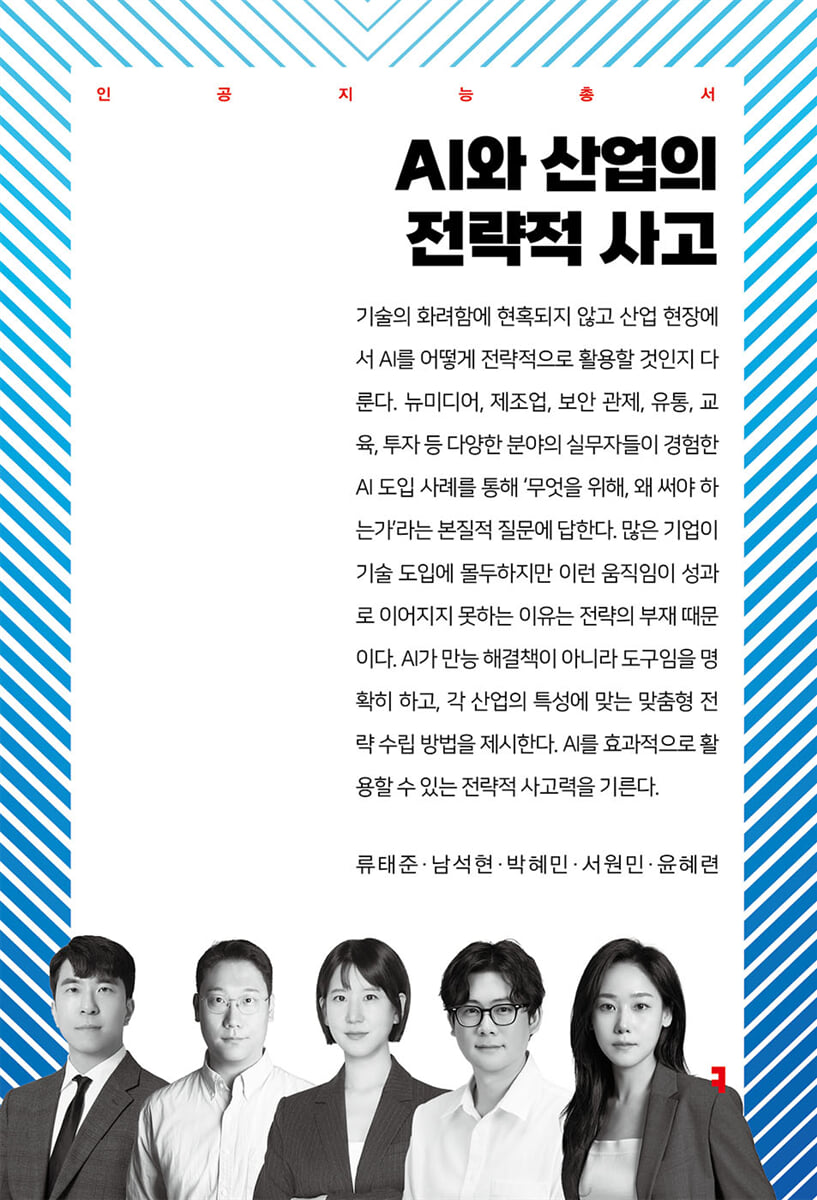
AI and Strategic Thinking in Industry
 |
Description
Book Introduction
AI is already a great technology, but it's strategy that will transform industries.
Beyond the anxiety of the uncanny valley, we ask what problems we should employ AI to solve.
Through the cases of Edison and Jobs and the chasm theory, we present a framework for strategic thinking for practitioners to utilize AI in the field.
Artificial Intelligence Encyclopedia.
You can find the artificial intelligence knowledge you need at aiseries.oopy.io.
Beyond the anxiety of the uncanny valley, we ask what problems we should employ AI to solve.
Through the cases of Edison and Jobs and the chasm theory, we present a framework for strategic thinking for practitioners to utilize AI in the field.
Artificial Intelligence Encyclopedia.
You can find the artificial intelligence knowledge you need at aiseries.oopy.io.
- You can preview some of the book's contents.
Preview
index
AI is coming, what is our strategy?
01 Why AI is Transforming Industries and Why Strategy Matters More Than Technology
02 From the Industrial Age to the AI Age: A Major Shift in Strategic Paradigm
03 Strategic Questions Needed in the Field
04 Strategy in New Media Content
05 Strategy in Manufacturing
06 Strategies in Security Control
07 Strategy in Distribution Marketing
08 Strategy in Education
09 Strategy in Investment
Strategic Thinking: A Future Core Driver Driving 10 Industries
01 Why AI is Transforming Industries and Why Strategy Matters More Than Technology
02 From the Industrial Age to the AI Age: A Major Shift in Strategic Paradigm
03 Strategic Questions Needed in the Field
04 Strategy in New Media Content
05 Strategy in Manufacturing
06 Strategies in Security Control
07 Strategy in Distribution Marketing
08 Strategy in Education
09 Strategy in Investment
Strategic Thinking: A Future Core Driver Driving 10 Industries
Into the book
The main reasons for the failure of AI strategies are 1) starting with pilot projects without a clear business purpose, 2) pushing ahead with implementation without a ready data infrastructure, and 3) distorting the collaboration system and decision-making structure within the organization around technology.
The potential of technology is clear, but without defining where and how to leverage it, the results will be insignificant.
Additionally, introducing technology without a strategy can create new confusion within the organization.
In particular, because AI is a technology that requires fundamental changes to existing work methods, it is difficult to achieve results through simple introduction.
For example, if we introduce AI but still make decisions in a “human way” and work at a “human pace,” the technology will inevitably become ineffective.
Therefore, the introduction of AI should not be a simple application of technology, but should be linked to the strategic redesign of the problem-solving structure of the entire organization.
--- From "01_“Why AI is more important than strategy in changing industrial environments and technology”
According to developmental psychologist Dr. Robert Kegan, people often resist change because they believe it is not in their best interest to agree with it or to maintain inertia.
This is a function of the individual's psychological defense system, and is closer to an unconscious risk avoidance mechanism that the individual is not even aware of.
In particular, there are cases where people oppose based on an emotional and instinctive sense of crisis rather than a rational judgment based on actual results.
This has been continuously proven throughout human history in dealing with new technologies.
Regarding the 'Luddite movement', which was a phenomenon of machine destruction during the actual Industrial Revolution, Byron (George Gordon Byron), who was a member of the British House of Lords at the time, pointed out a more fundamental 'lack of trust'.
Byron said, “There is a deeper cause for this despair and agitation.
“We must realize that no one has ever taken such extreme actions before previous policies destroyed their comfort,” he said.
--- From “03_“Strategic Questions Needed in the Field””
The most critical problem in security control is the inability to respond effectively even after detecting a threat. Even if AI identifies hundreds of anomalies, it's ultimately useless if it doesn't lead to concrete action.
A true security system must be a living process in which 'risk detection → situation assessment → immediate response' are naturally connected.
--- From “06_“Strategies in Security Control””
Not every startup needs to have such a grand vision.
But both businesses and investors need to understand how the technology fits into the bigger picture of AI.
There's a clear difference between a company that simply says, "We automate customer interactions with AI," and one that says, "We enable 'ubiquity,' where AI can communicate with all customers simultaneously."
The latter have the potential to evolve even in rapidly changing technological environments, and these companies are more likely to survive in the long term.
The potential of technology is clear, but without defining where and how to leverage it, the results will be insignificant.
Additionally, introducing technology without a strategy can create new confusion within the organization.
In particular, because AI is a technology that requires fundamental changes to existing work methods, it is difficult to achieve results through simple introduction.
For example, if we introduce AI but still make decisions in a “human way” and work at a “human pace,” the technology will inevitably become ineffective.
Therefore, the introduction of AI should not be a simple application of technology, but should be linked to the strategic redesign of the problem-solving structure of the entire organization.
--- From "01_“Why AI is more important than strategy in changing industrial environments and technology”
According to developmental psychologist Dr. Robert Kegan, people often resist change because they believe it is not in their best interest to agree with it or to maintain inertia.
This is a function of the individual's psychological defense system, and is closer to an unconscious risk avoidance mechanism that the individual is not even aware of.
In particular, there are cases where people oppose based on an emotional and instinctive sense of crisis rather than a rational judgment based on actual results.
This has been continuously proven throughout human history in dealing with new technologies.
Regarding the 'Luddite movement', which was a phenomenon of machine destruction during the actual Industrial Revolution, Byron (George Gordon Byron), who was a member of the British House of Lords at the time, pointed out a more fundamental 'lack of trust'.
Byron said, “There is a deeper cause for this despair and agitation.
“We must realize that no one has ever taken such extreme actions before previous policies destroyed their comfort,” he said.
--- From “03_“Strategic Questions Needed in the Field””
The most critical problem in security control is the inability to respond effectively even after detecting a threat. Even if AI identifies hundreds of anomalies, it's ultimately useless if it doesn't lead to concrete action.
A true security system must be a living process in which 'risk detection → situation assessment → immediate response' are naturally connected.
--- From “06_“Strategies in Security Control””
Not every startup needs to have such a grand vision.
But both businesses and investors need to understand how the technology fits into the bigger picture of AI.
There's a clear difference between a company that simply says, "We automate customer interactions with AI," and one that says, "We enable 'ubiquity,' where AI can communicate with all customers simultaneously."
The latter have the potential to evolve even in rapidly changing technological environments, and these companies are more likely to survive in the long term.
--- From "09_“Strategy in Investment”"
Publisher's Review
AI and Strategic Thinking in Industry: Turning Anxiety into Strategy
AI is rapidly becoming more human-like, but anxiety and resistance are also growing.
This book focuses on how to handle and utilize AI in industrial settings rather than providing technical explanations.
What we need to cross the uncanny valley of the 'uncanny valley' is not a technical manual, but a new frame of mind.
As the camera obscura in the film "Girl with a Pearl Earring" demonstrates, it's not the tool's performance that matters, but the perspective on composition and light. The same holds true for AI.
People buy problem solutions, not technology itself.
Therefore, the core of AI strategy is not “what can AI do?” but “what problems can AI solve?”
As chasm theory suggests, new technologies only cross the market when they have practical success stories.
Just as Edison created an electricity ecosystem beyond the light bulb and Jobs restructured Xerox's technology into an industry, the power to change an industry lies in strategy.
Through case studies from various fields, including content, manufacturing, security, distribution, education, and investment, this book presents a way to transform AI from a fear to an actionable strategy.
AI is rapidly becoming more human-like, but anxiety and resistance are also growing.
This book focuses on how to handle and utilize AI in industrial settings rather than providing technical explanations.
What we need to cross the uncanny valley of the 'uncanny valley' is not a technical manual, but a new frame of mind.
As the camera obscura in the film "Girl with a Pearl Earring" demonstrates, it's not the tool's performance that matters, but the perspective on composition and light. The same holds true for AI.
People buy problem solutions, not technology itself.
Therefore, the core of AI strategy is not “what can AI do?” but “what problems can AI solve?”
As chasm theory suggests, new technologies only cross the market when they have practical success stories.
Just as Edison created an electricity ecosystem beyond the light bulb and Jobs restructured Xerox's technology into an industry, the power to change an industry lies in strategy.
Through case studies from various fields, including content, manufacturing, security, distribution, education, and investment, this book presents a way to transform AI from a fear to an actionable strategy.
GOODS SPECIFICS
- Date of issue: September 15, 2025
- Page count, weight, size: 170 pages | 128*188*9mm
- ISBN13: 9791143008169
You may also like
카테고리
korean


korean

![GQ KOREA Mark (Monthly): December [2025]](http://librairie.coreenne.fr/cdn/shop/files/8ef265dbbfbf186523ed75ba7319009d.jpg?v=1765340328&width=3840)


