

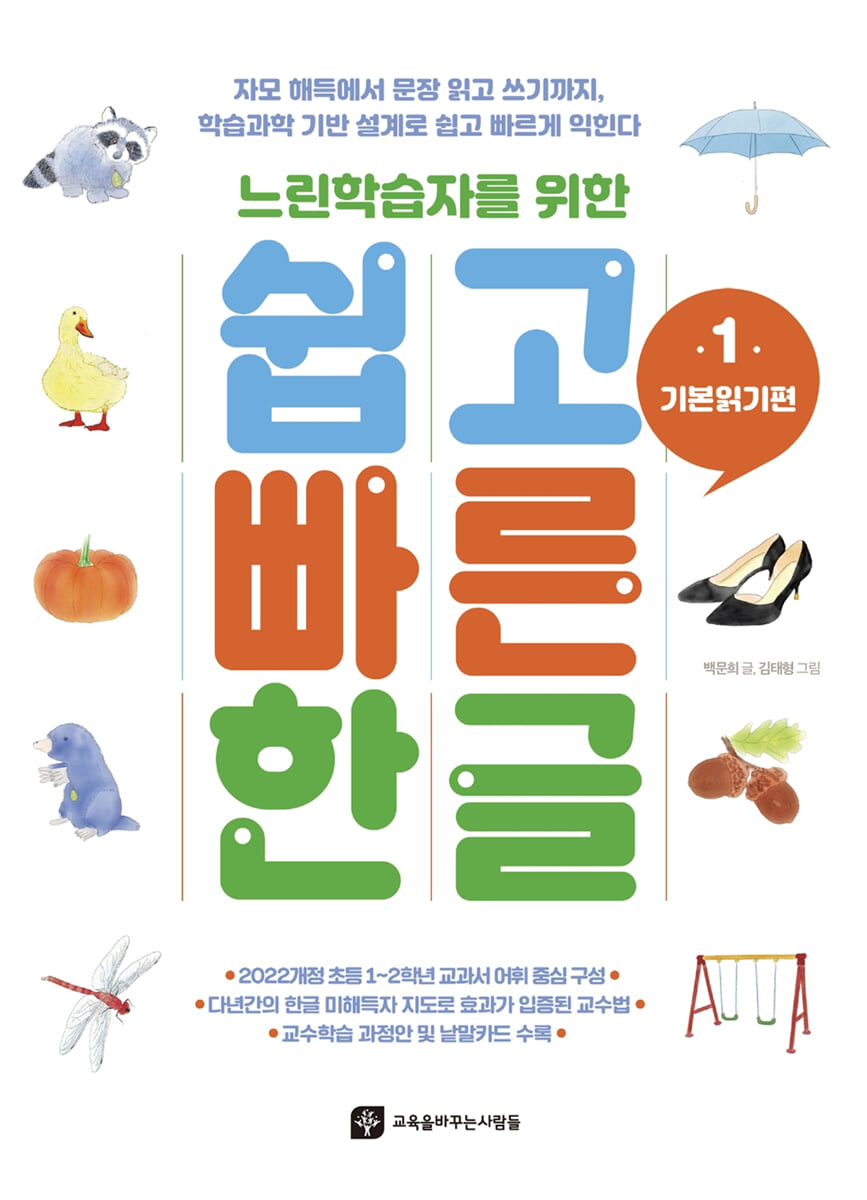
Easy and Fast Korean for Slow Learners 1: Basic Reading
 |
Description
Book Introduction
For slow learners
Easy and fast Korean
Learn easily and quickly with learning science-based design
Increases motivation and confidence in learning
Reflecting the 2022 revised curriculum, including teaching and learning plan and flashcards
This book contains the author's unique Korean language education know-how, having spent nearly half of his 30-year elementary school teaching career as a first-grade homeroom teacher.
The solution to the increasingly serious learning difficulties and basic academic problems in the classroom must begin with mastering the Korean alphabet.
If students do not learn Korean properly in the early grades, they will have difficulty adapting to school life and will not be able to gain confidence in their studies.
The author has been teaching Korean reading for many years using existing teaching methods and various teaching materials, and has compiled the most effective methodologies in this process into “Easy and Fast Korean.”
What makes this book different is that it is designed based on learning science.
By combining the principles of learning science with existing Korean language learning methods, it not only makes learning easier and faster, but also takes into account learners' senses, emotions, and feelings, thereby boosting their confidence and giving meaning to learning.
If students are not interested in the class, learning cannot proceed well no matter how passionately the teacher teaches.
This book aims not only to teach children the alphabet and how to read letters and words, but also to foster the joy of discovering letters in everyday life and the confidence gained by writing a sentence, however clumsy.
It is especially effective for children learning Korean for the first time, students with dyslexia, students from multicultural families, and students at the learning barrier, and is also recommended for foreigners and adults who want to learn Korean.
In Volume 1, “Basic Reading,” you will learn 10 vowels, 14 consonants, and 7 final consonants.
It is also structured so that you can read easy words and sentences and even write a sentence.
It includes a “teaching and learning process plan” and vocabulary cards for vowels, consonants, and final consonants, so teachers can use them when teaching.
Easy and fast Korean
Learn easily and quickly with learning science-based design
Increases motivation and confidence in learning
Reflecting the 2022 revised curriculum, including teaching and learning plan and flashcards
This book contains the author's unique Korean language education know-how, having spent nearly half of his 30-year elementary school teaching career as a first-grade homeroom teacher.
The solution to the increasingly serious learning difficulties and basic academic problems in the classroom must begin with mastering the Korean alphabet.
If students do not learn Korean properly in the early grades, they will have difficulty adapting to school life and will not be able to gain confidence in their studies.
The author has been teaching Korean reading for many years using existing teaching methods and various teaching materials, and has compiled the most effective methodologies in this process into “Easy and Fast Korean.”
What makes this book different is that it is designed based on learning science.
By combining the principles of learning science with existing Korean language learning methods, it not only makes learning easier and faster, but also takes into account learners' senses, emotions, and feelings, thereby boosting their confidence and giving meaning to learning.
If students are not interested in the class, learning cannot proceed well no matter how passionately the teacher teaches.
This book aims not only to teach children the alphabet and how to read letters and words, but also to foster the joy of discovering letters in everyday life and the confidence gained by writing a sentence, however clumsy.
It is especially effective for children learning Korean for the first time, students with dyslexia, students from multicultural families, and students at the learning barrier, and is also recommended for foreigners and adults who want to learn Korean.
In Volume 1, “Basic Reading,” you will learn 10 vowels, 14 consonants, and 7 final consonants.
It is also structured so that you can read easy words and sentences and even write a sentence.
It includes a “teaching and learning process plan” and vocabulary cards for vowels, consonants, and final consonants, so teachers can use them when teaching.
- You can preview some of the book's contents.
Preview
index
Learn vowels
Teaching and Learning Curriculum (Collection) 12
Day 1 A, I 16
Day 2 ㅓ, ㅜ 20
Day 3 ㅗ, ㅡ 24
Looking back, memories come flooding back 28
Day 4 ㅑ, ㅛ 30
Day 5 ㅕ, ㅠ 34
Looking back, memories come flooding back 38
Fun Reading and Writing Collection 40
Learn the consonants
Teaching and Learning Process (Consonants) 12
Day 6 ㄱ 48
Day 7 lol 52
Looking back, 56 memories come flooding back
Day 8 ㄴ 58
Day 9 D 62
Day 10 T 66
Looking back, 70 memories come flooding back
Day 11 ㅁ 72
Day 12 B 76
Day 13 ㅍ 80
Looking back, memories come flooding back 84
Day 14 ㅅ 86
Day 15 J 90
Day 16 ㅊ 94
Looking back, memories are vivid 98
Day 17 L 100
Day 18 ㅇ 104
Day 19 lol 108
Looking back, memories come flooding back 112
Have fun reading and writing Consonant 114
Learn the consonants
Teaching and Learning Process Plan (Supplement) 118
Day 20 ㅇ 122
Day 21 ㄱ 124
Day 22 ㄴ 126
Day 23 L 128
Day 24 ㅁ 130
Day 25 B 132
Day 26 ㅅ 134
Looking back, memories come flooding back 136
Have fun reading and writing 138 consonants
Appendix: Flashcards
Teaching and Learning Curriculum (Collection) 12
Day 1 A, I 16
Day 2 ㅓ, ㅜ 20
Day 3 ㅗ, ㅡ 24
Looking back, memories come flooding back 28
Day 4 ㅑ, ㅛ 30
Day 5 ㅕ, ㅠ 34
Looking back, memories come flooding back 38
Fun Reading and Writing Collection 40
Learn the consonants
Teaching and Learning Process (Consonants) 12
Day 6 ㄱ 48
Day 7 lol 52
Looking back, 56 memories come flooding back
Day 8 ㄴ 58
Day 9 D 62
Day 10 T 66
Looking back, 70 memories come flooding back
Day 11 ㅁ 72
Day 12 B 76
Day 13 ㅍ 80
Looking back, memories come flooding back 84
Day 14 ㅅ 86
Day 15 J 90
Day 16 ㅊ 94
Looking back, memories are vivid 98
Day 17 L 100
Day 18 ㅇ 104
Day 19 lol 108
Looking back, memories come flooding back 112
Have fun reading and writing Consonant 114
Learn the consonants
Teaching and Learning Process Plan (Supplement) 118
Day 20 ㅇ 122
Day 21 ㄱ 124
Day 22 ㄴ 126
Day 23 L 128
Day 24 ㅁ 130
Day 25 B 132
Day 26 ㅅ 134
Looking back, memories come flooding back 136
Have fun reading and writing 138 consonants
Appendix: Flashcards
Detailed image

Publisher's Review
[Author's Note]
“It was a difficult process with no clear path ahead.
Whenever Hope read a little Korean, she felt hopeful, and when she didn't get the expected response, she felt despair.
Between hope and despair, Hope slowly and little by little learned Korean.
On the first day of class, Hope couldn't read Korean at all.
However, when I did the mid-term check on July 15th, I was able to read some letters without final consonants, and on October 29th, I had progressed to the level of 'Hangul comprehension requiring supplementation' where I could not read some letters with final consonants.
And on January 27th, at the diagnostic evaluation, the child was finally diagnosed as being able to read Korean completely.
On November 27th, I received the evaluation results, returned home, and was writing my Korean language learning journal when tears suddenly poured down my face.
“It was tears of joy for me to have borne the fruit of my hard work teaching, even though no one had asked me to teach it or recognized it.”
“This book is designed to help you learn Hangul, starting with vowels, then consonants, consonant + vowel, and final consonant letters.
Rather than just learning the sounds of letters, we give you words and sentences with the letters in them and try to actually read them.
When I was teaching Hope, I remember her having fun reading sentences along with pictures, even though she had difficulty reading.
This book presents warm and comforting pictures and sentences, allowing teachers and students to read together and enjoy learning Korean together.”
"When I first started teaching Korean reading, I wondered, 'Can't they even read Korean? How can they write sentences? Will this kind of teaching really be effective?'
But writing one sentence had a bigger effect than I thought.
As we talked to each other to write sentences, I got to know Hope's interests better, and she really enjoyed the teacher's attention.
He voluntarily made an effort to write sentences that he had expressed in words, and he was proud of the sentences he had written.
Writing one sentence was a great way to not only encourage Hope's reading and develop her writing skills, but also increase her intimacy with her teacher.
If you have enough time, try to write a sentence while checking what you have learned in between learning the letters.”
I remember being moved to tears when I first received the author's manuscript.
I was determined to publish this manuscript after reading the author's words about how, despite experiencing countless frustrations and despair, he could not give up because hope was renewed when his students read even a little Korean.
Because I thought it was a book that the world absolutely needed, for students and teachers who struggle with learning difficulties.
Although quite a bit of time has passed and many difficulties have been encountered before publication, I am very happy and proud as an editor that this book has been able to come out into the world.
Learning science is based on the principles of how the 'brain' learns.
You might misunderstand that this is a special teaching and learning method that has never been seen before in the world, but in fact, it is not.
The methodology applied in this book is already being practiced by many teachers and has proven effective in the field.
However, I think this book's unique strength lies in its emphasis on the learner's socio-emotional aspects compared to existing textbooks.
Learn letter shapes using your senses
To learn Korean, you must first 'remember' the shape and sound of the letters.
There are many teaching materials that require you to learn by repeating the writing, but this is not easy for slow learners with limited working memory capacity, and they can easily lose interest and become bored.
The brain remembers information more effectively when it is combined with the senses.
This book actively utilizes visual, auditory, and kinesthetic senses, tracing with the whole arm, expressing with the body, and reading and writing out loud to connect the shapes and sounds of letters.
Connect new content to prior knowledge
“Learning is a change in long-term memory.”
As newly learned information is integrated or modified into existing memories, the schemas in our minds expand and new patterns are formed.
In other words, the goal of all teaching and learning is to add knowledge and skills to the long-term memory stored in the learner's brain.
For newly learned words to be remembered, they must be combined with prior knowledge in the student's head.
This book helps you learn the sounds and shapes of letters, then connects them with sounds and pictures you commonly see and hear in everyday life.
The presented pictures were also created to be as close to reality as possible, avoiding exaggeration or distortion for entertainment purposes.
Helping remember with context
Words or letters are rarely used alone in language.
The word 'baby' is more often encountered in sentences such as 'the baby is pretty' and 'the baby is crying'.
The author frequently gave the students sentences with the words written in them or read picture books.
This book contains short stories made up of a few sentences and pictures, and is designed for teachers and students to read together, discuss the stories, and look up words.
When we conducted a pre-book review before the book was published, we found that children who had some understanding of Korean and those who were just learning and still couldn't read well could all enjoy talking with each other.
The context of stories, pictures, and fun helps learners remember the words and letters better.
Connecting with words in everyday life
This is an activity to discover and apply learned letters in words you see for the first time.
It is an activity that can help new information become embedded in memory, expand upon it, and form new patterns.
I tried to reduce the burden by composing it with familiar and intuitive pictures and frequently heard words.
This is also the content that was revised and supplemented the most during the preliminary review process.
Through this process, learners were able to realize how many times the letters they had learned were used, and gain confidence by reading letters they had never seen before.
Review activities to help you remember
Students who are learning Korean for the first time or slow learners have difficulty remembering multiple words at once.
This book is designed to reduce the burden and make it easier to recall what you have learned by repeatedly exposing previously learned letters, words, and pictures.
In the vowels section, we learned two vowels at once and repeated the same words and pictures, and in the consonants section, we divided the vowels into 'ㅏ, ㅓ, ㅣ' and 'ㅗ, ㅜ, ㅡ' and repeated them.
And it is structured to be easy to remember by showing how the sound changes when a final consonant is placed on the same letter.
Additionally, by scheduling reviews at 2-3 day intervals and repeatedly exposing the words and pictures you have learned, we help you remember and understand.
Writing to build relationships and boost confidence
This is one of the differences between this book and other textbooks.
I wondered how I could possibly write if I couldn't even read properly, but this method actually proved to be very effective.
Because it boosts learners' confidence, gives meaning to learning, and has a positive impact on the teacher-student relationship.
According to the latest learning science research, emotions play a very important role in learning as a switch for learning.
This activity can help teachers elicit positive emotions in students, promote engagement, and boost self-esteem.
“It was a difficult process with no clear path ahead.
Whenever Hope read a little Korean, she felt hopeful, and when she didn't get the expected response, she felt despair.
Between hope and despair, Hope slowly and little by little learned Korean.
On the first day of class, Hope couldn't read Korean at all.
However, when I did the mid-term check on July 15th, I was able to read some letters without final consonants, and on October 29th, I had progressed to the level of 'Hangul comprehension requiring supplementation' where I could not read some letters with final consonants.
And on January 27th, at the diagnostic evaluation, the child was finally diagnosed as being able to read Korean completely.
On November 27th, I received the evaluation results, returned home, and was writing my Korean language learning journal when tears suddenly poured down my face.
“It was tears of joy for me to have borne the fruit of my hard work teaching, even though no one had asked me to teach it or recognized it.”
“This book is designed to help you learn Hangul, starting with vowels, then consonants, consonant + vowel, and final consonant letters.
Rather than just learning the sounds of letters, we give you words and sentences with the letters in them and try to actually read them.
When I was teaching Hope, I remember her having fun reading sentences along with pictures, even though she had difficulty reading.
This book presents warm and comforting pictures and sentences, allowing teachers and students to read together and enjoy learning Korean together.”
"When I first started teaching Korean reading, I wondered, 'Can't they even read Korean? How can they write sentences? Will this kind of teaching really be effective?'
But writing one sentence had a bigger effect than I thought.
As we talked to each other to write sentences, I got to know Hope's interests better, and she really enjoyed the teacher's attention.
He voluntarily made an effort to write sentences that he had expressed in words, and he was proud of the sentences he had written.
Writing one sentence was a great way to not only encourage Hope's reading and develop her writing skills, but also increase her intimacy with her teacher.
If you have enough time, try to write a sentence while checking what you have learned in between learning the letters.”
I remember being moved to tears when I first received the author's manuscript.
I was determined to publish this manuscript after reading the author's words about how, despite experiencing countless frustrations and despair, he could not give up because hope was renewed when his students read even a little Korean.
Because I thought it was a book that the world absolutely needed, for students and teachers who struggle with learning difficulties.
Although quite a bit of time has passed and many difficulties have been encountered before publication, I am very happy and proud as an editor that this book has been able to come out into the world.
Learning science is based on the principles of how the 'brain' learns.
You might misunderstand that this is a special teaching and learning method that has never been seen before in the world, but in fact, it is not.
The methodology applied in this book is already being practiced by many teachers and has proven effective in the field.
However, I think this book's unique strength lies in its emphasis on the learner's socio-emotional aspects compared to existing textbooks.
Learn letter shapes using your senses
To learn Korean, you must first 'remember' the shape and sound of the letters.
There are many teaching materials that require you to learn by repeating the writing, but this is not easy for slow learners with limited working memory capacity, and they can easily lose interest and become bored.
The brain remembers information more effectively when it is combined with the senses.
This book actively utilizes visual, auditory, and kinesthetic senses, tracing with the whole arm, expressing with the body, and reading and writing out loud to connect the shapes and sounds of letters.
Connect new content to prior knowledge
“Learning is a change in long-term memory.”
As newly learned information is integrated or modified into existing memories, the schemas in our minds expand and new patterns are formed.
In other words, the goal of all teaching and learning is to add knowledge and skills to the long-term memory stored in the learner's brain.
For newly learned words to be remembered, they must be combined with prior knowledge in the student's head.
This book helps you learn the sounds and shapes of letters, then connects them with sounds and pictures you commonly see and hear in everyday life.
The presented pictures were also created to be as close to reality as possible, avoiding exaggeration or distortion for entertainment purposes.
Helping remember with context
Words or letters are rarely used alone in language.
The word 'baby' is more often encountered in sentences such as 'the baby is pretty' and 'the baby is crying'.
The author frequently gave the students sentences with the words written in them or read picture books.
This book contains short stories made up of a few sentences and pictures, and is designed for teachers and students to read together, discuss the stories, and look up words.
When we conducted a pre-book review before the book was published, we found that children who had some understanding of Korean and those who were just learning and still couldn't read well could all enjoy talking with each other.
The context of stories, pictures, and fun helps learners remember the words and letters better.
Connecting with words in everyday life
This is an activity to discover and apply learned letters in words you see for the first time.
It is an activity that can help new information become embedded in memory, expand upon it, and form new patterns.
I tried to reduce the burden by composing it with familiar and intuitive pictures and frequently heard words.
This is also the content that was revised and supplemented the most during the preliminary review process.
Through this process, learners were able to realize how many times the letters they had learned were used, and gain confidence by reading letters they had never seen before.
Review activities to help you remember
Students who are learning Korean for the first time or slow learners have difficulty remembering multiple words at once.
This book is designed to reduce the burden and make it easier to recall what you have learned by repeatedly exposing previously learned letters, words, and pictures.
In the vowels section, we learned two vowels at once and repeated the same words and pictures, and in the consonants section, we divided the vowels into 'ㅏ, ㅓ, ㅣ' and 'ㅗ, ㅜ, ㅡ' and repeated them.
And it is structured to be easy to remember by showing how the sound changes when a final consonant is placed on the same letter.
Additionally, by scheduling reviews at 2-3 day intervals and repeatedly exposing the words and pictures you have learned, we help you remember and understand.
Writing to build relationships and boost confidence
This is one of the differences between this book and other textbooks.
I wondered how I could possibly write if I couldn't even read properly, but this method actually proved to be very effective.
Because it boosts learners' confidence, gives meaning to learning, and has a positive impact on the teacher-student relationship.
According to the latest learning science research, emotions play a very important role in learning as a switch for learning.
This activity can help teachers elicit positive emotions in students, promote engagement, and boost self-esteem.
GOODS SPECIFICS
- Date of issue: March 10, 2025
- Page count, weight, size: 164 pages | 210*290*20mm
- ISBN13: 9788997724321
- ISBN10: 8997724320
You may also like
카테고리
korean


korean

![GQ KOREA Mark (Monthly): December [2025]](http://librairie.coreenne.fr/cdn/shop/files/8ef265dbbfbf186523ed75ba7319009d.jpg?v=1765340328&width=3840)


