

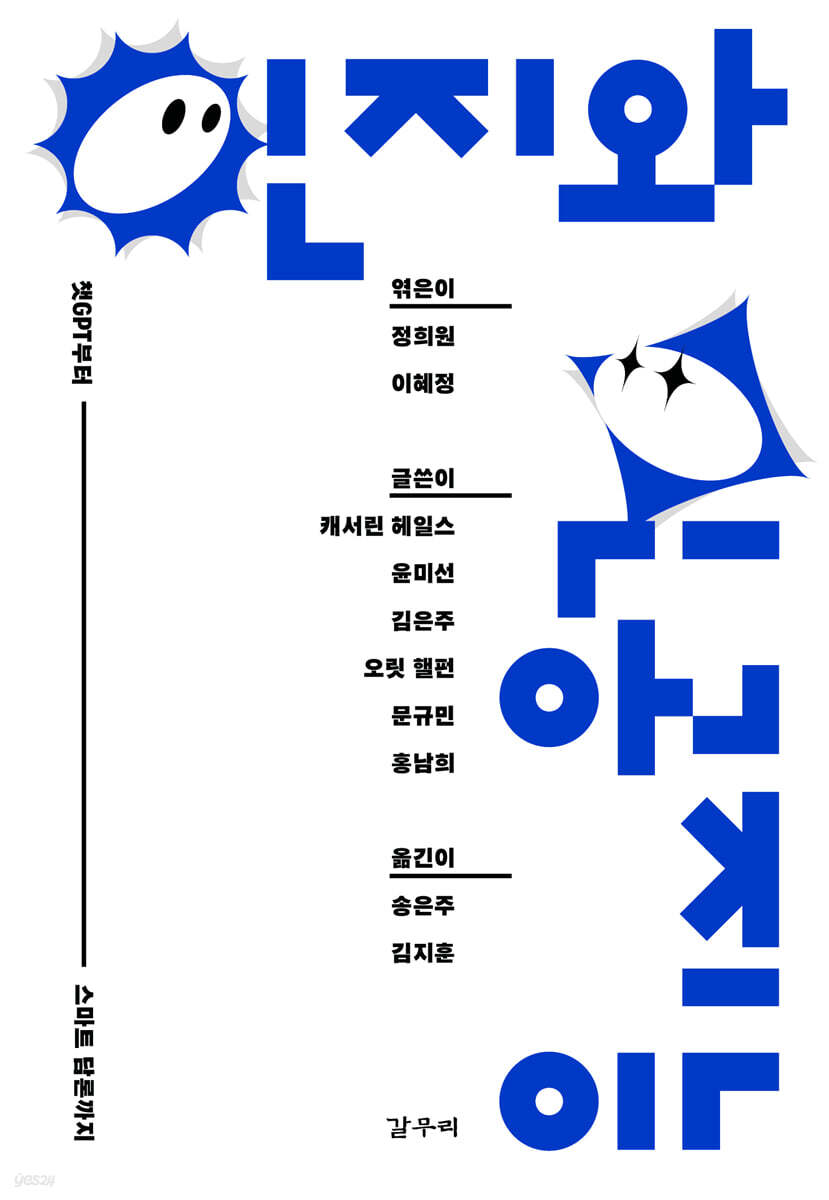
Cognition and Artificial Intelligence
 |
Description
Book Introduction
This book approaches the concepts of 'intelligence' and 'smart' from a humanistic perspective, examining the impact of advances in computer science on society, politics, and the environment.
Through Mumford's perspective on the city as a medium for information transmission and Kittler's analysis of the city as a computer, the origins of smart discourse are historicized.
With the advent of ChatGPT, the presence of artificial intelligence, which has entered the realm of human language, a field long explored by humanities researchers and literary critics, raises various questions.
For example, can we ascertain cognitive abilities from the linguistic output of LLMs? Can we discuss creativity in works of art produced by AI? How should we view the relationship between humans and emerging non-human agents, including AI? These questions are also related to the epistemological framework we collectively refer to under the term "smart."
The fact that technologies encompassing machine learning and artificial neural networks are being branded and used as artificial "intelligence" means that there is a need for an intellectual historical understanding and historicization of the concepts of "intelligence," "information," and "smart" based on these concepts, which were considered uniquely human characteristics and gifts from the gods in the Greek era and have since gone through various twists and turns in historical change.
This book analyzes technological cognition, machine learning, artificial neural networks, and the "smartness" of urban platforms from various angles.
This reveals that ‘smart’ is not just a technical adjective, but a mechanism of governance that reorganizes society and human relationships.
Through Mumford's perspective on the city as a medium for information transmission and Kittler's analysis of the city as a computer, the origins of smart discourse are historicized.
With the advent of ChatGPT, the presence of artificial intelligence, which has entered the realm of human language, a field long explored by humanities researchers and literary critics, raises various questions.
For example, can we ascertain cognitive abilities from the linguistic output of LLMs? Can we discuss creativity in works of art produced by AI? How should we view the relationship between humans and emerging non-human agents, including AI? These questions are also related to the epistemological framework we collectively refer to under the term "smart."
The fact that technologies encompassing machine learning and artificial neural networks are being branded and used as artificial "intelligence" means that there is a need for an intellectual historical understanding and historicization of the concepts of "intelligence," "information," and "smart" based on these concepts, which were considered uniquely human characteristics and gifts from the gods in the Greek era and have since gone through various twists and turns in historical change.
This book analyzes technological cognition, machine learning, artificial neural networks, and the "smartness" of urban platforms from various angles.
This reveals that ‘smart’ is not just a technical adjective, but a mechanism of governance that reorganizes society and human relationships.
- You can preview some of the book's contents.
Preview
index
Editor's Preface 6
Part 1: Writing about Artificial Intelligence, Cognition, and Algorithms
Chapter 1 Cognitive Modes and Their Relationship to Large-Scale Language Models - Conversing with ChatGPT / N.
Written by Catherine Hales, translated by Song Eun-ju 16
Chapter 2: "Number 1 on the Road," a Novel by AI James? - "The Art of Novel" and Writing Using Artificial Neural Network Algorithms / Yoon Mi-sun 53
Chapter 3: Technological Cognition and Cognitive Deployment as Non-Conscious Cognition - The Ethics of Artificial Intelligence and the Translation of the Black Box / Eunju Kim 96
Part 2: Reflections on the 'Smart' Discourse
Chapter 4: The Financialization of Intelligence: On the Integration of Machines and Markets / Orit Halpern, translated by Kim Ji-hoon, Notes 138
Chapter 5: The Intelligent City and Its Discontents - The Smart City and the Dilemma of Urban Politics / Moon Kyu-min 176
Chapter 6: Unmanned Stores and the "Smart" Population in Cities / Hong Nam-hee 218
Source of included article 274
About the Editor, Writer, and Translator 276
Part 1: Writing about Artificial Intelligence, Cognition, and Algorithms
Chapter 1 Cognitive Modes and Their Relationship to Large-Scale Language Models - Conversing with ChatGPT / N.
Written by Catherine Hales, translated by Song Eun-ju 16
Chapter 2: "Number 1 on the Road," a Novel by AI James? - "The Art of Novel" and Writing Using Artificial Neural Network Algorithms / Yoon Mi-sun 53
Chapter 3: Technological Cognition and Cognitive Deployment as Non-Conscious Cognition - The Ethics of Artificial Intelligence and the Translation of the Black Box / Eunju Kim 96
Part 2: Reflections on the 'Smart' Discourse
Chapter 4: The Financialization of Intelligence: On the Integration of Machines and Markets / Orit Halpern, translated by Kim Ji-hoon, Notes 138
Chapter 5: The Intelligent City and Its Discontents - The Smart City and the Dilemma of Urban Politics / Moon Kyu-min 176
Chapter 6: Unmanned Stores and the "Smart" Population in Cities / Hong Nam-hee 218
Source of included article 274
About the Editor, Writer, and Translator 276
Into the book
GPT-4 passed the bar exam with a top 10 percent success rate and demonstrated superior human ability to read X-rays.
Other researchers at Microsoft who had early access to GPT-4 determined that GPT-4 could construct complex mathematical proofs, possess a theory of mind about human behavior, and interpret and write poetry, plays, and essays, all on par with a math major.
--- From "Chapter 1 Cognitive Mode, and the Relationship Between Large-Scale Language Models and Cognitive Mode"
We shouldn't discuss creativity based on whether AI will achieve the same level of consciousness and self-awareness as humans.
Rather, we need to understand the creative properties that AI can create and discuss how to develop them.
--- From "Chapter 2, 'Number 1 on the Road', AI James's novel?
Fitbit bracelets encourage fitness by monitoring your heart rate, tracking exercise, recording calories burned, and measuring distance traveled and stairs climbed.
None of these devices enforce absolute obedience, for there are always ways to neutralize the intention to act.
Yet, the significance of these devices lies in their cumulative and expansive effects that significantly influence human social and unconscious behavior.
--- From “Chapter 3: Technical Cognition and Cognitive Deployment as Non-Conscious Cognition”
Halpern defines the Songdo New City project as a "testbed urban plan."
The project has emerged as a laboratory for self-organizing future urban communities and governance brought about by the triangular alliance of networks, computing infrastructure, sensors, and big data.
--- From "Translator's Note on Chapter 4: The Financialization of Intelligence"
Neoliberal economics often theorizes the world as a self-organizing, adaptive system, challenging the idea of a planned and perfectly controllable political (and potentially totalitarian) order.
Within this ideology, the market acquires a capacity for chance and creation, bordering on divine or biological determinism.
--- From "Chapter 4: Financialization of Intelligence"
The dilemma of urban sentiment demonstrates that if smart cities are to truly fulfill their inherent purpose of improving the quality of urban life, they cannot rely solely on smartness; they must be complemented by emotional politics.
--- From "Chapter 5: Intelligent Cities and Their Discontents"
Unmanned stores reorganize the time system of city dwellers and the city into a 24/7 operating system based on real-time, and enable the seamless circulation of logistics, capital, and population mobility.
Other researchers at Microsoft who had early access to GPT-4 determined that GPT-4 could construct complex mathematical proofs, possess a theory of mind about human behavior, and interpret and write poetry, plays, and essays, all on par with a math major.
--- From "Chapter 1 Cognitive Mode, and the Relationship Between Large-Scale Language Models and Cognitive Mode"
We shouldn't discuss creativity based on whether AI will achieve the same level of consciousness and self-awareness as humans.
Rather, we need to understand the creative properties that AI can create and discuss how to develop them.
--- From "Chapter 2, 'Number 1 on the Road', AI James's novel?
Fitbit bracelets encourage fitness by monitoring your heart rate, tracking exercise, recording calories burned, and measuring distance traveled and stairs climbed.
None of these devices enforce absolute obedience, for there are always ways to neutralize the intention to act.
Yet, the significance of these devices lies in their cumulative and expansive effects that significantly influence human social and unconscious behavior.
--- From “Chapter 3: Technical Cognition and Cognitive Deployment as Non-Conscious Cognition”
Halpern defines the Songdo New City project as a "testbed urban plan."
The project has emerged as a laboratory for self-organizing future urban communities and governance brought about by the triangular alliance of networks, computing infrastructure, sensors, and big data.
--- From "Translator's Note on Chapter 4: The Financialization of Intelligence"
Neoliberal economics often theorizes the world as a self-organizing, adaptive system, challenging the idea of a planned and perfectly controllable political (and potentially totalitarian) order.
Within this ideology, the market acquires a capacity for chance and creation, bordering on divine or biological determinism.
--- From "Chapter 4: Financialization of Intelligence"
The dilemma of urban sentiment demonstrates that if smart cities are to truly fulfill their inherent purpose of improving the quality of urban life, they cannot rely solely on smartness; they must be complemented by emotional politics.
--- From "Chapter 5: Intelligent Cities and Their Discontents"
Unmanned stores reorganize the time system of city dwellers and the city into a 24/7 operating system based on real-time, and enable the seamless circulation of logistics, capital, and population mobility.
--- From "Chapter 6: Unmanned Stores and 'Smart' Population in Cities"
Publisher's Review
AlphaGo's move, ChatGPT's sentence, showed us that artificial intelligence is no longer a science fiction.
In an era where artificial intelligence writes literature, composes music, and answers our questions—the adjective "smart" is no longer just a tech buzzword; it's a keyword that's reshaping how cities, society, and human relationships work.
But do we really understand the full implications of this change?
"Cognition and Artificial Intelligence: From Chat GPT to Smart Discourse" dissects artificial intelligence and the concept of "smart" from a humanistic perspective.
This book, which weaves together the latest discourses and case studies from researchers in various fields, ranging from cognition and creativity, cities and technology, and markets and governance, asks what we must preserve and what we must create anew in the new landscape created by technology.
Part 1: Writing about Artificial Intelligence, Cognition, and Algorithms
Part 1 focuses on artificial intelligence, cognition and cognitive deployment, computational creativity, mechanical creativity, and Henry James.
Catherine Hayles, with her LLM, questions the emergence of artificial intelligence, whether we can perceive without a brain, and whether texts produced by AI have meaning beyond what human readers project onto them.
Based on ChatGPT's interpretation of Henry James's "The Pattern in the Carpet," it argues that LLM possesses cognitive abilities, and that this is the most important cultural adaptation since the invention of language.
Yoon Mi-seon analyzes mechanical creativity by reading 『Number One on the Road』, generated by an artificial neural network, together with Henry James's "The Art of the Novel."
By juxtaposing texts produced by surveillance cameras and GPS-equipped vehicles with Kerouac's On the Road, we explore the potential of artificial intelligence as a media for producing experiences.
Kim Eun-ju draws attention to Hales' concept of "cognitive assemblage," suggesting that understanding artificial intelligence as a cognitive assemblage in a technological environment that is often black-boxed can create an ethical space through translatability.
Part 2: Reflections on the 'Smart' Discourse
Part 2 focuses on intelligence and smart, machines and markets, and cities and population.
Orrit Halpern is the son of economist Friedrich Hayek, who applied the concept of neuroplasticity to the study of free markets, and psychologist Donald O.
Hep traces the relationship between neoliberal economics and the AI paradigm, drawing a genealogy of neural network pioneers such as Frank Rosenblatt.
Moon Kyu-min highlights the issue of emotional responsiveness, which has been overlooked in smart city research.
Drawing on critiques of biometric data collection and surveillance, we explain how the definition and direction of smart cities inevitably pose a dilemma in relation to residents' urban sentiments.
Hong Nam-hee analyzes unmanned stores from the perspectives of media, platform, and logistics, critically examining the population and human relationships assumed by smart technologies, including unmanned ordering machines.
A humanistic perspective on technology and cities
The Urban Humanities Research Group of the Seoul Metropolitan University Humanities Research Institute has been conducting interdisciplinary research on the topic of "Humanities Vision of Digital Polis" since 2019.
He shared his research findings with readers by successively publishing 『Issues of Posthumanism』(Galmuri, 2021), 『Conditions of Digital Posthuman』(Galmuri, 2021), 『The Nation that Became an Idol』(Galmuri, 2022), 『Gated Communities and the Digital Polis』(Springer, 2023), and 『Digital Polis』(Galmuri, 2024).
This book is the result of the second phase of research, “Humanistic Critique of Smart Cities.”
An international academic conference on the topic of 'Cognition, Artificial Intelligence, and Smart' was held in May 2024, and this book was compiled based on the presentation manuscripts.
While Gated Communities and the Digital Polis reached an international audience through overseas publication, this book conveys the latest discussions in the humanities and social sciences surrounding artificial intelligence and smart technologies to domestic readers.
In an era where artificial intelligence writes literature, composes music, and answers our questions—the adjective "smart" is no longer just a tech buzzword; it's a keyword that's reshaping how cities, society, and human relationships work.
But do we really understand the full implications of this change?
"Cognition and Artificial Intelligence: From Chat GPT to Smart Discourse" dissects artificial intelligence and the concept of "smart" from a humanistic perspective.
This book, which weaves together the latest discourses and case studies from researchers in various fields, ranging from cognition and creativity, cities and technology, and markets and governance, asks what we must preserve and what we must create anew in the new landscape created by technology.
Part 1: Writing about Artificial Intelligence, Cognition, and Algorithms
Part 1 focuses on artificial intelligence, cognition and cognitive deployment, computational creativity, mechanical creativity, and Henry James.
Catherine Hayles, with her LLM, questions the emergence of artificial intelligence, whether we can perceive without a brain, and whether texts produced by AI have meaning beyond what human readers project onto them.
Based on ChatGPT's interpretation of Henry James's "The Pattern in the Carpet," it argues that LLM possesses cognitive abilities, and that this is the most important cultural adaptation since the invention of language.
Yoon Mi-seon analyzes mechanical creativity by reading 『Number One on the Road』, generated by an artificial neural network, together with Henry James's "The Art of the Novel."
By juxtaposing texts produced by surveillance cameras and GPS-equipped vehicles with Kerouac's On the Road, we explore the potential of artificial intelligence as a media for producing experiences.
Kim Eun-ju draws attention to Hales' concept of "cognitive assemblage," suggesting that understanding artificial intelligence as a cognitive assemblage in a technological environment that is often black-boxed can create an ethical space through translatability.
Part 2: Reflections on the 'Smart' Discourse
Part 2 focuses on intelligence and smart, machines and markets, and cities and population.
Orrit Halpern is the son of economist Friedrich Hayek, who applied the concept of neuroplasticity to the study of free markets, and psychologist Donald O.
Hep traces the relationship between neoliberal economics and the AI paradigm, drawing a genealogy of neural network pioneers such as Frank Rosenblatt.
Moon Kyu-min highlights the issue of emotional responsiveness, which has been overlooked in smart city research.
Drawing on critiques of biometric data collection and surveillance, we explain how the definition and direction of smart cities inevitably pose a dilemma in relation to residents' urban sentiments.
Hong Nam-hee analyzes unmanned stores from the perspectives of media, platform, and logistics, critically examining the population and human relationships assumed by smart technologies, including unmanned ordering machines.
A humanistic perspective on technology and cities
The Urban Humanities Research Group of the Seoul Metropolitan University Humanities Research Institute has been conducting interdisciplinary research on the topic of "Humanities Vision of Digital Polis" since 2019.
He shared his research findings with readers by successively publishing 『Issues of Posthumanism』(Galmuri, 2021), 『Conditions of Digital Posthuman』(Galmuri, 2021), 『The Nation that Became an Idol』(Galmuri, 2022), 『Gated Communities and the Digital Polis』(Springer, 2023), and 『Digital Polis』(Galmuri, 2024).
This book is the result of the second phase of research, “Humanistic Critique of Smart Cities.”
An international academic conference on the topic of 'Cognition, Artificial Intelligence, and Smart' was held in May 2024, and this book was compiled based on the presentation manuscripts.
While Gated Communities and the Digital Polis reached an international audience through overseas publication, this book conveys the latest discussions in the humanities and social sciences surrounding artificial intelligence and smart technologies to domestic readers.
GOODS SPECIFICS
- Date of issue: July 31, 2025
- Page count, weight, size: 280 pages | 293g | 130*188*20mm
- ISBN13: 9788961953900
- ISBN10: 8961953907
You may also like
카테고리
korean


korean

![GQ KOREA Mark (Monthly): December [2025]](http://librairie.coreenne.fr/cdn/shop/files/8ef265dbbfbf186523ed75ba7319009d.jpg?v=1765340328&width=3840)


