

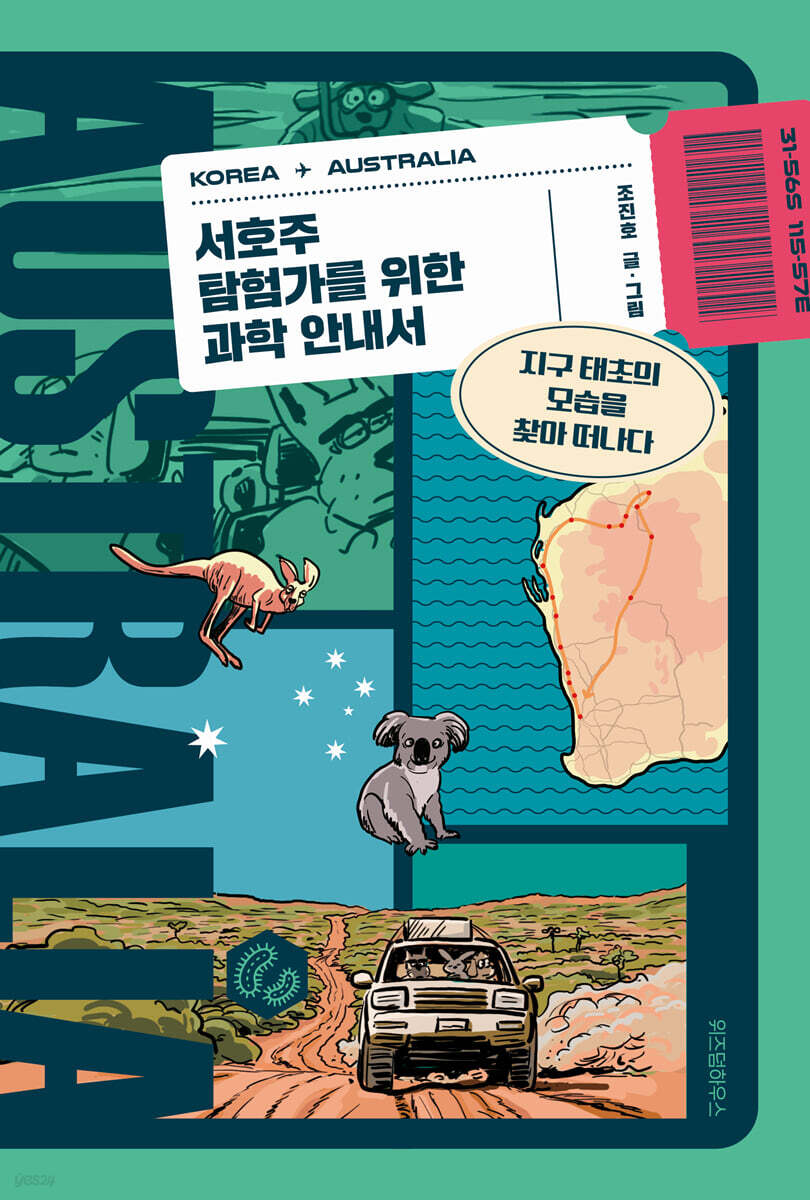
A Scientific Guide for Western Australian Explorers
 |
Description
Book Introduction
Jin-ho Jo, author of the science graphic novel series 'Express',
Head to Western Australia to discover the secrets of the origin and evolution of life on Earth!
“Our story is about the horrors and emptiness of nature,
“It is full of the wonders of science and respect for scientists.”
Author Jin-ho Jo, who has been loved by critics and readers for his graphic novels that explain difficult and complex science, tells the scientific stories he encountered while exploring Western Australia with a rookie expedition team in the form of a comic essay.
An expedition team of artists, science journalists, biology teachers, and science museum curators travel over 5,000km in a fortnight through remote Western Australia, encountering harsh natural environments and car accidents, becoming stranded in a village due to torrential rain, and encountering colonies of cyanobacteria and stromatolites, they encounter the origins of the Earth.
Through this journey, where the grandeur and emptiness of nature coexist, the expedition team experiences a life-changing experience.
Through the story of a rookie expedition team's tumultuous and unsuccessful exploration of remote areas, readers will be able to traverse the previously unknown charms of Western Australia and the origins and history of the Earth and the universe hidden there.
Head to Western Australia to discover the secrets of the origin and evolution of life on Earth!
“Our story is about the horrors and emptiness of nature,
“It is full of the wonders of science and respect for scientists.”
Author Jin-ho Jo, who has been loved by critics and readers for his graphic novels that explain difficult and complex science, tells the scientific stories he encountered while exploring Western Australia with a rookie expedition team in the form of a comic essay.
An expedition team of artists, science journalists, biology teachers, and science museum curators travel over 5,000km in a fortnight through remote Western Australia, encountering harsh natural environments and car accidents, becoming stranded in a village due to torrential rain, and encountering colonies of cyanobacteria and stromatolites, they encounter the origins of the Earth.
Through this journey, where the grandeur and emptiness of nature coexist, the expedition team experiences a life-changing experience.
Through the story of a rookie expedition team's tumultuous and unsuccessful exploration of remote areas, readers will be able to traverse the previously unknown charms of Western Australia and the origins and history of the Earth and the universe hidden there.
- You can preview some of the book's contents.
Preview
index
6 Major Routes to Explore Western Australia
Explore the worst of Western Australia! 7
Expedition members 8
Chapter 1: The Curtain Rises on the Exploration of Western Australia 9
- From Incheon, Korea to Perth, Australia
Chapter 2: The Kingdom of Strange Creatures, Western Australia 27
- From Perth to Shark Bay
Chapter 3: Crossing the desert and driving along the coastal road 45
- From Geraldton to Hamelin Pool and back to Geraldton
Chapter 4: The Expedition in Crisis 69
- From Geraldton to Cabla Point
Chapter 5: Stromatolites: Living Witnesses to Earth's History 85
- From Kabla Point to Hamelin Pool
Chapter 6: The True Time Travel of Cyanobacteria 113
- From Hamelin Pool to Nanutara
Chapter 7: Karijini Canyon, Preserving the Sea 3.5 Billion Years Ago 127
- From Nanutara to Marvel
Chapter 8: A Chance Encounter Presented by Heavy Rain 147
- At the Marvel Bar
Chapter 9: The Wild Night Sky and the World of Starlight 167
- At the Marvel Bar again
Chapter 10: The One Trip That Changed Your Life 189
- From Marble Bar to Perth and back to Korea
Epilogue: Exploring Western Australia, and Beyond 209
Author's Note: Concluding Our Exploration of Western Australia 220
Appendix: When you go to Western Australia
- Scenes from that day 222
- Exploration Essentials 226
- 230 Recommended Attractions in Western Australia
Explore the worst of Western Australia! 7
Expedition members 8
Chapter 1: The Curtain Rises on the Exploration of Western Australia 9
- From Incheon, Korea to Perth, Australia
Chapter 2: The Kingdom of Strange Creatures, Western Australia 27
- From Perth to Shark Bay
Chapter 3: Crossing the desert and driving along the coastal road 45
- From Geraldton to Hamelin Pool and back to Geraldton
Chapter 4: The Expedition in Crisis 69
- From Geraldton to Cabla Point
Chapter 5: Stromatolites: Living Witnesses to Earth's History 85
- From Kabla Point to Hamelin Pool
Chapter 6: The True Time Travel of Cyanobacteria 113
- From Hamelin Pool to Nanutara
Chapter 7: Karijini Canyon, Preserving the Sea 3.5 Billion Years Ago 127
- From Nanutara to Marvel
Chapter 8: A Chance Encounter Presented by Heavy Rain 147
- At the Marvel Bar
Chapter 9: The Wild Night Sky and the World of Starlight 167
- At the Marvel Bar again
Chapter 10: The One Trip That Changed Your Life 189
- From Marble Bar to Perth and back to Korea
Epilogue: Exploring Western Australia, and Beyond 209
Author's Note: Concluding Our Exploration of Western Australia 220
Appendix: When you go to Western Australia
- Scenes from that day 222
- Exploration Essentials 226
- 230 Recommended Attractions in Western Australia
Detailed image

Into the book
June in Australia, located in the southern part of the Earth, is early winter.
There were strange nights when I felt the chill of the season keenly in my bones, in a tent pitched on the rough ground of Western Australia, in a shabby roadside lodging, and strange days when the red earth stretched on endlessly.
---From "Chapter 1: The Prelude to the Exploration of Western Australia"
'Aborigine'.
They are the indigenous people who have lived in Australia for tens of thousands of years.
In the 18th century, when the British came to Australia, the Aboriginal population declined exponentially and was on the verge of extinction.
After the colonies were formed, it was due to the massacre of the indigenous people and the viruses introduced by Westerners.
Epidemics such as syphilis, smallpox, influenza, and measles were the final blow.
Their lives were a series of hardships.
In the name of civilization, their children were forcibly separated from their parents and sent to group homes or white families.
It was not until the 1990s that the Australian government repealed this vicious law.
Today, Aborigines still experience identity confusion and discrimination.
Addiction to alcohol and drugs is also common.
However, some Aborigines have emerged as leaders in social movements aimed at reforming Aborigines' awareness and compensating them for their land.
---From "Chapter 3: Crossing the Desert and Driving Along the Coastal Road"
The fact that Sharkman's stromatolites exist intact today and that we can see them for ourselves is very significant.
It's not hundreds of years ago, thousands of years ago.
Aren't they the very prototypes of life forms that likely existed 3.5 billion years ago? It's thanks to seeing stromatolites that paleontologists can study them and we can appreciate the grandeur of life itself.
Sharkman's stromatolites are a living museum in themselves.
---From "Chapter 6: True Time Travel Presented by Cyanobacteria"
Australia, an island and a country that occupies most of the continent.
But compared to that large area, there aren't many people.
Only half of our country's population lives in an area 80 times the size of Korea.
The country is practically empty.
If Western Australia were a lake, the lands of South Korea and North Korea would be submerged in it without any water overflowing.
Only 2.7 million people live in this vast state of Western Australia, and 2.1 million of them are in Perth.
Excluding the city, only 600,000 people live on the vast land, or about the population of Nowon-gu, Seoul.
The Australian government has yet to properly survey Western Australia.
Let's say you're driving on a highway in Western Australia and you park somewhere and walk off the road.
Perhaps you are the first Homo sapiens to set foot on that land.
There's no need to go to the moon.
---From "Chapter 6: True Time Travel Presented by Cyanobacteria"
Australia's economy was built on mining.
The gold rush of the mid-19th century began with the mining of the vast mineral deposits in the ground, making Australia the wealthiest colony of the Victorian era.
Immigrants flocked to Australia to experience the golden age.
Afterwards, Australia entered the golden age of mining by mass producing iron ore, aluminum, uranium, coal, etc.
Even today, minerals remain a vital part of Australia's economy, accounting for half of its exports.
The star of the show is iron ore! It accounts for 40 percent of global iron ore production.
About 60 percent of the iron ore imported by our country comes from Australia.
How common is iron ore in Australia? If you come across a flat, dark rock on the street, it's usually iron ore.
---From "Chapter 6: True Time Travel Presented by Cyanobacteria"
Western Australia is a place where nothing special happens.
It is true now, but it was also true in the very distant past.
According to geologists' research, there has been no volcanic eruption or major earthquake in 60 million years.
For the past 100 years, Western Australia has been sparsely populated compared to other places in the world.
Western Australia, largely untouched by the claws of civilization, retains its ancient appearance.
If you're lucky, you might find rocks that were formed hundreds of millions of years ago.
---From "Chapter 7: Karijini Gorge, Preserving the Sea 3.5 Billion Years Ago"
The Western Australian desert was a place teeming with little devils.
It is home to ten of the world's most venomous snakes, as well as the infamous funnel-web spider and ticks.
This is why you should only camp at campgrounds.
Because the campsite is much safer.
While we were in Western Australia, we didn't encounter any animals that threatened us, so we thought we wouldn't have much to fear except the cold, but we were very wrong.
If we had known in advance, our anxiety would have increased throughout the trip.
Should I say that it's fortunate that I didn't know?
---From "Chapter 9: The Wild Night Sky and the World of Starlight"
Our journey ended at the Marvel Bar.
We didn't get to the northern coast of Western Australia, and we didn't even encounter the stromatolite fossils of the Pilbara.
After our initial expedition plans were disrupted, we were unable to venture deeper into the wilderness due to safety concerns, and a sudden downpour at Marble Bar held us back for three days.
But anyway, I came back safely.
All we did in Western Australia was run over 5,000 kilometres in fear, sleep on the cold ground every night, and starve to death due to insufficient food.
The warm showers and cozy beds I had longed for in Western Australia quickly became familiar to me upon returning to Korea.
There was no time to adapt or to appreciate the value of civilization.
I didn't even experience any difficulties adjusting to the time difference.
I'm back to my normal routine perfectly.
---From "Epilogue: Exploring Western Australia, and After"
Looking back now, I realize that the cause of my failure was entirely my own.
In the early days of the expedition, we were completely unprepared for Western Australia, complacent and reckless.
As I passed the halfway point of the exploration, impatience took over me.
At that time, we were all under the compulsion that our explorations had to be productive.
I had to write a book about my expedition experiences, and Kang had to collect a lot of photos and sounds.
They perceived Western Australia as a tool for their own work.
In retrospect, it was only natural that I couldn't write the book properly after returning from the expedition.
Because I had no idea what to put in it.
But then, a year or two later… … As time passed, Western Australia came back to life in my heart.
At some point, I started to miss Western Australia and wanted to go back there again, and eventually it became a fantasy place in my mind.
I came to realize what it meant when people said that there is more to learning than just books, there is also traveling.
---From "Epilogue: Exploring Western Australia, and After"
It was not until nearly ten years later that anyone began writing about their exploration of Western Australia.
As I wrote, the memories of that time came back to me more strongly, and I was able to recall a little bit of what it felt like to be there.
And now it's time to end the story of Western Australia.
A time of completely subjective and brilliant memories, Western Australia… … .
There were strange nights when I felt the chill of the season keenly in my bones, in a tent pitched on the rough ground of Western Australia, in a shabby roadside lodging, and strange days when the red earth stretched on endlessly.
---From "Chapter 1: The Prelude to the Exploration of Western Australia"
'Aborigine'.
They are the indigenous people who have lived in Australia for tens of thousands of years.
In the 18th century, when the British came to Australia, the Aboriginal population declined exponentially and was on the verge of extinction.
After the colonies were formed, it was due to the massacre of the indigenous people and the viruses introduced by Westerners.
Epidemics such as syphilis, smallpox, influenza, and measles were the final blow.
Their lives were a series of hardships.
In the name of civilization, their children were forcibly separated from their parents and sent to group homes or white families.
It was not until the 1990s that the Australian government repealed this vicious law.
Today, Aborigines still experience identity confusion and discrimination.
Addiction to alcohol and drugs is also common.
However, some Aborigines have emerged as leaders in social movements aimed at reforming Aborigines' awareness and compensating them for their land.
---From "Chapter 3: Crossing the Desert and Driving Along the Coastal Road"
The fact that Sharkman's stromatolites exist intact today and that we can see them for ourselves is very significant.
It's not hundreds of years ago, thousands of years ago.
Aren't they the very prototypes of life forms that likely existed 3.5 billion years ago? It's thanks to seeing stromatolites that paleontologists can study them and we can appreciate the grandeur of life itself.
Sharkman's stromatolites are a living museum in themselves.
---From "Chapter 6: True Time Travel Presented by Cyanobacteria"
Australia, an island and a country that occupies most of the continent.
But compared to that large area, there aren't many people.
Only half of our country's population lives in an area 80 times the size of Korea.
The country is practically empty.
If Western Australia were a lake, the lands of South Korea and North Korea would be submerged in it without any water overflowing.
Only 2.7 million people live in this vast state of Western Australia, and 2.1 million of them are in Perth.
Excluding the city, only 600,000 people live on the vast land, or about the population of Nowon-gu, Seoul.
The Australian government has yet to properly survey Western Australia.
Let's say you're driving on a highway in Western Australia and you park somewhere and walk off the road.
Perhaps you are the first Homo sapiens to set foot on that land.
There's no need to go to the moon.
---From "Chapter 6: True Time Travel Presented by Cyanobacteria"
Australia's economy was built on mining.
The gold rush of the mid-19th century began with the mining of the vast mineral deposits in the ground, making Australia the wealthiest colony of the Victorian era.
Immigrants flocked to Australia to experience the golden age.
Afterwards, Australia entered the golden age of mining by mass producing iron ore, aluminum, uranium, coal, etc.
Even today, minerals remain a vital part of Australia's economy, accounting for half of its exports.
The star of the show is iron ore! It accounts for 40 percent of global iron ore production.
About 60 percent of the iron ore imported by our country comes from Australia.
How common is iron ore in Australia? If you come across a flat, dark rock on the street, it's usually iron ore.
---From "Chapter 6: True Time Travel Presented by Cyanobacteria"
Western Australia is a place where nothing special happens.
It is true now, but it was also true in the very distant past.
According to geologists' research, there has been no volcanic eruption or major earthquake in 60 million years.
For the past 100 years, Western Australia has been sparsely populated compared to other places in the world.
Western Australia, largely untouched by the claws of civilization, retains its ancient appearance.
If you're lucky, you might find rocks that were formed hundreds of millions of years ago.
---From "Chapter 7: Karijini Gorge, Preserving the Sea 3.5 Billion Years Ago"
The Western Australian desert was a place teeming with little devils.
It is home to ten of the world's most venomous snakes, as well as the infamous funnel-web spider and ticks.
This is why you should only camp at campgrounds.
Because the campsite is much safer.
While we were in Western Australia, we didn't encounter any animals that threatened us, so we thought we wouldn't have much to fear except the cold, but we were very wrong.
If we had known in advance, our anxiety would have increased throughout the trip.
Should I say that it's fortunate that I didn't know?
---From "Chapter 9: The Wild Night Sky and the World of Starlight"
Our journey ended at the Marvel Bar.
We didn't get to the northern coast of Western Australia, and we didn't even encounter the stromatolite fossils of the Pilbara.
After our initial expedition plans were disrupted, we were unable to venture deeper into the wilderness due to safety concerns, and a sudden downpour at Marble Bar held us back for three days.
But anyway, I came back safely.
All we did in Western Australia was run over 5,000 kilometres in fear, sleep on the cold ground every night, and starve to death due to insufficient food.
The warm showers and cozy beds I had longed for in Western Australia quickly became familiar to me upon returning to Korea.
There was no time to adapt or to appreciate the value of civilization.
I didn't even experience any difficulties adjusting to the time difference.
I'm back to my normal routine perfectly.
---From "Epilogue: Exploring Western Australia, and After"
Looking back now, I realize that the cause of my failure was entirely my own.
In the early days of the expedition, we were completely unprepared for Western Australia, complacent and reckless.
As I passed the halfway point of the exploration, impatience took over me.
At that time, we were all under the compulsion that our explorations had to be productive.
I had to write a book about my expedition experiences, and Kang had to collect a lot of photos and sounds.
They perceived Western Australia as a tool for their own work.
In retrospect, it was only natural that I couldn't write the book properly after returning from the expedition.
Because I had no idea what to put in it.
But then, a year or two later… … As time passed, Western Australia came back to life in my heart.
At some point, I started to miss Western Australia and wanted to go back there again, and eventually it became a fantasy place in my mind.
I came to realize what it meant when people said that there is more to learning than just books, there is also traveling.
---From "Epilogue: Exploring Western Australia, and After"
It was not until nearly ten years later that anyone began writing about their exploration of Western Australia.
As I wrote, the memories of that time came back to me more strongly, and I was able to recall a little bit of what it felt like to be there.
And now it's time to end the story of Western Australia.
A time of completely subjective and brilliant memories, Western Australia… … .
---From "Epilogue: Exploring Western Australia, and After"
Publisher's Review
Western Australia, which preserves the Earth's original appearance,
A rookie expedition heads into that vast and desolate wilderness!
Jin-ho Jo, the author of Korea's first science graphic novel series, 'Express,' has conveyed difficult and complex scientific stories in easy and fun comics.
He always runs to any place where there is a vivid scientific scene, and heads to Western Australia with a rookie expedition team.
Western Australia, the red land of Australia, “where only half the population of Korea lives in an area 80 times the size of Korea,” is a place that holds the wonders of the origins of the Earth, so much so that the world’s best geologists and biologists visit every year to make scientific discoveries.
The expedition, comprised of a biology teacher, a science journalist, an artist, and a science museum curator, will travel over 5,000km across Western Australia's endless outback and coastal roads over a fortnight, dreaming of exploring with scientists.
However, for foreigners, Western Australia's climate and nature only present harsh challenges.
However, the expedition did not stop because by directly encountering cyanobacteria and stromatolites, they discovered traces of the origin of life on Earth, glimpsed the mysteries of the universe through the Milky Way that decorates the night sky, and gained new perspectives on humanity and history through the indigenous people, drivers, and residents they met on the road.
Through this book, readers will be able to discover the true charm of Western Australia, a previously unknown region, and the vivid scientific stories hidden there.
The expedition team was in trouble due to the harsh natural environment and endless incidents and accidents.
The true meaning of life's journey, encountered at the end of a long journey
Although the expedition was a rookie group that had never pitched a tent before, they headed to Western Australia with the dream of witnessing scientific discoveries firsthand and finding artistic inspiration there, a place that embodies the primordial state of the Earth.
But in what is considered one of the worst remote places in the world, their car breaks down, their plans to join a scientists' expedition go awry, and a sudden downpour leaves them stranded in their village.
Tormented by hunger, cold, emptiness, and discord with their teammates, they are plagued by the anxiety that this journey will end in failure.
After the expedition, they each returned to their respective places and buried the story of Western Australia in the back of their minds, but as time passes, the memories of that time become clearer.
The author confesses that “memories of Western Australia permeated my whole being” and that “the astonishing vastness of the land, the countless stars in the pitch-black night sky, and the emptiness” “ignited the fire of my passion for writing.”
Western Australia, which also embraces “raw nature without any products of civilization,” says the author, “gave them silent advice on what they should do to feel alive and how to live a vibrant life.”
That experience, which I had only thought of as difficult and painful, redefine the meaning and value of life, and changed the lives of the expedition team in big and small ways.
By capturing this story in words and pictures, the author conveys the “endless possibilities and raw beauty” of Western Australia that cannot be conveyed through photographs or video.
“I’ve been waiting for this book for a long time.”
Highly recommended by science explorer Moon Kyung-soo!
From the wonders of Earth and space to Western Australia attractions and tips for preparing for your exploration,
A scientific guide for aspiring explorers exploring the true wilderness!
Recently, we have been able to see various aspects of Australia through SBS entertainment show “Let’s Go Beyond Real Friends, If We Go Only Once” and tvN entertainment show “Busan Country Bumpkin in Sydney,” but Western Australia is still an unfamiliar place to the public.
But if you want to see the true face of Australia, which preserves the Earth's appearance from 3.5 billion years ago, you must start in Perth, Western Australia and head north through Shark Bay.
The author has included photographs of actual locations explored, must-see attractions in Western Australia, and tips for exploring the outback, based on his own experiences, for both aspiring travelers and readers hungry for science and travel stories.
It also tells the story of the mysteries of the Earth and the universe hidden in Western Australia's exploration sites, the history of discrimination faced by the Aboriginal people encountered on the trip, the story of immigrants who came to Australia to experience the golden age after the discovery of iron ore, and the daily lives of truck drivers and residents who cross Western Australia.
As scientific explorer Moon Kyung-soo writes in his recommendation, readers of this book will find their intellectual curiosity piqued by the scientific discoveries hidden in the desolate wilderness of Western Australia, and a sense of relief that, even in this civilized age, there are still people who embark on such reckless and daring explorations.
A rookie expedition heads into that vast and desolate wilderness!
Jin-ho Jo, the author of Korea's first science graphic novel series, 'Express,' has conveyed difficult and complex scientific stories in easy and fun comics.
He always runs to any place where there is a vivid scientific scene, and heads to Western Australia with a rookie expedition team.
Western Australia, the red land of Australia, “where only half the population of Korea lives in an area 80 times the size of Korea,” is a place that holds the wonders of the origins of the Earth, so much so that the world’s best geologists and biologists visit every year to make scientific discoveries.
The expedition, comprised of a biology teacher, a science journalist, an artist, and a science museum curator, will travel over 5,000km across Western Australia's endless outback and coastal roads over a fortnight, dreaming of exploring with scientists.
However, for foreigners, Western Australia's climate and nature only present harsh challenges.
However, the expedition did not stop because by directly encountering cyanobacteria and stromatolites, they discovered traces of the origin of life on Earth, glimpsed the mysteries of the universe through the Milky Way that decorates the night sky, and gained new perspectives on humanity and history through the indigenous people, drivers, and residents they met on the road.
Through this book, readers will be able to discover the true charm of Western Australia, a previously unknown region, and the vivid scientific stories hidden there.
The expedition team was in trouble due to the harsh natural environment and endless incidents and accidents.
The true meaning of life's journey, encountered at the end of a long journey
Although the expedition was a rookie group that had never pitched a tent before, they headed to Western Australia with the dream of witnessing scientific discoveries firsthand and finding artistic inspiration there, a place that embodies the primordial state of the Earth.
But in what is considered one of the worst remote places in the world, their car breaks down, their plans to join a scientists' expedition go awry, and a sudden downpour leaves them stranded in their village.
Tormented by hunger, cold, emptiness, and discord with their teammates, they are plagued by the anxiety that this journey will end in failure.
After the expedition, they each returned to their respective places and buried the story of Western Australia in the back of their minds, but as time passes, the memories of that time become clearer.
The author confesses that “memories of Western Australia permeated my whole being” and that “the astonishing vastness of the land, the countless stars in the pitch-black night sky, and the emptiness” “ignited the fire of my passion for writing.”
Western Australia, which also embraces “raw nature without any products of civilization,” says the author, “gave them silent advice on what they should do to feel alive and how to live a vibrant life.”
That experience, which I had only thought of as difficult and painful, redefine the meaning and value of life, and changed the lives of the expedition team in big and small ways.
By capturing this story in words and pictures, the author conveys the “endless possibilities and raw beauty” of Western Australia that cannot be conveyed through photographs or video.
“I’ve been waiting for this book for a long time.”
Highly recommended by science explorer Moon Kyung-soo!
From the wonders of Earth and space to Western Australia attractions and tips for preparing for your exploration,
A scientific guide for aspiring explorers exploring the true wilderness!
Recently, we have been able to see various aspects of Australia through SBS entertainment show “Let’s Go Beyond Real Friends, If We Go Only Once” and tvN entertainment show “Busan Country Bumpkin in Sydney,” but Western Australia is still an unfamiliar place to the public.
But if you want to see the true face of Australia, which preserves the Earth's appearance from 3.5 billion years ago, you must start in Perth, Western Australia and head north through Shark Bay.
The author has included photographs of actual locations explored, must-see attractions in Western Australia, and tips for exploring the outback, based on his own experiences, for both aspiring travelers and readers hungry for science and travel stories.
It also tells the story of the mysteries of the Earth and the universe hidden in Western Australia's exploration sites, the history of discrimination faced by the Aboriginal people encountered on the trip, the story of immigrants who came to Australia to experience the golden age after the discovery of iron ore, and the daily lives of truck drivers and residents who cross Western Australia.
As scientific explorer Moon Kyung-soo writes in his recommendation, readers of this book will find their intellectual curiosity piqued by the scientific discoveries hidden in the desolate wilderness of Western Australia, and a sense of relief that, even in this civilized age, there are still people who embark on such reckless and daring explorations.
GOODS SPECIFICS
- Date of issue: May 24, 2023
- Page count, weight, size: 236 pages | 528g | 152*225*20mm
- ISBN13: 9791168126404
- ISBN10: 1168126401
You may also like
카테고리
korean


korean

![GQ KOREA Mark (Monthly): December [2025]](http://librairie.coreenne.fr/cdn/shop/files/8ef265dbbfbf186523ed75ba7319009d.jpg?v=1765340328&width=3840)


