

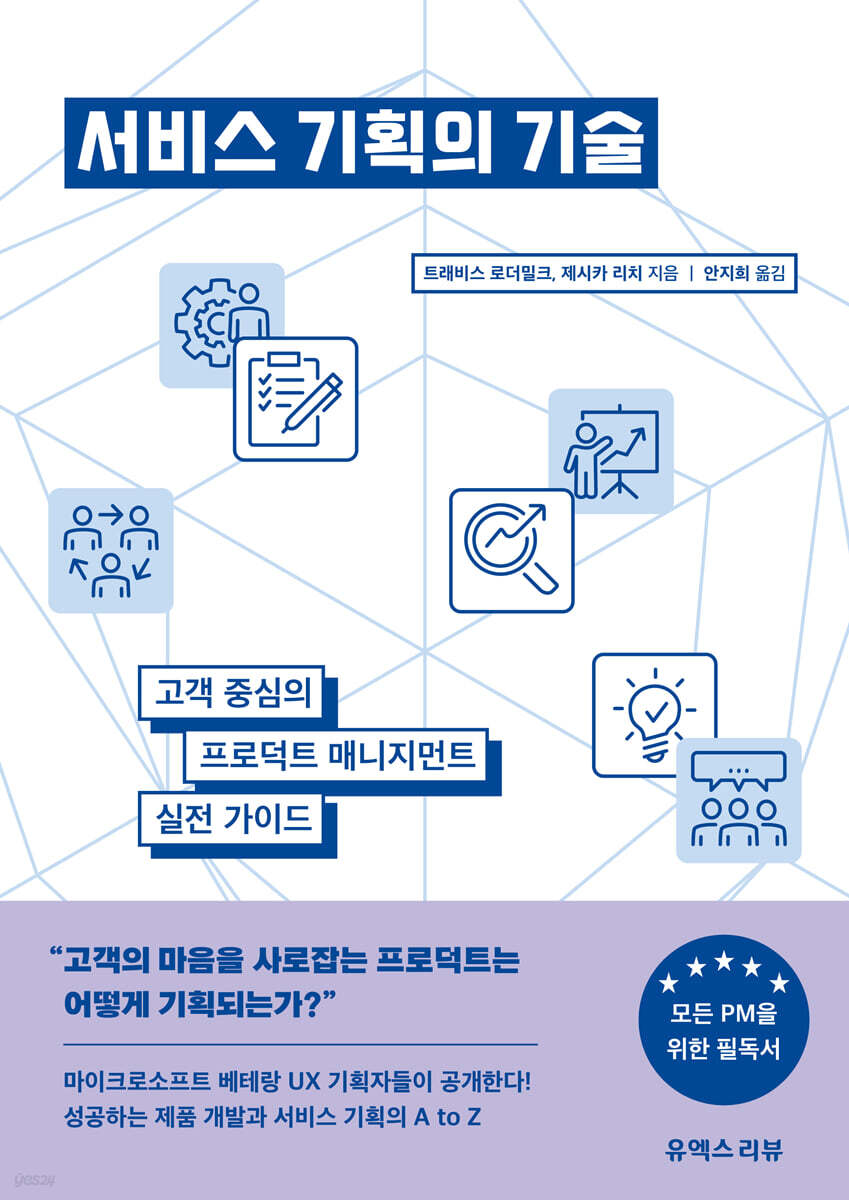
Service Planning Technology
 |
Description
Book Introduction
The first complete service planning process guide in Korea.
It helps to achieve systematic development centered on customers in service planning, product development, and UX planning.
Unlike other books, this book does not introduce various theories related to product development in a fragmented manner. Instead, it guides you step-by-step through the planning process that incorporates the lean approach and design thinking, which have been proven to be the most effective.
The abstract process of creating hypotheses, testing them, and developing concepts and UX will feel more concrete and actionable. Veteran planners with PhDs in UX and extensive experience at Microsoft will generously share their expertise and practical experience, so all you have to do is follow their step-by-step guidance.
Since the fate of a business hinges on product development practices and strategy formulation, the author's credibility is a crucial advantage of the process presented in this book.
Despite the diverse product development strategies being utilized by startups in particular, planners and product managers still struggle to translate those principles into meaningful action.
It is precisely in such situations that this practical guide is needed.
We will help you truly understand your customers, identify their problems, conceptualize new ideas, and quickly deliver fantastic products that your customers will truly love.
It helps to achieve systematic development centered on customers in service planning, product development, and UX planning.
Unlike other books, this book does not introduce various theories related to product development in a fragmented manner. Instead, it guides you step-by-step through the planning process that incorporates the lean approach and design thinking, which have been proven to be the most effective.
The abstract process of creating hypotheses, testing them, and developing concepts and UX will feel more concrete and actionable. Veteran planners with PhDs in UX and extensive experience at Microsoft will generously share their expertise and practical experience, so all you have to do is follow their step-by-step guidance.
Since the fate of a business hinges on product development practices and strategy formulation, the author's credibility is a crucial advantage of the process presented in this book.
Despite the diverse product development strategies being utilized by startups in particular, planners and product managers still struggle to translate those principles into meaningful action.
It is precisely in such situations that this practical guide is needed.
We will help you truly understand your customers, identify their problems, conceptualize new ideas, and quickly deliver fantastic products that your customers will truly love.
- You can preview some of the book's contents.
Preview
index
prolog
PART 1.
Customer-centered planning
CHAPTER 1.
Hypothesis Development Framework and Customer-Centric Cadence
CHAPTER 2.
formulation
CHAPTER 3.
experiment
CHAPTER 4.
Sensemaking
PART 2.
Understanding through examples
CHAPTER 5.
customer
CHAPTER 6.
problem
CHAPTER 7.
Concept
CHAPTER 8.
function
PART 3.
Step-by-step planning
CHAPTER 9.
Get ready
CHAPTER 10.
Customer Stage
CHAPTER 11.
Problem stage
CHAPTER 12.
Concept stage
CHAPTER 13.
Functional steps
Epilogue
References
PART 1.
Customer-centered planning
CHAPTER 1.
Hypothesis Development Framework and Customer-Centric Cadence
CHAPTER 2.
formulation
CHAPTER 3.
experiment
CHAPTER 4.
Sensemaking
PART 2.
Understanding through examples
CHAPTER 5.
customer
CHAPTER 6.
problem
CHAPTER 7.
Concept
CHAPTER 8.
function
PART 3.
Step-by-step planning
CHAPTER 9.
Get ready
CHAPTER 10.
Customer Stage
CHAPTER 11.
Problem stage
CHAPTER 12.
Concept stage
CHAPTER 13.
Functional steps
Epilogue
References
Detailed image

Publisher's Review
How are products designed to capture the hearts of customers?
Service Planning A to Z: Microsoft's Veteran UX Planners
How are innovative services that customers crave designed? Coupang's Rocket Delivery, Microsoft Excel, which has become the standard for accounting, Spotify's song recommendation AI... All of these were developed through a process of rapid incorporation of customer feedback, through experimentation and failure.
This book enables companies that have achieved such innovation to directly implement service planning based on the Lean strategy that has been utilized in product development.
The four-stage hypothesis development framework of 'customer, problem, concept, and function' helps you complete a complete customer-centric service.
The authors, who have planned Microsoft's flagship products, explain step-by-step, consistent processes for quickly incorporating customer needs and perspectives into service planning, allowing you to apply customer-centric processes and planning methods step-by-step to your practice.
This book guides business planners through the process of developing ideas and concepts while testing hypotheses, reimagining the hypothesis development framework optimized for digital service planning.
First, we collect assumptions and formalize them into testable hypotheses so that the best concept can be derived.
Next, you'll learn how to effectively research your customers and find the right ones to participate in your experiments, and how leading companies like Microsoft communicate with and document their customers.
In addition, we have outlined how to properly conduct experiments, including visiting and interviewing customers, as well as conducting surveys, focus groups, and usability tests.
Furthermore, a description of sensemaking, which involves identifying patterns and meanings in customer data collected in this way and sharing them with the entire organization, will help facilitate collaboration among various stakeholders involved in product development.
From product managers to UX designers and developers
A powerful customer-centric product planning method for everyone involved in product development!
The core of planning is hypothesis, verification, and formalization of the verified hypothesis.
The authors present an effective way to leverage a hypothesis development framework that tests assumptions about customers and products and turns them into fully developed concepts.
The processes in this book work effectively for everything from mega-services at large companies like Microsoft to startups with just a few hundred users.
The process is based on a lean strategy, making it invaluable for quickly developing and launching customer-centric services.
In this book, you will learn the following special contents:
- A step-by-step process for customer-centered service planning
- Experiments to create a continuous learning cadence
- Deriving patterns and meaning from customer feedback
- Establishing a basis and system for strategic business decision-making
- Creating a consistent feedback loop to improve customer satisfaction.
It's all about striking a balance between business and customers, while gradually evolving our services in the direction our customers truly want.
These approaches, which are effective for both large-scale and small-scale service planning, differ from typical UX research in that they develop concepts according to a customer-centered development process, allowing services to be launched as soon as the process is completed, rather than being limited to customer research before or after product development begins.
Service Planning A to Z: Microsoft's Veteran UX Planners
How are innovative services that customers crave designed? Coupang's Rocket Delivery, Microsoft Excel, which has become the standard for accounting, Spotify's song recommendation AI... All of these were developed through a process of rapid incorporation of customer feedback, through experimentation and failure.
This book enables companies that have achieved such innovation to directly implement service planning based on the Lean strategy that has been utilized in product development.
The four-stage hypothesis development framework of 'customer, problem, concept, and function' helps you complete a complete customer-centric service.
The authors, who have planned Microsoft's flagship products, explain step-by-step, consistent processes for quickly incorporating customer needs and perspectives into service planning, allowing you to apply customer-centric processes and planning methods step-by-step to your practice.
This book guides business planners through the process of developing ideas and concepts while testing hypotheses, reimagining the hypothesis development framework optimized for digital service planning.
First, we collect assumptions and formalize them into testable hypotheses so that the best concept can be derived.
Next, you'll learn how to effectively research your customers and find the right ones to participate in your experiments, and how leading companies like Microsoft communicate with and document their customers.
In addition, we have outlined how to properly conduct experiments, including visiting and interviewing customers, as well as conducting surveys, focus groups, and usability tests.
Furthermore, a description of sensemaking, which involves identifying patterns and meanings in customer data collected in this way and sharing them with the entire organization, will help facilitate collaboration among various stakeholders involved in product development.
From product managers to UX designers and developers
A powerful customer-centric product planning method for everyone involved in product development!
The core of planning is hypothesis, verification, and formalization of the verified hypothesis.
The authors present an effective way to leverage a hypothesis development framework that tests assumptions about customers and products and turns them into fully developed concepts.
The processes in this book work effectively for everything from mega-services at large companies like Microsoft to startups with just a few hundred users.
The process is based on a lean strategy, making it invaluable for quickly developing and launching customer-centric services.
In this book, you will learn the following special contents:
- A step-by-step process for customer-centered service planning
- Experiments to create a continuous learning cadence
- Deriving patterns and meaning from customer feedback
- Establishing a basis and system for strategic business decision-making
- Creating a consistent feedback loop to improve customer satisfaction.
It's all about striking a balance between business and customers, while gradually evolving our services in the direction our customers truly want.
These approaches, which are effective for both large-scale and small-scale service planning, differ from typical UX research in that they develop concepts according to a customer-centered development process, allowing services to be launched as soon as the process is completed, rather than being limited to customer research before or after product development begins.
GOODS SPECIFICS
- Date of issue: May 27, 2024
- Page count, weight, size: 312 pages | 690g | 170*240*20mm
- ISBN13: 9791193217306
- ISBN10: 119321730X
You may also like
카테고리
korean


korean

![GQ KOREA Mark (Monthly): December [2025]](http://librairie.coreenne.fr/cdn/shop/files/8ef265dbbfbf186523ed75ba7319009d.jpg?v=1765340328&width=3840)


