

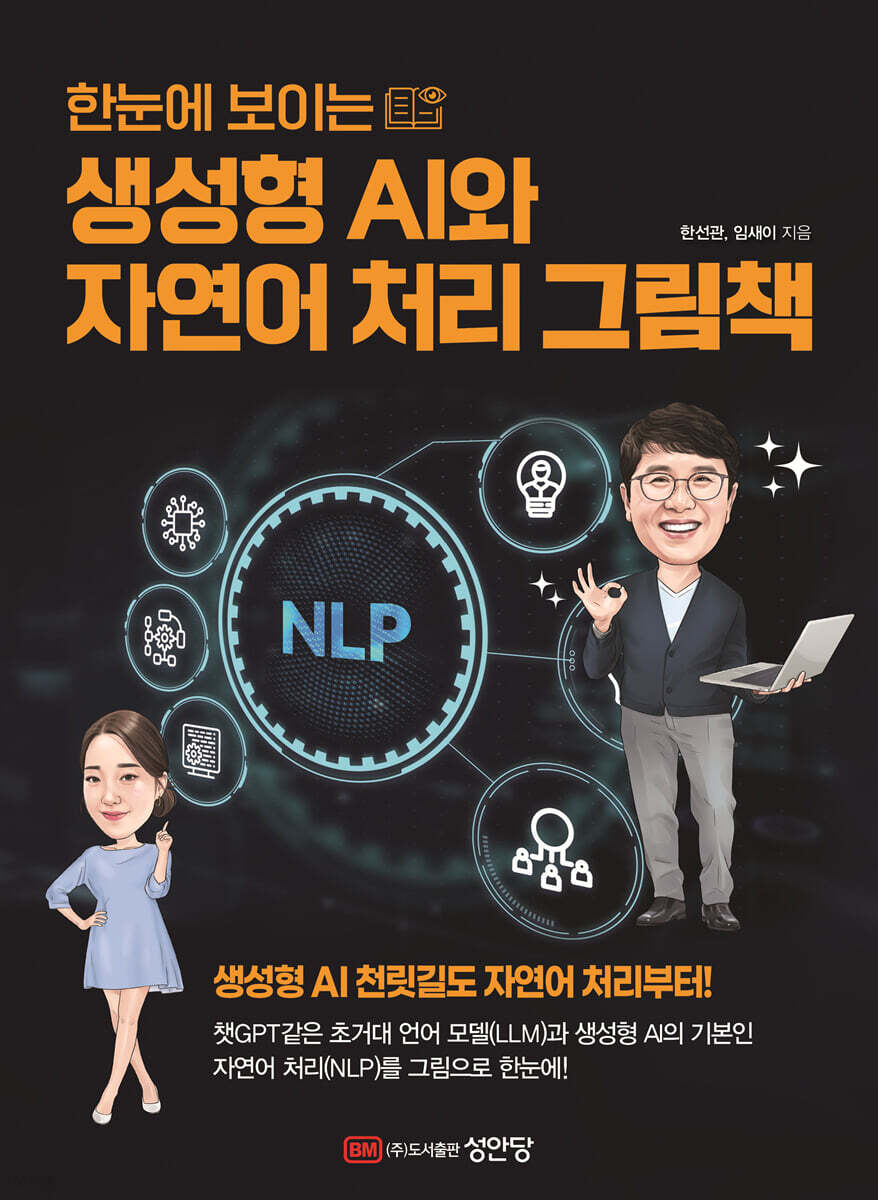
A Picture Book of Generative AI and Natural Language Processing at a Glance
 |
Description
Book Introduction
The world's easiest generative AI and natural language processing book!
A technology that allows machines to understand and process natural language used by humans.
A quick look at natural language processing (NLP) and generative AI!
The sixth installment of the "Picture Book at a Glance" series, the easiest book to read with pictures, "Natural Language Processing" covers the fundamentals of natural language processing (NLP), the basis of generative AI, a hot topic these days.
Generative AI is a type of AI capable of generating new content and ideas, such as conversations, stories, images, videos, and music. AI technology attempts to mimic human intelligence in new computing tasks, such as image recognition, natural language processing (NLP), and translation.
Generative AI is the next step in artificial intelligence, enabling AI to learn human language, programming languages, art, chemistry, biology, or other complex subjects. AI reuses training data to solve new problems.
For example, you can learn English vocabulary and then write poetry using the words you learn.
Natural language processing (NLP) focuses on the analysis of natural human language, allowing machines to learn how to understand and interpret sentences or phrases to answer questions, offer advice, provide translations, and interact with humans.
This process includes semantic analysis, speech tagging, syntactic analysis, and machine translation, and this book is structured to help readers easily understand the principles of how semantic analysis and syntactic analysis, which correspond to this process, are performed.
Natural language processing (NLP) is advancing further based on the Large Language Model (LLM), and it is expected to serve as the foundation for the development of chatbot AI such as ChatGPT. To help you take a step closer to the future of AI, generative AI, this book, written by Professor Han Seon-gwan, President of the Korean Society for Artificial Intelligence Education, and Professor Lim Sae-i, will provide a comprehensive overview of NLP and generative AI.
A technology that allows machines to understand and process natural language used by humans.
A quick look at natural language processing (NLP) and generative AI!
The sixth installment of the "Picture Book at a Glance" series, the easiest book to read with pictures, "Natural Language Processing" covers the fundamentals of natural language processing (NLP), the basis of generative AI, a hot topic these days.
Generative AI is a type of AI capable of generating new content and ideas, such as conversations, stories, images, videos, and music. AI technology attempts to mimic human intelligence in new computing tasks, such as image recognition, natural language processing (NLP), and translation.
Generative AI is the next step in artificial intelligence, enabling AI to learn human language, programming languages, art, chemistry, biology, or other complex subjects. AI reuses training data to solve new problems.
For example, you can learn English vocabulary and then write poetry using the words you learn.
Natural language processing (NLP) focuses on the analysis of natural human language, allowing machines to learn how to understand and interpret sentences or phrases to answer questions, offer advice, provide translations, and interact with humans.
This process includes semantic analysis, speech tagging, syntactic analysis, and machine translation, and this book is structured to help readers easily understand the principles of how semantic analysis and syntactic analysis, which correspond to this process, are performed.
Natural language processing (NLP) is advancing further based on the Large Language Model (LLM), and it is expected to serve as the foundation for the development of chatbot AI such as ChatGPT. To help you take a step closer to the future of AI, generative AI, this book, written by Professor Han Seon-gwan, President of the Korean Society for Artificial Intelligence Education, and Professor Lim Sae-i, will provide a comprehensive overview of NLP and generative AI.
- You can preview some of the book's contents.
Preview
index
preface
About the Author
Chapter 1: Fundamentals of Natural Language Processing
Lesson 1 Natural Language Processing
Lesson 2 Understanding Linguistics
Lesson 3 Text Preprocessing
Lesson 4 Vocabulary Analysis
Lesson 5 Syntax Analysis
Lesson 6: Semantic and Pragmatic Analysis
Chapter 2: Natural Language Processing Based on Deep Learning
Lesson 1: Deep Learning
Lesson 2 Embedding
Lesson 3: Convolutional Neural Networks (CNNs)
Lesson 4 Recurrent Neural Networks (RNNs)
Chapter 3: Realities and Applications of Natural Language Processing
Lesson 1 Text Classification
Lesson 2: Keywords and Information Extraction
Lesson 3 Text Summary
Lesson 4 Conversational Agents
Lesson 5 Machine Translation
Chapter 4 Large Language Models (LLMs) and Generative AI
Lesson 1: The Era of Large Language Models (LLMs)
Lesson 2: OpenAI's ChatGPT
Lesson 3: Microsoft's Bing AI
Lesson 4: Google's Gemini
Lesson 5: LLaMA
Lesson 6 Naver's HyperCLOVA X
Lesson 7 Multimodality and Language
Lesson 8: Ethical Issues in LLM
Lesson 9 With Natural Language Processing
About the Author
Chapter 1: Fundamentals of Natural Language Processing
Lesson 1 Natural Language Processing
Lesson 2 Understanding Linguistics
Lesson 3 Text Preprocessing
Lesson 4 Vocabulary Analysis
Lesson 5 Syntax Analysis
Lesson 6: Semantic and Pragmatic Analysis
Chapter 2: Natural Language Processing Based on Deep Learning
Lesson 1: Deep Learning
Lesson 2 Embedding
Lesson 3: Convolutional Neural Networks (CNNs)
Lesson 4 Recurrent Neural Networks (RNNs)
Chapter 3: Realities and Applications of Natural Language Processing
Lesson 1 Text Classification
Lesson 2: Keywords and Information Extraction
Lesson 3 Text Summary
Lesson 4 Conversational Agents
Lesson 5 Machine Translation
Chapter 4 Large Language Models (LLMs) and Generative AI
Lesson 1: The Era of Large Language Models (LLMs)
Lesson 2: OpenAI's ChatGPT
Lesson 3: Microsoft's Bing AI
Lesson 4: Google's Gemini
Lesson 5: LLaMA
Lesson 6 Naver's HyperCLOVA X
Lesson 7 Multimodality and Language
Lesson 8: Ethical Issues in LLM
Lesson 9 With Natural Language Processing
Detailed image

GOODS SPECIFICS
- Date of issue: March 20, 2024
- Page count, weight, size: 256 pages | 544g | 188*257*15mm
- ISBN13: 9788931558685
- ISBN10: 8931558686
You may also like
카테고리
korean


korean

![GQ KOREA Mark (Monthly): December [2025]](http://librairie.coreenne.fr/cdn/shop/files/8ef265dbbfbf186523ed75ba7319009d.jpg?v=1765340328&width=3840)


