

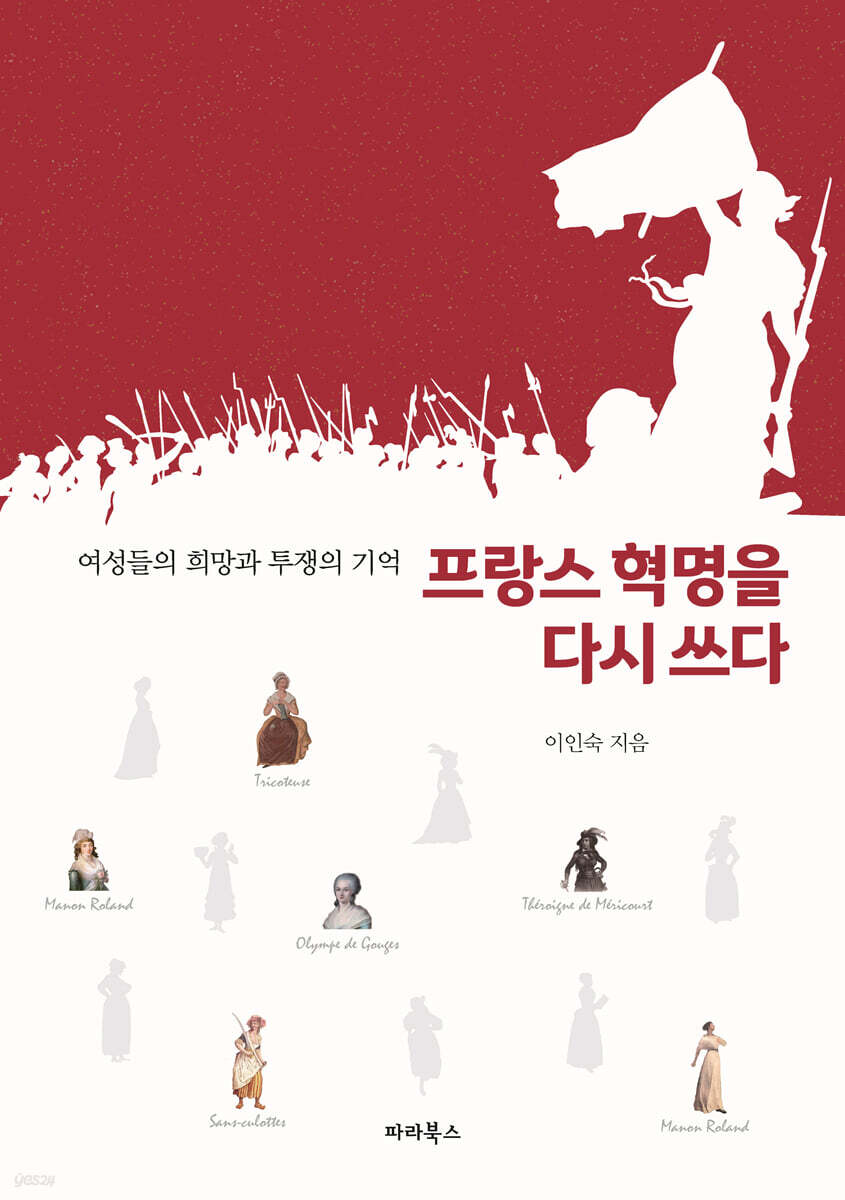
Rewriting the French Revolution
 |
Description
Book Introduction
“The history of revolution and progress continues even today.
In the winter of 2024 to 2025, a historic event occurred in our country called the “Revolution of Light.”
The process was broadcast throughout our country and around the world through television, YouTube, and individual social media.
On the night of December 3rd, people from all over the country rushed to protect the National Assembly, and since then, countless people have gathered in the square every day, staying up all night in the bitter cold to guard the square and the streets.
There were both men and women there.
There were a lot of women in their 20s and 30s who led the 'revolution of light' with cheering sticks, but we don't call it a women's revolution.
Because in the world we will create from now on, no one will be excluded.
In 1789, a great revolution took place in France that would go down in world history, and both men and women were involved.
But in the French Revolution, women's names were erased.
Although it was called a great revolution, the world afterwards promoted freedom, equality, and brotherhood for men, and women's rights were ignored.
This book restores the role of women, which had been erased from the forefront of history, as in the 2024 Paris Olympics, where the motto was “sorority” instead of “fraternity” along with “liberty” and “equality,” and a statue of Olympe de Gouges appeared at the opening ceremony.
The author analyzes the history of frustration in which the ideals of revolution were not granted to women, and sees how this overlaps with the struggles women have endured in our country's modern history.
This book goes beyond the history of the past and raises powerful questions about the "ongoing history" that struggles against the reality that "there is no structural gender discrimination."
In the winter of 2024 to 2025, a historic event occurred in our country called the “Revolution of Light.”
The process was broadcast throughout our country and around the world through television, YouTube, and individual social media.
On the night of December 3rd, people from all over the country rushed to protect the National Assembly, and since then, countless people have gathered in the square every day, staying up all night in the bitter cold to guard the square and the streets.
There were both men and women there.
There were a lot of women in their 20s and 30s who led the 'revolution of light' with cheering sticks, but we don't call it a women's revolution.
Because in the world we will create from now on, no one will be excluded.
In 1789, a great revolution took place in France that would go down in world history, and both men and women were involved.
But in the French Revolution, women's names were erased.
Although it was called a great revolution, the world afterwards promoted freedom, equality, and brotherhood for men, and women's rights were ignored.
This book restores the role of women, which had been erased from the forefront of history, as in the 2024 Paris Olympics, where the motto was “sorority” instead of “fraternity” along with “liberty” and “equality,” and a statue of Olympe de Gouges appeared at the opening ceremony.
The author analyzes the history of frustration in which the ideals of revolution were not granted to women, and sees how this overlaps with the struggles women have endured in our country's modern history.
This book goes beyond the history of the past and raises powerful questions about the "ongoing history" that struggles against the reality that "there is no structural gender discrimination."
- You can preview some of the book's contents.
Preview
index
Recommendation
Prologue: The French Revolution That Erased Women
Part 1: Women Who Jumped into the Revolution with Hope and Passion
1.
Scenes on the eve of the revolution
2.
The March on Versailles and the Women's Mass Action
3.
Various struggles of common women
4.
The view of women by men during the revolutionary period
5.
People's Association and Women's Club
6.
Revolutionary Republican Women's Civic Association
7.
The extinction of the women's movement
Part 2: Women Activists of the Revolutionary Period
1.
The Warrior of the Revolution, Théroigne de Méricourt
2.
Claire Lacombe, a fighter for the women's club
3.
Manon Rolland, the goddess of the Girondins
4.
Olympe de Gouges, a pioneer of French feminism
| Epilogue | A Manga for the Women Who Dedicated themselves to the Revolution
Chronology of the French Revolution
annotation
References
Prologue: The French Revolution That Erased Women
Part 1: Women Who Jumped into the Revolution with Hope and Passion
1.
Scenes on the eve of the revolution
2.
The March on Versailles and the Women's Mass Action
3.
Various struggles of common women
4.
The view of women by men during the revolutionary period
5.
People's Association and Women's Club
6.
Revolutionary Republican Women's Civic Association
7.
The extinction of the women's movement
Part 2: Women Activists of the Revolutionary Period
1.
The Warrior of the Revolution, Théroigne de Méricourt
2.
Claire Lacombe, a fighter for the women's club
3.
Manon Rolland, the goddess of the Girondins
4.
Olympe de Gouges, a pioneer of French feminism
| Epilogue | A Manga for the Women Who Dedicated themselves to the Revolution
Chronology of the French Revolution
annotation
References
Detailed image

Into the book
During the famine, the first to take the lead in the riots caused by food shortages were women from the common classes.
These people, who were merchants and odd jobs in the central market of Paris, laundresses, clerks, and workers in the textile mills, were responsible for a significant portion of their families' livelihoods.
They were willing to do anything to feed their families.
However, records of these are very rare and most of them remain anonymous.
Even the rare records that remain depict these women as dirty, ugly, threatening, terrifying, and more beastly than human.
This is because the bourgeois men who wrote the book could not understand the desperation of lower-class women trying to feed their families.
--- 「Part 1.
1. From “Scenes on the Eve of Revolution”
The women, who had initially gathered at the city hall to demand bread, decided to march towards Versailles, where King Louis XVI was staying.
They marched, chanting, “Let’s go find the baker and his wife!”
Their real target was the king who would solve the bread problem.
The number of women participating in the march initially was around 7,000, but gradually increased to nearly 10,000.
Husbands followed this revolutionary march led by women.
It was raining that day.
At around 5 p.m., the Parisian women finally arrived at their destination, drenched in rain.
The women, who had marched about 20 kilometers in the rain for six hours, forced their way into the National Assembly with their skirts soaked and muddy.
The women interrupted the speeches in the parliament and shouted.
“No more words are needed.
“Give me some bread!”
--- 「Part 1.
2. From “March on Versailles and Women’s Mass Action”
Women who were left alone because their fathers were incompetent or dead had to do whatever it took to keep their children from starving, and they did not hesitate to beg with their children.
Especially during the years of crop failure and famine around 1789, when even these jobs were difficult to find, women took to the streets in bread riots.
In fact, women were prosecuted far more often than men in the food riots that took place over several years starting in 1789.
It could be said that the bread riots of the French Revolution were markedly feminine.
What is the reason?
One cannot help but think that this is because women were more devoted to their families, along with a strong sense of responsibility for raising children.
--- 「Part 1.
3. Among the various struggles of women in the people
To keep women out of the public sphere and confined to the home, they emphasized that a woman's duty was solely to protect the home and that her role was to cultivate virtuous citizens for the country.
The role of women is to be the so-called 'mother of the republic', who devotes herself to housework and childcare while nurturing excellent citizens of the republic.
The plausible packaging was nothing more than a conspiracy to confine women to the private sphere of the home.
This was a theme repeatedly advocated by most revolutionary leaders.
--- 「Part 1.
4. From “Revolutionary Men’s Views on Women”
Théroigne de Méricourt, known as the 'Warrior of the Revolution' and the 'Goddess of Liberty', was a woman who became a legend of the French Revolution during her lifetime.
The image of a beautiful Amazon warrior woman in a feathered hat, red frock coat, and sword at her side, with her passionate revolutionary activities captivated the crowds and became a symbol of the revolution that thrilled the hearts of those who dedicated themselves to the revolution for freedom and equality.
Fact and legend were intertwined, and her name was mentioned at every crucial juncture of the revolution, and her role was exaggerated, even including activities she did not participate in.
When she returned to Paris, she became a heroine of the revolution, as the counter-revolutionary aristocracy who had gone over there kidnapped her and took her to Austria.
--- 「Part 2.
1. From "The Warrior of the Revolution, Théroigne de Méricourt"
Lacombe's first public appearance was a speech he delivered on the railing of the National Assembly on July 25, 1792.
Women were not allowed to stand on the podium of the House of Commons, but were permitted to speak from the railings of the gallery.
A young woman, then an unknown actress in the south of France, stood on the railings of the parliament and addressed hundreds of male lawmakers.
She was by no means an ordinary woman.
In her speech that day, Lacombe generously demonstrated her qualities as an orator and the true face of a female warrior.
In the introduction, she introduced herself as French and an unemployed artist.
--- 「Part 2.
2. From "Claire Lacombe, the Women's Club Fighter"
On October 31, a cart carrying Girondin deputies headed to the execution grounds.
They all stood up and sang the revolutionary song, the Hymn of Marseille.
On November 8, Madame Roland's trial was held, and she was sentenced to death and executed that very day.
On the wagon to the execution ground, she kept talking to another condemned man, who was completely exhausted, and made him smile.
Shouts and curses could be heard along the path the cart passed.
Standing before the guillotine, she uttered the famous words in a mournful voice: “Oh, freedom! How many crimes are committed in your name!”
- Part 2.
3. Manon Rolland, the goddess of the Girondins
Among the women beheaded during the French Revolution, Olympe de Gouges was one of the very few executed for publishing political writings.
She was a very exceptional woman who, as a petty bourgeois from the provinces, rejected the ordinary life and achieved social and intellectual advancement with her passionate humanism in an era when women's social activities were not permitted.
At the end of the 18th century, Goose, who actively participated in reality and demonstrated true humanism, was re-evaluated as a pioneer in the history of thought only after World War II.
Olympe de Gouges was the first woman to publicly express the passion for feminism that burned hotly along with the fervor of the revolution.
As a pioneer of French feminism, she is often considered a symbol of the women's liberation movement, but Gouges demonstrated a broad humanism and political thought that cannot be limited to feminism.
These people, who were merchants and odd jobs in the central market of Paris, laundresses, clerks, and workers in the textile mills, were responsible for a significant portion of their families' livelihoods.
They were willing to do anything to feed their families.
However, records of these are very rare and most of them remain anonymous.
Even the rare records that remain depict these women as dirty, ugly, threatening, terrifying, and more beastly than human.
This is because the bourgeois men who wrote the book could not understand the desperation of lower-class women trying to feed their families.
--- 「Part 1.
1. From “Scenes on the Eve of Revolution”
The women, who had initially gathered at the city hall to demand bread, decided to march towards Versailles, where King Louis XVI was staying.
They marched, chanting, “Let’s go find the baker and his wife!”
Their real target was the king who would solve the bread problem.
The number of women participating in the march initially was around 7,000, but gradually increased to nearly 10,000.
Husbands followed this revolutionary march led by women.
It was raining that day.
At around 5 p.m., the Parisian women finally arrived at their destination, drenched in rain.
The women, who had marched about 20 kilometers in the rain for six hours, forced their way into the National Assembly with their skirts soaked and muddy.
The women interrupted the speeches in the parliament and shouted.
“No more words are needed.
“Give me some bread!”
--- 「Part 1.
2. From “March on Versailles and Women’s Mass Action”
Women who were left alone because their fathers were incompetent or dead had to do whatever it took to keep their children from starving, and they did not hesitate to beg with their children.
Especially during the years of crop failure and famine around 1789, when even these jobs were difficult to find, women took to the streets in bread riots.
In fact, women were prosecuted far more often than men in the food riots that took place over several years starting in 1789.
It could be said that the bread riots of the French Revolution were markedly feminine.
What is the reason?
One cannot help but think that this is because women were more devoted to their families, along with a strong sense of responsibility for raising children.
--- 「Part 1.
3. Among the various struggles of women in the people
To keep women out of the public sphere and confined to the home, they emphasized that a woman's duty was solely to protect the home and that her role was to cultivate virtuous citizens for the country.
The role of women is to be the so-called 'mother of the republic', who devotes herself to housework and childcare while nurturing excellent citizens of the republic.
The plausible packaging was nothing more than a conspiracy to confine women to the private sphere of the home.
This was a theme repeatedly advocated by most revolutionary leaders.
--- 「Part 1.
4. From “Revolutionary Men’s Views on Women”
Théroigne de Méricourt, known as the 'Warrior of the Revolution' and the 'Goddess of Liberty', was a woman who became a legend of the French Revolution during her lifetime.
The image of a beautiful Amazon warrior woman in a feathered hat, red frock coat, and sword at her side, with her passionate revolutionary activities captivated the crowds and became a symbol of the revolution that thrilled the hearts of those who dedicated themselves to the revolution for freedom and equality.
Fact and legend were intertwined, and her name was mentioned at every crucial juncture of the revolution, and her role was exaggerated, even including activities she did not participate in.
When she returned to Paris, she became a heroine of the revolution, as the counter-revolutionary aristocracy who had gone over there kidnapped her and took her to Austria.
--- 「Part 2.
1. From "The Warrior of the Revolution, Théroigne de Méricourt"
Lacombe's first public appearance was a speech he delivered on the railing of the National Assembly on July 25, 1792.
Women were not allowed to stand on the podium of the House of Commons, but were permitted to speak from the railings of the gallery.
A young woman, then an unknown actress in the south of France, stood on the railings of the parliament and addressed hundreds of male lawmakers.
She was by no means an ordinary woman.
In her speech that day, Lacombe generously demonstrated her qualities as an orator and the true face of a female warrior.
In the introduction, she introduced herself as French and an unemployed artist.
--- 「Part 2.
2. From "Claire Lacombe, the Women's Club Fighter"
On October 31, a cart carrying Girondin deputies headed to the execution grounds.
They all stood up and sang the revolutionary song, the Hymn of Marseille.
On November 8, Madame Roland's trial was held, and she was sentenced to death and executed that very day.
On the wagon to the execution ground, she kept talking to another condemned man, who was completely exhausted, and made him smile.
Shouts and curses could be heard along the path the cart passed.
Standing before the guillotine, she uttered the famous words in a mournful voice: “Oh, freedom! How many crimes are committed in your name!”
- Part 2.
3. Manon Rolland, the goddess of the Girondins
Among the women beheaded during the French Revolution, Olympe de Gouges was one of the very few executed for publishing political writings.
She was a very exceptional woman who, as a petty bourgeois from the provinces, rejected the ordinary life and achieved social and intellectual advancement with her passionate humanism in an era when women's social activities were not permitted.
At the end of the 18th century, Goose, who actively participated in reality and demonstrated true humanism, was re-evaluated as a pioneer in the history of thought only after World War II.
Olympe de Gouges was the first woman to publicly express the passion for feminism that burned hotly along with the fervor of the revolution.
As a pioneer of French feminism, she is often considered a symbol of the women's liberation movement, but Gouges demonstrated a broad humanism and political thought that cannot be limited to feminism.
--- 「Part 2.
4. From “Olymp de Gouges, the Pioneer of French Feminism”
4. From “Olymp de Gouges, the Pioneer of French Feminism”
Publisher's Review
"Give us bread!" The women who led the revolution, walking 20 kilometers in the rain.
The women, who were merchants in the central market of Paris, laundresses, and textile workers, were described by male politicians and historians as “filthy, ugly, and menacing beasts,” but their desperate struggle, driven by “desperation to feed their families,” marked a major turning point in the revolution.
In particular, in October 1789, women who had gathered at the city hall demanding bread marched to the Palace of Versailles with the slogan, “Let us go and find the baker and his wife!”
After marching 20 kilometers in the rain with over 10,000 women, they said, “Words are no longer needed.
“Give us bread!” they shouted, pushing open the door to the National Assembly.
When men hesitated, this march led by women played a decisive role in bringing the king back to Paris from the Palace of Versailles.
The deceptive frames of "knitters" and "mothers of the republic"
Women didn't just stop at asking for bread on the streets.
They sat in the parliamentary gallery, observed the meetings, shouted and made their demands known, and even organized a women's-only political group, the "Women's Club," to make their political voices heard.
These women participated in the revolution by knitting in the parliamentary galleries and were called “knitters.”
But as the revolution progressed, even the male leaders who had initially encouraged women's active participation eventually rejected their participation.
They confined women solely to the 'realm of home and motherhood' and emphasized only their role as 'mothers of the republic' who nurture virtuous citizens for the fatherland.
This seemingly plausible packaging was nothing more than a conspiracy to expel women from the public sphere, and the revolutionary government suppressed the weakest link, the women's movement, under the pretext of restoring social order.
Women who dedicated themselves to the revolution and were beheaded
Part 2 of this book vividly introduces the lives and thoughts of four female activists who have been obscured by revolutionary history.
Théroigne de Méricourt, known as the 'Warrior of the Revolution', was a symbol of the revolution that captivated crowds in the streets.
Claire Lacombe, the 'Women's Club Fighter', showed her true colors by addressing hundreds of male MPs from the railings of the parliament, despite being an ordinary actress.
Manon Rolland, the 'goddess of the Girondins', was beheaded with the famous words, "Oh, liberty! How many crimes are committed in your name!"
And Olympe de Gouges was a pioneer of French feminism who published the “Declaration of the Rights of Woman,” and showed a wide range of humanism and political thought that could not be limited to feminism.
What do women's experiences in the French Revolution tell us?
The author says that the experiences of women in the French Revolution strangely overlap with the democratization process in our country's modern history.
Within the cause and ideals of democracy, women's rights have always been relegated to a lower priority, but ultimately, they have established themselves as the main force that changed the course of history.
The democratization process in modern Korean history also follows a similar trajectory.
Women fought devotedly in the democratization struggle of the 1980s.
However, women's names were easily erased from the achievements and commemorations following democratization.
In the male-centered narrative of democratization, women's issues have always been a 'postponed task.'
But eventually, after a long struggle and a lot of voices, the household system was abolished and legal and institutional equality was advanced.
As a result, the French Revolution was a history of both achievement and frustration for women.
Although women never fully achieved their rights as citizens, their resistance and sacrifice served as a starting point for expanding the discourse on gender equality, and even today, they serve as a historical asset that prompts reflection on issues of democracy and gender equality.
The women, who were merchants in the central market of Paris, laundresses, and textile workers, were described by male politicians and historians as “filthy, ugly, and menacing beasts,” but their desperate struggle, driven by “desperation to feed their families,” marked a major turning point in the revolution.
In particular, in October 1789, women who had gathered at the city hall demanding bread marched to the Palace of Versailles with the slogan, “Let us go and find the baker and his wife!”
After marching 20 kilometers in the rain with over 10,000 women, they said, “Words are no longer needed.
“Give us bread!” they shouted, pushing open the door to the National Assembly.
When men hesitated, this march led by women played a decisive role in bringing the king back to Paris from the Palace of Versailles.
The deceptive frames of "knitters" and "mothers of the republic"
Women didn't just stop at asking for bread on the streets.
They sat in the parliamentary gallery, observed the meetings, shouted and made their demands known, and even organized a women's-only political group, the "Women's Club," to make their political voices heard.
These women participated in the revolution by knitting in the parliamentary galleries and were called “knitters.”
But as the revolution progressed, even the male leaders who had initially encouraged women's active participation eventually rejected their participation.
They confined women solely to the 'realm of home and motherhood' and emphasized only their role as 'mothers of the republic' who nurture virtuous citizens for the fatherland.
This seemingly plausible packaging was nothing more than a conspiracy to expel women from the public sphere, and the revolutionary government suppressed the weakest link, the women's movement, under the pretext of restoring social order.
Women who dedicated themselves to the revolution and were beheaded
Part 2 of this book vividly introduces the lives and thoughts of four female activists who have been obscured by revolutionary history.
Théroigne de Méricourt, known as the 'Warrior of the Revolution', was a symbol of the revolution that captivated crowds in the streets.
Claire Lacombe, the 'Women's Club Fighter', showed her true colors by addressing hundreds of male MPs from the railings of the parliament, despite being an ordinary actress.
Manon Rolland, the 'goddess of the Girondins', was beheaded with the famous words, "Oh, liberty! How many crimes are committed in your name!"
And Olympe de Gouges was a pioneer of French feminism who published the “Declaration of the Rights of Woman,” and showed a wide range of humanism and political thought that could not be limited to feminism.
What do women's experiences in the French Revolution tell us?
The author says that the experiences of women in the French Revolution strangely overlap with the democratization process in our country's modern history.
Within the cause and ideals of democracy, women's rights have always been relegated to a lower priority, but ultimately, they have established themselves as the main force that changed the course of history.
The democratization process in modern Korean history also follows a similar trajectory.
Women fought devotedly in the democratization struggle of the 1980s.
However, women's names were easily erased from the achievements and commemorations following democratization.
In the male-centered narrative of democratization, women's issues have always been a 'postponed task.'
But eventually, after a long struggle and a lot of voices, the household system was abolished and legal and institutional equality was advanced.
As a result, the French Revolution was a history of both achievement and frustration for women.
Although women never fully achieved their rights as citizens, their resistance and sacrifice served as a starting point for expanding the discourse on gender equality, and even today, they serve as a historical asset that prompts reflection on issues of democracy and gender equality.
GOODS SPECIFICS
- Date of issue: October 10, 2025
- Page count, weight, size: 319 pages | 148*210*19mm
- ISBN13: 9791188509928
- ISBN10: 1188509926
You may also like
카테고리
korean


korean

![GQ KOREA Mark (Monthly): December [2025]](http://librairie.coreenne.fr/cdn/shop/files/8ef265dbbfbf186523ed75ba7319009d.jpg?v=1765340328&width=3840)


