

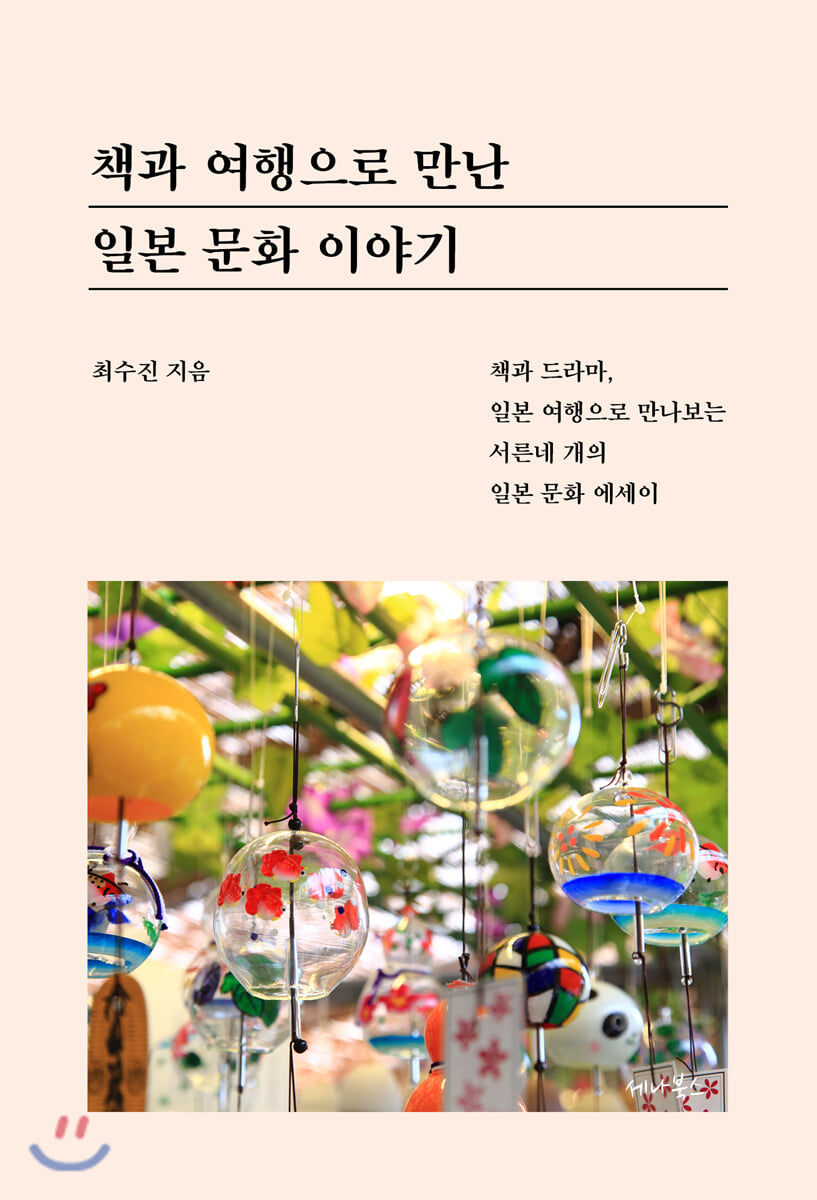
Stories of Japanese culture discovered through books and travel
 |
Description
Book Introduction
Thirty-Four Essays on Japanese Culture Through Books, Dramas, and Travel
Let's read about Japanese culture in general, including Japanese book culture, unique bookstores, Japanese craftsmanship, Japanese bathing culture, Japanese food, Japanese dramas, Japanese authors, and Japanese travel. Experience Japanese culture you didn't know much about and feel like you're briefly traveling to Japan with the author.
You will have the pleasure of getting to know aspects of Japanese culture you may not have known about before while getting a glimpse into one way of consuming Japanese culture.
You will also be able to receive fresh stimulation by encountering new and unique cultures and cultural phenomena.
Let's read about Japanese culture in general, including Japanese book culture, unique bookstores, Japanese craftsmanship, Japanese bathing culture, Japanese food, Japanese dramas, Japanese authors, and Japanese travel. Experience Japanese culture you didn't know much about and feel like you're briefly traveling to Japan with the author.
You will have the pleasure of getting to know aspects of Japanese culture you may not have known about before while getting a glimpse into one way of consuming Japanese culture.
You will also be able to receive fresh stimulation by encountering new and unique cultures and cultural phenomena.
- You can preview some of the book's contents.
Preview
index
Entering _004
Chapter 1: Japanese Book Culture and Bookstores
Japanese and Manga _014
Let's go to a unique Japanese bookstore _019
Lifestyle Bookstore, Daikanyama Tsutaya _023
Chapter 2: Walking through Japan
The Power of Storytelling: The Power of Japanese Tourism _028
Ureshino River and Hot Springs Walk _031
I went shopping in Ginza for four days.
And… _036
Why Japanese Ryokan Are Special _040
Secrets of Kyoto's Nishiki Market _044
Chapter 3: Japan through Books and Dramas
Meeting Young Japanese Writers: Ryo Asai of "Who" _050
Professor Yoo Hong-jun's My Cultural Heritage Tour: Japan _054
"The Japanese Who Tried to Reduce: Japan Hasn't Changed at All" _058
Why are Ekuni Kaori and Masuda Miri so popular in Korea? _062
Professor Kim Hyun-goo's Japan Story _065
The drama [Osen], Okami-san, and Sukiyaki _068
Kyoto Isn't Japan? 『Japanese Culture in Daily Life』_073
Chapter 4: Japanese Craftsmanship
The elegance of Japanese ryokans comes from their craftsmanship _078
The Power of Japanese Craftsmanship and Concept _082
Japanese Confectionery Story _086
Miyazaki Kamaage Udon Restaurant Iwami _090
Chapter 5: Experiencing Japanese Culture
Japanese and Bathing Culture _096
Japanese Lunch _099
Morning and Evening Nation _102
Going to a Beauty Salon in Japan _106
Let's go to a Japanese late-night restaurant (a restaurant open 24 hours) _109
Let's go to a Japanese neighborhood bathhouse _113
Taking a Taxi in Osaka _117
Taking a Taxi in Yufuin _121
Japanese Culture You Can't Learn at School_127
My Sharehouse Experience While Studying Abroad in Japan _130
Shiseido, a paradise for Japanese working moms _134
What's Your Soul Food? Japanese Udon Story _138
Chapter 6: Japanese Culture Essay
A Trip to Tokyo After 10 Years _144
Have you heard of voluntary freeter? _153
Is it okay not to get married? _159
Chapter 1: Japanese Book Culture and Bookstores
Japanese and Manga _014
Let's go to a unique Japanese bookstore _019
Lifestyle Bookstore, Daikanyama Tsutaya _023
Chapter 2: Walking through Japan
The Power of Storytelling: The Power of Japanese Tourism _028
Ureshino River and Hot Springs Walk _031
I went shopping in Ginza for four days.
And… _036
Why Japanese Ryokan Are Special _040
Secrets of Kyoto's Nishiki Market _044
Chapter 3: Japan through Books and Dramas
Meeting Young Japanese Writers: Ryo Asai of "Who" _050
Professor Yoo Hong-jun's My Cultural Heritage Tour: Japan _054
"The Japanese Who Tried to Reduce: Japan Hasn't Changed at All" _058
Why are Ekuni Kaori and Masuda Miri so popular in Korea? _062
Professor Kim Hyun-goo's Japan Story _065
The drama [Osen], Okami-san, and Sukiyaki _068
Kyoto Isn't Japan? 『Japanese Culture in Daily Life』_073
Chapter 4: Japanese Craftsmanship
The elegance of Japanese ryokans comes from their craftsmanship _078
The Power of Japanese Craftsmanship and Concept _082
Japanese Confectionery Story _086
Miyazaki Kamaage Udon Restaurant Iwami _090
Chapter 5: Experiencing Japanese Culture
Japanese and Bathing Culture _096
Japanese Lunch _099
Morning and Evening Nation _102
Going to a Beauty Salon in Japan _106
Let's go to a Japanese late-night restaurant (a restaurant open 24 hours) _109
Let's go to a Japanese neighborhood bathhouse _113
Taking a Taxi in Osaka _117
Taking a Taxi in Yufuin _121
Japanese Culture You Can't Learn at School_127
My Sharehouse Experience While Studying Abroad in Japan _130
Shiseido, a paradise for Japanese working moms _134
What's Your Soul Food? Japanese Udon Story _138
Chapter 6: Japanese Culture Essay
A Trip to Tokyo After 10 Years _144
Have you heard of voluntary freeter? _153
Is it okay not to get married? _159
Into the book
When it comes to books about Japan, I mainly read books on Japanese culture written by Koreans or translated and published by Japanese people.
I started traveling to Japan in earnest in 2011 and have been there 17 times.
A trip to Japan, where I occasionally get to escape the ordinary and boring daily life, is healing in itself.
When I'm exposed to new environments and cultures, I get a lot of ideas, and this energy is a great help in my work.
--- p.
5
Since starting my own publishing company in 2015, I have published several essays on Japan with excellent writers.
I think it was possible because of my many years of interest in, reading about, and traveling around Japan.
Fortunately, many readers have read the Japanese essays and Japanese travel essays published by Senabooks and have given them positive reviews.
In a way, you could say that I connected my interest in Japan and my hobby of traveling to Japan with my job.
I am truly grateful.
--- p.
5
I also occasionally buy Japanese magazines, and I am often surprised at how cheap they are for this level of quality.
It's a kind of popular service for readers.
Of course, this is only possible for large publishers in Japan, but it's surprising and enviable that thanks to the large sales of manga, they have the financial means to publish educational books for a small number of people.
--- p.
16
An edit store is a concept unfamiliar to us, but simply put, it is a store that, unlike large bookstores that focus on new releases, is a small store that carefully selects and displays books to maximize efficiency.
There are stores that are still going through trial and error in terms of standards for displaying books, and each bookstore has its own unique characteristics.
--- p.
20
The theme of Ginza Six Tsutaya is said to be art.
When I went there in person, there were so many different types of magazines and so many magazines with attractive content that I couldn't help but stay in the bookstore for a long time.
For example, I lost track of time and wandered around the bookstore several times because it was full of magazines and magazines with attractive and cool titles like [Reasons to Take Pictures with Leica], [A Journey to Discover the Real Kyoto], and [150 Japanese Hot Springs Designed for Ultimate Healing].
There's always a Starbucks in every Tsutaya store, and books and coffee are a fantastic combination.
Tsutaya is undoubtedly an attractive bookstore that draws many people to its stores to provide an experience that cannot be purchased online.
--- p.
25
If you're planning a trip to a Japanese hot spring, be sure to check the amount of hot spring water you get to experience the dreamy and magical atmosphere unique to hot springs.
By the way, Beppu Onsen is said to have the highest water output.
Yufuin is right nearby, so the water flow is high.
I think the reason Yufuin has become so popular recently is closely related to this amount of water.
It's been a year since I visited Yufuin, and only after visiting Ureshino Onsen, have I realized that Yufuin's competitiveness isn't just its cute and pretty streets.
--- p.
35
It is shocking, even despairing, that the problems Professor Lee Eo-ryeong points out about Japan in this book are still ongoing 20 years later and nothing has been resolved.
It is no exaggeration to say that if Japan does not reflect on itself, there will be no future for East Asia, coexisting with other countries.
--- p.
59
Ekuni Kaori's essay, "How Many Weekends Do You Have?" is so honest it's chilling.
If a woman who is hesitant about marriage reads this, she should be very careful, as it could ruin her marriage.
Ah, I think that men are similar in both Korea and Japan, and in that sense, I feel a sense of kinship with the author.
“This person, did he marry me just for food?” she thought…
--- p.
63
Many people recommend the drama Osen as a good drama for those who are thinking about starting a business.
The drama makes us think again about what a good store, a good restaurant, and good service are.
Could it be that the reason we're so fascinated by dramas like Osen is because we think a store like Isshouan would be impossible to realize in real life?
--- p.
72
Osaka and Kyoto are so Japanese (from the perspective of people from other countries) that they seem strange, but Kyoto is not so Japanese that it is actually considered a world-class city.
The image we usually have of Kyoto is that it is 'Japanese', but it's interesting that Kyoto is actually not Japanese.
Actually, it sounds quite plausible, considering that Kyoto is a city loved by people all over the world.
--- p.
76
In some ways, the idea that a ryokan is selective about who it accepts may seem arrogant, but in another way, it means, “We only do our best for normal customers who have the minimum courtesy.”
By preventing the risk of losing time and effort to strange guests in advance, you can do your best to accommodate the "real guests" who come to your ryokan.
The fact that ryokans have many cultural assets and valuable items may be the reason why it is not easy to accept just anyone as a guest.
--- p.
80
What's interesting is that not only is the concept important, but it also has a deep connection to the characteristics of long-lived Japanese companies.
The management philosophy of Toraya, a traditional Japanese confectionery company boasting 500 years of history, as cited in the book, is to “enable you to enjoy delicious Japanese confectionery.”
Looking at the perfection of Doraya's traditional Japanese confectionery, you can see that there is no compromise whatsoever. It is said that when sincerity is put into the product along with this lack of compromise, the power of the concept is maximized.
--- p.
83
We strive to deliver the best taste every day, and if we fall short, we close our doors and stop selling our products.
We put our heart into our products without compromise.
What on earth do these snacks taste like? Aren't you curious? Even Jiro Ono, Japan's top sushi chef, offers advice to his son, who is taking over the family business.
'I need to repeat this throughout my life.
That's the most important thing.' This repetition is not just repetition.
As novelist Kim Tak-hwan said, it is “repetition with sincerity.”
--- p.
88
On the taxi ride back to the hotel from Aoshima, I told the driver that I had udon in Iwami. He was surprised and asked how I knew about it, saying that it was one of the "Three Udon Restaurants Recommended by Miyazaki Taxi Drivers."
The udon was delicious, but I remember the person who took my order the most.
A restaurant that insists on boiling noodles every time an order is placed.
An udon restaurant that has the guts to say that you don't have to order if you don't want to because it takes a long time.
Isn't that wonderful? The old man's blunt question contained his determination to make every single bowl of udon exactly as promised to his customers.
--- p.
93
There is a Korean joke that says that the three things a quiet, blunt Korean man says when he comes home in the evening are 'Ah-neun (child), Bap-do (give me food), and sleep.'
There is something similar in Japan. When a blunt Japanese man comes home, the three things he says are 'give me bath water, give me food, and let's go to sleep.'
This is a story that shows how much Japanese people love bathing. ^^
--- p.
98
Next stop was the Yufudake Crater, which is truly the knight's secret weapon.
It is said that only drivers of two taxi companies licensed by Yufuin are allowed to enter the area around the crater.
As we climbed up the mountainside, a hot spring appeared.
It was a hot spring called 'Sugihara', and it was said to be a famous place known only to locals.
In fact, it seems to be a hidden gem since it doesn't appear in guidebooks or internet searches.
--- p.
124
All the Japanese friends I made in my dorm 12 years ago are now married and have children.
I sometimes wonder what my Japanese friends thought when I suddenly appeared like an alien one day.
Those friends of mine? When I first met them, they were just one of 130 million Japanese people, but now they're the most lovable friends in the entire universe.
--- p.
133
It may seem like nothing but udon, but my father puts all his heart into it.
Using machines and refrigerators makes work easier.
However, in order to make the same-tasting udon every day, we boil the noodles just before serving them to elementary school children who receive school lunches to ensure they are as fresh as possible.
I really cried at this part.
The experience was even more profound because I experienced firsthand what it was like to boil freshly kneaded udon noodles and how it differed from pre-boiled noodles.
--- p.
140
I bought some unique raisins, dried grapes in whole bunches.
Senbikia, a 150-year-old fruit shop in Ginza that even the genius poet Lee Sang loved, sells melons, dried in bunches. The taste is beyond imagination.
Is this what happens when you dry grapes like dried persimmons? I'm making a haphazard plan to one day visit all of Japan's famous depachika.
--- p.
148
Tokyo feels more special because of the memories.
Tokyo is a completely unknown world to those who have never been there, but a place of vague memories for those who have experienced it at least once.
What makes a trip to Tokyo so fun is that there's something to look forward to.
New encounters, amazing places, beautiful scenery, and something in my heart that grows a little more as I feel the city breeze, that kind of anticipation…
--- p.
152
What's even more surprising is why young people are happy.
It is precisely because we do not expect a 'hopeful future' that we feel happy now.
The current mindset of young Japanese people is to put aside future goals that may not be achieved and enjoy the present.
When we stop pinning our hopes on the future, we start thinking, “I’m happy now” or “I’m satisfied with my current life.”
Looking at Japan makes me think about Korea's future.
Although Korea is still younger than Japan, it is already following in Japan's footsteps.
I started traveling to Japan in earnest in 2011 and have been there 17 times.
A trip to Japan, where I occasionally get to escape the ordinary and boring daily life, is healing in itself.
When I'm exposed to new environments and cultures, I get a lot of ideas, and this energy is a great help in my work.
--- p.
5
Since starting my own publishing company in 2015, I have published several essays on Japan with excellent writers.
I think it was possible because of my many years of interest in, reading about, and traveling around Japan.
Fortunately, many readers have read the Japanese essays and Japanese travel essays published by Senabooks and have given them positive reviews.
In a way, you could say that I connected my interest in Japan and my hobby of traveling to Japan with my job.
I am truly grateful.
--- p.
5
I also occasionally buy Japanese magazines, and I am often surprised at how cheap they are for this level of quality.
It's a kind of popular service for readers.
Of course, this is only possible for large publishers in Japan, but it's surprising and enviable that thanks to the large sales of manga, they have the financial means to publish educational books for a small number of people.
--- p.
16
An edit store is a concept unfamiliar to us, but simply put, it is a store that, unlike large bookstores that focus on new releases, is a small store that carefully selects and displays books to maximize efficiency.
There are stores that are still going through trial and error in terms of standards for displaying books, and each bookstore has its own unique characteristics.
--- p.
20
The theme of Ginza Six Tsutaya is said to be art.
When I went there in person, there were so many different types of magazines and so many magazines with attractive content that I couldn't help but stay in the bookstore for a long time.
For example, I lost track of time and wandered around the bookstore several times because it was full of magazines and magazines with attractive and cool titles like [Reasons to Take Pictures with Leica], [A Journey to Discover the Real Kyoto], and [150 Japanese Hot Springs Designed for Ultimate Healing].
There's always a Starbucks in every Tsutaya store, and books and coffee are a fantastic combination.
Tsutaya is undoubtedly an attractive bookstore that draws many people to its stores to provide an experience that cannot be purchased online.
--- p.
25
If you're planning a trip to a Japanese hot spring, be sure to check the amount of hot spring water you get to experience the dreamy and magical atmosphere unique to hot springs.
By the way, Beppu Onsen is said to have the highest water output.
Yufuin is right nearby, so the water flow is high.
I think the reason Yufuin has become so popular recently is closely related to this amount of water.
It's been a year since I visited Yufuin, and only after visiting Ureshino Onsen, have I realized that Yufuin's competitiveness isn't just its cute and pretty streets.
--- p.
35
It is shocking, even despairing, that the problems Professor Lee Eo-ryeong points out about Japan in this book are still ongoing 20 years later and nothing has been resolved.
It is no exaggeration to say that if Japan does not reflect on itself, there will be no future for East Asia, coexisting with other countries.
--- p.
59
Ekuni Kaori's essay, "How Many Weekends Do You Have?" is so honest it's chilling.
If a woman who is hesitant about marriage reads this, she should be very careful, as it could ruin her marriage.
Ah, I think that men are similar in both Korea and Japan, and in that sense, I feel a sense of kinship with the author.
“This person, did he marry me just for food?” she thought…
--- p.
63
Many people recommend the drama Osen as a good drama for those who are thinking about starting a business.
The drama makes us think again about what a good store, a good restaurant, and good service are.
Could it be that the reason we're so fascinated by dramas like Osen is because we think a store like Isshouan would be impossible to realize in real life?
--- p.
72
Osaka and Kyoto are so Japanese (from the perspective of people from other countries) that they seem strange, but Kyoto is not so Japanese that it is actually considered a world-class city.
The image we usually have of Kyoto is that it is 'Japanese', but it's interesting that Kyoto is actually not Japanese.
Actually, it sounds quite plausible, considering that Kyoto is a city loved by people all over the world.
--- p.
76
In some ways, the idea that a ryokan is selective about who it accepts may seem arrogant, but in another way, it means, “We only do our best for normal customers who have the minimum courtesy.”
By preventing the risk of losing time and effort to strange guests in advance, you can do your best to accommodate the "real guests" who come to your ryokan.
The fact that ryokans have many cultural assets and valuable items may be the reason why it is not easy to accept just anyone as a guest.
--- p.
80
What's interesting is that not only is the concept important, but it also has a deep connection to the characteristics of long-lived Japanese companies.
The management philosophy of Toraya, a traditional Japanese confectionery company boasting 500 years of history, as cited in the book, is to “enable you to enjoy delicious Japanese confectionery.”
Looking at the perfection of Doraya's traditional Japanese confectionery, you can see that there is no compromise whatsoever. It is said that when sincerity is put into the product along with this lack of compromise, the power of the concept is maximized.
--- p.
83
We strive to deliver the best taste every day, and if we fall short, we close our doors and stop selling our products.
We put our heart into our products without compromise.
What on earth do these snacks taste like? Aren't you curious? Even Jiro Ono, Japan's top sushi chef, offers advice to his son, who is taking over the family business.
'I need to repeat this throughout my life.
That's the most important thing.' This repetition is not just repetition.
As novelist Kim Tak-hwan said, it is “repetition with sincerity.”
--- p.
88
On the taxi ride back to the hotel from Aoshima, I told the driver that I had udon in Iwami. He was surprised and asked how I knew about it, saying that it was one of the "Three Udon Restaurants Recommended by Miyazaki Taxi Drivers."
The udon was delicious, but I remember the person who took my order the most.
A restaurant that insists on boiling noodles every time an order is placed.
An udon restaurant that has the guts to say that you don't have to order if you don't want to because it takes a long time.
Isn't that wonderful? The old man's blunt question contained his determination to make every single bowl of udon exactly as promised to his customers.
--- p.
93
There is a Korean joke that says that the three things a quiet, blunt Korean man says when he comes home in the evening are 'Ah-neun (child), Bap-do (give me food), and sleep.'
There is something similar in Japan. When a blunt Japanese man comes home, the three things he says are 'give me bath water, give me food, and let's go to sleep.'
This is a story that shows how much Japanese people love bathing. ^^
--- p.
98
Next stop was the Yufudake Crater, which is truly the knight's secret weapon.
It is said that only drivers of two taxi companies licensed by Yufuin are allowed to enter the area around the crater.
As we climbed up the mountainside, a hot spring appeared.
It was a hot spring called 'Sugihara', and it was said to be a famous place known only to locals.
In fact, it seems to be a hidden gem since it doesn't appear in guidebooks or internet searches.
--- p.
124
All the Japanese friends I made in my dorm 12 years ago are now married and have children.
I sometimes wonder what my Japanese friends thought when I suddenly appeared like an alien one day.
Those friends of mine? When I first met them, they were just one of 130 million Japanese people, but now they're the most lovable friends in the entire universe.
--- p.
133
It may seem like nothing but udon, but my father puts all his heart into it.
Using machines and refrigerators makes work easier.
However, in order to make the same-tasting udon every day, we boil the noodles just before serving them to elementary school children who receive school lunches to ensure they are as fresh as possible.
I really cried at this part.
The experience was even more profound because I experienced firsthand what it was like to boil freshly kneaded udon noodles and how it differed from pre-boiled noodles.
--- p.
140
I bought some unique raisins, dried grapes in whole bunches.
Senbikia, a 150-year-old fruit shop in Ginza that even the genius poet Lee Sang loved, sells melons, dried in bunches. The taste is beyond imagination.
Is this what happens when you dry grapes like dried persimmons? I'm making a haphazard plan to one day visit all of Japan's famous depachika.
--- p.
148
Tokyo feels more special because of the memories.
Tokyo is a completely unknown world to those who have never been there, but a place of vague memories for those who have experienced it at least once.
What makes a trip to Tokyo so fun is that there's something to look forward to.
New encounters, amazing places, beautiful scenery, and something in my heart that grows a little more as I feel the city breeze, that kind of anticipation…
--- p.
152
What's even more surprising is why young people are happy.
It is precisely because we do not expect a 'hopeful future' that we feel happy now.
The current mindset of young Japanese people is to put aside future goals that may not be achieved and enjoy the present.
When we stop pinning our hopes on the future, we start thinking, “I’m happy now” or “I’m satisfied with my current life.”
Looking at Japan makes me think about Korea's future.
Although Korea is still younger than Japan, it is already following in Japan's footsteps.
--- p.
157
157
GOODS SPECIFICS
- Publication date: April 13, 2020
- Page count, weight, size: 164 pages | 188g | 128*188*20mm
- ISBN13: 9791187316633
- ISBN10: 1187316636
You may also like
카테고리
korean


korean

![GQ KOREA Mark (Monthly): December [2025]](http://librairie.coreenne.fr/cdn/shop/files/8ef265dbbfbf186523ed75ba7319009d.jpg?v=1765340328&width=3840)


