

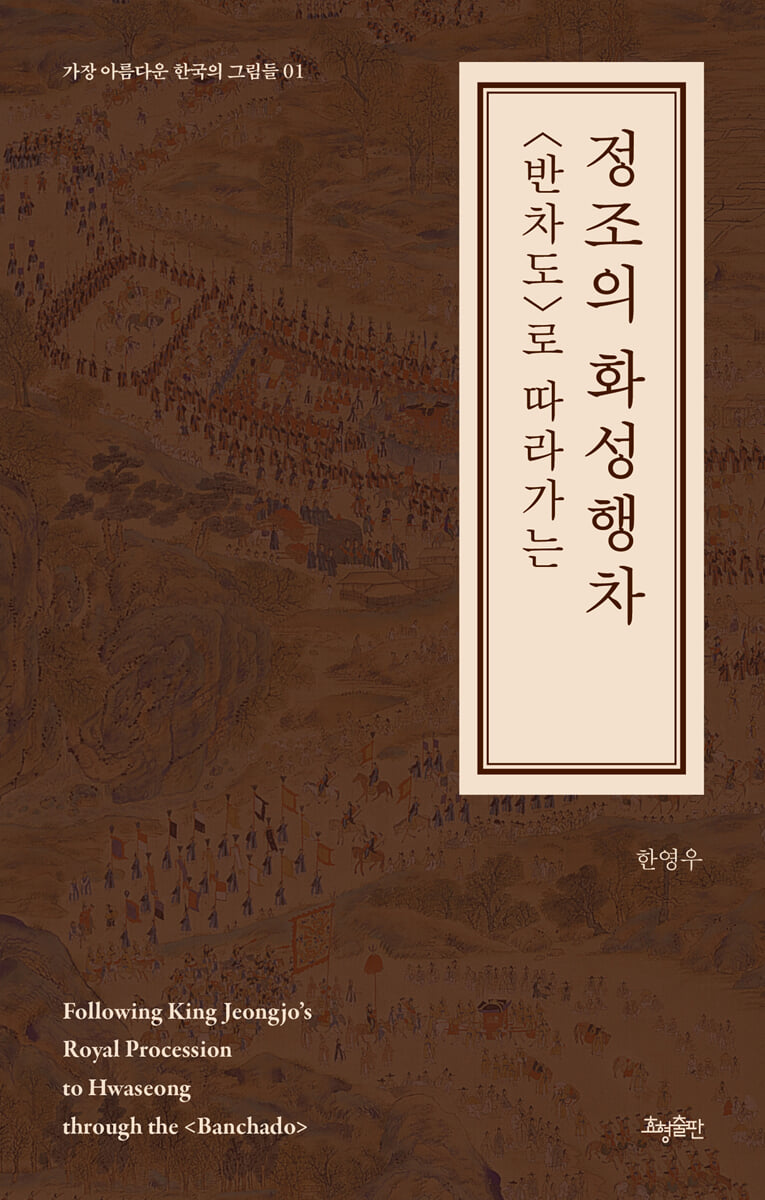
King Jeongjo's procession to Hwaseong, following the "Banchado"
 |
Description
Book Introduction
The record of just eight days transcends time and space and becomes the 'face of Joseon' that will be remembered forever.
The Most Beautiful Korean Paintings 01
Includes "Banchado" recreated in contemporary colors
Includes English commentary based on meticulous research
If we were to name the monarchs who ushered in a cultural, economic, and social renaissance during the Joseon Dynasty, the names of Sejong and Jeongjo would undoubtedly come to mind.
Among their legacies, the most condensed form of contemporary culture and art that brilliantly illuminated the history of the dynasty is undoubtedly the “Banchado.”
This epic, which decorates a beautiful scene in our history, is once again coming to readers.
The colorful procession of 1,779 people, recorded under the command of artist Kim Hong-do, transcends time and space and returns as a series titled “The Most Beautiful Korean Paintings.”
This book focuses on the true nature of King Jeongjo, a reformist monarch who led a people-oriented reform politics based on the spirit of Silhak and brought about the brilliant flowering of Joseon Dynasty culture in the 18th century.
His true nature as a ruler and his humanity as a suffering human being can be felt in his steps towards Mars.
The reason why historical facts can remain as 'official history' is because of the rationality and transparency in the thoughts and actions of the subjects.
King Jeongjo's 'thorough record-keeping spirit' stands out, as he depicts the eight-day march to Mars in meticulous detail.
The book contains a wealth of information, including references and illustrations, on the purpose and significance of the Mars mission, the various aspects of the preparation process, and the events that took place on Mars, all organized in an easy-to-read format.
Also included is a colored version of the “King Jeongjo’s Hwaseong Haenghaeng Banchado,” which was recreated by the late Professor Emeritus Han Yeong-woo of Seoul National University, who broadened the horizons of our history, after studying the pigments and colors of the time.
Here, detailed English commentary on the procession for each scene is provided, making it a good read for foreigners interested in Korean culture.
The Most Beautiful Korean Paintings 01
Includes "Banchado" recreated in contemporary colors
Includes English commentary based on meticulous research
If we were to name the monarchs who ushered in a cultural, economic, and social renaissance during the Joseon Dynasty, the names of Sejong and Jeongjo would undoubtedly come to mind.
Among their legacies, the most condensed form of contemporary culture and art that brilliantly illuminated the history of the dynasty is undoubtedly the “Banchado.”
This epic, which decorates a beautiful scene in our history, is once again coming to readers.
The colorful procession of 1,779 people, recorded under the command of artist Kim Hong-do, transcends time and space and returns as a series titled “The Most Beautiful Korean Paintings.”
This book focuses on the true nature of King Jeongjo, a reformist monarch who led a people-oriented reform politics based on the spirit of Silhak and brought about the brilliant flowering of Joseon Dynasty culture in the 18th century.
His true nature as a ruler and his humanity as a suffering human being can be felt in his steps towards Mars.
The reason why historical facts can remain as 'official history' is because of the rationality and transparency in the thoughts and actions of the subjects.
King Jeongjo's 'thorough record-keeping spirit' stands out, as he depicts the eight-day march to Mars in meticulous detail.
The book contains a wealth of information, including references and illustrations, on the purpose and significance of the Mars mission, the various aspects of the preparation process, and the events that took place on Mars, all organized in an easy-to-read format.
Also included is a colored version of the “King Jeongjo’s Hwaseong Haenghaeng Banchado,” which was recreated by the late Professor Emeritus Han Yeong-woo of Seoul National University, who broadened the horizons of our history, after studying the pigments and colors of the time.
Here, detailed English commentary on the procession for each scene is provided, making it a good read for foreigners interested in Korean culture.
- You can preview some of the book's contents.
Preview
index
Entering 6
King Jeongjo leads the Joseon Dynasty's Renaissance
What Kind of Monarch Did Jeongjo Dream of? 12
What was Hwaseong to King Jeongjo? 22
Why did King Jeongjo visit Hwaseong so often? 29
〈Half-course〉
A record of the magnificent and magnificent Martian procession, "Banchado" 34
A year of preparation for just eight days
Those who are extravagant or wasteful will be severely punished. 102
Opening New Paths and Building Bridges 105
After thorough preparation, the eve of departure arrives 112
The Mars Journey: A Record of the Eight Days
Day 1 (February 9th) 116
Second day (February 10th) 124
Third day (February 11th) 130
Fourth day (February 12th) 135
Fifth day (February 13th) 139
Sixth day (February 14th) 144
Seventh day (February 15th) 154
Eighth day (February 16th) 158
Coming out 166
Recommendation 168
King Jeongjo leads the Joseon Dynasty's Renaissance
What Kind of Monarch Did Jeongjo Dream of? 12
What was Hwaseong to King Jeongjo? 22
Why did King Jeongjo visit Hwaseong so often? 29
〈Half-course〉
A record of the magnificent and magnificent Martian procession, "Banchado" 34
A year of preparation for just eight days
Those who are extravagant or wasteful will be severely punished. 102
Opening New Paths and Building Bridges 105
After thorough preparation, the eve of departure arrives 112
The Mars Journey: A Record of the Eight Days
Day 1 (February 9th) 116
Second day (February 10th) 124
Third day (February 11th) 130
Fourth day (February 12th) 135
Fifth day (February 13th) 139
Sixth day (February 14th) 144
Seventh day (February 15th) 154
Eighth day (February 16th) 158
Coming out 166
Recommendation 168
Detailed image

Into the book
When people ask me about the extent of the record-keeping culture during the Joseon Dynasty, I simply answer, "It's scary."
In particular, the ceremonial records of this era can be said to be the flower of recorded culture.
--- p.8 From “Introduction”
This style of governance reflects the image of a capable CEO leading a large corporation.
He was an outstanding monarch in an era of changing times and changing politics.
--- p.20 From “What Kind of Monarch Did Jeongjo Dream of”
A grand political drama that unites the father, mother, and all the royal guards who follow him on Mars, that is precisely what Jeongjo aimed for.
So, the sincerity and interest that King Jeongjo put into this event was no small matter.
--- p.31 From “Why did Jeongjo visit Hwaseong so often?”
The newly created “Banchado” includes the names of dozens of people who participated in the procession but were not included in the original painting.
The original painting only had the title of the attendant written on it, but the person corresponding to that title was researched and included in the “Wonhaeng Eulmyeo Jeongni Uigwe.”
--- p.35, from “Banchado,” a record of the splendid and magnificent Martian procession
This was the first time that a magnificent floating bridge was built in a short period of time on the banks of the Han River. This was not only a major event that marked a turning point in the history of bridges during the Joseon Dynasty, but also a milestone that decorated a page in the history of our science and technology.
It is also evidence that King Jeongjo's trip to Hwaseong greatly contributed to the development of transportation culture along the Han River.
--- p.111 From “Opening a New Path and Building a Bridge”
Our history has experienced a Renaissance every 300 years.
If the 15th century era of King Sejong and the 18th century era of King Jeongjo were the lot of our ancestors, then isn't the 21st century Renaissance the lot of our generation?
In particular, the ceremonial records of this era can be said to be the flower of recorded culture.
--- p.8 From “Introduction”
This style of governance reflects the image of a capable CEO leading a large corporation.
He was an outstanding monarch in an era of changing times and changing politics.
--- p.20 From “What Kind of Monarch Did Jeongjo Dream of”
A grand political drama that unites the father, mother, and all the royal guards who follow him on Mars, that is precisely what Jeongjo aimed for.
So, the sincerity and interest that King Jeongjo put into this event was no small matter.
--- p.31 From “Why did Jeongjo visit Hwaseong so often?”
The newly created “Banchado” includes the names of dozens of people who participated in the procession but were not included in the original painting.
The original painting only had the title of the attendant written on it, but the person corresponding to that title was researched and included in the “Wonhaeng Eulmyeo Jeongni Uigwe.”
--- p.35, from “Banchado,” a record of the splendid and magnificent Martian procession
This was the first time that a magnificent floating bridge was built in a short period of time on the banks of the Han River. This was not only a major event that marked a turning point in the history of bridges during the Joseon Dynasty, but also a milestone that decorated a page in the history of our science and technology.
It is also evidence that King Jeongjo's trip to Hwaseong greatly contributed to the development of transportation culture along the Han River.
--- p.111 From “Opening a New Path and Building a Bridge”
Our history has experienced a Renaissance every 300 years.
If the 15th century era of King Sejong and the 18th century era of King Jeongjo were the lot of our ancestors, then isn't the 21st century Renaissance the lot of our generation?
--- p.167 From "Coming Out"
Publisher's Review
This book was created with the idea that readers need a guide to more easily access the Banchado.
I've always felt it was a shame that there weren't enough cultural products that could proudly showcase traditional culture to the general public and foreign tourists. I hope that this small booklet, along with the demonstrations of the Hwaseong Procession in Suwon and Seoul, will help increase understanding and pride in traditional culture.
- 2007, Han Young-woo
I've always felt it was a shame that there weren't enough cultural products that could proudly showcase traditional culture to the general public and foreign tourists. I hope that this small booklet, along with the demonstrations of the Hwaseong Procession in Suwon and Seoul, will help increase understanding and pride in traditional culture.
- 2007, Han Young-woo
GOODS SPECIFICS
- Date of issue: November 25, 2025
- Page count, weight, size: 170 pages | 120*188*9mm
- ISBN13: 9788958722465
- ISBN10: 8958722460
You may also like
카테고리
korean


korean

![GQ KOREA Mark (Monthly): December [2025]](http://librairie.coreenne.fr/cdn/shop/files/8ef265dbbfbf186523ed75ba7319009d.jpg?v=1765340328&width=3840)


