

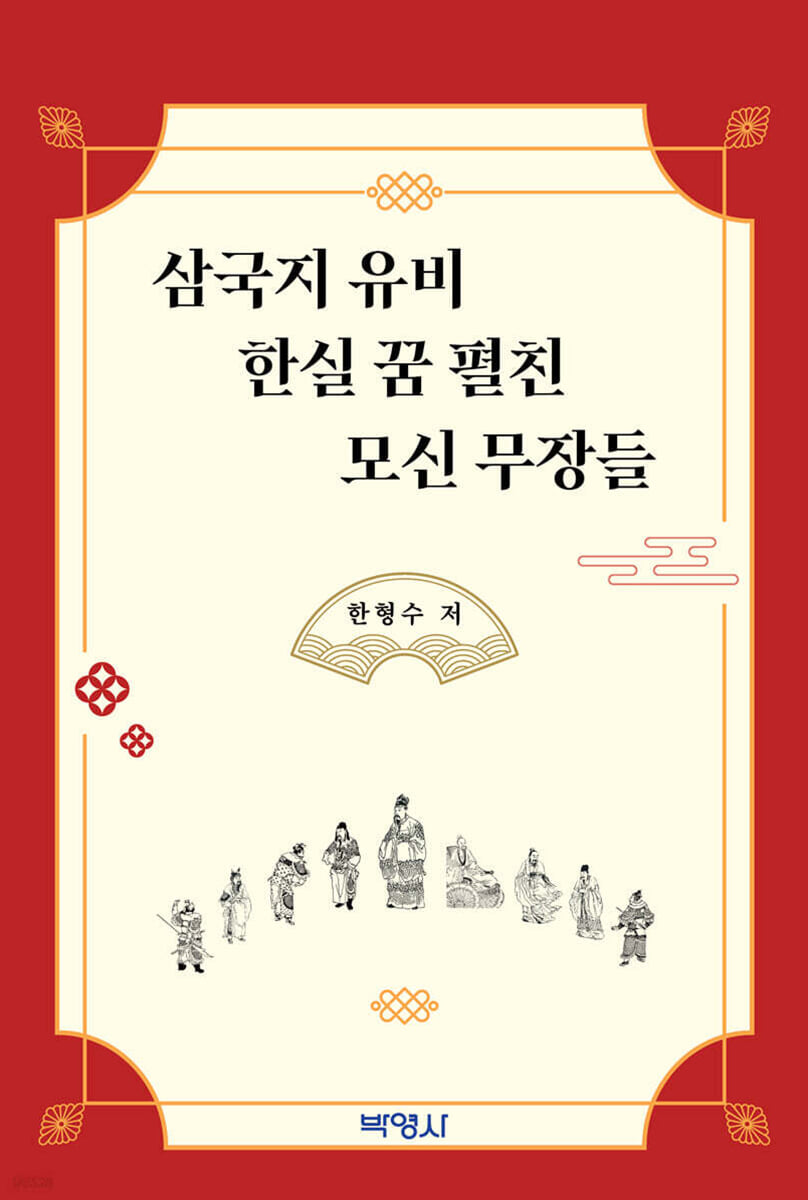
The warriors who served Liu Bei and Han Shi in the Three Kingdoms era and realized their dreams.
 |
Description
Book Introduction
On a snowy spring day in March 2008, I began my first lecture on “The Romance of the Three Kingdoms and the World of Life” at Seoul Citizens’ University, and at the same time, I began to think about writing “A Study of the Characters in the Romance of the Three Kingdoms.”
There was great excitement and also fear.
I was wandering around a mountaineering equipment store with the intention of climbing Mount Everest, the world's highest peak, without any experience climbing a high mountain.
As the saying goes, "You have to be crazy to be crazy," in 2017, after nearly eight years of being completely immersed in the world of the Romance of the Three Kingdoms, I published "A Study of the Characters of the Three Kingdoms Warlords," which can be considered the prologue to "A Study of the Characters of the Three Kingdoms."
Although he received encouragement for upgrading the level of Romance of the Three Kingdoms aimed at Romance of the Three Kingdoms enthusiasts, there were also many shortcomings as a first work, such as overlapping historical materials, as he attempted to analyze the personalities of the characters of Romance of the Three Kingdoms through a multifaceted prism.
After that, another eight years passed, and now, two volumes, “Romance of the Three Kingdoms: The Warlords Who Served Cao Cao and Who Dreamed of Building a World” and “Romance of the Three Kingdoms: The Warlords Who Served Liu Bei and Who Dreamed of Building a Han Dynasty,” which can be said to be the essence of “Studies on Characters of the Three Kingdoms,” are being published simultaneously.
Looking back, after planning to write “Study of Characters in the Romance of the Three Kingdoms” in March 2008, I was crazy about the world of “Study of Characters in the Romance of the Three Kingdoms,” but I had many shortcomings as an author, such as doing a lot of research. However, the two books published this time cover the essence of “Study of Characters in the Romance of the Three Kingdoms,” so I express my sincere feelings that I wrote it as I wanted to, and I hope that Donghak Jehyeon will show interest and receive many criticisms.
- From the author's words
There was great excitement and also fear.
I was wandering around a mountaineering equipment store with the intention of climbing Mount Everest, the world's highest peak, without any experience climbing a high mountain.
As the saying goes, "You have to be crazy to be crazy," in 2017, after nearly eight years of being completely immersed in the world of the Romance of the Three Kingdoms, I published "A Study of the Characters of the Three Kingdoms Warlords," which can be considered the prologue to "A Study of the Characters of the Three Kingdoms."
Although he received encouragement for upgrading the level of Romance of the Three Kingdoms aimed at Romance of the Three Kingdoms enthusiasts, there were also many shortcomings as a first work, such as overlapping historical materials, as he attempted to analyze the personalities of the characters of Romance of the Three Kingdoms through a multifaceted prism.
After that, another eight years passed, and now, two volumes, “Romance of the Three Kingdoms: The Warlords Who Served Cao Cao and Who Dreamed of Building a World” and “Romance of the Three Kingdoms: The Warlords Who Served Liu Bei and Who Dreamed of Building a Han Dynasty,” which can be said to be the essence of “Studies on Characters of the Three Kingdoms,” are being published simultaneously.
Looking back, after planning to write “Study of Characters in the Romance of the Three Kingdoms” in March 2008, I was crazy about the world of “Study of Characters in the Romance of the Three Kingdoms,” but I had many shortcomings as an author, such as doing a lot of research. However, the two books published this time cover the essence of “Study of Characters in the Romance of the Three Kingdoms,” so I express my sincere feelings that I wrote it as I wanted to, and I hope that Donghak Jehyeon will show interest and receive many criticisms.
- From the author's words
index
Chapter 1
Figures Who Drive the Chaos: Establishing the Three Kingdoms / 11
1.
The ideological and value tendencies of the lords and subordinate warriors of the Romance of the Three Kingdoms _18
2.
Personality Types of the Lords and Subordinate Generals in Romance of the Three Kingdoms _38
3.
The Shu-Shu situation in the Romance of the Three Kingdoms: The lords and their subordinate generals who pursued Han-Sil dreams _64
Chapter 2
Liu Bei, the hero of the savagery who embraced people and navigated the turbulent times / 71
1.
The Life Trajectory of Liu Bei _73
2.
A man who navigated the times based on virtue and righteousness _93
3.
A lord who gained public respect for his tolerance and sincerity _108
4.
The Remaining Discussions of Lord Liu Bei_147
Chapter 3
Zhuge Liang, the renowned strategist who mastered the principles of worldly governance / 157
1.
The Life Trajectory of Zhuge Liang _159
2.
A loyal patriot dedicated to the revival of the Han Dynasty and a renowned prime minister of all time _184
3.
An outstanding politician of fairness, transparency, and justice, with conviction and a cool-headed personality _198
4.
The Remaining Discussions of Zhuge Liang _239
Chapter 4
The ill-fated strategist Bang Tong, who pursued the conquest of Ikju but was defeated / 249
1.
The Life Trajectory of a Person's Voice _251
2.
A Taoist Taoist with both decisiveness and flexibility _257
3.
A creative personality who unleashes the potential of others _264
4.
The Remaining Discussion of the Mosin Broadcasting Station _283
Chapter 5
Beopjeong, a strategist with the ability to predict the success or failure of an undertaking, contributed to the annexation of Yizhou and the Sino-Korean War / 289
1.
The Trajectory of Life in the Court of Characters _291
2.
A scheming man who showed an enterprising side in his pursuit of success_298
3.
Mosa, who showed excellent judgment of situations due to his quick-witted personality _306
4.
The remaining discussions in the courtroom _326
Chapter 6
Guan Yu, the loyal and valiant warrior who rode a thousand miles alone on horseback / 329
1.
Guan Yu's Life Trajectory _331
2.
Eternal Etiquette that Promotes Loyalty and Courage _343
3.
A time-honored warrior whose strong convictions inspired awe and defiance _352
4.
The Remaining Discussion of the Warlord Guan Yu _377
Chapter 7
Yongryak's equipment, which defeated the enemy's large army with the great stamina of Dangyang Jangpanpa / 383
1.
The Life Trajectory of Character Equipment _385
2.
The courageous and generous Lim Hyo-sang, brimming with the spirit of loyalty and loyalty _392
3.
A contemporary general whose self-righteous personality brought misfortune _398
4.
Remaining Discussion on Armament Equipment _420
Chapter 8
General Zhao Yun, who managed the crisis by breaking through the enemy's massive army with his Adu in his arms / 425
1.
The Life Trajectory of the Character Jo Yun _427
2.
The legacy of a man of both civil and military virtues and of a man of virtue and virtue _434
3.
A master of principled principles and skilled in mobile strikes _440
4.
The Remaining Discussion of Armed Forces _461
Chapter 9
The rebellion of the sukjang Wi Yeon, who fought over the succession to the throne, ended up in a rebellion / 465
1.
The Life Trajectory of the Character Wei Yan _467
2.
The unfortunate warrior who could never escape the stigma of a rebel _474
3.
A lonely, self-righteous man, unable to express himself due to his arrogant personality _478
4.
The Remaining Discussion of the Armed Forces _495
Chapter 10
Jiang You, the last remaining leader of Shu, who failed to secure his reputation while engaged in the Northern Expedition / 499
1.
The Trajectory of Kang Yu's Life _501
2.
The lone general who never stopped his northern expedition to recover the Central Plains _508
3.
The last of the Shu dynasty, obsessively devoted to the Northern Expedition _516
4.
The Remaining Discussion of Mosin Kangyu _537
Figures Who Drive the Chaos: Establishing the Three Kingdoms / 11
1.
The ideological and value tendencies of the lords and subordinate warriors of the Romance of the Three Kingdoms _18
2.
Personality Types of the Lords and Subordinate Generals in Romance of the Three Kingdoms _38
3.
The Shu-Shu situation in the Romance of the Three Kingdoms: The lords and their subordinate generals who pursued Han-Sil dreams _64
Chapter 2
Liu Bei, the hero of the savagery who embraced people and navigated the turbulent times / 71
1.
The Life Trajectory of Liu Bei _73
2.
A man who navigated the times based on virtue and righteousness _93
3.
A lord who gained public respect for his tolerance and sincerity _108
4.
The Remaining Discussions of Lord Liu Bei_147
Chapter 3
Zhuge Liang, the renowned strategist who mastered the principles of worldly governance / 157
1.
The Life Trajectory of Zhuge Liang _159
2.
A loyal patriot dedicated to the revival of the Han Dynasty and a renowned prime minister of all time _184
3.
An outstanding politician of fairness, transparency, and justice, with conviction and a cool-headed personality _198
4.
The Remaining Discussions of Zhuge Liang _239
Chapter 4
The ill-fated strategist Bang Tong, who pursued the conquest of Ikju but was defeated / 249
1.
The Life Trajectory of a Person's Voice _251
2.
A Taoist Taoist with both decisiveness and flexibility _257
3.
A creative personality who unleashes the potential of others _264
4.
The Remaining Discussion of the Mosin Broadcasting Station _283
Chapter 5
Beopjeong, a strategist with the ability to predict the success or failure of an undertaking, contributed to the annexation of Yizhou and the Sino-Korean War / 289
1.
The Trajectory of Life in the Court of Characters _291
2.
A scheming man who showed an enterprising side in his pursuit of success_298
3.
Mosa, who showed excellent judgment of situations due to his quick-witted personality _306
4.
The remaining discussions in the courtroom _326
Chapter 6
Guan Yu, the loyal and valiant warrior who rode a thousand miles alone on horseback / 329
1.
Guan Yu's Life Trajectory _331
2.
Eternal Etiquette that Promotes Loyalty and Courage _343
3.
A time-honored warrior whose strong convictions inspired awe and defiance _352
4.
The Remaining Discussion of the Warlord Guan Yu _377
Chapter 7
Yongryak's equipment, which defeated the enemy's large army with the great stamina of Dangyang Jangpanpa / 383
1.
The Life Trajectory of Character Equipment _385
2.
The courageous and generous Lim Hyo-sang, brimming with the spirit of loyalty and loyalty _392
3.
A contemporary general whose self-righteous personality brought misfortune _398
4.
Remaining Discussion on Armament Equipment _420
Chapter 8
General Zhao Yun, who managed the crisis by breaking through the enemy's massive army with his Adu in his arms / 425
1.
The Life Trajectory of the Character Jo Yun _427
2.
The legacy of a man of both civil and military virtues and of a man of virtue and virtue _434
3.
A master of principled principles and skilled in mobile strikes _440
4.
The Remaining Discussion of Armed Forces _461
Chapter 9
The rebellion of the sukjang Wi Yeon, who fought over the succession to the throne, ended up in a rebellion / 465
1.
The Life Trajectory of the Character Wei Yan _467
2.
The unfortunate warrior who could never escape the stigma of a rebel _474
3.
A lonely, self-righteous man, unable to express himself due to his arrogant personality _478
4.
The Remaining Discussion of the Armed Forces _495
Chapter 10
Jiang You, the last remaining leader of Shu, who failed to secure his reputation while engaged in the Northern Expedition / 499
1.
The Trajectory of Kang Yu's Life _501
2.
The lone general who never stopped his northern expedition to recover the Central Plains _508
3.
The last of the Shu dynasty, obsessively devoted to the Northern Expedition _516
4.
The Remaining Discussion of Mosin Kangyu _537
Detailed image

Publisher's Review
preface
I was born in a rural village at the foot of Mt. Deogyusan and attended elementary school under the strict education of my grandparents and parents, while also receiving loving care.
I went to a middle school in a big city where the city hall was located, but I was extremely lonely and couldn't stop thinking about my hometown.
On days when school ended early, I would run to the public library near my boarding house and read anything I could find, from literary works to popular novels, to soothe my thoughts about home.
During that time, my attention was drawn to the four major Chinese classics: Journey to the West, Water Margin, The Golden Plum, and Romance of the Three Kingdoms.
Journey to the West is a story of absurd imagination, while Water Margin is a very exciting story about the Liangshanbo bandits.
Although the story of the Golden Plum Blossom was also a likely human story, the Romance of the Three Kingdoms was considered by far the most enjoyable to read, as it contained lessons of loyalty and wisdom about life.
It had a magic that went beyond simple fun, making it impossible to put down once you picked it up until you finished reading it.
At that time, I read almost all the different versions of the Romance of the Three Kingdoms, but among them, I read over and over again the 10-volume Romance of the Three Kingdoms published by Jeong-eumsa in 1954.
At the time, the booklet listed Choi Young-hae as the translator and publisher, but it was only much later that I learned that the original translator was Park Tae-won of Kubo, who defected to North Korea after completing about half of the translation, and that Choi Young-hae, the publisher, finished it in that style.
Anyway, I liked the style of the translation so much that I spent more than a few nights in my boarding house reading it.
I still vividly remember that I had borrowed the Romance of the Three Kingdoms from the library and was reading it deeply on a bench in the bamboo forest when the wind blew and the bamboo leaves swayed.
At that very moment, the thought that 'history flows' crossed my mind is still vivid as if it were yesterday.
When I entered high school and was a freshman, I had to take a year off due to family circumstances, so I followed my grandfather's advice and went to a seodang (traditional private school) in my hometown for a year.
There, I learned about Jiang Zhi's "Tonggamjeolyo" (Comprehensive Aid to Government-General), and found out that volumes 20 to 26 were the history of the Three Kingdoms period, and that the "Romance of the Three Kingdoms" that I had read in middle school was actually a novel called "Romance of the Three Kingdoms" by Luo Guanzhong.
During my first and second year of college, I took courses in the Great Learning, Doctrine of the Mean, the Analects of Confucius, Mencius, and the Book of Songs, which naturally brought me closer to the original Chinese texts and led me to devour Chen Shou's "Romance of the Three Kingdoms," a historical book on the Three Kingdoms period.
After graduating from college and graduate school, and then becoming a professor, my days were filled with research and lectures in my major field of social science, and I spent a considerable amount of time away from the Romance of the Three Kingdoms.
Then, in 1992, while hiking Mt. Gwanak with some professors, I happened to talk about the Romance of the Three Kingdoms.
This led to the formation of the 'Professors Who Love the Three Kingdoms', and with considerable support from enthusiasts, regular 'Three Kingdoms Seminars' were held in spring, summer, fall, and winter for over 20 years.
As I took an active part in this, I came to deeply study the 〈Comments of Pei Songzhi in the Romance of the Three Kingdoms〉, Fan Ye’s 〈Annals of the Book of the Later Han〉, and among them, the 13 characters in the 〈Biographies of the Book of the Later Han〉, whose biographies overlap with those of the 〈Romance of the Three Kingdoms〉.
Next, I delved deeply into the history of Sima Guang's "Zizhi Tongjian" (Volume 55, First Tang Dynasty War) to Volume 81, the Jin Dynasty's unification of the country, and the Chronicles of Emperor Xuan, Biography of Du Ye, and Biography of Wang Jun in Fang Xuanling's "Book of Jin".
The question of "history flows" that came to mind when I read the novel "Romance of the Three Kingdoms" in the bamboo forest of the library during middle school has now focused all my attention on the thesis of "What is the driving force that led the Three Kingdoms period, a long war that lasted about a century 1,800 years ago?" through the historical "Romance of the Three Kingdoms."
In the Three Kingdoms period of the Romance of the Three Kingdoms, Zhuge Liang once said in the Longzhong period, “Compared to Yuan Shao, Cao Cao’s reputation was faint and his military force was small, but the reason Cao Cao was able to defeat Yuan Shao and go from being weak to strong was not only because of heavenly timing, but also because he relied on human strategy.”
Ultimately, the driving force that drives history is the will of humans.
Also, Mao Zedong said in his “On the War of the Earth” that “conscious activity is a unique human characteristic.
This trait is particularly evident in war.
Clearly, victory or defeat is determined by a whole series of unique conditions for both sides waging war.
However, these conditions only determine the possibility of victory or defeat, and conscious activity in war is necessary to bring about the decision about victory or defeat,” he emphasizes.
In this paradigm of historical change, the Later Han Dynasty collapsed, and the Three Kingdoms period of the Romance of the Three Kingdoms entered a turbulent period of about 100 years, passing through a period of warlords and finally condensed into the establishment of the Three Kingdoms of Wei, Shu, and Wu, and each of these three countries, with the driving force of the 'will and strategy' of their lords, ministers, and military commanders, fought for the unification of the world.
In this series, “Character Studies of the Romance of the Three Kingdoms,” we will unfold the epic history of these figures, who have blazed a trail through history.
In “The Merchant of Shen Yuanchun,” Mao Zedong asks, “Oh, how vast is the expanse / I ask, on this vast earth / Who is it that presides over all human destinies?” and asks what the driving force of history is, to which he responds in “The Narrative of Shen Yuanchun,” “Everything has flowed away / If you truly want to find a hero / You must look to today.”
The magic that will unleash the ancient historical driving force of the Three Kingdoms period in the Romance of the Three Kingdoms is none other than your present day.
I hope to find a genuine point of intersection between the past and the present in the historical understanding of the text of the Romance of the Three Kingdoms, and I would be most grateful if this horizon could resonate, even in the slightest, with the readers of this book.
On a snowy spring day in March 2008, I began my first lecture on “The Romance of the Three Kingdoms and the World of Life” at Seoul Citizens’ University, and at the same time, I began to think about writing “A Study of the Characters in the Romance of the Three Kingdoms.”
There was great excitement and also fear.
I was wandering around a mountaineering equipment store with the intention of climbing Mount Everest, the world's highest peak, without any experience climbing a high mountain.
As the saying goes, "You have to be crazy to be crazy," in 2017, after nearly eight years of being completely immersed in the world of the Romance of the Three Kingdoms, I published "A Study of the Characters of the Three Kingdoms Warlords," which can be considered the prologue to "A Study of the Characters of the Three Kingdoms."
Although he received encouragement for upgrading the level of Romance of the Three Kingdoms aimed at Romance of the Three Kingdoms enthusiasts, there were also many shortcomings as a first work, such as overlapping historical materials, as he attempted to analyze the personalities of the characters of Romance of the Three Kingdoms through a multifaceted prism.
After that, another eight years passed, and now, two volumes, “Romance of the Three Kingdoms: The Warlords Who Served Cao Cao and Who Dreamed of Building a World” and “Romance of the Three Kingdoms: The Warlords Who Served Liu Bei and Who Dreamed of Building a Han Dynasty,” which can be said to be the essence of “Studies on Characters of the Three Kingdoms,” are being published simultaneously.
Looking back, after planning to write “Study of Characters in the Romance of the Three Kingdoms” in March 2008, I was crazy about the world of “Study of Characters in the Romance of the Three Kingdoms,” but I had many shortcomings as an author, such as doing a lot of research. However, the two books published this time cover the essence of “Study of Characters in the Romance of the Three Kingdoms,” so I express my sincere feelings that I wrote it as I wanted to, and I hope that Donghak Jehyeon will show interest and receive many criticisms.
First of all, I would like to express my deepest gratitude to my seniors, friends, and juniors who have consistently encouraged and supported me throughout my long writing career, and I would also like to express my gratitude to the members who have participated in the “Romance of the Three Kingdoms and the World of Life” course and have spent time with me.
I would also like to express my gratitude to my students at the Department of Social Welfare, Seoul Metropolitan University, who spared no effort in organizing the manuscript.
Finally, I would like to express my gratitude to the planning, marketing, and editorial staff at Park Young-sa, who generously took on the task of publishing this book.
October 2025
At Gogeumjae
Author Han Hyeong-su
I was born in a rural village at the foot of Mt. Deogyusan and attended elementary school under the strict education of my grandparents and parents, while also receiving loving care.
I went to a middle school in a big city where the city hall was located, but I was extremely lonely and couldn't stop thinking about my hometown.
On days when school ended early, I would run to the public library near my boarding house and read anything I could find, from literary works to popular novels, to soothe my thoughts about home.
During that time, my attention was drawn to the four major Chinese classics: Journey to the West, Water Margin, The Golden Plum, and Romance of the Three Kingdoms.
Journey to the West is a story of absurd imagination, while Water Margin is a very exciting story about the Liangshanbo bandits.
Although the story of the Golden Plum Blossom was also a likely human story, the Romance of the Three Kingdoms was considered by far the most enjoyable to read, as it contained lessons of loyalty and wisdom about life.
It had a magic that went beyond simple fun, making it impossible to put down once you picked it up until you finished reading it.
At that time, I read almost all the different versions of the Romance of the Three Kingdoms, but among them, I read over and over again the 10-volume Romance of the Three Kingdoms published by Jeong-eumsa in 1954.
At the time, the booklet listed Choi Young-hae as the translator and publisher, but it was only much later that I learned that the original translator was Park Tae-won of Kubo, who defected to North Korea after completing about half of the translation, and that Choi Young-hae, the publisher, finished it in that style.
Anyway, I liked the style of the translation so much that I spent more than a few nights in my boarding house reading it.
I still vividly remember that I had borrowed the Romance of the Three Kingdoms from the library and was reading it deeply on a bench in the bamboo forest when the wind blew and the bamboo leaves swayed.
At that very moment, the thought that 'history flows' crossed my mind is still vivid as if it were yesterday.
When I entered high school and was a freshman, I had to take a year off due to family circumstances, so I followed my grandfather's advice and went to a seodang (traditional private school) in my hometown for a year.
There, I learned about Jiang Zhi's "Tonggamjeolyo" (Comprehensive Aid to Government-General), and found out that volumes 20 to 26 were the history of the Three Kingdoms period, and that the "Romance of the Three Kingdoms" that I had read in middle school was actually a novel called "Romance of the Three Kingdoms" by Luo Guanzhong.
During my first and second year of college, I took courses in the Great Learning, Doctrine of the Mean, the Analects of Confucius, Mencius, and the Book of Songs, which naturally brought me closer to the original Chinese texts and led me to devour Chen Shou's "Romance of the Three Kingdoms," a historical book on the Three Kingdoms period.
After graduating from college and graduate school, and then becoming a professor, my days were filled with research and lectures in my major field of social science, and I spent a considerable amount of time away from the Romance of the Three Kingdoms.
Then, in 1992, while hiking Mt. Gwanak with some professors, I happened to talk about the Romance of the Three Kingdoms.
This led to the formation of the 'Professors Who Love the Three Kingdoms', and with considerable support from enthusiasts, regular 'Three Kingdoms Seminars' were held in spring, summer, fall, and winter for over 20 years.
As I took an active part in this, I came to deeply study the 〈Comments of Pei Songzhi in the Romance of the Three Kingdoms〉, Fan Ye’s 〈Annals of the Book of the Later Han〉, and among them, the 13 characters in the 〈Biographies of the Book of the Later Han〉, whose biographies overlap with those of the 〈Romance of the Three Kingdoms〉.
Next, I delved deeply into the history of Sima Guang's "Zizhi Tongjian" (Volume 55, First Tang Dynasty War) to Volume 81, the Jin Dynasty's unification of the country, and the Chronicles of Emperor Xuan, Biography of Du Ye, and Biography of Wang Jun in Fang Xuanling's "Book of Jin".
The question of "history flows" that came to mind when I read the novel "Romance of the Three Kingdoms" in the bamboo forest of the library during middle school has now focused all my attention on the thesis of "What is the driving force that led the Three Kingdoms period, a long war that lasted about a century 1,800 years ago?" through the historical "Romance of the Three Kingdoms."
In the Three Kingdoms period of the Romance of the Three Kingdoms, Zhuge Liang once said in the Longzhong period, “Compared to Yuan Shao, Cao Cao’s reputation was faint and his military force was small, but the reason Cao Cao was able to defeat Yuan Shao and go from being weak to strong was not only because of heavenly timing, but also because he relied on human strategy.”
Ultimately, the driving force that drives history is the will of humans.
Also, Mao Zedong said in his “On the War of the Earth” that “conscious activity is a unique human characteristic.
This trait is particularly evident in war.
Clearly, victory or defeat is determined by a whole series of unique conditions for both sides waging war.
However, these conditions only determine the possibility of victory or defeat, and conscious activity in war is necessary to bring about the decision about victory or defeat,” he emphasizes.
In this paradigm of historical change, the Later Han Dynasty collapsed, and the Three Kingdoms period of the Romance of the Three Kingdoms entered a turbulent period of about 100 years, passing through a period of warlords and finally condensed into the establishment of the Three Kingdoms of Wei, Shu, and Wu, and each of these three countries, with the driving force of the 'will and strategy' of their lords, ministers, and military commanders, fought for the unification of the world.
In this series, “Character Studies of the Romance of the Three Kingdoms,” we will unfold the epic history of these figures, who have blazed a trail through history.
In “The Merchant of Shen Yuanchun,” Mao Zedong asks, “Oh, how vast is the expanse / I ask, on this vast earth / Who is it that presides over all human destinies?” and asks what the driving force of history is, to which he responds in “The Narrative of Shen Yuanchun,” “Everything has flowed away / If you truly want to find a hero / You must look to today.”
The magic that will unleash the ancient historical driving force of the Three Kingdoms period in the Romance of the Three Kingdoms is none other than your present day.
I hope to find a genuine point of intersection between the past and the present in the historical understanding of the text of the Romance of the Three Kingdoms, and I would be most grateful if this horizon could resonate, even in the slightest, with the readers of this book.
On a snowy spring day in March 2008, I began my first lecture on “The Romance of the Three Kingdoms and the World of Life” at Seoul Citizens’ University, and at the same time, I began to think about writing “A Study of the Characters in the Romance of the Three Kingdoms.”
There was great excitement and also fear.
I was wandering around a mountaineering equipment store with the intention of climbing Mount Everest, the world's highest peak, without any experience climbing a high mountain.
As the saying goes, "You have to be crazy to be crazy," in 2017, after nearly eight years of being completely immersed in the world of the Romance of the Three Kingdoms, I published "A Study of the Characters of the Three Kingdoms Warlords," which can be considered the prologue to "A Study of the Characters of the Three Kingdoms."
Although he received encouragement for upgrading the level of Romance of the Three Kingdoms aimed at Romance of the Three Kingdoms enthusiasts, there were also many shortcomings as a first work, such as overlapping historical materials, as he attempted to analyze the personalities of the characters of Romance of the Three Kingdoms through a multifaceted prism.
After that, another eight years passed, and now, two volumes, “Romance of the Three Kingdoms: The Warlords Who Served Cao Cao and Who Dreamed of Building a World” and “Romance of the Three Kingdoms: The Warlords Who Served Liu Bei and Who Dreamed of Building a Han Dynasty,” which can be said to be the essence of “Studies on Characters of the Three Kingdoms,” are being published simultaneously.
Looking back, after planning to write “Study of Characters in the Romance of the Three Kingdoms” in March 2008, I was crazy about the world of “Study of Characters in the Romance of the Three Kingdoms,” but I had many shortcomings as an author, such as doing a lot of research. However, the two books published this time cover the essence of “Study of Characters in the Romance of the Three Kingdoms,” so I express my sincere feelings that I wrote it as I wanted to, and I hope that Donghak Jehyeon will show interest and receive many criticisms.
First of all, I would like to express my deepest gratitude to my seniors, friends, and juniors who have consistently encouraged and supported me throughout my long writing career, and I would also like to express my gratitude to the members who have participated in the “Romance of the Three Kingdoms and the World of Life” course and have spent time with me.
I would also like to express my gratitude to my students at the Department of Social Welfare, Seoul Metropolitan University, who spared no effort in organizing the manuscript.
Finally, I would like to express my gratitude to the planning, marketing, and editorial staff at Park Young-sa, who generously took on the task of publishing this book.
October 2025
At Gogeumjae
Author Han Hyeong-su
GOODS SPECIFICS
- Date of issue: November 4, 2025
- Page count, weight, size: 544 pages | Checking size
- ISBN13: 9791130322797
- ISBN10: 1130322793
You may also like
카테고리
korean


korean

![GQ KOREA Mark (Monthly): December [2025]](http://librairie.coreenne.fr/cdn/shop/files/8ef265dbbfbf186523ed75ba7319009d.jpg?v=1765340328&width=3840)


