

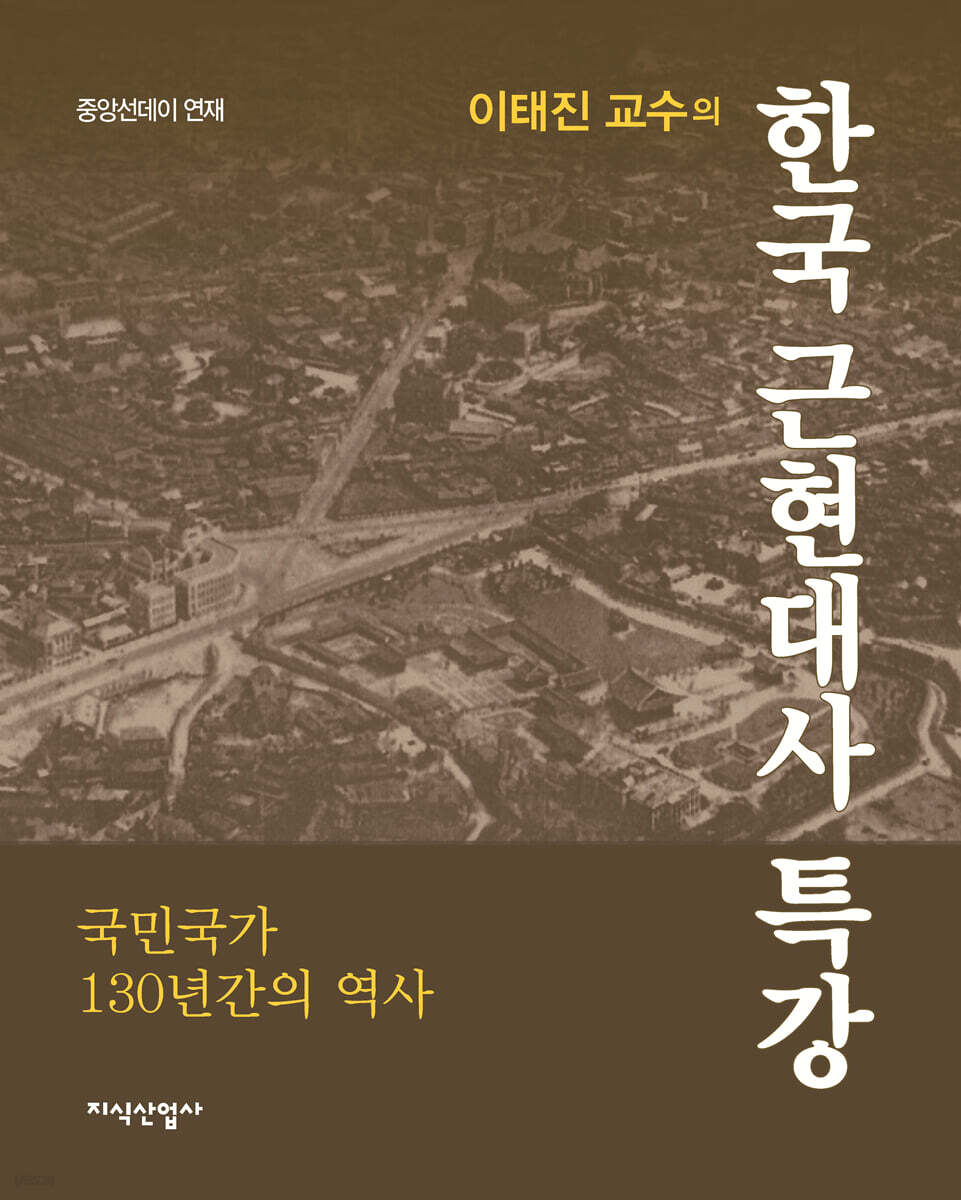
Professor Lee Tae-jin's special lecture on modern and contemporary Korean history
 |
Description
Book Introduction
Unfolding an Introduction to the Study of the Korean Nation-State Theory
The claim that the history of our country's establishment of a modern nation through its own efforts dates back 130 years from now (2025) is shocking my academic circles through a book.
The author, Professor Lee Tae-jin (Seoul National University Emeritus), is a veteran figure who has been in charge of Korean history for over 50 years.
He turned the academic world at home and abroad upside down with his work of precisely analyzing the original text of the 1905 Protectorate Treaty (Eulsa Treaty) and the 1910 Annexation Treaty, and has been engrossed in research that overturns the prevailing theory that Joseon (the Korean Empire) lost its sovereignty to Japan due to its incompetence in governing during the reigns of King Yeongjo and King Jeongjo in the late Joseon Dynasty.
This book is divided into eight parts, from Part 1 to Part 8. Part 1, “The Roots of Modern Distortion,” introduces Yoshida Shoin, the root of Japan’s colonialist view of history, and criticizes his “preemptive occupation theory” of neighboring countries.
The claim that the history of our country's establishment of a modern nation through its own efforts dates back 130 years from now (2025) is shocking my academic circles through a book.
The author, Professor Lee Tae-jin (Seoul National University Emeritus), is a veteran figure who has been in charge of Korean history for over 50 years.
He turned the academic world at home and abroad upside down with his work of precisely analyzing the original text of the 1905 Protectorate Treaty (Eulsa Treaty) and the 1910 Annexation Treaty, and has been engrossed in research that overturns the prevailing theory that Joseon (the Korean Empire) lost its sovereignty to Japan due to its incompetence in governing during the reigns of King Yeongjo and King Jeongjo in the late Joseon Dynasty.
This book is divided into eight parts, from Part 1 to Part 8. Part 1, “The Roots of Modern Distortion,” introduces Yoshida Shoin, the root of Japan’s colonialist view of history, and criticizes his “preemptive occupation theory” of neighboring countries.
- You can preview some of the book's contents.
Preview
index
Preface: Promoting the "130-Year History of a Nation-State" _4
Words of Thanks _13
_16
Part 1: The Roots of Modern Distortion
01 The Government-General of Korea ignored over 10,000 official documents related to self-reliant modernization when compiling the Annals of King Gojong and the Annals of King Sunjong. _22
02 The Meiji Emperor's nationalism, established 130 years ago, still poses a stumbling block to the Korea-Japan partnership. _31
03 Joseon pursued "peaceful coexistence," while Japan pursued "preemptive domination of neighboring countries." Their national policies were different. _39
Part 2: The Dawn of Modernity
04 The Tangpyeong monarchs left the palace and met the people directly to ask for their opinions. _48
05 The Tale of Simcheong and the Tale of Chunhyang, conceived by the politics of tangpyeong, signaled a new history. _57
06 The "Republican" World of Equality for All That King Jeongjo Dreamed of _65
Part 3: Emperor Gojong's Ascension to the Throne: Abolishing Sedo politics
07 The Northern Learning School's Political Winds of the "Gyeonghwa Sajok" Seeking Innovation _74
08 Queen Dowager Jo's Reform Policies Disguised as Heungseon Daewongun's Achievements _82
09 Daewongun, who ignored the monarchy restored by Queen Dowager Jo, was overthrown after seven years. _90
10 The Blue Dream of the Young King Gojong, Carried to Geoncheonggung Palace _98
Part 4: The Opening of a New Port? The Dark Clouds and Glow of the Opening
11 The 'Unyoho' that appeared on Ganghwa Island in 1875 did not fly the Japanese flag _108
12 "Joseon must not become friendly with the United States!" Obstruction of Qing and Japanese policies toward Joseon's opening _117
13 King Gojong personally administered the world's first English exam _125
14 "The Four Great Parties are conservative, the Independence Party is enlightenment." The Japanese political manipulation frame _134
Part 5: The Sino-Japanese War and the Queen's Assassination
15 In 1894, the Japanese army climbed over the walls of Gyeongbokgung Palace before even fighting the Qing. _ 144
16 The Madness of Japanese Military Invasion Disguised as the Gabo Reforms _153
17 Eight Japanese military officers disguised as civilians and commanded the assassination of the queen. _161
18 The Story of the Queen's Photo Disguised as a Court Lady _169
Part 6: The Creation of the "Nation" and the Establishment of the Korean Empire
19 Donghak Army, "The goal was to overthrow evil officials" and did not view the king as an enemy _178
The Independent Newspaper, founded as a national newspaper, was not founded by Seo Jae-pil. _187
21. Radial road design centered around Gyeongungung Palace (now Deoksugung Palace), something even Tokyo could not do at the time _194
22 Empress Myeongseong's State Funeral, Soothing Han with Posthumous Empress Honors _205
23 National income rose thanks to the land consolidation project, illuminating the Korean Empire. _ 213
Part 7: Condemnation and Protests Against the Invaders
24 "It's sad, the island barbarians have swallowed up the eight provinces." King Gojong wept in his writing. _ 224
25 "Intellectual" Ahn Jung-geun, who presented a path to world peace beyond Korea, China, and Japan _ 233
26 Cheondogyo's Pro-King National Ideology Leads the March 1st Independence Movement _241
27 Was Emperor Sunjong really a puppet of Resident-General Ito? _250
Part 8: Towards a Modern History with 'Modernity'
27 Ranking 10th in the world economy, democratization, and industrialization didn't happen overnight. _ 274
28 Colonial Modernization Theory: Denial of the Korean Empire's Self-Reliance on Modernization _283
29. The issue of compensation for colonial rule is intertwined. It is only natural for Japan to make concessions. _290
supplement
『Education Regulations』 Full Text _300
References _305
Words of Thanks _13
_16
Part 1: The Roots of Modern Distortion
01 The Government-General of Korea ignored over 10,000 official documents related to self-reliant modernization when compiling the Annals of King Gojong and the Annals of King Sunjong. _22
02 The Meiji Emperor's nationalism, established 130 years ago, still poses a stumbling block to the Korea-Japan partnership. _31
03 Joseon pursued "peaceful coexistence," while Japan pursued "preemptive domination of neighboring countries." Their national policies were different. _39
Part 2: The Dawn of Modernity
04 The Tangpyeong monarchs left the palace and met the people directly to ask for their opinions. _48
05 The Tale of Simcheong and the Tale of Chunhyang, conceived by the politics of tangpyeong, signaled a new history. _57
06 The "Republican" World of Equality for All That King Jeongjo Dreamed of _65
Part 3: Emperor Gojong's Ascension to the Throne: Abolishing Sedo politics
07 The Northern Learning School's Political Winds of the "Gyeonghwa Sajok" Seeking Innovation _74
08 Queen Dowager Jo's Reform Policies Disguised as Heungseon Daewongun's Achievements _82
09 Daewongun, who ignored the monarchy restored by Queen Dowager Jo, was overthrown after seven years. _90
10 The Blue Dream of the Young King Gojong, Carried to Geoncheonggung Palace _98
Part 4: The Opening of a New Port? The Dark Clouds and Glow of the Opening
11 The 'Unyoho' that appeared on Ganghwa Island in 1875 did not fly the Japanese flag _108
12 "Joseon must not become friendly with the United States!" Obstruction of Qing and Japanese policies toward Joseon's opening _117
13 King Gojong personally administered the world's first English exam _125
14 "The Four Great Parties are conservative, the Independence Party is enlightenment." The Japanese political manipulation frame _134
Part 5: The Sino-Japanese War and the Queen's Assassination
15 In 1894, the Japanese army climbed over the walls of Gyeongbokgung Palace before even fighting the Qing. _ 144
16 The Madness of Japanese Military Invasion Disguised as the Gabo Reforms _153
17 Eight Japanese military officers disguised as civilians and commanded the assassination of the queen. _161
18 The Story of the Queen's Photo Disguised as a Court Lady _169
Part 6: The Creation of the "Nation" and the Establishment of the Korean Empire
19 Donghak Army, "The goal was to overthrow evil officials" and did not view the king as an enemy _178
The Independent Newspaper, founded as a national newspaper, was not founded by Seo Jae-pil. _187
21. Radial road design centered around Gyeongungung Palace (now Deoksugung Palace), something even Tokyo could not do at the time _194
22 Empress Myeongseong's State Funeral, Soothing Han with Posthumous Empress Honors _205
23 National income rose thanks to the land consolidation project, illuminating the Korean Empire. _ 213
Part 7: Condemnation and Protests Against the Invaders
24 "It's sad, the island barbarians have swallowed up the eight provinces." King Gojong wept in his writing. _ 224
25 "Intellectual" Ahn Jung-geun, who presented a path to world peace beyond Korea, China, and Japan _ 233
26 Cheondogyo's Pro-King National Ideology Leads the March 1st Independence Movement _241
27 Was Emperor Sunjong really a puppet of Resident-General Ito? _250
Part 8: Towards a Modern History with 'Modernity'
27 Ranking 10th in the world economy, democratization, and industrialization didn't happen overnight. _ 274
28 Colonial Modernization Theory: Denial of the Korean Empire's Self-Reliance on Modernization _283
29. The issue of compensation for colonial rule is intertwined. It is only natural for Japan to make concessions. _290
supplement
『Education Regulations』 Full Text _300
References _305
Into the book
I interpreted that King Gojong issued this decree out of boundless trust in the fierce anti-Japanese struggle of the Donghak Peasant Army in the latter half of 1894, judging that the common people were the ones qualified to be the subjects of ‘protecting the nation and the people,’ that is, the people.
The declaration that all official documents would be written in a mixed Korean and Chinese script rather than in Chinese characters was also the creation of a new world of writing for the common people as citizens.
It was also newly revealed that the Independent Newspaper, founded on April 7, 1896, was not published by Seo Jae-pil as an individual, but rather by multiple government officials in accordance with the monarch's policy to cultivate new knowledge that the common people should have as citizens, in line with the government's policy of creating a new nation.
Seo Jae-pil was one of them.
Having met these basic conditions necessary for the creation of a nation, King Gojong changed the national title to the Korean Empire and ascended to the throne as emperor on October 11, 1897.
Simultaneously with its launch, the project of surveying land (farmland) and issuing land ownership certificates was launched to stabilize the economic base of farmers and transform the national tax collection into a modern structure, which was also interpreted as securing the economic base for creating a nation.
This is a further interpretation of the 'Gwangmu Yangjeon' project.
--- From "Introduction to the Book"
Despite the catastrophic losses suffered under Japanese colonial rule, Korean history grew rapidly after the 'national studies boom'.
The fact that the Annals of the Joseon Dynasty (hereinafter referred to as the Annals) were provided to researchers as a reprint early on as a highly reliable historical source served as a driving force for its rapid growth.
《Sillok》 is a compilation that, when a king's reign ends, collects and selects records from each level of governmental organization produced during that king's reign, organizes them chronologically, and allows later generations to vividly read the king's political history.
Once the compilation was completed, four sets were printed in movable type and placed in the archives.
The Joseon Dynasty's Annals established the principle that no descendant king could view them after they were compiled, thereby ensuring the objectivity of their compilation.
The Annals of the Chinese dynasties were only made public after they were compiled, so the objectivity of the records is much lower and their length is not as long as ours.
In short, the Joseon Dynasty was the only country in world history that carried out the modern 'historical compilation' project every time the king changed.
--- p.26
There is a saying that the Sino-Japanese War broke out 300 years later because the aftermath of the Imjin War was not properly resolved.
It means that the lack of retaliation by the two countries of Joseon and Ming against Toyotomi Hideyoshi's war of aggression led to the second invasion.
Ambassador Ito Hirobumi [1841-1909], who was returning after forcing the Treaty of Protectorate in 1905, immediately sent his entourage to the grave of his teacher Yoshida Shoin [1830-1859], who had taught him the absoluteness of invading Korea, and reported to him as soon as he arrived in Shimonoseki.
Resident-General Terauchi Masatake [寺?正毅, 1852-1919], after the proclamation of the ‘annexation of Korea’ on August 29, 1910, he toasted with his subordinates at the Resident-General’s residence and shouted, “Toyotomi Hideyoshi, we have achieved what you could not.”
It makes you feel the fear of history without punishment or judgment.
--- p.32
On the morning of October 8, 1895, a tragedy occurred in which the queen was murdered at Geoncheonggung Palace, located at the northern end of Gyeongbokgung Palace.
After the war, the Japanese murdered another country's queen.
Why did they commit such atrocities, unprecedented in human history? All domestic history books answer as follows.
“At the end of the Sino-Japanese War, Japan saw that it could not reject the ‘triple intervention’ led by Russia, and so the Min clan, which was at the center of the government, led the anti-Japanese sentiment, so in order to break it, the queen was killed.” This is an explanation full of the wrong historical interpretations of Japanese scholars who claim that the country is controlled by the queen.
The declaration that all official documents would be written in a mixed Korean and Chinese script rather than in Chinese characters was also the creation of a new world of writing for the common people as citizens.
It was also newly revealed that the Independent Newspaper, founded on April 7, 1896, was not published by Seo Jae-pil as an individual, but rather by multiple government officials in accordance with the monarch's policy to cultivate new knowledge that the common people should have as citizens, in line with the government's policy of creating a new nation.
Seo Jae-pil was one of them.
Having met these basic conditions necessary for the creation of a nation, King Gojong changed the national title to the Korean Empire and ascended to the throne as emperor on October 11, 1897.
Simultaneously with its launch, the project of surveying land (farmland) and issuing land ownership certificates was launched to stabilize the economic base of farmers and transform the national tax collection into a modern structure, which was also interpreted as securing the economic base for creating a nation.
This is a further interpretation of the 'Gwangmu Yangjeon' project.
--- From "Introduction to the Book"
Despite the catastrophic losses suffered under Japanese colonial rule, Korean history grew rapidly after the 'national studies boom'.
The fact that the Annals of the Joseon Dynasty (hereinafter referred to as the Annals) were provided to researchers as a reprint early on as a highly reliable historical source served as a driving force for its rapid growth.
《Sillok》 is a compilation that, when a king's reign ends, collects and selects records from each level of governmental organization produced during that king's reign, organizes them chronologically, and allows later generations to vividly read the king's political history.
Once the compilation was completed, four sets were printed in movable type and placed in the archives.
The Joseon Dynasty's Annals established the principle that no descendant king could view them after they were compiled, thereby ensuring the objectivity of their compilation.
The Annals of the Chinese dynasties were only made public after they were compiled, so the objectivity of the records is much lower and their length is not as long as ours.
In short, the Joseon Dynasty was the only country in world history that carried out the modern 'historical compilation' project every time the king changed.
--- p.26
There is a saying that the Sino-Japanese War broke out 300 years later because the aftermath of the Imjin War was not properly resolved.
It means that the lack of retaliation by the two countries of Joseon and Ming against Toyotomi Hideyoshi's war of aggression led to the second invasion.
Ambassador Ito Hirobumi [1841-1909], who was returning after forcing the Treaty of Protectorate in 1905, immediately sent his entourage to the grave of his teacher Yoshida Shoin [1830-1859], who had taught him the absoluteness of invading Korea, and reported to him as soon as he arrived in Shimonoseki.
Resident-General Terauchi Masatake [寺?正毅, 1852-1919], after the proclamation of the ‘annexation of Korea’ on August 29, 1910, he toasted with his subordinates at the Resident-General’s residence and shouted, “Toyotomi Hideyoshi, we have achieved what you could not.”
It makes you feel the fear of history without punishment or judgment.
--- p.32
On the morning of October 8, 1895, a tragedy occurred in which the queen was murdered at Geoncheonggung Palace, located at the northern end of Gyeongbokgung Palace.
After the war, the Japanese murdered another country's queen.
Why did they commit such atrocities, unprecedented in human history? All domestic history books answer as follows.
“At the end of the Sino-Japanese War, Japan saw that it could not reject the ‘triple intervention’ led by Russia, and so the Min clan, which was at the center of the government, led the anti-Japanese sentiment, so in order to break it, the queen was killed.” This is an explanation full of the wrong historical interpretations of Japanese scholars who claim that the country is controlled by the queen.
--- p.162
Publisher's Review
This book is divided into eight parts, from Part 1 to Part 8. Part 1, “The Roots of Modern Distortion,” introduces Yoshida Shoin, the root of Japan’s colonialist view of history, and criticizes his “preemptive occupation theory” of neighboring countries.
In Part 2, “The Dawn of Modernity,” “Simcheongjeon” and “Chunhyangjeon” are viewed as the first indigenous “republican consciousness” that emerged since the “common people protection” politics of the Yeongjo and Jeongjo eras, and as the beginning of a modern era that abolished class distinctions and a consciousness of equality.
Part 3, “Gojong’s Ascension to the Throne, Eliminating the Politics of Sedo,” reveals the background of how Queen Sinjeong’s (Queen Dowager Jo) reformist politics, which designated Heungseon Daewongun’s second son as the successor to the throne, was disguised as Daewongun’s achievements, and reveals that Gojong’s royal rule originated from Queen Dowager Jo’s reformist politics.
In Part 4, “The Dark Clouds and Dawn of Opening the Nation,” the claim that the Ganghwa Treaty was a favor bestowed upon Korea by Japan is false, revealing the truth of history.
Part 5, “The Sino-Japanese War and the Queen’s Assassination,” focuses on the Donghak Peasant Army’s anti-Japanese war and Emperor Gojong’s response to it, the “Educational Imperial Rescript” issued in February 1895 to create a new nation.
Part 6, “Creating the ‘Nation’ and Establishing the Korean Empire,” clarifies the principles of establishing schools to deepen practical education for the people, including the three aspects of cultivating virtue [德養], cultivating the body [體養], and cultivating wisdom [智養] contained in the Imperial Rescript on Education, and reveals that the “Independent Newspaper” was not founded by Seo Jae-pil personally, but was founded by the Gojong government as a medium to supply new Western knowledge in order to create a ‘nation.’
Part 7, “Condemnation and Protest Against the Invaders,” introduces three laments that Gojong burst into tears at the national damage suffered by Japan’s invasion policy.
During the Gapsin Coup, when the Japanese legation guards beheaded five high-ranking officials with a false imperial order, Emperor Gojong cried out, “Do not kill them,” and wept bitterly. After the queen (Min) was murdered during the Eulmi Incident, when a state funeral was held, he lamented in his diary, “I was unable to protect the queen in the palace.” In March 1909, when the sovereignty of the nation had completely fallen to Japan, he berated himself for not being able to stop the Japanese invasion as the emperor, and said, “Still, do not say that we are ruined.
He introduces the lament he expressed while saying, “There will come a day when all people will be liberated.”
Part 8, “On Modern History with Modernity,” points out that a history in which modernity and contemporary times are not connected cannot be found in other countries, and that this is a product of a severely negative perception of our modern history, and that modern history without “modernity” cannot exist, and that this is a task that must be quickly resolved.
The author included the above content in the introduction, “Proclaiming the 130-Year History of a Nation-State.”
Although many elements of indigenous modernity had already been created during the reign of King Gojong, the significance of the new view was emphasized by viewing the promulgation of the “Education Imperial Decree” on February 26, 1895, as the launching point for a “modern nation” based on such historical achievements.
130 years is the number from 1895 to the present year 2025.
The author noted that the "Educational Regulations", which emphasized the three nurturing principles of education, aimed to create subjects, or citizens, who would "fight and wash away the nation's indignation," "prevent the nation's insults," and "cultivate the nation's political system."
The three-year education theory was first re-established by the 17th century British philosopher John Locke for the education of gentry children.
In the mid-19th century in the United States, Calvin Albert reinterpreted it from a Christian perspective.
In other words, the task of education was interpreted as developing the virtues, physical abilities, and intellectual capacities that God had bestowed upon all human beings, thereby overcoming the consciousness of status.
Calvin Albert was the father of Homer Hulbert, an American missionary who came to teach at Yukyeong Park, and it is believed that Homer introduced him to King Gojong.
In the first half of 1894, the Donghak Peasant Army raised the values of the monarchy to protect the nation and the people and to eradicate corrupt officials.
At this time, the Donghak Peasant Army assumed that King Gojong was on the side of the common people and called for the eradication of corrupt officials who were blocking the king's grace.
On July 23 of the same year, when the Japanese army invaded Gyeongbokgung Palace, the Donghak Peasant Army resisted and launched a second uprising, suffering 50,000 casualties in the decisive battle that followed in October.
The author interpreted the following year, Emperor Gojong's "Educational Imperial Decree" of February 26, 1895, as a response of boundless trust in the Donghak Peasant Army's desperate patriotic activities.
It was a major reform of national policy that accepted the Donghak Peasant Army's value of 'protecting the nation and protecting the people' in a modern way.
The two Donghak Peasant Uprisings of 1894 have long been the subject of academic attention, but Professor Lee Tae-jin is the first to interpret them as a historical event of the "birth of a nation" through the "Educational Decree."
In Professor Lee Tae-jin's interpretation, the Donghak Peasant Army's anti-Japanese struggle was a manifestation of loyalty to the monarch, which is different from the interpretation of the class-based view of history.
The author is one of the 33 national representatives of the March 1st Independence Movement in 1919, including Son Byeong-hui, 15 of whom were representatives of Cheondoism, a successor to Donghak.
It was noted that they were from the local leadership of Jeopju during the anti-Japanese struggle in late 1894.
The relationship between the two countries was revealed by the fact that their loyalty to the emperor, Gojong, who died from poisoning by the Japanese, remained unchanged for 25 years, and they led the independence movement on the occasion of the state funeral of the Grand Emperor.
Professor Lee Tae-jin concluded that the participation of 16 Christian representatives in this independence movement was a sign that they were all united in the history of creating a new nation through the Educational Regulations.
The history of the Republic of Korea since the March 1st Independence Movement in 1919 can be defined as the prelude to modern history that unfolded in the absence of the modern nation's sense of loyalty to the monarchy.
In Part 2, “The Dawn of Modernity,” “Simcheongjeon” and “Chunhyangjeon” are viewed as the first indigenous “republican consciousness” that emerged since the “common people protection” politics of the Yeongjo and Jeongjo eras, and as the beginning of a modern era that abolished class distinctions and a consciousness of equality.
Part 3, “Gojong’s Ascension to the Throne, Eliminating the Politics of Sedo,” reveals the background of how Queen Sinjeong’s (Queen Dowager Jo) reformist politics, which designated Heungseon Daewongun’s second son as the successor to the throne, was disguised as Daewongun’s achievements, and reveals that Gojong’s royal rule originated from Queen Dowager Jo’s reformist politics.
In Part 4, “The Dark Clouds and Dawn of Opening the Nation,” the claim that the Ganghwa Treaty was a favor bestowed upon Korea by Japan is false, revealing the truth of history.
Part 5, “The Sino-Japanese War and the Queen’s Assassination,” focuses on the Donghak Peasant Army’s anti-Japanese war and Emperor Gojong’s response to it, the “Educational Imperial Rescript” issued in February 1895 to create a new nation.
Part 6, “Creating the ‘Nation’ and Establishing the Korean Empire,” clarifies the principles of establishing schools to deepen practical education for the people, including the three aspects of cultivating virtue [德養], cultivating the body [體養], and cultivating wisdom [智養] contained in the Imperial Rescript on Education, and reveals that the “Independent Newspaper” was not founded by Seo Jae-pil personally, but was founded by the Gojong government as a medium to supply new Western knowledge in order to create a ‘nation.’
Part 7, “Condemnation and Protest Against the Invaders,” introduces three laments that Gojong burst into tears at the national damage suffered by Japan’s invasion policy.
During the Gapsin Coup, when the Japanese legation guards beheaded five high-ranking officials with a false imperial order, Emperor Gojong cried out, “Do not kill them,” and wept bitterly. After the queen (Min) was murdered during the Eulmi Incident, when a state funeral was held, he lamented in his diary, “I was unable to protect the queen in the palace.” In March 1909, when the sovereignty of the nation had completely fallen to Japan, he berated himself for not being able to stop the Japanese invasion as the emperor, and said, “Still, do not say that we are ruined.
He introduces the lament he expressed while saying, “There will come a day when all people will be liberated.”
Part 8, “On Modern History with Modernity,” points out that a history in which modernity and contemporary times are not connected cannot be found in other countries, and that this is a product of a severely negative perception of our modern history, and that modern history without “modernity” cannot exist, and that this is a task that must be quickly resolved.
The author included the above content in the introduction, “Proclaiming the 130-Year History of a Nation-State.”
Although many elements of indigenous modernity had already been created during the reign of King Gojong, the significance of the new view was emphasized by viewing the promulgation of the “Education Imperial Decree” on February 26, 1895, as the launching point for a “modern nation” based on such historical achievements.
130 years is the number from 1895 to the present year 2025.
The author noted that the "Educational Regulations", which emphasized the three nurturing principles of education, aimed to create subjects, or citizens, who would "fight and wash away the nation's indignation," "prevent the nation's insults," and "cultivate the nation's political system."
The three-year education theory was first re-established by the 17th century British philosopher John Locke for the education of gentry children.
In the mid-19th century in the United States, Calvin Albert reinterpreted it from a Christian perspective.
In other words, the task of education was interpreted as developing the virtues, physical abilities, and intellectual capacities that God had bestowed upon all human beings, thereby overcoming the consciousness of status.
Calvin Albert was the father of Homer Hulbert, an American missionary who came to teach at Yukyeong Park, and it is believed that Homer introduced him to King Gojong.
In the first half of 1894, the Donghak Peasant Army raised the values of the monarchy to protect the nation and the people and to eradicate corrupt officials.
At this time, the Donghak Peasant Army assumed that King Gojong was on the side of the common people and called for the eradication of corrupt officials who were blocking the king's grace.
On July 23 of the same year, when the Japanese army invaded Gyeongbokgung Palace, the Donghak Peasant Army resisted and launched a second uprising, suffering 50,000 casualties in the decisive battle that followed in October.
The author interpreted the following year, Emperor Gojong's "Educational Imperial Decree" of February 26, 1895, as a response of boundless trust in the Donghak Peasant Army's desperate patriotic activities.
It was a major reform of national policy that accepted the Donghak Peasant Army's value of 'protecting the nation and protecting the people' in a modern way.
The two Donghak Peasant Uprisings of 1894 have long been the subject of academic attention, but Professor Lee Tae-jin is the first to interpret them as a historical event of the "birth of a nation" through the "Educational Decree."
In Professor Lee Tae-jin's interpretation, the Donghak Peasant Army's anti-Japanese struggle was a manifestation of loyalty to the monarch, which is different from the interpretation of the class-based view of history.
The author is one of the 33 national representatives of the March 1st Independence Movement in 1919, including Son Byeong-hui, 15 of whom were representatives of Cheondoism, a successor to Donghak.
It was noted that they were from the local leadership of Jeopju during the anti-Japanese struggle in late 1894.
The relationship between the two countries was revealed by the fact that their loyalty to the emperor, Gojong, who died from poisoning by the Japanese, remained unchanged for 25 years, and they led the independence movement on the occasion of the state funeral of the Grand Emperor.
Professor Lee Tae-jin concluded that the participation of 16 Christian representatives in this independence movement was a sign that they were all united in the history of creating a new nation through the Educational Regulations.
The history of the Republic of Korea since the March 1st Independence Movement in 1919 can be defined as the prelude to modern history that unfolded in the absence of the modern nation's sense of loyalty to the monarchy.
GOODS SPECIFICS
- Date of issue: October 20, 2025
- Page count, weight, size: 320 pages | 165*210*30mm
- ISBN13: 9788942391417
- ISBN10: 8942391419
You may also like
카테고리
korean


korean

![GQ KOREA Mark (Monthly): December [2025]](http://librairie.coreenne.fr/cdn/shop/files/8ef265dbbfbf186523ed75ba7319009d.jpg?v=1765340328&width=3840)


