

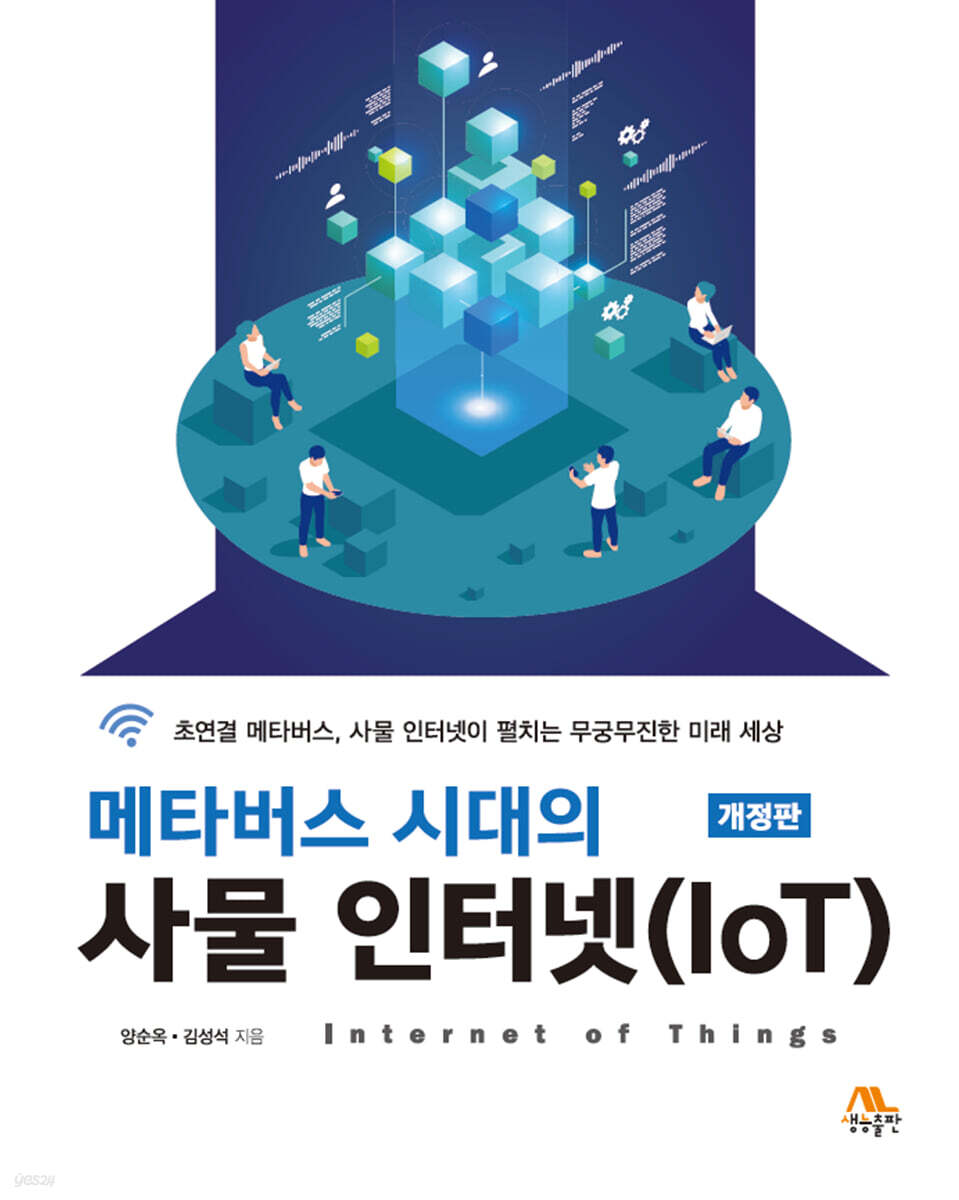
The Internet of Things (IoT) in the Metaverse Era
 |
Description
Book Introduction
This book is a fundamental guide that helps you understand why the Internet of Things is a core technology of the Fourth Industrial Revolution, how it can expand into a hyper-connected metaverse, what other key technologies are out there, and their ripple effects through smart cars and smart factories.
In a situation where it is difficult to predict how the metaverse, closely linked to the Internet of Things, will affect people in the future, there are few books that can explain the direction of change.
Recognizing this need, we have systematically organized this book to provide a comprehensive understanding of the key technologies and directions of change impacting the Fourth Industrial Revolution and the hyper-connected metaverse.
In a situation where it is difficult to predict how the metaverse, closely linked to the Internet of Things, will affect people in the future, there are few books that can explain the direction of change.
Recognizing this need, we have systematically organized this book to provide a comprehensive understanding of the key technologies and directions of change impacting the Fourth Industrial Revolution and the hyper-connected metaverse.
index
Part 01 The Changing Competitive Environment Based on the Internet of Things
CHAPTER 01 The New World of the Fourth Industrial Revolution
1.1 Definition of the Fourth Industrial Revolution
1.2 Characteristics of the Fourth Industrial Revolution
1.3 Key technologies and corporate application trends in the era of the Fourth Industrial Revolution
1.3.1 Expanding Digital Technologies
1.3.2 Metaverse-related technologies
1.3.3 Technologies that Change the Physical World
1.4 Progress of the Fourth Industrial Revolution through Case Studies
1.4.1 Autonomous vehicles
1.4.2 Next-Generation Intelligent Transportation Systems
1.4.3 Progress of the Fourth Industrial Revolution
Glossary of Terms
CHAPTER 02 Shifting Business Paradigms
2.1 Distribution companies that provide refrigerators for free
2.2 From post-treatment care to preventive care
2.3 The logistics industry is changing from price to personalized delivery competition.
2.4 The Leisure Industry: A Shift from Rest to Time Utilization
2.5 Manufacturing industry advanced by convergence of information and communication technology (ICT)
2.5.1 Manufacturing Transforms into Customized Production and Service Sales
2.5.2 Customized and Personalized Manufacturing Innovation
2.5.3 On-Demand Economy
2.6 The Protocol Economy: Transforming the Platform Economy into a Fair Distribution
2.6.1 Protocol Economy
Glossary of Terms
CHAPTER 03: Industrial Transformation Driven by the Internet of Things
3.1 Business Sectors in the Internet of Things Era
3.2 Effects of the Internet of Things
3.2.1 Reducing transaction and manufacturing costs
3.2.2 Performance Improvement through Innovation in Product Development Process
3.2.3 Market Expansion Using the Internet of Things
Glossary of Terms
Practice problems
Part 02 The concept, key technologies, and development direction of the Internet of Things
CHAPTER 04 Concept and Characteristics of the Internet of Things
4.1 Concept of the Internet of Things
4.1.1 Similar concepts to the Internet of Things
4.1.2 The Meaning of Things in the Internet of Things
4.2 Technologies that enable the Internet of Things
4.2.1 Basic technologies of the Internet of Things
4.2.2 Internet of Things, Big Data, Artificial Intelligence, Cloud and Edge Computing
4.3 Characteristics of the Internet of Things
4.3.1 Technical Features
4.3.2 Market Characteristics
Glossary of Terms
CHAPTER 05 Key Technologies of the Internet of Things
5.1 Internet of Things Devices
5.2 Internet of Things Network
5.3 Internet of Things Platform
5.3.1 Information Analysis and Judgment Skills
5.3.2 Trends in Internet of Things Platform Research and Development
5.4 Internet of Things Services
5.4.1 Key Service Areas of the Internet of Things
5.5 Internet of Things Architecture
5.5.1 Internet of Things Service Architecture
5.5.2 Changes in the Internet of Things Model
5.6 Security Technology
5.6.1 Internet of Things Security Threat Levels
5.6.2 Open Internet of Things Platform
5.7 Current Status and Outlook of the Internet of Things Market
Glossary of Terms
CHAPTER 06 Development Direction of the Internet of Things
6.1 Direction of Development of the Internet Paradigm
6.2 Hyperconnected, hyperconverged, and hyperintelligent society
6.3 Connected, Intelligent, and Autonomous Internet of Things
6.3.1 Internet of Intelligent Things
6.3.2 Autonomous Internet of Things
Glossary of Terms
Practice problems
Part 03: A Hyper-Connected Metaverse Made Possible by the Internet of Things and Augmented Reality
CHAPTER 07 Metaverse
7.1 The Expanding Metaverse Concept
7.1.1 Members of the Metaverse
7.1.2 Interacting with the Real World
7.2 Characteristics and Types of the Metaverse
7.2.1 Characteristics of the Metaverse
7.2.2 Types of Metaverse
7.3 Transition to a hyper-connected metaverse environment
7.3.1 Metaverse Disconnection Issues
7.3.2 Hyperconnected Metaverse Driven by the Internet of Things and Augmented Reality
7.3.3 Prototype Design Case for Metaverse Expansion
7.4 Representative Metaverse Media Platform Configuration
7.4.1 Technologies supporting interoperability between the real and virtual worlds
7.4.2 Technology to support real-world sensory effects
Glossary of Terms
CHAPTER 08 Utilizing Extended Reality
8.1 The concept of extended reality
8.2 Applications of Extended Reality
8.3 Development Direction of Key Extended Reality Technologies
8.3.1 Development direction of input/output interface technology
8.3.2 Trends in Extended Reality Technology Related to the Metaverse
8.3.3 Important International Standards Related to Mixed Reality
Glossary of Terms
Practice problems
Part 04: Linkages with Artificial Intelligence and Robotics, and Innovation in Parts and Materials
CHAPTER 09 Innovation Using Artificial Intelligence
9.1 The Concept of Artificial Intelligence
9.2 Key technologies and development cases of artificial intelligence
9.2.1 Case Studies of Artificial Intelligence Development
9.3 Applications of Artificial Intelligence
9.4 Pursuing the Strengths of Distributed Edge Computing-Based Artificial Intelligence
Glossary of Terms
CHAPTER 10: THE EVOLUTION OF ROBOTS
10.1 Combination of Robots and IT
10.2 Evolutionary Cases of Robot Companies
10.2.1 Hwanak's FIELD platform
10.2.2 Baxter and Sawyer from Rethink Robotics
Glossary of Terms
CHAPTER 11 Innovation in Components and Materials
11.1 Internet of Things and Semiconductors
11.1.1 Increasing demand for semiconductors with diverse functions
11.1.2 Systems on Chips (SoCs) and Low-Power Semiconductors
11.1.3 Artificial Intelligence Semiconductors
11.2 Advanced Materials
11.2.1 Strengthening the development of materials for biometrics and robotics
11.3 Rapid Growth of the Wearable Device Market
Glossary of Terms
Practice problems
Part 05 Smart Car
CHAPTER 12: CONCEPT AND CHARACTERISTICS OF SMART CAR
12.1 The concept of smart cars
12.1.1 Similar concepts to smart cars
12.1.2 Stages of Automotive Automation
12.2 Key Features and Issues
12.2.1 Features
12.2.2 Issue
Glossary of Terms
CHAPTER 13 Key Technologies and Services for Smart Cars
13.1 Key technologies of smart cars
13.1.1 Technical composition and core technologies
13.1.2 Automotive Sensors
13.1.3 Automotive Safety Technology
13.1.4 Autonomous Driving System Technology
13.1.5 Automotive Convenience Technology
13.1.6 Infotainment Platform
13.1.7 Automotive Operating System
Glossary of Terms
CHAPTER 14 Major domestic and international smart cars and services
14.1 Partnerships between Automotive and IT Companies
14.2 Major overseas smart cars and services
14.2.1 Google Self-Driving Car
14.2.2 BMW
14.3 Major domestic smart cars
14.3.1 Hyundai and Kia Motors
Glossary of Terms
Practice problems
Part 06 Smart Factory
CHAPTER 15: THE CONCEPT AND CHARACTERISTICS OF SMART FACTORIES
15.1 The concept of smart factories
15.1.1 Product Production Process
15.1.2 Configuration
15.2 Key Features and Issues
15.2.1 Features
15.2.2 Key Issues
15.3 Smart Factory Classification
Glossary of Terms
CHAPTER 16 Key Technologies for Smart Factories
16.1 Core Technologies
16.2 Industrial Internet of Things (IIoT)
16.2.1 Applications of the Industrial Internet of Things
16.3 Cyber-Physical Systems
16.3.1 Cyber-physical systems for smart factory design/operation
16.4 Security
16.4.1 Security Technology Applied to Smart Factories
16.5 The Role of Big Data
16.6 The Role of Artificial Intelligence
Glossary of Terms
CHAPTER 17 Cases of Major Domestic and Foreign Companies
17.1 Overseas companies
17.1.1 Siemens' Amberg plant
17.2 Domestic companies
17.2.1 POSCO's Gwangyang Steelworks
Glossary of Terms
Practice problems
Part 07: Reflections on the Internet of Things Beyond 2030
CHAPTER 18 Autonomous Internet of Things in 6G Networks
18.1 Comparison of 5G and 6G Scenarios
18.2 Key Features of 6G Networks
18.3 Autonomous Internet of Things
18.3.1 Edge Computing
18.3.2 Quantum Computing
18.3.3 Tactile Internet
18.4 New Applications of the Autonomous Internet of Things
18.4.1 Smart Medical
Glossary of Terms
Practice problems
References
ㆍ Search
CHAPTER 01 The New World of the Fourth Industrial Revolution
1.1 Definition of the Fourth Industrial Revolution
1.2 Characteristics of the Fourth Industrial Revolution
1.3 Key technologies and corporate application trends in the era of the Fourth Industrial Revolution
1.3.1 Expanding Digital Technologies
1.3.2 Metaverse-related technologies
1.3.3 Technologies that Change the Physical World
1.4 Progress of the Fourth Industrial Revolution through Case Studies
1.4.1 Autonomous vehicles
1.4.2 Next-Generation Intelligent Transportation Systems
1.4.3 Progress of the Fourth Industrial Revolution
Glossary of Terms
CHAPTER 02 Shifting Business Paradigms
2.1 Distribution companies that provide refrigerators for free
2.2 From post-treatment care to preventive care
2.3 The logistics industry is changing from price to personalized delivery competition.
2.4 The Leisure Industry: A Shift from Rest to Time Utilization
2.5 Manufacturing industry advanced by convergence of information and communication technology (ICT)
2.5.1 Manufacturing Transforms into Customized Production and Service Sales
2.5.2 Customized and Personalized Manufacturing Innovation
2.5.3 On-Demand Economy
2.6 The Protocol Economy: Transforming the Platform Economy into a Fair Distribution
2.6.1 Protocol Economy
Glossary of Terms
CHAPTER 03: Industrial Transformation Driven by the Internet of Things
3.1 Business Sectors in the Internet of Things Era
3.2 Effects of the Internet of Things
3.2.1 Reducing transaction and manufacturing costs
3.2.2 Performance Improvement through Innovation in Product Development Process
3.2.3 Market Expansion Using the Internet of Things
Glossary of Terms
Practice problems
Part 02 The concept, key technologies, and development direction of the Internet of Things
CHAPTER 04 Concept and Characteristics of the Internet of Things
4.1 Concept of the Internet of Things
4.1.1 Similar concepts to the Internet of Things
4.1.2 The Meaning of Things in the Internet of Things
4.2 Technologies that enable the Internet of Things
4.2.1 Basic technologies of the Internet of Things
4.2.2 Internet of Things, Big Data, Artificial Intelligence, Cloud and Edge Computing
4.3 Characteristics of the Internet of Things
4.3.1 Technical Features
4.3.2 Market Characteristics
Glossary of Terms
CHAPTER 05 Key Technologies of the Internet of Things
5.1 Internet of Things Devices
5.2 Internet of Things Network
5.3 Internet of Things Platform
5.3.1 Information Analysis and Judgment Skills
5.3.2 Trends in Internet of Things Platform Research and Development
5.4 Internet of Things Services
5.4.1 Key Service Areas of the Internet of Things
5.5 Internet of Things Architecture
5.5.1 Internet of Things Service Architecture
5.5.2 Changes in the Internet of Things Model
5.6 Security Technology
5.6.1 Internet of Things Security Threat Levels
5.6.2 Open Internet of Things Platform
5.7 Current Status and Outlook of the Internet of Things Market
Glossary of Terms
CHAPTER 06 Development Direction of the Internet of Things
6.1 Direction of Development of the Internet Paradigm
6.2 Hyperconnected, hyperconverged, and hyperintelligent society
6.3 Connected, Intelligent, and Autonomous Internet of Things
6.3.1 Internet of Intelligent Things
6.3.2 Autonomous Internet of Things
Glossary of Terms
Practice problems
Part 03: A Hyper-Connected Metaverse Made Possible by the Internet of Things and Augmented Reality
CHAPTER 07 Metaverse
7.1 The Expanding Metaverse Concept
7.1.1 Members of the Metaverse
7.1.2 Interacting with the Real World
7.2 Characteristics and Types of the Metaverse
7.2.1 Characteristics of the Metaverse
7.2.2 Types of Metaverse
7.3 Transition to a hyper-connected metaverse environment
7.3.1 Metaverse Disconnection Issues
7.3.2 Hyperconnected Metaverse Driven by the Internet of Things and Augmented Reality
7.3.3 Prototype Design Case for Metaverse Expansion
7.4 Representative Metaverse Media Platform Configuration
7.4.1 Technologies supporting interoperability between the real and virtual worlds
7.4.2 Technology to support real-world sensory effects
Glossary of Terms
CHAPTER 08 Utilizing Extended Reality
8.1 The concept of extended reality
8.2 Applications of Extended Reality
8.3 Development Direction of Key Extended Reality Technologies
8.3.1 Development direction of input/output interface technology
8.3.2 Trends in Extended Reality Technology Related to the Metaverse
8.3.3 Important International Standards Related to Mixed Reality
Glossary of Terms
Practice problems
Part 04: Linkages with Artificial Intelligence and Robotics, and Innovation in Parts and Materials
CHAPTER 09 Innovation Using Artificial Intelligence
9.1 The Concept of Artificial Intelligence
9.2 Key technologies and development cases of artificial intelligence
9.2.1 Case Studies of Artificial Intelligence Development
9.3 Applications of Artificial Intelligence
9.4 Pursuing the Strengths of Distributed Edge Computing-Based Artificial Intelligence
Glossary of Terms
CHAPTER 10: THE EVOLUTION OF ROBOTS
10.1 Combination of Robots and IT
10.2 Evolutionary Cases of Robot Companies
10.2.1 Hwanak's FIELD platform
10.2.2 Baxter and Sawyer from Rethink Robotics
Glossary of Terms
CHAPTER 11 Innovation in Components and Materials
11.1 Internet of Things and Semiconductors
11.1.1 Increasing demand for semiconductors with diverse functions
11.1.2 Systems on Chips (SoCs) and Low-Power Semiconductors
11.1.3 Artificial Intelligence Semiconductors
11.2 Advanced Materials
11.2.1 Strengthening the development of materials for biometrics and robotics
11.3 Rapid Growth of the Wearable Device Market
Glossary of Terms
Practice problems
Part 05 Smart Car
CHAPTER 12: CONCEPT AND CHARACTERISTICS OF SMART CAR
12.1 The concept of smart cars
12.1.1 Similar concepts to smart cars
12.1.2 Stages of Automotive Automation
12.2 Key Features and Issues
12.2.1 Features
12.2.2 Issue
Glossary of Terms
CHAPTER 13 Key Technologies and Services for Smart Cars
13.1 Key technologies of smart cars
13.1.1 Technical composition and core technologies
13.1.2 Automotive Sensors
13.1.3 Automotive Safety Technology
13.1.4 Autonomous Driving System Technology
13.1.5 Automotive Convenience Technology
13.1.6 Infotainment Platform
13.1.7 Automotive Operating System
Glossary of Terms
CHAPTER 14 Major domestic and international smart cars and services
14.1 Partnerships between Automotive and IT Companies
14.2 Major overseas smart cars and services
14.2.1 Google Self-Driving Car
14.2.2 BMW
14.3 Major domestic smart cars
14.3.1 Hyundai and Kia Motors
Glossary of Terms
Practice problems
Part 06 Smart Factory
CHAPTER 15: THE CONCEPT AND CHARACTERISTICS OF SMART FACTORIES
15.1 The concept of smart factories
15.1.1 Product Production Process
15.1.2 Configuration
15.2 Key Features and Issues
15.2.1 Features
15.2.2 Key Issues
15.3 Smart Factory Classification
Glossary of Terms
CHAPTER 16 Key Technologies for Smart Factories
16.1 Core Technologies
16.2 Industrial Internet of Things (IIoT)
16.2.1 Applications of the Industrial Internet of Things
16.3 Cyber-Physical Systems
16.3.1 Cyber-physical systems for smart factory design/operation
16.4 Security
16.4.1 Security Technology Applied to Smart Factories
16.5 The Role of Big Data
16.6 The Role of Artificial Intelligence
Glossary of Terms
CHAPTER 17 Cases of Major Domestic and Foreign Companies
17.1 Overseas companies
17.1.1 Siemens' Amberg plant
17.2 Domestic companies
17.2.1 POSCO's Gwangyang Steelworks
Glossary of Terms
Practice problems
Part 07: Reflections on the Internet of Things Beyond 2030
CHAPTER 18 Autonomous Internet of Things in 6G Networks
18.1 Comparison of 5G and 6G Scenarios
18.2 Key Features of 6G Networks
18.3 Autonomous Internet of Things
18.3.1 Edge Computing
18.3.2 Quantum Computing
18.3.3 Tactile Internet
18.4 New Applications of the Autonomous Internet of Things
18.4.1 Smart Medical
Glossary of Terms
Practice problems
References
ㆍ Search
Publisher's Review
Features of this book
First, the progress of the Fourth Industrial Revolution was broadly understood and reflected.
Initially, the Internet of Things played a divergent role in driving the Fourth Industrial Revolution, but it has now established itself as a foundational and core technology for each industry.
Advances are being made not only in ICT technologies such as artificial intelligence, big data, cloud computing, mobile communications, quantum computing, and extended reality, but also in non-ICT technologies such as intelligent semiconductors, cutting-edge materials, and robotics.
Various technologies are being integrated and applied across various industries, bringing about rapid change, and their ripple effects are growing as they are intertwined with changes in the economic environment.
Economic terms derived from information technology, such as platform economy, protocol economy, and cryptocurrency, are becoming increasingly common, and business paradigms are rapidly changing.
It is structured so that even these economic changes can be understood from a technological perspective.
Second, it enabled us to understand the concept and future development direction of the intelligent and autonomous Internet of Things.
The Internet of Things (IoT) has evolved from an initially sensor- and actuator-centric, connected IoT to an intelligent, autonomous IoT, and is evolving to support high-performance platforms and diverse services.
Intelligent systems that are connected to not only all objects but also all spaces, and that can make predictions through big data analysis and artificial intelligence, are becoming widespread.
Artificial intelligence technology is being widely applied and utilized in both software and hardware fields, to the extent that artificial intelligence semiconductors have been developed and utilized.
In addition, it helped us understand the development direction of the autonomous Internet of Things and the fundamental technologies that play a crucial role, such as mobile communications, cloud computing, and edge computing.
Third, it is designed to help you understand how the real world and the metaverse are connected and expanded to make a hyper-connected metaverse possible.
Just as mp3 music files and mp4 video files have become common, mp5 is being researched and developed as a technology to connect and control virtual world objects and real world objects.
To support hyper-realistic services, research and development are actively underway on visual, auditory, olfactory, and even tactile senses.
A lot of investment is also being made in the development of haptic technologies that change movements depending on the feeling of touch or the strength of the force applied by the hand.
As holoportation technology for transmitting holograms and real-time hologram rendering technology develop and the 6th generation mobile communication (6G) supports ultra-realistic services and hologram transmission, real-time hologram calls are expected to become possible.
We have made it possible to understand how this hyper-connected metaverse is realized through Internet of Things and extended reality technologies.
Fourth, it was designed to examine the development direction of 6G and the Internet of Things after 2030.
When 6G is commercialized in 2030, communication will be possible even under the sea and in space, virtually eliminating blind spots in communication.
The network itself will incorporate quantum computing and artificial intelligence technologies to support ultra-high reliability and ultra-low latency services at transmission speeds of 1 Tbps.
Tactile Internet technology, which requires more precise control over the network, enables the popularization of advanced convergence services such as real-time remote surgery and fully autonomous vehicles.
This book explores what's possible, using specific healthcare examples to illustrate how 6G networks can support the autonomous Internet of Things.
Structure and contents of this book
This book is a fundamental guide that helps you understand why the Internet of Things is a core technology of the Fourth Industrial Revolution, how it can expand into a hyper-connected metaverse, what other key technologies are out there, and their ripple effects through smart cars and smart factories.
In a situation where it is difficult to predict how the metaverse, closely linked to the Internet of Things, will affect people in the future, there are few books that can explain the direction of change.
Recognizing this need, we have systematically organized this book to provide a comprehensive understanding of the key technologies and directions of change impacting the Fourth Industrial Revolution and the hyper-connected metaverse.
Part 1.
The Changing Competitive Environment Based on the Internet of Things (Chapters 1-3)
In a competitive environment evolving around the Internet of Things, we examine the definition and characteristics of the Fourth Industrial Revolution, key technologies and trends in corporate application, and the progress of the Fourth Industrial Revolution.
We examine the shifts in the business paradigm, including the platform economy and protocol economy, and explore the business sectors and adoption effects of the Internet of Things era.
Part 2.
The concept, key technologies, and development direction of the Internet of Things (Chapters 4-6)
We will examine the concept and characteristics of the Internet of Things, its key technologies: devices, network infrastructure, platforms utilizing big data and artificial intelligence, and key service areas.
We will examine the operating principles of the Internet of Things architecture and specific services that take these detailed technologies into account, and also examine technical issues related to security.
We also examine the direction of the Internet paradigm's development and the direction of its development toward a hyper-connected, hyper-converged, and hyper-intelligent society, as well as the direction of its evolution toward a connected, intelligent, and autonomous Internet of Things.
Part 3.
A Hyperconnected Metaverse Enabled by the Internet of Things and Augmented Reality (Chapters 7-8)
We will examine the concept, characteristics, and types of the metaverse, and learn about the transition to a hyper-connected metaverse environment and the technology that implements a hyper-connected metaverse through a metaverse media platform.
We examine the concept of extended reality technology, which forms the basis of the metaverse platform, through the concept of virtuality continuity, and examine related technologies and application areas, as well as important international standardization related to mixed reality.
Part 4.
Links with artificial intelligence and robotics, and innovation in components and materials (Chapters 9-11)
In addition to the Internet of Things, artificial intelligence, collaboration with robots, and innovation in components and materials are also contributing significantly to changes in major industries.
Therefore, we will learn about the concept, key technologies, and application areas of artificial intelligence, and examine robots and cases evolving through their combination with IT.
We will also look at components and materials used in the Internet of Things, such as artificial intelligence semiconductors.
Part 5.
Smart Cars (Chapters 12-14)
We examine the concept, characteristics, and issues of smart cars, which apply Internet of Things technology to automobiles, and explore their key technologies: safety, convenience, autonomous driving, and infotainment platforms.
We will also look at major domestic and international smart car and service examples, including Google's self-driving car, BMW, and Hyundai/Kia Motors.
Part 6.
Smart Factory (Chapters 15-17)
We examine the concept, characteristics, and issues of smart factories, which are the starting point of the Fourth Industrial Revolution and have an impact on the entire economic system. We also examine the role of key IT technologies in smart factories: the Industrial Internet of Things (IIoT), cyber-physical systems (CPS), security, big data, and artificial intelligence.
We will also examine examples of major domestic and international smart factory companies, such as Siemens' Amberg plant in Germany and POSCO's Gwangyang Steelworks.
Part 7.
Reflections on the Internet of Things Beyond 2030 (Chapter 18)
We explore the autonomous Internet of Things, which leverages 6G network infrastructure to provide advanced convergence services beyond 2030.
We compare 5G and 6G scenarios to examine the key features of 6G and explore edge computing, quantum computing, and the tactile Internet, key technologies supporting the autonomous Internet of Things.
And we look at new applications of the autonomous Internet of Things.
First, the progress of the Fourth Industrial Revolution was broadly understood and reflected.
Initially, the Internet of Things played a divergent role in driving the Fourth Industrial Revolution, but it has now established itself as a foundational and core technology for each industry.
Advances are being made not only in ICT technologies such as artificial intelligence, big data, cloud computing, mobile communications, quantum computing, and extended reality, but also in non-ICT technologies such as intelligent semiconductors, cutting-edge materials, and robotics.
Various technologies are being integrated and applied across various industries, bringing about rapid change, and their ripple effects are growing as they are intertwined with changes in the economic environment.
Economic terms derived from information technology, such as platform economy, protocol economy, and cryptocurrency, are becoming increasingly common, and business paradigms are rapidly changing.
It is structured so that even these economic changes can be understood from a technological perspective.
Second, it enabled us to understand the concept and future development direction of the intelligent and autonomous Internet of Things.
The Internet of Things (IoT) has evolved from an initially sensor- and actuator-centric, connected IoT to an intelligent, autonomous IoT, and is evolving to support high-performance platforms and diverse services.
Intelligent systems that are connected to not only all objects but also all spaces, and that can make predictions through big data analysis and artificial intelligence, are becoming widespread.
Artificial intelligence technology is being widely applied and utilized in both software and hardware fields, to the extent that artificial intelligence semiconductors have been developed and utilized.
In addition, it helped us understand the development direction of the autonomous Internet of Things and the fundamental technologies that play a crucial role, such as mobile communications, cloud computing, and edge computing.
Third, it is designed to help you understand how the real world and the metaverse are connected and expanded to make a hyper-connected metaverse possible.
Just as mp3 music files and mp4 video files have become common, mp5 is being researched and developed as a technology to connect and control virtual world objects and real world objects.
To support hyper-realistic services, research and development are actively underway on visual, auditory, olfactory, and even tactile senses.
A lot of investment is also being made in the development of haptic technologies that change movements depending on the feeling of touch or the strength of the force applied by the hand.
As holoportation technology for transmitting holograms and real-time hologram rendering technology develop and the 6th generation mobile communication (6G) supports ultra-realistic services and hologram transmission, real-time hologram calls are expected to become possible.
We have made it possible to understand how this hyper-connected metaverse is realized through Internet of Things and extended reality technologies.
Fourth, it was designed to examine the development direction of 6G and the Internet of Things after 2030.
When 6G is commercialized in 2030, communication will be possible even under the sea and in space, virtually eliminating blind spots in communication.
The network itself will incorporate quantum computing and artificial intelligence technologies to support ultra-high reliability and ultra-low latency services at transmission speeds of 1 Tbps.
Tactile Internet technology, which requires more precise control over the network, enables the popularization of advanced convergence services such as real-time remote surgery and fully autonomous vehicles.
This book explores what's possible, using specific healthcare examples to illustrate how 6G networks can support the autonomous Internet of Things.
Structure and contents of this book
This book is a fundamental guide that helps you understand why the Internet of Things is a core technology of the Fourth Industrial Revolution, how it can expand into a hyper-connected metaverse, what other key technologies are out there, and their ripple effects through smart cars and smart factories.
In a situation where it is difficult to predict how the metaverse, closely linked to the Internet of Things, will affect people in the future, there are few books that can explain the direction of change.
Recognizing this need, we have systematically organized this book to provide a comprehensive understanding of the key technologies and directions of change impacting the Fourth Industrial Revolution and the hyper-connected metaverse.
Part 1.
The Changing Competitive Environment Based on the Internet of Things (Chapters 1-3)
In a competitive environment evolving around the Internet of Things, we examine the definition and characteristics of the Fourth Industrial Revolution, key technologies and trends in corporate application, and the progress of the Fourth Industrial Revolution.
We examine the shifts in the business paradigm, including the platform economy and protocol economy, and explore the business sectors and adoption effects of the Internet of Things era.
Part 2.
The concept, key technologies, and development direction of the Internet of Things (Chapters 4-6)
We will examine the concept and characteristics of the Internet of Things, its key technologies: devices, network infrastructure, platforms utilizing big data and artificial intelligence, and key service areas.
We will examine the operating principles of the Internet of Things architecture and specific services that take these detailed technologies into account, and also examine technical issues related to security.
We also examine the direction of the Internet paradigm's development and the direction of its development toward a hyper-connected, hyper-converged, and hyper-intelligent society, as well as the direction of its evolution toward a connected, intelligent, and autonomous Internet of Things.
Part 3.
A Hyperconnected Metaverse Enabled by the Internet of Things and Augmented Reality (Chapters 7-8)
We will examine the concept, characteristics, and types of the metaverse, and learn about the transition to a hyper-connected metaverse environment and the technology that implements a hyper-connected metaverse through a metaverse media platform.
We examine the concept of extended reality technology, which forms the basis of the metaverse platform, through the concept of virtuality continuity, and examine related technologies and application areas, as well as important international standardization related to mixed reality.
Part 4.
Links with artificial intelligence and robotics, and innovation in components and materials (Chapters 9-11)
In addition to the Internet of Things, artificial intelligence, collaboration with robots, and innovation in components and materials are also contributing significantly to changes in major industries.
Therefore, we will learn about the concept, key technologies, and application areas of artificial intelligence, and examine robots and cases evolving through their combination with IT.
We will also look at components and materials used in the Internet of Things, such as artificial intelligence semiconductors.
Part 5.
Smart Cars (Chapters 12-14)
We examine the concept, characteristics, and issues of smart cars, which apply Internet of Things technology to automobiles, and explore their key technologies: safety, convenience, autonomous driving, and infotainment platforms.
We will also look at major domestic and international smart car and service examples, including Google's self-driving car, BMW, and Hyundai/Kia Motors.
Part 6.
Smart Factory (Chapters 15-17)
We examine the concept, characteristics, and issues of smart factories, which are the starting point of the Fourth Industrial Revolution and have an impact on the entire economic system. We also examine the role of key IT technologies in smart factories: the Industrial Internet of Things (IIoT), cyber-physical systems (CPS), security, big data, and artificial intelligence.
We will also examine examples of major domestic and international smart factory companies, such as Siemens' Amberg plant in Germany and POSCO's Gwangyang Steelworks.
Part 7.
Reflections on the Internet of Things Beyond 2030 (Chapter 18)
We explore the autonomous Internet of Things, which leverages 6G network infrastructure to provide advanced convergence services beyond 2030.
We compare 5G and 6G scenarios to examine the key features of 6G and explore edge computing, quantum computing, and the tactile Internet, key technologies supporting the autonomous Internet of Things.
And we look at new applications of the autonomous Internet of Things.
GOODS SPECIFICS
- Date of issue: February 3, 2023
- Page count, weight, size: 516 pages | 190*240*35mm
- ISBN13: 9791192932026
- ISBN10: 1192932021
You may also like
카테고리
korean


korean

![GQ KOREA Mark (Monthly): December [2025]](http://librairie.coreenne.fr/cdn/shop/files/8ef265dbbfbf186523ed75ba7319009d.jpg?v=1765340328&width=3840)


