

C Language Coding Dojo
 |
Description
Book Introduction
Programming is learned through practice!
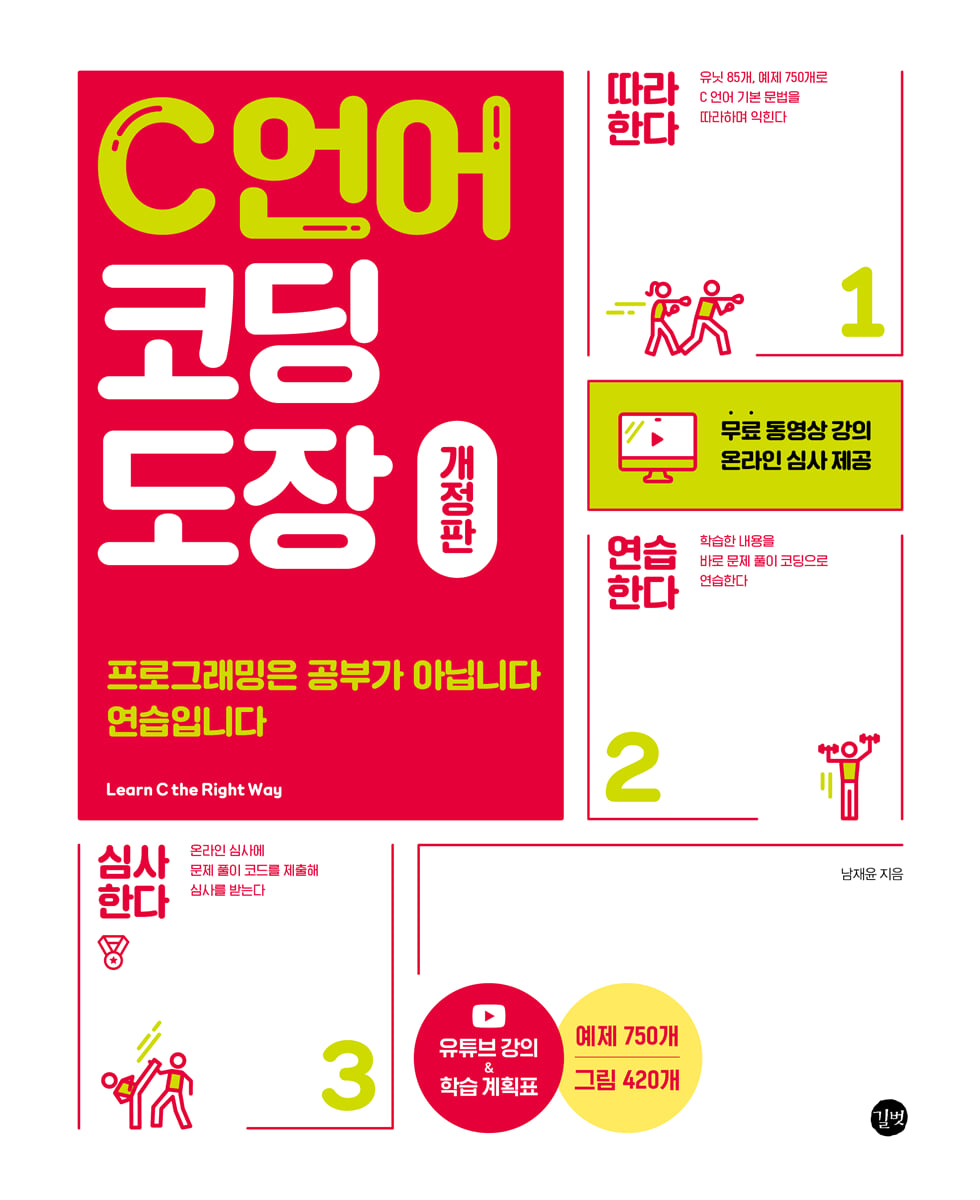
The most in-depth introduction to the C language
It explains difficult and tricky topics of the C language step by step without skipping anything.
Rather than omitting concepts and making it an easy book, explain it properly.
It is structured in a way that even beginners to programming can understand it by following it step by step.
Study one topic five times by following the steps of theory, practice, quizzes, practice problems, and exam questions.
Finally, we will summarize the key points and Q&A.
The most in-depth introduction to the C language
It explains difficult and tricky topics of the C language step by step without skipping anything.
Rather than omitting concepts and making it an easy book, explain it properly.
It is structured in a way that even beginners to programming can understand it by following it step by step.
Study one topic five times by following the steps of theory, practice, quizzes, practice problems, and exam questions.
Finally, we will summarize the key points and Q&A.
- You can preview some of the book's contents.
Preview
index
UNIT 1.
Software Education and the C Language
UNIT 2.
Installing Visual Studio
UNIT 3.
Start with Hello, world!
UNIT 4.
Learn basic grammar
Key Summary
Q&A
UNIT 5.
Create a variable
UNIT 6.
Using the debugger
UNIT 7.
Using integer data types
UNIT 8.
Using real data types
Key Summary
Q&A
UNIT 9.
Using character data types
UNIT 10.
Using constants
UNIT 11.
Store input values in variables
Key Summary
Q&A
UNIT 12.
Addition and subtraction
UNIT 13.
Using increment and decrement operators
UNIT 14.
Multiplication and division
UNIT 15.
Calculate the remainder
UNIT 16.
Learn about data type expansion and contraction
Key Summary
Q&A
UNIT 17.
Executing code when a specific condition is met using an if statement
UNIT 18.
Branching in two directions using else
UNIT 19.
Branching in multiple directions using else if
Key Summary
Q&A
UNIT 20.
Using comparison operators and ternary operators
UNIT 21.
Using logical operators
UNIT 22.
Using Boolean data types
Key Summary
Q&A
UNIT 23.
Using bitwise operators
UNIT 24.
Applying bitwise operators
UNIT 25.
Understanding operator precedence
Key Summary
Q&A
UNIT 26.
Handling various conditions with switch statements
UNIT 27.
Print "Hello, world!" 100 times using a for loop
UNIT 28.
Print "Hello, world!" 100 times using a while loop
UNIT 29.
Execute at least once with a do while loop
UNIT 30.
Controlling loops with break and continue
UNIT 31.
Outputting stars in steps
Key Summary
Q&A
UNIT 32.
Change the flow of the program as desired with goto
UNIT 33.
FizzBuzz
Key Summary
Q&A
UNIT 34.
Using pointers
UNIT 35.
Using memory
Key Summary
Q&A
UNIT 36.
Using arrays
UNIT 37.
Using a two-dimensional array
UNIT 38.
Applying Pointers and Arrays
Key Summary
Q&A
UNIT 39.
Using strings
UNIT 40.
Store input values in a string
Key Summary
Q&A
UNIT 41.
Find and compare the length of strings
UNIT 42.
Copy and paste strings
UNIT 43.
Creating a string
UNIT 44.
Search for a string
UNIT 45.
Truncate string
UNIT 46.
Converting strings and numbers to each other
UNIT 47.
Palindrome Detection and N-gram Creation
Key Summary
Q&A
UNIT 48.
Using structures
UNIT 49.
Using structure pointers
UNIT 50.
Finding the distance between two points
Key Summary
Q&A
UNIT 51.
Using structure member alignment
UNIT 52.
Using Structures and Memory
UNIT 53.
Using an array of structures
Key Summary
Q&A
UNIT 54.
Using unions
UNIT 55.
Using structures and unions
Key Summary
Q&A
UNIT 56.
Using structure bit fields
UNIT 57.
Using enumerations
Key Summary
Q&A
UNIT 58.
Converting data types
UNIT 59.
Using pointer arithmetic
Key Summary
Q&A
UNIT 60.
Using functions
UNIT 61.
Using return values from functions
UNIT 62.
Using parameters in functions
Key Summary
Q&A
UNIT 63.
Using pointer parameters in functions
UNIT 64.
Using array parameters in functions
UNIT 65.
Using structure parameters in functions
Key Summary
Q&A
UNIT 66.
Using variable arguments in functions
UNIT 67.
Using recursive calls in functions
UNIT 68.
Using function pointers
UNIT 69.
Using function pointers
Key Summary
Q&A
UNIT 70.
Reading and writing strings from files
UNIT 71.
Using file pointers
UNIT 72.
Reading and writing structures from files
Key Summary
Q&A
UNIT 73.
Sorting an array
UNIT 74.
Implementing a linked list
Key Summary
Q&A
UNIT 75.
Using macros
UNIT 76.
Using conditional compilation and file inclusion
UNIT 77.
Using multiple source files
Key Summary
Q&A
UNIT 78.
Using global variables
UNIT 79.
Using memory class specifiers
UNIT 80.
Using executable options
Key Summary
Q&A
UNIT 81.
Practical Example: Converting a Bitmap File to ASCII Art
UNIT 82.
Practical Example: Implementing a File Archive
Key Summary
Q&A
UNIT 83.
Practical Example: Reading and Writing JSON Files
UNIT 84.
Practical Example: Using Source Code from GitHub
Key Summary
Q&A
UNIT 85.
supplement
Software Education and the C Language
UNIT 2.
Installing Visual Studio
UNIT 3.
Start with Hello, world!
UNIT 4.
Learn basic grammar
Key Summary
Q&A
UNIT 5.
Create a variable
UNIT 6.
Using the debugger
UNIT 7.
Using integer data types
UNIT 8.
Using real data types
Key Summary
Q&A
UNIT 9.
Using character data types
UNIT 10.
Using constants
UNIT 11.
Store input values in variables
Key Summary
Q&A
UNIT 12.
Addition and subtraction
UNIT 13.
Using increment and decrement operators
UNIT 14.
Multiplication and division
UNIT 15.
Calculate the remainder
UNIT 16.
Learn about data type expansion and contraction
Key Summary
Q&A
UNIT 17.
Executing code when a specific condition is met using an if statement
UNIT 18.
Branching in two directions using else
UNIT 19.
Branching in multiple directions using else if
Key Summary
Q&A
UNIT 20.
Using comparison operators and ternary operators
UNIT 21.
Using logical operators
UNIT 22.
Using Boolean data types
Key Summary
Q&A
UNIT 23.
Using bitwise operators
UNIT 24.
Applying bitwise operators
UNIT 25.
Understanding operator precedence
Key Summary
Q&A
UNIT 26.
Handling various conditions with switch statements
UNIT 27.
Print "Hello, world!" 100 times using a for loop
UNIT 28.
Print "Hello, world!" 100 times using a while loop
UNIT 29.
Execute at least once with a do while loop
UNIT 30.
Controlling loops with break and continue
UNIT 31.
Outputting stars in steps
Key Summary
Q&A
UNIT 32.
Change the flow of the program as desired with goto
UNIT 33.
FizzBuzz
Key Summary
Q&A
UNIT 34.
Using pointers
UNIT 35.
Using memory
Key Summary
Q&A
UNIT 36.
Using arrays
UNIT 37.
Using a two-dimensional array
UNIT 38.
Applying Pointers and Arrays
Key Summary
Q&A
UNIT 39.
Using strings
UNIT 40.
Store input values in a string
Key Summary
Q&A
UNIT 41.
Find and compare the length of strings
UNIT 42.
Copy and paste strings
UNIT 43.
Creating a string
UNIT 44.
Search for a string
UNIT 45.
Truncate string
UNIT 46.
Converting strings and numbers to each other
UNIT 47.
Palindrome Detection and N-gram Creation
Key Summary
Q&A
UNIT 48.
Using structures
UNIT 49.
Using structure pointers
UNIT 50.
Finding the distance between two points
Key Summary
Q&A
UNIT 51.
Using structure member alignment
UNIT 52.
Using Structures and Memory
UNIT 53.
Using an array of structures
Key Summary
Q&A
UNIT 54.
Using unions
UNIT 55.
Using structures and unions
Key Summary
Q&A
UNIT 56.
Using structure bit fields
UNIT 57.
Using enumerations
Key Summary
Q&A
UNIT 58.
Converting data types
UNIT 59.
Using pointer arithmetic
Key Summary
Q&A
UNIT 60.
Using functions
UNIT 61.
Using return values from functions
UNIT 62.
Using parameters in functions
Key Summary
Q&A
UNIT 63.
Using pointer parameters in functions
UNIT 64.
Using array parameters in functions
UNIT 65.
Using structure parameters in functions
Key Summary
Q&A
UNIT 66.
Using variable arguments in functions
UNIT 67.
Using recursive calls in functions
UNIT 68.
Using function pointers
UNIT 69.
Using function pointers
Key Summary
Q&A
UNIT 70.
Reading and writing strings from files
UNIT 71.
Using file pointers
UNIT 72.
Reading and writing structures from files
Key Summary
Q&A
UNIT 73.
Sorting an array
UNIT 74.
Implementing a linked list
Key Summary
Q&A
UNIT 75.
Using macros
UNIT 76.
Using conditional compilation and file inclusion
UNIT 77.
Using multiple source files
Key Summary
Q&A
UNIT 78.
Using global variables
UNIT 79.
Using memory class specifiers
UNIT 80.
Using executable options
Key Summary
Q&A
UNIT 81.
Practical Example: Converting a Bitmap File to ASCII Art
UNIT 82.
Practical Example: Implementing a File Archive
Key Summary
Q&A
UNIT 83.
Practical Example: Reading and Writing JSON Files
UNIT 84.
Practical Example: Using Source Code from GitHub
Key Summary
Q&A
UNIT 85.
supplement
Detailed image

Publisher's Review
Programming is learned through practice!
The most in-depth introduction to the C language
It explains difficult and tricky topics of the C language step by step without skipping anything.
Rather than omitting concepts and making it an easy book, explain it properly.
Even beginners can follow along!
It is structured in a way that even beginners to programming can understand it by following it step by step.
Study one topic five times by following the steps of theory > practice > quizzes > practice problems > exam questions.
Finally, we will summarize the key points and Q&A.
Learn proper coding
C is an old language with many pitfalls.
It's a language that makes it easy to write bad code and then mistake it for correct.
We carefully grade your work through online evaluation to correct any mistakes.
Achieve meaningful growth
Check your learning progress and monitor your growth through the learning progress chart.
The average pass rate for the exam questions is 90%! Pass the exam and see your growth!
This is a test question that you can definitely pass and grow if you try hard!
You will definitely grow as much as you try 10 or 20 times.
Providing a dedicated learning site
The Coding Dojang (dojang.io) website provides learning progress, online evaluation, and reader Q&A.
Since the first edition was published, it has accumulated 55 million page views and 18 million unique visitors!
Example source: https://github.com/gilbutITbook/006759
Coding Dojang: https://dojang.io
[A Word from a Beta Tester]
There has never been a book as easy to understand as this one.
"There are many C language books.
But there is only one proper book.
That's this book.
A must-read for anyone studying the C language! It covers everything from the basics to advanced techniques in a solid manner.
Other C language books are difficult and boring.
However, anyone can learn the C language easily and enjoyably through this book.
I've read many C language books, but none of them were as easy to understand as this one.
Whether you are a beginner or have experience studying the C language, this one book will solve your problem.
I recommend this book to anyone who wants to relearn the C language, wants to solidify their foundation, or wants to study in a fun way.
Kim Hyun-myeong | 20s
The process of thinking and typing code was fun.
Even though it was my first time learning the C language and programming, I had fun learning each and every thing and solving problems.
There were some easy parts and some difficult parts, but it was refreshing to be able to think in a new direction through the problems.
I think it was fun to think and input code directly rather than just reading the text.
Lee Won-hee | 30s
The course content was not boring and was easy to understand.
I liked how it presented control flow, how to utilize data structures, and the guidance defined by ANSI C.
The course content was not boring and was easy to understand, which was very helpful.
Jeong Gu-min | 20s
I was able to practice pointers and memory thoroughly! I was able to build a solid foundation in the C language from the very beginning.
In particular, you can definitely practice with pointers and memory.
Hyukun | 30s
From beginners to seasoned C users! Whether you're new to C or studying it, this is a great way to get started or review what you already know!
Lee Chang-ho | 20s
[Author's Preface]
There is no field that is advancing as quickly as computers.
In just over 70 years since the invention of computers, they have achieved performance and capabilities beyond imagination.
The first computer I ever encountered was an 8-bit computer, which at the time was just a typewriter that displayed text on the screen.
Before that, it was a military calculator the size of a house.
But now, we enjoy games with graphics so splendid they are indistinguishable from reality, and computers have even reached the level of beating humans at Go, a game that was once thought to be impossible for humans to beat.
Although electrical and electronic technology has advanced computer hardware to higher performance, the advancement of computers is actually the advancement of software.
Both games and AlphaGo are all software.
What we actually encounter with computers is software.
Programming languages have played a major role in the development of such software.
In the very early days, people would connect wires directly to perform the desired calculations, and for a while, they would develop by entering machine language or assembly language.
It was difficult to develop, inconvenient, and took a long time.
As time went by and programming languages became more human-friendly, the pace of development accelerated significantly.
The representative language is C, and operating systems such as Windows, Linux, and OS X and various software were developed in C.
Since then, numerous programming languages have emerged, ushering in the era of software.
The flashy graphic games we play on our computers today, the web browsers we use to browse the Internet, and the apps on our smartphones are all software.
Vending machines, subway displays, car engines, elevators, and traffic lights are all software, even though they are invisible to the eye.
It is no exaggeration to say that our daily lives begin and end with software.
As the times change, I believe that software will be used more and more and that its future as a profession is bright.
We want to learn C language here.
Although the C language is known as the foundation of programming, it is not easy to learn.
Although the language itself is simple, you need to learn the structure of the computer and the operation of the operating system to use it smoothly.
When I think back to when I first learned the C language, I had many difficulties.
I struggled because I didn't understand pointers, and I just memorized the grammar and used it because I didn't understand data type conversion.
So, while writing this book, I thought a lot about how to make learning the C language easier.
While explaining the grammar and usage of the C language, I minimized the difficult computer architecture and operating system parts and focused only on the necessary parts.
We have structured it so that you can learn more in-depth and detailed explanations through references and Q&A.
Programming languages are not something you can learn simply by studying; it's important to naturally learn the principles through practice.
This book provides a coding dojo website so you can practice typing yourself.
The process of thinking and solving problems on your own through Coding Dojo's evaluation questions will deepen your understanding of programming.
We would like to thank everyone who provided feedback on the book's content and tested the review questions during the beta testing period.
I hope this will be helpful to anyone who is having trouble learning the C language.
_Nam Jae-yoon
The most in-depth introduction to the C language
It explains difficult and tricky topics of the C language step by step without skipping anything.
Rather than omitting concepts and making it an easy book, explain it properly.
Even beginners can follow along!
It is structured in a way that even beginners to programming can understand it by following it step by step.
Study one topic five times by following the steps of theory > practice > quizzes > practice problems > exam questions.
Finally, we will summarize the key points and Q&A.
Learn proper coding
C is an old language with many pitfalls.
It's a language that makes it easy to write bad code and then mistake it for correct.
We carefully grade your work through online evaluation to correct any mistakes.
Achieve meaningful growth
Check your learning progress and monitor your growth through the learning progress chart.
The average pass rate for the exam questions is 90%! Pass the exam and see your growth!
This is a test question that you can definitely pass and grow if you try hard!
You will definitely grow as much as you try 10 or 20 times.
Providing a dedicated learning site
The Coding Dojang (dojang.io) website provides learning progress, online evaluation, and reader Q&A.
Since the first edition was published, it has accumulated 55 million page views and 18 million unique visitors!
Example source: https://github.com/gilbutITbook/006759
Coding Dojang: https://dojang.io
[A Word from a Beta Tester]
There has never been a book as easy to understand as this one.
"There are many C language books.
But there is only one proper book.
That's this book.
A must-read for anyone studying the C language! It covers everything from the basics to advanced techniques in a solid manner.
Other C language books are difficult and boring.
However, anyone can learn the C language easily and enjoyably through this book.
I've read many C language books, but none of them were as easy to understand as this one.
Whether you are a beginner or have experience studying the C language, this one book will solve your problem.
I recommend this book to anyone who wants to relearn the C language, wants to solidify their foundation, or wants to study in a fun way.
Kim Hyun-myeong | 20s
The process of thinking and typing code was fun.
Even though it was my first time learning the C language and programming, I had fun learning each and every thing and solving problems.
There were some easy parts and some difficult parts, but it was refreshing to be able to think in a new direction through the problems.
I think it was fun to think and input code directly rather than just reading the text.
Lee Won-hee | 30s
The course content was not boring and was easy to understand.
I liked how it presented control flow, how to utilize data structures, and the guidance defined by ANSI C.
The course content was not boring and was easy to understand, which was very helpful.
Jeong Gu-min | 20s
I was able to practice pointers and memory thoroughly! I was able to build a solid foundation in the C language from the very beginning.
In particular, you can definitely practice with pointers and memory.
Hyukun | 30s
From beginners to seasoned C users! Whether you're new to C or studying it, this is a great way to get started or review what you already know!
Lee Chang-ho | 20s
[Author's Preface]
There is no field that is advancing as quickly as computers.
In just over 70 years since the invention of computers, they have achieved performance and capabilities beyond imagination.
The first computer I ever encountered was an 8-bit computer, which at the time was just a typewriter that displayed text on the screen.
Before that, it was a military calculator the size of a house.
But now, we enjoy games with graphics so splendid they are indistinguishable from reality, and computers have even reached the level of beating humans at Go, a game that was once thought to be impossible for humans to beat.
Although electrical and electronic technology has advanced computer hardware to higher performance, the advancement of computers is actually the advancement of software.
Both games and AlphaGo are all software.
What we actually encounter with computers is software.
Programming languages have played a major role in the development of such software.
In the very early days, people would connect wires directly to perform the desired calculations, and for a while, they would develop by entering machine language or assembly language.
It was difficult to develop, inconvenient, and took a long time.
As time went by and programming languages became more human-friendly, the pace of development accelerated significantly.
The representative language is C, and operating systems such as Windows, Linux, and OS X and various software were developed in C.
Since then, numerous programming languages have emerged, ushering in the era of software.
The flashy graphic games we play on our computers today, the web browsers we use to browse the Internet, and the apps on our smartphones are all software.
Vending machines, subway displays, car engines, elevators, and traffic lights are all software, even though they are invisible to the eye.
It is no exaggeration to say that our daily lives begin and end with software.
As the times change, I believe that software will be used more and more and that its future as a profession is bright.
We want to learn C language here.
Although the C language is known as the foundation of programming, it is not easy to learn.
Although the language itself is simple, you need to learn the structure of the computer and the operation of the operating system to use it smoothly.
When I think back to when I first learned the C language, I had many difficulties.
I struggled because I didn't understand pointers, and I just memorized the grammar and used it because I didn't understand data type conversion.
So, while writing this book, I thought a lot about how to make learning the C language easier.
While explaining the grammar and usage of the C language, I minimized the difficult computer architecture and operating system parts and focused only on the necessary parts.
We have structured it so that you can learn more in-depth and detailed explanations through references and Q&A.
Programming languages are not something you can learn simply by studying; it's important to naturally learn the principles through practice.
This book provides a coding dojo website so you can practice typing yourself.
The process of thinking and solving problems on your own through Coding Dojo's evaluation questions will deepen your understanding of programming.
We would like to thank everyone who provided feedback on the book's content and tested the review questions during the beta testing period.
I hope this will be helpful to anyone who is having trouble learning the C language.
_Nam Jae-yoon
GOODS SPECIFICS
- Date of issue: January 30, 2023
- Page count, weight, size: 1,172 pages | 2,236g | 210*257*41mm
- ISBN13: 9791140703005
You may also like
카테고리
korean


korean

![GQ KOREA Mark (Monthly): December [2025]](http://librairie.coreenne.fr/cdn/shop/files/8ef265dbbfbf186523ed75ba7319009d.jpg?v=1765340328&width=3840)


