

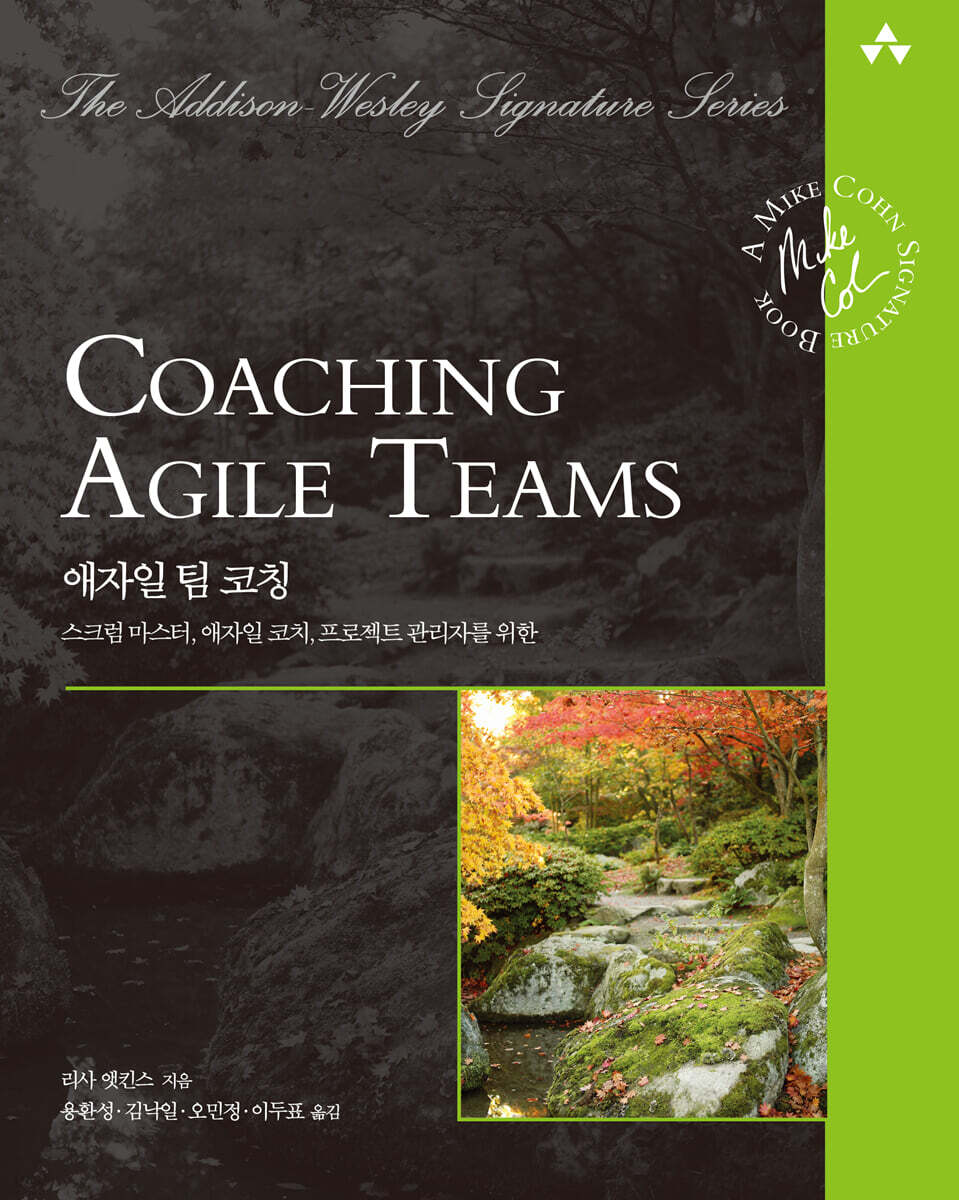
Agile Team Coaching
 |
Description
Book Introduction
Agile has become widespread and widespread across various industries, and numerous agilists are already working as scrum masters or agile coaches in each company.
However, I don't know how to become an agile coach, and even if I am performing the role of a coach, I always reflect on whether I am performing it properly.
Drawing on years of experience as an agile coach, the author helps Scrum Masters, technical leaders, and project managers find their own path and voice on their agile journey toward becoming an agile coach.
It will be an essential companion as you progress to becoming an agile coach who provides the best service as a mentor, facilitator, problem solver, conflict navigator, and collaboration leader.
However, I don't know how to become an agile coach, and even if I am performing the role of a coach, I always reflect on whether I am performing it properly.
Drawing on years of experience as an agile coach, the author helps Scrum Masters, technical leaders, and project managers find their own path and voice on their agile journey toward becoming an agile coach.
It will be an essential companion as you progress to becoming an agile coach who provides the best service as a mentor, facilitator, problem solver, conflict navigator, and collaboration leader.
- You can preview some of the book's contents.
Preview
index
Part 1 - It Starts with You
Chapter 1.
Can I be a good coach?
__Why Agile Coaching Is Important
__Agile Coaching Environment
__Let's create our own common language
__Getting one step closer to agile coaching
__The Birth of the Agile Coach
__Native Wiring
__Creating Your Own Agile Coaching Method
__summation
__Additional Materials
Chapter 2.
Expect high performance
__Setting expectations
__Introducing a Metaphor for High Performance
__The destination never comes
__summation
__Additional Materials
__References
Chapter 3.
Know yourself completely
__Start with self-awareness
__Recovery from command-and-control tendencies
__Prepare a day in advance
__Practice at that very moment
__Be their model
__Believe in yourself
__Invest in yourself
__summation
__Additional Materials
__References
Chapter 4.
Change your style
__Agile Team Stages
__Agile Coaching Style
__Change your coaching style freely
__summation
__Additional Materials
__References
Part 2 - Helping Your Team Achieve More
Chapter 5.
Coach as Mentor
__What is Agile Coaching?
__Why do coaching?
__Coaching on two levels
__1:1 coaching
__Product Owner Coaching
__Coaching Agile Coaches
__Coaching Agile Managers
__summation
__Additional Materials
__References
Chapter 6.
Coach as Facilitator
__Exercise authority lightly
__Facilitation in a stand-up meeting
Facilitation in Sprint Planning
__Facilitation in Sprint Reviews
__Facilitation in Retrospectives
__Facilitation during team conversations
__Facilitating Expert and Agile Coach
__summation
__Additional Materials
__References
Chapter 7.
Coach as Teacher
Training while forming a __team
__Training new team members
__Take advantage of teaching moments
__Always train in agile roles
__summation
__Additional Materials
__References
Chapter 8.
Coach as a Problem Solver
__Agile Problem Solving Criteria
__Problem occurrence and tracking
__See the problem clearly
__Solve the problem
__summation
__Additional Materials
__References
Chapter 9.
Coach as Conflict Mediator
The Role of the Agile Coach in Conflict
__The 5 Stages of Conflict
__What is the current level of conflict?
__What should I do in a conflict situation?
__Move your complaints
__Irresolvable conflict
__The last word of conflict
__summation
__Additional Materials
__References
Chapter 10.
Coach as a Collaborative Conductor
__Collaboration or Collaboration?
From cooperation to collaboration
__Create individual collaborators
__Need some spare ideas
__Build a collaborative foundation for your team
__Reveal the core of collaboration
__summation
__Additional Materials
__References
Part 3 - Know Yourself More
Chapter 11.
Types of Failure, Recovery, and Success for Agile Coaches
__Types of Failure in Agile Coaching
__Where do failure types come from?
__Recovery from failure type
__Agile Coach Success Types
__summation
__Additional Materials
__References
Chapter 12.
When will I be able to reach that level?
__The Art of Agile Coaching
__Other technologies
__summation
__Additional Materials
Chapter 13.
It's your own journey
__The Agile Coach's Journey
__summation
__Additional Materials
__References
__Find
Chapter 1.
Can I be a good coach?
__Why Agile Coaching Is Important
__Agile Coaching Environment
__Let's create our own common language
__Getting one step closer to agile coaching
__The Birth of the Agile Coach
__Native Wiring
__Creating Your Own Agile Coaching Method
__summation
__Additional Materials
Chapter 2.
Expect high performance
__Setting expectations
__Introducing a Metaphor for High Performance
__The destination never comes
__summation
__Additional Materials
__References
Chapter 3.
Know yourself completely
__Start with self-awareness
__Recovery from command-and-control tendencies
__Prepare a day in advance
__Practice at that very moment
__Be their model
__Believe in yourself
__Invest in yourself
__summation
__Additional Materials
__References
Chapter 4.
Change your style
__Agile Team Stages
__Agile Coaching Style
__Change your coaching style freely
__summation
__Additional Materials
__References
Part 2 - Helping Your Team Achieve More
Chapter 5.
Coach as Mentor
__What is Agile Coaching?
__Why do coaching?
__Coaching on two levels
__1:1 coaching
__Product Owner Coaching
__Coaching Agile Coaches
__Coaching Agile Managers
__summation
__Additional Materials
__References
Chapter 6.
Coach as Facilitator
__Exercise authority lightly
__Facilitation in a stand-up meeting
Facilitation in Sprint Planning
__Facilitation in Sprint Reviews
__Facilitation in Retrospectives
__Facilitation during team conversations
__Facilitating Expert and Agile Coach
__summation
__Additional Materials
__References
Chapter 7.
Coach as Teacher
Training while forming a __team
__Training new team members
__Take advantage of teaching moments
__Always train in agile roles
__summation
__Additional Materials
__References
Chapter 8.
Coach as a Problem Solver
__Agile Problem Solving Criteria
__Problem occurrence and tracking
__See the problem clearly
__Solve the problem
__summation
__Additional Materials
__References
Chapter 9.
Coach as Conflict Mediator
The Role of the Agile Coach in Conflict
__The 5 Stages of Conflict
__What is the current level of conflict?
__What should I do in a conflict situation?
__Move your complaints
__Irresolvable conflict
__The last word of conflict
__summation
__Additional Materials
__References
Chapter 10.
Coach as a Collaborative Conductor
__Collaboration or Collaboration?
From cooperation to collaboration
__Create individual collaborators
__Need some spare ideas
__Build a collaborative foundation for your team
__Reveal the core of collaboration
__summation
__Additional Materials
__References
Part 3 - Know Yourself More
Chapter 11.
Types of Failure, Recovery, and Success for Agile Coaches
__Types of Failure in Agile Coaching
__Where do failure types come from?
__Recovery from failure type
__Agile Coach Success Types
__summation
__Additional Materials
__References
Chapter 12.
When will I be able to reach that level?
__The Art of Agile Coaching
__Other technologies
__summation
__Additional Materials
Chapter 13.
It's your own journey
__The Agile Coach's Journey
__summation
__Additional Materials
__References
__Find
Publisher's Review
What this book covers
◆ Understand what it takes to be a great agile coach
◆ Master the roles of an agile coach, including teacher, mentor, problem solver, conflict mediator, and performance coach.
◆ Creating an environment where self-organizing, high-performance teams can emerge.
Coaching teams to move beyond cooperation to full collaboration
◆ Evolving the coach's leadership style to match the team's growth and change.
◆ Actively participate without dominating the team or hindering its growth.
◆ Recognizing failure, recovery, and success modes in coaching
◆ Finding the model that best suits your agile coaching journey
Target audience for this book
Although the Agile I use may be different from yours, the core concepts of Agile discussed in this book and those of all Agile frameworks are not very different.
My agile experience started with Scrum, and I still use it as a foundation, mixing other agile methodologies with non-agile tools and techniques.
You can check it out in this book.
If any of the following apply to you, you've chosen this book well.
◆ I have had some coaching experience as a Scrum Master, XP (Extreme Programming) coach, or other agile team leader, but it hasn't been of much help.
Or maybe the experience was good, but you felt there was more to it.
◆ Coaching work has become routine, and the teams being coached seem to be performing agile well.
◆ The team has mastered and is practicing agile practices well, but is not yet achieving the expected outstanding results.
◆ Your manager assigned you to several agile teams because he or she doesn't think agile coaching is a full-time job, and you don't know how to prove them wrong.
◆ I'm not sure if the role of an agile coach is right for me, so I want to get a feel for what an agile coach is like before I get into the real world.
Structure of this book
Part 1.
It starts with you
Chapter 1: Can You Be a Good Coach?
Who are we calling an agile coach, and how do I know if I already am? What are the ten characteristics of "native wiring" that indicate a successful transformation into an agile coach?
Chapter 2: Expect High Performance
Describe the foundations upon which high-performance teams are built and deploy them in the work environment of agile teams.
The secret is to believe that your team can achieve high performance.
Chapter 3: Know Yourself Completely
Coaching starts with you, but it's not about you.
Coaching is about what you can give to your team to help them get better.
To do this, you need to get out of your command-and-control mindset and truly understand yourself.
Chapter 4: Change Your Style
The leadership style framework described in Chapter 4 helps coaches decide which style to use as the teams they coach evolve and develop.
Part 2.
Help your team achieve more
Chapter 5: The Coach as Mentor
Introduces the fundamentals of professional coaching for agile team settings, with details on coaching for the entire team, not just team members, product owners, and agile managers.
Chapter 6: The Coach as a Facilitator
We present practical facilitation tools to facilitate conversations in stand-up meetings and informal collaborations, such as agile planning sessions.
Chapter 7: The Coach as Teacher
Be the best teacher you can be, like the teachers who were kind to you, the teachers who made it difficult for you, the teachers who knew you could do better, and the teachers who expected better results from you.
Then, use the techniques in Chapter 7 to teach agile, and specifically, roles in agile.
Be prepared for teaching moments like team setups, stand-up meetings, and any other random moments, and teach when someone needs it.
Chapter 8: The Coach as a Problem Solver
If we view the team as an ecosystem, the coach's role is as a 'system revealer.'
Keeping in mind that we work in an agile way, we ensure that our teams can recover from issues and regain their health and vitality.
Chapter 9: The Coach as Conflict Mediator
Conflict is an essential element of high-performance, agile teams, and coaches must help teams overcome conflict and move toward a state of desirable, constructive disagreement.
Chapter 10: The Coach as a Collaborative Leader
Building a team's collaborative muscles is a crucial role for agile coaches, but they only do so when coaches expect amazing results.
Part 3.
Know yourself better
Chapter 11: Agile Coaches' Failure, Recovery, and Success Strategies
Describes common failure and success patterns in agile coaching.
Steps to recover from failure types are also introduced.
Don't get too caught up in failure on the road to success.
Chapter 12: When Will I Reach That Realm?
Introducing a 'roadmap' for capabilities.
It includes a list of techniques, mindsets, tools, and skills, all of which indicate whether you have successfully transitioned to becoming an agile coach.
Chapter 13: Your Own Journey
Every coach's journey is different, and the most valuable thing to find in agile coaching is to find your own best expression of the coaching role.
Chapter 13 will give you a fresh perspective on your coaching journey through the stories of other coaches.
Author's Note
These few pages in the introduction were much harder to write than the other chapters of the book.
I confided this to a fellow agile coach who had trained with me as an agile coach a few years ago.
“Ask the team,” she said with a sly smile on her face.
How many times did I tell her this when she was a trainee agile coach? I've said it to her countless times.
I helped her break free from her command-and-control tendencies, and now she's solving problems with a team rather than alone.
So when faced with this problematic introduction, “Ask the team” sounded like wise advice.
I asked people who worked with me before the book was born what two things they thought should be included in the "Introduction" page.
I've summarized and explained their answers and my thoughts in the rest of the introduction.
This introduction, which reminds us of what it means to be an agile coach, sets out the purpose of this book.
Perhaps you're like me and find yourself breaking away from old ways of working with teams or people that were once successful but no longer are.
Or you may feel that the way you were trained to work with others is ineffective or even inhumane.
You may not know how to embrace the role of agile leadership and begin to change.
I've been out of my old ways for years, but they still remain with me now that I'm in a new agile environment full of freedom, responsibility, and possibility.
It was the same with writing the introduction.
The idea that I had to solve this problem on my own before I could say, “I solved it all!” still haunted me.
This is exactly where agile coaching can help.
That is, we constantly re-evaluate and focus on improving the scope and impact of coaching.
Only then will people become great agilists, teams build products they can be proud of, and companies and nations benefit from free and accountable teams living in a world where all innovation and excellence are possible.
The imperative to 'continuously improve' means embracing a variety of agile coaching ideas and incorporating them into your day-to-day responses when coaching teams and people.
This book is very provocative, yet practical, diverse, and offers some pretty good coaching ideas.
Some ideas will take a long time to digest and may even be difficult to understand.
Some ideas may become yours immediately, so you can look forward to both.
Translator's Note
My first exposure to Agile was in a training course in the summer of 2007.
At that time, I was working at large corporations and venture companies, building a successful career as an application developer, project leader, and then a competent project manager.
A question I kept hearing while receiving Scrum training was, “Is it really possible to run a project this way, rather than using traditional project management methodologies?”
However, although I encountered various difficulties while applying the training to actual work, my confidence in Agile grew through the process.
When I was getting really familiar with Agile, I thought, “Isn’t there something I can do better?”
The word I encountered then was agile coaching.
Looking back now, it wasn't even coaching, but coaching, and I always ended up in conflict with the developers and Scrum Master.
In retrospect, I thought I knew a lot about agile, but I was still using traditional command and control management techniques rather than agile coaching.
At the time, I didn't even know what coaching was, and there was no one around me who could give me advice on how to navigate this difficult situation.
I spent years literally heading into the ground and learning what coaching was all about.
We know that true agile must be deeply rooted in a company's culture, but many agilists still struggle to establish agile processes and transform agile into the company culture.
I think this is proof that Agile seems simple, but is actually difficult.
Additionally, coaches who consult under the title of agile coach only have experience coaching one or two or three teams, and agile consulting firms also seem to be suggesting many systematic tools necessary for smoothly executing agile or DevOps, along with consulting on agile processes or frameworks, rather than agile as a corporate culture.
For this reason, although full-scale training of coaches to coach agile seems to be lacking, there seems to be considerable demand for it.
In that respect, it is important to emphasize the results created by introducing agile, but it is also time to begin training coaches who can comprehensively coach agile from a cultural perspective.
Lisa Atkins' book will be a great companion for professionals like me who are familiar with traditional project management methodologies, tech-based technical professionals, and those who are already skilled in agile as a Scrum Master and want to take the next step toward becoming an agile coach, either out of personal desire or due to corporate demands, or for those who are curious about what agile coaching is all about.
-Yong Hwan-seong
◆ Understand what it takes to be a great agile coach
◆ Master the roles of an agile coach, including teacher, mentor, problem solver, conflict mediator, and performance coach.
◆ Creating an environment where self-organizing, high-performance teams can emerge.
Coaching teams to move beyond cooperation to full collaboration
◆ Evolving the coach's leadership style to match the team's growth and change.
◆ Actively participate without dominating the team or hindering its growth.
◆ Recognizing failure, recovery, and success modes in coaching
◆ Finding the model that best suits your agile coaching journey
Target audience for this book
Although the Agile I use may be different from yours, the core concepts of Agile discussed in this book and those of all Agile frameworks are not very different.
My agile experience started with Scrum, and I still use it as a foundation, mixing other agile methodologies with non-agile tools and techniques.
You can check it out in this book.
If any of the following apply to you, you've chosen this book well.
◆ I have had some coaching experience as a Scrum Master, XP (Extreme Programming) coach, or other agile team leader, but it hasn't been of much help.
Or maybe the experience was good, but you felt there was more to it.
◆ Coaching work has become routine, and the teams being coached seem to be performing agile well.
◆ The team has mastered and is practicing agile practices well, but is not yet achieving the expected outstanding results.
◆ Your manager assigned you to several agile teams because he or she doesn't think agile coaching is a full-time job, and you don't know how to prove them wrong.
◆ I'm not sure if the role of an agile coach is right for me, so I want to get a feel for what an agile coach is like before I get into the real world.
Structure of this book
Part 1.
It starts with you
Chapter 1: Can You Be a Good Coach?
Who are we calling an agile coach, and how do I know if I already am? What are the ten characteristics of "native wiring" that indicate a successful transformation into an agile coach?
Chapter 2: Expect High Performance
Describe the foundations upon which high-performance teams are built and deploy them in the work environment of agile teams.
The secret is to believe that your team can achieve high performance.
Chapter 3: Know Yourself Completely
Coaching starts with you, but it's not about you.
Coaching is about what you can give to your team to help them get better.
To do this, you need to get out of your command-and-control mindset and truly understand yourself.
Chapter 4: Change Your Style
The leadership style framework described in Chapter 4 helps coaches decide which style to use as the teams they coach evolve and develop.
Part 2.
Help your team achieve more
Chapter 5: The Coach as Mentor
Introduces the fundamentals of professional coaching for agile team settings, with details on coaching for the entire team, not just team members, product owners, and agile managers.
Chapter 6: The Coach as a Facilitator
We present practical facilitation tools to facilitate conversations in stand-up meetings and informal collaborations, such as agile planning sessions.
Chapter 7: The Coach as Teacher
Be the best teacher you can be, like the teachers who were kind to you, the teachers who made it difficult for you, the teachers who knew you could do better, and the teachers who expected better results from you.
Then, use the techniques in Chapter 7 to teach agile, and specifically, roles in agile.
Be prepared for teaching moments like team setups, stand-up meetings, and any other random moments, and teach when someone needs it.
Chapter 8: The Coach as a Problem Solver
If we view the team as an ecosystem, the coach's role is as a 'system revealer.'
Keeping in mind that we work in an agile way, we ensure that our teams can recover from issues and regain their health and vitality.
Chapter 9: The Coach as Conflict Mediator
Conflict is an essential element of high-performance, agile teams, and coaches must help teams overcome conflict and move toward a state of desirable, constructive disagreement.
Chapter 10: The Coach as a Collaborative Leader
Building a team's collaborative muscles is a crucial role for agile coaches, but they only do so when coaches expect amazing results.
Part 3.
Know yourself better
Chapter 11: Agile Coaches' Failure, Recovery, and Success Strategies
Describes common failure and success patterns in agile coaching.
Steps to recover from failure types are also introduced.
Don't get too caught up in failure on the road to success.
Chapter 12: When Will I Reach That Realm?
Introducing a 'roadmap' for capabilities.
It includes a list of techniques, mindsets, tools, and skills, all of which indicate whether you have successfully transitioned to becoming an agile coach.
Chapter 13: Your Own Journey
Every coach's journey is different, and the most valuable thing to find in agile coaching is to find your own best expression of the coaching role.
Chapter 13 will give you a fresh perspective on your coaching journey through the stories of other coaches.
Author's Note
These few pages in the introduction were much harder to write than the other chapters of the book.
I confided this to a fellow agile coach who had trained with me as an agile coach a few years ago.
“Ask the team,” she said with a sly smile on her face.
How many times did I tell her this when she was a trainee agile coach? I've said it to her countless times.
I helped her break free from her command-and-control tendencies, and now she's solving problems with a team rather than alone.
So when faced with this problematic introduction, “Ask the team” sounded like wise advice.
I asked people who worked with me before the book was born what two things they thought should be included in the "Introduction" page.
I've summarized and explained their answers and my thoughts in the rest of the introduction.
This introduction, which reminds us of what it means to be an agile coach, sets out the purpose of this book.
Perhaps you're like me and find yourself breaking away from old ways of working with teams or people that were once successful but no longer are.
Or you may feel that the way you were trained to work with others is ineffective or even inhumane.
You may not know how to embrace the role of agile leadership and begin to change.
I've been out of my old ways for years, but they still remain with me now that I'm in a new agile environment full of freedom, responsibility, and possibility.
It was the same with writing the introduction.
The idea that I had to solve this problem on my own before I could say, “I solved it all!” still haunted me.
This is exactly where agile coaching can help.
That is, we constantly re-evaluate and focus on improving the scope and impact of coaching.
Only then will people become great agilists, teams build products they can be proud of, and companies and nations benefit from free and accountable teams living in a world where all innovation and excellence are possible.
The imperative to 'continuously improve' means embracing a variety of agile coaching ideas and incorporating them into your day-to-day responses when coaching teams and people.
This book is very provocative, yet practical, diverse, and offers some pretty good coaching ideas.
Some ideas will take a long time to digest and may even be difficult to understand.
Some ideas may become yours immediately, so you can look forward to both.
Translator's Note
My first exposure to Agile was in a training course in the summer of 2007.
At that time, I was working at large corporations and venture companies, building a successful career as an application developer, project leader, and then a competent project manager.
A question I kept hearing while receiving Scrum training was, “Is it really possible to run a project this way, rather than using traditional project management methodologies?”
However, although I encountered various difficulties while applying the training to actual work, my confidence in Agile grew through the process.
When I was getting really familiar with Agile, I thought, “Isn’t there something I can do better?”
The word I encountered then was agile coaching.
Looking back now, it wasn't even coaching, but coaching, and I always ended up in conflict with the developers and Scrum Master.
In retrospect, I thought I knew a lot about agile, but I was still using traditional command and control management techniques rather than agile coaching.
At the time, I didn't even know what coaching was, and there was no one around me who could give me advice on how to navigate this difficult situation.
I spent years literally heading into the ground and learning what coaching was all about.
We know that true agile must be deeply rooted in a company's culture, but many agilists still struggle to establish agile processes and transform agile into the company culture.
I think this is proof that Agile seems simple, but is actually difficult.
Additionally, coaches who consult under the title of agile coach only have experience coaching one or two or three teams, and agile consulting firms also seem to be suggesting many systematic tools necessary for smoothly executing agile or DevOps, along with consulting on agile processes or frameworks, rather than agile as a corporate culture.
For this reason, although full-scale training of coaches to coach agile seems to be lacking, there seems to be considerable demand for it.
In that respect, it is important to emphasize the results created by introducing agile, but it is also time to begin training coaches who can comprehensively coach agile from a cultural perspective.
Lisa Atkins' book will be a great companion for professionals like me who are familiar with traditional project management methodologies, tech-based technical professionals, and those who are already skilled in agile as a Scrum Master and want to take the next step toward becoming an agile coach, either out of personal desire or due to corporate demands, or for those who are curious about what agile coaching is all about.
-Yong Hwan-seong
GOODS SPECIFICS
- Date of issue: January 28, 2022
- Page count, weight, size: 384 pages | 188*235*22mm
- ISBN13: 9791161756110
- ISBN10: 1161756116
You may also like
카테고리
korean


korean

![GQ KOREA Mark (Monthly): December [2025]](http://librairie.coreenne.fr/cdn/shop/files/8ef265dbbfbf186523ed75ba7319009d.jpg?v=1765340328&width=3840)


