

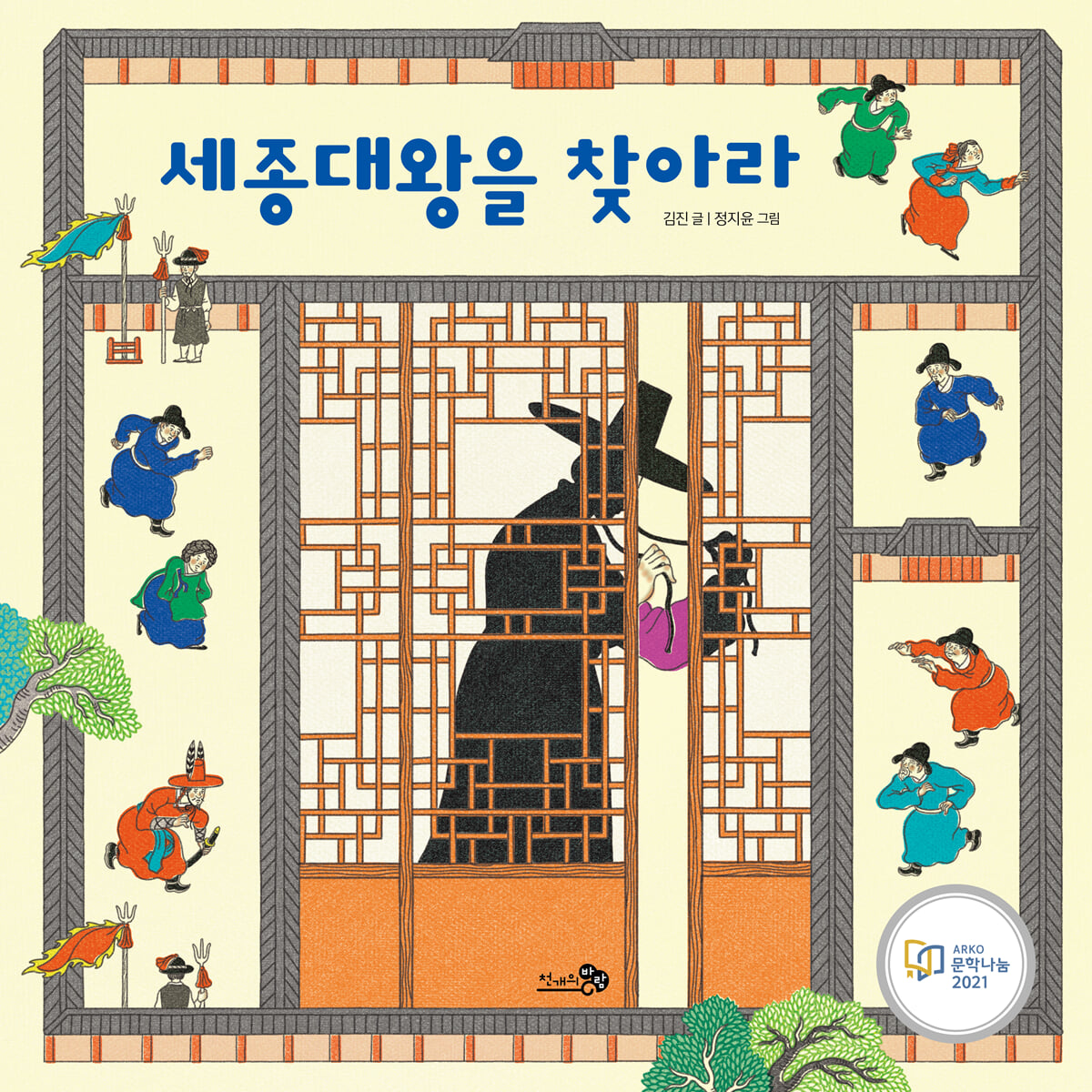
Find King Sejong (Big Book)
 |
Description
Book Introduction
Why and where did King Sejong disappear?
The achievements of King Sejong, who created Hangul for the people
A historical picture book filled with whimsical imagination and fun play!
★Selected by Literature Sharing, Morning Reading Newspaper
Boy's Korea's Best Children's Books, Recommended by the Korean School Librarians Association★
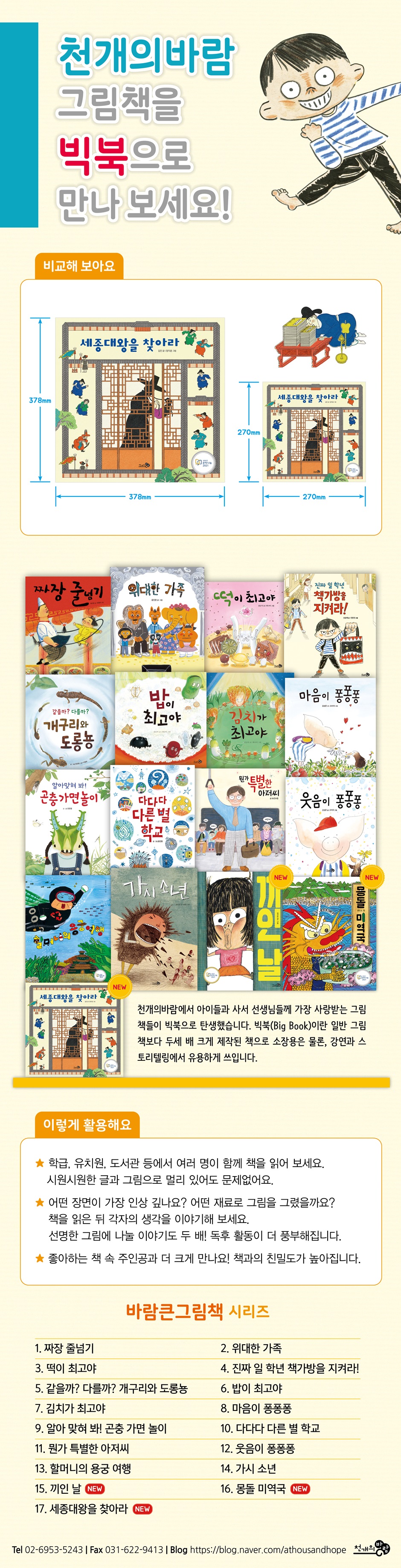
A selection of 17 Korean picture books that are great to read together, 'Wind Big Picture Book'.
It's the day of the past exam.
The subject came to wake up King Sejong and was startled.
The seat was empty.
Soon the palace was turned upside down, and the subjects searched the palace for the king.
I searched thoroughly from Geunjeongjeon to Suragan, but I couldn't find King Sejong.
The subjects went out of the palace.
I passed the playhouse, looked around the market selling goods, and walked along the bloody road where the common people used to avoid the nobles.
But King Sejong could not be found.
The subjects dispersed and went outside the four gates.
Dongdaemun, Seodaemun, Namdaemun, Bukdaemun.
But King Sejong was nowhere to be found.
Where on earth did King Sejong disappear to? Why did he suddenly disappear?
The achievements of King Sejong, who created Hangul for the people
A historical picture book filled with whimsical imagination and fun play!
★Selected by Literature Sharing, Morning Reading Newspaper
Boy's Korea's Best Children's Books, Recommended by the Korean School Librarians Association★
A selection of 17 Korean picture books that are great to read together, 'Wind Big Picture Book'.
It's the day of the past exam.
The subject came to wake up King Sejong and was startled.
The seat was empty.
Soon the palace was turned upside down, and the subjects searched the palace for the king.
I searched thoroughly from Geunjeongjeon to Suragan, but I couldn't find King Sejong.
The subjects went out of the palace.
I passed the playhouse, looked around the market selling goods, and walked along the bloody road where the common people used to avoid the nobles.
But King Sejong could not be found.
The subjects dispersed and went outside the four gates.
Dongdaemun, Seodaemun, Namdaemun, Bukdaemun.
But King Sejong was nowhere to be found.
Where on earth did King Sejong disappear to? Why did he suddenly disappear?
- You can preview some of the book's contents.
Preview
Detailed image
Publisher's Review
● A large picture book that children love and are great to read together
This is the 'Wind Big Picture Book' series, a selection of domestic picture books that are great to read together.
Because it is produced two to three times larger than a typical picture book, it is not only valuable for personal collections, but can also be used as a lecture material and as a reading material in institutions such as kindergartens, schools, and libraries.
● Understanding the background that led King Sejong to create Hangul
On the day of the exam, King Sejong sneaked out of the palace without his subjects knowing.
He escaped from the courtiers who came looking for him and went outside the four gates, then secretly returned.
Then he asks the late-arriving officials a mischievous question about where they have been, and thinks to himself.
'You must have seen vividly how the people live, right?'
This one sentence contains the theme of ‘Find King Sejong’.
How much King Sejong loved his people and how much he tried to make them comfortable.
Following this, King Sejong the Great posed a question in the civil service examination, saying, "Even if I want to teach the people farming methods, they don't know Chinese characters and can't read books. What should I do?"
This naturally brings to mind the passage in the Hunminjeongeum Haeryebon that begins with, “The language of our country is different from that of China…”
Through 『Find King Sejong』, readers can naturally understand not only King Sejong's love for the people, but also the excellence and value of Hangul, the Korean alphabet invented by him.
● Capturing Joseon culture through meticulously composed paintings
In “Find King Sejong,” a picture unfolds that seems to have been taken straight from Gyeongbokgung Palace.
The location of the palace, as well as the rooftop statues, water jars, and stairs are realistically depicted.
This picture book, which resembles today's Gyeongbokgung Palace, allows you to learn about the palace's organization and structure.
In particular, the Seven-Clawed Dragon (a dragon with seven claws) hidden in the ceiling of Geunjeongjeon is something that cannot be easily seen without going inside Geunjeongjeon.
The Joseon landscape that unfolds outside the palace as the story unfolds is also detailed.
It is full of depictions of objects that allow us to glimpse into Joseon life, such as performance groups that gather people with gongs, janggu, and buk, as well as shops selling goods, paper, and fish inside the market.
Also, 'Pimatgil', better known today as 'Pimatgol'.
At first glance, it may seem like the road was drawn much wider than it is now, but in fact, when 'Pimatgil' was first created, it was a wide road about 6 meters wide.
Since the 17th century, houses have been built and the roads have become narrower, resulting in the current street.
You can see how meticulously artist Jeong Ji-yoon researched to portray the Joseon society in which King Sejong lived.
In addition, to depict such materials in the picture, various drawing techniques were used, such as the bird's-eye view method, which depicts a view from above.
In "Find King Sejong," aspects of Joseon that are not described in the text are described in detail.
Readers can enjoy observing and feeling the landscape of Joseon society and the lives of its people through the pictures.
● The first history picture book series tailored to your child's eye level
How should we explain and help children understand history as they begin to learn Korean? Wouldn't it be more effective to teach it after they've already acquired a certain level of knowledge? This question, conversely, led me to the conclusion that there are no books that effectively convey history to children.
The picture book that was born from this is 『Find King Sejong』.
The story begins with the intriguing premise that King Sejong suddenly disappeared, and unfolds quickly in short, easy-to-read text suitable for children.
Also, King Sejong is hidden in each scene, leading to a game of finding him.
This configuration makes it both fun to look at and fun to find.
Moreover, after reading the book, you will naturally come to understand why King Sejong created Hangul and why he created it.
Here are some appendix pages to help you learn more in depth.
“Find King Sejong” is the first story in the “Our Child’s First History Picture Book” series, which was planned to reflect children’s interests, concentration, and learning ability.
This is the 'Wind Big Picture Book' series, a selection of domestic picture books that are great to read together.
Because it is produced two to three times larger than a typical picture book, it is not only valuable for personal collections, but can also be used as a lecture material and as a reading material in institutions such as kindergartens, schools, and libraries.
● Understanding the background that led King Sejong to create Hangul
On the day of the exam, King Sejong sneaked out of the palace without his subjects knowing.
He escaped from the courtiers who came looking for him and went outside the four gates, then secretly returned.
Then he asks the late-arriving officials a mischievous question about where they have been, and thinks to himself.
'You must have seen vividly how the people live, right?'
This one sentence contains the theme of ‘Find King Sejong’.
How much King Sejong loved his people and how much he tried to make them comfortable.
Following this, King Sejong the Great posed a question in the civil service examination, saying, "Even if I want to teach the people farming methods, they don't know Chinese characters and can't read books. What should I do?"
This naturally brings to mind the passage in the Hunminjeongeum Haeryebon that begins with, “The language of our country is different from that of China…”
Through 『Find King Sejong』, readers can naturally understand not only King Sejong's love for the people, but also the excellence and value of Hangul, the Korean alphabet invented by him.
● Capturing Joseon culture through meticulously composed paintings
In “Find King Sejong,” a picture unfolds that seems to have been taken straight from Gyeongbokgung Palace.
The location of the palace, as well as the rooftop statues, water jars, and stairs are realistically depicted.
This picture book, which resembles today's Gyeongbokgung Palace, allows you to learn about the palace's organization and structure.
In particular, the Seven-Clawed Dragon (a dragon with seven claws) hidden in the ceiling of Geunjeongjeon is something that cannot be easily seen without going inside Geunjeongjeon.
The Joseon landscape that unfolds outside the palace as the story unfolds is also detailed.
It is full of depictions of objects that allow us to glimpse into Joseon life, such as performance groups that gather people with gongs, janggu, and buk, as well as shops selling goods, paper, and fish inside the market.
Also, 'Pimatgil', better known today as 'Pimatgol'.
At first glance, it may seem like the road was drawn much wider than it is now, but in fact, when 'Pimatgil' was first created, it was a wide road about 6 meters wide.
Since the 17th century, houses have been built and the roads have become narrower, resulting in the current street.
You can see how meticulously artist Jeong Ji-yoon researched to portray the Joseon society in which King Sejong lived.
In addition, to depict such materials in the picture, various drawing techniques were used, such as the bird's-eye view method, which depicts a view from above.
In "Find King Sejong," aspects of Joseon that are not described in the text are described in detail.
Readers can enjoy observing and feeling the landscape of Joseon society and the lives of its people through the pictures.
● The first history picture book series tailored to your child's eye level
How should we explain and help children understand history as they begin to learn Korean? Wouldn't it be more effective to teach it after they've already acquired a certain level of knowledge? This question, conversely, led me to the conclusion that there are no books that effectively convey history to children.
The picture book that was born from this is 『Find King Sejong』.
The story begins with the intriguing premise that King Sejong suddenly disappeared, and unfolds quickly in short, easy-to-read text suitable for children.
Also, King Sejong is hidden in each scene, leading to a game of finding him.
This configuration makes it both fun to look at and fun to find.
Moreover, after reading the book, you will naturally come to understand why King Sejong created Hangul and why he created it.
Here are some appendix pages to help you learn more in depth.
“Find King Sejong” is the first story in the “Our Child’s First History Picture Book” series, which was planned to reflect children’s interests, concentration, and learning ability.
GOODS SPECIFICS
- Publication date: February 28, 2022
- Page count, weight, size: 40 pages | 378*378mm
- ISBN13: 9791165732189
- ISBN10: 1165732181
- KC Certification: Certification Type: Conformity Confirmation
You may also like
카테고리
korean


korean

![GQ KOREA Mark (Monthly): December [2025]](http://librairie.coreenne.fr/cdn/shop/files/8ef265dbbfbf186523ed75ba7319009d.jpg?v=1765340328&width=3840)


