

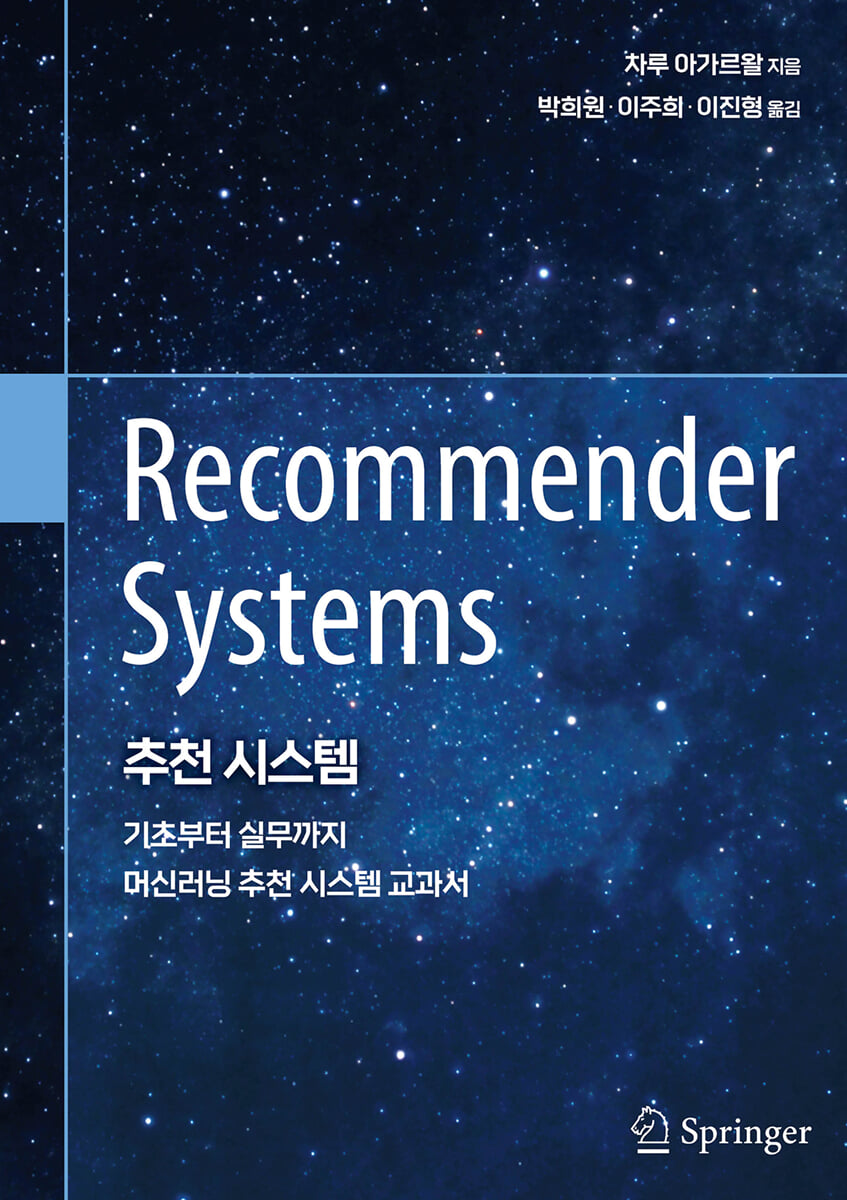
Recommendation system
 |
Description
Book Introduction
It comprehensively covers recommender systems that provide personalized recommendations of products or services based on a user's previous searches or purchases.
Recommender system methods have been applied to a variety of applications, including query log mining, social networking, news recommendations, and computer advertising.
This book is organized into three categories: Algorithms and Evaluation, Recommendations for Specific Domains and Contexts, and Advanced Topics and Applications.
While primarily intended to serve as a textbook, it also introduces current topics and applications, making it useful for both industry professionals and researchers.
Provides numerous examples and practice problems.
Recommender system methods have been applied to a variety of applications, including query log mining, social networking, news recommendations, and computer advertising.
This book is organized into three categories: Algorithms and Evaluation, Recommendations for Specific Domains and Contexts, and Advanced Topics and Applications.
While primarily intended to serve as a textbook, it also introduces current topics and applications, making it useful for both industry professionals and researchers.
Provides numerous examples and practice problems.
- You can preview some of the book's contents.
Preview
index
Chapter 1.
Introduction to the Recommendation System
1.1 Overview
1.2 Goals of the Recommender System
1.21 Scope of Recommended Applications
1.3 Basic model of the recommendation system
1.3.1 Collaborative Filtering Model
1.3.1.1 Types of ratings
1.3.1.2 Relationship with missing value analysis
1.3.1.3 Collaborative Filtering as a Generalization of Classification and Regression Modeling
1.3.2 Content-based recommendation system
1.3.3 Knowledge-based recommendation system
1.3.31 Utility-based Recommender Systems
1.3.4 Demographic Recommendation System
1.3.5 Hybrid and Ensemble-Based Recommender Systems
1.3.6 Evaluation of the Recommender System
1.4 Domain-Specific Tasks of Recommender Systems
1.4.1 Context-based Recommendation System
1.4.2 Time-Sensitive Recommender Systems
1.4.3 Location-based recommendation system
1.4.4 Social Recommendation System
1.4.4.1 Structural Recommendations for Nodes and Links
1.4.4.2 Product and content recommendations that take social impact into account
1.4.4.3 Trustworthy Recommendation Systems
1.4.4.4 Recommendations using social tag feedback
1.5 Advanced Topics and Applications
1.5.1 Cold Start Problem in Recommender Systems
1.5.2 Attack-resistant recommendation system
1.5.3 Group Recommendation System
1.5.4 Multi-criteria recommender system
1.5.5 Active Learning in Recommender Systems
1.5.6 Privacy Protection in Recommendation Systems
1.5.7 Application Domain
1.6 Summary
1.7 References
1.8 Practice Problems
Chapter 2.
Neighbor-based collaborative filtering
2.1 Overview
2.2 Key Features of the Rating Matrix
2.3 Rating Prediction Using Neighborhood-Based Methodology
2.3.1 User-Based Neighborhood Model
2.3.1.1 Similarity function transformation
2.3.1.2 Variation of the prediction function
2.3.1.3 Variations of Peer Group Filtering
2.3.1.4 The Impact of the Long Tail
2.3.2 Item-based neighborhood model
2.3.3 Efficient implementation and computational complexity
2.3.4 Comparison of User-Based and Item-Based Methodologies
2.3.5 Advantages and Disadvantages of Neighborhood-Based Methodologies
2.3.6 An Integrated Perspective on User-Based and Item-Based Methodologies
2.4 Clustering and Neighborhood-Based Methodologies
2.5 Dimensionality Reduction and Neighborhood-Based Methodology
2.5.1 Handling Bias Issues
2.5.1.1 Maximum likelihood estimation
2.5.1.2 Direct matrix factorization of incomplete data
2.6 Regression Modeling Perspective of Neighbor Methodology
2.6.1 User-Based Nearest Neighbor Regression
2.6.1.1 Sparsity and Bias Problems
2.6.2 Item-based nearest neighbor regression
2.6.3 Combining User-Based and Item-Based Methods
2.6.4 Joint interpolation using similarity weights
2.6.5 Sparse Linear Model (SLIM)
2.7 Graph Models for Neighbor-Based Methods
2.7.1 User-Item Graph
2.7.1.1 Defining Neighborhood Using Random Walk
2.7.1.2 Defining neighbors using the Katz scale
2.7.2 User-User Graph
2.7.3 Item-Item Graph
2.8 Summary
2.9 References
2.10 Practice Problems
Chapter 3.
Model-based collaborative filtering
3.1 Overview
3.2 Decision and Regression Trees
3.2.1 Extending decision trees with collaborative filtering
3.3 Rule-based collaborative filtering
3.3.1 Leveraging Association Rules for Collaborative Filtering
3.3.2 Item-specific vs. user-specific models
3.4 Naive Bayes Collaborative Filtering
3.4.1 Overfitting Correction
3.4.2 Example of applying Bayes' method to binary ratings
3.5 Using an arbitrary classification model as a black box
3.5.1 Example: Using a Neural Network as a Black Box
3.6 Latent Factor Model
3.6.1 Geometric Intuition about Latent Factor Models
3.6.2 Low-dimensional intuition about latent factor models
3.6.3 Basic matrix factorization principles
3.6.4 Unconstrained matrix factorization
3.6.4.1 Stochastic gradient descent
3.6.4.2 Normalization
3.6.4.3 Progressive latent component training
3.6.4.4 Alternating applications of least squares and coordinate descent
3.6.4.5 User and Item Bias Integration
3.6.4.6 Integrating Implicit Feedback
3.6.5 Singular value decomposition
3.6.5.1 A Simple Iterative Approach to SVD
3.6.5.2 Optimization-based approach
3.6.5.3 Recommendations outside the sample
3.6.5.4 Example of Singular Value Decomposition
3.6.6 Factorization of nonnegative matrices
3.6.6.1 Advantages of Interpretability
3.6.6.2 Consideration of Factorization Using Implicit Feedback
3.6.6.3 Computational and Weighting Problems for Implicit Feedback
3.6.6.4 Ratings with both likes and dislikes
3.6.7 Understanding the matrix factorization series
3.7 Decomposition and Neighbor Model Integration
3.7.1 Baseline Estimation Model: Non-Personalized Bias-Centric Model
3.7.2 Neighboring parts of the model
3.7.3 Latent factor part of the model
3.7.4 Integration of neighboring and latent factors
3.7.5 Solving the Optimization Model
3.7.6 Considerations on Accuracy
3.7.7 Integrating latent factor models with random models
3.8 Summary
3.9 References
3.10 Practice Problems
Chapter 4.
Content-based recommendation system
4.1 Overview
4.2 Basic Components of a Content-Based System
4.3 Preprocessing and feature extraction
4.3.1 Feature Extraction
4.3.1.1 Example of Product Recommendation
4.3.1.2 Example of Web Page Recommendation
4.3.1.3 Example of music recommendation
4.3.2 Feature Representation and Refinement
4.3.3 Collecting user likes and dislikes
4.3.4 Selecting Map Features and Setting Weights
4.3.4.1 Gini coefficient
4.3.4.2 Entropy
4.3.4.3 X2-Statistics
4.3.4.4 Normalized deviation
4.3.4.5 Setting feature weights
4.4 User Profile Learning and Filtering
4.4.1 Nearest Neighbor Classification
4.4.2 Connecting with a Case-Based Recommendation System
4.4.3 Bayesian classification model
4.4.3.1 Intermediate probability estimation
4.4.3.2 Example of a Bayesian Model
4.4.4 Rule-based classification model
4.4.4.1 Example of a rule-based method
4.4.5 Regression-based models
4.4.6 Overview of Other Learning Models and Comparisons
4.4.7 Description of the Content-Based System
4.5 Content-Based vs. Collaborative Filtering Recommendations
4.6 Using Content-Based Models for Collaborative Filtering Systems
4.61 Using User Profiles
4.7 Summary
4.8 References
4.9 Practice Problems
Chapter 5.
Knowledge-based recommendation system
5.1 Overview
5.2 Constraint-based recommendation system
5.2.1 Returning Related Results
5.2.2 Interaction Methodology
5.2.3 Ranking matching items
5.2.4 Handling Unacceptable Results or Empty Sets
5.2.5 Add constraints
5.3 Case-Based Recommendations
5.3.1 Similarity Metrics
5.3.1.1 Incorporating Diversity into Similarity Calculations
5.3.2 Modification Methodology
5.3.2.1 Simple fixes
5.3.2.2 Complex Modifications
5.3.2.3 Dynamic Modification
5.3.3 Description of the modification
5.4 Continuous personalization of knowledge-based systems
5.5 Summary
5.6 References
5.7 Practice Problems
Chapter 6.
Ensemble-based and hybrid recommender systems
6.1 Overview
6.2 Ensemble methods from a classification perspective
6.3 Weighted Hybrid
6.3.1 Combining different types of models
6.3.2 Bagging Adaptation in Classification
6.3.3 Injection of Randomness
6.4 Switching Hybrid
6.4.1 Switching Mechanism for Cold Start Problems
6.4.2 Model Bucket
6.5 Cascade Hybrid
6.5.1 Continuous redefinition of recommendations
6.5.2 Boosting
6.5.2.1 Weighted Base Model
6.6 Feature Augmented Hybrid
6.7 Meta-Level Hybrid
6.8 Feature Combination Hybrid
6.8.1 Regression and Matrix Factorization
6.8.2 Meta-level features
6.9 Mixed Hybrid
6.10 Summary
6.11 References
6.12 Practice Problems
Chapter 7.
Recommender System Evaluation
7.1 Overview
7.2 Evaluation Paradigm
7.2.1 User Research
7.2.2 Online Assessment
7.2.3 Offline Evaluation Using Past Data Sets
7.3 General Goals of Evaluation Design
7.3.1 Accuracy
7.3.2 Coverage
7.3.3 Reliability and Trust
7.3.4 Novelty
7.3.5 Surprise
7.3.6 Diversity
7.3.7 Robustness and Stability
7.3.8 Scalability
7.4 Design Issues for Offline Recommendation Evaluation
7.4.1 Netflix Prize Dataset Case Study
7.4.2 Classification of training and test scores
7.4.2.1 Holdout
7.4.2.2 Cross-validation
7.4.3 Classification Design and Comparison
7.5 Accuracy indicators for offline evaluation
7.5.1 Measuring the accuracy of rating predictions
7.5.1.1 RMSE vs. MAE
7.5.1.2 The Influence of the Long Tail
7.5.2 Ranking Evaluation through Correlation
7.5.3 Ranking by Usefulness
7.5.4 Ranking Evaluation through Receiver Operational Characteristics
7.5.5 Which ranking metric is best?
7.6 Limitations of the Evaluation Measurement Scale
7.6.1 Preventing Evaluation Manipulation
7.7 Summary
7.8 References
7.9 Practice Problems
Chapter 8.
Context-sensitive recommendation system
8.1 Overview
8.2 Multidimensional Approach
8.2.1 The Importance of Hierarchy
8.3 Context Prefiltering: A Reduction-Based Approach
8.3.1 Ensemble-based improvements
8.3.2 Multi-stage estimation
8.4 Post-filtering methodology
8.5 Context-specific modeling
8.5.1 Neighbor-based methods
8.5.2 Latent Factor Model
8.5.2.1 Factoring Machine
8.5.2.2 Generalization of the quadratic factorization machine
8.5.2.3 Other Applications of Latent Parameterization
8.5.3 Content-based model
8.6 Summary
8.7 References
8.8 Practice Problems
Chapter 9.
Time and location-sensitive recommendation systems
9.1 Overview
9.2 Temporal Collaborative Filtering
9.2.1 Recency-based model
9.2.1.1 Attenuation-based methods
9.2.1.2 Windows-based method
9.2.2 Periodic Context Processing
9.2.2.1 Pre-filtering and post-filtering
9.2.2.2 Direct inclusion of temporal context
9.2.3 Modeling Ratings as a Function of Time
9.2.3.1 Time-SVD++ Model
9.3 Discrete-time models
9.3.1 Markov Model
9.3.1.1 Selective Markov Model
9.3.1.2 Other Markov Alternatives
9.3.2 Sequential Pattern Mining
9.4 Location-Aware Recommendation Systems
9.4.1 Preferred Areas
9.4.2 Travel Area
9.4.3 Combination of Preferences and Travel Locations
9.5 Summary
9.6 References
9.7 Practice Problems
Chapter 10.
Recommended network structure
10.1 Overview
10.2 Ranking Algorithm
10.2.1 PageRank
10.2.2 Personalized PageRank
10.2.3 Applications to Neighborhood-Based Methods
10.2.3.1 Social Network Recommendations
10.2.3.2 Personalization of Heterogeneous Social Media
10.2.3.3 Traditional Collaborative Filtering
10.2.4 Similarity Rank
10.2.5 Relationship between Search and Recommendation
10.3 Recommendations by group classification
10.3.1 Iterative classification algorithm
10.3.2 Label propagation via random walk
10.3.3 Applicability of Collaborative Filtering to Social Networks
10.4 Friend Recommendations: Link Prediction
10.4.1 Neighborhood-based scale
10.4.2 Katz scale
10.4.3 Random walk-based scale
10.4.4 Link Prediction as a Classification Problem
10.4.5 Matrix Factorization for Link Prediction
10.4.5.1 Symmetric matrix factorization
10.4.6 The Connection Between Link Prediction and Collaborative Filtering
10.4.6.1 Using Link Prediction Algorithms in Collaborative Filtering
10.4.6.2 Link Prediction Using Collaborative Filtering Algorithms
10.5 Social Impact Analysis and Word-of-Mouth Marketing
10.5.1 Linear Threshold Model
10.5.2 Independent Cascade Model
10.5.3 Influence Function Evaluation
10.5.4 Target Influence Analysis Model for Social Streams
10.6 Summary
10.7 References
10.8 Practice Problems
Chapter 11.
Social and Trust-Centric Recommendation Systems
11.1 Overview
11.2 Multidimensional Models for Social Context
11.3 Network-Centric and Trust-Centric Methodologies
11.3.1 Data Collection for Building a Trust Network
11.3.2 Trust Propagation and Aggregation
11.3.3 Simple recommendation model without trust propagation
11.3.4 TidalTrust Algorithm
11.3.5 MoleTrust Algorithm
11.3.6 TrustWalker Algorithm
11.3.7 Link Prediction Methodology
11.3.8 Matrix Factorization Methodology
11.3.8.1 Improvements to the Logistic Function
11.3.8.2 Variations of the Social Trust Component
11.3.9 Advantages of Social Recommendation Systems
11.3.9.1 Recommendations for Controversial Users and Items
11.3.9.2 Usefulness of Cold Start
11.3.9.3 Attack Resistance
11.4 User Interactions in Social Recommendation Models
11.4.1 Expressing Folksonomy
11.4.2 Collaborative Filtering in Social Tagging Systems
11.4.3 Selecting meaningful tags
11.4.4 Social Tagging Recommendation Model without Rating Matrix
11.4.4.1 Multidimensional Methodology for Context-Sensitive Systems
11.4.4.2 Rank-based methodology
11.4.4.3 Content-based methodology
11.4.5 Social Tagging Recommendation Model Using Rating Matrix
11.4.5.1 Neighborhood-based approach
11.4.5.2 Linear Regression
11.4.5.3 Matrix Factorization
11.4.5.4 Content-based methods
11.5 Summary
11.6 References
11.7 Practice Problems
Chapter 12.
Attack Prevention Recommendation System
12.1 Overview
12.2 Understanding the Tradeoffs of Attack Models
12.2.1 Quantifying Attack Impact
12.3 Attack Types
12.3.1 Random Attacks
12.3.2 Average Attack
12.3.3 Bandwagon Attack
12.3.4 Popular Attacks
12.3.5 Love/Hate Attacks
12.3.6 Reverse Bandwagon Attack
12.3.7 Detection Attack
12.3.8 Segment Attack
12.3.9 Effectiveness of the Basic Recommendation Algorithm
12.4 Attack Detection in Recommendation Systems
12.4.1 Detecting Personal Attack Profiles
12.4.2 Group Attack Profile Detection
12.4.2.1 Preprocessing Methods
12.4.2.2 Online method
12.5 Strategies for Strong Recommendation Design
12.5.1 Preventing Automated Attacks Using CAPTCHA
12.5.2 Using Social Trust
12.5.3 Designing a Strong Recommendation Algorithm
12.5.3.1 Integrating Clustering into the Neighbor Method
12.5.3.2 Detecting fake profiles during recommended times
12.5.3.3 Association-based algorithms
12.5.3.4 Robust Matrix Factorization
12.6 Summary
12.7 References
12.8 Practice Problems
Chapter 13.
Advanced Topics in Recommender Systems
13.1 Overview
13.2 Ranking Learning
13.2.1 Pairwise Rank Learning
13.2.2 List Ranking Learning
13.2.3 Comparison with Ranking Learning Methods in Other Domains
13.3 Multi-arm bandit algorithm
13.3.1 Naive Algorithm
13.3.2 e-Greedy Algorithm
13.3.3 Offset (Upper Confidence Limit) Method
13.4 Group Recommendation System
13.4.1 Collaborative and Content-Based Systems
13.4.2 Knowledge-Based Systems
13.5 Multi-criteria Recommender Systems
13.5.1 Neighbor-based methods
13.5.2 Ensemble-based methods
13.5.3 Multi-criteria system without overall rating
13.6 Active Learning in Recommender Systems
13.6.1 Heterogeneity-based model
13.6.2 Performance-based model
13.7 Privacy Protection in Recommendation Systems
13.7.1 Condensation-based privacy protection
13.7.2 Challenges with High-Dimensional Data
13.8 Interesting Applications
13.8.1 Portal Content Personalization
13.8.1.1 Dynamic Profiler
13.8.1.2 Google News Personalization
13.8.2 Computerized Advertising vs. Recommendation Systems
13.8.2.1 The Importance of Multi-Arm Bandits
13.8.3 Mutual Recommendation System
13.8.3.1 Using Hybrid Methods
13.8.3.2 Using link prediction methods
13.9 Summary
13.10 References
Introduction to the Recommendation System
1.1 Overview
1.2 Goals of the Recommender System
1.21 Scope of Recommended Applications
1.3 Basic model of the recommendation system
1.3.1 Collaborative Filtering Model
1.3.1.1 Types of ratings
1.3.1.2 Relationship with missing value analysis
1.3.1.3 Collaborative Filtering as a Generalization of Classification and Regression Modeling
1.3.2 Content-based recommendation system
1.3.3 Knowledge-based recommendation system
1.3.31 Utility-based Recommender Systems
1.3.4 Demographic Recommendation System
1.3.5 Hybrid and Ensemble-Based Recommender Systems
1.3.6 Evaluation of the Recommender System
1.4 Domain-Specific Tasks of Recommender Systems
1.4.1 Context-based Recommendation System
1.4.2 Time-Sensitive Recommender Systems
1.4.3 Location-based recommendation system
1.4.4 Social Recommendation System
1.4.4.1 Structural Recommendations for Nodes and Links
1.4.4.2 Product and content recommendations that take social impact into account
1.4.4.3 Trustworthy Recommendation Systems
1.4.4.4 Recommendations using social tag feedback
1.5 Advanced Topics and Applications
1.5.1 Cold Start Problem in Recommender Systems
1.5.2 Attack-resistant recommendation system
1.5.3 Group Recommendation System
1.5.4 Multi-criteria recommender system
1.5.5 Active Learning in Recommender Systems
1.5.6 Privacy Protection in Recommendation Systems
1.5.7 Application Domain
1.6 Summary
1.7 References
1.8 Practice Problems
Chapter 2.
Neighbor-based collaborative filtering
2.1 Overview
2.2 Key Features of the Rating Matrix
2.3 Rating Prediction Using Neighborhood-Based Methodology
2.3.1 User-Based Neighborhood Model
2.3.1.1 Similarity function transformation
2.3.1.2 Variation of the prediction function
2.3.1.3 Variations of Peer Group Filtering
2.3.1.4 The Impact of the Long Tail
2.3.2 Item-based neighborhood model
2.3.3 Efficient implementation and computational complexity
2.3.4 Comparison of User-Based and Item-Based Methodologies
2.3.5 Advantages and Disadvantages of Neighborhood-Based Methodologies
2.3.6 An Integrated Perspective on User-Based and Item-Based Methodologies
2.4 Clustering and Neighborhood-Based Methodologies
2.5 Dimensionality Reduction and Neighborhood-Based Methodology
2.5.1 Handling Bias Issues
2.5.1.1 Maximum likelihood estimation
2.5.1.2 Direct matrix factorization of incomplete data
2.6 Regression Modeling Perspective of Neighbor Methodology
2.6.1 User-Based Nearest Neighbor Regression
2.6.1.1 Sparsity and Bias Problems
2.6.2 Item-based nearest neighbor regression
2.6.3 Combining User-Based and Item-Based Methods
2.6.4 Joint interpolation using similarity weights
2.6.5 Sparse Linear Model (SLIM)
2.7 Graph Models for Neighbor-Based Methods
2.7.1 User-Item Graph
2.7.1.1 Defining Neighborhood Using Random Walk
2.7.1.2 Defining neighbors using the Katz scale
2.7.2 User-User Graph
2.7.3 Item-Item Graph
2.8 Summary
2.9 References
2.10 Practice Problems
Chapter 3.
Model-based collaborative filtering
3.1 Overview
3.2 Decision and Regression Trees
3.2.1 Extending decision trees with collaborative filtering
3.3 Rule-based collaborative filtering
3.3.1 Leveraging Association Rules for Collaborative Filtering
3.3.2 Item-specific vs. user-specific models
3.4 Naive Bayes Collaborative Filtering
3.4.1 Overfitting Correction
3.4.2 Example of applying Bayes' method to binary ratings
3.5 Using an arbitrary classification model as a black box
3.5.1 Example: Using a Neural Network as a Black Box
3.6 Latent Factor Model
3.6.1 Geometric Intuition about Latent Factor Models
3.6.2 Low-dimensional intuition about latent factor models
3.6.3 Basic matrix factorization principles
3.6.4 Unconstrained matrix factorization
3.6.4.1 Stochastic gradient descent
3.6.4.2 Normalization
3.6.4.3 Progressive latent component training
3.6.4.4 Alternating applications of least squares and coordinate descent
3.6.4.5 User and Item Bias Integration
3.6.4.6 Integrating Implicit Feedback
3.6.5 Singular value decomposition
3.6.5.1 A Simple Iterative Approach to SVD
3.6.5.2 Optimization-based approach
3.6.5.3 Recommendations outside the sample
3.6.5.4 Example of Singular Value Decomposition
3.6.6 Factorization of nonnegative matrices
3.6.6.1 Advantages of Interpretability
3.6.6.2 Consideration of Factorization Using Implicit Feedback
3.6.6.3 Computational and Weighting Problems for Implicit Feedback
3.6.6.4 Ratings with both likes and dislikes
3.6.7 Understanding the matrix factorization series
3.7 Decomposition and Neighbor Model Integration
3.7.1 Baseline Estimation Model: Non-Personalized Bias-Centric Model
3.7.2 Neighboring parts of the model
3.7.3 Latent factor part of the model
3.7.4 Integration of neighboring and latent factors
3.7.5 Solving the Optimization Model
3.7.6 Considerations on Accuracy
3.7.7 Integrating latent factor models with random models
3.8 Summary
3.9 References
3.10 Practice Problems
Chapter 4.
Content-based recommendation system
4.1 Overview
4.2 Basic Components of a Content-Based System
4.3 Preprocessing and feature extraction
4.3.1 Feature Extraction
4.3.1.1 Example of Product Recommendation
4.3.1.2 Example of Web Page Recommendation
4.3.1.3 Example of music recommendation
4.3.2 Feature Representation and Refinement
4.3.3 Collecting user likes and dislikes
4.3.4 Selecting Map Features and Setting Weights
4.3.4.1 Gini coefficient
4.3.4.2 Entropy
4.3.4.3 X2-Statistics
4.3.4.4 Normalized deviation
4.3.4.5 Setting feature weights
4.4 User Profile Learning and Filtering
4.4.1 Nearest Neighbor Classification
4.4.2 Connecting with a Case-Based Recommendation System
4.4.3 Bayesian classification model
4.4.3.1 Intermediate probability estimation
4.4.3.2 Example of a Bayesian Model
4.4.4 Rule-based classification model
4.4.4.1 Example of a rule-based method
4.4.5 Regression-based models
4.4.6 Overview of Other Learning Models and Comparisons
4.4.7 Description of the Content-Based System
4.5 Content-Based vs. Collaborative Filtering Recommendations
4.6 Using Content-Based Models for Collaborative Filtering Systems
4.61 Using User Profiles
4.7 Summary
4.8 References
4.9 Practice Problems
Chapter 5.
Knowledge-based recommendation system
5.1 Overview
5.2 Constraint-based recommendation system
5.2.1 Returning Related Results
5.2.2 Interaction Methodology
5.2.3 Ranking matching items
5.2.4 Handling Unacceptable Results or Empty Sets
5.2.5 Add constraints
5.3 Case-Based Recommendations
5.3.1 Similarity Metrics
5.3.1.1 Incorporating Diversity into Similarity Calculations
5.3.2 Modification Methodology
5.3.2.1 Simple fixes
5.3.2.2 Complex Modifications
5.3.2.3 Dynamic Modification
5.3.3 Description of the modification
5.4 Continuous personalization of knowledge-based systems
5.5 Summary
5.6 References
5.7 Practice Problems
Chapter 6.
Ensemble-based and hybrid recommender systems
6.1 Overview
6.2 Ensemble methods from a classification perspective
6.3 Weighted Hybrid
6.3.1 Combining different types of models
6.3.2 Bagging Adaptation in Classification
6.3.3 Injection of Randomness
6.4 Switching Hybrid
6.4.1 Switching Mechanism for Cold Start Problems
6.4.2 Model Bucket
6.5 Cascade Hybrid
6.5.1 Continuous redefinition of recommendations
6.5.2 Boosting
6.5.2.1 Weighted Base Model
6.6 Feature Augmented Hybrid
6.7 Meta-Level Hybrid
6.8 Feature Combination Hybrid
6.8.1 Regression and Matrix Factorization
6.8.2 Meta-level features
6.9 Mixed Hybrid
6.10 Summary
6.11 References
6.12 Practice Problems
Chapter 7.
Recommender System Evaluation
7.1 Overview
7.2 Evaluation Paradigm
7.2.1 User Research
7.2.2 Online Assessment
7.2.3 Offline Evaluation Using Past Data Sets
7.3 General Goals of Evaluation Design
7.3.1 Accuracy
7.3.2 Coverage
7.3.3 Reliability and Trust
7.3.4 Novelty
7.3.5 Surprise
7.3.6 Diversity
7.3.7 Robustness and Stability
7.3.8 Scalability
7.4 Design Issues for Offline Recommendation Evaluation
7.4.1 Netflix Prize Dataset Case Study
7.4.2 Classification of training and test scores
7.4.2.1 Holdout
7.4.2.2 Cross-validation
7.4.3 Classification Design and Comparison
7.5 Accuracy indicators for offline evaluation
7.5.1 Measuring the accuracy of rating predictions
7.5.1.1 RMSE vs. MAE
7.5.1.2 The Influence of the Long Tail
7.5.2 Ranking Evaluation through Correlation
7.5.3 Ranking by Usefulness
7.5.4 Ranking Evaluation through Receiver Operational Characteristics
7.5.5 Which ranking metric is best?
7.6 Limitations of the Evaluation Measurement Scale
7.6.1 Preventing Evaluation Manipulation
7.7 Summary
7.8 References
7.9 Practice Problems
Chapter 8.
Context-sensitive recommendation system
8.1 Overview
8.2 Multidimensional Approach
8.2.1 The Importance of Hierarchy
8.3 Context Prefiltering: A Reduction-Based Approach
8.3.1 Ensemble-based improvements
8.3.2 Multi-stage estimation
8.4 Post-filtering methodology
8.5 Context-specific modeling
8.5.1 Neighbor-based methods
8.5.2 Latent Factor Model
8.5.2.1 Factoring Machine
8.5.2.2 Generalization of the quadratic factorization machine
8.5.2.3 Other Applications of Latent Parameterization
8.5.3 Content-based model
8.6 Summary
8.7 References
8.8 Practice Problems
Chapter 9.
Time and location-sensitive recommendation systems
9.1 Overview
9.2 Temporal Collaborative Filtering
9.2.1 Recency-based model
9.2.1.1 Attenuation-based methods
9.2.1.2 Windows-based method
9.2.2 Periodic Context Processing
9.2.2.1 Pre-filtering and post-filtering
9.2.2.2 Direct inclusion of temporal context
9.2.3 Modeling Ratings as a Function of Time
9.2.3.1 Time-SVD++ Model
9.3 Discrete-time models
9.3.1 Markov Model
9.3.1.1 Selective Markov Model
9.3.1.2 Other Markov Alternatives
9.3.2 Sequential Pattern Mining
9.4 Location-Aware Recommendation Systems
9.4.1 Preferred Areas
9.4.2 Travel Area
9.4.3 Combination of Preferences and Travel Locations
9.5 Summary
9.6 References
9.7 Practice Problems
Chapter 10.
Recommended network structure
10.1 Overview
10.2 Ranking Algorithm
10.2.1 PageRank
10.2.2 Personalized PageRank
10.2.3 Applications to Neighborhood-Based Methods
10.2.3.1 Social Network Recommendations
10.2.3.2 Personalization of Heterogeneous Social Media
10.2.3.3 Traditional Collaborative Filtering
10.2.4 Similarity Rank
10.2.5 Relationship between Search and Recommendation
10.3 Recommendations by group classification
10.3.1 Iterative classification algorithm
10.3.2 Label propagation via random walk
10.3.3 Applicability of Collaborative Filtering to Social Networks
10.4 Friend Recommendations: Link Prediction
10.4.1 Neighborhood-based scale
10.4.2 Katz scale
10.4.3 Random walk-based scale
10.4.4 Link Prediction as a Classification Problem
10.4.5 Matrix Factorization for Link Prediction
10.4.5.1 Symmetric matrix factorization
10.4.6 The Connection Between Link Prediction and Collaborative Filtering
10.4.6.1 Using Link Prediction Algorithms in Collaborative Filtering
10.4.6.2 Link Prediction Using Collaborative Filtering Algorithms
10.5 Social Impact Analysis and Word-of-Mouth Marketing
10.5.1 Linear Threshold Model
10.5.2 Independent Cascade Model
10.5.3 Influence Function Evaluation
10.5.4 Target Influence Analysis Model for Social Streams
10.6 Summary
10.7 References
10.8 Practice Problems
Chapter 11.
Social and Trust-Centric Recommendation Systems
11.1 Overview
11.2 Multidimensional Models for Social Context
11.3 Network-Centric and Trust-Centric Methodologies
11.3.1 Data Collection for Building a Trust Network
11.3.2 Trust Propagation and Aggregation
11.3.3 Simple recommendation model without trust propagation
11.3.4 TidalTrust Algorithm
11.3.5 MoleTrust Algorithm
11.3.6 TrustWalker Algorithm
11.3.7 Link Prediction Methodology
11.3.8 Matrix Factorization Methodology
11.3.8.1 Improvements to the Logistic Function
11.3.8.2 Variations of the Social Trust Component
11.3.9 Advantages of Social Recommendation Systems
11.3.9.1 Recommendations for Controversial Users and Items
11.3.9.2 Usefulness of Cold Start
11.3.9.3 Attack Resistance
11.4 User Interactions in Social Recommendation Models
11.4.1 Expressing Folksonomy
11.4.2 Collaborative Filtering in Social Tagging Systems
11.4.3 Selecting meaningful tags
11.4.4 Social Tagging Recommendation Model without Rating Matrix
11.4.4.1 Multidimensional Methodology for Context-Sensitive Systems
11.4.4.2 Rank-based methodology
11.4.4.3 Content-based methodology
11.4.5 Social Tagging Recommendation Model Using Rating Matrix
11.4.5.1 Neighborhood-based approach
11.4.5.2 Linear Regression
11.4.5.3 Matrix Factorization
11.4.5.4 Content-based methods
11.5 Summary
11.6 References
11.7 Practice Problems
Chapter 12.
Attack Prevention Recommendation System
12.1 Overview
12.2 Understanding the Tradeoffs of Attack Models
12.2.1 Quantifying Attack Impact
12.3 Attack Types
12.3.1 Random Attacks
12.3.2 Average Attack
12.3.3 Bandwagon Attack
12.3.4 Popular Attacks
12.3.5 Love/Hate Attacks
12.3.6 Reverse Bandwagon Attack
12.3.7 Detection Attack
12.3.8 Segment Attack
12.3.9 Effectiveness of the Basic Recommendation Algorithm
12.4 Attack Detection in Recommendation Systems
12.4.1 Detecting Personal Attack Profiles
12.4.2 Group Attack Profile Detection
12.4.2.1 Preprocessing Methods
12.4.2.2 Online method
12.5 Strategies for Strong Recommendation Design
12.5.1 Preventing Automated Attacks Using CAPTCHA
12.5.2 Using Social Trust
12.5.3 Designing a Strong Recommendation Algorithm
12.5.3.1 Integrating Clustering into the Neighbor Method
12.5.3.2 Detecting fake profiles during recommended times
12.5.3.3 Association-based algorithms
12.5.3.4 Robust Matrix Factorization
12.6 Summary
12.7 References
12.8 Practice Problems
Chapter 13.
Advanced Topics in Recommender Systems
13.1 Overview
13.2 Ranking Learning
13.2.1 Pairwise Rank Learning
13.2.2 List Ranking Learning
13.2.3 Comparison with Ranking Learning Methods in Other Domains
13.3 Multi-arm bandit algorithm
13.3.1 Naive Algorithm
13.3.2 e-Greedy Algorithm
13.3.3 Offset (Upper Confidence Limit) Method
13.4 Group Recommendation System
13.4.1 Collaborative and Content-Based Systems
13.4.2 Knowledge-Based Systems
13.5 Multi-criteria Recommender Systems
13.5.1 Neighbor-based methods
13.5.2 Ensemble-based methods
13.5.3 Multi-criteria system without overall rating
13.6 Active Learning in Recommender Systems
13.6.1 Heterogeneity-based model
13.6.2 Performance-based model
13.7 Privacy Protection in Recommendation Systems
13.7.1 Condensation-based privacy protection
13.7.2 Challenges with High-Dimensional Data
13.8 Interesting Applications
13.8.1 Portal Content Personalization
13.8.1.1 Dynamic Profiler
13.8.1.2 Google News Personalization
13.8.2 Computerized Advertising vs. Recommendation Systems
13.8.2.1 The Importance of Multi-Arm Bandits
13.8.3 Mutual Recommendation System
13.8.3.1 Using Hybrid Methods
13.8.3.2 Using link prediction methods
13.9 Summary
13.10 References
Publisher's Review
Target audience for this book
It includes numerous examples and practice problems to make it suitable for use as a textbook, and the basic topics and algorithms chapters are designed with lecture-based teaching in mind.
And we have put a lot of effort into making it useful for application and reference by many industrial practitioners and researchers.
Structure of this book
Each chapter in this book is organized into three categories.
1.
Algorithms and Evaluation: Discusses the basic algorithms of recommender systems, including collaborative filtering methods, content-based methods, and knowledge-based methods.
We also cover techniques for hybrid methods and evaluation of recommender systems.
2.
Domain and Context-Specific Recommender Systems: The context of a recommender system plays a crucial role in providing effective recommendations.
For example, a user looking for a restaurant might want to use their location data as additional context.
The context of a recommendation can be seen as very important additional information that influences the goal of the recommendation.
Different domain types, such as temporal data, spatial data, and social data, provide different types of context.
We will also discuss the issues that arise when using social information to increase the reliability of the recommendation process.
We also cover factorization machines and reliable recommendation systems.
3.
Advanced Topics and Applications: We explore various robustness aspects of recommender systems, such as sealing systems, attack models, and defense methods.
Topics such as ranked learning, multi-arm bandits, group recommender systems, multi-criteria systems, and active learning systems are also discussed.
We also examine several application environments in which it has been used, such as news recommendation systems, query search, and computerized advertising.
The 'Applications' section provides ideas on how to apply the methods introduced in these previous chapters to other domains.
Author's Note
As the Web became a vital medium for business and e-commerce, the importance of recommendation systems increased in the 1990s.
The web offers unprecedented opportunities for personalization that other channels simply can't offer.
In particular, we have provided a user interface that can be used for recommended items, adding convenience to data collection.
Since then, recommendation systems have grown significantly in public awareness.
Many conferences and workshops have been devoted exclusively to recommender systems, with the ACM conference being particularly noteworthy.
Because he regularly contributes extensively to the latest results on recommender systems.
The topic of recommendation systems is very diverse.
Because when creating recommendations, you can specify different types, such as 'user-preferences' and 'user-requirements'.
The most well-known methods in recommender systems are collaborative filtering, content-based, and knowledge-based methods.
These three methods form the basis of research on recommender systems.
In recent years, special methods have been designed for various data domains and contexts such as time, location, and social information.
We have proposed numerous advanced methods applicable to special scenarios and diverse application domains such as query log mining, news recommendation, and computational advertising.
This book is structured to reflect these key themes.
Translator's Note
'Recommendation' is a methodology that can be utilized not only in certain industries but also in a wide variety of industries, and is especially sought after these days when data is just beginning to accumulate.
However, it was difficult to find a book that introduced the situations in which recommended algorithms should be used and the pros and cons of each algorithm compared to their general usability.
Moreover, it is even more difficult to find materials written in a language that can be understood by non-experts other than data engineers and data scientists.
I believe this book will answer any questions you may have had, and as new ML models are emerging based on the basic algorithms introduced in the book, I believe it will be even more helpful in understanding today's recommendation algorithms.
Park Hee-won
While translating this book, I learned that recommendation systems are not just specific algorithms used in specific fields, but are being applied across all industries.
I think it would be helpful for those who want to understand recommendation systems to use it as a basic book, as it provides theoretical explanations ranging from basic algorithm explanations to the latest algorithms that practitioners can utilize.
Lee Joo-hee
I first encountered this book in a recommendation systems class in graduate school.
I wanted to learn more about recommendation systems, so I looked for related books in online bookstores, but I couldn't find any books that covered the theory of recommendation systems.
So, I found this book among the original books that covers the theory of recommendation systems from the basics to the advanced level.
This book provided a good opportunity to understand recommendation systems, but I was disappointed that there was no such book in Korea.
So, I translated this book to help lower the barrier to entry for those who want to study, research, and apply recommendation systems in practice.
Lee Jin-hyung
It includes numerous examples and practice problems to make it suitable for use as a textbook, and the basic topics and algorithms chapters are designed with lecture-based teaching in mind.
And we have put a lot of effort into making it useful for application and reference by many industrial practitioners and researchers.
Structure of this book
Each chapter in this book is organized into three categories.
1.
Algorithms and Evaluation: Discusses the basic algorithms of recommender systems, including collaborative filtering methods, content-based methods, and knowledge-based methods.
We also cover techniques for hybrid methods and evaluation of recommender systems.
2.
Domain and Context-Specific Recommender Systems: The context of a recommender system plays a crucial role in providing effective recommendations.
For example, a user looking for a restaurant might want to use their location data as additional context.
The context of a recommendation can be seen as very important additional information that influences the goal of the recommendation.
Different domain types, such as temporal data, spatial data, and social data, provide different types of context.
We will also discuss the issues that arise when using social information to increase the reliability of the recommendation process.
We also cover factorization machines and reliable recommendation systems.
3.
Advanced Topics and Applications: We explore various robustness aspects of recommender systems, such as sealing systems, attack models, and defense methods.
Topics such as ranked learning, multi-arm bandits, group recommender systems, multi-criteria systems, and active learning systems are also discussed.
We also examine several application environments in which it has been used, such as news recommendation systems, query search, and computerized advertising.
The 'Applications' section provides ideas on how to apply the methods introduced in these previous chapters to other domains.
Author's Note
As the Web became a vital medium for business and e-commerce, the importance of recommendation systems increased in the 1990s.
The web offers unprecedented opportunities for personalization that other channels simply can't offer.
In particular, we have provided a user interface that can be used for recommended items, adding convenience to data collection.
Since then, recommendation systems have grown significantly in public awareness.
Many conferences and workshops have been devoted exclusively to recommender systems, with the ACM conference being particularly noteworthy.
Because he regularly contributes extensively to the latest results on recommender systems.
The topic of recommendation systems is very diverse.
Because when creating recommendations, you can specify different types, such as 'user-preferences' and 'user-requirements'.
The most well-known methods in recommender systems are collaborative filtering, content-based, and knowledge-based methods.
These three methods form the basis of research on recommender systems.
In recent years, special methods have been designed for various data domains and contexts such as time, location, and social information.
We have proposed numerous advanced methods applicable to special scenarios and diverse application domains such as query log mining, news recommendation, and computational advertising.
This book is structured to reflect these key themes.
Translator's Note
'Recommendation' is a methodology that can be utilized not only in certain industries but also in a wide variety of industries, and is especially sought after these days when data is just beginning to accumulate.
However, it was difficult to find a book that introduced the situations in which recommended algorithms should be used and the pros and cons of each algorithm compared to their general usability.
Moreover, it is even more difficult to find materials written in a language that can be understood by non-experts other than data engineers and data scientists.
I believe this book will answer any questions you may have had, and as new ML models are emerging based on the basic algorithms introduced in the book, I believe it will be even more helpful in understanding today's recommendation algorithms.
Park Hee-won
While translating this book, I learned that recommendation systems are not just specific algorithms used in specific fields, but are being applied across all industries.
I think it would be helpful for those who want to understand recommendation systems to use it as a basic book, as it provides theoretical explanations ranging from basic algorithm explanations to the latest algorithms that practitioners can utilize.
Lee Joo-hee
I first encountered this book in a recommendation systems class in graduate school.
I wanted to learn more about recommendation systems, so I looked for related books in online bookstores, but I couldn't find any books that covered the theory of recommendation systems.
So, I found this book among the original books that covers the theory of recommendation systems from the basics to the advanced level.
This book provided a good opportunity to understand recommendation systems, but I was disappointed that there was no such book in Korea.
So, I translated this book to help lower the barrier to entry for those who want to study, research, and apply recommendation systems in practice.
Lee Jin-hyung
GOODS SPECIFICS
- Date of issue: December 31, 2021
- Page count, weight, size: 600 pages | 180*255*28mm
- ISBN13: 9791161755878
- ISBN10: 116175587X
You may also like
카테고리
korean


korean

![GQ KOREA Mark (Monthly): December [2025]](http://librairie.coreenne.fr/cdn/shop/files/8ef265dbbfbf186523ed75ba7319009d.jpg?v=1765340328&width=3840)


