

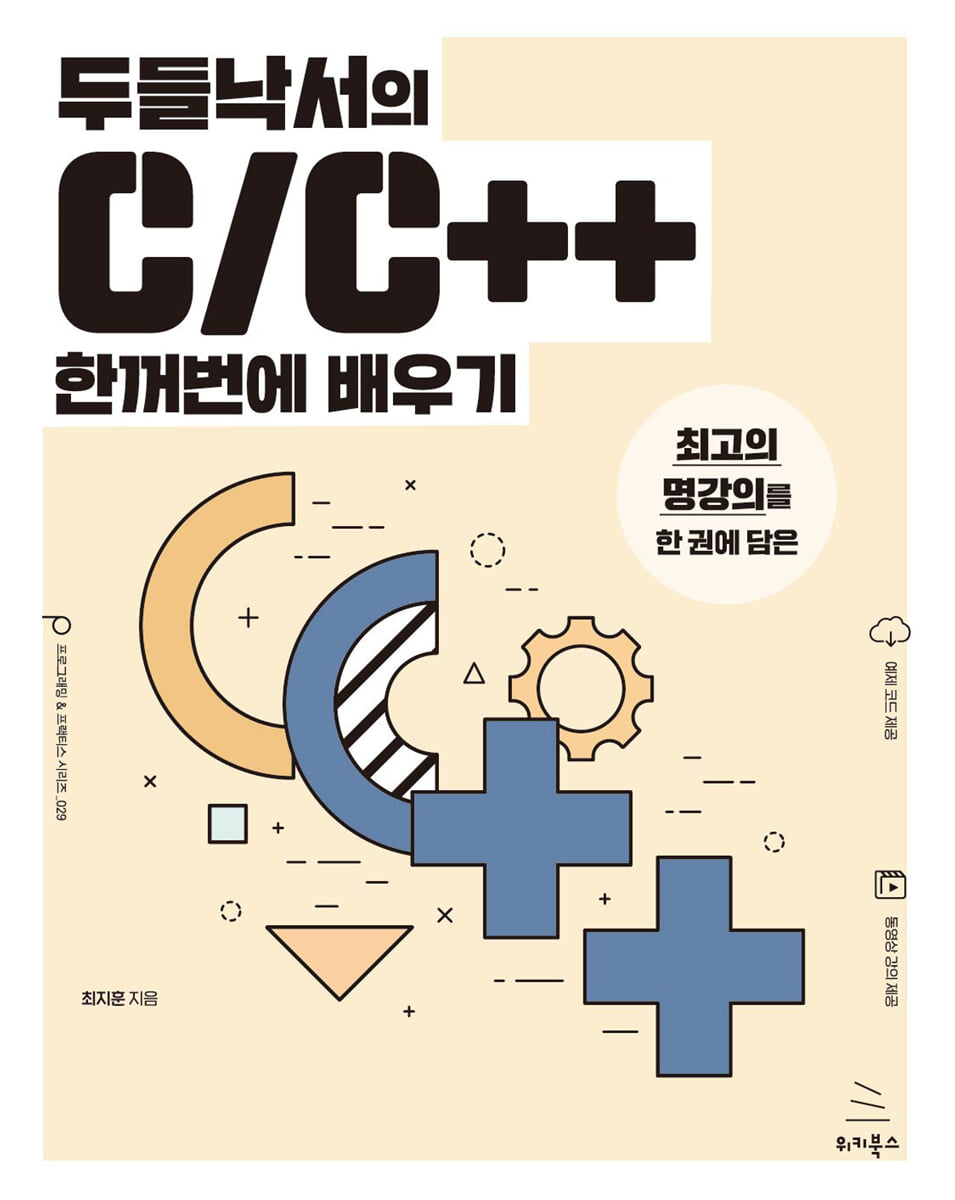
Learn C/C++ all at once with Doodle Doodle
 |
Description
Book Introduction
You can learn C and C++ at the same time through the best lectures! 『Learn C/C++ All at Once with Doodle Doodle』 is an introductory book for beginners in coding or those learning C and C++ for the first time. Even those learning coding for the first time can easily learn the grammar of C and C++ and start coding. Since C++ can be said to be an extension of C, you need to learn C to learn C++, and learning the convenient C++ rather than just learning C will allow you to code more efficiently. So, why not learn C and C++ together? |
- You can preview some of the book's contents.
Preview
index
Chapter 1: Printing
1.1 Hello, world!
____1.1.1 Creating a Project
____1.1.2 Creating Your First Program
1.2 Interpreting "Hello, world!"
1.3 Outputting various data with printf
____1.3.1 Adding source files
____1.3.2 Print the result of adding integers: 2 + 3 = 5
____1.3.3 Format Specifiers
Chapter 2: Variables and Operators
2.1 Using variables
____2.1.1 Declaration and assignment of variables
____2.1.2 Initializing variables
____2.1.3 Variable names
2.2 Data types
____2.2.1 int and float
____2.2.2 Bits and Bytes
____2.2.3 Binary and Integer Data Types
____2.2.4 Various data types
____2.2.5 sizeof operator
2.3 Type conversion
2.4 Char type and ASCII code
____2.4.1 Addition of letters: '2' + '3' = 'e'
____2.4.2 char type as a character type
2.5 Operations with variables
____2.5.1 Assignment Operators and Compound Assignment Operators
____2.5.2 Increment/decrement operators
____2.5.3 Comparison Operators and Truth Values
____2.5.4 Logical Operators
____2.5.5 Operator Precedence
Chapter 3: Receiving Input
3.1 Using scanf
3.2 scanf format specifiers
3.3 Security issues related to the scanf function
Chapter 4: Control Statements
4.1 Dividing cases with if statements
____4.1.1 if statement
____4.1.2 if-else
____4.1.3 else if
4.2 Advanced if statement
____4.2.1 Nested if statements
____4.2.2 else if from the perspective of nested if statements
____4.2.3 if statement and various coding styles
4.3 switch statement
4.4 goto statement
4.5 Looping with a while loop
____4.5.1 while loop
____4.5.2 do-while statement
4.6 Iterating with a for loop
4.7 Advanced for loop
____4.7.1 Omitting conditions
____4.7.2 Using more than one condition
____4.7.3 break and continue: Manipulating loops
____4.7.4 Nested for loops
Chapter 5: Arrays and Pointers
5.1 Array
____5.1.1 Declaration and use of arrays
____5.1.2 Array Initialization
5.2 Using Arrays
____5.2.1 Print backwards
____5.2.2 Finding the maximum and minimum
____5.2.3 Finding the number of even numbers
5.3 Multidimensional arrays
____5.3.1 Two-dimensional arrays
____5.3.2 Multidimensional Arrays
5.4 Strings
____5.4.1 Initializing and Outputting Strings
____5.4.2 Receiving string input
____5.4.3 String-related functions
5.5 Pointing to Variables - Pointers
____5.5.1 Using Pointers
____5.5.2 Null Pointers
____5.5.3 Double Pointer
5.6 Relationship between arrays and pointers
5.7 Pointing to Arrays - Array Pointers
5.8 Two-dimensional arrays and array pointers
5.9 Pointer Arrays
Chapter 6: Functions
6.1 Defining and calling functions
6.2 Let's create a function!
6.3 Variable scope, local variables and global variables
____6.3.1 Block Scope
____6.3.2 Function Scope
6.4 Returning a function
6.5 Call-by-value, Call-by-address, Call-by-reference
6.6 Prototype (Function prototype)
6.7 Recursive functions
6.8 Passing arrays as parameters
____6.8.1 One-dimensional array parameters
____6.8.2 Two-dimensional array parameters
Chapter 7: Structures
7.1 typedef
7.2 Creating a Structure
____7.2.1 Creating a Structure
____7.2.2 Defining a Structure Type
____7.2.3 Utilizing Structures
7.3 Structures and Memory
7.4 Pointing to structure variables
7.5 Structures and Functions
____7.5.1 Call-by-value and Call-by-address of structure parameters
____7.5.2 Embedding functions into structures
Chapter 8: Advanced C Language Features
8.1 Creating Constants
____8.1.1 const keyword
____8.1.2 Macros
____8.1.3 enum
8.2 Learn more about macros
8.3 Bit Operations
____8.3.1 Types of bitwise operators
____8.3.2 Using bitwise operators
8.4 File Input/Output
____8.4.1 Stream
____8.4.2 Creating a File in Visual Studio
____8.4.3 File I/O
8.5 Useful functions
____8.5.1 getchar, putchar, gets, puts - Character and string input/output
____8.5.2 sscanf and sprintf - String stream input/output
____8.5.3 rand and time - Generating random numbers and getting the current time
____8.5.4 exit - Terminate the program
Chapter 9: C++ Style Basic Grammar
9.1 C++ Style Input/Output
9.2 string
9.3 Initialization with a slightly different meaning in C++
9.4 References and rvalue references
____9.4.1 Reference Variables
____9.4.2 r-value reference
9.5 Range-based for loop
9.6 C++-style functions
____9.6.1 Function Overloading
____9.6.2 Default Parameters
Chapter 10: Objects and Classes
10.1 Namespaces
____10.1.1 Namespace Concept
____10.1.2 Creating and Using a Namespace
____10.1.3 Namespaces and Function Definitions
____10.1.4 Nested Namespaces
____10.1.5 using statement
10.2 Classes and Objects
____10.2.1 Concepts of classes and objects
____10.2.2 Creating a TV Class
____10.2.3 Access Control
10.3 this pointer
10.4 Object Creation and Destruction
____10.4.1 When objects are created and destroyed
____10.4.2 Using Constructors
____10.4.3 Constructor Overloading and Default Constructors
10.5 Various uses of constructors
10.6 Static Members
____10.6.1 Static Member Methods
____10.6.2 Static Member Variables
10.7 Constant Methods
10.8 Separating method declarations and definitions
10.9 Operator Overloading
____10.9.1 Operating between objects using member methods
____10.9.2 Arithmetic Operator Overloading
Chapter 11: Dynamic Allocation and Object Copying
11.1 Dynamic Allocation
____11.1.1 Dynamically allocating variables
____11.1.2 Dynamically allocating arrays
____11.1.3 Dynamically allocating objects
11.2 Deep and shallow copying
11.3 Copy constructors and copy assignment operators
____11.3.1 Creating a String class
____11.3.2 Copy Constructor Overloading
____11.3.3 Copy Assignment Operator Overloading
11.4 Movement Semantics
11.5 Move constructors and move assignment operators
____11.5.1 Augmenting the String class
____11.5.2 Overloading Move Constructors and Move Assignment Operators
11.6 Implicit Type Conversion
____11.6.1 The concept of implicit type conversion
____11.6.2 Type conversion constructor overloading
____11.6.3 Type Conversion Operator Overloading
____11.6.4 explicit keyword
Chapter 12: Inheritance
12.1 Inheritance Basics
____12.1.1 Concept of inheritance
____12.1.2 Inheritance and Access Control
____12.1.3 Inheritance Example
12.2 Creator/Destructor in Inheritance Relationships
12.3 Why inheritance is necessary (1)
12.4 Overriding
____12.4.1 Member Redefinition and Static Binding
____12.4.2 Virtual functions, overriding, and dynamic binding
____12.4.3 Virtual Destructor
12.5 Why inheritance is necessary (2)
12.6 Pure virtual functions and abstract classes
12.7 Type Conversion in Inheritance Relationships
____12.7.1 Upcasting
____12.7.2 Downcasting
____12.7.3 RTTI and dynamic_cast
12.8 The Four Principles of Object-Oriented Programming
____12.8.1 Encapsulation
____12.8.2 Inheritance
____12.8.3 Polymorphism
____12.8.4 Abstraction
12.9 Problems with Object-Oriented Programming
____12.9.1 Multiple Inheritance and the Diamond Problem
____12.9.2 Square and Rectangle Problems
Chapter 13: Advanced C++ Features
13.1 Template
____13.1.1 Function Templates
____13.1.2 Class Templates
____13.1.3 Template Specialization
____13.1.4 Non-typed parameters
13.2 Exception Handling
13.3 auto
13.4 Function Pointers, Function Objects, and Lambda Expressions
____13.4.1 Function Pointers
____13.4.2 Function Objects
____13.4.3 Lambda expressions
13.5 friends
13.6 Memory Ownership and Smart Pointers
____13.6.1 Memory Ownership
____13.6.2 unique_ptr
____13.6.3 shared_ptr
____13.6.4 weak_ptr
13.7 STL
____13.7.1 vector
____13.7.2 pair
____13.7.3 map
____13.7.4 sort
Appendix A: Comprehensive Problem Solutions
Appendix B: ASCII Code Table
1.1 Hello, world!
____1.1.1 Creating a Project
____1.1.2 Creating Your First Program
1.2 Interpreting "Hello, world!"
1.3 Outputting various data with printf
____1.3.1 Adding source files
____1.3.2 Print the result of adding integers: 2 + 3 = 5
____1.3.3 Format Specifiers
Chapter 2: Variables and Operators
2.1 Using variables
____2.1.1 Declaration and assignment of variables
____2.1.2 Initializing variables
____2.1.3 Variable names
2.2 Data types
____2.2.1 int and float
____2.2.2 Bits and Bytes
____2.2.3 Binary and Integer Data Types
____2.2.4 Various data types
____2.2.5 sizeof operator
2.3 Type conversion
2.4 Char type and ASCII code
____2.4.1 Addition of letters: '2' + '3' = 'e'
____2.4.2 char type as a character type
2.5 Operations with variables
____2.5.1 Assignment Operators and Compound Assignment Operators
____2.5.2 Increment/decrement operators
____2.5.3 Comparison Operators and Truth Values
____2.5.4 Logical Operators
____2.5.5 Operator Precedence
Chapter 3: Receiving Input
3.1 Using scanf
3.2 scanf format specifiers
3.3 Security issues related to the scanf function
Chapter 4: Control Statements
4.1 Dividing cases with if statements
____4.1.1 if statement
____4.1.2 if-else
____4.1.3 else if
4.2 Advanced if statement
____4.2.1 Nested if statements
____4.2.2 else if from the perspective of nested if statements
____4.2.3 if statement and various coding styles
4.3 switch statement
4.4 goto statement
4.5 Looping with a while loop
____4.5.1 while loop
____4.5.2 do-while statement
4.6 Iterating with a for loop
4.7 Advanced for loop
____4.7.1 Omitting conditions
____4.7.2 Using more than one condition
____4.7.3 break and continue: Manipulating loops
____4.7.4 Nested for loops
Chapter 5: Arrays and Pointers
5.1 Array
____5.1.1 Declaration and use of arrays
____5.1.2 Array Initialization
5.2 Using Arrays
____5.2.1 Print backwards
____5.2.2 Finding the maximum and minimum
____5.2.3 Finding the number of even numbers
5.3 Multidimensional arrays
____5.3.1 Two-dimensional arrays
____5.3.2 Multidimensional Arrays
5.4 Strings
____5.4.1 Initializing and Outputting Strings
____5.4.2 Receiving string input
____5.4.3 String-related functions
5.5 Pointing to Variables - Pointers
____5.5.1 Using Pointers
____5.5.2 Null Pointers
____5.5.3 Double Pointer
5.6 Relationship between arrays and pointers
5.7 Pointing to Arrays - Array Pointers
5.8 Two-dimensional arrays and array pointers
5.9 Pointer Arrays
Chapter 6: Functions
6.1 Defining and calling functions
6.2 Let's create a function!
6.3 Variable scope, local variables and global variables
____6.3.1 Block Scope
____6.3.2 Function Scope
6.4 Returning a function
6.5 Call-by-value, Call-by-address, Call-by-reference
6.6 Prototype (Function prototype)
6.7 Recursive functions
6.8 Passing arrays as parameters
____6.8.1 One-dimensional array parameters
____6.8.2 Two-dimensional array parameters
Chapter 7: Structures
7.1 typedef
7.2 Creating a Structure
____7.2.1 Creating a Structure
____7.2.2 Defining a Structure Type
____7.2.3 Utilizing Structures
7.3 Structures and Memory
7.4 Pointing to structure variables
7.5 Structures and Functions
____7.5.1 Call-by-value and Call-by-address of structure parameters
____7.5.2 Embedding functions into structures
Chapter 8: Advanced C Language Features
8.1 Creating Constants
____8.1.1 const keyword
____8.1.2 Macros
____8.1.3 enum
8.2 Learn more about macros
8.3 Bit Operations
____8.3.1 Types of bitwise operators
____8.3.2 Using bitwise operators
8.4 File Input/Output
____8.4.1 Stream
____8.4.2 Creating a File in Visual Studio
____8.4.3 File I/O
8.5 Useful functions
____8.5.1 getchar, putchar, gets, puts - Character and string input/output
____8.5.2 sscanf and sprintf - String stream input/output
____8.5.3 rand and time - Generating random numbers and getting the current time
____8.5.4 exit - Terminate the program
Chapter 9: C++ Style Basic Grammar
9.1 C++ Style Input/Output
9.2 string
9.3 Initialization with a slightly different meaning in C++
9.4 References and rvalue references
____9.4.1 Reference Variables
____9.4.2 r-value reference
9.5 Range-based for loop
9.6 C++-style functions
____9.6.1 Function Overloading
____9.6.2 Default Parameters
Chapter 10: Objects and Classes
10.1 Namespaces
____10.1.1 Namespace Concept
____10.1.2 Creating and Using a Namespace
____10.1.3 Namespaces and Function Definitions
____10.1.4 Nested Namespaces
____10.1.5 using statement
10.2 Classes and Objects
____10.2.1 Concepts of classes and objects
____10.2.2 Creating a TV Class
____10.2.3 Access Control
10.3 this pointer
10.4 Object Creation and Destruction
____10.4.1 When objects are created and destroyed
____10.4.2 Using Constructors
____10.4.3 Constructor Overloading and Default Constructors
10.5 Various uses of constructors
10.6 Static Members
____10.6.1 Static Member Methods
____10.6.2 Static Member Variables
10.7 Constant Methods
10.8 Separating method declarations and definitions
10.9 Operator Overloading
____10.9.1 Operating between objects using member methods
____10.9.2 Arithmetic Operator Overloading
Chapter 11: Dynamic Allocation and Object Copying
11.1 Dynamic Allocation
____11.1.1 Dynamically allocating variables
____11.1.2 Dynamically allocating arrays
____11.1.3 Dynamically allocating objects
11.2 Deep and shallow copying
11.3 Copy constructors and copy assignment operators
____11.3.1 Creating a String class
____11.3.2 Copy Constructor Overloading
____11.3.3 Copy Assignment Operator Overloading
11.4 Movement Semantics
11.5 Move constructors and move assignment operators
____11.5.1 Augmenting the String class
____11.5.2 Overloading Move Constructors and Move Assignment Operators
11.6 Implicit Type Conversion
____11.6.1 The concept of implicit type conversion
____11.6.2 Type conversion constructor overloading
____11.6.3 Type Conversion Operator Overloading
____11.6.4 explicit keyword
Chapter 12: Inheritance
12.1 Inheritance Basics
____12.1.1 Concept of inheritance
____12.1.2 Inheritance and Access Control
____12.1.3 Inheritance Example
12.2 Creator/Destructor in Inheritance Relationships
12.3 Why inheritance is necessary (1)
12.4 Overriding
____12.4.1 Member Redefinition and Static Binding
____12.4.2 Virtual functions, overriding, and dynamic binding
____12.4.3 Virtual Destructor
12.5 Why inheritance is necessary (2)
12.6 Pure virtual functions and abstract classes
12.7 Type Conversion in Inheritance Relationships
____12.7.1 Upcasting
____12.7.2 Downcasting
____12.7.3 RTTI and dynamic_cast
12.8 The Four Principles of Object-Oriented Programming
____12.8.1 Encapsulation
____12.8.2 Inheritance
____12.8.3 Polymorphism
____12.8.4 Abstraction
12.9 Problems with Object-Oriented Programming
____12.9.1 Multiple Inheritance and the Diamond Problem
____12.9.2 Square and Rectangle Problems
Chapter 13: Advanced C++ Features
13.1 Template
____13.1.1 Function Templates
____13.1.2 Class Templates
____13.1.3 Template Specialization
____13.1.4 Non-typed parameters
13.2 Exception Handling
13.3 auto
13.4 Function Pointers, Function Objects, and Lambda Expressions
____13.4.1 Function Pointers
____13.4.2 Function Objects
____13.4.3 Lambda expressions
13.5 friends
13.6 Memory Ownership and Smart Pointers
____13.6.1 Memory Ownership
____13.6.2 unique_ptr
____13.6.3 shared_ptr
____13.6.4 weak_ptr
13.7 STL
____13.7.1 vector
____13.7.2 pair
____13.7.3 map
____13.7.4 sort
Appendix A: Comprehensive Problem Solutions
Appendix B: ASCII Code Table
Detailed image

Publisher's Review
Features of this book
◎ You can learn C and C++ at the same time with one book.
◎ You can learn why each concept is necessary through examples.
◎ You can learn concepts by writing code yourself through abundant examples.
◎ You can check what you have learned through practice problems.
◎ Video lectures are also provided to help you understand.
What this book covers
◎ Learn the basic grammar and usage of C and C++.
◎ Develop basic coding skills using C and C++.
◎ Learn about the concepts and principles of object-oriented programming.
◎ You can learn C and C++ at the same time with one book.
◎ You can learn why each concept is necessary through examples.
◎ You can learn concepts by writing code yourself through abundant examples.
◎ You can check what you have learned through practice problems.
◎ Video lectures are also provided to help you understand.
What this book covers
◎ Learn the basic grammar and usage of C and C++.
◎ Develop basic coding skills using C and C++.
◎ Learn about the concepts and principles of object-oriented programming.
GOODS SPECIFICS
- Date of issue: June 4, 2021
- Page count, weight, size: 600 pages | 188*240*35mm
- ISBN13: 9791158392581
- ISBN10: 1158392583
You may also like
카테고리
korean


korean

![GQ KOREA Mark (Monthly): December [2025]](http://librairie.coreenne.fr/cdn/shop/files/8ef265dbbfbf186523ed75ba7319009d.jpg?v=1765340328&width=3840)


