

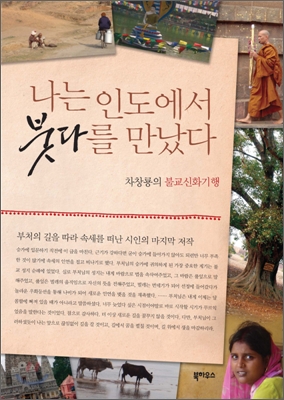
I met Buddha in India
 |
Description
Book Introduction
Poet Cha Chang-ryong's last work left behind in this world
Poet Cha Chang-ryong, winner of the 13th Kim Su-yeong Literary Award for his poetry collection.
We may no longer be able to encounter his poetry, which warmly embraced the weary emotions of modern people through poetry collections such as “Plowing Where the Sun Never Sets” and “Wooden Fish.”
Because in the spring of 2010, I left the secular world and became a Buddhist monk.
"I Met Buddha in India" is a Buddhist mythological travelogue written by a poet before he became a monk.
The author, who had already published 『Travelogue of Indian Mythology』, had a special interest in India.
Although this book takes the form of a travelogue, its character is somewhat different from other travelogues.
Most travelogues record the scenery of the travel destination and the stories of the people encountered along the way.
In contrast, this book focuses on introducing Buddha and stories related to him.
In particular, it introduces Buddhist mythology, including stories of Buddha's previous lives and myths related to his life.
In this process, readers can travel to Buddhist holy sites, from Lumbini Garden, where the Buddha was born, to Kushinagar, where he entered nirvana.
Poet Cha Chang-ryong, winner of the 13th Kim Su-yeong Literary Award for his poetry collection.
We may no longer be able to encounter his poetry, which warmly embraced the weary emotions of modern people through poetry collections such as “Plowing Where the Sun Never Sets” and “Wooden Fish.”
Because in the spring of 2010, I left the secular world and became a Buddhist monk.
"I Met Buddha in India" is a Buddhist mythological travelogue written by a poet before he became a monk.
The author, who had already published 『Travelogue of Indian Mythology』, had a special interest in India.
Although this book takes the form of a travelogue, its character is somewhat different from other travelogues.
Most travelogues record the scenery of the travel destination and the stories of the people encountered along the way.
In contrast, this book focuses on introducing Buddha and stories related to him.
In particular, it introduces Buddhist mythology, including stories of Buddha's previous lives and myths related to his life.
In this process, readers can travel to Buddhist holy sites, from Lumbini Garden, where the Buddha was born, to Kushinagar, where he entered nirvana.
- You can preview some of the book's contents.
Preview
index
Preface_It's time to leave again
Prologue_On the way to meet Buddha
Chapter 1: Lumbini and Kapilavastu, the Hometowns of the Buddha
Why was Buddha born on the road?
Buddha's Two Mothers
Kapilavastu, the true home of Buddha
Chapter 2: Bodhgaya, the Land of Enlightenment
On the way to Bodgaya
Dungeswari, the mountain Buddha climbed before attaining enlightenment
Sujata Village
The Battle of Bodhi Gaya under the Barley Tree
Chapter 3: Sarnath, the First Sermon Site
The Miracle of Deer Park
The place where the first Sangha was born
Chapter 4: The Sermon on the Lotus Sutra, Rajgir
Jukrimjeongsa Temple, the first Buddhist temple
The bad relationship between Devadatta and the Buddha
The Tragedy of King Bimbisara
Vulture Peak, where the Lotus Sutra was preached
Seven-leaf Cave and Ananda
Chapter 5: Vaishali, the hometown of the great monk Yuma
Amrapali's human bomb attack
Dialogue between Manjushri Bodhisattva and Vimalakirti
Buddha receiving honey offering from a monkey
Singing a farewell song in advance
Chapter 6: Sravasti, the Land of Origin
On the way to Sravasti
The Land of Miracles, Sravasti and the Temple of Gibberish
Stupa of the Murderer Angulimala
Thousand Buddhas and Devadatta's Journey to Hell
Temple food eaten in Sravasti
Chapter 7: Sankasha, the City Connected to Heaven
Why did Buddha come down to Sankaṣa?
Letter from Sankasha
Chapter 8: The Buddha's Nirvana, Kushinagar
An unforgettable person and an unforgettable town
Ramavar Stupa, built on the site of Buddha's cremation
On the way back to Kushinagar
Epilogue_At the end of the journey
Prologue_On the way to meet Buddha
Chapter 1: Lumbini and Kapilavastu, the Hometowns of the Buddha
Why was Buddha born on the road?
Buddha's Two Mothers
Kapilavastu, the true home of Buddha
Chapter 2: Bodhgaya, the Land of Enlightenment
On the way to Bodgaya
Dungeswari, the mountain Buddha climbed before attaining enlightenment
Sujata Village
The Battle of Bodhi Gaya under the Barley Tree
Chapter 3: Sarnath, the First Sermon Site
The Miracle of Deer Park
The place where the first Sangha was born
Chapter 4: The Sermon on the Lotus Sutra, Rajgir
Jukrimjeongsa Temple, the first Buddhist temple
The bad relationship between Devadatta and the Buddha
The Tragedy of King Bimbisara
Vulture Peak, where the Lotus Sutra was preached
Seven-leaf Cave and Ananda
Chapter 5: Vaishali, the hometown of the great monk Yuma
Amrapali's human bomb attack
Dialogue between Manjushri Bodhisattva and Vimalakirti
Buddha receiving honey offering from a monkey
Singing a farewell song in advance
Chapter 6: Sravasti, the Land of Origin
On the way to Sravasti
The Land of Miracles, Sravasti and the Temple of Gibberish
Stupa of the Murderer Angulimala
Thousand Buddhas and Devadatta's Journey to Hell
Temple food eaten in Sravasti
Chapter 7: Sankasha, the City Connected to Heaven
Why did Buddha come down to Sankaṣa?
Letter from Sankasha
Chapter 8: The Buddha's Nirvana, Kushinagar
An unforgettable person and an unforgettable town
Ramavar Stupa, built on the site of Buddha's cremation
On the way back to Kushinagar
Epilogue_At the end of the journey
Publisher's Review
The poet's last work, following the path of Buddha and leaving the secular world
In the spring of 2010, poet Cha Chang-ryong, who shocked the literary world with his unexpectedly late ordination, has published a book of Buddhist mythological travelogues that he completed just before becoming a monk.
The author, who has been a member of the ‘Artists Thinking of India’ for a long time and published the previous work ‘Travelogue of Indian Mythology’ (Bookhouse) dealing with Hindu mythology, wrote this book as his last work in the secular world, leaving “to throw away what he had built up until now” and “to learn how to build a new tower.”
I am finishing this article just before entering the Sangha.
If I had strong perseverance, I wouldn't have to enter the Sangha, but I have so many shortcomings that I decided to leave my worldly ties and leave.
The most important reason for converting to the Buddha's Sangha was a pilgrimage to Buddhist holy sites.
The Buddha's holy land whispered the Dharma to me through the wind, and the wind spoke to me through the blades of grass, and the blades of grass conveyed their will through the movements of insects, and the insects became chrysalises and entered into meditation, and through the amazing parable of the enlightenment, they became butterflies and urged me to form new relationships.
… …
The Buddha told me that now was not the time to indulge in sweetness.
The point at which it seems too late is precisely when the time is ripe to begin.
Thank you very much.
I will no longer dream of new paths.
However, just like the Buddha, I will continue to walk the path, pursue my dreams on the path, and end my life on the path.
(Pages 298-301)
Encounter the myths that blossomed with every step Buddha took.
Although this book is also a travelogue, it has a very different atmosphere from other travelogues, focusing on the scenery of the travel destinations and anecdotes from the people met there.
Since this is a conscious journey to visit places where Buddhist mythology lives and breathes, we focus on introducing myths related to Buddha above all else.
Some readers may tilt their heads because no image immediately comes to mind when they think of Buddhist mythology.
The author unfolds a rich and fascinating array of Buddhist stories, beginning with the story of Hindus who believe that Buddha is the ninth incarnation of Vishnu, the Hindu deity, and the story of the Buddha from the incredibly distant past.
The Buddha's story exists from the distant past to the distant future.
Although Buddhism is a doctrine-centered religion, it is clear that these myths cannot be ignored.
Moreover, the birth of Buddha Sakyamuni is completely different from the birth of an ordinary person.
While on a pilgrimage to Buddhist holy sites, I wanted to read these myths rather than Buddhist doctrines.
It would be correct to say that the story of Buddha Shakyamuni is history with mythical elements added.
I don't want to talk about history.
Buddhism clearly believes in myths similar to those of other religions.
Buddhism can be established without believing in it, but I believe that the moment we believe in the myths handed down in the scriptures, our imagination will expand and the scope of our faith will broaden.
If Buddhism were based solely on doctrine, it would be a religion that illiterate people could not believe in.
Just by the story alone, Buddhism is clearly a religion.
(Page 24)
There are probably countless books that approach the life and thoughts of Buddha from an academic perspective, and each of these books has its own value and virtue.
So what sets this book apart from others? It's the poet's keen eye and deep imagination, striving to penetrate the essence of phenomena.
As the author notes, this imagination may clash with existing Buddhist doctrines and interpretations, but the book's greatest appeal lies in its ability to naturally reveal difficult Buddhist ideas through myths, allowing readers to encounter a human Buddha.
For example, the scene depicting Siddhartha's showdown with the demon Mara, who persistently tempts him while he sits and meditates under the Bodhi tree, is vivid as if you are witnessing the scene firsthand, and is also subtly humorous.
“Your body is so thin, like a dry tree branch.
How can you navigate this harsh world with such a weak body? You have to live.
Even if you roll around in dog shit, you have to survive.
Stand up and exercise.
Eat plenty of nutritious food and live happily.
If you live happily, you will be healthy.
Don't try to practice hard and achieve hard enlightenment, but pray to God.
If you study the Vedas, perform sacrifices, and worship fire, you will accumulate great merit.
“How vibrant would life be if we lived with that virtue?”
Every time we try something new, we are struck down by this powerful punch from the devil.
I think it was called Dogomaseong (道高魔盛).
The higher the degree, the more extreme the devil becomes.
Because high degrees are fatal to the devil.
If Siddhartha attains enlightenment, no one will fear Mara, and his own power will be greatly weakened, so Mara must prevent Siddhartha from attaining enlightenment.
Siddhartha spoke to Mara, who was wandering in front of him.
"You wicked one, you foolish one, you greedy one! What are you doing here? You will be of no use here.
You should only talk to those who seek worldly happiness.
Isn't it your job to bestow them with appropriate blessings and ensure they receive ancestral rites food? I have attained the ultimate wisdom.
This is not the time for you to be concerned about my health.
Your health is in jeopardy right now.
“Come to your senses and let go of your desires.” ……
Mara came again with a great army to defeat Siddhartha, but Siddhartha was no longer Siddhartha.
He was an impregnable fortress, an invincible hero.
Mara's army fell like fallen leaves as soon as they charged.
One side led a large army and swayed, but was as powerless as autumn leaves, while the other side sat with a gentle smile, but was as solid as a rock.
The place where the Buddha defeated Mara, sitting firmly like a rock without moving even a little, is called the Vajra Seat.
The first war between Buddha and Mara ended so blandly.
I call this war the 'Battle of Bodh Gaya' from the Buddha's perspective.
(Pages 102-107)
A journey that engraved the Buddha's teachings in one's heart while wandering barefoot through the mountains and rivers.
The author says he has traveled to India four times.
He said that he visited major sacred sites steeped in the myth of Buddha through three subsequent trips, including his first and longest backpacking trip in 2001, and the subsequent trips in 2008 and 2009.
However, the flow of the text in the book does not follow the chronological order of the travel destinations.
Instead, it is reconstructed into eight chapters that follow the Buddha's footsteps: birth and growth, leaving home and asceticism, enlightenment, preaching and trials, and nirvana.
India, the birthplace of Buddhism, is not a place where Buddhism flourishes today, so most of the places the author visited were remote and poor villages, and there were many places where even the traces of Buddhism were faint.
The author's feelings of extreme sorrow at seeing such a desolate landscape, yet also being deeply moved by the living teachings of the Buddha, will likely be fully conveyed to the readers.
Here is a brief introduction to the places that “resonated deeply with the author”:
* Lumbini Garden and Kapilavastu: The place where Buddha was born and raised.
This is the place where the myth of Buddha's birth, the Buddha's agony before becoming a monk, and the longing hearts of his family are recorded.
* Bodhgaya: The place where Buddha attained enlightenment after leaving home and practicing Buddhism.
This is the place where the virgin Sujata's milk porridge offering and enlightenment under the barley were achieved.
* Sarnath: The place where Buddha first conveyed his enlightenment to others and formed the Sangha, and where the legend of the Deer Park is told.
* Rajgir: The first Buddhist temple, Jukrimjeongsa, donated by King Bimbisara of Magadha, who was friendly to Buddhism, and Vulture Peak, where Buddha preached the Lotus Sutra, are located.
It is also a place where the story of Devadatta, who had a long-standing conflict with the Buddha, and the tragic story of Bimbisara and the king remain.
* Vaishali: A place where the Buddha stayed several times during his 45-year journey to spread the Dharma, and where the story of Vimalakirti, the protagonist of the Vimalakirti Sutra, is told.
* Sravasti: The place where Buddha stayed the longest after attaining enlightenment and spent the rainy season. It is the site of the Jetavana Monastery donated by Prince Sudatta of Kosala and the place where he preached the Diamond Sutra.
The site of the Thousand Buddhas' Incense Burner and the place where Devadatta died remain.
* Sankasha: The place where Buddha ascended to heaven after competing with various gods in Sravasti and then descended again after 90 days.
Why did the Buddha descend to Sankaṣa rather than Sravasti? This question seems to be a thorn in the author's side.
* Kushinagar: The place where the Buddha, whose illness had worsened after receiving the last offering made by the blacksmith Cunda, visited with his disciple Ananda.
There are places with myths related to Buddha's nirvana, such as Ramavar Stupa, the place where Buddha was cremated.
In the spring of 2010, poet Cha Chang-ryong, who shocked the literary world with his unexpectedly late ordination, has published a book of Buddhist mythological travelogues that he completed just before becoming a monk.
The author, who has been a member of the ‘Artists Thinking of India’ for a long time and published the previous work ‘Travelogue of Indian Mythology’ (Bookhouse) dealing with Hindu mythology, wrote this book as his last work in the secular world, leaving “to throw away what he had built up until now” and “to learn how to build a new tower.”
I am finishing this article just before entering the Sangha.
If I had strong perseverance, I wouldn't have to enter the Sangha, but I have so many shortcomings that I decided to leave my worldly ties and leave.
The most important reason for converting to the Buddha's Sangha was a pilgrimage to Buddhist holy sites.
The Buddha's holy land whispered the Dharma to me through the wind, and the wind spoke to me through the blades of grass, and the blades of grass conveyed their will through the movements of insects, and the insects became chrysalises and entered into meditation, and through the amazing parable of the enlightenment, they became butterflies and urged me to form new relationships.
… …
The Buddha told me that now was not the time to indulge in sweetness.
The point at which it seems too late is precisely when the time is ripe to begin.
Thank you very much.
I will no longer dream of new paths.
However, just like the Buddha, I will continue to walk the path, pursue my dreams on the path, and end my life on the path.
(Pages 298-301)
Encounter the myths that blossomed with every step Buddha took.
Although this book is also a travelogue, it has a very different atmosphere from other travelogues, focusing on the scenery of the travel destinations and anecdotes from the people met there.
Since this is a conscious journey to visit places where Buddhist mythology lives and breathes, we focus on introducing myths related to Buddha above all else.
Some readers may tilt their heads because no image immediately comes to mind when they think of Buddhist mythology.
The author unfolds a rich and fascinating array of Buddhist stories, beginning with the story of Hindus who believe that Buddha is the ninth incarnation of Vishnu, the Hindu deity, and the story of the Buddha from the incredibly distant past.
The Buddha's story exists from the distant past to the distant future.
Although Buddhism is a doctrine-centered religion, it is clear that these myths cannot be ignored.
Moreover, the birth of Buddha Sakyamuni is completely different from the birth of an ordinary person.
While on a pilgrimage to Buddhist holy sites, I wanted to read these myths rather than Buddhist doctrines.
It would be correct to say that the story of Buddha Shakyamuni is history with mythical elements added.
I don't want to talk about history.
Buddhism clearly believes in myths similar to those of other religions.
Buddhism can be established without believing in it, but I believe that the moment we believe in the myths handed down in the scriptures, our imagination will expand and the scope of our faith will broaden.
If Buddhism were based solely on doctrine, it would be a religion that illiterate people could not believe in.
Just by the story alone, Buddhism is clearly a religion.
(Page 24)
There are probably countless books that approach the life and thoughts of Buddha from an academic perspective, and each of these books has its own value and virtue.
So what sets this book apart from others? It's the poet's keen eye and deep imagination, striving to penetrate the essence of phenomena.
As the author notes, this imagination may clash with existing Buddhist doctrines and interpretations, but the book's greatest appeal lies in its ability to naturally reveal difficult Buddhist ideas through myths, allowing readers to encounter a human Buddha.
For example, the scene depicting Siddhartha's showdown with the demon Mara, who persistently tempts him while he sits and meditates under the Bodhi tree, is vivid as if you are witnessing the scene firsthand, and is also subtly humorous.
“Your body is so thin, like a dry tree branch.
How can you navigate this harsh world with such a weak body? You have to live.
Even if you roll around in dog shit, you have to survive.
Stand up and exercise.
Eat plenty of nutritious food and live happily.
If you live happily, you will be healthy.
Don't try to practice hard and achieve hard enlightenment, but pray to God.
If you study the Vedas, perform sacrifices, and worship fire, you will accumulate great merit.
“How vibrant would life be if we lived with that virtue?”
Every time we try something new, we are struck down by this powerful punch from the devil.
I think it was called Dogomaseong (道高魔盛).
The higher the degree, the more extreme the devil becomes.
Because high degrees are fatal to the devil.
If Siddhartha attains enlightenment, no one will fear Mara, and his own power will be greatly weakened, so Mara must prevent Siddhartha from attaining enlightenment.
Siddhartha spoke to Mara, who was wandering in front of him.
"You wicked one, you foolish one, you greedy one! What are you doing here? You will be of no use here.
You should only talk to those who seek worldly happiness.
Isn't it your job to bestow them with appropriate blessings and ensure they receive ancestral rites food? I have attained the ultimate wisdom.
This is not the time for you to be concerned about my health.
Your health is in jeopardy right now.
“Come to your senses and let go of your desires.” ……
Mara came again with a great army to defeat Siddhartha, but Siddhartha was no longer Siddhartha.
He was an impregnable fortress, an invincible hero.
Mara's army fell like fallen leaves as soon as they charged.
One side led a large army and swayed, but was as powerless as autumn leaves, while the other side sat with a gentle smile, but was as solid as a rock.
The place where the Buddha defeated Mara, sitting firmly like a rock without moving even a little, is called the Vajra Seat.
The first war between Buddha and Mara ended so blandly.
I call this war the 'Battle of Bodh Gaya' from the Buddha's perspective.
(Pages 102-107)
A journey that engraved the Buddha's teachings in one's heart while wandering barefoot through the mountains and rivers.
The author says he has traveled to India four times.
He said that he visited major sacred sites steeped in the myth of Buddha through three subsequent trips, including his first and longest backpacking trip in 2001, and the subsequent trips in 2008 and 2009.
However, the flow of the text in the book does not follow the chronological order of the travel destinations.
Instead, it is reconstructed into eight chapters that follow the Buddha's footsteps: birth and growth, leaving home and asceticism, enlightenment, preaching and trials, and nirvana.
India, the birthplace of Buddhism, is not a place where Buddhism flourishes today, so most of the places the author visited were remote and poor villages, and there were many places where even the traces of Buddhism were faint.
The author's feelings of extreme sorrow at seeing such a desolate landscape, yet also being deeply moved by the living teachings of the Buddha, will likely be fully conveyed to the readers.
Here is a brief introduction to the places that “resonated deeply with the author”:
* Lumbini Garden and Kapilavastu: The place where Buddha was born and raised.
This is the place where the myth of Buddha's birth, the Buddha's agony before becoming a monk, and the longing hearts of his family are recorded.
* Bodhgaya: The place where Buddha attained enlightenment after leaving home and practicing Buddhism.
This is the place where the virgin Sujata's milk porridge offering and enlightenment under the barley were achieved.
* Sarnath: The place where Buddha first conveyed his enlightenment to others and formed the Sangha, and where the legend of the Deer Park is told.
* Rajgir: The first Buddhist temple, Jukrimjeongsa, donated by King Bimbisara of Magadha, who was friendly to Buddhism, and Vulture Peak, where Buddha preached the Lotus Sutra, are located.
It is also a place where the story of Devadatta, who had a long-standing conflict with the Buddha, and the tragic story of Bimbisara and the king remain.
* Vaishali: A place where the Buddha stayed several times during his 45-year journey to spread the Dharma, and where the story of Vimalakirti, the protagonist of the Vimalakirti Sutra, is told.
* Sravasti: The place where Buddha stayed the longest after attaining enlightenment and spent the rainy season. It is the site of the Jetavana Monastery donated by Prince Sudatta of Kosala and the place where he preached the Diamond Sutra.
The site of the Thousand Buddhas' Incense Burner and the place where Devadatta died remain.
* Sankasha: The place where Buddha ascended to heaven after competing with various gods in Sravasti and then descended again after 90 days.
Why did the Buddha descend to Sankaṣa rather than Sravasti? This question seems to be a thorn in the author's side.
* Kushinagar: The place where the Buddha, whose illness had worsened after receiving the last offering made by the blacksmith Cunda, visited with his disciple Ananda.
There are places with myths related to Buddha's nirvana, such as Ramavar Stupa, the place where Buddha was cremated.
GOODS SPECIFICS
- Date of issue: July 1, 2010
- Page count, weight, size: 122 pages | 504g | 148*210*20mm
- ISBN13: 9788956054599
- ISBN10: 8956054592
You may also like
카테고리
korean


korean

![GQ KOREA Mark (Monthly): December [2025]](http://librairie.coreenne.fr/cdn/shop/files/8ef265dbbfbf186523ed75ba7319009d.jpg?v=1765340328&width=3840)


