

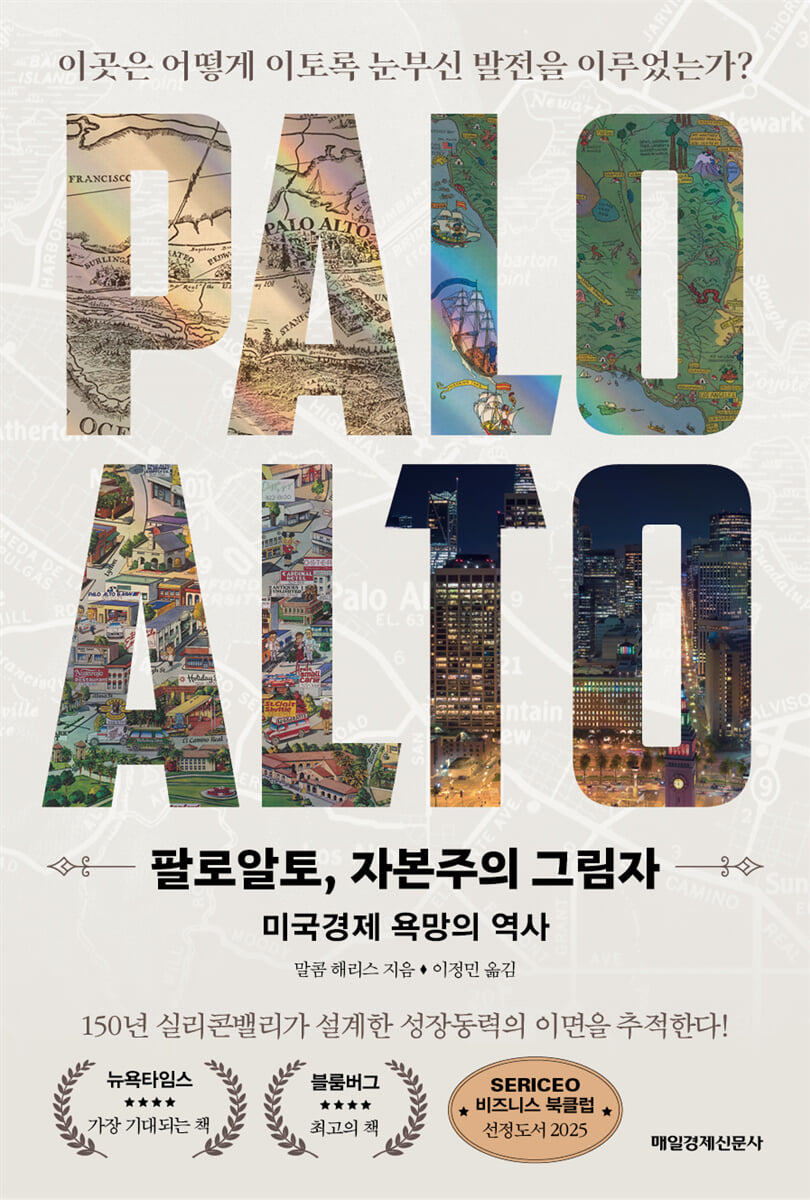
Palo Alto, the Shadow of Capitalism
 |
Description
Book Introduction
A book that shook North America
The New York Times' Most Anticipated Book · Bloomberg's Best Book
SERICEO Business Book Club Selections 2025
How did this place achieve such remarkable development?
Tracing the growth engine behind 150 years of Silicon Valley design!
This book is the first global history of Silicon Valley.
It shows how this place, which was less developed than the East, became a powerful driving force in the economic war, how it led to the surprisingly splendid and disastrous 21st century, how the technology that developed rapidly during World War I and II connected countless talents and capital and brought about economic abundance, how high-tech companies that shook the world such as Hewlett-Packard (HP), General Electric (GE), Microsoft, Amazon, Apple, and Facebook appeared one after another, and even the stories of the small letters hidden behind the desires of American capitalism.
The New York Times' Most Anticipated Book · Bloomberg's Best Book
SERICEO Business Book Club Selections 2025
How did this place achieve such remarkable development?
Tracing the growth engine behind 150 years of Silicon Valley design!
This book is the first global history of Silicon Valley.
It shows how this place, which was less developed than the East, became a powerful driving force in the economic war, how it led to the surprisingly splendid and disastrous 21st century, how the technology that developed rapidly during World War I and II connected countless talents and capital and brought about economic abundance, how high-tech companies that shook the world such as Hewlett-Packard (HP), General Electric (GE), Microsoft, Amazon, Apple, and Facebook appeared one after another, and even the stories of the small letters hidden behind the desires of American capitalism.
- You can preview some of the book's contents.
Preview
index
Entering
Part 1 1850-1900
Chapter 1 Time is money
- Move quickly and break the board.
- The birth of a bank
Chapter 2 Monopolies
- Could someone have stopped it?
- Railroad and workers
Chapter 3 Stanford
- Uninterrupted speed
- A university named after his deceased son
Part 2 1900–1945
Chapter 4: Confusion and Growth
- Campus Nightmare
- The age of technology and science
Chapter 5: Bionomics and Eugenics
- Excellent Gene Discovery Project
- Is racism the foundation of prosperity?
- Revolutionary, bombs everywhere
Chapter 6: Hooverville
- Mining financial fraudster vs. presidential candidate
- General, Herbert Hoover
- The Great Depression and World War I
- American communism
Chapter 7: Young Talents in Turbulent Times
- The Age of Electronic Communication and War
- Japanese in California at that time
- The growth industry of inequality
Part 3 1945–1975
Chapter 8: Explosive Industrialization
- After the war
- Permanence of inequality
Chapter 9: Solid Blocks of Military, Industry, and Academia
- The intersection of technologies
The Cold War and Outsourcing Capitalism
- Low cost, rapid growth
Chapter 10: The Rise of the PC and the Personal Revolution
-Why so much LSD?
- Numerous experiments to win
Chapter 11: Decolonization: How to Destroy Empires
Part 4 1975–2000
Chapter 12: California, the World's Best
- White Rebellion
- Hoover's return
Chapter 13: President Reagan's War Capitalism
- Privatization of life
- A new order with a new world
- Stanford Technology
Chapter 14 Jobs and Gates
- shoot a shot
- Nerd
Chapter 15 Online America
- Coffee, computers, and cocaine
- Too many bad guys
Part 5 2000–2020
Chapter 16 B2K
- Unpredictable or incorrect behavior
- Real world
Chapter 17 It would be nice if you made me rich
- Million Dollar Spot
- Is it going well?
Chapter 18: Bubbles of the Sun
- Sleeping with the enemy
- Speed
- How to stop it?
In conclusion
Part 1 1850-1900
Chapter 1 Time is money
- Move quickly and break the board.
- The birth of a bank
Chapter 2 Monopolies
- Could someone have stopped it?
- Railroad and workers
Chapter 3 Stanford
- Uninterrupted speed
- A university named after his deceased son
Part 2 1900–1945
Chapter 4: Confusion and Growth
- Campus Nightmare
- The age of technology and science
Chapter 5: Bionomics and Eugenics
- Excellent Gene Discovery Project
- Is racism the foundation of prosperity?
- Revolutionary, bombs everywhere
Chapter 6: Hooverville
- Mining financial fraudster vs. presidential candidate
- General, Herbert Hoover
- The Great Depression and World War I
- American communism
Chapter 7: Young Talents in Turbulent Times
- The Age of Electronic Communication and War
- Japanese in California at that time
- The growth industry of inequality
Part 3 1945–1975
Chapter 8: Explosive Industrialization
- After the war
- Permanence of inequality
Chapter 9: Solid Blocks of Military, Industry, and Academia
- The intersection of technologies
The Cold War and Outsourcing Capitalism
- Low cost, rapid growth
Chapter 10: The Rise of the PC and the Personal Revolution
-Why so much LSD?
- Numerous experiments to win
Chapter 11: Decolonization: How to Destroy Empires
Part 4 1975–2000
Chapter 12: California, the World's Best
- White Rebellion
- Hoover's return
Chapter 13: President Reagan's War Capitalism
- Privatization of life
- A new order with a new world
- Stanford Technology
Chapter 14 Jobs and Gates
- shoot a shot
- Nerd
Chapter 15 Online America
- Coffee, computers, and cocaine
- Too many bad guys
Part 5 2000–2020
Chapter 16 B2K
- Unpredictable or incorrect behavior
- Real world
Chapter 17 It would be nice if you made me rich
- Million Dollar Spot
- Is it going well?
Chapter 18: Bubbles of the Sun
- Sleeping with the enemy
- Speed
- How to stop it?
In conclusion
Detailed image

Into the book
Leland and Jane Lathrop Stanford gave Palo Alto its name and raison d'être, but they did not pioneer the area or even give it its name.
Palo Alto, which means 'tall tree' in Spanish, is the name of a tree.
The name El Palo Alto was given to the sequoia tree by the governor of California (referring to the three Californias of California, USA, Baja California and Baja California Sur, Mexico).
The Spanish expedition led by Governor Gaspar de Portola, the first European expedition to reach the San Francisco Bay Area, named many of the natural features, many of which remain by their names to this day.
In November 1769, the expedition camped for five days under this towering tree near the present-day San Francisco River.
Now over 1,000 years old, El Palo Alto stands majestically just below the railroad tracks, a mile straight from Palo Alto High School.
--- From "Entering"
At the age of thirty, his combined experience as a lawyer and a merchant gave him a special position in Michigan City, a hub of hydropower mining and a city teeming with hungry young men.
With the money he earned from trading, he bought a tavern and was elected justice of the peace in the frontier.
While selling whiskey, he also acted as a judge and mediator when at least minor disputes arose.
It's like a normal-sized fish meeting a small pond and becoming the leader.
In 1855, he returned east, brought his wife with him, and his position within the family grew, allowing him to take over the Sacramento store.
The timing was also incredible at this time.
While ownership of the land around Michigan City was consolidated into the Big Gun mine, the owners dug so deeply that by 1858 the entire foundations of the town began to shake, the walls cracked, and by the following year it was completely uninhabitable.
Leland Stanford moved to a bigger pond where his Sacramento store was located and hung out with bigger fish.
Besides the Stanford brothers, many others also gathered, realizing that selling dried foods and hardware to miners, who, despite their appearance, had a lot of gold, could be a stable source of income.
But as surface mining rights quickly ran out, the independent miners who had been throwing gold nuggets at jeans and eggs without asking how much they cost also disappeared.
Stanford moved the store and switched to grocery.
In my new neighborhood, I met three like-minded retailers: Charles Crocker, Mark Hopkins, and Collis Huntington.
These four men, who soon came together under the unusual name of 'Associates', were all ambitious, physically fit and politically 'progressive'.
--- From "Chapter 2 Monopolies"
Leland Stanford was merely a historical agent, but he was so powerful and so enormous that anything in his orbit tended to swell.
In fact, his vineyard was the largest in the world, and his wife's jewelry was second to none in splendor.
As a man, he was nothing but ordinary, but as a being who embodies historical power, he was driven to make a single horse the fastest horse in the world.
The scientific principles of control, measurement, and intentional change paved the way to modernity, and capital acted as the driving force, pulling California and the world along that path.
The wealth of the 20th century was created right here in California, and much of that wealth flowed, in one way or another, through Governor Leland Stanford.
As if he were the King Midas of the financial world, he created an international speculative storm with every move he made.
Everything created greater value than before.
So what value did his son, Leland Stanford Jr., create?
--- From "Chapter 3 Stanford"
The 1906 earthquake gave Jordan a divine aura of approval for his victory over Jane Stanford.
God chose the faculty over the building.
President Jordan's coup was a huge success, leading to the Earth swallowing up all of its rival's work.
Now he has transformed Stanford University into a new home for cutting-edge research and development.
In many ways, this marked the birth of Stanford University and Palo Alto, both of which are known worldwide today.
Stanford University has integrated FTC, the first alumni-founded tech startup, into its campus facilities, granting it access to high-voltage labs on campus in exchange for donated equipment.
Elwell took the transmitter to Washington, where Navy officials were amazed at the device's range and quiet operation.
In the end, not only did they order 10 units on the spot, but they also signed an exclusive supply contract for the naval project, which was growing in scale.
Brand loyalty was built in a situation where it was unclear whether the company's future capabilities would support it.
After the United States entered World War I and the FTC built a newer, larger plant, Palo Alto was flooded with contracts and jobs.
This rural town, home to Stanford University, became a hub for a new industry over the next decade: wireless communications.
--- From "Chapter 4: Confusion and Growth"
Beginning in 1911, Terman collected anecdotes about gifted children (identified by teachers and confirmed with IQ tests), and in 1920 he agreed to fund $500 to study children with IQs exceeding 140, which researchers called "geniuses."
The results of this first experiment were promising.
Contrary to some expectations, children classified as geniuses did not have poor social skills and tended to get bored in classes that were below their tested abilities.
Having secured a feasible conclusion at this time, Terman proposed a concrete method in 1922 while leading the National Education Association's reform committee.
The report, titled 'Intelligence Testing and School Reform', proposed dividing children into five tracks (genius, smart, average, slow, and special) based on their abilities and drawing out the full potential of each.
That same year, Terman secured a substantial grant for an unprecedented long-term study.
Based on teacher recommendations, the study sample was expanded to include approximately 1,500 California students with genius-level IQs.
The study followed these 'termites' throughout their lives, testing the hypothesis that childhood outcomes shape adult life.
Gifted children were also classified as national assets according to the bionomics model.
However, as of this writing, this study has not yet reached a public conclusion.
--- From "Chapter 5 Bionomics and Eugenics"
In 1939, when the American scientific community was preoccupied with war research, Shockley struggled at Bell Laboratories to understand why his model of a semiconductor transistor failed to work in real-world applications. Having earned a doctorate from MIT, he was considered a promising prospect in Bell's solid-state physics department, but in 1940, he switched to military affairs.
Until 1942, while researching solid uranium at Bell Labs, he received a call from Phil Morse, his advisor at MIT and who was working at the MIT Radiation Laboratory at the time.
Morse was recruiting a research group on anti-submarine warfare operations and asked Shockley to lead the research.
He convinced them that they could do whatever they wanted as long as it involved blowing up a Nazi submarine.
Shockley, whose heart was moved, began to be dispatched from Bell Labs to the military from this time on.
And he proved himself to be the best person for the job by solving the problem he was initially given in just a few days.
--- From "Chapter 7: Young Talents in Turbulent Times"
To understand the emergence of Silicon Valley, it's important to understand more than just the series of inventors and investors who defined the region.
We must also understand the role Silicon Valley played in transforming the world order from one of complex intertwined competition and alliances between nations to the bipolar system of the Cold War.
In short, we need to understand what the United States wanted from other countries and what role the massive funding poured into Palo Alto and Stanford played in obtaining it.
The United States is a land of contradictions, yet American capital has consistently pursued higher returns, and what we are dealing with here is capital.
It was essential for capitalists to secure as much territory in the world as possible.
This is because 'freedom' meant a country devoted to high profits, not to trade or to monitoring 'human rights'.
… In 1959, Hewlett-Packard, while expanding its own business, established its first overseas manufacturing facility in Böblingen, Germany.
The company boasted an international reputation, and Europe, recovering from the war, needed quality test and measurement equipment, but why expand from Palo Alto to Böblingen?
--- From "Chapter 9: Solid Blocks of Military, Industry, and Academia"
The history of business has always flowed like this.
Xerox held the future in its hands thanks to PARC, but it was too big to respond quickly, and eventually, the various innovations Alto achieved all slipped through Xerox's fat fingers.
Ultimately, Xerox never made a profit from PCs or networking, but its laser printers were so successful that they more than covered the enormous amount of money spent on R&D.
But making money was the norm in Silicon Valley, and Xerox was a company from Rochester, New York.
This left Licklider and Engelbart with the feeling that they had not achieved what their Eastern superiors wanted.
Doug Engelbart, in his conceptual framework of human augmentation, asks the question: whose intelligence should be augmented first?
And I concluded that computer programmers, especially those researching human augmentation, should naturally be at the forefront.
This is because it allows for more reinforcement and faster reinforcement.
--- From "Chapter 10: The Emergence of the PC, Personal Revolution"
As the new civil order was established, various plans and various people emerged to carry out those plans.
The first generation of digital pioneers focused on the office, not the home, and technology companies like Hewlett-Packard and Intel sold their products to businesses, not individuals.
But that doesn't mean they couldn't imagine a future where computers would be smaller and cheaper.
The problem was that people living in the mid-20th century had no idea what to do with it.
As the boundaries between home and office became more distinct after the war, engineers had difficulty imagining how their inventions could be used in the home.
In the 1960s and early 1970s, as technological developments outpaced social change, industry executives abandoned the personal computer development project.
Intel's Gordon Moore rejected an engineer's plan to develop a home computer.
“The only use he could think of at the time was for a housewife to input recipes, and I couldn’t imagine my wife sitting in front of the computer in the evening preparing dinner,” Moore recalled in 1993.
Computer work was for work, but for men, home was a place for rest and relaxation.
Moreover, companies still did not expect women to buy expensive machines with no real features.
To the engineer, the home computer project was nothing more than a dim, blinking light that was nothing special.
--- From "Chapter 14 Jobs and Gates"
The model that revolutionized offline industries using the Internet was Amazon.
Amazon, an online bookstore in Seattle founded by Jeff Bezos, a young entrepreneur with a hedge fund background, was one of the most Generation X-centric companies in existence.
Books were his choice as a cheap, non-perishable commodity that seemed suitable for the web.
Thanks to an early investment from his adoptive father, an Exxon oil engineer who left Cuba as a teenager after Castro nationalized his father's lumber mills, Bezos was able to build and scale his concept at a pace that even nimbler, more responsive competitors like Barnes & Noble couldn't keep up with.
Amazon was an internet bookstore.
Amazon's stock price, which debuted at less than $2 in 1997, had risen tenfold in about a year.
From the summer of 1998 to the fall of 1999, demand was so high that the stock price soared three times.
Amazon ended 1998 with over $500 million in revenue, and Bezos reinvested money into the business, making a firm choice to prioritize growth over profits.
The company acquired two European competitors and expanded into music and film sales.
--- From "Chapter 15 Online America"
As of this writing, there are six companies worldwide with a market capitalization exceeding $1 trillion.
Excluding the state-owned oil monopoly Saudi Aramco, the remaining five are all technology companies on the West Coast of the United States: Apple, Microsoft, Google, Amazon, and Facebook.
Compared to other companies boasting the highest valuations in the world, these are young companies that emerged in the last quarter of the 20th century or the first quarter of the 21st century.
Both are companies founded by the founders and are their first jobs after graduation.
These are career winners chosen early by capital.
All five companies are well-suited to Palo Alto's systems, and three of them are even located near Palo Alto.
The oldest of these is Microsoft, where Bill Gates still reigns supreme in the Seattle suburbs with ruthless tactics and an operating system monopoly.
Oracle and Adobe did well, but no one could match Gates and his team in making money from PC software.
Google and Facebook's scrapers have discovered the most important features of the web, search, and social media, and have harshly disciplined the global advertising industry, quickly throwing the media into disarray.
--- From "Chapter 16 B2K"
When Steve Jobs took the stage in the new West Wing of San Francisco's Moscone Convention Center, people knew what to expect.
Jobs delivered a passionate speech about Apple's mission and unveiled his latest project during the convention demo, drawing wild applause from the Bay Area crowd and throwing red meatballs at the Apple faithful.
Having already heard the rumors, leaks, and trademark applications, the audience knew this event was going to be one to remember.
Apple was introducing a mobile phone.
Perhaps the biggest rupture in Apple's monolithic corporate communications was a report in the Chinese-language Commercial Times a couple of months early that the product would be released in the first half of 2007.
This media outlet knew better than anyone when the iPhone would be released.
The iPhone was being built.
Steve Jobs' speech at the 2007 Macworld Expo gave Apple fans a peek inside the products ahead of their official public unveiling.
This performance resonated well with the significant role that enthusiastic fans have played in Apple's success, and the curious social relationship these superusers have with the computer brand.
--- From "Chapter 17 It would be good if you made me rich"
Elizabeth Holmes, an 18-year-old freshman, was the youngest student in the program, which targets current students, and Balwani, at 37, was the oldest.
Holmes, a typical Stanford student with ambitious ambitions, struggled to make friends with her peers and instead bonded with successful entrepreneurs.
Holmes had already met her first millionaire before she even arrived on campus.
But Holmes didn't plan to stay at the school long, and after spending her first summer doing chemistry research on blood samples, an idea struck her.
Returning to Palo Alto, she found opportunities to connect with faculty.
The concept of a wearable patch that delivers drugs directly to the user via the internet, along with a patent application for a circulatory system and monitors, captivated Channing Robertson, Dean of the College of Engineering, who agreed to advise her.
Thanks to this, Holmes was able to convince her parents to drop out and use her tuition as seed money for her startup.
Everyone at Stanford thought there was a future billionaire on campus, and Holmes seemed like a likely candidate.
She knew that her youth and experience enhanced her worth, and that her unaccomplished nature meant her potential was limitless.
Elizabeth Holmes, who had secured her Stanford connections as a sophomore, turned pro.
She named her company Theranos, a portmanteau of the words "treatment" and "diagnosis."
Palo Alto, which means 'tall tree' in Spanish, is the name of a tree.
The name El Palo Alto was given to the sequoia tree by the governor of California (referring to the three Californias of California, USA, Baja California and Baja California Sur, Mexico).
The Spanish expedition led by Governor Gaspar de Portola, the first European expedition to reach the San Francisco Bay Area, named many of the natural features, many of which remain by their names to this day.
In November 1769, the expedition camped for five days under this towering tree near the present-day San Francisco River.
Now over 1,000 years old, El Palo Alto stands majestically just below the railroad tracks, a mile straight from Palo Alto High School.
--- From "Entering"
At the age of thirty, his combined experience as a lawyer and a merchant gave him a special position in Michigan City, a hub of hydropower mining and a city teeming with hungry young men.
With the money he earned from trading, he bought a tavern and was elected justice of the peace in the frontier.
While selling whiskey, he also acted as a judge and mediator when at least minor disputes arose.
It's like a normal-sized fish meeting a small pond and becoming the leader.
In 1855, he returned east, brought his wife with him, and his position within the family grew, allowing him to take over the Sacramento store.
The timing was also incredible at this time.
While ownership of the land around Michigan City was consolidated into the Big Gun mine, the owners dug so deeply that by 1858 the entire foundations of the town began to shake, the walls cracked, and by the following year it was completely uninhabitable.
Leland Stanford moved to a bigger pond where his Sacramento store was located and hung out with bigger fish.
Besides the Stanford brothers, many others also gathered, realizing that selling dried foods and hardware to miners, who, despite their appearance, had a lot of gold, could be a stable source of income.
But as surface mining rights quickly ran out, the independent miners who had been throwing gold nuggets at jeans and eggs without asking how much they cost also disappeared.
Stanford moved the store and switched to grocery.
In my new neighborhood, I met three like-minded retailers: Charles Crocker, Mark Hopkins, and Collis Huntington.
These four men, who soon came together under the unusual name of 'Associates', were all ambitious, physically fit and politically 'progressive'.
--- From "Chapter 2 Monopolies"
Leland Stanford was merely a historical agent, but he was so powerful and so enormous that anything in his orbit tended to swell.
In fact, his vineyard was the largest in the world, and his wife's jewelry was second to none in splendor.
As a man, he was nothing but ordinary, but as a being who embodies historical power, he was driven to make a single horse the fastest horse in the world.
The scientific principles of control, measurement, and intentional change paved the way to modernity, and capital acted as the driving force, pulling California and the world along that path.
The wealth of the 20th century was created right here in California, and much of that wealth flowed, in one way or another, through Governor Leland Stanford.
As if he were the King Midas of the financial world, he created an international speculative storm with every move he made.
Everything created greater value than before.
So what value did his son, Leland Stanford Jr., create?
--- From "Chapter 3 Stanford"
The 1906 earthquake gave Jordan a divine aura of approval for his victory over Jane Stanford.
God chose the faculty over the building.
President Jordan's coup was a huge success, leading to the Earth swallowing up all of its rival's work.
Now he has transformed Stanford University into a new home for cutting-edge research and development.
In many ways, this marked the birth of Stanford University and Palo Alto, both of which are known worldwide today.
Stanford University has integrated FTC, the first alumni-founded tech startup, into its campus facilities, granting it access to high-voltage labs on campus in exchange for donated equipment.
Elwell took the transmitter to Washington, where Navy officials were amazed at the device's range and quiet operation.
In the end, not only did they order 10 units on the spot, but they also signed an exclusive supply contract for the naval project, which was growing in scale.
Brand loyalty was built in a situation where it was unclear whether the company's future capabilities would support it.
After the United States entered World War I and the FTC built a newer, larger plant, Palo Alto was flooded with contracts and jobs.
This rural town, home to Stanford University, became a hub for a new industry over the next decade: wireless communications.
--- From "Chapter 4: Confusion and Growth"
Beginning in 1911, Terman collected anecdotes about gifted children (identified by teachers and confirmed with IQ tests), and in 1920 he agreed to fund $500 to study children with IQs exceeding 140, which researchers called "geniuses."
The results of this first experiment were promising.
Contrary to some expectations, children classified as geniuses did not have poor social skills and tended to get bored in classes that were below their tested abilities.
Having secured a feasible conclusion at this time, Terman proposed a concrete method in 1922 while leading the National Education Association's reform committee.
The report, titled 'Intelligence Testing and School Reform', proposed dividing children into five tracks (genius, smart, average, slow, and special) based on their abilities and drawing out the full potential of each.
That same year, Terman secured a substantial grant for an unprecedented long-term study.
Based on teacher recommendations, the study sample was expanded to include approximately 1,500 California students with genius-level IQs.
The study followed these 'termites' throughout their lives, testing the hypothesis that childhood outcomes shape adult life.
Gifted children were also classified as national assets according to the bionomics model.
However, as of this writing, this study has not yet reached a public conclusion.
--- From "Chapter 5 Bionomics and Eugenics"
In 1939, when the American scientific community was preoccupied with war research, Shockley struggled at Bell Laboratories to understand why his model of a semiconductor transistor failed to work in real-world applications. Having earned a doctorate from MIT, he was considered a promising prospect in Bell's solid-state physics department, but in 1940, he switched to military affairs.
Until 1942, while researching solid uranium at Bell Labs, he received a call from Phil Morse, his advisor at MIT and who was working at the MIT Radiation Laboratory at the time.
Morse was recruiting a research group on anti-submarine warfare operations and asked Shockley to lead the research.
He convinced them that they could do whatever they wanted as long as it involved blowing up a Nazi submarine.
Shockley, whose heart was moved, began to be dispatched from Bell Labs to the military from this time on.
And he proved himself to be the best person for the job by solving the problem he was initially given in just a few days.
--- From "Chapter 7: Young Talents in Turbulent Times"
To understand the emergence of Silicon Valley, it's important to understand more than just the series of inventors and investors who defined the region.
We must also understand the role Silicon Valley played in transforming the world order from one of complex intertwined competition and alliances between nations to the bipolar system of the Cold War.
In short, we need to understand what the United States wanted from other countries and what role the massive funding poured into Palo Alto and Stanford played in obtaining it.
The United States is a land of contradictions, yet American capital has consistently pursued higher returns, and what we are dealing with here is capital.
It was essential for capitalists to secure as much territory in the world as possible.
This is because 'freedom' meant a country devoted to high profits, not to trade or to monitoring 'human rights'.
… In 1959, Hewlett-Packard, while expanding its own business, established its first overseas manufacturing facility in Böblingen, Germany.
The company boasted an international reputation, and Europe, recovering from the war, needed quality test and measurement equipment, but why expand from Palo Alto to Böblingen?
--- From "Chapter 9: Solid Blocks of Military, Industry, and Academia"
The history of business has always flowed like this.
Xerox held the future in its hands thanks to PARC, but it was too big to respond quickly, and eventually, the various innovations Alto achieved all slipped through Xerox's fat fingers.
Ultimately, Xerox never made a profit from PCs or networking, but its laser printers were so successful that they more than covered the enormous amount of money spent on R&D.
But making money was the norm in Silicon Valley, and Xerox was a company from Rochester, New York.
This left Licklider and Engelbart with the feeling that they had not achieved what their Eastern superiors wanted.
Doug Engelbart, in his conceptual framework of human augmentation, asks the question: whose intelligence should be augmented first?
And I concluded that computer programmers, especially those researching human augmentation, should naturally be at the forefront.
This is because it allows for more reinforcement and faster reinforcement.
--- From "Chapter 10: The Emergence of the PC, Personal Revolution"
As the new civil order was established, various plans and various people emerged to carry out those plans.
The first generation of digital pioneers focused on the office, not the home, and technology companies like Hewlett-Packard and Intel sold their products to businesses, not individuals.
But that doesn't mean they couldn't imagine a future where computers would be smaller and cheaper.
The problem was that people living in the mid-20th century had no idea what to do with it.
As the boundaries between home and office became more distinct after the war, engineers had difficulty imagining how their inventions could be used in the home.
In the 1960s and early 1970s, as technological developments outpaced social change, industry executives abandoned the personal computer development project.
Intel's Gordon Moore rejected an engineer's plan to develop a home computer.
“The only use he could think of at the time was for a housewife to input recipes, and I couldn’t imagine my wife sitting in front of the computer in the evening preparing dinner,” Moore recalled in 1993.
Computer work was for work, but for men, home was a place for rest and relaxation.
Moreover, companies still did not expect women to buy expensive machines with no real features.
To the engineer, the home computer project was nothing more than a dim, blinking light that was nothing special.
--- From "Chapter 14 Jobs and Gates"
The model that revolutionized offline industries using the Internet was Amazon.
Amazon, an online bookstore in Seattle founded by Jeff Bezos, a young entrepreneur with a hedge fund background, was one of the most Generation X-centric companies in existence.
Books were his choice as a cheap, non-perishable commodity that seemed suitable for the web.
Thanks to an early investment from his adoptive father, an Exxon oil engineer who left Cuba as a teenager after Castro nationalized his father's lumber mills, Bezos was able to build and scale his concept at a pace that even nimbler, more responsive competitors like Barnes & Noble couldn't keep up with.
Amazon was an internet bookstore.
Amazon's stock price, which debuted at less than $2 in 1997, had risen tenfold in about a year.
From the summer of 1998 to the fall of 1999, demand was so high that the stock price soared three times.
Amazon ended 1998 with over $500 million in revenue, and Bezos reinvested money into the business, making a firm choice to prioritize growth over profits.
The company acquired two European competitors and expanded into music and film sales.
--- From "Chapter 15 Online America"
As of this writing, there are six companies worldwide with a market capitalization exceeding $1 trillion.
Excluding the state-owned oil monopoly Saudi Aramco, the remaining five are all technology companies on the West Coast of the United States: Apple, Microsoft, Google, Amazon, and Facebook.
Compared to other companies boasting the highest valuations in the world, these are young companies that emerged in the last quarter of the 20th century or the first quarter of the 21st century.
Both are companies founded by the founders and are their first jobs after graduation.
These are career winners chosen early by capital.
All five companies are well-suited to Palo Alto's systems, and three of them are even located near Palo Alto.
The oldest of these is Microsoft, where Bill Gates still reigns supreme in the Seattle suburbs with ruthless tactics and an operating system monopoly.
Oracle and Adobe did well, but no one could match Gates and his team in making money from PC software.
Google and Facebook's scrapers have discovered the most important features of the web, search, and social media, and have harshly disciplined the global advertising industry, quickly throwing the media into disarray.
--- From "Chapter 16 B2K"
When Steve Jobs took the stage in the new West Wing of San Francisco's Moscone Convention Center, people knew what to expect.
Jobs delivered a passionate speech about Apple's mission and unveiled his latest project during the convention demo, drawing wild applause from the Bay Area crowd and throwing red meatballs at the Apple faithful.
Having already heard the rumors, leaks, and trademark applications, the audience knew this event was going to be one to remember.
Apple was introducing a mobile phone.
Perhaps the biggest rupture in Apple's monolithic corporate communications was a report in the Chinese-language Commercial Times a couple of months early that the product would be released in the first half of 2007.
This media outlet knew better than anyone when the iPhone would be released.
The iPhone was being built.
Steve Jobs' speech at the 2007 Macworld Expo gave Apple fans a peek inside the products ahead of their official public unveiling.
This performance resonated well with the significant role that enthusiastic fans have played in Apple's success, and the curious social relationship these superusers have with the computer brand.
--- From "Chapter 17 It would be good if you made me rich"
Elizabeth Holmes, an 18-year-old freshman, was the youngest student in the program, which targets current students, and Balwani, at 37, was the oldest.
Holmes, a typical Stanford student with ambitious ambitions, struggled to make friends with her peers and instead bonded with successful entrepreneurs.
Holmes had already met her first millionaire before she even arrived on campus.
But Holmes didn't plan to stay at the school long, and after spending her first summer doing chemistry research on blood samples, an idea struck her.
Returning to Palo Alto, she found opportunities to connect with faculty.
The concept of a wearable patch that delivers drugs directly to the user via the internet, along with a patent application for a circulatory system and monitors, captivated Channing Robertson, Dean of the College of Engineering, who agreed to advise her.
Thanks to this, Holmes was able to convince her parents to drop out and use her tuition as seed money for her startup.
Everyone at Stanford thought there was a future billionaire on campus, and Holmes seemed like a likely candidate.
She knew that her youth and experience enhanced her worth, and that her unaccomplished nature meant her potential was limitless.
Elizabeth Holmes, who had secured her Stanford connections as a sophomore, turned pro.
She named her company Theranos, a portmanteau of the words "treatment" and "diagnosis."
--- From "Chapter 18: Bubbles of the Sun"
Publisher's Review
In the gold rush of the 1850s
The emergence and development of tech companies in the 2000s
A History of the Growth of Silicon Valley Capitalism
Palo Alto is a really nice place.
The weather is mild, the people are well-educated, wealthy, ambitious, and enterprising.
The combination of cutting-edge technology and massive funding, combined with the remnants of a rebellious hippie culture, created the spiritually and materially confident heart of Silicon Valley.
This small city, with a current population of just 70,000, has even acquired a mythical reputation as a postmodern El Dorado.
Billions of dollars are poured into programmers every day, squandered in shabby garages, who are changing every aspect of human life, from what we eat to how we drive.
The products here accompany people's every move not only across the United States but around the world.
Based on per capita income, Silicon Valley is undeniably one of the wealthiest places on Earth, and many believe it is practically the center of the world.
But it is also a haunted toxic waste dump built on the graves of Indians who have been robbed of their land, and an integral part of the capitalist world system.
California's economic history begins with the Gold Rush of the 1850s.
Around that time, the atrocities of massacring Native Americans were committed without hesitation under the belief that "Manifest Destiny" was not only justified but inevitable for the United States to expand throughout the American continent.
The only people who came to settle in this slow-developing West were some strange people, and the California Gold Rush began when a Swiss merchant named John Sutter, who had abandoned his wife and children to escape debt collectors, discovered a few stones that appeared to be gold with his carpenter.
As the so-called forty-niners begin to overflow, the struggle to mine gold more quickly and on a large scale begins, and the capitalist economic system begins to shake.
As people gathered, industries diversified, and finance and commerce developed, California's economy needed a new foundation: the railroad.
In the process of building the railroad, which was a profitable business in many ways, a group emerged that monopolized the profits, and among them, the name 'Stanford' appeared, who held a special position as a railroad tycoon, a U.S. senator, and the governor of California.
The name has significant significance for the economic growth of Silicon Valley. When his only son, who had been a wealthy man and had been able to afford a high-quality education while standing shoulder to shoulder with influential figures around the world, died young, he and his wife founded the university in 1885 on their vast Palo Alto horse ranch.
Regardless of the process, Stanford University has been a place for the development of cutting-edge technologies and the discovery of talent that has made Silicon Valley what it is today.
Just as Stanford selected foals with the best training methods and raised them into genius racehorses, Stanford University established a department of eugenics and established a practice of discovering and nurturing outstanding individuals early on.
The rapid development of electronics and communications technology during World War I and World War II laid the foundation for explosive industrialization.
This rural town, home to Stanford University, has grown into a hub for high-tech industries, and the work of Stanford students, who have led the 20th century since Lee de Forest's invention of the triode amplifier in 1906, continues.
In 1939, the Varian brothers invented the Klystron, David Packard of Hewlett-Packard also participated in the Klystron project, and Hewlett-Packard was the first startup that Frederick Terman, the symbolic result of Stanford's talent scouting, connected to the US military.
In 1951, William Shockley invented the transistor, and in 1957, eight researchers from Shockley's company left the company and moved to Fairchild to establish a semiconductor division. As they each pursued their careers, the landscape of Silicon Valley expanded.
Among those whom Shockley dubbed the "Traitor Eight" were Intel founders Robert Noyce and Gordon Moore.
Palo Alto's talented individuals are nurtured, compete, and connect with each other around Stanford University, developing their own technology companies like picking the fruit hanging from a tree.
Stanford University did not only function as a place to nurture talent.
Herbert Hoover, who entered Stanford University in the late 19th century, was an ambitious man who became the 31st President of the United States in 1929.
Hoover was the first American president to be born in the West, and he was a natural leader with a talent for organizational management that was superior to his abilities and able to handle any situation with dignity.
A solid bloc of military, industrial, and academic circles was formed around Hoover, who was a very useful figure during the period when California society was being built.
This led to the collusion of politics and capital, which was well-planned and orchestrated under President Reagan in the 1980s, and the great external conflict known as the Cold War, which continued until just before 1990, also played a role.
Fueled by the advancement of personal computers (PCs) thanks to the efforts of first-generation digital pioneers, tech companies like Amazon, Apple, and Google, which rose rapidly in the 2000s through the online era of the 1980s and 1990s, are unprecedented examples of companies that achieved unprecedented growth and wealth in the shortest period of time in human history.
Starting with Bill Gates' software royalty contracts and monopoly supply issues, Apple's Foxconn outsourcing and low wage pressure, Google's unimaginable data collection power and privacy infringement, Amazon's inhumane productivity maximization system, and Theranos, Uber, Airbnb's survival strategy rather than profitability, those at the forefront of cutting-edge technology are also creatively utilizing the properties of capitalist power and interests to monetize.
The first comprehensive global history of Silicon Valley, Palo Alto: The Shadow of Capitalism traces the ideologies, technologies, and policies that shaped California over 150 years, examining how and why they shaped the region's extraordinary development.
Not only does it detail the flashy technologies and corporate growth that often come to mind when thinking of Silicon Valley, it also tells a somewhat candid story about the utter greed and plunder of real American capitalism hidden behind a nice facade.
This book vividly and indifferently reveals the atmosphere of exploitation, violence, and guilt that permeates the fertile soil of neoliberalism.
The emergence and development of tech companies in the 2000s
A History of the Growth of Silicon Valley Capitalism
Palo Alto is a really nice place.
The weather is mild, the people are well-educated, wealthy, ambitious, and enterprising.
The combination of cutting-edge technology and massive funding, combined with the remnants of a rebellious hippie culture, created the spiritually and materially confident heart of Silicon Valley.
This small city, with a current population of just 70,000, has even acquired a mythical reputation as a postmodern El Dorado.
Billions of dollars are poured into programmers every day, squandered in shabby garages, who are changing every aspect of human life, from what we eat to how we drive.
The products here accompany people's every move not only across the United States but around the world.
Based on per capita income, Silicon Valley is undeniably one of the wealthiest places on Earth, and many believe it is practically the center of the world.
But it is also a haunted toxic waste dump built on the graves of Indians who have been robbed of their land, and an integral part of the capitalist world system.
California's economic history begins with the Gold Rush of the 1850s.
Around that time, the atrocities of massacring Native Americans were committed without hesitation under the belief that "Manifest Destiny" was not only justified but inevitable for the United States to expand throughout the American continent.
The only people who came to settle in this slow-developing West were some strange people, and the California Gold Rush began when a Swiss merchant named John Sutter, who had abandoned his wife and children to escape debt collectors, discovered a few stones that appeared to be gold with his carpenter.
As the so-called forty-niners begin to overflow, the struggle to mine gold more quickly and on a large scale begins, and the capitalist economic system begins to shake.
As people gathered, industries diversified, and finance and commerce developed, California's economy needed a new foundation: the railroad.
In the process of building the railroad, which was a profitable business in many ways, a group emerged that monopolized the profits, and among them, the name 'Stanford' appeared, who held a special position as a railroad tycoon, a U.S. senator, and the governor of California.
The name has significant significance for the economic growth of Silicon Valley. When his only son, who had been a wealthy man and had been able to afford a high-quality education while standing shoulder to shoulder with influential figures around the world, died young, he and his wife founded the university in 1885 on their vast Palo Alto horse ranch.
Regardless of the process, Stanford University has been a place for the development of cutting-edge technologies and the discovery of talent that has made Silicon Valley what it is today.
Just as Stanford selected foals with the best training methods and raised them into genius racehorses, Stanford University established a department of eugenics and established a practice of discovering and nurturing outstanding individuals early on.
The rapid development of electronics and communications technology during World War I and World War II laid the foundation for explosive industrialization.
This rural town, home to Stanford University, has grown into a hub for high-tech industries, and the work of Stanford students, who have led the 20th century since Lee de Forest's invention of the triode amplifier in 1906, continues.
In 1939, the Varian brothers invented the Klystron, David Packard of Hewlett-Packard also participated in the Klystron project, and Hewlett-Packard was the first startup that Frederick Terman, the symbolic result of Stanford's talent scouting, connected to the US military.
In 1951, William Shockley invented the transistor, and in 1957, eight researchers from Shockley's company left the company and moved to Fairchild to establish a semiconductor division. As they each pursued their careers, the landscape of Silicon Valley expanded.
Among those whom Shockley dubbed the "Traitor Eight" were Intel founders Robert Noyce and Gordon Moore.
Palo Alto's talented individuals are nurtured, compete, and connect with each other around Stanford University, developing their own technology companies like picking the fruit hanging from a tree.
Stanford University did not only function as a place to nurture talent.
Herbert Hoover, who entered Stanford University in the late 19th century, was an ambitious man who became the 31st President of the United States in 1929.
Hoover was the first American president to be born in the West, and he was a natural leader with a talent for organizational management that was superior to his abilities and able to handle any situation with dignity.
A solid bloc of military, industrial, and academic circles was formed around Hoover, who was a very useful figure during the period when California society was being built.
This led to the collusion of politics and capital, which was well-planned and orchestrated under President Reagan in the 1980s, and the great external conflict known as the Cold War, which continued until just before 1990, also played a role.
Fueled by the advancement of personal computers (PCs) thanks to the efforts of first-generation digital pioneers, tech companies like Amazon, Apple, and Google, which rose rapidly in the 2000s through the online era of the 1980s and 1990s, are unprecedented examples of companies that achieved unprecedented growth and wealth in the shortest period of time in human history.
Starting with Bill Gates' software royalty contracts and monopoly supply issues, Apple's Foxconn outsourcing and low wage pressure, Google's unimaginable data collection power and privacy infringement, Amazon's inhumane productivity maximization system, and Theranos, Uber, Airbnb's survival strategy rather than profitability, those at the forefront of cutting-edge technology are also creatively utilizing the properties of capitalist power and interests to monetize.
The first comprehensive global history of Silicon Valley, Palo Alto: The Shadow of Capitalism traces the ideologies, technologies, and policies that shaped California over 150 years, examining how and why they shaped the region's extraordinary development.
Not only does it detail the flashy technologies and corporate growth that often come to mind when thinking of Silicon Valley, it also tells a somewhat candid story about the utter greed and plunder of real American capitalism hidden behind a nice facade.
This book vividly and indifferently reveals the atmosphere of exploitation, violence, and guilt that permeates the fertile soil of neoliberalism.
GOODS SPECIFICS
- Date of issue: February 17, 2025
- Page count, weight, size: 572 pages | 854g | 152*225*36mm
- ISBN13: 9791164847501
You may also like
카테고리
korean


korean

![GQ KOREA Mark (Monthly): December [2025]](http://librairie.coreenne.fr/cdn/shop/files/8ef265dbbfbf186523ed75ba7319009d.jpg?v=1765340328&width=3840)


