

Data Science for Everyone with Python
 |
Description
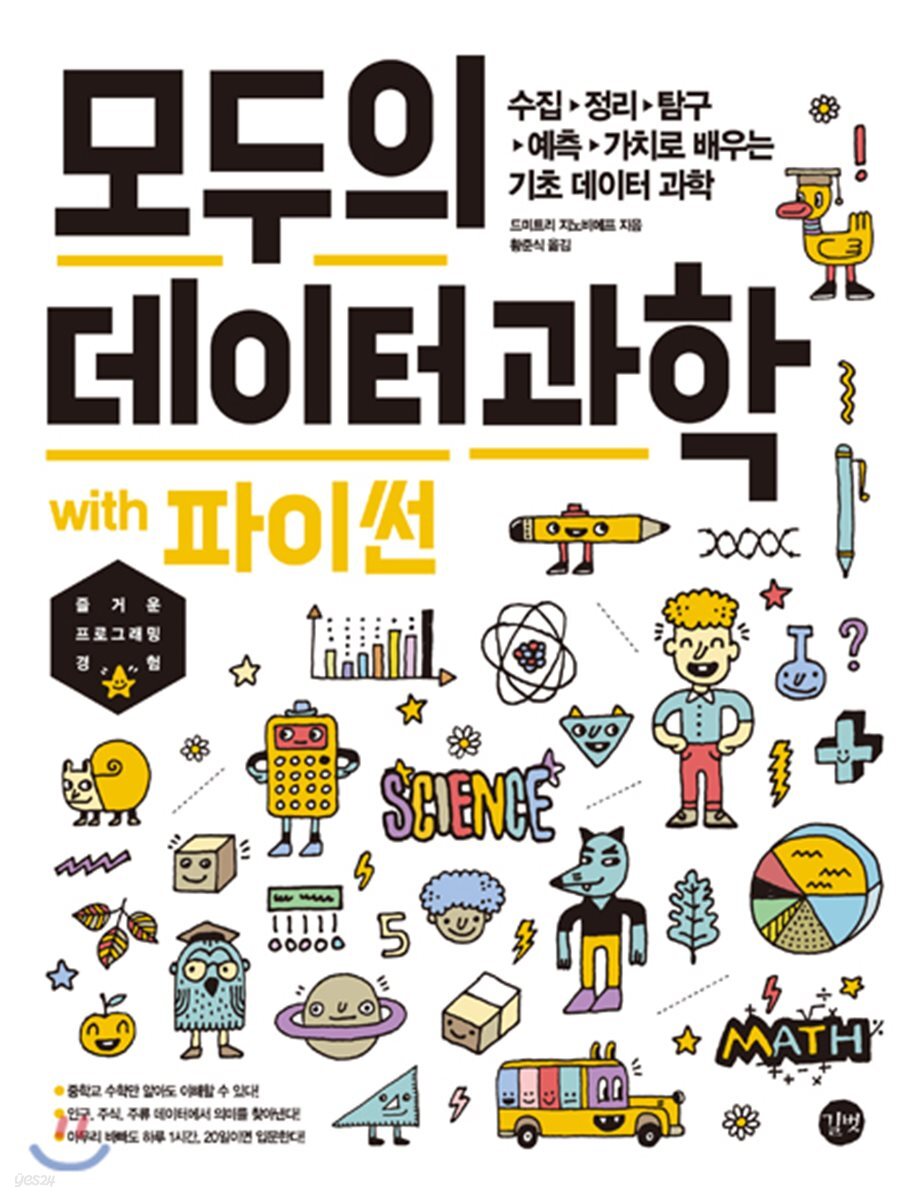
Book Introduction
In the age of big data, why data science?
It is important to analyze the data and find meaning!
"Everyone's Data Science with Python" explains things as simply as possible without using technical terms or complex mathematics, so that even beginners and non-majors can learn.
First, we will learn about the concepts of data science and then look at the core contents of Python, which is mainly used in data science.
You will also learn how to actually handle and utilize data by analyzing HTML, CSV, JSON files, numerical and tabular data, and creating graphs using Beautiful Soup, NLTK, NumPy, and Pandas.
If you're new to data science, don't hesitate and get started!
It is important to analyze the data and find meaning!
"Everyone's Data Science with Python" explains things as simply as possible without using technical terms or complex mathematics, so that even beginners and non-majors can learn.
First, we will learn about the concepts of data science and then look at the core contents of Python, which is mainly used in data science.
You will also learn how to actually handle and utilize data by analyzing HTML, CSV, JSON files, numerical and tabular data, and creating graphs using Beautiful Soup, NLTK, NumPy, and Pandas.
If you're new to data science, don't hesitate and get started!
- You can preview some of the book's contents.
Preview
index
[index]
Chapter 1: What is Data Science?
UNIT 01 Data Analysis Process
UNIT 02 Data Collection Pipeline
UNIT 03 Report Structure
Let's try
Chapter 2: Understanding the Core of Python in Data Science
UNIT 04 Understanding Basic String Functions
UNIT 05 Choosing the Right Data Structure
UNIT 06 Understanding Lists with List Comprehension
UNIT 07 Counting with a Counter
UNIT 08 File Handling
UNIT 09 Accessing the Web
UNIT 10 Pattern Matching with Regular Expressions
UNIT 11 Handling Files and Other Strings
UNIT 12: Compressing Data with Pickle
Let's try
Chapter 3: Handling Text Data
UNIT 13 Processing HTML Files
UNIT 14 Handling CSV Files
UNIT 15 Reading JSON Files
UNIT 16 Natural Language Processing
Let's try
Chapter 4: Working with Databases
UNIT 17 Setting up a MySQL database
UNIT 18 Using MySQL: The Command Line
UNIT 19 Using MySQL: pymysql
UNIT 20 Document Handling: MongoDB
Let's try
Chapter 5: Handling Tabular Numeric Data
UNIT 21 Creating Arrays
UNIT 22 Row-Matrix Transformation and Shape Transformation
UNIT 23 Indexing and Truncation
UNIT 24 Broadcasting
UNIT 25: Uncovering Universal Functions
UNIT 26 Understanding Conditional Functions
UNIT 27 Array Aggregation and Sorting
UNIT 28 Treating Arrays as Sets
UNIT 29 Storing and Reading Arrays
UNIT 30 Creating a Synthetic Sine Wave
Let's try
Chapter 6: Handling Data Series and Frames
UNIT 31 Getting Familiar with Pandas Data Structures
UNIT 32 Reshaping Data
UNIT 33 Handling Missing Data
UNIT 34 Merging Data
UNIT 35 Sorting Data
UNIT 36 Data Transformation
UNIT 37 Handling Pandas File Input/Output
Let's try
Chapter 7: Handling Network Data
UNIT 38 Decomposing Graphs
UNIT 39 Network Analysis Sequence
UNIT 40 Using NetworkX
Let's try
Plotting Chapter 8
UNIT 41 Drawing basic plots with pyplot
UNIT 42 Learning about different plot types
UNIT 43 Plot Design
UNIT 44 Plotting with Pandas
Let's try
Chapter 9 Probability and Statistics
UNIT 45 Probability Distributions Review
UNIT 46: Statistical Methodology Review
UNIT 47: Statistical Analysis with Python
Let's try
Chapter 10 Machine Learning
UNIT 48 Designing Predictive Experiments
UNIT 49 Fitting a Regression Line
UNIT 50: Clustering Data with K-Means Clustering
UNIT 51 Surviving the Random Forest
Let's try
Appendix A Read More
See the answers to the 1-star practice problems in Appendix B.
Appendix C: Setting Up Your Lab Environment
References
Chapter 1: What is Data Science?
UNIT 01 Data Analysis Process
UNIT 02 Data Collection Pipeline
UNIT 03 Report Structure
Let's try
Chapter 2: Understanding the Core of Python in Data Science
UNIT 04 Understanding Basic String Functions
UNIT 05 Choosing the Right Data Structure
UNIT 06 Understanding Lists with List Comprehension
UNIT 07 Counting with a Counter
UNIT 08 File Handling
UNIT 09 Accessing the Web
UNIT 10 Pattern Matching with Regular Expressions
UNIT 11 Handling Files and Other Strings
UNIT 12: Compressing Data with Pickle
Let's try
Chapter 3: Handling Text Data
UNIT 13 Processing HTML Files
UNIT 14 Handling CSV Files
UNIT 15 Reading JSON Files
UNIT 16 Natural Language Processing
Let's try
Chapter 4: Working with Databases
UNIT 17 Setting up a MySQL database
UNIT 18 Using MySQL: The Command Line
UNIT 19 Using MySQL: pymysql
UNIT 20 Document Handling: MongoDB
Let's try
Chapter 5: Handling Tabular Numeric Data
UNIT 21 Creating Arrays
UNIT 22 Row-Matrix Transformation and Shape Transformation
UNIT 23 Indexing and Truncation
UNIT 24 Broadcasting
UNIT 25: Uncovering Universal Functions
UNIT 26 Understanding Conditional Functions
UNIT 27 Array Aggregation and Sorting
UNIT 28 Treating Arrays as Sets
UNIT 29 Storing and Reading Arrays
UNIT 30 Creating a Synthetic Sine Wave
Let's try
Chapter 6: Handling Data Series and Frames
UNIT 31 Getting Familiar with Pandas Data Structures
UNIT 32 Reshaping Data
UNIT 33 Handling Missing Data
UNIT 34 Merging Data
UNIT 35 Sorting Data
UNIT 36 Data Transformation
UNIT 37 Handling Pandas File Input/Output
Let's try
Chapter 7: Handling Network Data
UNIT 38 Decomposing Graphs
UNIT 39 Network Analysis Sequence
UNIT 40 Using NetworkX
Let's try
Plotting Chapter 8
UNIT 41 Drawing basic plots with pyplot
UNIT 42 Learning about different plot types
UNIT 43 Plot Design
UNIT 44 Plotting with Pandas
Let's try
Chapter 9 Probability and Statistics
UNIT 45 Probability Distributions Review
UNIT 46: Statistical Methodology Review
UNIT 47: Statistical Analysis with Python
Let's try
Chapter 10 Machine Learning
UNIT 48 Designing Predictive Experiments
UNIT 49 Fitting a Regression Line
UNIT 50: Clustering Data with K-Means Clustering
UNIT 51 Surviving the Random Forest
Let's try
Appendix A Read More
See the answers to the 1-star practice problems in Appendix B.
Appendix C: Setting Up Your Lab Environment
References
Detailed image
Publisher's Review
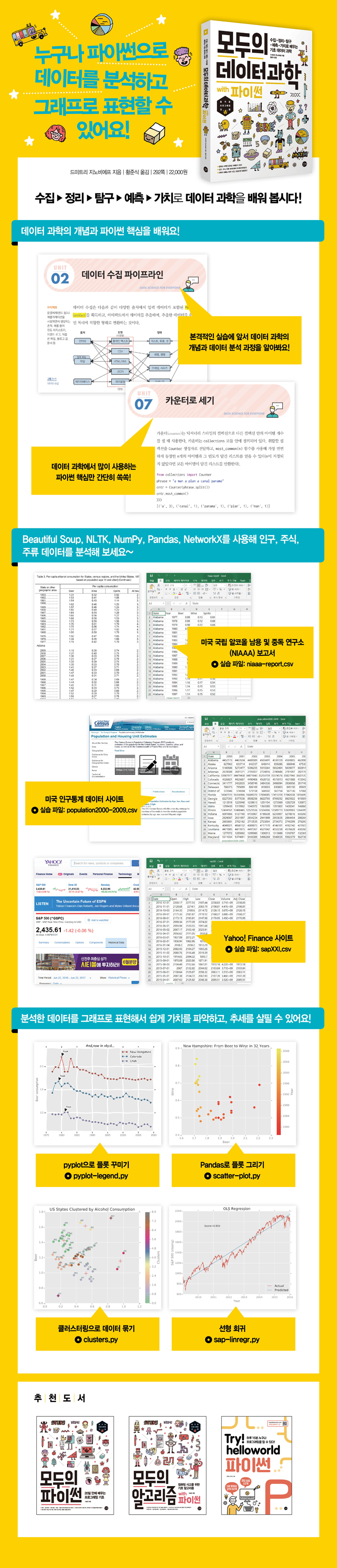
Anyone can analyze and visualize data with Python!
Units 1-12 | Learn Data Science Concepts and Python Core
Learn the concepts of what data science is and also learn the core Python concepts commonly used in data science, such as basic string functions, data structures, counters, lists, regular expressions, and pickle.
UNIT 13-40 | Handling Various Data
We cover how to handle text files such as HTML, CSV, and JSON using Beautiful Soup and NLTK, how to process numerical data using NumPy, how to handle tabular data using Pandas, and how to perform network analysis using NetworkX.
We also explain how to use external databases such as MySQL (relational database) and MongoDB (non-relational database).
Units 41-51 | Data Visualization, Probability and Statistics, and Machine Learning
This explains how to draw and decorate various plots using pyplot and Pandas.
We'll also briefly explore more off-the-beaten-path topics like predictive analytics, probability distributions, statistical analysis in Python, clustering data with K-means clustering, and random forests.
Units 1-12 | Learn Data Science Concepts and Python Core
Learn the concepts of what data science is and also learn the core Python concepts commonly used in data science, such as basic string functions, data structures, counters, lists, regular expressions, and pickle.
UNIT 13-40 | Handling Various Data
We cover how to handle text files such as HTML, CSV, and JSON using Beautiful Soup and NLTK, how to process numerical data using NumPy, how to handle tabular data using Pandas, and how to perform network analysis using NetworkX.
We also explain how to use external databases such as MySQL (relational database) and MongoDB (non-relational database).
Units 41-51 | Data Visualization, Probability and Statistics, and Machine Learning
This explains how to draw and decorate various plots using pyplot and Pandas.
We'll also briefly explore more off-the-beaten-path topics like predictive analytics, probability distributions, statistical analysis in Python, clustering data with K-means clustering, and random forests.
GOODS SPECIFICS
- Date of issue: July 14, 2017
- Page count, weight, size: 292 pages | 678g | 183*235*20mm
- ISBN13: 9791160502152
- ISBN10: 1160502153
You may also like
카테고리
korean


korean

![GQ KOREA Mark (Monthly): December [2025]](http://librairie.coreenne.fr/cdn/shop/files/8ef265dbbfbf186523ed75ba7319009d.jpg?v=1765340328&width=3840)


