

Artificial Intelligence and the Transformation of International Politics
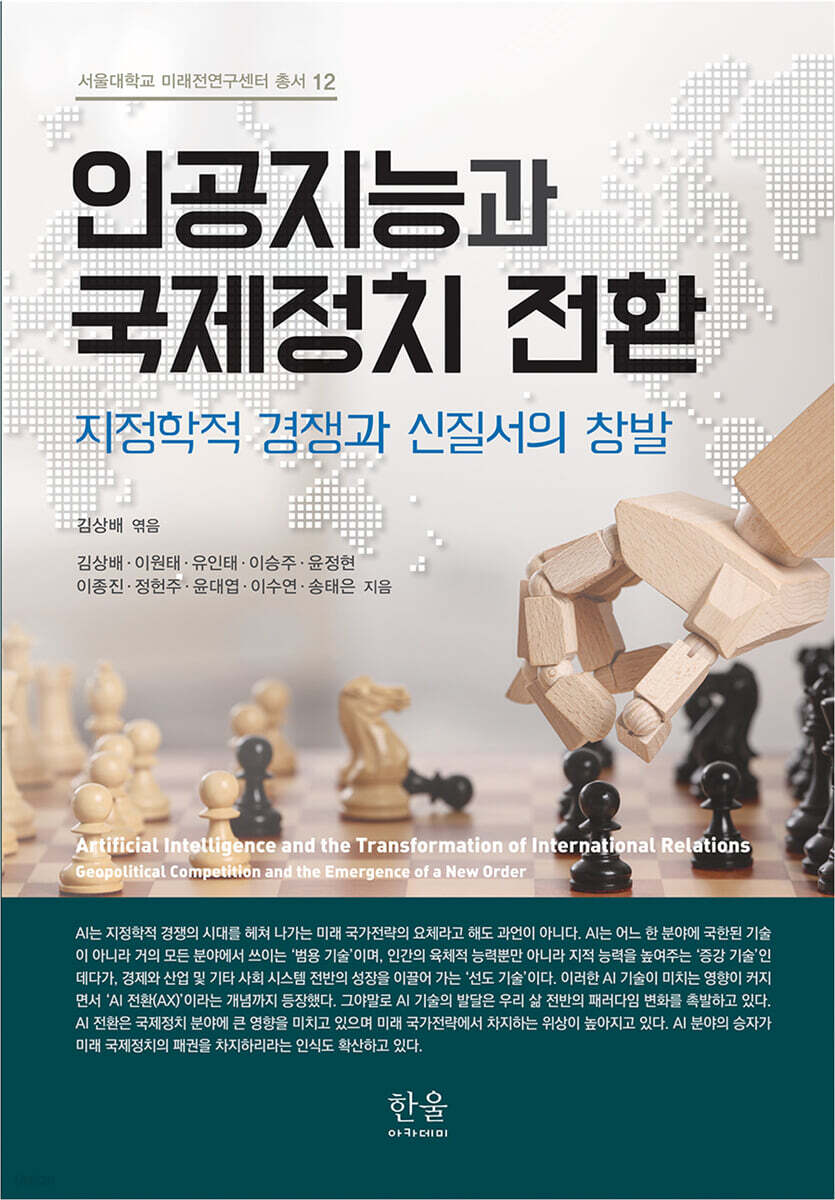 |
Description
Book Introduction
Discussing AI from the Perspective of International Politics
AI technology poses both opportunities and threats.
To establish a strategy that takes into account the versatility and duality of AI
Today, artificial intelligence (AI) creates new economic and industrial value, but it also intersects with technological sovereignty and economic security issues related to the data, algorithms, and manufacturing infrastructure that form its foundation.
Considering its potential for military use, such as inciting public opinion through disinformation or as a dual-use technology, AI can also be a means of national security threat with inherent political objectives.
Thus, technological advancements in AI can both enhance security and pose a threat, and the global spread of AI technology could increase interdependence between nations while also giving rise to new forms of conflict.
Considering these characteristics, a comprehensive analysis of the opportunities and threats presented by AI and preparation for them in military, security, technological, legal, and institutional settings are essential.
This book analyzes the competition for AI technology hegemony between the United States and China, providing an overview of the current state of global AI competition. It then examines the transformation of AI and international politics, dividing it into three sections.
In 'Artificial Intelligence and International Political Economy,' we analyzed controversial topics related to artificial intelligence from the perspective of international political economy, focusing on technological competition, export controls, and platform competition.
In "Artificial Intelligence and Emerging Security," we examine the issues surrounding AI international politics from the perspective of a new security theory, focusing on emerging technology security in general, cybersecurity, and space security.
In 'Artificial Intelligence and War, Governance, and International Norms,' we analyzed issues in AI-related international politics, including military innovation, future warfare, global regulatory governance, and international norms and multilateral diplomacy, from a diplomatic and security perspective.
AI technology poses both opportunities and threats.
To establish a strategy that takes into account the versatility and duality of AI
Today, artificial intelligence (AI) creates new economic and industrial value, but it also intersects with technological sovereignty and economic security issues related to the data, algorithms, and manufacturing infrastructure that form its foundation.
Considering its potential for military use, such as inciting public opinion through disinformation or as a dual-use technology, AI can also be a means of national security threat with inherent political objectives.
Thus, technological advancements in AI can both enhance security and pose a threat, and the global spread of AI technology could increase interdependence between nations while also giving rise to new forms of conflict.
Considering these characteristics, a comprehensive analysis of the opportunities and threats presented by AI and preparation for them in military, security, technological, legal, and institutional settings are essential.
This book analyzes the competition for AI technology hegemony between the United States and China, providing an overview of the current state of global AI competition. It then examines the transformation of AI and international politics, dividing it into three sections.
In 'Artificial Intelligence and International Political Economy,' we analyzed controversial topics related to artificial intelligence from the perspective of international political economy, focusing on technological competition, export controls, and platform competition.
In "Artificial Intelligence and Emerging Security," we examine the issues surrounding AI international politics from the perspective of a new security theory, focusing on emerging technology security in general, cybersecurity, and space security.
In 'Artificial Intelligence and War, Governance, and International Norms,' we analyzed issues in AI-related international politics, including military innovation, future warfare, global regulatory governance, and international norms and multilateral diplomacy, from a diplomatic and security perspective.
index
Introduction: Artificial Intelligence and the Transformation of International Politics
Chapter 1: Artificial Intelligence Geopolitics and Korea: Focusing on the US-China AI Hegemony Competition_Kim Sang-bae
1.
preface
2.
US-China AI Technology and Platform Competition
3.
US-China AI Regulation and Discourse Competition
4.
US-China AI Diplomacy and Arms Race
4.
Challenges of AI National Strategies for Middle Power Countries
5.
Conclusion
Part 1: Artificial Intelligence and International Political Economy
Chapter 2: Current Status and Prospects of Artificial Intelligence (AI) Technology_Wontae Lee
1.
preface
2.
Historical development and recent trends in artificial intelligence technology
3.
Key features of artificial intelligence technology development
4.
Future Prospects and International Political Implications of Artificial Intelligence Technology
Chapter 3: Artificial Intelligence and AI Semiconductor Competition_Yoo In-tae
1.
introduction
2.
US AI semiconductor export control policy
3.
Corporate Response to US AI Semiconductor Export Controls
4. AI Semiconductor Export Controls and International Cooperation
5.
Conclusion: China's AI semiconductor technology development and ecosystem expansion
Chapter 4: US-China AI Competition and the Platform Economy_Lee Seung-ju
1.
Evolutionary stages of digital technology innovation and platform competition
2. The Emergence of an AI-Based Platform Industry Ecosystem
3.
Changing the Platform Competition Framework
4. Blockchainization of the AI ecosystem
5. A New Phase of AI Platform Competition
Part 2: Artificial Intelligence and Emerging Security
Chapter 5: Artificial Intelligence and Emerging Technology Security_Jeong-Hyeon Yoon
1.
Entering
2.
The universal impact of artificial intelligence and its recognition in major countries
3.
The Emerging Security of AI: Aspects of Quality Telephony
4.
The Emerging Security of Artificial Intelligence: Aspects of Issue Linkage
5.
The Emerging Security of Artificial Intelligence: The Emergence Aspect
6.
Conclusion: Future Implications of AI and Emerging Technology Security
Chapter 6: Artificial Intelligence and Cybersecurity: Tools, Objects, and Agency_Jongjin Lee
1.
Entering
2.
AI in Cyber Security
3.
Cyber Security in AI
4.
In conclusion: The limited agency of artificial intelligence
Chapter 7: Artificial Intelligence and Space Security_Jeong Heon-ju
1.
introduction
2.
Artificial Intelligence and Space Activities
3.
The Dynamics of Artificial Intelligence and Space Security
4.
Artificial Intelligence and Space Security: Diverse Threats and Responses
5.
conclusion
Part 3: Artificial Intelligence and War, Governance, and International Norms
Chapter 8: Artificial Intelligence and Future Warfare: The Transition of Defense AI and the Challenges of Digital Military Innovation_Yoon Dae-yeop
1.
Issue: AI Wars
2.
Automation, Unmanned Systems, and the Transformation of Defense AI: A Perspective
3.
The Origins of Defense AI Transformation: Project Maven
4.
The Digital Foundation of Defense AI: Lessons from the Louwu War
5.
Conclusion and AI Military Innovation Challenges
Chapter 9: The International Politics of Global Regulatory Governance of AI: A Multilayered Landscape of Competition and Cooperation_Lee Soo-yeon
1.
Entering
2.
The Global Competitive Landscape of AI Regulatory Governance
3.
Collaborative Structure of AI Regulatory Governance
4.
Competition and Cooperation on Issues in AI Regulatory Governance
5.
Conclusion: Building a Global Regulatory Governance for AI and Korea
Chapter 10: International Norms and Multilateral Diplomacy on AI Risks_Song Tae-eun
1.
Raising an issue
2. AI technological innovation and AI security
3. AI Risk Management and AI Safety
4. Tensions Between AI Norms, Multilateral Diplomacy, and National Security
5.
Conclusion: AI Multilateral Diplomacy with Civilian Participation
Chapter 1: Artificial Intelligence Geopolitics and Korea: Focusing on the US-China AI Hegemony Competition_Kim Sang-bae
1.
preface
2.
US-China AI Technology and Platform Competition
3.
US-China AI Regulation and Discourse Competition
4.
US-China AI Diplomacy and Arms Race
4.
Challenges of AI National Strategies for Middle Power Countries
5.
Conclusion
Part 1: Artificial Intelligence and International Political Economy
Chapter 2: Current Status and Prospects of Artificial Intelligence (AI) Technology_Wontae Lee
1.
preface
2.
Historical development and recent trends in artificial intelligence technology
3.
Key features of artificial intelligence technology development
4.
Future Prospects and International Political Implications of Artificial Intelligence Technology
Chapter 3: Artificial Intelligence and AI Semiconductor Competition_Yoo In-tae
1.
introduction
2.
US AI semiconductor export control policy
3.
Corporate Response to US AI Semiconductor Export Controls
4. AI Semiconductor Export Controls and International Cooperation
5.
Conclusion: China's AI semiconductor technology development and ecosystem expansion
Chapter 4: US-China AI Competition and the Platform Economy_Lee Seung-ju
1.
Evolutionary stages of digital technology innovation and platform competition
2. The Emergence of an AI-Based Platform Industry Ecosystem
3.
Changing the Platform Competition Framework
4. Blockchainization of the AI ecosystem
5. A New Phase of AI Platform Competition
Part 2: Artificial Intelligence and Emerging Security
Chapter 5: Artificial Intelligence and Emerging Technology Security_Jeong-Hyeon Yoon
1.
Entering
2.
The universal impact of artificial intelligence and its recognition in major countries
3.
The Emerging Security of AI: Aspects of Quality Telephony
4.
The Emerging Security of Artificial Intelligence: Aspects of Issue Linkage
5.
The Emerging Security of Artificial Intelligence: The Emergence Aspect
6.
Conclusion: Future Implications of AI and Emerging Technology Security
Chapter 6: Artificial Intelligence and Cybersecurity: Tools, Objects, and Agency_Jongjin Lee
1.
Entering
2.
AI in Cyber Security
3.
Cyber Security in AI
4.
In conclusion: The limited agency of artificial intelligence
Chapter 7: Artificial Intelligence and Space Security_Jeong Heon-ju
1.
introduction
2.
Artificial Intelligence and Space Activities
3.
The Dynamics of Artificial Intelligence and Space Security
4.
Artificial Intelligence and Space Security: Diverse Threats and Responses
5.
conclusion
Part 3: Artificial Intelligence and War, Governance, and International Norms
Chapter 8: Artificial Intelligence and Future Warfare: The Transition of Defense AI and the Challenges of Digital Military Innovation_Yoon Dae-yeop
1.
Issue: AI Wars
2.
Automation, Unmanned Systems, and the Transformation of Defense AI: A Perspective
3.
The Origins of Defense AI Transformation: Project Maven
4.
The Digital Foundation of Defense AI: Lessons from the Louwu War
5.
Conclusion and AI Military Innovation Challenges
Chapter 9: The International Politics of Global Regulatory Governance of AI: A Multilayered Landscape of Competition and Cooperation_Lee Soo-yeon
1.
Entering
2.
The Global Competitive Landscape of AI Regulatory Governance
3.
Collaborative Structure of AI Regulatory Governance
4.
Competition and Cooperation on Issues in AI Regulatory Governance
5.
Conclusion: Building a Global Regulatory Governance for AI and Korea
Chapter 10: International Norms and Multilateral Diplomacy on AI Risks_Song Tae-eun
1.
Raising an issue
2. AI technological innovation and AI security
3. AI Risk Management and AI Safety
4. Tensions Between AI Norms, Multilateral Diplomacy, and National Security
5.
Conclusion: AI Multilateral Diplomacy with Civilian Participation
Into the book
It's no exaggeration to say that AI is a key national strategy for navigating an era of geopolitical competition. AI is not limited to a single field, but rather a "general-purpose technology" applicable across virtually all sectors. It's an "augmentation technology" that enhances not only human physical abilities but also intellectual capabilities, and it's also a "leading technology" that drives growth across the economy, industry, and other social systems.
As the impact of these AI technologies grows, the concept of 'AI Transformation (AX)' has emerged.
Indeed, the advancement of AI technology is triggering a paradigm shift across our lives. The AI transition is having a profound impact on international politics and is gaining increasing prominence in future national strategies. There is also a growing perception that the winners in AI will seize the future hegemony of international politics.
--- From "Chapter 1: Artificial Intelligence Geopolitics and Korea"
The primary target of the Biden administration's export control policy has been China, particularly with the aim of controlling advanced AI chips (for military use).
And AI semiconductor export controls were a key policy tool for protecting national security interests and achieving core benefits such as victory in the US-China strategic competition.
The development of these policies can be seen to have been achieved through technological advancements and the gradual learning and information updates of policymakers.
The policy's development direction has been characterized by increasingly detailed product design and broad application, which demonstrates that the United States views advanced AI semiconductors as a core national interest and that strategic competition with China is intensifying.
--- From Chapter 3, Artificial Intelligence and AI Semiconductor Competition
The combination of AI and space security is expected to bring about significant changes to traditional missile defense systems.
US President Trump, who began his second term on January 20, 2025, signed an executive order, "The Iron Dome for America," on January 27, one week after taking office, to establish a next-generation missile defense system.
In this executive order, President Trump emphasized that while existing missile defense systems have focused on responding to threats from rogue states and accidental or unauthorized missile launches, the new system needs to defend against ballistic missiles, hypersonic missiles, advanced cruise missiles, and next-generation air attacks by adversaries with capabilities equal to or approaching the United States, and directed the development and deployment of a variety of space-based sensors and a large number of distributed interceptors.
--- From Chapter 7, Artificial Intelligence and Space Security
While Korea possesses its own AI technology capabilities, it lacks the scale of the US or China, making it difficult for it to move toward independent and proactive governance from the outset.
It seems appropriate to use an established platform to gradually increase one's voice based on one's own capabilities.
In the ongoing international politics of establishing global regulatory governance for artificial intelligence, one approach Korea can take is to play an active role as a partner country in the Hiroshima AI Process.
As the impact of these AI technologies grows, the concept of 'AI Transformation (AX)' has emerged.
Indeed, the advancement of AI technology is triggering a paradigm shift across our lives. The AI transition is having a profound impact on international politics and is gaining increasing prominence in future national strategies. There is also a growing perception that the winners in AI will seize the future hegemony of international politics.
--- From "Chapter 1: Artificial Intelligence Geopolitics and Korea"
The primary target of the Biden administration's export control policy has been China, particularly with the aim of controlling advanced AI chips (for military use).
And AI semiconductor export controls were a key policy tool for protecting national security interests and achieving core benefits such as victory in the US-China strategic competition.
The development of these policies can be seen to have been achieved through technological advancements and the gradual learning and information updates of policymakers.
The policy's development direction has been characterized by increasingly detailed product design and broad application, which demonstrates that the United States views advanced AI semiconductors as a core national interest and that strategic competition with China is intensifying.
--- From Chapter 3, Artificial Intelligence and AI Semiconductor Competition
The combination of AI and space security is expected to bring about significant changes to traditional missile defense systems.
US President Trump, who began his second term on January 20, 2025, signed an executive order, "The Iron Dome for America," on January 27, one week after taking office, to establish a next-generation missile defense system.
In this executive order, President Trump emphasized that while existing missile defense systems have focused on responding to threats from rogue states and accidental or unauthorized missile launches, the new system needs to defend against ballistic missiles, hypersonic missiles, advanced cruise missiles, and next-generation air attacks by adversaries with capabilities equal to or approaching the United States, and directed the development and deployment of a variety of space-based sensors and a large number of distributed interceptors.
--- From Chapter 7, Artificial Intelligence and Space Security
While Korea possesses its own AI technology capabilities, it lacks the scale of the US or China, making it difficult for it to move toward independent and proactive governance from the outset.
It seems appropriate to use an established platform to gradually increase one's voice based on one's own capabilities.
In the ongoing international politics of establishing global regulatory governance for artificial intelligence, one approach Korea can take is to play an active role as a partner country in the Hiroshima AI Process.
--- From Chapter 9, “International Politics of Global Regulatory Governance of Artificial Intelligence”
Publisher's Review
In what direction is artificial intelligence technology developing?
A notable characteristic of the advancement of AI technology presented in this book is the remarkable activation of the open-source AI ecosystem.
In particular, the development of open source AI accelerated with the announcement of Meta's LLaMA 1 model in February 2023.
As Meta's open-source AI model gained attention, other competing companies quickly announced open-source AI models as well.
The destructive power of open-source AI reached its peak with China's 'DeepSeek shock' in early 2025.
DeepSeak is being received with shock because it was developed despite the strengthening of US export controls and because it showed the possibility of commercialization by drastically reducing development costs.
This has raised fundamental questions about whether the United States will continue its AI strategy based on a high-cost and closed approach.
Another key characteristic is that AI technology advancements are shifting beyond simply developing large models (large-scale language models) to strengthening the ability to think and reason independently. Accuracy is crucial in AI applications, and the trend is toward providing accurate answers, albeit somewhat calmer and slower, rather than quick, seemingly plausible answers.
With the emergence of "inferential AI," which enhances the ability to solve problems through logical thought processes rather than simple text generation, AI technology is evolving in a comprehensive and increasingly autonomous direction, going beyond simple language processing to process diverse inputs and perform symbolic reasoning.
In this way, AI technology is becoming more advanced, even reaching the level of inference-type AI, due to fierce competition among companies for performance innovation. At the same time, the types of AI models and services are diversifying and becoming more diverse in response to demands for miniaturization and lightweighting.
In the future, almost all software may be integrated with AI in some form, and AI may even advance to the point where it surpasses the status of the operating system.
The United States actively seeks to support its own technological innovation through deregulation.
China's "DeepSec Shock" Shows the Beginning of a Technological Pursuit
A Map of the Global Hegemony Competition Through the Eyes of Two Superpowers
The most representative example of the "AI-based shift in international politics" that will determine the future direction of the international order is the US-China competition for AI hegemony.
The US-China AI hegemony competition is a multifaceted competition, not only to lead in technology, but also to lead in standards, platforms, and ecosystems, to shape policy-level regulations, security discourse, and international norms, and to ultimately win AI-based diplomacy and war.
This book explores the US-China AI hegemony competition in numerous chapters, including Chapters 1 and 4, with the aim of mapping out the future global hegemony competition by analyzing two influential powers on the global landscape.
The US export controls and the 'Deepseak Shock' from China are clear examples of the dynamics of the recent US-China competition.
From the first Trump administration to the Biden administration and finally to the second Trump administration, the United States has consistently strengthened its containment of China, judging that AI will not only be key to securing future industrial competitiveness but also have significant military implications.
This was based on the expectation that export controls would be effective in maintaining and widening the technological gap by delaying China's pursuit of AI.
However, the US's dilemma is that DeepSec showed the beginning of China's pursuit of AI despite continued strengthening of checks and balances.
There is also criticism that export controls have not only reduced global demand for US semiconductors but have also harmed private and national interests by forcing countries to seek alternative AI ecosystems rather than the US one.
The implications of export control measures for the development of China's AI ecosystem should also be noted.
For example, control of the H20 chip has promoted the growth of China's indigenous ecosystem.
Ironically, US export controls have encouraged Chinese tech giants like ByteDance and Tencent to use Huawei AI chips.
The book's common vision for America's future AI strategy is "deregulation."
What we should keep in mind here is that, as the balance of AI development tilts toward technological innovation based on deregulation policies, the likelihood of AI technologies emerging that threaten social safety and the fundamental rights of citizens increases.
The book points out that as Trump's America First AI policy is pushed toward enhancing the efficiency of AI technology, the international cooperation that Western countries have been pursuing to establish AI norms could weaken.
AI can be a companion or a lethal agent.
The burgeoning threat of artificial intelligence in cybersecurity and space security
Cyber threats using AI technology as a tool are continuously increasing.
The means and forms of cyberattacks are becoming more sophisticated, and the targets of cyberattacks are becoming more diverse. New threats have emerged, such as deploying AI models to exploit vulnerabilities in cyberattack targets. Furthermore, AI prompts have revealed that AI systems themselves can be targets of cyberattacks, revealing the potential for leaks of national secrets, critical corporate data, and personal information.
This situation suggests that the importance of cybersecurity is increasing along with the advancement of AI technology.
This book predicts that future advancements in AI technology in the cyberattack domain will further increase autonomy and agency.
In other words, it will be possible to acquire advanced capabilities such as independently deriving optimal attack paths in complex network environments or conducting long-term attack campaigns without human intervention.
Furthermore, collaboration with AI systems with other egos will increase the possibility of carrying out more sophisticated attacks.
In space security, AI technology is being used to identify, classify, track, and monitor satellites, space debris, and terrestrial, maritime, and aerial objects. High-quality Earth observation data and space-based communication and navigation services are contributing to the advancement of AI technology.
However, there is a risk that AI technology could threaten space security, and that the absence of space security could negatively impact AI technology.
The book highlights the potential for AI technology onboard satellites to pose a threat, the potential for space security to be compromised by actors exploiting vulnerabilities in AI algorithms and learning processes, and the potential for significant harm, particularly in military decision-making.
Accordingly, this book proposes countermeasures, including establishing AI technology standards and strengthening regulations through partnerships between various actors, including private sector actors, and establishing international cooperation and governance to minimize the risks inherent in AI technology. The pace of AI technology development can surpass not only human cognitive abilities but even imagination.
If that happens, we must remember that AI could either be a beneficial and versatile companion to humanity, which relies on cyberspace and space, or it could become a lethal agent that poses a terrifying threat to humanity.
How to become a 'tool of Prometheus' rather than 'Oppenheimer's tragedy'?
A powerful military, artificial intelligence to deter war
AI is transforming traditional deterrence systems as it combines with hypersonic weapons, autonomous drones, electronic warfare, and cyberwarfare.
Furthermore, it has been argued that demonstrating the ability to retaliate with ultra-precise non-nuclear weapons, such as AI-based hypersonic missiles, in the event that an adversary detects a threat to use nuclear weapons would provide an additional option to the nuclear-only deterrence system, further reducing the possibility of nuclear confrontation.
On the other hand, if AI's autonomous decision-making capabilities develop to the point where it can make strategic and tactical decisions in a battlefield environment, security dilemmas beyond human control could arise. If AI evolves to mimic human thought processes and even merge with them, the philosophical and ethical question of "what it means to be human" will inevitably be reframed.
Moving beyond existing human-centered thinking, a new ontological paradigm will be required, one where humans and machines coexist. As AI is increasingly likely to transform the labor market, education system, social relations, and even the very concept of human existence, this book emphasizes the need to foster social discussion and establish ethical and legal frameworks early on to strengthen the policy foundation for the coexistence of AI and humans.
'Weaponization of AI' is a mixture of 'Oppenheimer's tragedy' and 'Prometheus myth'.
Many people agree that artificial intelligence could pose a threat to humanity, like pandemics or nuclear war.
AI technology, with its high commercial viability, generalizability, and therefore low barriers to military application, is impossible to regulate, unlike nuclear weapons. An entirely new arms race leveraging AI has already begun, and technological innovation, not moral appeals, will be the primary driver of securing an edge over hostile threats to liberal democracies.
In future warfare, AI technology must become a "Promethean tool" for a powerful military and deterrence of war, not Oppenheimer's tragedy.
The path forward for countries with differing positions toward forming international governance and norms
Dominating global AI governance will help solidify dominance and dominance over AI technology.
Currently, AI regulatory governance is being shaped by a competitive landscape between the United States, the established hegemon, China, a country challenging it, and the European Union, which seeks to pursue its own independent path without siding with either.
The United States pursues regulatory governance through technological prowess, China proposes regulatory governance through authoritarian control and countervailing power, and the European Union proposes regulatory governance through normative power.
It can be said that all of this strongly reflects the purpose of suppressing and restraining the opponent.
Due to the different security environments and levels of AI technology development faced by each country around the world, each country's perspectives and stances on AI technology differ.
What's important is that international norms can manage situations where the AI technology race is heading in an uncontrollable direction, regardless of each country's intentions.
Therefore, in order to implement open governance that reflects the diverse perspectives of various countries, a cooperative relationship must be established in which friendly major powers can support developing countries in building their AI capabilities.
Because the knowledge gap about AI between countries must be narrowed to enable practical participation in norm-building discussions.
Presenting the direction of Korea's AI strategy
As a middle power, Korea faces the challenges of a national AI strategy.
First, in terms of the "scale" of national capabilities, Korea, a mid-sized country, must consider whether to prioritize a "leading strategy" or a "niche strategy" in pursuing its AI technology innovation strategy.
Second, as a middle power positioned between the US and China, South Korea stands at a crossroads, choosing between the "closed" and "open" AI ecosystems and platforms led by the two countries.
Third, in terms of its "role" in the international community, Korea, as a middle power, is tasked with not only deliberating on the principles of AI security discourse but also participating in the formation of AI ethics standards at the global level.
Accordingly, this book points out that the problem is that the direction of the domestic policy and institutional environment is leaning toward 'regulation' rather than 'promotion' of the AI field, and emphasizes the establishment of a new concept of national AI strategy that reflects Korea's unique experience and achievements in the AI field, rather than simply increasing the scale of investment to develop technological and human resources capabilities.
This is why the need for a national strategy to efficiently utilize Korea's limited resources is often discussed.
Ultimately, in the process of US-China competition, rather than a simple dichotomy of AI policies and discourses established by both the US and China, it is necessary to establish a "Korean strategy" that flexibly adopts AI policies and discourses raised across a wide spectrum according to the situation.
A notable characteristic of the advancement of AI technology presented in this book is the remarkable activation of the open-source AI ecosystem.
In particular, the development of open source AI accelerated with the announcement of Meta's LLaMA 1 model in February 2023.
As Meta's open-source AI model gained attention, other competing companies quickly announced open-source AI models as well.
The destructive power of open-source AI reached its peak with China's 'DeepSeek shock' in early 2025.
DeepSeak is being received with shock because it was developed despite the strengthening of US export controls and because it showed the possibility of commercialization by drastically reducing development costs.
This has raised fundamental questions about whether the United States will continue its AI strategy based on a high-cost and closed approach.
Another key characteristic is that AI technology advancements are shifting beyond simply developing large models (large-scale language models) to strengthening the ability to think and reason independently. Accuracy is crucial in AI applications, and the trend is toward providing accurate answers, albeit somewhat calmer and slower, rather than quick, seemingly plausible answers.
With the emergence of "inferential AI," which enhances the ability to solve problems through logical thought processes rather than simple text generation, AI technology is evolving in a comprehensive and increasingly autonomous direction, going beyond simple language processing to process diverse inputs and perform symbolic reasoning.
In this way, AI technology is becoming more advanced, even reaching the level of inference-type AI, due to fierce competition among companies for performance innovation. At the same time, the types of AI models and services are diversifying and becoming more diverse in response to demands for miniaturization and lightweighting.
In the future, almost all software may be integrated with AI in some form, and AI may even advance to the point where it surpasses the status of the operating system.
The United States actively seeks to support its own technological innovation through deregulation.
China's "DeepSec Shock" Shows the Beginning of a Technological Pursuit
A Map of the Global Hegemony Competition Through the Eyes of Two Superpowers
The most representative example of the "AI-based shift in international politics" that will determine the future direction of the international order is the US-China competition for AI hegemony.
The US-China AI hegemony competition is a multifaceted competition, not only to lead in technology, but also to lead in standards, platforms, and ecosystems, to shape policy-level regulations, security discourse, and international norms, and to ultimately win AI-based diplomacy and war.
This book explores the US-China AI hegemony competition in numerous chapters, including Chapters 1 and 4, with the aim of mapping out the future global hegemony competition by analyzing two influential powers on the global landscape.
The US export controls and the 'Deepseak Shock' from China are clear examples of the dynamics of the recent US-China competition.
From the first Trump administration to the Biden administration and finally to the second Trump administration, the United States has consistently strengthened its containment of China, judging that AI will not only be key to securing future industrial competitiveness but also have significant military implications.
This was based on the expectation that export controls would be effective in maintaining and widening the technological gap by delaying China's pursuit of AI.
However, the US's dilemma is that DeepSec showed the beginning of China's pursuit of AI despite continued strengthening of checks and balances.
There is also criticism that export controls have not only reduced global demand for US semiconductors but have also harmed private and national interests by forcing countries to seek alternative AI ecosystems rather than the US one.
The implications of export control measures for the development of China's AI ecosystem should also be noted.
For example, control of the H20 chip has promoted the growth of China's indigenous ecosystem.
Ironically, US export controls have encouraged Chinese tech giants like ByteDance and Tencent to use Huawei AI chips.
The book's common vision for America's future AI strategy is "deregulation."
What we should keep in mind here is that, as the balance of AI development tilts toward technological innovation based on deregulation policies, the likelihood of AI technologies emerging that threaten social safety and the fundamental rights of citizens increases.
The book points out that as Trump's America First AI policy is pushed toward enhancing the efficiency of AI technology, the international cooperation that Western countries have been pursuing to establish AI norms could weaken.
AI can be a companion or a lethal agent.
The burgeoning threat of artificial intelligence in cybersecurity and space security
Cyber threats using AI technology as a tool are continuously increasing.
The means and forms of cyberattacks are becoming more sophisticated, and the targets of cyberattacks are becoming more diverse. New threats have emerged, such as deploying AI models to exploit vulnerabilities in cyberattack targets. Furthermore, AI prompts have revealed that AI systems themselves can be targets of cyberattacks, revealing the potential for leaks of national secrets, critical corporate data, and personal information.
This situation suggests that the importance of cybersecurity is increasing along with the advancement of AI technology.
This book predicts that future advancements in AI technology in the cyberattack domain will further increase autonomy and agency.
In other words, it will be possible to acquire advanced capabilities such as independently deriving optimal attack paths in complex network environments or conducting long-term attack campaigns without human intervention.
Furthermore, collaboration with AI systems with other egos will increase the possibility of carrying out more sophisticated attacks.
In space security, AI technology is being used to identify, classify, track, and monitor satellites, space debris, and terrestrial, maritime, and aerial objects. High-quality Earth observation data and space-based communication and navigation services are contributing to the advancement of AI technology.
However, there is a risk that AI technology could threaten space security, and that the absence of space security could negatively impact AI technology.
The book highlights the potential for AI technology onboard satellites to pose a threat, the potential for space security to be compromised by actors exploiting vulnerabilities in AI algorithms and learning processes, and the potential for significant harm, particularly in military decision-making.
Accordingly, this book proposes countermeasures, including establishing AI technology standards and strengthening regulations through partnerships between various actors, including private sector actors, and establishing international cooperation and governance to minimize the risks inherent in AI technology. The pace of AI technology development can surpass not only human cognitive abilities but even imagination.
If that happens, we must remember that AI could either be a beneficial and versatile companion to humanity, which relies on cyberspace and space, or it could become a lethal agent that poses a terrifying threat to humanity.
How to become a 'tool of Prometheus' rather than 'Oppenheimer's tragedy'?
A powerful military, artificial intelligence to deter war
AI is transforming traditional deterrence systems as it combines with hypersonic weapons, autonomous drones, electronic warfare, and cyberwarfare.
Furthermore, it has been argued that demonstrating the ability to retaliate with ultra-precise non-nuclear weapons, such as AI-based hypersonic missiles, in the event that an adversary detects a threat to use nuclear weapons would provide an additional option to the nuclear-only deterrence system, further reducing the possibility of nuclear confrontation.
On the other hand, if AI's autonomous decision-making capabilities develop to the point where it can make strategic and tactical decisions in a battlefield environment, security dilemmas beyond human control could arise. If AI evolves to mimic human thought processes and even merge with them, the philosophical and ethical question of "what it means to be human" will inevitably be reframed.
Moving beyond existing human-centered thinking, a new ontological paradigm will be required, one where humans and machines coexist. As AI is increasingly likely to transform the labor market, education system, social relations, and even the very concept of human existence, this book emphasizes the need to foster social discussion and establish ethical and legal frameworks early on to strengthen the policy foundation for the coexistence of AI and humans.
'Weaponization of AI' is a mixture of 'Oppenheimer's tragedy' and 'Prometheus myth'.
Many people agree that artificial intelligence could pose a threat to humanity, like pandemics or nuclear war.
AI technology, with its high commercial viability, generalizability, and therefore low barriers to military application, is impossible to regulate, unlike nuclear weapons. An entirely new arms race leveraging AI has already begun, and technological innovation, not moral appeals, will be the primary driver of securing an edge over hostile threats to liberal democracies.
In future warfare, AI technology must become a "Promethean tool" for a powerful military and deterrence of war, not Oppenheimer's tragedy.
The path forward for countries with differing positions toward forming international governance and norms
Dominating global AI governance will help solidify dominance and dominance over AI technology.
Currently, AI regulatory governance is being shaped by a competitive landscape between the United States, the established hegemon, China, a country challenging it, and the European Union, which seeks to pursue its own independent path without siding with either.
The United States pursues regulatory governance through technological prowess, China proposes regulatory governance through authoritarian control and countervailing power, and the European Union proposes regulatory governance through normative power.
It can be said that all of this strongly reflects the purpose of suppressing and restraining the opponent.
Due to the different security environments and levels of AI technology development faced by each country around the world, each country's perspectives and stances on AI technology differ.
What's important is that international norms can manage situations where the AI technology race is heading in an uncontrollable direction, regardless of each country's intentions.
Therefore, in order to implement open governance that reflects the diverse perspectives of various countries, a cooperative relationship must be established in which friendly major powers can support developing countries in building their AI capabilities.
Because the knowledge gap about AI between countries must be narrowed to enable practical participation in norm-building discussions.
Presenting the direction of Korea's AI strategy
As a middle power, Korea faces the challenges of a national AI strategy.
First, in terms of the "scale" of national capabilities, Korea, a mid-sized country, must consider whether to prioritize a "leading strategy" or a "niche strategy" in pursuing its AI technology innovation strategy.
Second, as a middle power positioned between the US and China, South Korea stands at a crossroads, choosing between the "closed" and "open" AI ecosystems and platforms led by the two countries.
Third, in terms of its "role" in the international community, Korea, as a middle power, is tasked with not only deliberating on the principles of AI security discourse but also participating in the formation of AI ethics standards at the global level.
Accordingly, this book points out that the problem is that the direction of the domestic policy and institutional environment is leaning toward 'regulation' rather than 'promotion' of the AI field, and emphasizes the establishment of a new concept of national AI strategy that reflects Korea's unique experience and achievements in the AI field, rather than simply increasing the scale of investment to develop technological and human resources capabilities.
This is why the need for a national strategy to efficiently utilize Korea's limited resources is often discussed.
Ultimately, in the process of US-China competition, rather than a simple dichotomy of AI policies and discourses established by both the US and China, it is necessary to establish a "Korean strategy" that flexibly adopts AI policies and discourses raised across a wide spectrum according to the situation.
GOODS SPECIFICS
- Date of issue: October 20, 2025
- Format: Hardcover book binding method guide
- Page count, weight, size: 320 pages | 153*224*15mm
- ISBN13: 9788946076075
You may also like
카테고리
korean


korean

![GQ KOREA Mark (Monthly): December [2025]](http://librairie.coreenne.fr/cdn/shop/files/8ef265dbbfbf186523ed75ba7319009d.jpg?v=1765340328&width=3840)


