

AI and Precision Medicine
 |
Description
Book Introduction
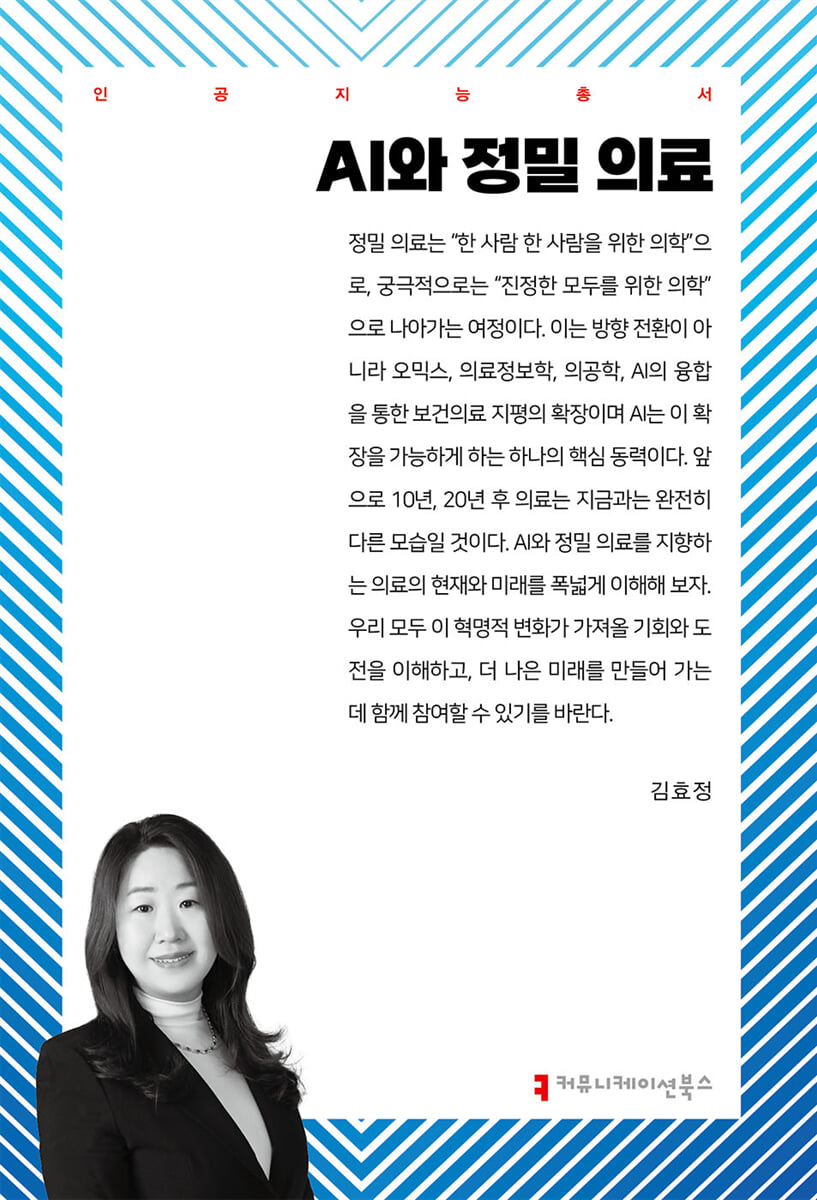
AI integrates genetic, lifestyle, and environmental data to predict optimal treatment for each individual and precisely design diagnosis, prognosis, and drug response.
By examining the current state and limitations of clinical applications, explainability, bias, privacy, and the principles of human intervention, we present implementation strategies that go beyond "medicine for average."
It covers data standardization and interoperability, digital twins and adaptive clinical trials, and even a domestic application roadmap, all in one volume.
Artificial Intelligence Encyclopedia.
You can find the artificial intelligence knowledge you need at aiseries.oopy.io.
By examining the current state and limitations of clinical applications, explainability, bias, privacy, and the principles of human intervention, we present implementation strategies that go beyond "medicine for average."
It covers data standardization and interoperability, digital twins and adaptive clinical trials, and even a domestic application roadmap, all in one volume.
Artificial Intelligence Encyclopedia.
You can find the artificial intelligence knowledge you need at aiseries.oopy.io.
- You can preview some of the book's contents.
Preview
index
The Precision Medicine Revolution Begins
01 History of Medical Artificial Intelligence
02 Cases of Medical Artificial Intelligence
03 Genomic Revolution: The Foundation of Precision Medicine
04 The Future of Medical Imaging: Diseases Seen Through the Eyes of AI
05 Big Data and Electronic Health Records: The Digital Revolution in Healthcare
06 The Era of Personalized Treatment: AI-Designed Personalized Medicine
07 Revolution in the Operating Room: Surgery with AI Robots
08 Language Models and Medical Big Data: Medical Knowledge Read by AI
09 Ethics and Security
10 Future of Medicine
01 History of Medical Artificial Intelligence
02 Cases of Medical Artificial Intelligence
03 Genomic Revolution: The Foundation of Precision Medicine
04 The Future of Medical Imaging: Diseases Seen Through the Eyes of AI
05 Big Data and Electronic Health Records: The Digital Revolution in Healthcare
06 The Era of Personalized Treatment: AI-Designed Personalized Medicine
07 Revolution in the Operating Room: Surgery with AI Robots
08 Language Models and Medical Big Data: Medical Knowledge Read by AI
09 Ethics and Security
10 Future of Medicine
Into the book
The history of medical AI is longer than we think, and its impact is deeper.
Lessons learned from past failures, insights gleaned from successes, and a relentless spirit of challenge have become the foundation of today's medical AI.
The explainability of expert systems, the practicality of CAD systems, and the adaptability of machine learning are all baked into today's AI systems.
Next, we will examine in detail the performance of current medical AI, created through this long history, in actual clinical practice.
Along with the incredible advancements brought about by the deep learning revolution, we will also address the challenges that still remain.
By understanding the past, we can better prepare for the future.
--- From “01_“History of Medical Artificial Intelligence””
Recently, artificial intelligence has been increasingly utilized in predicting the structure of disease-related receptors and in the search for new drug candidates.
For example, AlphaFold-based structural prediction of the GLP-1 receptor, a key target for the treatment of type 2 diabetes and obesity, has enabled understanding of drug mechanisms of action and the design of novel agents. The development and utilization of AI drug design platforms are attracting attention, and examples such as the design and activity verification of semaglutide analogs are emerging. AI is supporting efficiency improvements across multiple stages of new drug development, from protein structure-based target prediction, drug candidate discovery, and mechanism of action exploration.
Its potential is rapidly expanding, especially in the fields of complex metabolic diseases and chronic diseases.
--- From "03_“Genome Revolution: The Foundation of Precision Medicine”"
The medical field is undergoing a paradigm shift from ‘standard treatment for the average patient’ to ‘personalized treatment for individual patients.’
At the heart of this transformation are genomics, biomarker discovery, and multi-omics approaches, with pharmacogenomics and AI-based drug development emerging as key tools to make this happen.
The one-size-fits-all approach of traditional medicine is showing its limitations, and precision treatment that comprehensively considers an individual's genetic characteristics, molecular profile, living environment, and disease status is now becoming a reality.
In particular, rapid advances in genome sequencing technology, computer-based analysis of molecular biology data, and AI-enabled multidimensional data integration are forming the core foundation of personalized medicine.
--- From "06_“The Era of Customized Treatment: Personalized Medicine Designed by AI”"
We examine the ethical and security aspects that must be considered as precision medicine expands.
As precision medicine expands from population data to personalized treatments, advances in genomic medicine in particular present unprecedented opportunities while also raising complex ethical and social questions.
As individuals' most sensitive information is processed on a massive scale by AI systems, a balanced approach that protects human-centered values alongside technological innovation is needed.
Lessons learned from past failures, insights gleaned from successes, and a relentless spirit of challenge have become the foundation of today's medical AI.
The explainability of expert systems, the practicality of CAD systems, and the adaptability of machine learning are all baked into today's AI systems.
Next, we will examine in detail the performance of current medical AI, created through this long history, in actual clinical practice.
Along with the incredible advancements brought about by the deep learning revolution, we will also address the challenges that still remain.
By understanding the past, we can better prepare for the future.
--- From “01_“History of Medical Artificial Intelligence””
Recently, artificial intelligence has been increasingly utilized in predicting the structure of disease-related receptors and in the search for new drug candidates.
For example, AlphaFold-based structural prediction of the GLP-1 receptor, a key target for the treatment of type 2 diabetes and obesity, has enabled understanding of drug mechanisms of action and the design of novel agents. The development and utilization of AI drug design platforms are attracting attention, and examples such as the design and activity verification of semaglutide analogs are emerging. AI is supporting efficiency improvements across multiple stages of new drug development, from protein structure-based target prediction, drug candidate discovery, and mechanism of action exploration.
Its potential is rapidly expanding, especially in the fields of complex metabolic diseases and chronic diseases.
--- From "03_“Genome Revolution: The Foundation of Precision Medicine”"
The medical field is undergoing a paradigm shift from ‘standard treatment for the average patient’ to ‘personalized treatment for individual patients.’
At the heart of this transformation are genomics, biomarker discovery, and multi-omics approaches, with pharmacogenomics and AI-based drug development emerging as key tools to make this happen.
The one-size-fits-all approach of traditional medicine is showing its limitations, and precision treatment that comprehensively considers an individual's genetic characteristics, molecular profile, living environment, and disease status is now becoming a reality.
In particular, rapid advances in genome sequencing technology, computer-based analysis of molecular biology data, and AI-enabled multidimensional data integration are forming the core foundation of personalized medicine.
--- From "06_“The Era of Customized Treatment: Personalized Medicine Designed by AI”"
We examine the ethical and security aspects that must be considered as precision medicine expands.
As precision medicine expands from population data to personalized treatments, advances in genomic medicine in particular present unprecedented opportunities while also raising complex ethical and social questions.
As individuals' most sensitive information is processed on a massive scale by AI systems, a balanced approach that protects human-centered values alongside technological innovation is needed.
--- From “09_“Ethics and Security””
Publisher's Review
Precision Medicine Powered by AI: A Revolution for Every Person
Precision medicine is a new paradigm in medicine that aims to provide 'accurate treatment to the person in need, at the optimal time.'
This book comprehensively explains how AI integrates genomic, proteomic, microbiome, and lifestyle/environmental data, interpreting their complexity to enable personalized treatment. It explores genetic variants like CYP2D6 and CYP2C19, drug responses, the heterogeneous effects of SSRIs, and the challenges of connecting data overload to clinical context. It presents current clinical applications, encompassing diagnostic, prognostic, and treatment optimization, as well as real-time risk detection.
Based on the principles of explainability, bias and privacy, regulation and governance, and human-in-the-loop, we propose a blueprint to move beyond “medicine for average people” to “medicine for all.”
We cover multimodal learning encompassing genome analysis, imaging, and biosignals, digital twins, adaptive clinical trials, and drug repurposing, and address implementation requirements such as data standardization and interoperability.
Above all, rather than viewing AI as a panacea, we present a roadmap for ensuring safety and fairness by combining human expert judgment and evidence-based design.
We concretize changes in the field by including an action checklist and domestic application strategies.
Precision medicine is a new paradigm in medicine that aims to provide 'accurate treatment to the person in need, at the optimal time.'
This book comprehensively explains how AI integrates genomic, proteomic, microbiome, and lifestyle/environmental data, interpreting their complexity to enable personalized treatment. It explores genetic variants like CYP2D6 and CYP2C19, drug responses, the heterogeneous effects of SSRIs, and the challenges of connecting data overload to clinical context. It presents current clinical applications, encompassing diagnostic, prognostic, and treatment optimization, as well as real-time risk detection.
Based on the principles of explainability, bias and privacy, regulation and governance, and human-in-the-loop, we propose a blueprint to move beyond “medicine for average people” to “medicine for all.”
We cover multimodal learning encompassing genome analysis, imaging, and biosignals, digital twins, adaptive clinical trials, and drug repurposing, and address implementation requirements such as data standardization and interoperability.
Above all, rather than viewing AI as a panacea, we present a roadmap for ensuring safety and fairness by combining human expert judgment and evidence-based design.
We concretize changes in the field by including an action checklist and domestic application strategies.
GOODS SPECIFICS
- Date of issue: October 24, 2025
- Page count, weight, size: 197 pages | 128*188*7mm
- ISBN13: 9791143011060
You may also like
카테고리
korean


korean

![GQ KOREA Mark (Monthly): December [2025]](http://librairie.coreenne.fr/cdn/shop/files/8ef265dbbfbf186523ed75ba7319009d.jpg?v=1765340328&width=3840)


